You probably know the moment. A customer buys, likes the product, says thanks, and then nothing happens. No friend text. No review. No intro. In a small founder group I've seen that stall happen after a strong launch, a good first order, even a happy delivery. The product was fine. The customer was happy. The conversation just never got built.
That's where word of mouth marketing gets misunderstood. It's not luck. It's the deliberate design of conversations that move from one buyer to another. When I ran small dinner events in the Midwest, the best growth came from the same pattern, a person heard a real story, trusted the person telling it, then acted on it. If you want a practical framework for that kind of growth, start with how to build trust with customers. For a different angle on customer-made content, what is UGC marketing is a useful companion read.
What Word of Mouth Marketing Means
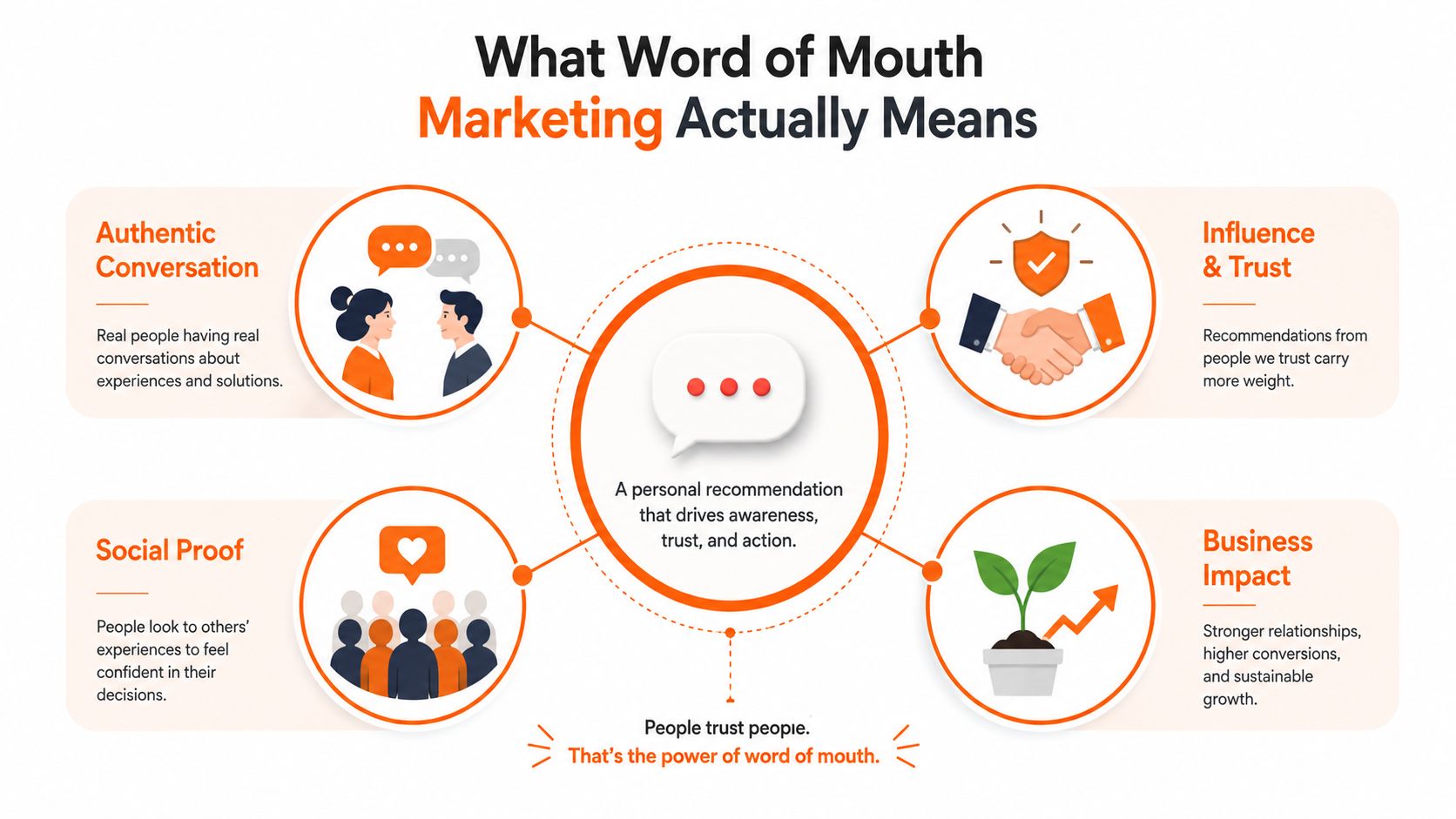
A Chicago founder once told me their first real customer came from a six-person dinner table, not from an ad, not from a cold email, and not from a polished launch page. Someone at the table mentioned the product to a cousin, the cousin asked for the site, and the sale landed two days later. That is the cleanest way to understand word of mouth marketing. It is the deliberate design of a conversation that travels from one buyer to another.
The moving parts you can control
I think of WOM as four pieces working together, sender, message, recipient, and context. The sender is the person talking. The message is what they say. The recipient is who hears it. The context is the room, the group chat, the review page, or the dinner table where it lands.
Practical rule: If you cannot name who will say it, what they will say, where they will say it, and why the listener should care, you do not have a WOM plan yet.
WOM works differently from paid ads and most content. Ads buy reach. Content builds familiarity. Sponsorship buys borrowed attention. WOM asks a real person to vouch for you in a setting where the listener already trusts the speaker. That is why it feels different, and why it usually works better when the buyer needs reassurance, not just awareness.
The best mental model for founders
The cleanest mental model I have found is simple. You do not chase “buzz.” You shape the conditions for a useful recommendation. A happy customer can become a sender, but only if you give them a reason, a moment, and a place to talk.
That is also why so much customer-made content fits inside WOM. A founder who wants to understand the visual side of that loop should read what is UGC marketing after this piece. In practice, UGC is often one branch of WOM, while referrals and reviews are other branches.
A founder who wants to understand the trust side of that loop should also read how to build trust with customers. Word of mouth grows faster when the buyer already believes the person sending the message.
The Numbers That Make WOM Worth Your Attention
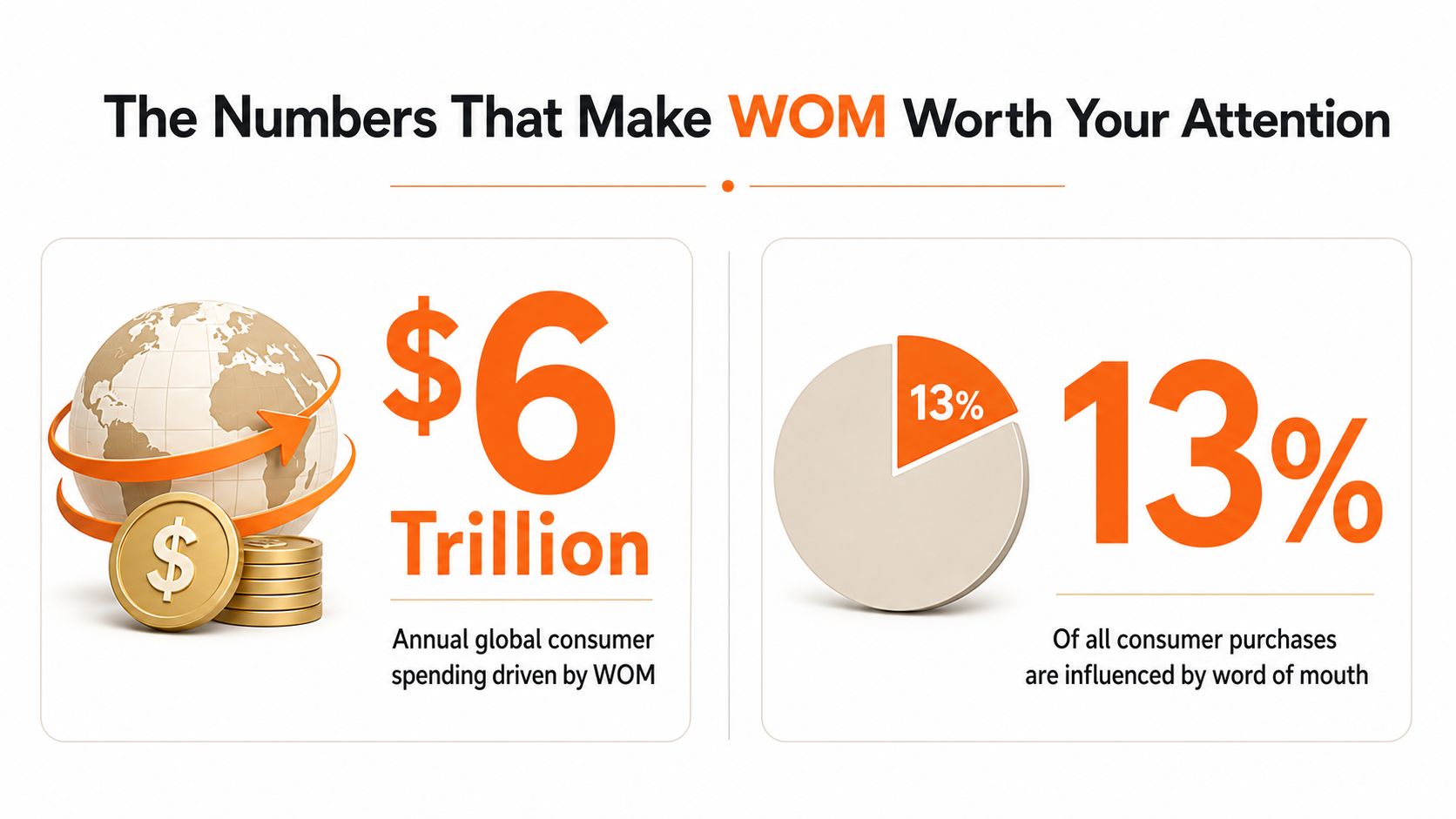
I don't treat WOM like a feel-good side channel, because the numbers do not support that view. Analysts cited in the brief put word of mouth at about $6 trillion in annual global consumer spending and roughly 13% of all consumer sales worldwide, with word of mouth driving about 20% to 50% of purchasing decisions depending on category. That is not a soft metric. It is a buying system.
Trust beats exposure
The trust data makes the case even faster. 92% of consumers trust recommendations from friends and family over other forms of advertising, and 88% of people globally trust personal recommendations most, according to the cited summaries in the brief. A separate U.S. survey says 72% of consumers get news about products and companies from friends and family. Another source says 83% of Americans have made a word-of-mouth recommendation themselves. Those numbers point to the same pattern. People pay attention when the message comes through a relationship they already trust.
For a founder, the point is simple. A warm intro can do more work than a stack of cold impressions because the listener borrows trust from the speaker. That is why a dinner-table mention or a neighbor's text often moves faster than a polished campaign.
The conversion logic you can use
One cited summary says word of mouth can generate 5 times more sales than a paid media impression. I'd treat that as a directional reminder, not a promise you can paste into a pitch deck. It does show where attention should go first when budget is tight. If you have to choose between another weak ad test and one more customer conversation that might lead to a referral, take the conversation.
The founder mistake is spending hours polishing messages for strangers and none at all shaping messages for people who already trust the buyer.
That is how I read the numbers in a tiny brand setting. WOM earns its place when you need people to move, not just look. For a practical next step, start with customer retention tactics that give happy buyers a reason to return, talk, and send someone else your way.
The Four Engines of Word of Mouth
Most founders treat WOM like one lump. That's a mistake. I split it into four engines, because each one behaves differently and each one fits a different kind of business.
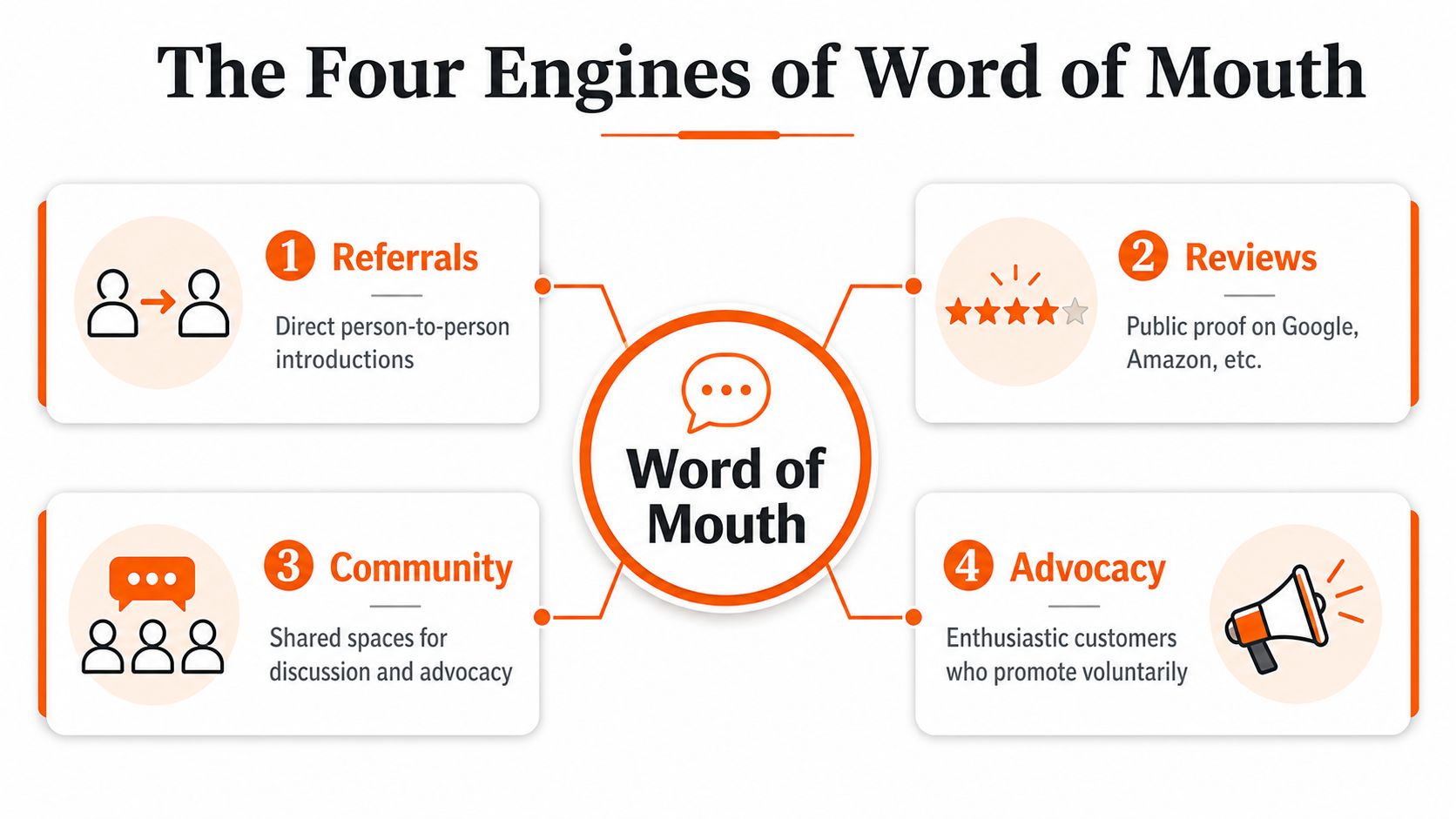
Referrals and reviews do different jobs
Referrals are direct person-to-person intros. They work best when a buyer wants reassurance from someone they know. Reviews are public proof on Google, Amazon, G2, Yelp, or a similar platform. They work best when a stranger wants to see what other buyers think before clicking.
A referral is a handoff. A review is a shelf tag. One happens in private, the other in public. If you sell a high-consideration B2B product, referrals usually matter more. If you sell local services or ecommerce, reviews can carry a lot of weight because they meet buyers right where they compare options.
UGC and community need different energy
User-generated content is what happens when customers make posts, photos, or videos about you. It's useful for visual brands and products that look better in the wild than in a spec sheet. Community is the ongoing relationship layer, the dinner group, Slack room, forum, or private chat where people keep talking after the first purchase.
The main trade-off is speed versus depth. UGC can spread fast if the visuals land. Community takes more time, but it can keep producing conversations long after the first post fades. If you want a fuller retention lens for that side of the system, customer retention tactics is a useful next read.
Pick one engine first
I'd use this rule. Start with the engine that matches your buyer's habit, not the one that sounds coolest.
- Pick referrals if trust depends on personal credibility.
- Pick reviews if people compare you in public before they buy.
- Pick UGC if the product is visual or identity-driven.
- Pick community if repeated conversations can create ongoing demand.
You do not need all four on day one. You need one engine that fits your stage, then you can add the others later.
Why Most WOM Programs Quietly Fail
Most WOM programs fail because founders wait for happy customers to do the work. That sounds reasonable, but it leaves too much to chance. I've seen small Midwest brands with strong products and almost no talk around them because the journey never asked anyone to speak.
Happy customers don't always talk
A customer can love the product, reorder twice, and still never mention it to anyone. That's normal. People need a trigger, a setting, or a simple next step. Without that, the experience stays private.
McKinsey's idea of word-of-mouth equity helps here. It treats WOM as the average sales impact of a message multiplied by the number of messages, and it asks which part matters most, the who, what, or where of the recommendation. That framing is better than chasing raw referral counts because two recommendations can look equal in volume and still move revenue in very different ways.
The common failure modes
The brands I've watched stall usually make one of four mistakes.
- They ask too late. They wait until the memory is cold.
- They treat reviews as a side chore. The happy moment passes, and no one asks.
- They post UGC without permission. That kills trust fast.
- They build community around hype. People show up once, then leave because the room has no utility.
Focus on fewer conversations that buyers trust more. Loud spread with weak credibility usually wastes time.
This is also where source and context matter. A recommendation from a category peer can matter more than a broad post from someone with a bigger audience. The listener wants relevance, not just reach.
Design the system, don't wish for it
If you want WOM to keep working, build it into the customer journey. Put the ask near the moment of delight. Make the review path easy. Give customers a reason to share that feels natural. That's the difference between hoping for buzz and designing a system that creates it.
Six High-Impact Tactics You Can Run This Quarter
I like tactics that fit a small team and don't require theater. If you have two people and a lean budget, these are the moves I'd test first. The point isn't to do everything. The point is to create one clean loop, then repeat it.
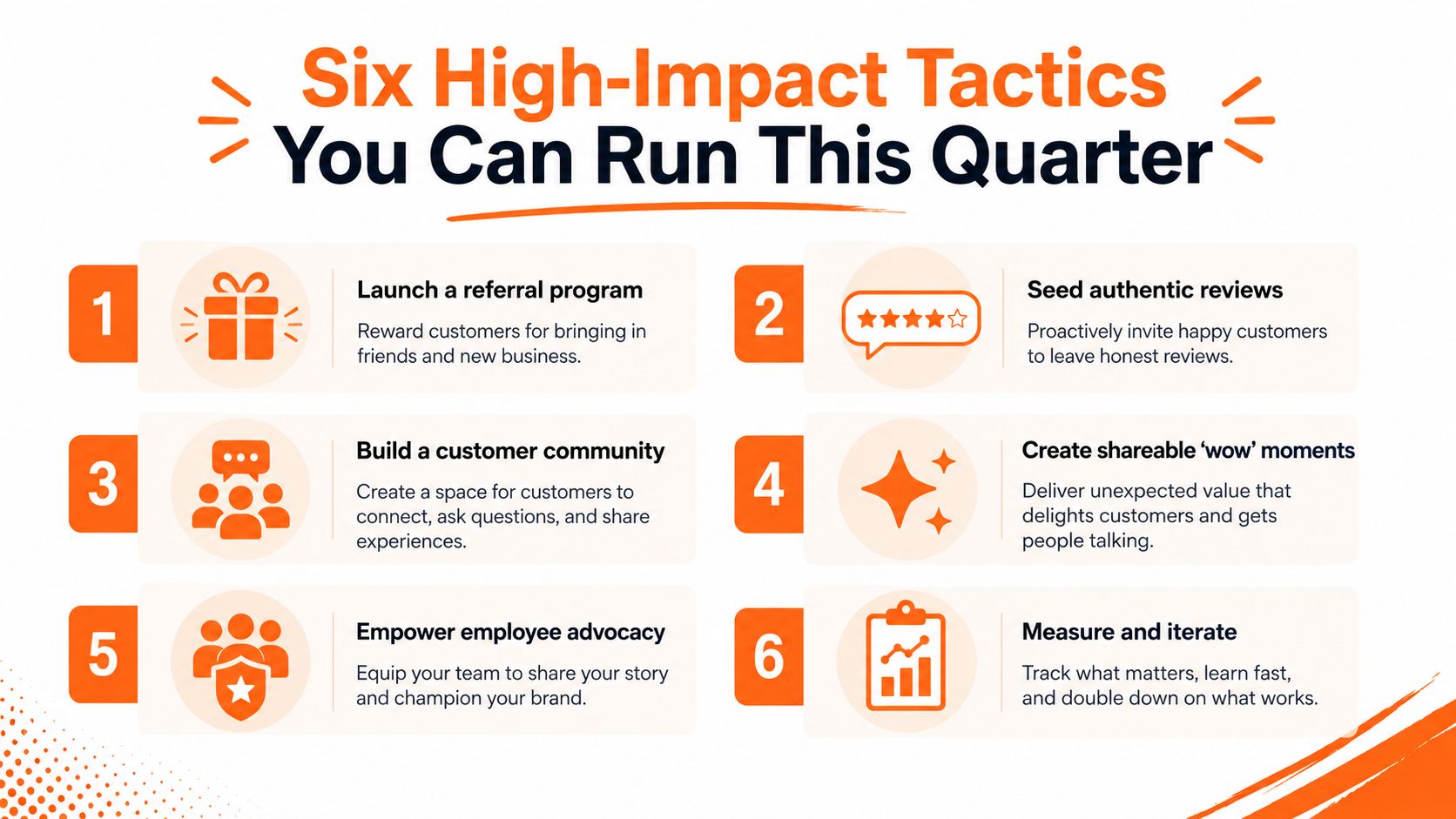
1. Ask for a referral right after the win
A referral ask works best when the customer has just had a good result. Not before. Not three weeks later. Right after delivery, setup, or a solved problem, send a simple ask to one person who's already happy.
The best Midwest version I've seen was a founder who asked, “Who else should have this?” instead of “Can you refer us?” That tiny shift mattered because it made the customer think of a friend first, not of a task. Keep the metric simple, count the replies that turn into warm intros. If you want a structure for that, how to create a referral program is a practical place to start.
2. Build a review trigger into the workflow
Don't treat reviews as a late-stage cleanup job. Trigger the ask at the moment the buyer feels relief or satisfaction, then make the path obvious. For local brands, that can mean a short email with one link. For ecommerce, it can mean a post-purchase prompt tied to product use.
3. Use founder storytelling that feels like a person, not a banner
People share stories that sound like people. Tell the origin, the problem, the trade-off, the mistake. I've seen Chicago founders get more traction from a plain story about a bad first batch than from a slick brand manifesto. The metric here is simple, watch whether people repeat the story back to you in their own words.
4. Run micro-community dinners
Six to eight people around a table beats a crowded room if you want honest conversation. The dinner doesn't need a pitch. It needs a topic, a reason to attend, and a way for people to meet peers they trust. I've watched these rooms create more follow-on intros than bigger events because people leave with context, not just business cards.
5. Prompt UGC with a clear action
Don't ask customers to “share.” Ask them to post a photo in a specific setting, with a specific angle, for a specific reason. The easier the prompt, the better the result. Track tagged posts, but also watch for untagged mentions in DMs and comments, because a lot of real sharing stays off the surface.
6. Reward advocates with access, not just discounts
Discounts can work, but access often works better for your best fans. Give them early looks, founder Q&A time, or the chance to test something new. That keeps the loop human. If someone already talks about you, give them a reason to keep talking that doesn't cheapen the product.
Midwestern Brand vs National Ecommerce Brand
A neighborhood brand in Chicago does not need the same WOM setup as a brand that ships everywhere. Geography changes how trust moves. Audience density changes how often people bump into each other. That changes the mix.
| WOM Engine Priorities by Brand Footprint | Midwestern Local Brand | National Ecommerce Brand |
|---|---|---|
| Referrals | Strong fit, because local trust travels through tight networks and personal intros carry weight | Useful, but needs a broader structure because buyers are spread out |
| Reviews | Strong fit for local services and community-backed commerce | Strong fit for online comparison shopping and first-time buyers |
| Community | Good fit through dinner groups, local chats, and city-based founder circles | Good fit if it stays niche and useful, not generic |
| UGC | Helpful, but usually secondary to direct trust channels | Often more important because scale needs public proof and repeatable content |
A local skincare maker in the Midwest can lean on referrals, reviews, and small dinner-table communities because people in the area often know someone who knows someone. A national ecommerce supplement brand can't depend on that same density, so it needs reviews, UGC, and a wider advocate loop that reaches strangers in many places.
The trade-off is simple. Local brands can win with depth. National brands need breadth. If you try to copy the national playbook in a neighborhood business, you'll waste time. If you try to run a dinner-table strategy for a national store, you'll cap your reach too early.
I'd also separate how you measure each one. Local brands can watch for more warm intros and more repeat local mentions. National brands should pay closer attention to public proof and repeatable sharing patterns. Same discipline, different shape.
Your 90-Day Word of Mouth Marketing Plan
You don't need a giant launch. You need a clean rhythm. I'd run this in three phases, with one small win in each phase and one thing to cut if it's not working.
Days 1 to 30, build the base
Pick one WOM engine. Write down who the sender is, what they'll say, where they'll say it, and what moment triggers the ask. Set up a simple tracking sheet. Draft two founder stories, one about the origin and one about a customer result.
Your checkpoint is basic, can you name the exact moment when you'll ask for the share? If not, keep refining the flow.
Days 31 to 60, launch one or two tactics
Run one referral ask, one review request, or one micro-dinner, not all three at once. Keep the ask close to a win. Keep the language plain. If the event is the dinner model, invite a tight group of people who can learn from each other.
Your checkpoint is response quality, not volume. If the replies are warm and specific, keep going. If people ignore the ask, the timing or the message is off.
Days 61 to 90, measure and prune
Look at what created real conversations. Cut the tactic that felt busy but didn't move anything. Double down on the one that got the most useful replies. If a customer story got shared again by another buyer, treat that as a signal you found a repeatable message.
Don't scale the tactic that got applause. Scale the one that got action.
That's enough for a first quarter. A tiny team can't manage ten loops at once. One clean loop beats five weak ones.
Measuring What Actually Matters and What Comes Next
Track three numbers every week. First, count how many advocates you activated. Second, count how often each advocate shares. Third, count how many warm leads reached you. That mix gives you a sender metric, a message metric, and a recipient metric without turning the whole thing into spreadsheet theater.
After that, tie WOM to your email capture, turn your top advocates into beta testers, and keep feeding customer stories into your content. When you do that, one conversation can lead to another one instead of dying in place. The habit is simple. Ask at the right moment. Reward with access. Treat every customer exchange like a future recommendation seed.
If you want help turning word of mouth marketing into a real system for a Chicago or Midwest brand, Chicago Brandstarters can help you think through the room, the ask, and the follow-up. Visit Chicago Brandstarters if you want a free, vetted community built around honest founder conversation, small dinner groups, and practical peer support.
Leave a Reply