You know the meeting. Six people join. Everyone gives updates. A few smart comments fly around. Then the call ends, and nothing changes.
If you're a founder, that pattern gets expensive fast. You leave with a full notebook and an empty next step. Your team heard each other, but nobody built anything together.
A workshop meeting fixes that by changing the job of the room. Instead of asking people to report, it asks them to work. That's why small founder groups keep moving from loose discussion toward structured collaboration. Even simple habits like shared prompts, visible notes, and a clear decision path can change the energy. If you want a practical starting point for that shift, I like AIDictation's collaboration framework because it helps you think about how people contribute, not just how they talk.
For first-time workshop leaders, this idea can feel bigger than it is. It isn't about acting like a polished consultant. It's about giving a group one problem, one process, and one output so your time produces something useful.
Introduction to Workshop Meetings
I think of a workshop meeting as the difference between watching a cooking show and cooking dinner with friends. In a regular meeting, people talk about the recipe. In a workshop, you chop, taste, fix, and plate.
That difference matters most when the problem is messy. A founder group trying to name a product, diagnose weak retention, or decide which customer segment to pursue usually can't solve it through round-robin updates. Those questions need live thinking, rough drafts, and fast reactions.
A workshop meeting pulls people into that kind of work on purpose. You don't show up just to listen. You show up ready to write, sort, vote, sketch, challenge, and decide.
Workshops work best when the room has one shared job to finish before everyone leaves.
For peer groups, that is especially useful. You may not have a paid facilitator, a giant whiteboard wall, or a formal offsite budget. You can still run a strong workshop if you narrow the topic, set the rules, and protect the time. That's the shift many founders need. Stop asking, "Can we discuss this?" Start asking, "What are we producing by the end?"
Defining a Workshop Meeting
A lot of people use the word "workshop" for any meeting that feels slightly more interactive. I don't. If you want to answer the question what is a workshop meeting, start with a stricter definition.
A workshop meeting is a hands-on group session built around one topic and one intended output. It is not a loose brainstorm. It is not a status review with sticky notes added at the end.
One academic definition puts it plainly: "A workshop meeting is defined as an assembled group of 10 to 25 persons who share a common interest or problem, meeting together to improve individual skills through intensive study, research, practice, and discussion rather than a passive information exchange" in the National Work Shop Report.
The core parts of a real workshop
A real workshop has a few parts that need to be present.
- A focused topic. You don't workshop "the business." You workshop pricing, onboarding friction, packaging ideas, or a launch plan.
- An active group. People contribute through exercises and discussion. Quiet observation isn't the default mode.
- A clear output. The group should leave with something concrete, like decisions, a draft roadmap, a list of tested ideas, or a resolved issue.
- A bounded time frame. Workshops can last from a couple of hours to multiple days in the definition above, but they still have a set beginning and end.
- A process. Activities are sequenced. The room doesn't just "see where it goes."
Why people get confused
The word workshop comes from a physical place where people make things. That older meaning is still useful. Think of the meeting as a maker space for ideas. The tools are prompts, notes, voting dots, whiteboards, and timed discussion. The product is the thing you create together.
That's why participation is mandatory in a workshop. If half the room sits back like an audience, the format breaks. A workshop is closer to a lab than a lecture.
Practical rule: If your agenda has people listening for most of the time, you're planning a meeting, not a workshop.
For small founder groups, you can scale this down without losing the point. Even if only six or eight people join, the spirit stays the same. Everyone works on one problem together, and the session ends with a usable result.
How Workshop Meetings Differ from Regular Meetings
A regular meeting and a workshop can both happen on Zoom, in a coffee shop, or around a dinner table. The room may look the same. The mechanics are not the same.
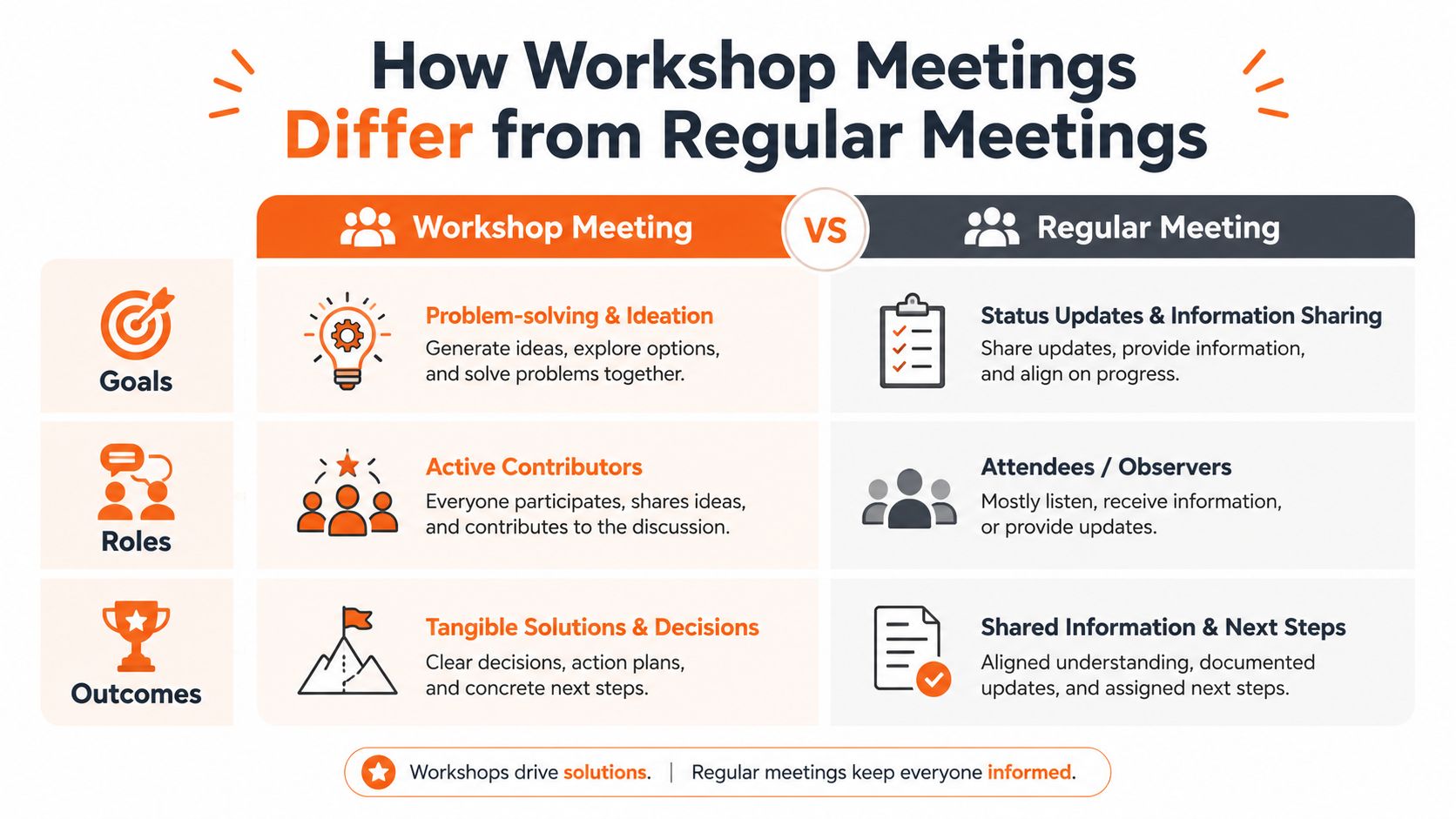
A regular meeting usually spreads attention across many topics. A workshop goes deep on one. A regular meeting often ends with shared awareness. A workshop should end with a deliverable.
One practical definition captures that difference well. According to Lucid Meetings' workshop glossary, a workshop meeting is a task-oriented, facilitated session distinct from status-update meetings by its requirement for a predefined, actionable output, typically involving 10–25 participants engaged in structured activities like rapid sketching, voting, and debate to resolve non-trivial technical or strategic problems.
A simple side-by-side view
| Format | Main job | What people do | What you leave with |
|---|---|---|---|
| Regular meeting | Share updates and discuss | Listen, report, comment | Context, notes, maybe next steps |
| Workshop meeting | Solve or create | Sketch, rank, debate, decide | A draft, decision, plan, or solution |
The biggest shift is role clarity
In a status meeting, people act like reporters. "I did this. I have a blocker."
In a workshop, people act like builders. "Here are three options. Let's test them. Let's pick one."
That shift changes the energy of the room. It also changes how you prepare. A workshop leader needs prompts, time boxes, and a decision path. You can't just open the call and hope the group becomes productive.
When to choose one over the other
Use a regular meeting when you need quick alignment across several topics.
Use a workshop when the group needs to:
- Generate ideas for a new offer, campaign, or product direction
- Resolve tension around a hard choice
- Build agreement across people with different opinions
- Create an artifact like a roadmap, message hierarchy, or action plan
If the problem is shallow, use a meeting. If the problem is sticky, use a workshop.
Common Workshop Types and Their Goals
Not every workshop has the same shape. That's good news for founders, because your group doesn't need one giant format for every problem. You just need to match the workshop type to the output you want.
Here are four workshop types I use most with peer-led founder groups.
Ideation sprints
This format is for idea volume first. You use it when the group needs options, not closure.
A founder might bring in a stuck question like, "What are five ways I can position this product for a clearer buyer?" The group spends the first stretch generating directions without judging them too early. Then you sort and shortlist.
This works well for dinner-table sessions and short meetups because the pace is quick and the energy stays high.
Problem-solving labs
This format is for one hard issue that already has context. The goal isn't more inspiration. The goal is diagnosis.
You might use it for a founder who has traffic but weak conversion, strong interest but poor retention, or manufacturing confusion that keeps delaying launch. The group asks clarifying questions, maps causes, then proposes fixes.
That style mirrors a broader pattern in health research workshops, where stakeholders gather in one or multiple workshops to propose intervention components and generate specific outputs rather than broad outcomes. I like that framing because it keeps the room honest. You are there to produce something concrete.
A practical example of this founder-centered format appears in Chicago peer communities like this marketing workshop format, where the discussion stays focused on live business issues instead of generic networking.
Consensus workshops
Sometimes your problem isn't a lack of ideas. It's too many opinions.
Consensus workshops help a group narrow choices and commit. You use them when co-founders, advisers, or peers all see the issue differently and you need one decision everyone can support enough to move on.
A consensus workshop is less like brainstorming and more like editing a film. You keep cutting until the story is clear.
Roadmap building sessions
This format turns goals into sequence. It answers, "What happens first, next, and later?"
Founders often need this after a burst of ideation. Once the room agrees on direction, the group can map tasks, ownership, and timing. This works best when people already know the business context and can pressure-test the order of work.
Here's a short explainer that can help you picture workshop flow in action:
Workshop Structure and Agenda Templates for Founders
When founders ask me how to run a workshop without hiring a facilitator, I give them a simple answer. Use a tight agenda and don't improvise the bones of the session.
The good news is that workshops don't need to be huge events. The U.S. Fish and Wildlife workshop guidance describes an effective range of 45 minutes to two full days, with group size capped at 25 participants so interactive work and consensus stay workable. For founder groups, that means your small circle is already in a strong range.
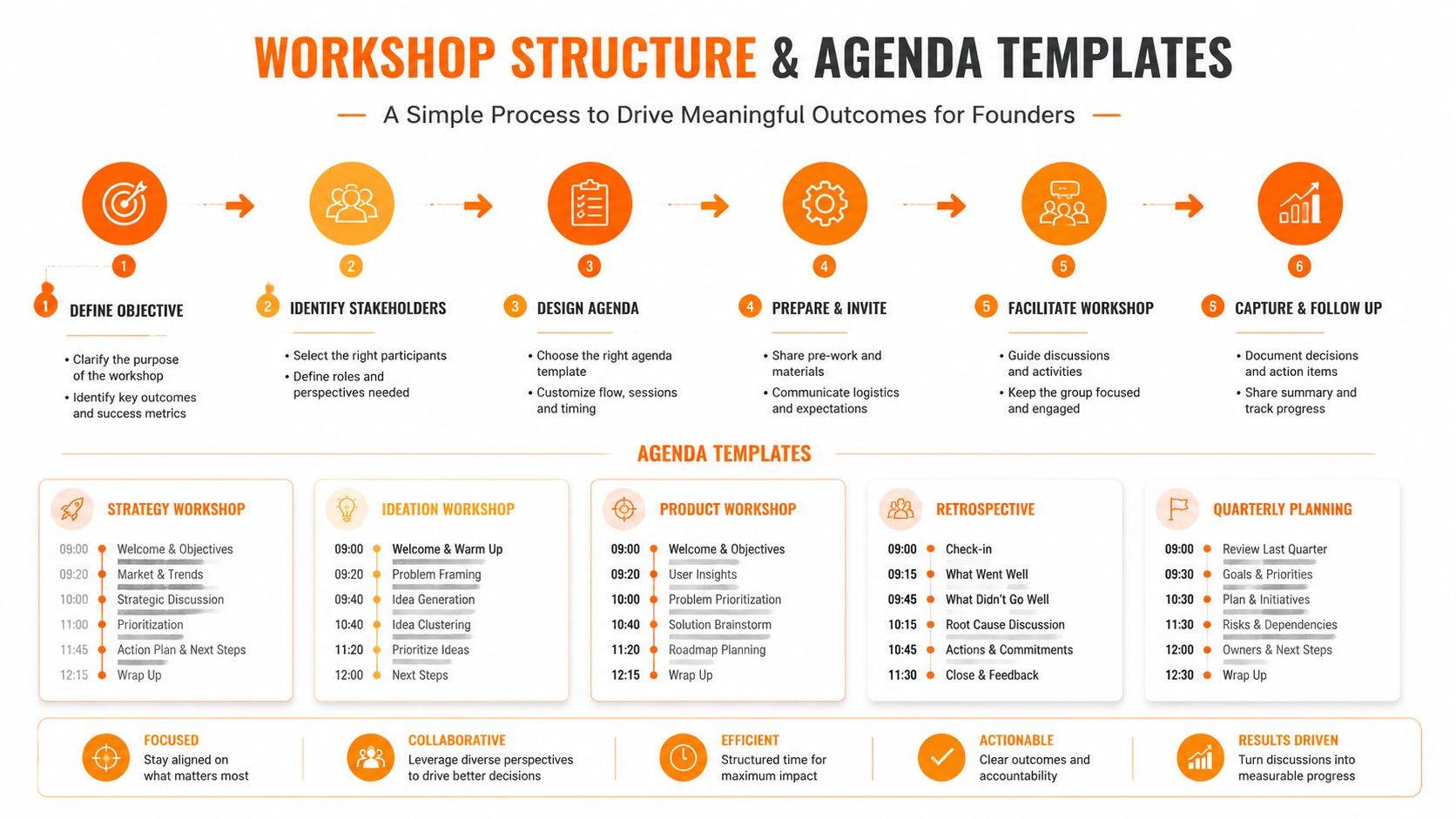
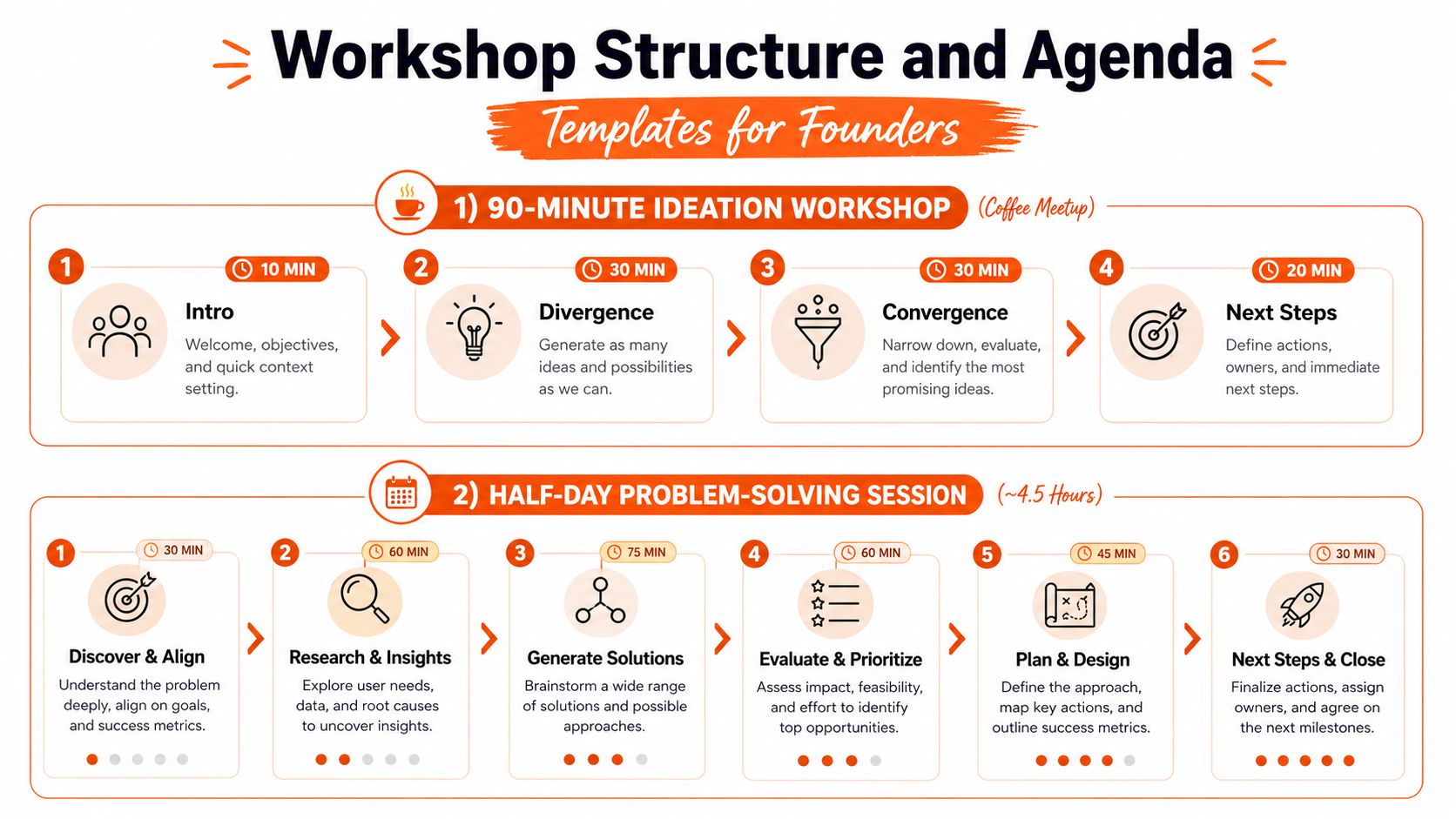
Template one for a 90-minute ideation workshop
Use this for coffee meetups, founder dinners, or quick remote sessions.
Best for: naming, positioning, content angles, product ideas
- Arrival and framing
State the question. Add one rule: defer judgment during idea generation. - Context from the founder
Give a short problem brief. Keep it tight. - Silent idea round
Everyone writes ideas on paper, in Miro, or in a shared doc. - Share and cluster
Read ideas out. Group similar ones together. - Vote
Each person backs the ideas they think are strongest. - Wrap
Name the top options and the next test.
Materials can be simple. Sticky notes, index cards, Miro, Mural, or Lucid all work.
Template two for a half-day problem-solving session
Use this when the problem has layers and the founder needs a real diagnosis.
Best for: stalled growth, weak conversion, unclear messaging, process breakdowns
- Opening
Set ground rules and define the output. - Clarifying questions
Let the group ask only questions first. - Problem mapping
Write possible causes, constraints, and assumptions. - Solution round
Move from causes to interventions. - Prioritization
Pick the moves worth trying now. - Action close
Assign owners and deadlines.
The right space is essential. If you're meeting in person, a room with walls, moveable chairs, and enough table space makes the work easier. If you need ideas, this guide to local workshop spaces is a useful starting point for thinking through layout and setup.
Template three for a full-day roadmap session
Use this when your group already knows the direction and now needs sequence.
Best for: quarterly planning, launch mapping, offer development
| Phase | What happens |
|---|---|
| Morning | Reset goals and list open decisions |
| Midday | Sort initiatives by dependency and effort |
| Afternoon | Build the roadmap and assign follow-up |
One founder community option that uses a structured in-person format is this business workshop model, where participants bring live issues and move through a defined group process. It's one example of how peer-led rooms can work without turning into open-ended networking.
Tips for Facilitation and Setting Group Norms
A lot of workshop advice assumes you'll hire a pro. Real founder groups often don't. That's why peer facilitation matters more than people think.
One recent article argues that workshop content still leans too hard on paid facilitators, while self-run formats are growing. It cites 45% growth in Miro, Mural, and Lucid adoption by solo operators over the last 12 months, and says 62% of users run workshops without a designated facilitator in this Medium piece on workshop-first meetings.
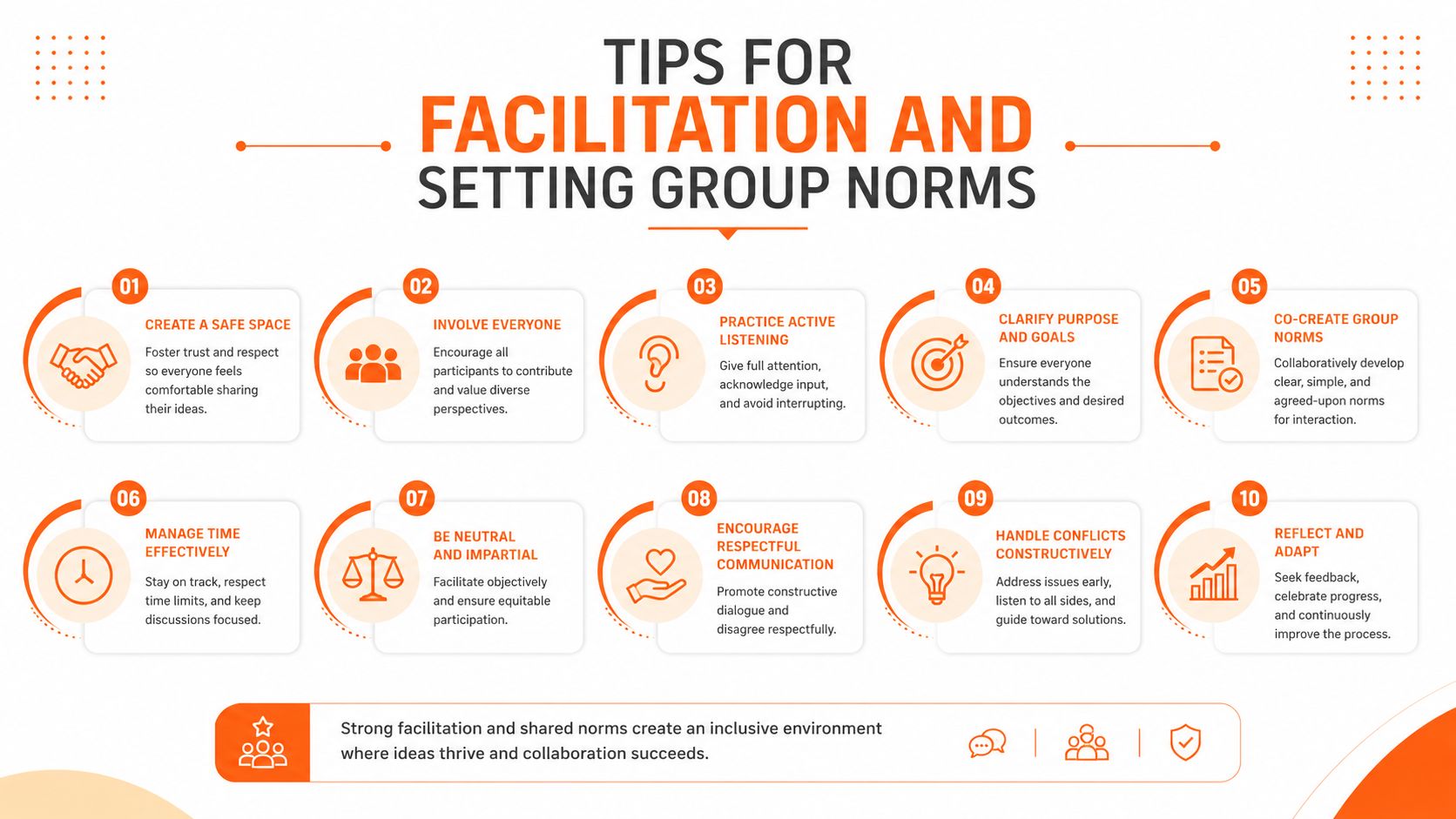
Six facilitation habits that help immediately
- Name the destination. Start with one sentence that says what the room must produce.
- Separate idea time from decision time. If people critique too early, the group gets timid.
- Use time boxes. Short bursts keep the room moving.
- Write everything where all can see it. Shared visibility reduces repeated talking.
- Rotate micro-roles. One person watches time, one captures notes, one guides the next prompt.
- Close with commitments. Don't end with "great chat."
Group norms matter even more in peer-led rooms
If nobody has formal authority, your norms carry the weight. I like a short agreement at the start.
- Confidentiality stays firm. What's shared in the room stays there.
- Vulnerability beats performance. People should bring the actual problem, not the polished one.
- Feedback gets specific. Vague encouragement feels nice and helps little.
- Challenge ideas, protect people. Push the work without making the founder defensive.
For groups that want a simple model for honest critique, this guide on how to give and receive feedback is useful because it keeps the focus on direct, usable responses.
If your workshop doesn't feel safe enough for honesty, it won't get deep enough to help.
Common Pitfalls and How to Avoid Them
Most workshop failures aren't dramatic. They drift. The room gets fuzzy, polite, and tired.
The first trap is an unclear goal. If people can't answer "What are we making today?" they default to discussion. Fix that by writing the output in one plain sentence before anyone arrives.
The second trap is weak facilitation. In peer-led groups, this usually means nobody cuts off tangents. Solve it by assigning one person to protect the process, even if that person isn't the smartest voice in the room.
Quick symptom check
- The room keeps circling. Your prompt is too broad.
- One person dominates. You need silent writing before open discussion.
- Energy drops halfway through. The session is too long or too talk-heavy.
- People leave inspired but lost. You closed without owners and next actions.
- Tension gets weird. The group lacks norms for challenge and disagreement.
When a workshop stalls, don't add more discussion. Tighten the question.
A final trap is trying to fix everything in one sitting. Workshops work because they narrow attention. If you stuff five strategic problems into one agenda, you'll get shallow thinking on all of them. Pick one real issue and finish it well.
Tracking Outcomes and Suggested Follow-up Steps
A workshop isn't done when people stand up from the table. It is done when the output turns into action.
I keep follow-up simple. Use one shared document, one owner per task, and one visible deadline. Fancy systems don't matter much if nobody checks them.
A lightweight follow-up framework
Create a page in Notion, Google Docs, or Google Sheets with five fields:
- Decision or output
- Next action
- Owner
- Due date
- Open question
That structure is enough for most founder groups. If the workshop produced a shortlist of product directions, the next action might be customer interviews, mockups, or ad tests. If it produced a roadmap, each line should move straight into ownership.
Keep momentum alive after the room clears
I like two follow-up moves.
- Run a short check-in a few days later in the group chat. Ask what moved and what got stuck.
- Pair accountability buddies so one founder nudges another between sessions.
You can also track broader impact over time in whatever way fits your group. In research-oriented workshop settings, organizers may collect participant demographics and review impact measures every six months or annually, as discussed earlier in the article. For founder groups, the simpler version is enough. Track whether the promised output got used.
A workshop earns its keep when the group can point to the draft, decision, or change it produced.
If you want a clean rule to remember, use this one: every workshop ends with an artifact, an owner, and a next date.
If you want a peer-led place to practice this style of working, Chicago Brandstarters is a free community for vetted founders and builders in Chicago and the Midwest who meet in small groups and talk through real business problems with a structured, honest approach.
Leave a Reply