
Most networking advice is trash.
It tells you to go meet more people, work the room, collect cards, and build a huge LinkedIn audience. I've done enough of that to know the truth. When your business is shaky, your hire is wrong, your margins are collapsing, or you're one bad month away from panic, a pile of loose contacts won't help you. You need a small circle of people who will tell you the truth.
That's what a trusted advisor network is. It isn't a public flex. It's a private support system. Think less cocktail hour, more kitchen cabinet. A few people. Real trust. Honest calls. Zero posturing.
What a Trusted Advisor Network Really Is
A trusted advisor network is your business kitchen cabinet.
It's the small group you call before you make the move that could cost you a year, a customer, or your sanity. You don't bring vanity questions to this group. You bring the ugly stuff. Cash flow problems. Co-founder tension. A bad offer you want to say yes to because you're tired.
That's why I have no patience for traditional networking theater. Most of it is quantity worship. More intros. More cards. More surface area. People call that community. I call it a contact list.
The difference is trust, not access
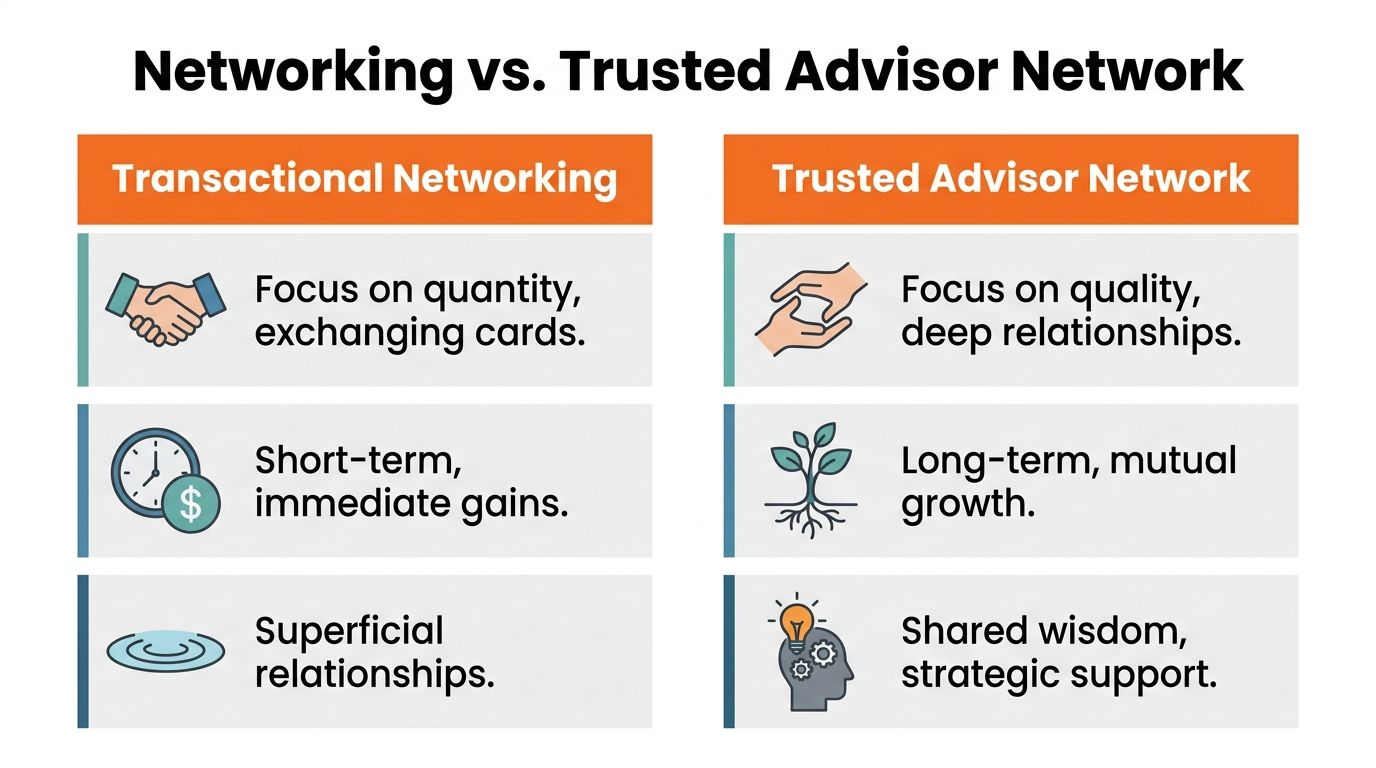
The cleanest way to think about it is this. Traditional networking is like speed dating for business. A trusted advisor network is more like a private board of people who know your strengths, your blind spots, and your patterns under stress.
The CIO coverage on trusted advisors says 88% of IT leaders agree that CIOs increasingly need to rely on trusted advisors to help manage complex business challenges. That same piece includes one executive saying they are "one hundred times more likely" to take a solution recommendation from a peer than from any other source. That tells you everything you need to know. Trust beats pitch.
Here's the part people miss. These relationships don't appear because you shook hands twice and followed each other online. They deepen over time. The pattern is simple: service-based, then needs-based, then relationship-based, then trust-based. If you skip steps, you get fake intimacy and bad advice.
Traditional networking vs trusted advisor network
| Attribute | Traditional Networking | Trusted Advisor Network |
|---|---|---|
| Purpose | Meet many people fast | Build a few relationships that hold under pressure |
| Style | Self-promotion | Honest exchange |
| Value | Immediate opportunity hunting | Long-term judgment and support |
| Depth | Thin | Deep |
| Risk | Low vulnerability, low payoff | High vulnerability, high payoff |
| Best use | Broad exposure | Better decisions |
Practical rule: If a group makes you perform competence instead of admit confusion, it isn't a trusted advisor network.
What real trust looks like
You want advisors who show four things consistently: credibility, consistency, competence, and compatibility. If one is missing, the whole thing gets shaky.
- Credibility: They've done enough to earn your attention.
- Consistency: They show up the same way over time.
- Competence: They can help.
- Compatibility: You can hear hard feedback from them without shutting down.
A trusted advisor network isn't built around applause. It's built around truth. If your current “network” mostly trades pleasantries, referrals, and humblebrags, that isn't your kitchen cabinet. It's a waiting room.
Why Founders Need More Than Just Connections
I'll say it plainly. A big network can make you look well-connected while leaving you badly exposed.
Founders get praised for “building relationships” when what they're really doing is collecting lightweight contacts. That works for attention. It does not work for pressure. When payroll is tight, a hire goes sideways, or your judgment gets cloudy, the people who clap for your LinkedIn post are useless.

Lone-wolf founders pay the dumb tax
Isolation distorts decision-making. You start treating every problem like a referendum on your competence. Small fires feel existential. Serious risks get delayed because facing them would force an uncomfortable call.
I've watched capable founders waste months this way. They keep the weak contractor because replacing them feels tiring. They avoid the hard customer conversation because they want one more week of denial. They keep drowning in scheduling, inbox triage, and follow-up work because handing it off feels indulgent, right up until the backlog starts hurting revenue.
If admin work is eating your week, fix that problem instead of glorifying the grind. Read these tips for hiring an executive assistant. Buying back your time is not a luxury. It is basic operating discipline.
And if you still don't have one experienced person who can tell you the truth without trying to impress you, start with this guide on how to find a business mentor. One honest mentor beats fifty shallow intros.
The right circle changes the quality of your decisions
Founders rarely blow up because they lacked access to more people. They blow up because they lacked the right people. People who know their blind spots. People who will hear the ugly version of the story. People who care more about the outcome than about looking smart in the room.
That is the difference between a contact list and a trusted advisor network.
A real network helps you make cleaner decisions under stress. It gives you context, memory, and friction. Friction matters. You need someone who will stop you before you make the panic hire, chase the wrong customer segment, or keep funding a strategy your ego loves and your market already rejected.
Chicago Brandstarters gets this right because the point is not self-promotion. The point is support. People are useful because they are kind enough to be honest, and honest enough to stay kind. That sounds soft to people who mistake networking for status management. It is not soft at all. It is how adults build companies without lying to themselves.
If nobody in your circle can hear your worst week without turning it into gossip, posturing, or a pitch, you do not have support. You have spectators.
What loose connections never give you
Loose connections have a place. They can open doors, make introductions, and widen your field of view.
They usually fail where founders need help:
- Truth without performance: Acquaintances protect the vibe. Trusted advisors protect your judgment.
- Context over hot takes: A real ally knows your patterns, your team, and the history behind the problem.
- Staying power: Transactional people disappear when the issue gets messy, embarrassing, or slow to fix.
- Care with accountability: The best advisors do not just critique you. They help you carry the weight of the decision afterward.
That last part gets ignored. Founders do not just need smart people around them. They need people safe enough for honesty. That is why a trusted advisor network is built on vulnerability, not optics. You have to be able to say, “I handled this badly,” and trust the room not to use it against you.
Collect contacts if you want reach. Build allies if you want staying power.
How to Find Your People in a World of Fakes
Most groups talk about community. Very few deserve the word.
A real trusted advisor network has standards. It vets people. It protects confidentiality. It filters out users, clout-chasers, and service sellers who treat every room like a prospecting list. If a group lets anyone in and everyone talks in slogans, leave.
Green flags and red flags
I judge a founder community by what happens when someone admits something embarrassing. Missed payroll. Toxic client. Product flop. Shame spiral. If the room turns that into gossip, advice theater, or a sales pitch, it's rotten.
Use this filter instead:
| Signal | Green flag | Red flag |
|---|---|---|
| Admission | Vetting before entry | Open-door join link for everyone |
| Tone | Candid and private | Polished and performative |
| Incentive | Members help each other | People hunt leads |
| Advice | Specific and earned | Generic and loud |
| Follow-through | Same people keep showing up | Constant churn |
Beware arbitrary gates
Some groups block good people for reasons that have nothing to do with trust or character. YPO Chicago's membership criteria require new applications to be approved before the applicant reaches their 45th birthday. That may work for their model. I think it screens out a lot of capable operators who just didn't enter the right room early enough.
Another example is the Chicago Rubber Club membership criteria, which require full members to physically reside within the Chicagoland Area. Again, that's their choice. But if you care about finding strong builders across the Midwest, rigid geography can shut out exactly the people you want around the table.
I'd rather back a network that picks for mindset and values. The stated view I agree with is simple: unlike networks with arbitrary cutoffs, like YPO Chicago's age requirement or groups restricted to a narrow geography, a better network prioritizes mindset and values over demographics. Chicago Brandstarters is one example of that approach. It welcomes kind, hardworking builders from the idea stage onward across the Midwest.
Trust your instincts, then verify
Founders get catfished in business too. Different costume, same trick. Someone plays expert, copies the language, mirrors your ambitions, then starts extracting attention, intros, or credibility.
That's why I like basic identity checks, referral checks, and public-profile review. If you want a simple analogy for spotting deception patterns, this expert guide to avoid romance scams is oddly useful. The domain is dating, but the red flags transfer. Inconsistency, urgency, vague history, and too-good-to-be-true positioning usually mean the same thing in business.
If you want a sharper filter for choosing a founder group, read this guide to finding the right business network group. Then ask one blunt question before you join anything: “Would I trust these people with my worst current problem?” If the answer is no, keep walking.
The Playbook for Building Your Own Network
If you can't find the right room, build one.
People act like you need permission. You don't. A trusted advisor network can start with three people and one honest conversation. That's enough.
Start smaller than your ego wants
The mistake is trying to launch a “community” before you've built trust. Don't do that. Start a micro-circle.
This piece on why leaders should invest in a network of trusted advisors puts it well. Your network is a strategic "kitchen cabinet". Relationships move through a sequence: from a simple interaction, to a needs-based request, to a relationship, and then to a trust-based partnership. That sequence matters. Skip it, and the group stays shallow.
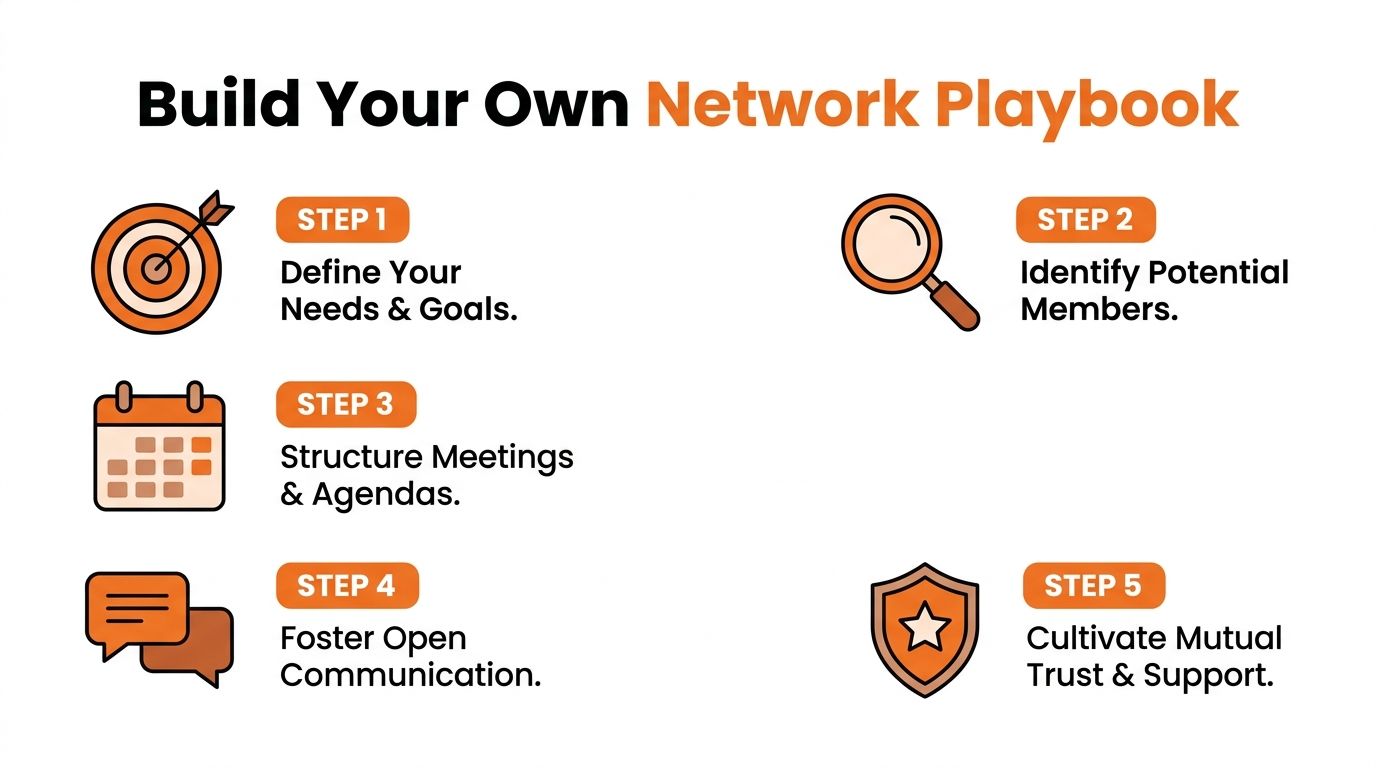
Here's the build order I'd use.
- Pick 3 to 5 people. Choose operators, not talkers. You want people with judgment, not just charisma.
- Define the use case. Don't say, “Let's network.” Say, “I want a private circle where we bring real business problems and give blunt feedback.”
- Set the rules early. Confidentiality is rule one. No forwarding. No screenshotting. No gossip.
- Meet on a rhythm. Every two weeks or monthly. Inconsistent groups die.
- Keep it practical. Each person brings one live issue. The others ask questions before giving advice.
Use a simple invite
The ask is often overcomplicated. Here's a version that works:
I'm putting together a small founder circle. Private, candid, no selling. I want people who'll bring real problems and give honest feedback. Interested?
That's it. Clear beats clever.
If you want more ideas on group design, these steps to create a thriving coaching community are useful because they focus on structure and participation, not hype. And if you want a founder-specific format, look at these mastermind groups for entrepreneurs.
What to discuss in the first three meetings
Don't waste early meetings on life stories and vague goals. Bring stakes.
- Meeting one: What problem am I avoiding?
- Meeting two: What decision am I delaying because I'm afraid of fallout?
- Meeting three: Where am I lying to myself about the business?
That last question does serious work.
A good trusted advisor network isn't built by collecting impressive people. It's built by creating repeated moments of useful honesty. Trust grows when people tell the truth, keep confidence, and come back.
How to Nurture Your Network So It Lasts
Starting a group is easy. Keeping it sharp is the hard part.
Most networks decay for boring reasons. People get busy. Meetings drift. Advice gets softer. The room fills with polite nodding instead of real challenge. Once that happens, the group still exists on paper, but it stops being useful.
Tell the truth or don't bother
The best advisors are truth tellers. They give honest feedback for the good of the partnership, not for personal gain. That principle is front and center in CloudCom's explanation of trusted advisors, which also says projects involving trusted advisors can see a 35% higher success rate and a 25% reduction in scope creep compared to typical vendor engagements.
Those numbers make sense to me because honest advice saves time. It also cuts fantasy. A truth teller will say, “Your timeline is nonsense,” or “You don't need another feature, you need better onboarding,” before you waste money proving them right.
Protect the room with habits
Trust doesn't survive on vibes. It needs rules people follow.
- Show up prepared: Bring one real issue, not a polished update.
- Respect time: Start on time. End on time. Rambling kills energy.
- State constraints: Say what resources, deadlines, and budget limits you have.
- Close loops: If the group gave advice, report back on what you did.
- Reciprocate: Don't only appear when you need saving.
A strong network is like a garden. If nobody tends it, weeds take over fast.
Keep standards high
Every healthy group eventually faces the same question. What do you do with someone who wants support but won't contribute, won't be candid, or keeps breaking trust?
You remove them.
That sounds harsh. It's also necessary. One leaky, self-centered, or performative member can poison the whole room. A trusted advisor network only works when people believe they can speak freely and hear the truth without the conversation getting weaponized later.
Consistency matters too. If the group says confidentiality matters, test that in small ways. If the group says members should be direct, don't reward diplomacy over honesty. Standards become culture only when you enforce them.
Stop Collecting Contacts and Start Building Allies
You don't need more random people in your orbit. You need better people in your corner.
That's the shift. Stop treating networking like prospecting. Start treating it like building a private circle of allies who can help you think straight when things get messy. A trusted advisor network is one of the few assets that gets more useful as the stakes rise.
I've seen founders waste years in rooms full of clever people who never said anything real. I've also seen a tiny group of honest operators change the direction of a business with one conversation. The difference wasn't access. It was trust.
If your current network is mostly handshakes, follow-ups, and low-risk chatter, don't defend it. Fix it.
Start this week.
- Pick one person you respect and trust.
- Ask for a real conversation about an actual business problem.
- Go first with honesty instead of trying to sound impressive.
- See how they handle the weight of a real issue.
That's how this starts. One real conversation. Then another. Then a pattern. Then a circle.
You don't need a bigger audience. You need a better kitchen cabinet. Build that, and a lot of bad advice stops reaching you in the first place.
If you want a founder community built around honesty instead of performance, take a look at Chicago Brandstarters. It's a free, vetted group for kind, bold, hard-working builders across Chicago and the Midwest who want real conversations, small private dinners, and the kind of support that helps when business gets hard.
Leave a Reply