Tag: peer advisory

  • A Founder’s Guide to a Workshop for Business

    A Founder’s Guide to a Workshop for Business

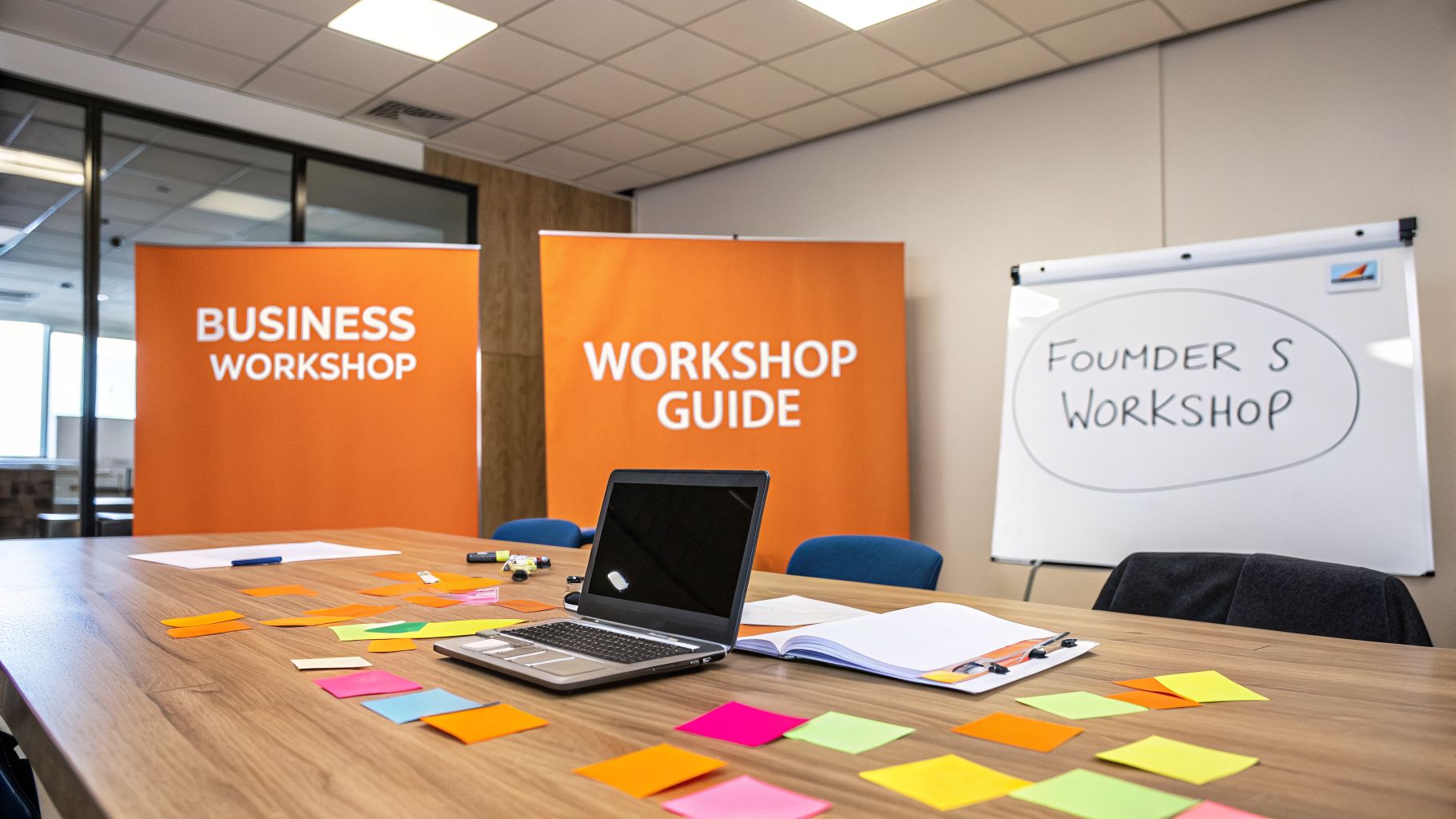
    A business workshop isn’t another boring conference where you collect business cards and listen to someone drone on from a stage. I think of it as a confidential command center. It’s a focused, small-group session where you and a handful of trusted founders solve stubborn problems, get brutally honest feedback, and find real support.

    It's where you finally get to work on your business, not just get buried in it.

    Why Business Workshops Are Your Secret Weapon

    Three professionals collaborating on a project in a bright, modern workshop space, looking at documents and a laptop.

    Let's cut right to it. I know building a business often feels like you're riding a rollercoaster, by yourself, in the dark. A great workshop isn't some stuffy seminar; it's the moment you get to turn the lights on.

    I like to think of it as a master mechanic's garage for your company. You bring in your engine—that big idea, that nagging problem—and a small group of fellow builders helps you tune it up. They offer tools and perspectives you never would have found on your own.

    Crush the Isolation, Find Your People

    Imagine the difference between a chef's intimate tasting kitchen and a chaotic food court. That’s the gap between a focused workshop and a huge, generic networking event. This is where you destroy the isolation that sinks so many of your great ideas before they even have a chance.

    The real magic of a good workshop isn't just about finding answers. It's about finding a confidential space to share your war stories, not just your highlight reel. It's a room where I find vulnerability is more valuable than a polished pitch.

    You get to skip the painful trial-and-error and learn directly from people who genuinely want to see you win. This isn't just a hunch I have; the data backs it up.

    As the startup world grew, I saw these small-group sessions become a game-changer. Research from the early 2000s showed that entrepreneurs in structured peer workshops were 63% more likely to survive their first five years. Here in Chicago, between 2010 and 2015, over 1,200 founders who joined these kinds of intimate sessions saw their average revenue grow by 45%. Turning isolation into an alliance works. You can dig into more of the data in this introduction to statistical workshops.

    Here's a quick comparison of what you can expect from a small-group workshop versus a standard networking event.

    Workshop Impact vs. Traditional Networking

    Attribute Small-Group Workshop Traditional Networking Event
    Primary Goal Solving a specific, shared problem. Making a high volume of new contacts.
    Atmosphere Collaborative, confidential, and vulnerable. Transactional, loud, and often superficial.
    Key Outcome Actionable next steps and deeper relationships. A stack of business cards and surface-level intros.
    Who You Meet A curated group with relevant experience. A random mix of attendees with varied motives.
    Follow-Up Built-in accountability with peers. Relies entirely on your own initiative.

    The difference is clear to me. One is about depth and real progress; the other is often just a numbers game.

    The Real-World Impact on Your Business

    The benefits go way beyond just feeling less alone. I know a well-run workshop delivers tangible results that hit your bottom line and restore your sanity.

    Here’s what you actually walk away with:

    • Solve Problems Faster: Instead of banging your head against a wall for weeks, you can often crack a problem in a single 90-minute session just by borrowing from someone else's playbook.
    • Get Honest Feedback: You get direct, unfiltered feedback on your ideas from people who have skin in the game—not from a consultant who’s trying to sell you something.
    • Built-in Accountability: When you state your next step out loud in front of your peers, you're way more likely to actually do it. I've found it's a powerful weapon against procrastination and self-doubt.

    Choosing the Right Workshop for Your Problem

    Picking the right workshop is everything. Using the wrong one is like trying to use a wrench to hammer a nail—you’ll make a lot of noise, create a huge mess, and get absolutely nowhere. You have to match the workshop to the problem you're actually trying to solve.

    I think about it like this: a carpenter doesn’t just have one tool; they have a whole toolbox. You wouldn’t use a sledgehammer for delicate trim work. In the same way, a Strategy workshop is for figuring out your big-picture direction, while something like a Growth workshop is for hitting the gas on something that’s already moving.

    Strategy and Vision Workshops

    This is your "North Star" workshop. I recommend you pull this one out when your team feels like it's drifting, when arguments over priorities are constant, or when the future just feels like a big, foggy question mark. The only goal here is to lock in your company’s purpose, your long-term vision, and the core strategies that will actually get you there.

    A Strategy workshop is not the time to debate button colors or tiny product features. It’s for tackling the huge, existential questions:

    • Why are we even doing this? This is about you digging past "making money" to find your real mission.
    • Where do we want to be in 3-5 years? This forces you to paint a clear, compelling picture of the future you're building.
    • What are our non-negotiables? These are your core values, the principles that guide every single decision when things get tough.

    This workshop gives your team a shared compass. Months later, when you’re facing a hard choice, you can just ask, "Does this move us closer to our North Star?" If the answer is no, the path forward becomes obvious.

    Ideation and Brainstorming Workshops

    You run an Ideation workshop when you need a breakthrough, not a detailed plan. This is your creative sandbox. The entire point is to generate a massive number of raw, unfiltered ideas for a specific challenge. This could be anything from finding a new angle for a product, dreaming up a marketing campaign, or solving a nagging customer problem.

    The golden rule here is dead simple: quantity over quality. You're looking for diamonds in the rough, which means you have to be willing to sift through a lot of dirt first. In my experience, no idea is too crazy or too dumb at this stage.

    I know a Chicago e-commerce founder who was completely stuck. Sales had flatlined. They ran an Ideation workshop with one simple prompt: "What are the craziest ways we could get our product in front of 1,000 new people?" The ideas were all over the place, from "sponsor a local hot dog eating contest" to "partner with dog walkers." That dog walker idea, once they refined it, ended up becoming a massive new channel for them.

    Customer Discovery Workshops

    Honestly, I think this might be the most important workshop for any new business. Its entire purpose is to drag you out of your own head and force you to live in your customer's world for a while. You run this to make sure the problem you think you're solving is a problem people actually have—and more importantly, a problem they're willing to pay you to fix.

    This is not a sales pitch. You aren't selling anything. You are a detective, hunting for clues.

    Here’s what that looks like in practice:

    • Writing interview questions that uncover pain points without leading the witness.
    • Role-playing customer interviews with your team so you don't sound like a robot.
    • Actually getting out there and talking to real people—at a coffee shop, a trade show, or wherever your potential customers spend their time.

    A local tech founder I know did this perfectly. He went to a Starbucks in the Loop and just offered to buy people coffee in exchange for 15 minutes of their time. The insights he got completely flipped his product roadmap on its head and probably saved him a year of building something nobody wanted.

    Product and Growth Workshops

    Once you've validated your idea, you can move on to Product and Growth workshops. They sound similar, but they do very different jobs.

    A Product workshop is all about brutal prioritization. It’s where you decide which features to build next, weighing customer impact against the time and effort it takes to build them. With limited resources, it's about making smart, ruthless choices.

    A Growth workshop, on the other hand, is about scaling what’s already working. You look at your wins—your best marketing channels, your highest-converting funnels—and you brainstorm how to double down. This is where you find the leverage to pour gasoline on the fire and really accelerate your business.

    How I Design a Workshop That Actually Works

    So, you want to run a workshop for your business. Good. Let me give you a blueprint that actually gets results.

    I think of designing a great workshop like planning a multi-course dinner party for friends. You can’t just toss random ingredients on the table and hope for the best. Every detail, from who you invite to what you talk about, needs to be intentional.

    I'm going to walk you through my exact process, step-by-step. We'll go from nailing down one crystal-clear goal to building an agenda that flows naturally without being a total snooze-fest.

    Start With One Sharp Objective

    First things first: what is the one single, most important thing you need to walk away with? You can only have one. If you try to solve three different problems, you'll end up solving zero.

    You have to be specific. "Improve our marketing" is a useless objective. "Decide on our top three marketing channels for next quarter" is perfect. It's measurable, it's focused, and it gives everyone a target to aim for.

    Your objective is your compass. It keeps everyone pointed in the same direction. Without it, you're just a bunch of people talking in a room.

    This focus is how a killer 90-minute session can be more productive than an entire day of unfocused meetings. I believe constraints force you to cut the fluff and get right to what matters.

    This graphic shows how different goals lead to completely different kinds of workshops.

    A process flow diagram illustrates three workshop types: Strategy, Ideation, and Growth with icons.

    As you can see, the path from big-picture Strategy to creative Ideation and then focused Growth is all determined by what you're trying to achieve. Your objective sets the entire game plan.

    My Non-Negotiables For Success

    Once you’ve got your objective locked in, you need to set some ground rules. These aren't just polite suggestions; they're the foundation for a session that gets real results, not just good vibes. I know that a workshop where people don't feel safe to speak up is a total waste of time.

    Here are my three non-negotiables:

    1. Set Clear Ground Rules: Say the rules out loud at the beginning. My favorite is "no self-promoters." This isn't a networking event. We're here to solve a problem together, not pitch each other.
    2. Choose Participants Wisely: The people in the room are everything. I only invite kind givers—people who show up to help, not just to take. A room full of givers creates an incredible upward spiral of generosity and brilliant ideas.
    3. Prepare Amazing Prompts: Don't just walk in and ask, "So, what does everyone think?" Your job is to craft questions that spark real, honest conversation. A great prompt is open-ended and actually makes people think.

    For example, instead of asking, "What should our next product be?" try asking, "If we could solve one nagging problem for our absolute best customer, what would it be?" See the difference? That second question gets to the heart of what matters. For more on this, check out our guide on building a workshop for marketing that really delivers.

    My Go-To Workshop Design Canvas

    To make this dead simple, I use a basic canvas to map out every single workshop. It’s my checklist to make sure I don't miss anything critical. It’s not fancy, but it works every time.

    Here's my breakdown:

    • Objective (The ONE Thing): What will we have decided or created by the end of this?
    • Participants (The Givers): Who has to be in this room? Who brings the right energy and knowledge?
    • Agenda Flow (The Story): What are the 3-5 key steps we'll go through? I think of it as a story with a beginning (the problem), a middle (the ideas), and an end (the decision).
    • Key Prompts (The Sparks): What are the 1-2 killer questions I’ll use for each part of the agenda?
    • Deliverable (The Proof): What tangible thing will we have at the end? A prioritized list? A sketched-out plan? A clear "yes" or "no"?

    I once ran a workshop that almost went completely off the rails because I forgot that last part. We had a fantastic discussion, but with 10 minutes left, I realized we hadn't actually decided anything. I had to scramble to force a decision.

    Now, I always start with the deliverable in mind. If you follow this process, you’ll walk in confident, knowing you've designed a workshop that’s built to succeed.

    The Art of Facilitation and Leading the Room

    You’ve poured your heart into designing the perfect workshop. Now for the really hard part: actually leading the thing. I’m convinced that facilitation is one of the most underrated—and most powerful—skills you can develop.

    A good facilitator is like an orchestra conductor. You’re not there to play an instrument yourself. Your job is to pull the best out of every single person in the room, guiding them to create something amazing together that none of them could have managed alone.

    This isn’t about being the smartest person in the room. It’s about creating a space where everyone else’s smarts can come out to play. Let me get into the real-world skills you need to lead a business workshop that people will actually remember.

    Becoming a Warm Demander

    The facilitators I admire most are what I call “warm demanders.” They’re incredibly kind and create a space where everyone feels safe to speak up, but they also refuse to let the group settle for mediocrity. You’re there to get a result, not just to make friends.

    This means you have to get comfortable being both the supportive coach and the firm referee. You are the friendly guardian of the workshop’s purpose, and it's your job to keep everything on track, even when it gets a little awkward.

    You’re a shepherd, not a sheep. Your role is to gently guide the conversation toward its destination, protecting it from distractions and detours along the way.

    It’s a balancing act. If you're too demanding, people will clam up. If you're too warm and let the conversation meander, you’ve just wasted everyone’s afternoon.

    Managing the Cast of Characters

    Every workshop has the same cast of characters. It’s almost predictable. If you learn to spot them early, you can manage their energy and make sure the whole room gets a chance to contribute.

    You’ll almost always run into these three personality types. Here’s how I handle them:

    • The Dominant Talker: This person usually has good intentions but sucks all the oxygen out of the room. You have to learn how to gracefully cut them off. I try something like, "That's a fantastic point, Alex. I want to build on that and hear from someone who hasn't spoken yet. Maria, what are your thoughts?" It works wonders.
    • The Quiet Observer: This person is often sitting on a pile of brilliant ideas but is too hesitant to jump in. Your job is to create a safe entry point for them. I find a simple, "John, I know you have a lot of experience in this area. I'd love to get your perspective on what we're discussing," can be all they need.
    • The Off-Topic Storyteller: This person loves sharing anecdotes that are, at best, loosely related to the goal. You need to redirect them kindly but firmly. I try this: "That’s an interesting story, and it reminds me—let’s bring it back to our main goal of deciding on X. What’s our next step on that?"

    Your ability to manage these dynamics is what separates a good session from a great one. You ensure the group’s collective brainpower is on display, not just the loudest person’s opinion.

    My Go-To Facilitation Toolkit

    Leading a killer workshop for business isn't about memorizing some textbook theory. It's about having a few solid moves you can pull out of your back pocket to control the room's energy and focus.

    I keep these three tools ready to go in every single session I lead:

    1. Use Silence as a Tool: After you ask a really good question, just stop talking. The silence will feel a bit awkward for a second—that's the point. That's when the real thinking is happening. Don't be the first person to break it. Let someone else step in with a thoughtful answer.
    2. Capture Everything Visibly: If an idea isn't written down, it might as well have never happened. It’ll just vanish into thin air. I use a whiteboard, flip chart, or sticky notes to capture key ideas and decisions as they come up. This creates a shared map of your progress and proves to the group that they’re getting somewhere.
    3. Gracefully Redirect Conversations: You absolutely need a few go-to phrases for when things get sidetracked. My personal favorite is, "I'm going to put that in the 'parking lot' for now." This tells the person their point is valid without letting it derail the whole agenda. I just create a spot on the whiteboard for these "parking lot" ideas and promise to come back to them if time allows.

    Getting good at this stuff takes practice, but these are the skills that turn a chaotic meeting into a workshop that actually gets things done. You become the person who can walk into any room and lead a group toward clarity and action.

    After the Workshop: From Ideas to Action

    Alright, the workshop's over. The sticky notes are coming down, the coffee pot is empty, and everyone’s buzzing with new ideas. It feels great, right? But here's the hard truth I’ve learned from running dozens of these: the real work hasn’t even started yet.

    The magic of a workshop for business isn't what happens in the room. It’s what you do with that energy in the days and weeks that follow. Think of it like charging a battery. A fully charged battery is useless if you just leave it on the shelf to slowly die. You have to plug it into something to make it work.

    Overhead view of people making notes in planners and using a laptop, with an 'ACTION COMMITMENTS' banner.

    Turning Good Vibes Into Actual Results

    So how do you make sure that post-workshop buzz turns into real progress? Forget measuring "good vibes." The only thing that truly matters to me is action. Forward motion.

    The secret I've found is tracking "Actionable Commitments." These aren't wishy-washy goals like, "I'll try to improve our marketing." No. They are specific, public promises. Think: "I will call three new potential distributors by next Friday."

    An idea without a deadline is just a dream. An Actionable Commitment is a promise with a person's name and a date attached. It’s the bridge between a great conversation and a real business outcome.

    Something powerful happens when you say what you're going to do out loud, in front of your peers. It's not just another item on your to-do list anymore; it’s a standard you've set for yourself. That's how you get real results.

    A Simple System for Accountability

    That initial momentum is fragile. You have to protect it with a simple system for accountability. This isn’t about you being a drill sergeant; it's about building a structure that helps everyone win.

    Here’s the simple rhythm I use:

    1. The 24-Hour Follow-Up: Within a day, I send out a short email. It’s not long or formal. It just recaps the energy and, most importantly, lists out every single Actionable Commitment with the person's name next to it.
    2. The Public Tracker: I create a dead-simple Google Sheet with three columns: Who, What, and When. Everyone gets the link. It’s a shared, visible record of the promises we all made. No hiding.
    3. The Gentle Nudge: A week or two later, a quick check-in can work wonders. I find a simple, "Hey, how's it going with that thing you were working on?" is often all it takes to get someone unstuck.

    This process builds a culture of actually getting things done. It shows the workshop wasn't just a fun day away from the office—it was the starting line. For more on this, our guide on how to set business goals will help you make those commitments even sharper.

    Why This Works: The Hard Numbers

    This isn't just my opinion—the data is overwhelming. Since the lean startup movement took hold, I've seen collaborative workshops become a massive growth hack. Founders in peer-led workshops scale 3.2x faster. We're talking about hitting $1M in annual revenue in just 18 months, compared to the 48 months it takes for those going it alone.

    Here in the Midwest, Chicago's workshop scene—driven by groups like ours—has helped 41% of participating ventures blast past the seven-figure mark. Even better, a massive 84% of participants solve a major 'stubborn problem' that was holding them back, usually within weeks of a single session.

    If you want to geek out on the data, these advanced industry reports show the full picture. A well-run workshop for business isn't an expense; it’s a launchpad.

    Finding Your People, The Chicago Brandstarters Way

    All this talk about workshops is great, but where do you actually find them? More importantly, where do you find your people? This is where I bring it all home to Chicago.

    I started Chicago Brandstarters for one reason: I know how to help kind people build million-dollar brands, and I’m a huge believer in the Midwest values of hard work and giving back. This isn’t a sales pitch. It’s a look behind the curtain at a totally different way to do business workshops—one that’s about building a real tribe, not just another contact list.

    Our Model: The Anti-Networking Group

    I got sick of the fake positivity and what-can-you-do-for-me vibe of most networking events. So I just built the opposite.

    Chicago Brandstarters runs on a few simple rules:

    • It's Free, But Vetted. Membership doesn't cost a dime, but you have to be the right fit. We vet every single person to make sure they’re kind, bold, and actually building something. No tire-kickers.
    • Small and Consistent. Forget giant, one-off events. We meet in small groups of 6-8 founders for dinner every two weeks. It’s a steady rhythm of real support.
    • Confidential and Raw. What's said in the group, stays in the group. This is the place for your war stories, not just your highlight reels.

    We screen out the self-promoters and the service-sellers from the get-go. I’m looking for the givers—the people who show up asking, "How can I help?" When you fill a room with givers, the energy is incredible.

    How We Build Real Connections

    The goal here is durable friendships, not a stack of business cards. We’ve created a space where you can be brutally honest about your screw-ups and get real, practical advice from people who’ve been in your exact situation.

    It’s a confidential place for you to grow, ask the "dumb" questions, and finally find your people.

    This is for you if you're tired of putting on a show. We’re building a community where your real-world problems get real-world help, not just another empty platitude from someone on LinkedIn.

    I’ve seen some insane wins come out of these connections. One founder was pulling her hair out over a complex manufacturing problem. Another member made one phone call, and she got a personal intro and a private factory tour that solved the entire issue in a week. That could have taken you months of cold calls.

    That’s the power of a true tribe. You can see more on how we set up our mastermind groups for entrepreneurs to get these kinds of results.

    An Invitation to Chicago's Givers

    The whole point of Chicago Brandstarters is simple: we believe the kindest people should be the next millionaires. We’re all about that uniquely Midwestern mix of grit and genuine kindness you find in Chicago. It’s the total opposite of the sharp-elbowed culture in other big cities.

    If you’re a kind, bold, hard-working person building a brand—or even just dreaming about it—this is your invitation. This is how you find your people, skip the painful mistakes, and get the support you need to build something that lasts.

    This is your command center.

    Answering Your Top Workshop Questions

    Founders ask me all the time about how to get the most out of a business workshop. I've heard every question in the book, so let's just get right to it and tackle the big ones.

    My goal here is to cut through the noise and give you the confidence you need to jump in.

    How Much Should a Workshop Cost?

    This is always the first question, and my answer is pretty simple: it really depends on what you're trying to get out of it.

    If you’re paying for a super-specialized skill, like a one-day masterclass on intellectual property law, expect to shell out some cash. These can run anywhere from a few hundred to over a thousand dollars. You're not just paying for a seat; you're buying concentrated expertise that could save you ten times that in future legal bills.

    But if your goal is to find real peer support and solve tough problems together, I believe the best workshops should be free. That's exactly why our Chicago Brandstarters sessions don't cost a dime. We're not selling you a ticket; we're building a community of givers. The only "cost" is your commitment to show up, be real, and genuinely help the other people in the room.

    Is a Virtual Workshop as Good as In-Person?

    I have a very strong opinion on this. For the kind of deep, vulnerable, problem-solving work we do, absolutely nothing beats being in the same room.

    A virtual workshop can be fine for learning a specific technical skill or watching a lecture. Think of it like watching a cooking show versus actually being in the kitchen cooking a meal with friends. One is passive, the other is an experience.

    When you're in person, especially at our small dinner events, a different kind of energy takes over. You can read body language, you break bread together, and you build a level of trust that just doesn't translate over a screen. One study I read on team dynamics found that in-person teams come up with ideas that are 20% more creative and valuable than remote teams. For building relationships and getting into the nitty-gritty of your business challenges, I think face-to-face is the only way to go.

    A Zoom call is for exchanging information. A workshop is for creating a shared experience. They are two different tools for two different jobs.

    What if I Don't Have a Business Yet?

    Then you are exactly the person who needs to be in a workshop. Seriously. This is the perfect place to pressure-test your idea before you sink your life savings and a year of your life into it. Think of it as the ultimate low-stakes simulator for your startup.

    You get to "borrow" the brains and hard-won experiences of 6-8 other founders. They'll poke holes in your concept, ask the tough questions you haven't even thought of yet, and help you see around corners.

    Getting yourself into a workshop when you're still at the idea stage is one of the smartest and most efficient things you can possibly do. I believe it’s the ultimate shortcut.


    Ready to find your people and build your brand with a community that has your back? At Chicago Brandstarters, we host free, vetted workshops for kind, bold builders in the Midwest. Apply to join our community today at https://www.chicagobrandstarters.com.

  • Grow Your Network: My Go-To Strategies of Business Networking for Real Partnerships

    Grow Your Network: My Go-To Strategies of Business Networking for Real Partnerships

    Let’s be honest. Most "business networking" feels fake. You walk into a room, swap a hundred flimsy business cards, and leave feeling more drained than connected. You’ve been told to "work the room," but what if the room itself is the problem? I believe there’s a better way. It’s not about collecting contacts; it's about curating real connections.

    Think of it like building a personal board of directors. But instead of stuffy executives, it’s a small crew of fellow founders who’ve got your back. These are the people who will celebrate your wins and help you troubleshoot your losses, no strings attached. In this guide, I’m going to walk you through 10 powerful strategies of business networking that ditch the fake hustle. We'll focus on what actually moves the needle: genuine relationships, honest talks, and growing together.

    These aren't vague theories. They are the exact, actionable frameworks I use at Chicago Brandstarters to build a community that supports real founders. Get ready to learn how to build a network that feels less like a chore and more like coming home. You'll see concrete examples and learn how to use these ideas immediately, so you can stop collecting contacts and start building your founder family.

    1. Intimate Peer Cohort Dinners

    Forget collecting business cards in a loud, crowded room. The most powerful strategies of business networking often happen in smaller, more intentional settings. Imagine a curated dinner with just 6-8 fellow founders, all navigating the same entrepreneurial rapids as you. This is the peer cohort dinner, a model that prioritizes deep connection over superficial contact collecting.

    People share a meal and conversation at a candlelit dinner table, fostering deep connections.

    Unlike a one-off event, these dinners happen regularly, building a foundation of trust that allows for real vulnerability. You’re not just sharing what you do; you’re sharing what’s breaking, what you’re scared of, and what you just figured out. This model is the cornerstone of how we operate at Chicago Brandstarters, where our bi-weekly dinners create a reliable support system.

    How I Implement This Strategy

    To make this work, you need more than just good food. You need structure and intention.

    • Set Ground Rules: Before anyone picks up a fork, establish a clear confidentiality agreement. This creates a safe space for open discussion.
    • Guide the Conversation: I use structured prompts to get things started. For instance, "What's your biggest business challenge this month?" or "Share a recent win and the specific tactic that got you there."
    • Send a Pre-Dinner Brief: I email attendees a short bio and the current focus of each person coming. This helps everyone arrive with context, ready to dive deep.
    • Follow Up with Action: After dinner, I send a recap with key takeaways or introductions I promised to make. This reinforces the value and keeps the momentum going.

    2. Community Chat-Based Knowledge Sharing

    The best networking strategies don’t just happen face-to-face; they thrive in the daily, quick conversations between founders. A curated group chat, like on Slack or WhatsApp, transforms occasional meetups into a constant source of support. It's your digital lifeline where you can ask for a last-minute contract review, share a sudden win, or find encouragement after a tough sales call.

    A laptop, smartphone, and notebook on a wooden desk with a 'FOUNDER CHAT' speech bubble.

    This model bridges the gap between formal events. It’s like having a living, searchable library of shared founder experiences. At Chicago Brandstarters, our Slack community is the connective tissue for our cohort, letting members tap into our collective wisdom anytime. A quick question about a new marketing tool at 10 PM gets three brilliant answers by morning. This continuous dialogue fosters a level of trust that scheduled meetings alone cannot build.

    How I Implement This Strategy

    A successful community chat is a well-tended garden, not just a group of people. Here’s how you can cultivate one.

    • Establish Clear Norms: From day one, I set guidelines for confidentiality, response times, and self-promotion. A "no-pitch" rule keeps the focus on mutual support.
    • Create Structured Channels: Organize conversations to prevent chaos. Use specific channels like #wins, #challenges, #ask-for-help, and #introductions so you can find what you need quickly.
    • Prompt Vulnerable Sharing: I actively encourage members to post their struggles, not just their successes. I might kickstart this by sharing a personal challenge or asking, "What's one thing keeping you up at night this week?"
    • Celebrate Generosity: I publicly thank members who offer exceptional advice or make helpful introductions. This reinforces the culture of giving that is essential for a thriving community.

    3. Identity Verification and Vetting for Community Quality

    Not all networking is good networking. One of the most critical strategies of business networking is curating the room itself. A high-quality community is built on trust, and that trust begins with a rigorous vetting process. You have to make sure every member is aligned, committed, and genuine. This isn't about being exclusive for its own sake; it's about creating safety by filtering out consultants, self-promoters, and anyone not truly in the trenches with you.

    This proactive gatekeeping maintains the integrity of the network. It's the bouncer at the door of your club, ensuring conversations are vulnerable and advice is freely given without fear of being sold to. At Chicago Brandstarters, our LinkedIn verification and multi-step application process are non-negotiable. I make sure that when you share a challenge, you’re sharing it with a fellow founder, not a salesperson in disguise. This approach protects the value of every connection you make.

    How I Implement This Strategy

    A strong vetting process acts as a quality filter, letting the right people in and respectfully guiding others elsewhere.

    • Establish Clear Criteria: I publicly share my standards. I let applicants know what I look for regarding founder stage, business model, and community values. Transparency manages expectations.
    • Ask Values-Alignment Questions: Go beyond metrics. I ask questions like, "How do you define generosity in a professional setting?" to gauge cultural fit.
    • Conduct a Brief Intro Call: For promising but uncertain candidates, a 15-minute call with me or a community leader can quickly reveal alignment and intent.
    • Communicate Rejections Kindly: If someone isn't a fit, I reject them with grace. I'll offer specific feedback or point them toward other resources that might be a better match.

    4. Values-Based Community Curation

    Effective networking isn’t just about who you know; it’s about what you stand for together. This is values-based community curation, one of the most powerful strategies of business networking for long-term success. It means you intentionally build a group around shared principles like kindness, generosity, and mutual support, rather than purely transactional goals. It’s a shift from a "what can I get?" mindset to a "what can we build?" culture.

    This approach attracts founders who prioritize impact and relationships. It’s like creating a garden where only certain plants thrive, naturally choking out the weeds of hyper-competitive, take-first networking. At Chicago Brandstarters, our community is built on the explicit value of being "kind givers." This simple filter ensures every member is here to contribute first, creating a safe, high-trust environment where real growth happens. It’s about building a network that feels less like a marketplace and more like a movement.

    How I Implement This Strategy

    A values-driven community doesn't happen by accident. It requires deliberate design and consistent reinforcement.

    • Define and Document Your Values: Be explicit. Write down your core principles. Is it "radical generosity," "brutal honesty with kindness," or "mission over ego"? I make them public.
    • Share Your Origin Story: I explain why these values matter to me personally. A story connects people to the mission far more than a simple rulebook.
    • Celebrate and Reward Value-Aligned Behavior: I feature members who exemplify our values. You can create an award like a "Giver of the Month" to publicly recognize and encourage selfless contributions.
    • Establish Clear Norms: I implement rules that protect our culture, such as a strict "no pitching" policy in community spaces. This guards against the transactional behavior you want to avoid.
    • Hold Members Accountable: You have to gently but firmly address actions that violate your shared values. Protecting the community's integrity is crucial for maintaining trust.

    5. Structured Problem-Solving Peer Advisory

    Conventional networking gives you contacts. This strategy gives you a board of directors for your biggest problems. Imagine presenting your most pressing business challenge to a trusted group of peers whose only agenda is to help you win. This is structured peer advisory, a facilitated format that transforms a group chat into a high-impact problem-solving session.

    Diverse group of young adults engaged in a peer advisory session, using a laptop and sticky notes.

    Unlike informal brainstorming, this model uses a strict protocol, like a well-run courtroom, to ensure the founder asking for help gets clear, unfiltered, and actionable feedback. It’s a core component of our dinners at Chicago Brandstarters, mirroring the focused "hot seat" format popularized by organizations like EO (Entrepreneurs' Organization) and Vistage. You're not just getting opinions; you're getting a dedicated brain trust focused entirely on your success.

    How I Implement This Strategy

    To turn advice into action, you need a disciplined process. A structured format prevents conversations from spiraling and keeps the focus tight.

    • Define Clear Roles: I assign a facilitator to guide the process and a timekeeper to enforce the agenda. The person presenting shares their issue uninterrupted first.
    • Establish Ground Rules: Before starting, everyone must agree to provide kind, honest, and specific feedback. The goal is to build up, not tear down.
    • Use a Timer: I allocate specific time blocks for each phase: problem presentation, clarifying questions, and feedback. This ensures the session stays on track.
    • Capture Action Items: I designate one person to document key insights and the specific next steps the presenter commits to. This creates accountability and a clear path forward.

    This approach is one of the most powerful strategies of business networking because it delivers immediate, tangible value. If you want to dive deeper into this framework, you can learn more about how mastermind groups for entrepreneurs use it to accelerate growth.

    6. Vulnerability-First Culture Over Performative Positivity

    Stop performing and start connecting. Many networking events pressure you to present a flawless highlight reel, but the most effective strategies of business networking do the opposite. They build a culture where sharing struggles is not just accepted but encouraged. This is about trading your polished mask for authentic vulnerability. It creates a space safe enough for real problem-solving and deep, supportive relationships.

    When you admit what’s keeping you up at night, you invite real help, not just a handshake. This approach transforms networking from a transactional chore into a transformational support system. At Chicago Brandstarters, I build our entire community around this principle, creating spaces where "honest war stories" are the currency of connection. It’s this shared struggle that forges the strongest bonds.

    How I Implement This Strategy

    Fostering vulnerability requires deliberate, consistent effort. You have to make people feel safe enough to lower their guard.

    • Lead by Example: As a leader or host, I am the first to share a genuine struggle or recent setback. My candor sets the tone for everyone else.
    • Prompt for Honesty: Instead of asking "How's business?", I ask "What's the hardest thing you're dealing with right now?" This explicitly invites real talk.
    • Respond with Empathy, Not Fixes: When someone shares a problem, you listen first. Offer support and understanding before you jump to solutions. Avoid toxic positivity like "Just stay positive!"
    • Establish Confidentiality Norms: I create a "what's shared here, stays here" rule. This is fundamental to building trust and encouraging openness. You can learn more about how we apply this concept in our guide to vulnerability in leadership.

    7. Strategic Referral and Connector Networks

    Effective business networking isn't just about who you know; it’s about who your network knows. Instead of building your connections one by one, you can tap into a curated ecosystem of experts. Think of this strategy as having a special forces team on call. You create a trusted, external circle of mentors, advisors, service providers, and investors who are aligned with your values and can offer high-level support when you need it.

    This isn’t about creating a public directory or a sales channel. The power is in the careful vetting and the warm, situational introductions. At Chicago Brandstarters, I partner with groups like Goldman Sachs 10KSB and EcomFuel, not to promote them, but to have them available as a resource for our members facing specific growth challenges. This approach ensures you get relevant, high-quality guidance without the noise of unsolicited pitches.

    How I Implement This Strategy

    Building a reliable external network requires diligence and a focus on mutual benefit, not just transactions.

    • Vet for Values, Not Just Skills: Before adding anyone to your trusted circle, you must ensure their values align with yours. A brilliant advisor with a cutthroat approach can damage your culture.
    • Make Introductions with Context: I only connect people when there's a clear, mutual win. A warm introduction should solve a specific problem for one person and offer a relevant opportunity for the other.
    • Maintain a Clear Boundary: You have to keep your community space sacred. Advisors and mentors should provide value through office hours or specific sessions, not by pitching their services in your primary communication channels.
    • Create Escalation Pathways: I guide my members to seek peer support first, then a mentor for broader advice, and finally an external advisor or investor for specialized needs. Properly finding the right people is crucial, and you can learn more about finding business partners to strengthen this process.

    8. Founder-Led Facilitation and Organic Leadership Development

    Instead of relying on a single, top-down leader, the most resilient communities empower their own members to lead. Founder-led facilitation turns participants into stewards of the group’s culture. It’s a powerful strategy that distributes ownership and prevents organizer burnout. This model is like a self-sustaining ecosystem; it ensures the community’s values are deeply embedded in its operations because the members themselves are upholding them.

    This model is the engine behind Chicago Brandstarters. I don't run every event. Instead, we have a documented system that allows different members to step up and facilitate, ensuring our gatherings remain authentic and founder-focused. This approach develops leadership skills within the group, making the entire community stronger and more self-sufficient. You move from a "hub and spoke" model to a true, interconnected web.

    How I Implement This Strategy

    To build a self-sustaining community, you need to create a clear path for members to take the lead. This requires trust, documentation, and a supportive framework.

    • Document Your Process: I created a simple playbook for facilitators. It outlines the event format, key values, and prompts for guiding conversation. This empowers new leaders to step in confidently.
    • Rotate Roles Clearly: Define and rotate responsibilities like sending invites, facilitating the discussion, and handling follow-ups. This prevents any single person from becoming a bottleneck.
    • Provide Mentorship: I've established "facilitator office hours" and pair new facilitators with experienced ones. A little guidance goes a long way in building comfort.
    • Gather Constant Feedback: After each event, I ask attendees for feedback specifically on the facilitation. I use this input to help our member-facilitators grow and refine their approach.

    9. Free Membership Model with Graduated Pathways

    Effective business networking shouldn't be about exclusive, high-cost clubs; it should be about accessibility and genuine value. A free membership model with graduated pathways flips the script by removing the financial barrier to entry. This strategy invites you, an early-stage founder, into a high-value community for free. It nurtures you with resources and connections, while providing clear, optional routes to paid programs as your business scales and your needs evolve.

    Think of it like an open-door policy that builds a massive, engaged ecosystem. You offer immense value upfront, building trust and loyalty. This approach is central to my model at Chicago Brandstarters, where our free community provides foundational support, while partnerships offer pathways to specialized, paid programs when a founder is ready. It’s a sustainable model that grows with you, seen in communities like Y Combinator’s free resources that lead to their core accelerator.

    How I Implement This Strategy

    Success hinges on transparency and delivering real value at the free tier. Your community should never feel like a bait-and-switch.

    • Be Transparent: I clearly explain my business model. I let members know how the free community is sustained and how paid programs fit into the ecosystem. This builds trust.
    • Create Clear Pathways: You should visibly map out the journey. For instance, a founder might start with your free peer meetups, then access a paid workshop, and eventually graduate to a high-touch mastermind.
    • Deliver Genuine Free Value: Your free offering must be valuable on its own. Provide access to strong peer connections, foundational resources, or expert-led Q&A sessions.
    • Make Aligned Recommendations: I only guide members toward paid offerings when it directly addresses their current stage and challenges. A personalized, needs-based approach is crucial.

    10. Confidentiality-Protected Knowledge Exchange

    True strategic growth comes from sharing the unshareable: your actual numbers, your biggest fears, and your half-baked ideas. Most networking environments don't allow for this level of candor. A confidentiality-protected knowledge exchange creates a vault of trust. In this vault, you can discuss sensitive business information without fear of it leaving the room. This safety transforms generic talk into high-value strategic sessions.

    This isn’t just a handshake agreement; it’s a foundational rule that enables real talk about unit economics, pricing strategies, or investor feedback. It's the cone of silence you need to get real. At Chicago Brandstarters, our confidentiality-first approach is non-negotiable, allowing you to openly dissect challenges. It’s a core principle behind effective executive peer boards and mastermind groups, where the value is directly tied to the vulnerability of the participants.

    How I Implement This Strategy

    Creating a secure space for sharing requires clear and consistent reinforcement of the rules.

    • Establish the Mantra: I start every meeting by repeating the core principle: "What's shared here stays here; what's learned here leaves here." This separates confidential details from universal lessons.
    • Use a Simple Agreement: Have members sign a straightforward, one-page confidentiality agreement. It’s less about legal threats and more about formalizing a shared commitment to privacy.
    • Define the Boundaries Clearly: During onboarding, I explain what is confidential (e.g., your name, company, specific numbers) versus what is shareable (e.g., a general business framework or a new marketing tactic).
    • Get Explicit Permission: Before I ever share a member’s story or win publicly, even for marketing, I always get their explicit written consent. This builds lasting trust and shows respect for their privacy.

    10-Strategy Business Networking Comparison

    Strategy Implementation Complexity 🔄 Resource Requirements ⚡ Expected Outcomes ⭐ / 📊 Ideal Use Cases 💡
    Intimate Peer Cohort Dinners High 🔄 — recurring coordination, skilled facilitation Moderate ⚡ — venues, catering, facilitator time High ⭐📊 — deep trust, durable relationships, rich peer mentoring Founders seeking depth over breadth; early-stage builders needing peer validation
    Community Chat-Based Knowledge Sharing Low–Medium 🔄 — setup + ongoing moderation and norms Low ⚡ — platform subscription, moderators, time to archive Medium ⭐📊 — fast tactical help, continuous connection, searchable knowledge Geographically dispersed or very busy founders; maintain momentum between events
    Identity Verification & Vetting for Community Quality Medium–High 🔄 — applications, checks, re-evaluation process Medium ⚡ — admin time, LinkedIn/reference checks, possible background checks High ⭐📊 — higher trust, fewer bad actors, safer sharing environment Communities prioritizing psychological safety and cultural fit; exclusive cohorts
    Values-Based Community Curation Medium 🔄 — define values, model behavior, enforce norms Low–Medium ⚡ — leader commitment, content & recognition systems Medium–High ⭐📊 — loyal membership, reduced toxicity, distinct brand identity Impact-driven founders; regions or groups seeking a counterculture to aggressive networking
    Structured Problem-Solving Peer Advisory High 🔄 — structured agendas, prep, facilitation and follow-up Medium–High ⚡ — facilitator training, meeting time, documentation High ⭐📊 — actionable solutions, accountability, measurable member wins Founders with specific solvable problems; groups valuing peer board-style feedback
    Vulnerability-First Culture Over Performative Positivity Medium 🔄 — culture building, leader modeling, safety norms Low–Medium ⚡ — leader time, small-group spaces, mental-health resources High ⭐📊 — reduced isolation, authentic connections, healthier founder wellbeing Founders facing burnout/loneliness; communities valuing authenticity over hustle
    Strategic Referral & Connector Networks Medium 🔄 — curate partners, manage introductions, transparency rules Medium ⚡ — partner management, vetting, coordination for warm intros Medium–High ⭐📊 — access to mentors/advisors, smoother scaling pathways, network effects Communities preparing members to scale; markets lacking local resources
    Founder-Led Facilitation & Organic Leadership Development Medium 🔄 — role rotation, documentation, facilitator mentoring Low–Medium ⚡ — training time, playbooks, feedback loops Medium ⭐📊 — sustainability, distributed ownership, leadership growth Groups planning for long-term sustainability and founder succession
    Free Membership Model with Graduated Pathways Medium 🔄 — design clear graduation funnels and partner integrations Low ⚡ — partnership coordination, tracking member progression Medium ⭐📊 — broad reach, trust-building, referral funnel to paid programs Early-stage, cash‑strained founders; mission-led communities building pipelines
    Confidentiality-Protected Knowledge Exchange Medium–High 🔄 — craft agreements, enforce violations, clear norms Medium ⚡ — legal review, onboarding, enforcement mechanisms High ⭐📊 — candid strategic discussion, safe sharing of sensitive metrics Communities discussing pricing, unit economics, investor terms where secrecy matters

    Your Turn: Choose Connection Over Contacts

    I've just unpacked ten powerful strategies of business networking that turn the old, transactional approach on its head. From intimate peer dinners to building a culture of vulnerability, each strategy shares one thing: putting authentic human connection over a long list of contacts. This isn't just a feel-good philosophy; it's a fundamentally better way to build your business and your support system.

    Think of it like building a bridge. Old-school networking is like throwing a single, flimsy rope across a canyon and hoping it holds. The strategies I discussed are about meticulously laying a foundation, placing sturdy pillars of trust, and constructing a robust bridge that can bear the weight of your real challenges and opportunities. A network built on shared values, mutual support, and genuine vulnerability will not only withstand storms but will actively help you navigate them.

    From Theory to Action: Your Next Steps

    The shift from a "contact collector" to a "community builder" is a conscious choice. You don't need a thousand LinkedIn connections; you need a handful of people you can call at 10 PM when a server crashes or when you close a huge deal. The real magic happens not in the crowded conference hall but in the quiet, confidential conversations where you can be fully yourself.

    Here's how you can start putting these ideas into practice today:

    • Audit Your Network: Instead of asking "Who can help me?", ask "Who can I help?". Identify three people in your existing circle you can support this week with an introduction, a resource, or a simple check-in. This is the foundation of a giving-first ecosystem.
    • Initiate One Deep Connection: Forget the mass outreach. Identify one person you admire and craft a thoughtful, personal message focused on a specific, shared interest. Your goal isn't to get something from them; it's to start a genuine dialogue.
    • Find Your Cohort: Seek out a community that aligns with the principles we've discussed, one built on vetting, trust, and shared values. Stop trying to build your support structure from scratch, alone.

    Mastering these modern strategies of business networking isn't about becoming a better schmoozer. It's about becoming a better leader, a more resilient founder, and a more fulfilled human being. It’s about building a professional life so intertwined with real relationships that your "network" becomes indistinguishable from your community of trusted friends. This is where your most meaningful growth will come from.


    Tired of navigating the founder journey alone? The principles in this article are the very foundation of Chicago Brandstarters. If you're a kind, ambitious builder in the Midwest looking for a vetted community of peers to solve problems with, I invite you to learn more and see if you're a fit for our founder cohort at Chicago Brandstarters.