
You have a product on your kitchen table. You have 40 contacts who might care, a short list, and no budget for a fake countdown. You don't need a stage. You need a product launch format that tells you who to invite, what number counts as a pass, and when you earn the right to grow.
I treat a small launch like a measuring cup. You pour in a small cohort. You read the line. You spend more money only when the line tells you to. That means you write your kill line before you announce a date, and you pick the format by the commitment you can collect. A deposit beats a compliment. A second order beats a busy comment thread. You pick one format, you run it to the end, and you let the result make the next call.
Product Launch Formats You Can Actually Run
You probably don't have a big email list. You have a first batch, a phone, and people who trust you enough to answer. Start there. I want you to pick one row from the table below and ignore the other five until that row finishes.
Most launch guides tell you what to post. They skip the hard part, which is how you launch with a tiny audience and a local customer base. The Articos guide to product launch barriers names the choice you face, picking between a private beta, a local pop-up, a preorder, a founder-led sales sprint, or a limited geographic release. You make that choice with your cohort size, your channel, and your pass number on one page. If you want a wider view before you pick, read the creator launch advice from SleekPost, then come back and circle one row.
Six product launch formats for a small brand
| Format | First cohort | Main channel | Pass signal | Expand only when |
|---|---|---|---|---|
| Private beta | 15 to 40 people you already know | Direct messages and one group chat | Most finish the core job twice | 8 of 10 finish without you coaching them |
| Local pop-up | One city, one weekend | In-person table or small dinner | Paid orders that day | Sell-through hits about 60 percent of units you brought |
| Preorder with deposit | Qualified waitlist who pay | One product page and email | Deposits cover the first batch | Cash in hand covers unit cost plus freight |
| Founder sales sprint | 20 conversations in 14 days | Calls and direct messages | 5 paid yeses | The same objection shows up and you can fix it |
| Limited geographic release | One metro or one ad region | Your site plus one local partner | Second orders without a coupon | Fulfillment stays on time for that region |
| Preview then dated release | One live demo, then a set ship window | Event plus email | Waitlist turns into paid orders | You can ship on the date you already named |
How you pick your row
You pick a private beta when people must use the thing before they trust it. You invite people you know, you watch them work, and you count finishes. You don't count praise.
You pick a local pop-up when you sell a physical good in one city. You carry in a set number of units, you take payment on the spot, and you write down every no. A Midwest city works like a test lab here. You hear objections in person, you watch hands pick up the box, and you fix fulfillment before you ship across the country.
You pick a preorder when a factory run scares you, and it should. A free email signup doesn't pay for tooling. A deposit does. You cut the batch only when deposits cover unit cost plus freight.
You run a founder sales sprint when you have no audience at all. Twenty real conversations in fourteen days beats six weeks of posts to nobody. You run a limited geographic release when shipping and support worry you, because one metro keeps late orders and angry emails in view. You run a preview then dated release when a demo sells the product better than a page does. One demo, one ship window, one link.
Write this before you announce: the format, the cohort, the pass number, and the expand rule, all on one page you can see from your desk.
You don't need reach first. You need trust and proximity turned into a number. A small room of buyers in Chicago gives you cleaner data than a scattered national launch gives you, because you can ask a follow-up question the same day and watch a second use with your own eyes. Pick the row that matches your access and your capacity. Then stop shopping for formats. You run that row, you read the pass signal, and you earn or you don't earn the next step.
Evidence Strong Enough to Order Inventory
Someone tells you your idea sounds useful. You smile, you thank them, and you spend nothing. That sentence sits on the bottom rung of evidence, and founders lose money when they treat it like demand.
I sort evidence by commitment, like rungs on a ladder. Each rung supports a bigger spend. You climb only when a buyer gives you time, effort, or money.
- Sounds useful: You keep interviewing. You buy nothing, and you run no ads.
- Qualified waitlist signup: You keep talking and you build a page. You still don't order stock.
- Prototype used twice: You build a small batch or a rough version for a tight cohort.
- Deposit or paid pilot: You place the first real order, sized to the cash you hold.
- Second purchase with no coupon: You put money into the channel that produced that buyer.
The stakes sit right next to the ladder. The Articos breakdown of why product launches fail reports poor product-market fit in 43% of analyzed startup shutdowns, with bad timing in 29% and unsustainable unit economics in 19%. You can't fix fit with a louder launch. You find fit, or you find the lack of it, on the deposit rung and the repeat rung.
Three lines you write before you announce
You write three lines on paper. Proceed, pivot, and kill. You write them while you're calm, because launch week makes everyone generous with their own results.
Say you plan a first run of 200 units. I would proceed if at least 40 people pay a deposit and refund requests stay under 8 percent. I would pivot the offer if people pay and keep naming the same fixable objection, like size, setup time, or a missing refill. I would kill the run if fewer than 15 people pay after 50 qualified conversations. Those are my example numbers, so you set yours to match your price and your costs. The point stays the same. You decide the line now so you don't move it later.
If your product is digital, the rungs still work. You swap the factory order for build time and ad spend, and you can scan digital product inspiration for independent sellers to see what forms a small paid pilot can take. A paid workshop, a template with a deposit, or a paid beta seat all test the same thing, which is whether a stranger trades money for the outcome.
You also want a clear test plan behind the ladder. The guide on what is product validation helps you separate interviews from proof, and I would read it before you set your numbers.
A long free waitlist and a busy comment section sit below the deposit rung, so they don't unlock a factory order.
Paste your three lines above your calendar. Don't edit them on launch morning. When the cohort clears the proceed line, you order with a clear head. When it hits the kill line, you stop and you keep your cash. A small launch earns its keep when it talks you out of a bad order early, while the mistake still fits in a closet instead of a warehouse.
The Scorecard That Separates Buzz from Demand
A post can travel far and your reorder file can stay empty. You avoid that trap when you sort every number into three buckets before launch day, and you refuse a fourth vanity number.
The Crayon guide to product launch KPIs lists leads, email open and click-through rates, advertising cost and click-through rates, website or landing-page views, trials, continuing product usage, revenue, and competitive win rate as launch measures. I group those measures into attention, adoption, and business result, because each bucket triggers a different fix.
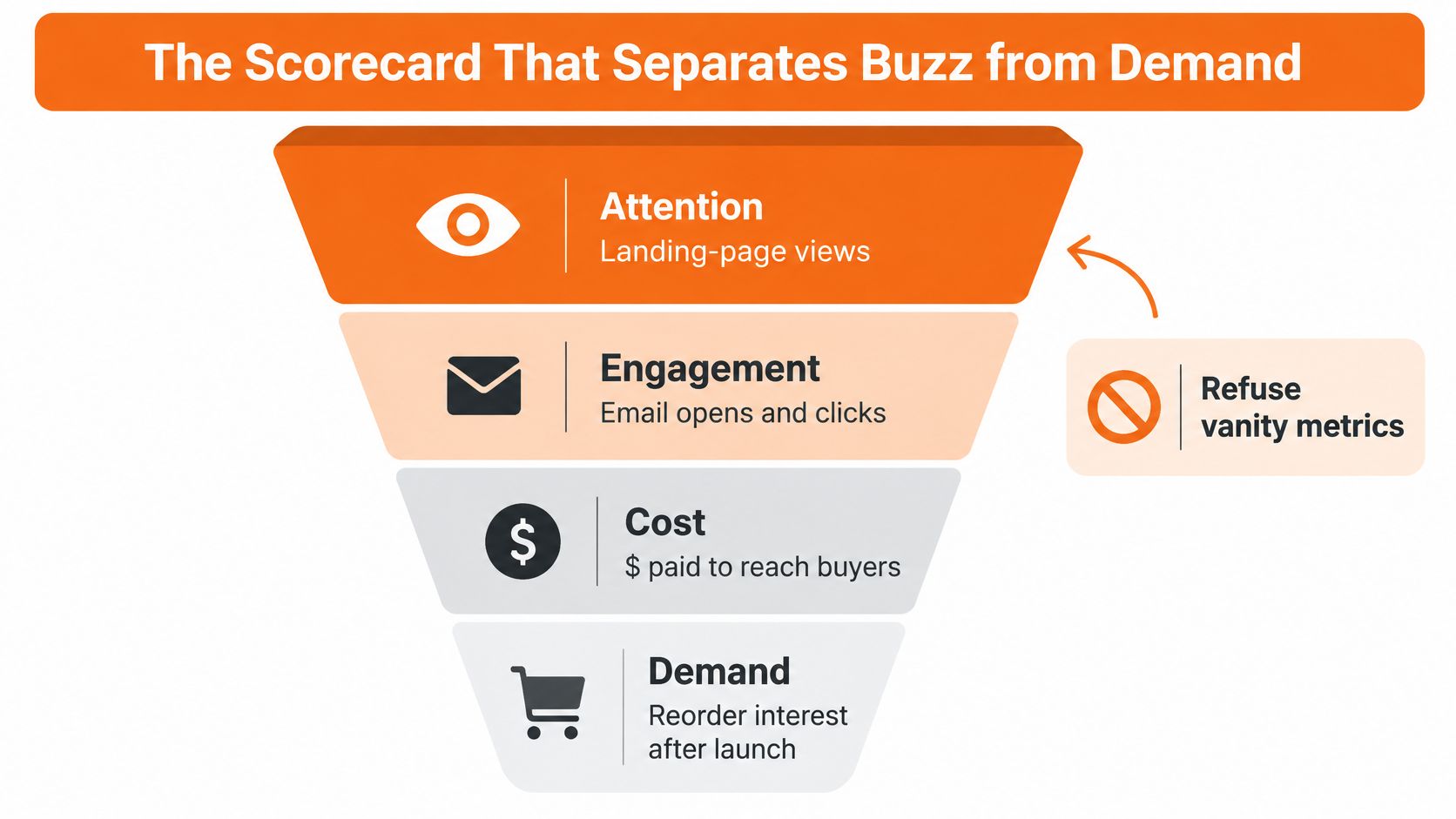
Launch scorecard by stage
| Stage | Numbers | Check | Decision it can trigger |
|---|---|---|---|
| Attention | Landing views, email open and click rate, ad cost and click rate | Daily in week 1 | Fix the page or the subject line, not the factory order |
| Adoption | First orders or trials, setup or unboxing finished, still active in week 2 | Daily, then at day 14 | Keep the offer or change the product |
| Business result | Revenue, refund rate, contribution after product and shipping, referrals | Day 30 and day 90 | Scale, reprice, or stop |
A trial tells you a person feels curious. Week-two use tells you the product did the job. You count orders, paid units, shipments, and repeat buys as four separate numbers, because a crowded first weekend can mix units people activate, units people hold, and units people plan to resell. If you only celebrate orders, you restock a product people plan to return.
You check attention and adoption daily in week one. You check results at day 30 and day 90. If attention runs high and adoption stays flat, you fix the product or the offer. If adoption looks real and margin runs negative, you fix price or shipping before you buy more reach. The walkthrough on how to measure product success gives you a simple sheet structure for this. You fill in your targets before you go live, and the bucket that misses tells you where your next dollar goes.
How to Run Pre-Launch Launch Day and After
Treat your launch like a kitchen timer. You set it, you hear it ring, and you act. You don't launch when the mood feels right.
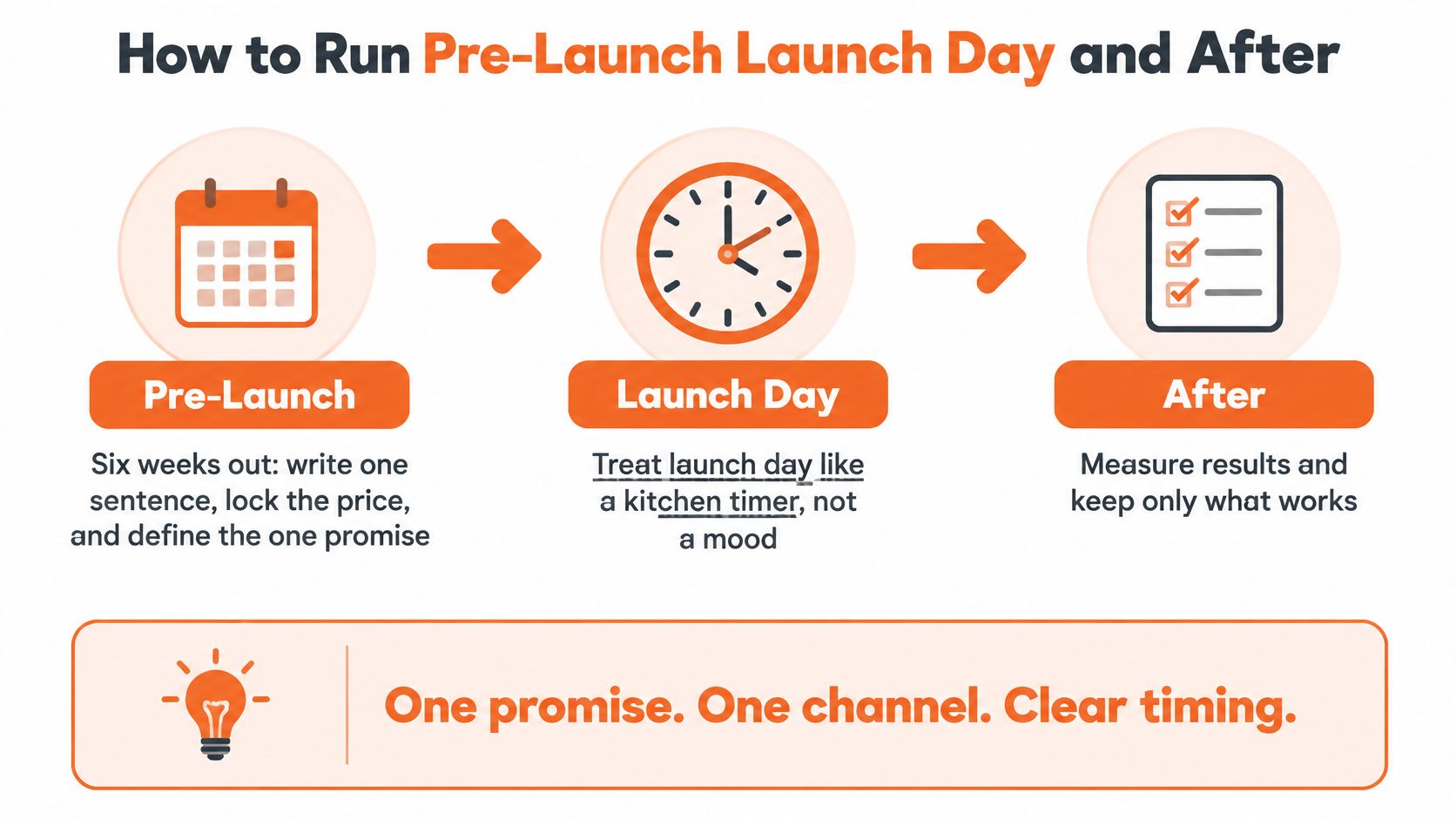
Your six-week run
- Six weeks out: You write one sentence with who it serves, what it does, and what it replaces. You lock the test price and the one promise you can prove.
- Five weeks out: You name one owner. That person holds the checklist when ads, inventory, and email start arguing.
- Four weeks out: You run a bounded test of the whole offer. You test trial, second purchase, price pushback, and on-time shipping together.
- Three weeks out: You stage only the inventory your deposits or beta users earned. You train the person who answers email on the three questions buyers ask most.
- Launch week: You publish one link and one ask. You check traffic, orders, refunds, and support tickets each morning.
- First 72 hours: You fix what breaks and you leave the product alone.
- Day 30, 60, and 90: You scale the channel that produced second orders, you change the offer, or you pull the product.
The AMA guide to a successful new product launch backs the slow front end, reporting a 75% success rate for products with well-defined and well-executed predevelopment activities compared with slightly above 31% when those activities were weak. That gap pays for your test weeks.
Watch this walkthrough before you set your dates, and copy the sequence into your own calendar.
You change one variable per week after launch. If you change price, creative, and audience together, you never learn which change did the work.
Example Launch Cadences for Three Formats
You picked a row. Now you run its cadence week by week, and you let each week end with a count.
Private beta cadence
In week one, you invite 15 to 40 people you already know. You give each person one job to finish and one place to report a stall. In week two, you watch two live sessions per person and you log every place they pause, reread, or ask for help. In week three, you count finishes with no coaching from you. You expand to a second cohort only when 8 of 10 people finish alone. If people need you in the room, you fix instructions, setup, or the product itself, and you run the same cohort size again.
Local pop-up cadence
In week one, you tell your 20 closest contacts about one weekend, one table, and payment on the spot. You keep the ask small and concrete. On weekend one, you sell what you bring and you log each objection in the buyer's words. Two to three weeks later, you book a second date only if you sold about 60 percent of the units you carried in. The notes on pop-up event planning help you plan the table, the payment setup, and the follow-up email. If you carry most units home, you change the offer before you book a bigger room.
Preorder with deposit cadence
In week one, you open a waitlist page with one link and one clear outcome. In weeks two and three, you call the people who joined and you ask for a deposit. You hear the objections on those calls, and you write them down word for word. In week four, you check whether deposits cover unit cost plus freight. You place the factory order only when the cash covers both, and you name the ship date on the page before you take money. If deposits fall short, you shrink the batch, raise the deposit, or stop. You don't cover the gap with hope and a credit card.
One Message One Channel and a Short Room
You get one promise. Write it like this: who you serve, what the product does, and what the buyer stops using. If your sentence needs a second "and," you cut it down.
The Userpilot product launch checklist gives you the same shape with a one-sentence positioning statement and one primary launch channel plus only two or three supporting channels. I go tighter. If you have no list, you make conversations your primary channel. Email is your receipt. A short video is your proof. You skip the sixth network you post to out of guilt.
Short video earns its slot when it shows the job. HubSpot marketing statistics cited by JoinBrands say short-form video was the primary product-launch content format for 60% of marketers in 2025, according to JoinBrands product launch content statistics. You shoot a 30 to 45 second clip of the product doing the work in real light. You skip the packaging montage. A buyer believes a stain coming out, a lid sealing, or a screen finishing a task. A buyer ignores slow spins of a box.

The 55-minute room
If you gather people, you run a short room and you add no extra speakers. The EventDex product launch event guide lays out this exact run: welcome at 0:00, the problem at 0:05, a one-sentence reveal at 0:15, a live demo of three capabilities at 0:25, customer input or Q&A at 0:45, and the offer at 0:55.
You rehearse it like a script. At 0:00, you welcome people and name the one action at the end. At 0:05, you say their problem in their words. At 0:15, you reveal the product in one sentence. At 0:25, you show three things on the actual product, with no slides. At 0:45, you take questions or you let one customer speak. At 0:55, you give the offer, one link, and one ask. Buy, book, or join the beta. You pick one verb.
A room can beat a feed when your buyers live near you. The Splash 2025 Events Outlook Report says 66% of U.S. marketers who used in-person, hybrid, and virtual events in 2024 said in-person events generated the most revenue. A small dinner or a pop-up table gives you that effect at your scale.
You set price on the same page, in a structure you can say out loud without a chart. You choose a flat tier, a usage-based fee, or a freemium plan before you write the page. You pick with two inputs you can collect this week, which are what customers tell you on calls and what competitors charge for the same job. If you can't explain the price in one breath, your buyer can't repeat it at home.
One promise, one channel, one link.
Read that line out loud before you publish anything. If a post, a page, or a room asks for two actions, you cut one. Your buyer gives you a few seconds. You spend those seconds on the job your product does and the single next step.
When the Launch Misses and What You Change
A quiet launch usually points to a plain cause. You match the symptom to one change and you leave the other knobs alone for seven days.
- Nobody came: Your list or room has the wrong people. You go back to 20 direct conversations before you buy traffic.
- People came and didn't buy: You read the top objection and you change the promise or the price. You change one, so you can read the result.
- People bought and refunded: You stop ads the same day. You fix the product, the ship time, or the claim you can't support.
- Support is swamped: You promised more than your operation can deliver. You pause the channel that creates the tickets.
The McKinsey report on product and service launches reports that more than half of product launches fail to hit business targets, with average failure rates above 40% across industries, and it found no correlation between launch investment and success. Money doesn't repair a weak promise or a team with no owner. You fix readiness first.
You run a 24 to 72 hour incident rule when something breaks. One owner writes what broke, picks one fix, and runs a 15-minute review each day until numbers settle. You watch for three boring failures. Two people think they own the launch. Your ad plan assumes stock you don't have. Your tracking is broken, so you read a blank report and guess.
Your kill line decides your next step. If the cohort misses it, you stop or you reshape the offer. You don't write a new line because your posts looked busy.
Lock One Format and Start This Week
Tonight, you circle one row from the format table. You write the pass number beside it in pen. That single act ends the shopping phase.
Tomorrow, you book the first 10 conversations or you book the room. You put the ship date or the demo date on a calendar you won't move. A date you can move in secret is a wish. A date you told ten people about is a plan.
This week, you draft the one-sentence promise and the single link. You write your kill line on the same page. You keep that page where you work, and you read it before you spend a dollar.
If you want operators to pressure-test your plan before you commit inventory, you can apply to join Chicago Brandstarters. You can join at the idea stage with no prototype yet, and membership is free at $0. You bring your one page, you say your pass number out loud, and you let other builders poke holes in it while the holes are cheap.
When your first cohort hits the number, you scale. When it misses, you change one thing or you stop. That is the whole format, and it fits on the page in front of you.
Bring your one-page launch plan, your pass number, and your kill line to a room of Chicago and Midwest builders who will tell you the truth about it before you order inventory. You can apply at the idea stage, membership costs you $0, and you get small dinners and a group chat with founders who share what worked and what flopped. Visit Chicago Brandstarters and apply this week, before you set your launch date.
Leave a Reply