

You're probably doing this right now. You've got a spreadsheet open, a bank balance that feels too small, and six tabs telling you six different things about how much to spend on marketing. One says spend like you're already big. Another says stay lean. A third says pour money into ads and “scale.”
Most of that advice is useless if you're a founder in Chicago or anywhere else in the Midwest trying to get from idea to first traction without lighting cash on fire.
I don't treat a marketing budget like a finance exercise. I treat it like a betting slip. You place a few smart bets, protect your downside, and keep enough dry powder to learn fast. That's what good marketing budget allocation is. Not fancy dashboards. Not jargon. Just clear bets, measured accurately, with the discipline to cut losers.
Why Most Founders Get Budgeting Wrong
I've seen the same movie a hundred times. A founder guesses a budget, spreads it thin across Instagram, Google Ads, some content, maybe a local event, and then waits. A month later, nothing is clear except one fact. The cash is gone.
The mistake isn't just overspending. It's starting with the wrong question.
Most founders ask, “What percent of revenue should I spend?” That's fine if you're already stable. It's a terrible first move when you're early. It pushes you into copying averages from companies that have teams, systems, and enough margin for waste.
And those averages are slippery anyway. The average marketing budget is 7.7% of company revenue, but that number doesn't tell the full story. Half of all companies spend 6% or less, which is why you shouldn't panic if your budget feels tight, according to Sender's marketing budget statistics roundup.
You're not behind just because your budget is small. You're behind when you spend small money in a sloppy way.
Generic advice breaks at the founder level
Big-company advice assumes a few things you probably don't have:
- A clean attribution setup: You probably have partial data at best.
- Enough spend for diversification: You probably don't have room for six channels.
- Time for slow committee decisions: You need to decide this week, not next quarter.
If you're pre-revenue or just past first revenue, your budget has one job. It needs to help you learn what creates customers. That's it.
Think like a bookie, not a bureaucrat
I like to think of budget allocation like setting a lineup before a game. You don't put equal money on every player. You back the ones most likely to produce, keep a few high-upside plays in rotation, and bench the ones that keep missing.
That means your budget is not a cage. It's a control system.
A good founder budget does three things:
- Protects cash
- Creates fast feedback
- Forces hard choices
If your budget doesn't do those three things, it's just a prettier version of guessing.
Your Budget Starts With Goals Not Numbers
If you don't know where you're going, every channel pitch sounds smart.
That's why I always start with goals before numbers. Same logic as packing for a trip. If you're going to Miami, you pack one way. If you're going to Minneapolis in February, you pack another. Your marketing budget works the same way.

Pick one or two goals
You need a target that is clear enough to judge spending against. If you can't say whether a dollar moved you closer to the goal, that dollar is wandering around unsupervised.
One rule I like is simple. Define clear objectives, because without them your spending is guesswork. ReachLabs puts it bluntly and even uses examples like generating 1,000 marketing-qualified leads as a measurable target in its marketing budget allocation best practices.
Good founder goals usually sound like this:
- Get first customers: You need proof people will buy.
- Build a warm audience: You need an email list or remarketing pool.
- Book qualified conversations: You need buyer feedback, not likes.
- Drive repeat purchases: You need to improve retention before scaling acquisition.
Bad goals sound like “grow awareness” or “post more on social.” Those are activities, not outcomes.
Do a quick asset inventory
Before you allocate a dollar, look at what you already have.
You do not need some giant audit. Just write down the assets already in play.
- Your website: Is it live, clear, and built to convert?
- Your email list: Even a small list matters if the people are real.
- Your social accounts: Which one already gets replies, saves, DMs, or shares?
- Your founder network: Friends, past coworkers, local buyers, community groups.
- Your content bank: Product photos, customer texts, reviews, videos, FAQs.
Budget allocation should amplify traction, not compensate for missing basics. If your site is confusing, paid traffic just buys you faster failure.
Practical rule: Don't fund distribution before you fix the page people land on.
Match the budget to the destination
A founder trying to get first sales should budget differently from a founder trying to make an existing channel more efficient. One needs signal. The other needs scale.
If you need help getting concrete, I'd start with this guide on how to set business goals. It's easier to build a smart budget once you stop pretending every marketing task matters equally.
Here's the test I use. For every line item in your budget, ask: what goal does this help, and how would I know?
If you can't answer in one sentence, cut it.
Use the 70-20-10 Rule for Smart Bets
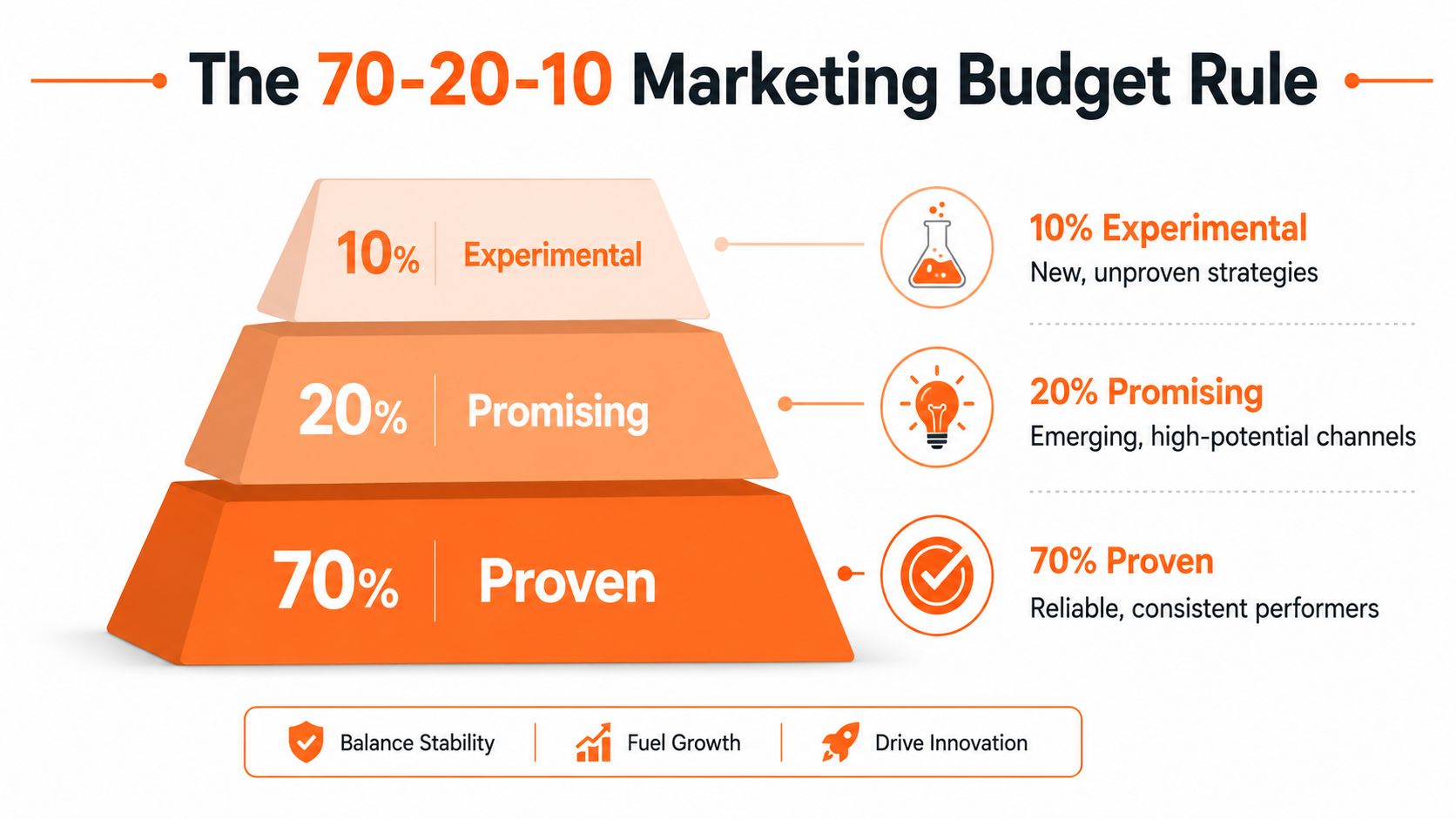
The 70-20-10 rule gives founders a simple way to spend with discipline. Put 70% into channels that already produce customers, 20% into tests with a clear case, and 10% into experiments that could open a new lane.
That split matters even more in Chicago and the Midwest, where a lot of businesses grow through trust, repeat business, local referrals, and channel efficiency, not flashy spend. If you treat every new idea like a priority, your budget gets scattered fast.
What proven means when you're small
“Proven” is simpler than founders make it.
You do not need perfect attribution. You need evidence that a channel brings in real buyers. For an early-stage founder in Chicago, that might be pop-ups in the neighborhood, founder-led outreach, warm email intros, local search, or Instagram content that consistently drives qualified traffic. For a B2B founder in the Midwest, it might be LinkedIn outreach, partner referrals, trade groups, or email sequences that turn conversations into demos.
Put your 70% behind the channels that already move people closer to a sale. Protect that base first. A lot of founders starve the one thing working because a friend told them to try five new channels at once. That is how you burn cash and lose momentum.
What belongs in the 20%
The 20% bucket is for ideas with logic behind them.
You have a signal. Now you test the next step. If branded search converts, test non-brand search. If your email list responds to offers, test segmented campaigns. If Chicago customers respond to neighborhood-specific messaging, run geo-targeted campaigns around places where you already have traction. If you sell across the Midwest, test creative that speaks to regional buying behavior instead of copying generic coastal startup ads.
A good 20% test needs three things:
- A reason it should work
- A review window
- A cut line
Set those before you spend. If you want a stronger system for connecting these channels across paid, owned, and local touchpoints, use an omnichannel marketing strategy built for growing brands.
Here's a useful explainer if you want another take on how to split that testing logic:
Guard your mad scientist fund
The last 10% is where you buy learning.
Use it for odd ideas with real upside. A local sponsorship tied to the right audience. A direct mail test for high-value prospects in the suburbs. A collaboration with another Midwest brand that shares your buyer. A pop-up around a Chicago event. A bold landing page angle you would not trust with serious budget yet.
Keep it small on purpose. The 10% bucket exists to surface winners, not entertain your team. Once experiments start eating 25% or 30% of spend, you are not achieving true breakthroughs. You are avoiding commitment.
Add one more layer of discipline
Run the 70-20-10 split by dollars and by attention.
Founders love to say only 10% of the budget is experimental, then spend half the week talking about the experiment. That still wrecks focus. Give your 70% bucket the best operators, the fastest feedback, and the clearest reporting. Give your 20% bucket a deadline. Give your 10% bucket permission to fail fast.
That's how smart budget allocation works. You keep the engine fed, test the next growth move, and leave a small corner for ideas that might surprise you.
Your Marketing Channel Mix by Growth Stage
Your channel mix should change as your business changes. A founder at zero traction should not copy a founder doing steady monthly revenue. That's like dressing a Little League team in NFL pads.
I'd break it into three stages and budget with very different instincts in each one.
Sample marketing budget allocation by stage
| Stage | Pre-Revenue | First Revenue ($1k-$10k/mo) | Growth ($10k-$80k/mo) |
|---|---|---|---|
| Core focus | Direct feedback and proof of demand | Repeatable acquisition | Scaling what already converts |
| 70% bucket | Founder-led outreach, local markets, product sampling, email to warm network | Best-performing owned channel, retargeting, local search, repeat purchase email | Paid search, paid social, email, SEO or content that already produces sales |
| 20% bucket | Boosted social posts, small creative tests, local partnerships | One new paid channel, creator partnerships, landing page tests | New audience segments, new creative angles, selective local sponsorships |
| 10% bucket | Weird but cheap tests, pop-up concepts, collaborations | Experimental offer formats, niche channels, community-led stunts | New geos, new platforms, bold campaign concepts |
Pre-revenue founders should buy learning
If you have no revenue, stop pretending you need a full-stack marketing machine.
Your “proven” channel may just be face-to-face selling, small vendor markets, DMs, or warm intros. Fine. That still counts. In Chicago or the broader Midwest, I'd rather see a founder talk to real buyers at local markets, community events, or neighborhood pop-ups than waste money on broad cold traffic too early.
That's also where local texture matters. A product brand can learn more from a weekend market, a retailer pop-in, or a collab with another small local business than from a month of untargeted ad spend.
Focus on:
- Customer conversations: You need language straight from buyers.
- Product sampling: Especially if taste, texture, scent, or quality matters.
- Simple owned channels: A clean site, basic email capture, active social replies.
- Very small paid tests: Only after the message gets traction organically.
First revenue founders should tighten the machine
Once money starts coming in, the job changes. You're no longer proving demand from scratch. You're trying to find a repeatable path.
At this point, your budget should start favoring the channels that create consistent purchases, not random spikes.
One reason paid channels take over here is simple. Paid media is the single largest marketing expense, capturing 30.6% of budgets, and for DTC eCommerce brands, allocations average 25% to paid social and 22% to paid search, according to Vidico's marketing budget planning analysis.
That doesn't mean you copy those numbers blindly. It means you respect where spend tends to concentrate once founders need predictable customer flow.
For a Midwest founder at first revenue, I'd usually prioritize:
- Retargeting warm traffic
- Paid search if buyers already know the problem
- Paid social if creative is strong
- Email for abandoned carts, launches, and repeat buyers
- Offers built around seasonality, events, or local relevance
If you're building across channels, this breakdown on omnichannel marketing strategy is worth reading. Most founders don't need more channels. They need the same message to show up cleanly wherever buyers already touch the brand.
Growth-stage founders should scale with restraint
When you hit steady monthly revenue, the temptation is to spend everywhere. Resist it.
Growth-stage budgeting is where founders get punished for sloppy confidence. They see one winning campaign, assume everything can scale the same way, and then watch efficiency drop.
At this stage, your channel mix should have more structure:
- Keep proven paid channels funded first
- Support them with retention channels like email
- Build owned demand through content and search if those channels already show life
- Use local sponsorships or event tie-ins only when they connect to a clear audience
- Test one expansion move at a time
For Chicago founders, that might mean geo-targeting around McCormick Place events, tying product campaigns to neighborhood patterns, or partnering with adjacent local brands that share the same customer base.
The point is simple. Don't build a channel mix from internet averages. Build it from your stage.
How to Track and Reallocate Your Budget
It's Thursday night. You open Ads Manager, Shopify, HubSpot, and your bank account, and every dashboard tells a different story. That's how founders waste money. They react to noise, keep weak channels alive for another month, and call it patience.
Run your budget like an operator. Review it on a fixed cadence, track a short list of numbers, and move money fast when a channel stops earning its keep.

Track a few numbers that matter
Start with three: customer acquisition cost, conversion rate, and revenue by channel.
That's enough to make good decisions.
Customer acquisition cost keeps founders honest. If you spent $4,000 on a channel and got 40 new customers, your CAC is $100. Now compare that number to gross margin, payback period, and the quality of those buyers. A cheap customer who never buys again is not a win.
If you want a cleaner system for review cycles and budget shifts, this marketing budget allocation strategy is useful because it treats spend like an operating discipline, not a yearly spreadsheet exercise.
Review on a real cadence
Weekly reviews are for paid channels. Monthly reviews are for total allocation. Quarterly reviews are for bigger calls like killing a channel, adding headcount, or committing to a new acquisition bet.
Keep the meeting short. Thirty minutes is enough if your reporting is clean.
For Chicago and Midwest founders, I'd get even more specific. Review event-driven campaigns right after the event window closes. If you ran geo-targeted ads around a McCormick Place conference, a neighborhood festival, or a regional retail push across Illinois, Indiana, or Wisconsin, don't wait until month end to judge performance. Those campaigns have a short shelf life, and late decisions burn cash.
Cut slower than a panic move, faster than your ego wants.
Reallocate based on signal, not hope
Here's the rule. If a channel misses target for two review cycles in a row and you can't point to a clear fix, reduce spend and move that budget to a channel that is already producing.
Do not spread the money across five experiments. Put it where you already have evidence.
If retargeting keeps converting, fund it first. If email keeps driving repeat purchases, treat it like a revenue channel, not a support task. If Meta prospecting is expensive but your warm audiences convert well, fix the funnel before you spend more on cold traffic. This guide to Facebook retargeting ads for warm audience conversion is a good place to tighten that layer.
Good reallocation feels uncomfortable because it forces you to admit a past decision was wrong. Fine. That's part of the job.
Your budget should change every month. In the Midwest, markets shift fast, seasonality is real, and local buying patterns are rarely identical to coastal benchmarks. Founders who keep adjusting usually beat founders who keep explaining.
Common Budget Traps and How to Sidestep Them
Most founders don't lose money because they're lazy. They lose money because the wrong data looks convincing.
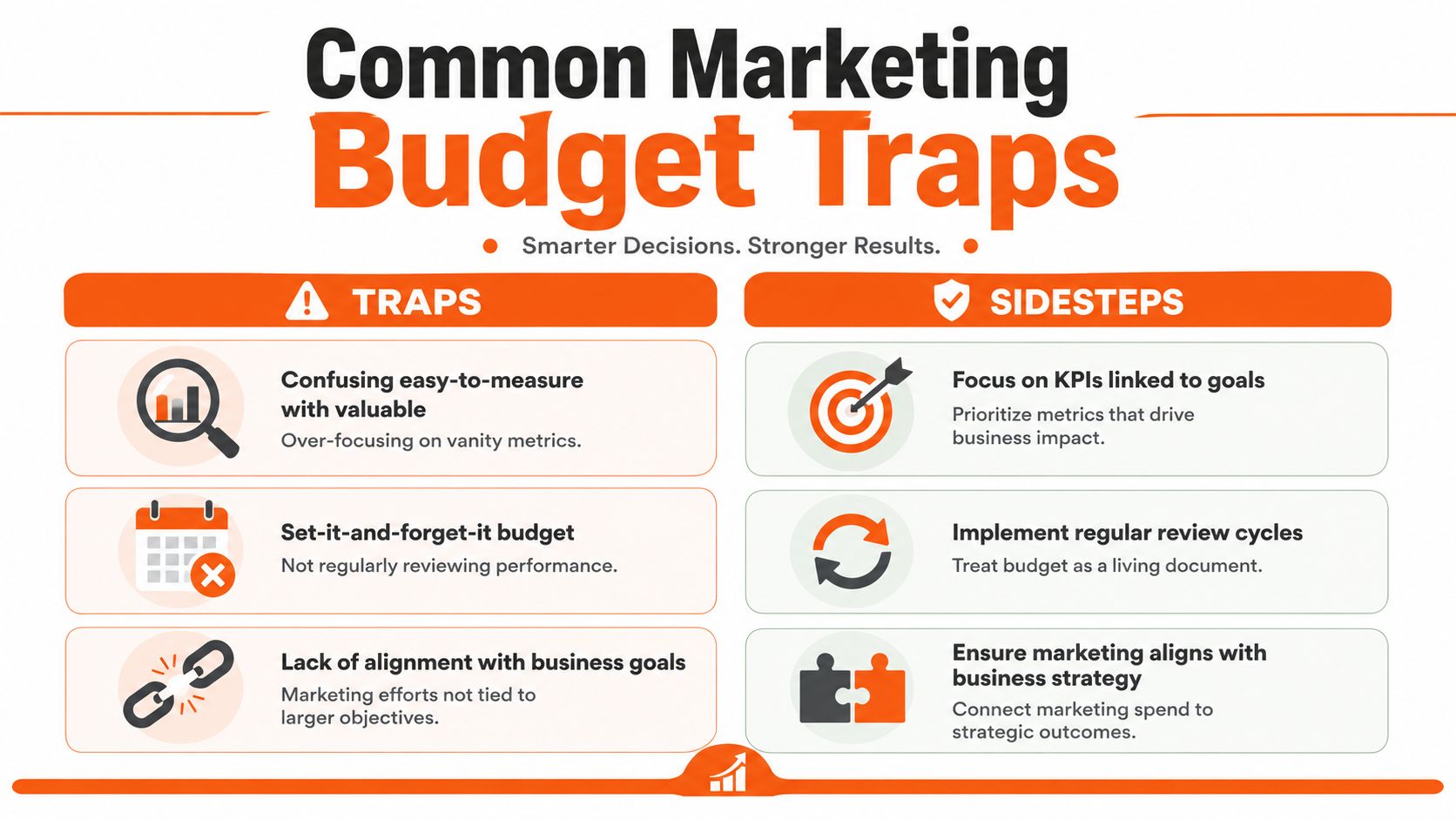
The biggest trap is giving too much credit to the channel closest to the sale. That's how founders end up worshipping branded search, retargeting, or last-click reports while starving the things that made buyers care in the first place.
Trap one is confusing attribution with causation
This is the one that fools smart people.
A channel claims the conversion, so you assume it created the demand. Maybe it did. Maybe it just showed up at the end and grabbed credit. That's why I care more about incremental lift than clean-looking dashboard attribution.
Measured makes the point sharply. A huge pitfall is relying on attributed return instead of incremental return, and 20% of marketing channels typically generate 80% of results, which is why you have to reallocate away from underperformers fast, based on Measured's explanation of marketing budget accuracy.
That means two things:
- Don't overfund channels just because they claim conversions
- Don't keep weak channels alive because you “already invested”
If a campaign goes dark and sales barely move, that campaign may have been harvesting demand, not creating it.
Trap two is getting sentimental about bad channels
Founders keep bad channels around for emotional reasons. They like the creative. They like the vendor. They like the feeling of “being present” somewhere.
That's expensive.
If a channel has had enough time and enough honest testing, and it still underperforms, cut it. Don't write breakup poetry about it. Reallocate.
If you're outsourcing paid acquisition, this gets even more important. A lot of agencies will happily keep your weakest campaigns on life support because it protects their retainers. If you're in that situation, read this guide on choosing a PPC agency. It's useful because it frames the relationship around budget discipline, not flashy reports.
Trap three is chasing neat metrics
Reach, impressions, follower growth, clicks. All fine. None of them pay payroll on their own.
I'm not saying ignore top-of-funnel metrics. I'm saying don't confuse movement with progress. If those numbers rise while customers don't, your budget has drifted away from the business.
A few quick sidesteps help:
- Tie every spend line to a business goal: If it doesn't connect, remove it.
- Use a living budget: Review and move money regularly.
- Protect some testing spend: Otherwise the current winners eat everything.
- Ask what created demand, not just what captured it: That question alone will save you money.
Most wasted marketing spend comes from comfort. Comfort with familiar channels, familiar reports, familiar stories. The fix is simple. Get less comfortable.
If you're building in Chicago or the Midwest and you want honest feedback on what to fund, what to cut, and how other founders are handling the same mess, join Chicago Brandstarters. It's a free community for kind, serious founders who want real operator conversations, not networking theater.
Leave a Reply