
You're probably at the stage where the first production run looks simple on paper and messy in real life. The sample looked clean. The buyer wants a date. Your cash is tied up in inventory. The factory wants a bigger order than you want to place. That's where manufacturing partnerships stop being a sourcing task and start acting like a structure that carries product, money, quality, and risk all at once.
I've watched founders treat a factory like a vendor and then act surprised when the relationship breaks the second the order changes shape. That's the wrong model. A real partnership is more like a bridge you both have to walk across with weight on it. If you don't plan for the load, the bridge tells you fast.
What a Manufacturing Partnership Has to Carry
The first purchase order feels like a win. Then you realize it's also the first real test of the relationship. At that moment, the factory isn't just making parts. It's carrying your design, your cash cycle, your quality promise, and your exposure if something slips.
A founder who treats this like a simple buy-sell deal gets burned quickly. The sample can be perfect and the production run can still fail because the factory never really understood your tolerances, your launch timing, or your rework rules. That gap is where margin leaks out. It's also where trust gets replaced by email arguments.
Four jobs that sit on one table
A manufacturing partnership has to do four jobs at once. It has to make the product, protect cash, handle IP cleanly, and absorb operational risk when things go sideways. Miss one of those and the whole arrangement gets brittle.
Practical rule: If your factory relationship only works when nothing changes, you don't have a partnership. You have a fragile purchase order.
This is why the old “get samples, place order, hope for the best” playbook fails. The U.S. Manufacturing Extension Partnership was created in 1988 and is administered by NIST within the U.S. Department of Commerce NIST MEP. That's a useful reminder that manufacturers have needed outside expertise for a long time. I use that fact as a sanity check. Smart operators don't try to own every skill in-house when the job needs outside structure.
What founders get wrong first
They write the deal as if it's a single transaction. It isn't. Your partner needs to know who owns tooling, who pays for scrap, who decides on rework, and what happens if demand jumps while the line is full. If those answers live only in Slack, you don't have control. You have memory, and memory gets fuzzy at exactly the wrong time.
The strongest partnerships I've seen act more like a small operating system than a supplier relationship. Each side knows the rules before volume starts moving. That saves time, but more important, it stops small issues from becoming expensive fights.
Where to Find Manufacturers You Can Actually Trust
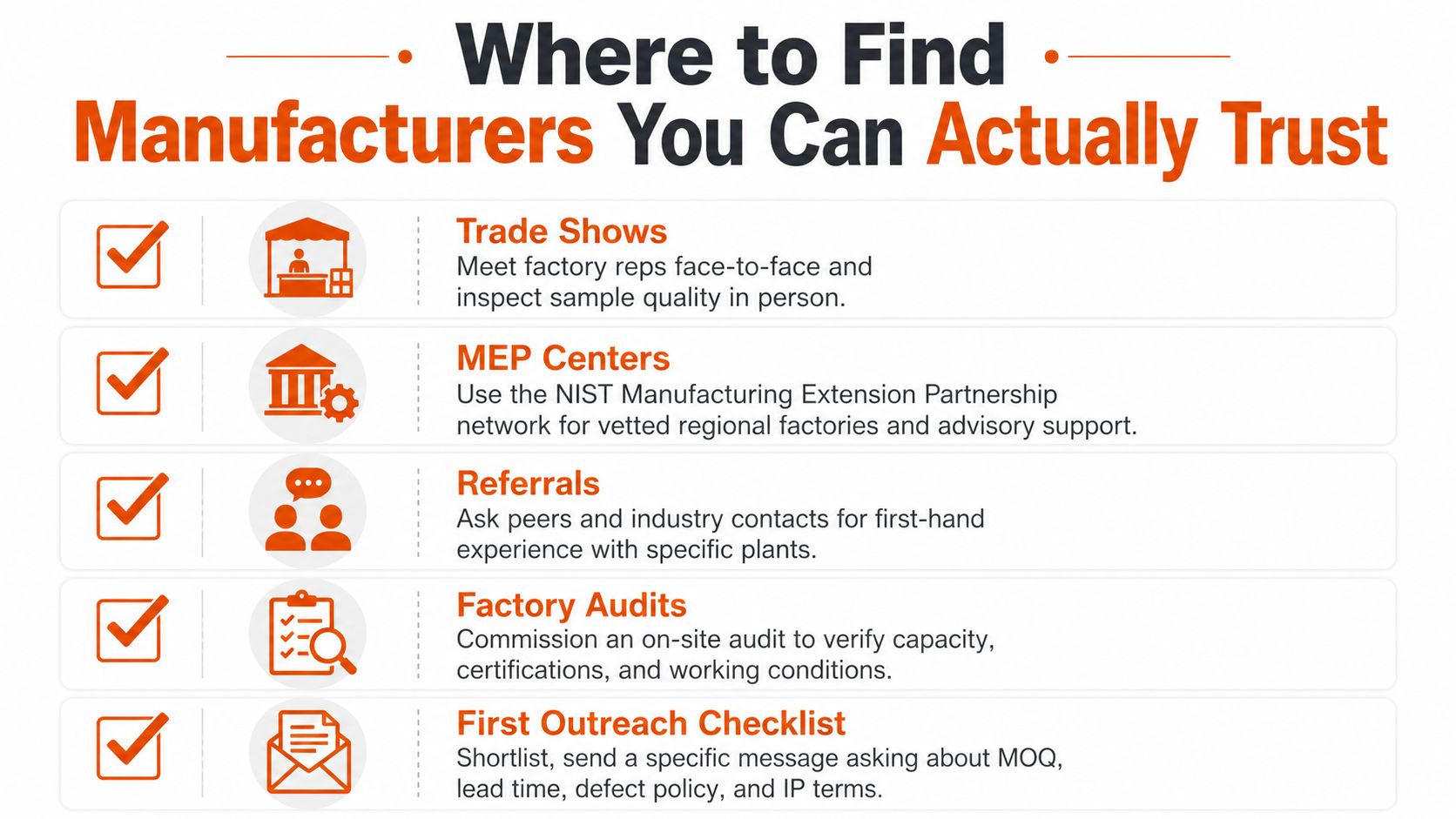
If you start with the cheapest lead, you usually get the noisiest signal. I'd rank sourcing channels in this order: referrals, trade shows, regional support networks, then on-site audits. Each one tells you something different. The trick is to use them together, not in isolation.
For Midwest founders, proximity matters more than people admit. A plant you can visit in a day beats a plant you'll only see in staged photos. Shorter logistics lines also make it easier to inspect inventory, catch drift early, and fix problems before they become a shipment problem.
Start with signal, then move to distance
Referrals are still the cleanest starting point because another founder has already paid the tuition. Trade shows help when you need to inspect samples and watch how factory reps talk under pressure. For regional support, the Manufacturing Extension Partnership network can help you find vetted factories and advisory support through the public infrastructure run by NIST browse Sheridan's partner guide and the broader sourcing playbook at Chicago Brandstarters' sourcing guide.
A factory visit tells you more in twenty minutes than a week of polished emails.
If you're in Chicago or anywhere in the Midwest, I'd treat Illinois, Indiana, Ohio, Michigan, and Wisconsin as your first search band. You want factories you can reach without turning every issue into a travel budget line. That matters when you need a line walk, a tooling check, or a sample review on short notice.
Use a simple first outreach message
Send a short note that asks for the few things that matter. Ask about MOQ, lead time, certification, defect handling, sample cost, and IP terms. If they answer clearly, you've got something to work with. If they dance around basic questions, keep moving.
I'd also read response time like a health indicator. A factory that takes days to answer a simple request will usually take even longer when a shipment is late. You don't need perfect speed. You need predictable communication.
Vetting a Factory Before You Sign Anything
Treat vetting like hiring, because that's what it is. You're not buying a commodity. You're choosing a team that will touch your margin, your customer experience, and your reputation. I'd score every candidate on four buckets, financial health, capacity, quality systems, and references.
A factory can look fine on a website and still be a bad fit. What you want is evidence that they can handle your product at your volume without improvising every week. Response time and English fluency matter too, but only as early signals. They tell you how the working rhythm will feel once problems start.
The scorecard I'd actually use
Give each factory a simple pass, mixed, or fail in these areas:
- Financial health: Can they explain how they handle raw material buys, deposits, and overdue accounts without sounding shaky?
- Capacity: Can they show current load, open slots, and what happens if you need a rush run?
- Quality systems: Do they have documented inspection steps, traceability, and a real defect process?
- References: Have they shipped products similar to yours, at a similar pace, for actual customers?
The strongest warning signs usually show up early. One is vague answers on capacity. Another is a sales contact who won't loop in production or quality. The third is a factory that says yes too fast to everything. That last one feels friendly until the line starts missing specs.
Read the boring signals
I care a lot about how fast a plant replies to basic questions, because it tells me how they'll behave when the order gets messy. I also listen for whether they can write clean English in email. That's not about accent or polish. It's about whether they can handle details without dropping them.
For quality discipline at serial scale, this guide on quality control for serial production is worth a look if you want a tighter lens on repeatability and process control. I'd use it after the first conversation, not before. First you need a plant that can talk plainly. Then you can judge whether it can build plainly too.
Running Samples and a Paid Pilot That Teach You Something
A sample is not proof. It's a guess with nice packaging. A paid pilot is where you find out if the factory can repeat the result when the clock is running and the batch isn't tiny anymore.
I like paid pilots because they force real behavior. The factory has to order materials, manage a line, communicate, and invoice properly. You get more than a part. You get a read on whether this relationship can survive actual use.
Set the pilot up like a test, not a favor
Your first PO should be small enough to limit pain and large enough to expose process mistakes. Put the lead time in writing. Put the defect allowance in writing. Put the rework process in writing. If the factory pushes back on basic clarity, that tells you something useful.
Rule I use: If the pilot can't expose a problem, it's too polite to be useful.
Keep weekly check-ins short and specific. Ask what's late, what's waiting on material, what got rejected, and what changed in the process since last week. Don't ask for comfort. Ask for facts.
What you should learn from the pilot
You want three things from this run. First, you want to see true unit economics. Second, you want to see how they handle defects without drama. Third, you want to see whether their team keeps promises in writing and in person.
If you want a sharper lens on how to run early technical checks, Chicago Brandstarters' rapid prototyping guide is a useful companion when you're still moving from prototype to real production. I'd use that mindset to keep the pilot honest. Don't fall in love with the sample. Fall in love with repeatability.
Negotiating MOQ, Pricing, and Lead Times Without Losing Margin
Most founders negotiate each lever alone and lose the bigger game. MOQ, unit price, and lead time pull against each other. If you force one too hard, the others bend back at you. That's why I like to negotiate them as a package.
A lower MOQ often means a higher unit cost or a less friendly schedule. A lower unit cost can mean a bigger commitment. Faster lead times can mean premium pricing or less room for error. You don't need to win every point. You need a structure that keeps your cash alive.
Compare the three levers
| Lever | What you ask for | What you give up | When to use it |
|---|---|---|---|
| MOQ | Smaller first run, or staged releases | Higher unit price or deposit | Early demand, uncertain fit |
| Unit price | Tiered pricing by volume | Bigger commitment on future orders | You expect repeat volume |
| Lead time | Written turn time with rush rules | Less flexibility on last-minute changes | Launch windows, retail deadlines |
A tiered pricing curve is usually smarter than a single hard number. You can also push back on MOQ by offering a deposit tied to scheduled releases instead of one giant buy. That keeps the factory covered without forcing you to carry inventory you can't move.
The guide at how to negotiate with suppliers is useful if you want more language for the conversation, but the principle is simple. Don't haggle like a shopper. Negotiate like an operator. You're building a cash structure, not chasing a discount.
Write the lead time clause like you mean it
Lead time needs a trigger, a clock, and a consequence. If demand spikes, the factory should tell you when it can absorb more volume and when it can't. If you need priority treatment, pay for it on purpose instead of hoping goodwill will do the work.
A clean clause beats a long apology after the shipment misses the date.
I like contracts that spell out what happens when forecasts change. If you forecast wrong, you should carry some of that risk. If the factory overpromises, it should carry some too. That split keeps everyone honest.
Writing IP and Quality Clauses That Actually Hold
I'd never leave IP and quality on a handshake. That's how founders end up arguing after the damage is done. If a factory can copy your product, sell your tooling, or wave off a defect with no remedy, you don't have a partnership. You have leakage.
The contract needs to say who owns the mold, who owns the files, who owns revisions, and who can use the design after the run ends. It also needs a defect remedy that isn't vague. If a batch fails, what gets replaced, who pays freight, and how fast does the fix happen? Put that in writing before money moves.
The clauses I refuse to skip
I want inspection cadence, acceptance criteria, and escalation steps in the document. For a first run, that usually means incoming material checks, in-process checks, and final inspection before shipment. If the part is sensitive, I want a sample retention step too.
Tooling ownership gets messy fast. If you paid for the mold, your paper trail should say you own it. If the factory holds the mold, you need access terms that keep you from getting trapped later. That matters more than founders think because tooling is a key asset.
The hidden resale risk
There's one clause many founders forget. They protect the brand name but forget the product geometry and production method. If the factory can reuse your design with another customer, your “unique” product is no longer unique. That clause belongs in the first draft, not after a dispute.
Deloitte's work on partner ecosystems in Industry 4.0 notes that partner roles can stretch across product development, marketing, sales, delivery, and customer success and support Deloitte partner ecosystem. I read that as a warning to founders, too. The factory relationship can touch the whole customer journey, so the legal terms need to match that width.
Onboarding Logistics and Scaling Without a Single Point of Failure
The relationship that works for one SKU can fall apart at three SKUs. The line gets crowded, freight gets uglier, and inventory becomes a puzzle instead of a buffer. If you wait for a crisis to build a second source, you're already late.
I like to think about onboarding as the moment when freight, customs, inventory, and production stop being separate topics. They're one system. If one piece breaks, the rest feel it.
Build the fallback before you need it
Your partner should know what happens if the primary plant gets overloaded or hit by a cross-border shock. That means you need a second-source plan on paper. It doesn't have to be active on day one, but it does have to exist.
Practical rule: If you can't explain your fallback in one paragraph, you don't have one yet.
A contingency clause should cover inventory ownership, fallback capacity, and who absorbs delay costs if a tariff change or logistics hit forces a reroute. Manufacturers are already rethinking sourcing because tariffs, geopolitics, and disruption make regional diversification more attractive, and Deloitte also notes that firms are using ecosystem partnerships to close workforce and capability gaps Deloitte manufacturing growth amid workforce challenges. I'd turn that into plain contract language, not strategy slide language.
If you want a cleaner grasp of quality controls around process consistency, QC principles and SPC is a good reference point for how repeatable production gets monitored in practice. That matters once volume starts climbing and small drift turns into customer returns.
Keep the handoff boring
The best logistics setup is the one nobody talks about because it keeps working. Your freight terms, customs paperwork, inventory counts, and inbound checks should all be dull and predictable. If a partner can't keep those boring steps clean, scaling will punish you later.
The MEP program's own fiscal year 2023 estimate reported 308,926 jobs, $15.1 billion in cost savings, and $5.6 billion in new client investment in its firm-based scenario Upjohn report on MEP impacts. I don't use that as a slogan. I use it as a proof point that structured manufacturing support can move real business numbers when the system is set up right.
Chicago Brandstarters gives founders a place to compare factory notes, sourcing tactics, and hard lessons without the usual sales pitch noise. If you're building physical products in Chicago or the Midwest, Chicago Brandstarters is worth visiting because it connects you with other operators who've had to make the same manufacturing calls, and the same mistakes, in the world.
Leave a Reply