
The usual advice on Amazon Seller Central vs Vendor Central is to choose control or choose scale. That's too simple when you're funding inventory from your own bank account. A wholesale order can look like progress while leaving you short of cash for the next production run.
I'd start with a harder question: Can you survive the channel's payment, pricing and replenishment rules? Compare the money you actually collect, the inventory you must finance and the decisions you can still make when sales slow down. Then decide how much retail work you want your team to handle.
Seller Central and Vendor Central at a Glance
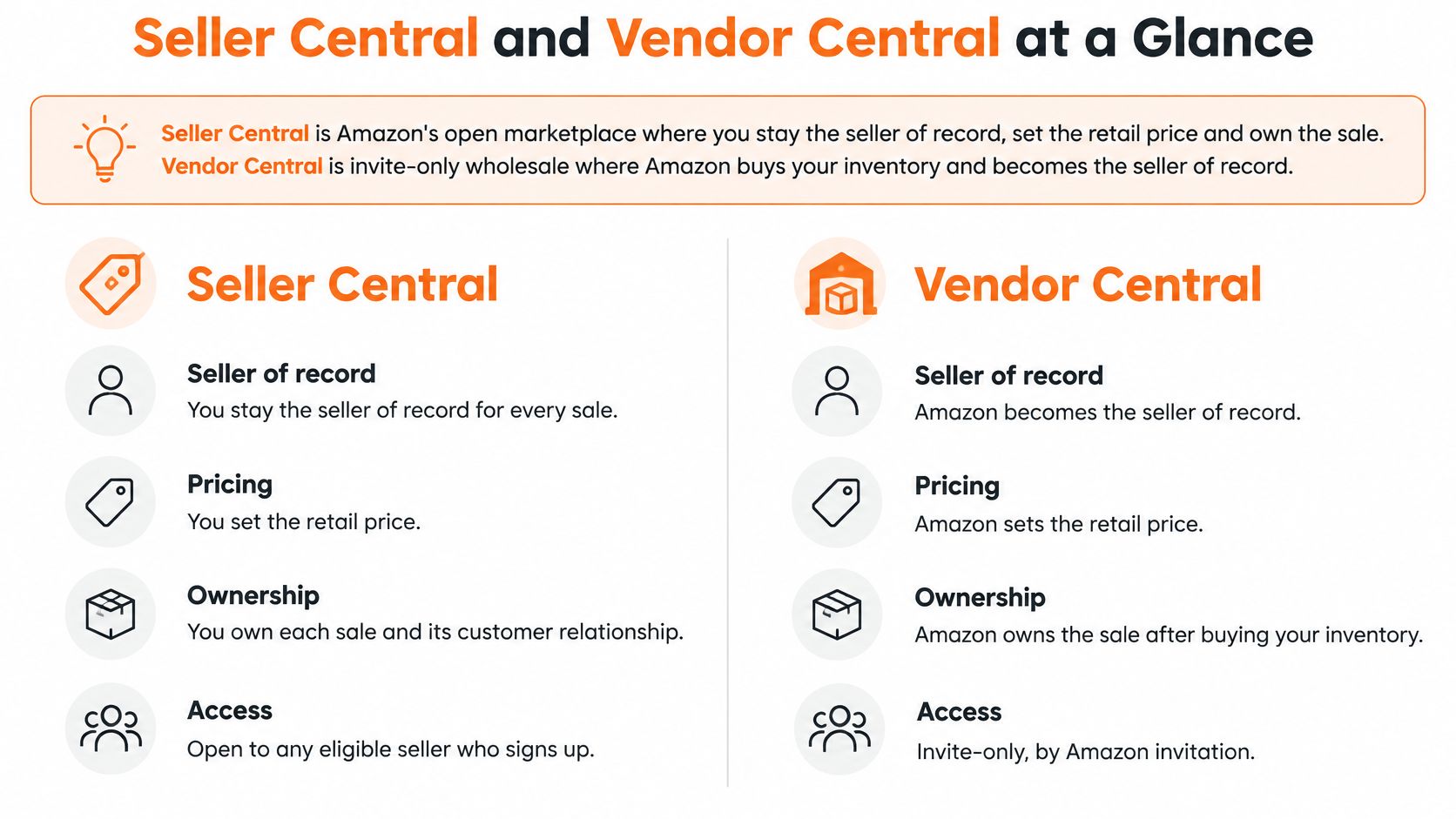
Seller Central makes you the retailer; Vendor Central makes Amazon your wholesale customer. You register for Seller Central, sell directly to shoppers and set your retail price. With Vendor Central, you need an invitation, negotiate a wholesale price and supply Amazon for resale.
Seller Central vs Vendor Central side by side
The ownership and payment distinctions below follow Feedvisor's Vendor Central guide, which describes Seller disbursements approximately every two weeks and Vendor invoice terms of 30, 60 or 90 days.
| Factor | Seller Central | Vendor Central |
|---|---|---|
| Business model | Third-party marketplace | First-party wholesale |
| Seller of record | You | Amazon |
| Who sets retail price | You | Amazon |
| Who owns inventory before sale | You, until the buyer purchases | Amazon, after it receives the goods |
| How you get access | Open registration for eligible sellers | Invitation only |
| Payment timing | Disbursements about every two weeks | Invoice terms of 30, 60 or 90 days |
| Main costs | Referral fee of about 8%–15%, plus fulfillment, storage and advertising | Wholesale discount plus co-op, allowances, freight, damage and deductions |
| What you receive per unit | Retail price less fees | About 40%–60% of MSRP, before deductions |
| Who owns the customer relationship | You, within Amazon's marketplace restrictions | Amazon |
For the table's commercial benchmarks, MOART's 2025 marketplace operations playbook places Seller referral fees at 8%–15% by category and Vendor wholesale pricing at 40%–60% of manufacturer's suggested retail price. Treat the wholesale range as a negotiation reference, not a guaranteed offer.
Think of Seller Central as running your own shop inside Amazon's mall. You choose the merchandise and shelf price, but you also manage the shop's economics. Vendor Central means selling your goods to the mall's owner, who decides how to retail them.
You can use both channels. Keep established wholesale products in Vendor Central and selected launches or specialist products in Seller Central, provided you can manage separate forecasts and avoid unnecessary competition on your own listings.
The practical distinction is decision-making responsibility. Seller Central gives you more levers to pull when demand changes. Vendor Central lets Amazon handle more downstream retail work, while you manage the supplier relationship.
What Each Channel Costs You
Don't compare a Seller referral percentage with a Vendor allowance percentage and call the smaller number cheaper. You start from different revenue bases. In Seller Central, you start with the shopper's payment; in Vendor Central, you start with an already discounted wholesale price.
As the Saras Analytics Vendor Central guide explains, you retain inventory ownership and pay marketplace-related charges under Seller Central. That makes your job a retail calculation: collect revenue, subtract selling expenses and check what remains.
Seller fees follow the consumer order
Amazon calculates your referral fee using the category percentage multiplied by the total sales price, or the category minimum, whichever is higher. Under Amazon's referral-fee rules, that sales price includes delivery and gift wrap, excludes taxes calculated through Amazon's tax-calculation services, and triggers the fee when Amazon ships the order rather than when you create a listing.
With Fulfillment by Amazon, or FBA, you pay Amazon to pick, pack and ship. Size and weight matter: the Saras Analytics cost comparison gives an example of $5.32 for a large-standard T-shirt weighing 12.32 ounces, alongside Vendor estimates of 13%–22% for market-development funds, 2%–5% for freight allowances and 2%–11% for damage allowances.
Add storage, returns and advertising before you declare a product profitable. With Fulfilled by Merchant, or FBM, you avoid the FBA fulfillment charge, but you still pay for warehouse labor, packaging, postage and return handling yourself.
Cost categories in each channel
| Cost item | Seller Central | Vendor Central |
|---|---|---|
| Referral or margin | Referral fee of about 8%–15% of sales | Wholesale pricing around 40%–60% of MSRP, before deductions |
| Fulfillment | FBA fee by size and weight, including the T-shirt example above | Freight allowance of 2%–5% |
| Marketing funds | Advertising you choose to purchase | Market-development funds of 13%–22% |
| Co-op | No standard wholesale co-op | About 4%–10% of product cost |
| Damage | Returns, processing and removal charges where applicable | Damage allowance of 2%–11% |
| Storage | Monthly FBA storage based on inventory characteristics and applicable rates | Amazon handles storage of inventory it purchases; review contractual allowances |
| Deductions | Marketplace adjustments rather than wholesale deductions | Contractual deductions and compliance chargebacks |
Vendor co-op commonly falls around 4%–10% of product cost, according to Wise's Seller and Vendor comparison. Don't automatically add co-op and market-development estimates together: your agreement may use overlapping labels or different calculation bases.
Your contract determines the actual deductions. Ask what Amazon applies each percentage to, when it collects the money and whether it can claim other costs separately.
Build a net-revenue bridge for each channel. Subtract referral fees, fulfillment, advertising, storage and returns from Seller revenue. Subtract allowances, freight, damage, deductions, compliance expenses and financing from Vendor revenue. Only then subtract product cost and compare the result.
Margins and Payment Timing Side by Side
A larger Vendor purchase order can still leave a cash-constrained brand short of money for production. Compare what each channel leaves per unit, when the money arrives, and whether you can fund the next order while waiting.
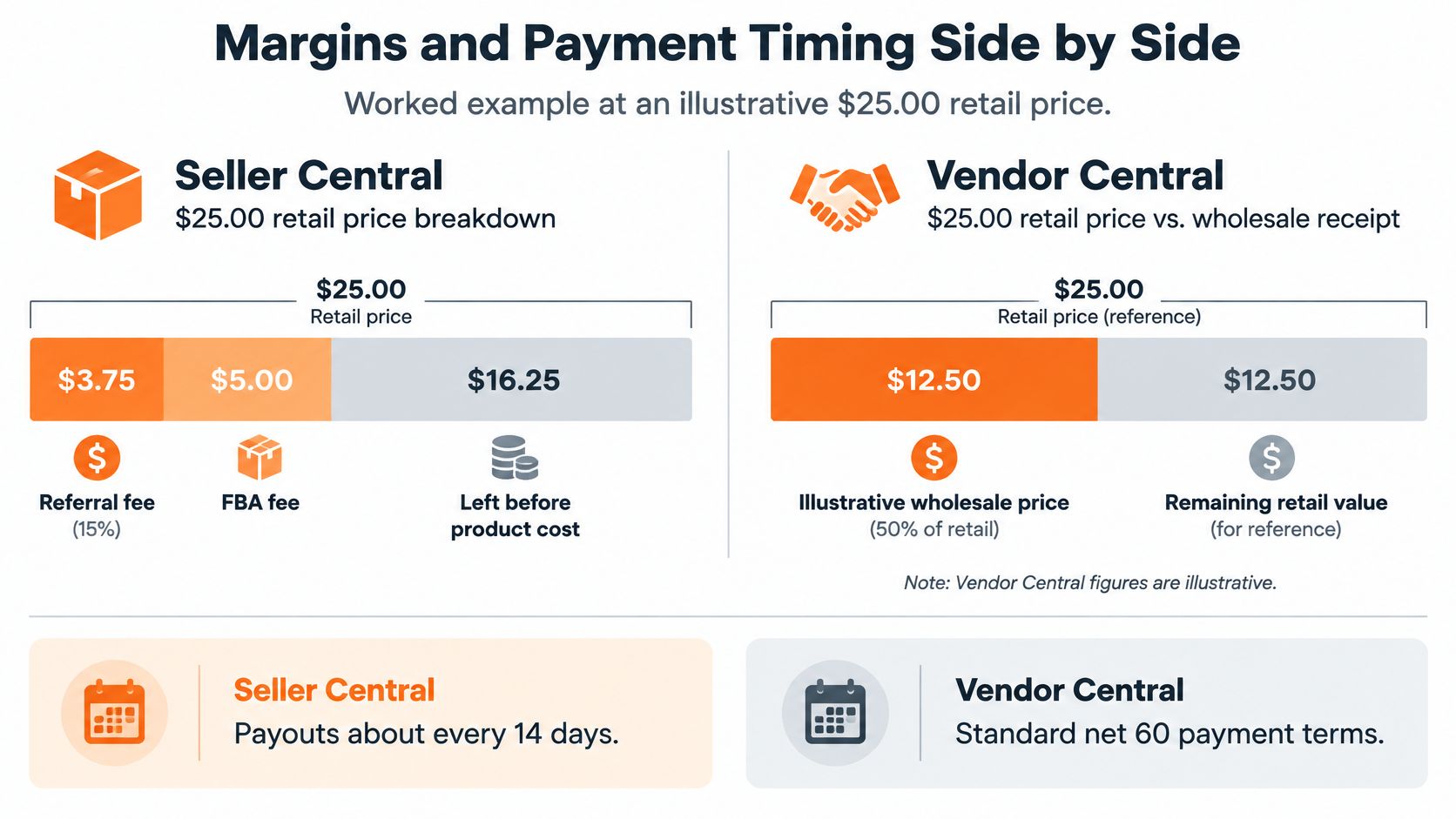
Use a hypothetical $25.00 retail price. For Seller Central, assume a 15% referral fee and a $5.00 FBA fee. For Vendor Central, assume Amazon pays half the retail reference price, then deducts co-op, freight, and damage allowances from that wholesale amount.
Worked example per unit on a $25.00 retail price
These figures illustrate the calculation, not an Amazon quote. Freight is rounded to the nearest cent.
| Line item | Seller Central | Vendor Central |
|---|---|---|
| Price basis | $25.00 retail revenue | $12.50 wholesale revenue, 50% of MSRP |
| Referral fee at 15% | −$3.75 | None |
| FBA fee, assumed | −$5.00 | None |
| Co-op at 6% | None | −$0.75 |
| Freight allowance at 3.5% | Included only in the assumed fulfillment figure | −$0.44 |
| Damage allowance at 4% | No separate allowance in this example | −$0.50 |
| Net per unit before product cost | $16.25 | $10.81 |
| Payment timing | About every two weeks | Contractual invoice terms, commonly 30, 60 or 90 days |
Neither figure is net profit. Subtract product cost and any costs excluded from this example, including advertising, storage, returns, overhead, and financing.
Cash test: Can you manufacture the next order before payment for the last one arrives?
Net margins differ by channel and depend on your contract terms and fee structure. The example shows why headline revenue or margin alone is a weak basis for choosing: the Seller calculation leaves more per unit before product cost, while Vendor payment timing can delay access to cash.
The following visual uses the same illustrative retail reference. Its Vendor timing card shows a payment-term example, not a universal contractual requirement.
Separate profit from available cash
Even if you accept the illustrated Vendor economics, a long invoice term may leave you waiting for payment while bills come due. You may need to pay your manufacturer, freight provider, and staff before the receivable becomes cash. A profitable invoice cannot cover those bills until it is paid.
A higher negotiated wholesale price does not necessarily solve the timing problem. Amazon may request allowances that absorb the increase, or the additional revenue may go toward financing inventory and receivables.
Replace the sample inputs with your actual SKU economics. Then compare the expected payment date with the next supplier deposit date. That cash gap shows whether the channel can support replenishment, not just whether the unit calculation looks profitable.
Who Controls Price, Listings and Customer Data
Start with what the shopper sees: a price, a product page, a delivery promise and a seller. Your channel determines which of those decisions you can change directly and which ones require Amazon's cooperation.
With Seller Central, you set your offer price, submit listing copy and images, choose promotions and manage your advertising. You also handle buyer messages and returns where your fulfillment arrangement assigns that work to you. FBA shifts much of the order-service workload to Amazon, but you still need to monitor the customer experience.
Control doesn't mean unrestricted ownership
You don't own an exclusive product page just because you sell on it. Other sellers can compete on the same listing, and Amazon applies catalog rules to content contributions. Likewise, order-level visibility doesn't give you an unrestricted customer list for outside marketing.
- Price decisions: You can change your Seller offer, but you still compete for the Buy Box and must protect your contribution margin.
- Listing decisions: You can submit improvements, but you shouldn't assume Amazon will accept every edit immediately.
- Customer information: Use the data and communication tools Amazon permits. Don't build your acquisition plan around exporting buyer identities.
With Vendor Central, Amazon becomes the retailer and generally controls the shelf price, promotions and consumer relationship. You supply product information and manage the account, but you can't treat the retail offer as your own checkout. You work from purchase orders and available sell-through reporting rather than a direct consumer order book.
A price decision in practice
In a hypothetical scenario, you list a product at $30 through Seller Central and a rival undercuts your offer. You can compare the lower price with your contribution floor, then decide whether to match, hold or pause advertising. You own that decision and its consequences.
Now assume Amazon retails the same product through Vendor Central and discounts it to $24. You don't control that shelf-price decision. If your agreement includes promotional funding, you may fund part of the activity through the terms you negotiated, although a retail discount doesn't automatically reduce your wholesale invoice.
If you use price to communicate premium positioning, count the cost of losing that decision before comparing fees.
I'd favor Seller Central when price discipline matters across specialty retailers, your own website and Amazon. You'll still face competitive pressure, but you retain the ability to choose your response.
Daily Workload and the Numbers You Track
On a typical Seller Central week, you start by checking whether profitable products have enough stock. You compare available inventory with sales pace, review inbound shipments and investigate listings that attract clicks without converting.
Then you check advertising. A campaign can show an attractive return on advertising spend while leaving little contribution after fulfillment and returns. Review ROAS alongside contribution margin, rather than letting the advertising console define profitability for you.
Your weekly operating rhythm
By midweek, you might revise bids, correct a listing, work through a return issue and adjust a replenishment shipment against FBA capacity. With FBM, you also need a reliable shipping queue and someone responsible for delivery exceptions. You're running a retailer, even when Amazon handles the physical parcel.
Your Vendor week starts elsewhere: review purchase orders, check available stock and confirm what you can supply. You coordinate shipping against receiving requirements, investigate shortages and reconcile what Amazon deducted from invoices.
The eBrands Vendor Central glossary distinguishes these operating priorities: Seller teams monitor contribution margin, conversion, advertising, inventory and FBA capacity, while Vendor teams track wholesale margin, purchase-order acceptance, fill rate, delivery compliance, deductions and payment-term impact.
KPIs to track in each channel
| Area | Seller Central KPIs | Vendor Central KPIs |
|---|---|---|
| Profit | Contribution margin per order | Wholesale gross margin |
| Demand | Conversion rate and share of voice | Sell-through and purchase-order forecast |
| Compliance | FBA capacity and inbound accuracy | Fill rate and on-time in-full, or OTIF |
| Money | Advertising ROAS and inventory turns | Deductions, accruals and payment-term impact |
| Risk | Buy Box share and pricing position | Shortages, chargebacks and reorder swings |
Give each metric an owner and an action. If conversion falls, someone should check price, traffic quality, availability and listing content. If deductions rise, someone should reconcile the claims against shipment records and contract terms.
A dashboard without that response process won't protect your cash.
Match the work to your team
Seller Central puts more frequent retail decisions on your desk. You can respond directly, but you need someone who understands how advertising, price, fulfillment and stock interact.
Vendor Central reduces individual-order fulfillment work while increasing the importance of wholesale administration. A warehouse that ships accurately can still lose money if nobody checks deductions or notices that purchase orders no longer match the production forecast.
Before choosing either channel, assign responsibility for retail execution, replenishment and cash reconciliation. Then ask who covers those tasks when your main operator takes time off.
Choose the KPI set you can staff. Don't accept a channel because its interface looks simpler or because Amazon handles the final delivery.
Eligibility Rules for Each Channel
You can register for Seller Central without waiting for Amazon to invite your brand. That makes it the practical entry route when you're still validating demand, preparing your catalog or learning how to fulfill orders consistently.
You still need to pass account verification and meet the requirements for your products. Open registration doesn't mean automatic approval for every category or listing.
Prepare your Seller Central registration
Gather the documents before you start, and use consistent legal names and addresses throughout the application.
- Identity and business details: Prepare the information Amazon requests for you and your business, with supporting verification documents.
- Tax information: Use the details that match your legal selling entity.
- Payment setup: Prepare a bank account for disbursements and a chargeable credit card.
- Selling plan: Compare the Individual plan's per-sale structure with the Professional plan's monthly subscription and tools.
- Product eligibility: Check category approvals and product restrictions before buying inventory.
Verify current plan prices and approval requirements inside Amazon's help pages during registration. Don't choose a plan purely on a commonly repeated sales-volume shortcut. Consider whether you need its tools and whether you can support the inventory you intend to list.
Keep your first catalog manageable. Getting an account open matters less than getting accurate listings, compliant products and a workable replenishment process in place.
Approach Vendor Central as a supplier relationship
You can't open Vendor Central through the same self-service route. Amazon must invite you, and you still need to evaluate the proposed commercial agreement before accepting.
Prepare for that conversation with evidence of demand, a clear wholesale price list and an honest view of your supply capacity. Know your production lead times, case configurations, freight responsibilities and limits on order changes. Don't promise volume just to secure an invitation.
If you already have an Amazon contact, ask whether a Vendor relationship makes sense for your assortment. A proven product with consistent sell-through gives you a more concrete discussion than an untested launch, but it doesn't guarantee an invitation.
For a new brand, I'd use Seller Central to establish operating discipline rather than build a plan around Amazon eventually approaching you. Treat a future Vendor invitation as an option to evaluate, not a milestone you must reach.
Which Business Should Choose Which Path
If you have little cash runway, I'd usually start with Seller Central. You can manage your offer and replenishment more directly instead of accepting a wholesale commitment that may require you to finance receivables through another production cycle.
That doesn't make Seller Central safe by default. You can still overbuy inventory, overspend on ads or sell at a loss. The advantage is your ability to change course before committing more stock.
Choose according to your constraint
- Limited runway: Favor Seller Central when a delayed payment could stop your next production run. Budget for inventory and settlement uncertainty rather than treating sales revenue as immediately spendable cash.
- Proven products and funded receivables: Consider Vendor Central when you understand demand, can fulfill reliably and have enough working capital to carry the agreement.
- High volume with a thin retail team: Vendor can fit when you'd rather manage wholesale supply than daily consumer-order operations. Keep someone accountable for compliance and reconciliation.
- Premium positioning: Favor Seller Central when you need to make your own pricing decisions and protect consistency across channels.
- A broad testing catalog: Use Seller Central when you need to test, pause or replace products without depending on a wholesale reorder.
- An established Vendor account: Consider a deliberate catalog split if selected products need direct retail control. Budget for the extra reporting and operational work.
Amazon's Seller Central overview describes the tools for managing a direct marketplace business. For an early-stage founder, the practical appeal is the ability to operate and adjust your retail offer rather than wait for a wholesale buying decision.
Don't confuse transferred stock with transferred risk
Vendor Central can shift inventory ownership to Amazon after receipt. You still carry risks around production, future orders, deductions and dependence on a large customer.
Suppose Amazon orders strongly, then reduces its next purchase. You may have already booked factory capacity or bought packaging against a more optimistic forecast. You need a plan for that stock even if Amazon paid correctly for the earlier shipment.
A wholesale customer can take ownership of your goods without taking responsibility for your next production run.
For Chicago and Midwestern founders using savings to launch, that distinction deserves attention before the prestige of an invitation. Ask how you would fund payroll, supplier deposits and freight if Amazon reordered later than expected or paid less than the invoice face value after deductions.
The deciding question is whether you can survive the payment, pricing and replenishment rules. Choose the relationship that fits your balance sheet and operating capacity, rather than the one that makes your revenue forecast look larger.
Run the Channel Math Before You Apply
Open a spreadsheet and use the worked-example rows as a template. Start with your most important products rather than averaging the entire catalog, since bulky items, return-prone products and compact repeat sellers can produce very different results.
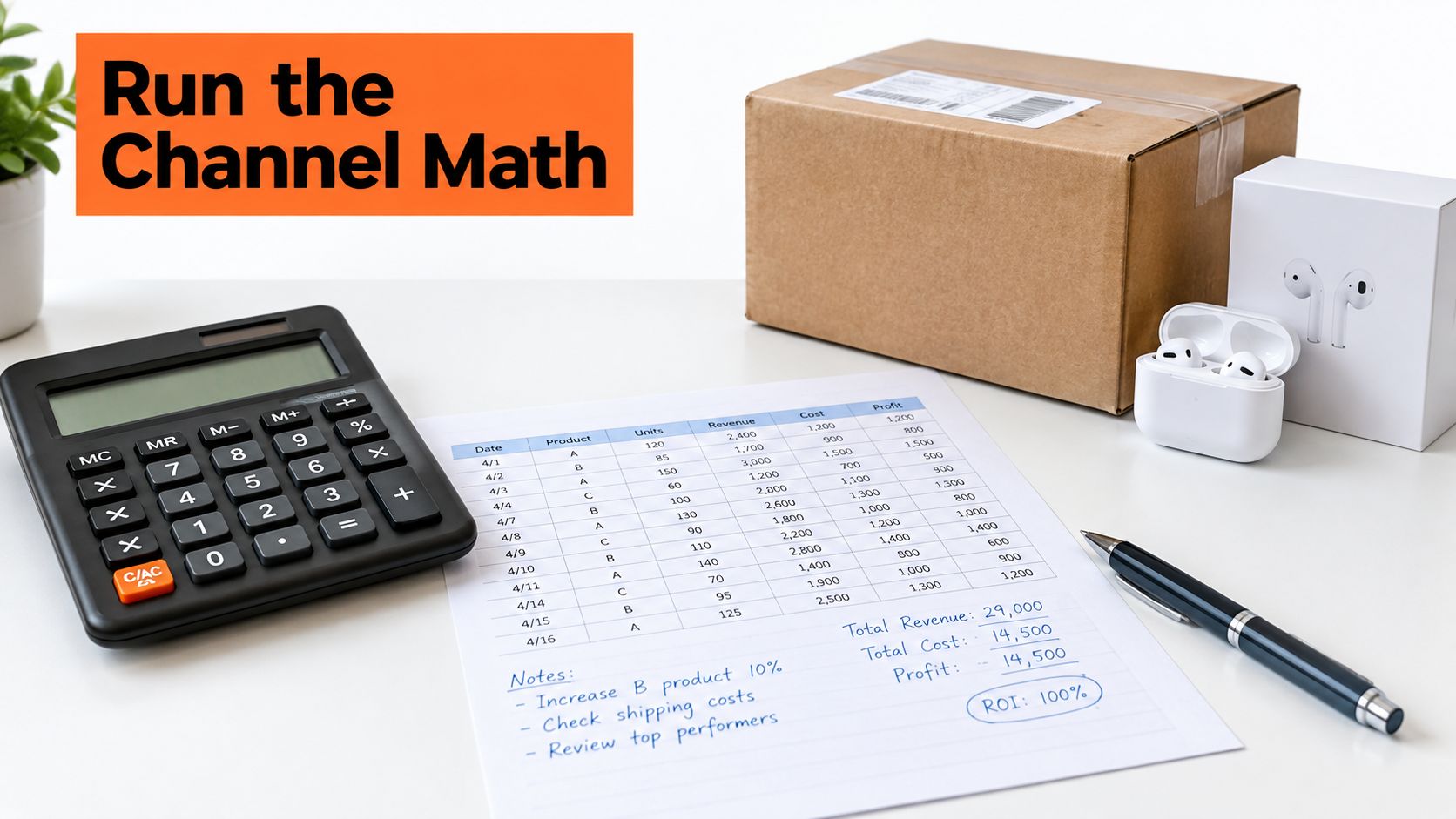
- Calculate net contribution. Enter your actual selling or wholesale price, then subtract channel expenses and landed product cost. Use separate lines for allowances so you can see what you've agreed to fund.
- Model the cash gap. Multiply payment delay in months by monthly unit volume and unit cost as a starting estimate of receivables funding. Add supplier deposits, production lead time, freight and inventory buffers separately.
- Test price response. Try controlled changes on selected Seller SKUs before committing stock to wholesale. Compare contribution and conversion while keeping advertising and availability reasonably stable.
- Get Vendor terms in writing. Confirm allowance bases, deduction policies, freight responsibilities, payment terms and dispute procedures. Don't substitute a verbal explanation for the agreement.
- Stress-test replenishment. Delay an expected payment, reduce the next purchase order and add a disputed deduction in your forecast. Check whether you can still fund committed supplier payments.
Choose Vendor Central only if its contribution after deductions and financing justifies the lost control and your cash runway holds under the stress test.
If the outcomes look close, I'd start with Seller Central. You can adjust a retail offer more readily than unwind a wholesale commitment, although you still need to manage stock carefully.
Chicago Brandstarters is a free, vetted community where Chicago and Midwestern founders share practical tactics, honest setbacks and confidential support through small dinners and an active group chat. If you're weighing Amazon channels while protecting a limited launch budget, visit Chicago Brandstarters to connect with fellow builders and bring your channel math into a candid founder conversation.
Leave a Reply