You've got a product idea, a supplier asking about quantities, and friends who keep saying they'd buy one. You're close to spending real money, but you still don't know whether anyone will pay your planned price.
Learning how to pre sell a product starts with separating encouragement from orders. Before you commit to inventory, put a specific offer in front of a specific buyer, collect a meaningful commitment, and decide in advance what would make you stop.
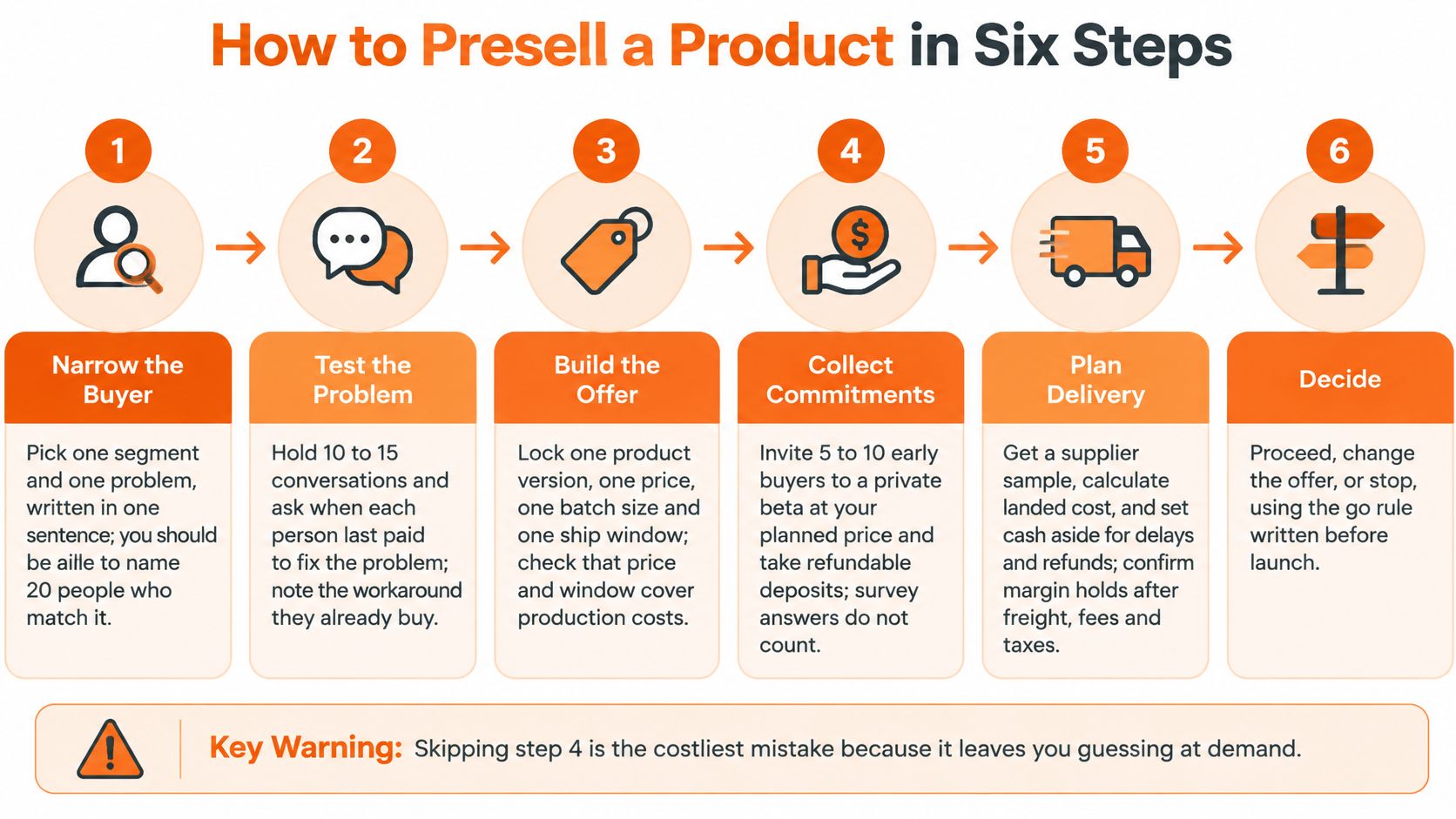
How to Pre Sell a Product in Six Steps
Treat your presale as a market test with a stop rule. Write down the minimum demand, workable economics, and delivery conditions you need before you accept money. A checkout page alone won't answer those questions.
Use this sequence to keep customer discovery, payment collection, and production decisions separate.
Start with the buyer and the problem
1. Narrow the buyer. Pick one segment and one problem, then put both in a sentence. For a practical exercise, try naming 20 people who match your description. If you can only name broad categories like busy professionals, narrow further.
Say you're developing a travel mug. Independent sales reps who drive between appointments give you a more useful starting point than everyone who drinks coffee.
2. Test the problem. Start with 10 to 15 conversations as a working interview target. Ask when each person last paid to fix the problem, what they bought, and what still annoys them. Write down the workaround they already buy, rather than your interpretation of their enthusiasm.
3. Build the offer. Lock one product version, one price, one batch size, and one ship window. Use our guide to pricing a new product to check your economics before you choose a tempting introductory discount.
Ask for money, then verify delivery
4. Collect commitments. For an initial private beta, invite 5 to 10 prospective buyers to place refundable deposits at your planned price. Explain the remaining balance and cancellation terms before payment. Survey answers don't count as commitments.
I'd treat skipping this step as the costliest mistake: you can negotiate packaging and polish a website while still guessing whether anyone will buy.
5. Plan delivery. Get a supplier sample, calculate landed cost, and reserve cash for delays and refunds. Include tooling, packaging, freight, payment fees, taxes, replacements, and customer support. Check when each bill comes due, because a profitable order can still leave you short of cash.
A peer-reviewed analysis of Indiegogo technology and innovation campaigns found that, after statistical matching, preorder products already in production or shipping achieved higher success rates, funding ratios, and backer counts than comparable concept or prototype campaigns. Show buyers credible product readiness, and don't confuse a persuasive demonstration with a finished production process.
6. Decide. Proceed, change the offer, or stop according to the rule you wrote before launch. Don't lower your threshold because you've grown attached to the product.
Presale phases, questions and go signals
Use these working targets to identify the decision you need to make today.
| Phase | Question It Answers | Output You Need | Go Signal |
|---|---|---|---|
| 1. Narrow the buyer | Who has this problem right now? | One-sentence buyer profile | You can name 20 people who match it |
| 2. Test the problem | Do they pay to solve it today? | Notes from 10 to 15 conversations | Buyers describe a workaround they already pay for |
| 3. Build the offer | What exactly do they get, and when? | One product version, price, batch size and ship window | Price and window fit production costs |
| 4. Collect commitments | Will they pay before launch? | Deposits or refundable reservations | Paid orders reach the minimum batch |
| 5. Plan delivery | Can you ship what you sell? | Supplier sample, landed cost and cash reserve | Margin holds after freight, fees and refunds |
| 6. Decide | Build, change or stop? | Written go or no-go note | Decision matches the rule you set in advance |
Practical rule: Count deposits as evidence of demand, but calculate separately whether the cash collected can cover the bills you must pay before collecting balances.
Telling Real Buyers from Polite Interest
| Signal | What It Tells You | Strength | What to Do With It |
|---|---|---|---|
| Likes, follows or comments | People noticed the idea | Weak | Ignore for the batch decision |
| Survey answers or verbal interest | People say they might want it | Weak | Use to refine the offer |
| Waitlist sign-up with email | People want updates | Moderate | Follow up with a direct price question |
| Refundable deposit with exit option | Buyer commits money and keeps a way out | Strong | Count toward the minimum batch |
| Full-price paid pre-order | Buyer accepts the price and delivery window | Strongest | Count toward the batch and plan delivery |
Likes require almost no effort, while survey answers let people express preferences without consequences. An email sign-up gives you permission to follow up, but it doesn't establish willingness to pay. Deposits involve money; full-price orders test acceptance of the whole transaction.
Count the paid rungs toward your batch, subject to cancellations and balance collection. Use the unpaid rungs to improve your message and identify objections.
A 2019 Management Science study describes reward-based crowdfunding as a way to update demand expectations before investing at scale. You gain room to proceed, redesign, or walk away before inventory locks you into a decision.
Read mixed results without bargaining with yourself
Set your interpretation rules before launch. Proceed when commitments support your minimum batch and acquisition costs; revise when people register but won't pay; refund when your delivery assumptions fail.
Friends and local contacts may want to support you without wanting your product. Use customer discovery interviews to understand their current behavior, then ask for an actual purchase decision. For help designing an explicit demand experiment, consult the Polish demand validation playbook before choosing what action to measure.
Track these measures separately:
- Visitor-to-email rate: Does the proposition earn further attention?
- Email-to-deposit rate: Will interested people put money down?
- Cost per deposit: Can you afford to recruit these buyers?
- Deposit-to-paid-order rate: Will reservation holders complete payment?
For example, suppose 400 visitors generate 40 emails and 4 deposits. Your hypothetical visitor-to-deposit rate is 1 percent. Split those results by traffic source and buyer type, because purchases from close friends and purchases from unfamiliar qualified buyers answer different questions.
A buyer's experience begins when you accept their money.

A test that rules out a price, segment, or positioning before you buy inventory has done its job.
Shipping Promises, Refunds and Terms
| Situation | What the Rule Requires | What You Do |
|---|---|---|
| You gave a ship date with a reasonable basis | Ship by that date | Ship on time or notify the buyer early |
| You gave no ship date | Generally ship within 30 days of the order, under the FTC merchandise rule | Set a date you can meet |
| Production slips past the promised date | Notify the buyer and offer a choice of new date or full refund | Get consent to the new date or refund the unshipped product |
| You cannot ship at all | Cancel and refund promptly, within seven working days for several payment methods under the FTC business guide | Return money to the original payment method, not store credit or a gift card |
If you sell merchandise into the United States, build your process around these requirements. A ship date is a promise, and you need a reasonable basis for making it. Use supplier confirmation, a tested sample, and a realistic production schedule rather than your preferred launch date.
Distinguish shipping from arrival. Tell buyers when you expect to hand orders to the carrier, and explain transit assumptions separately. Don't disguise an uncertain manufacturing schedule with precise-looking delivery language.
Plan your calendar and customer notices together.

Write the delay process before launch
Assign responsibility before anyone needs a refund. You don't want a supplier delay to become an argument about who should email customers.
- Name the sender. Assign one person to monitor production milestones and contact buyers.
- Prepare the message. Explain the delay, the revised schedule, the cancellation option, and how buyers can respond.
- Set the notice deadline. Work backward from the promised ship date. Schedule notice before that deadline when you know you can't ship, rather than giving yourself a grace period afterward.
- Test the refund path. Check your payment processor's procedure and return the required money through the original payment method.
Keep records of notices, customer responses, and refunds. Don't interpret every silent customer as agreeing to an indefinite delay; have a lawyer review the consent process for your circumstances.
Put the uncomfortable terms in writing
Your terms should identify refund conditions, shipping regions, duties, and tax treatment. State whether buyers pay import charges, which destinations you support, and whether checkout includes applicable taxes.
Keep enough cash available to honor cancellations. Spending every deposit on tooling leaves you exposed if the supplier changes specifications or misses a production slot.
Check the rules in your own country and any market you sell into, and have a lawyer review your terms. A clear refund policy helps customers understand the deal; it doesn't replace their legal rights.
Write Outreach Messages and a Presale Page
Start with a direct message. For a hypothetical limited launch, use:
I am building a [product] for [segment] who [problem]. I am taking 10 early orders at [price], shipping [window], with a full refund if I miss that window. Would you order one?
The segment filters the reader, the price tests the purchase, the limited quantity creates urgency, and the refund promise reduces fear of loss. Only use that refund promise if you're prepared to honor it.
For someone who went quiet, send:
You mentioned [problem] when we spoke. Are you still looking for a solution? The presale is open at [price], with shipping planned for [window]. If it's no longer relevant, tell me and I'll close the loop.
This message gives the person a clean way to decline instead of forcing another polite reply.
Ask about the obstacle
For someone who says they'll think about it, try:
What's holding you back: the price, the shipping window, or uncertainty about whether it solves [problem]? A direct answer will help me decide what to change. There's no pressure to order.
Don't answer every objection with a discount. If someone needs the product immediately, cheaper pricing won't fix your production lead time.
Use a simple form to record buyer type, objection, source, and next action. If you want to organize that intake without custom development, consider Kiwiform's no-code data collection workflows and keep payment handling in your checkout system.
Use the video alongside your own written launch checklist.
Make the page answer purchase questions
Build the page around the transaction, using our landing page best practices to keep the path to purchase clear.
- Product and proof: Show one version, measurable specifications, and a photo or short video of actual use.
- Development status: Separate what you've finished from what you still need to solve.
- Purchase terms: State the price, batch limit, ship window, and refund policy near checkout.
- Progress updates: Explain when and where you'll report production milestones.
Kickstarter's platform explanation describes projects with a defined goal that create something new to share. Bring that same specificity to a direct presale, and don't accept orders beyond your ability to fulfill them.
Before paying, buyers need clear answers: When will it arrive? What happens if it's late?
Decide to Build, Change or Stop
Set your go rule before the first deposit arrives: proceed only when paid demand covers your minimum batch and your calculated margin after freight, fees, taxes, and refunds. Keep demand validation separate from the cash you need to fund production.
For a hypothetical example, say your minimum batch is 50 units, and you calculate $40 per unit in margin after a 5 percent refund reserve. You need 50 paid orders, rather than likes, before ordering production under that rule. Those assumptions belong to this example, not to every product.
Inspect the physical product before you authorize the batch.

Choose the outcome your evidence supports
Build when paid demand clears your batch and margin requirements. Confirm the supplier's production slot, approve the sample in writing, and retain a cash reserve rather than spending every available dollar.
Change when qualified people register but don't pay. Pick one variable, price, segment, or product promise, and give the next test a fixed deadline. For example, you could test revised positioning for two weeks, then make another decision without extending the campaign indefinitely.
Stop when demand falls short or you can't deliver responsibly. Refund buyers promptly and explain the decision without asking them to absorb your disappointment.
Refund message: We didn't reach the production threshold, so we won't manufacture this batch. I've issued your full refund. Thank you for trusting the idea; if you'd like future updates, you can choose to stay on the list.
Use that message only after you've issued the refund. Ask permission before carrying buyers into another launch, and don't turn their refund into store credit for your next experiment.
Run the final production check
Before you release production money, verify:
- Paid orders: You have enough committed purchases to cover the batch.
- Complete economics: Your margin holds after every cost.
- Approved sample: Your supplier sample passes inspection.
- Delivery buffer: Your schedule allows for foreseeable setbacks.
- Tested refunds: You've written and checked the cancellation process.
Take your signal table, cost sheet, and decision rule to a peer group before you commit. Ask someone to challenge the assumption you most want to believe, especially whether your buyers will complete payment and whether your supplier can meet the promise.
At Chicago Brandstarters, we give kind, bold, hard-working Chicagoans and Midwesterners a community for honest founder conversations and practical peer support. You can apply at the idea stage, even without a prototype, so bring your presale assumptions before you commit inventory money. Visit Chicago Brandstarters to apply and pressure-test your next decision with fellow builders.
Leave a Reply