834 venture-backed companies made up half of every U.S. public company founded between 1979 and 2014 that reached a $1 billion market value, and those 834 held 77% of the group's total market capitalization, per a Kauffman Foundation study cited in the NVCA yearbook. Venture capital isn't a rounding error in the American economy. It's a concentrated bet on a tiny set of companies, and the headline returns hide how few get in.
So I don't read bootstrapping vs venture capital as a personality type or a one-time vote. I read it as a sequence with a price on each step. Speed costs equity. Leanness costs your unpaid hours and your savings. Your job is to know which bill you're paying, and whether a measurable trigger has fired that makes the trade worth it.
Bootstrapping vs Venture Capital at a Glance
| Factor | Bootstrapping | Venture Capital |
|---|---|---|
| Source of money | Founder savings, customer revenue, reinvested profit | Outside equity from venture funds |
| Ownership | You keep the company unless you sell equity later | You give up equity, board seats and approval rights |
| Growth pace | Set by cash flow | Set by investor milestones and growth targets |
| Timeline to $1 million ARR | Over three years at median, about two years at top quartile | Under three years at median |
| Exit pressure | None, you choose sale, steady income or continued operation | Pressure toward a large exit that returns the fund |
| Founder financial risk | Personal money and unpaid labor at risk | Investor capital at risk, with preference terms shaping payouts |
Every row is a price. Bootstrapping trades speed for control: you grow at the pace your bank account and your customers allow, and nobody outvotes you on pricing, product or hiring. Venture capital trades control for speed: cash lands early, and a board, a growth target and a preference stack arrive with it.
Think about dinner. Bootstrapping is cooking from your pantry. You use what's there, you pay as you go, and you pick the menu at 6 p.m. Venture capital is hiring a catering team that brings the ingredients, the equipment and a chef with opinions, because they've promised 200 covers and the room has to fill.
The one question that decides it: does faster growth in your market pay back more than the ownership and freedom you hand over to get it?
Notice the phrase "in your market." A taqueria on a block with forty competitors faces a different answer than a founder building scheduling software for dental labs. One is a race. The other is a garden. Where customers switch slowly and distribution is cheap, extra capital buys very little. Where the winner takes the whole category and the category gets decided in eighteen months, patience is the expensive choice.
Neither path is permanent. Founders who do well switch on evidence, not on mood. A bootstrapped company can raise later at a better price once the risk is gone. A funded company can tighten its belt and run to profit. What matters is that the switch has a trigger you wrote down before you needed it.
Who Venture Capital Is Built For
In 2018, more than 8,380 U.S. venture-backed companies received a combined $131 billion, above the roughly $100 billion invested at the height of the dot-com boom in 2000, according to the NVCA's 2018 yearbook release. That same release shows how narrow the door is. Only 2,040 companies took first-time institutional funding that year, though those newcomers raised a record $10.1 billion. Money flows to the companies already inside the club.
The fund math that decides who gets a check
A venture fund doesn't need every company to work. It needs one or two to return the entire fund, so partners hunt for businesses that can plausibly reach a scale most companies never touch. That filter is structural. Your churn rate and your charm matter far less than whether the market can produce an outlier.
The Kauffman Firm Survey shows how little the average company depends on that world. About 92% of surveyed firms survived through 2005, about 84% made it through 2006, and the four-year survival rate had fallen to 68% by 2008. Outside equity, including venture capital and government funding, was rarely used. The survey mixes industries, ages and economic conditions, so it doesn't prove that bootstrapping causes survival. It does prove outside money was never the default.
Here's the test I hand founders. Could this market produce a company big enough to return a fund? If yes, venture money is on the table and the argument is about timing. If no, you're shopping for a tool nobody stocks in your aisle, and bootstrapping fits better.
That test depends on where you stand. Local access matters, so map the venture capital scene in Chicago before you assume a round is waiting for you.
If you do raise, treat the news as marketing, not paperwork. A well-built funding round announcement brings customers and job candidates, not just applause from people who already like you.
Growth Speed and Revenue Milestones
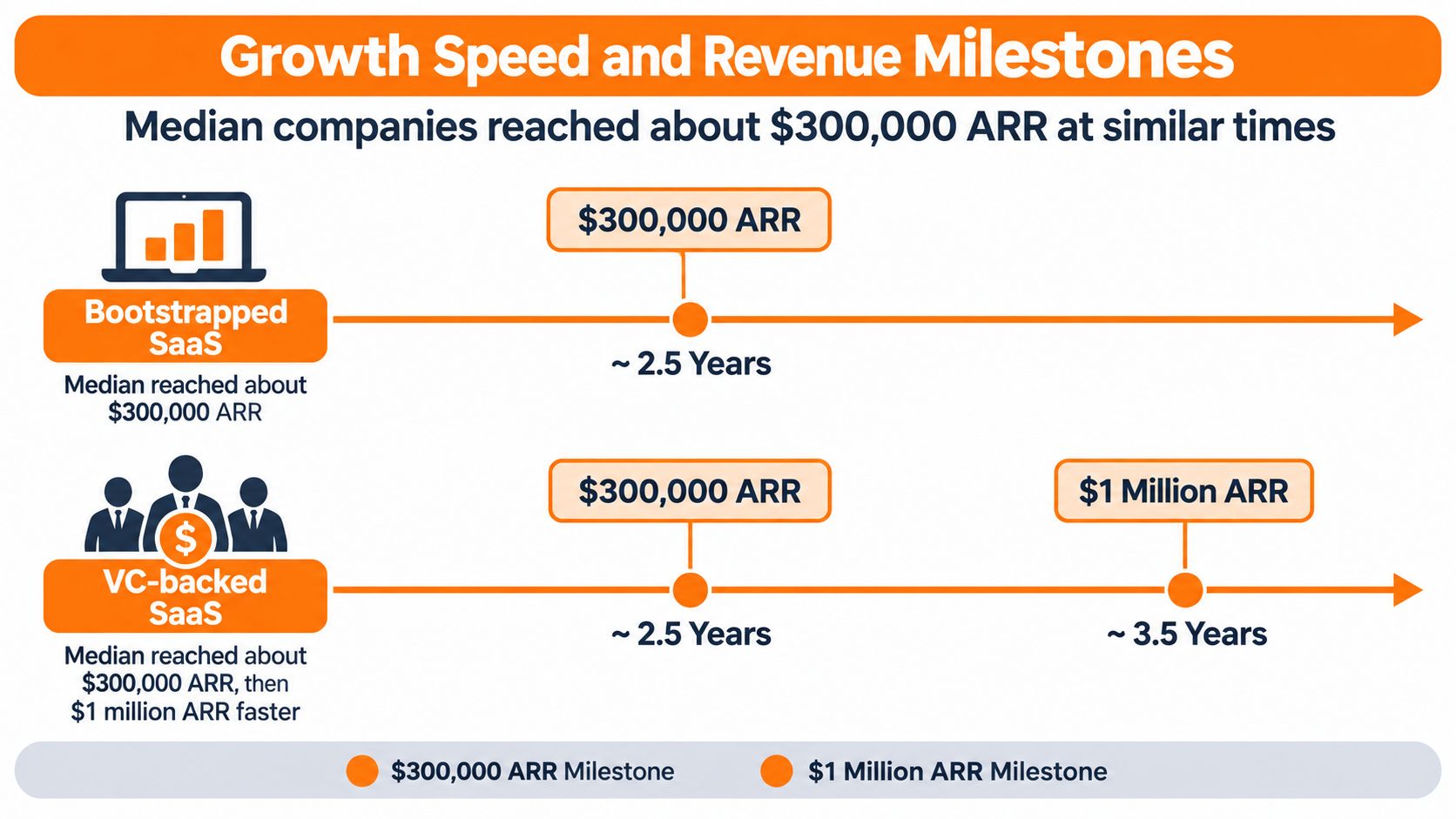
ChartMogul's 2024 SaaS growth benchmark tells the honest version of the speed story. Median bootstrapped and venture-backed companies reached about $300,000 in ARR at similar times. After that, the curves split: VC-backed companies reached $1 million ARR in under three years, while bootstrapped companies needed more than three.
Then comes the number that gets skipped. At the top quartile, bootstrapped firms hit $1 million in roughly two years, only four months behind their funded peers.
Read those two sentences together and the story changes. Capital buys speed in the middle of the distribution and almost nothing at the top, because the best bootstrapped operators aren't slow. They're just unfunded.
The reason is sequencing. Outside money helps most after you have product-market evidence, when hiring, paid acquisition or inventory can compress the distance between traction and scale. Before that point, cash mostly buys the right to keep doing something that isn't working, and bootstrapping keeps product, pricing and segment decisions inside the room.
Running the numbers on your own gap
Use one formula. Months to target = (target ARR minus current ARR) divided by net new ARR per month.
Say you're at $300,000 ARR with $700,000 to go. Organic signups add $25,000 of net new ARR a month, so you reach $1 million in 28 months. Your cash runway is 16 months. You never arrive.
Now run it with two funded sales hires and a paid channel, lifting net new ARR to $55,000 a month. You arrive in about 13 months. Those hires and ads cost roughly $30,000 a month, which is $390,000 across those 13 months, and the round has to cover it. Thirteen months against twenty-eight is what you're buying.
Flip the inputs and the answer flips. If organic growth already adds $45,000 a month, you hit $1 million in about 16 months inside your own runway, and a round buys you seven months for a slice of the company and a board seat. That's a bad trade.
Four numbers decide this before you talk to any investor:
- Months to validated demand: how long until repeat, paid usage shows up without you pushing each sale personally.
- Gross-margin payback per growth dollar: months of contribution margin needed to earn back each dollar you spend on acquisition or capacity.
- Cash runway: months of cash at your real burn, not the burn in your plan.
- The divergence level: the revenue point where funded and unfunded growth rates separate in your model, which for SaaS sits where the two curves above peel apart.
Write your target ARR and the date you need it by. If you're still pre-product, start with our resources for early-stage companies and hold the financing question until demand is measurable.
Control, Equity and What Founders Give Up
Most founders can explain dilution. Almost none can explain the waterfall, and the waterfall is where the money lands.
The NVCA model term sheet lays out the two structures you'll see. With non-participating preferred, the investor takes a preference, often 1× the original purchase price, or converts to common stock when that pays more. With fully participating preferred, the investor takes the preference first and then shares pro rata in what's left alongside common shareholders. One structure leaves your equity worth something on a modest sale. The other shrinks it more than you'd guess.
The same $5 million sale, two payouts
Say an investor puts in $1 million for 20% of the company with a 1× preference, and you sell for $5 million.
Under non-participating preferred, the investor takes the greater of $1 million or 20% of $5 million. Both come to $1 million, so founders and the team split $4 million.
Under participating preferred, the investor takes $1 million, then 20% of the remaining $4 million, which is $800,000. That's $1.8 million total, and founders split $3.2 million. Same company, same sale price, $800,000 less for you.
Bootstrapping skips that waterfall because no outside investor holds equity. The cost shifts onto you: savings spent, salary deferred, slower hiring, and sometimes a personal guarantee on a loan.
The Federal Reserve's 2024 report on startup firms found that startup firms were more likely than older firms to have received funds from their owners. Owner money creates no investor ownership percentage. It does expose you to the loss if the business fails.
The trade isn't automatic in either direction. A 2025 comparison of the two paths reported that bootstrapped companies generally produce smaller exits but retain more of the proceeds, while venture-backed companies get scale along with dilution and investor-set milestones.
Price your own labor: a clean cap table that hides three years of unpaid work and a drained savings account isn't ownership. It's a loan you made to your company at 100% of your time.
Three terms to read before you sign anything: the preference type (participating or not, and the multiple), the board seats and who appoints them, and the option pool size, since the pool usually gets carved out of your side of the table.
Margins, Burn and Financial Models Compared
The margin evidence surprises people. A Capchase analysis of about 500 private SaaS companies, roughly 66% VC-backed and 34% bootstrapped across the U.S. and Europe, found growth was broadly similar while bootstrapped companies had significantly better margins, as reported in TechCrunch's coverage of efficient growth. Wharton's Mack Institute summarized research pointing the same way: high-growth, tech-driven startups that bootstrapped outperformed VC-backed firms on both profitability and growth, and the work also examined how bootstrapping changes experimentation.
Treat that as direction, not proof. These comparisons mix business types and self-selected founders. Nobody assigned those companies to a funding path at random, and the founder who chooses to stay small is often the founder with the margins to do it.
| Metric | Bootstrapping target | VC-funded target |
|---|---|---|
| Gross margin | High enough to fund the next growth step from cash | High enough to support a scale plan investors will fund |
| Customer acquisition payback | Recovered from cash flow, ideally within a few months | Can run longer if investor capital covers the gap |
| Monthly operating burn | Near or below revenue | Set by the funded runway and the next round date |
| Net revenue retention | Above 100 percent, so existing customers grow spend | Above 100 percent, with proof for investors |
| Cash break-even | The month revenue covers all costs | Often pushed later by the spending plan |
The benchmark that survives all the selection bias is simple. Each financing dollar should produce incremental gross profit faster than it adds fixed burn and dilution. If it doesn't, the money is buying activity, not value.
Bootstrapping suits iterative testing for a reason that has nothing to do with virtue. You fund experiments from customer revenue, and you can kill one on a Tuesday without explaining to a board why the story changed. Funded companies carry a narrative, and narratives get defended long after the evidence turns.
Build two 24-month models, one bootstrapped and one funded, and compare cash position, ownership and break-even month side by side. Neither model works until your burn number is real, so learn to calculate monthly burn rate from bank and card statements rather than from your budget. Then pressure-test the plan with our guide to financial planning for startups.
Matching Each Path to Your Business Case
A funding path should have a starting point and a measurable switch trigger. The trigger depends on what is constraining the business, not on whether raising money feels like progress.
| Business case | Starting path | Trigger to switch |
|---|---|---|
| Ecommerce brand with repeat buyers | Bootstrap with reinvested profit | Inventory orders outpace available cash for two cycles |
| Hardware product needing tooling | Pre-orders or grants first | Tooling costs exceed revenue across two production runs |
| SaaS tool with organic signups | Bootstrap until paid acquisition pays back | Paid-channel payback is proven, and demand exceeds hiring capacity |
| Side hustle alongside a day job | Bootstrap with strict runway limits | Revenue covers living costs for six months |
| Marketplace where a rival may raise first | Consider a targeted VC round if traction is proven | Competitor funding threatens the market window |

Each case ties financing to a constraint. Start with the path your cash flow allows, then reconsider when a specific bottleneck limits growth. Include the cost of founder labor and personal financial risk in the bootstrap model, alongside any owner-funded capital. Free tools can keep early cash costs down; this lean startup tool stack covers software options for bootstrapping startups.
Raise on a trigger, not on a hunch
A staged approach preserves options: validate demand with savings and early revenue, then consider angels, revenue-based finance, or grants if they fit the funding gap. Venture capital becomes a stronger candidate when numbers show that a constraint such as inventory, hiring, or customer acquisition is limiting growth.
Market-wide funding figures are poor proxies for an individual founder's odds. CB Insights' 2025 venture report reported global venture funding of $469 billion in 2025, up 47% year over year. Deal count fell 17% to 29,501, while mega-rounds accounted for 65% of funding. Those totals show capital concentrating in fewer deals, not that a typical Midwest founder will find it easier to raise.
A useful default is to bootstrap until a measured constraint makes outside capital valuable. Then write down the decision in four steps:
- Set a trigger metric and target. Choose one measurable threshold that indicates when financing could remove the bottleneck.
- Set runway and a deadline. If the target date falls beyond available runway, revise the plan or funding source.
- Match the source to the constraint. Pre-orders or grants may fit tooling; revenue-based finance may fit inventory; venture capital may fit a time-sensitive market opportunity.
- Review the decision every 90 days. Reassess the metric, cash position, ownership cost, and founder risk.
A competitor's ability to buy distribution can justify raising earlier, before all the proof is in. Treat that as an explicit exception, not a standing reason to raise.
Write down the trigger, runway, and review date. A clear threshold turns the financing choice into a decision that can be revisited against actual results.
Chicago Brandstarters is a free community for Chicagoans and Midwesterners building brands, from the idea stage to seven figures. Members can join the group chat and small private dinners, where founders share experiences and support. People can apply to join; membership costs $0.
Chicago Brandstarters' group chat and small private dinners offer places to connect with other founders while building a brand. Members who reach $75k in revenue are encouraged to apply to the Goldman Sachs 10ksb program. If the community sounds useful, apply to join Chicago Brandstarters.
Leave a Reply