

You're sitting with three tabs open. One is a bestseller list. One is a supplier catalog. One is a cart of samples you haven't ordered, because the last box you did order came back scuffed and unsold.
I get the freeze. A clean product photo is not a business. I would rather you spend a week proving one buyer has a painful job, and that the margin survives shipping and returns, than spend a month on stock you can't move.
How to find ecommerce niche ideas is a filter, not a trend list. You start where buyers already complain. You shrink a category until one person owns the problem. You score returns, shipping, and trust before you fall for a ranking. Then you run the math on one order. If the math breaks, you stop.
Find Niche Candidates From Real Buyer Sources
Start where buyers already search, compare, and complain. A trending-product roundup is a costume party. The people with the problem are already talking.
Open one marketplace, Amazon or Etsy, whichever matches the price you can fulfill. Sort a parent category by bestsellers, then drop into the small subcategories. Write down the ones with steady sales and only a handful of sellers. Twenty names is enough. Skip anything that only jumped for a holiday week.
Then read the problem side. Search Reddit, Facebook groups, and hobby forums for "can't find," "doesn't fit," and "broke again." Copy the buyer's words. Open the review tabs on two or three nearby products. Three-star reviews often name the missing feature, because the buyer wanted the item and still felt shortchanged.
Your own repeated frustration can be one lead. It is not proof. A friend who nods is not proof either.
Supplier catalogs and trade-show floors show products that already exist and still have no clear online story. If a booth demo needs a person standing there to explain it, that gap might be your product page.
If you sell on Shopify and want a second pass on ads people already run, the niche discovery for Shopify stores guide from AdLibrarySpy shows how to read winning creatives without treating them as a shopping list.
Work in this order:
- Pull 20 subcategories from marketplace rankings with steady sales and few sellers.
- Collect 30 complaint quotes from forums and reviews, in the buyer's words.
- Group the quotes into five to ten problems.
- Keep a problem only when it shows up in at least three separate sources.
- Send each survivor through the category-to-niche formula in the next part.
Five to ten candidates is plenty to start scoring. Put the source next to each one in a sheet so you can check it later.
Turn a Broad Category Into a Niche You Can Test
"Fitness accessories" sounds specific until you try to write an ad. Nobody wakes up and buys a category. A person in a third-floor walk-up wants a quiet setup that fits in a closet.
Pet products has the same hole. On paper it is a market. No single buyer owns it.
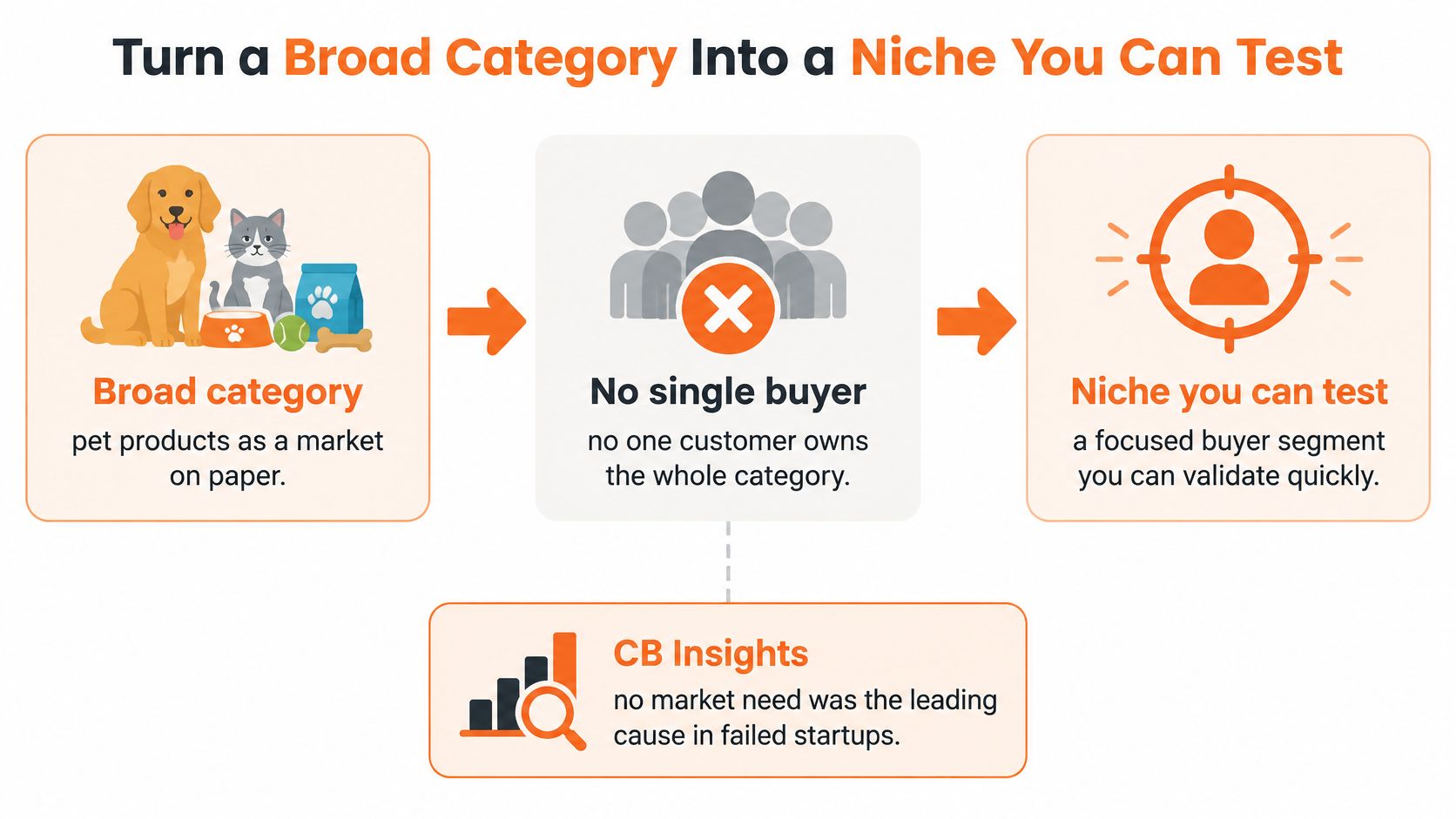
In the CB Insights post-mortem analysis of failed startups, "no market need" was the cited reason in 42% of cases. A niche built on a category name builds for a crowd that never shows up. Start with one person's problem.
Rewrite it in four parts
I use customer identity, urgent job, constrained context, and differentiated promise. Each rewrite should lose vague buyers and gain a sentence you can test. The constrained context is where returns and shipping hide, so put fit uncertainty, storage limits, and delivery expectations in the sentence itself rather than discovering them after the first hundred orders.
Fitness accessories becomes apartment-based strength trainees who need quiet, storage-efficient equipment for early workouts without waking a roommate.
Water bottles becomes office workers on a no-desk-bottle floor who need a leakproof bottle that fits a shallow drawer and survives a commute.
Dog treats becomes owners of senior small dogs who need a soft chew for stiff joints, sold in a small bag so it doesn't go stale in a week.
Notice each version already filters for return risk. The apartment buyer rejects heavy, damage-prone gear. The dog owner expects freshness on every reorder. Constraints like these keep buyers trusting you and keep margin intact before you commit to stock.
If you fail three questions, the idea is still a category.
- Name the buyer without saying "anyone."
- Describe the problem in words you copied from a review or a thread.
- Say where that buyer shops, a subreddit, a marketplace subcategory, or a local club.
A no on any line means you rewrite before you email a supplier. For a tighter pass on naming the buyer, use our notes on how to define a target audience.
Write the niche in one sentence. Read it to five people who fit the buyer. If they ask what you mean, narrow it again.
Score Each Niche on Six Criteria Before You Dig Deeper
Rate each row from 1 to 3. I count repeat buying and margin room twice. Those two decide whether the niche pays you.
| Criterion | Strong sign | Red flag | Quick check |
|---|---|---|---|
| Repeat buying | Buyers reorder or replace parts within a year | One-time purchase only | Look for repeat-buyer mentions in comparable product reviews |
| Clear problem | Buyers describe a specific pain in their own words | Interest comes from likes and friends | Interview five buyers and code their complaints |
| Competitor spending | Paying customers already buy imperfect alternatives | No seller has reviews or sales rank | Count sellers with recent reviews in the subcategory |
| Return risk | Low size uncertainty and low damage risk | Fit problems, fragile items, and low resale value | Scan 1-star and 2-star reviews for fit and breakage |
| Shipping and restocking | Compact, light, and easy to restock | Bulky, heavy, or prone to stockouts | Compare package size and weight against carrier rates |
| Margin room | Contribution stays positive under conservative assumptions | Margin turns negative after ad costs | Run the unit economics check later in this guide |
A global survey in the DHL ecommerce trends report found that 81% of shoppers abandon carts when their preferred delivery option is unavailable, and 79% do so when their preferred returns option is unavailable. A 2025 returns report in that same document found apparel and footwear returns are expensive. Customer-service costs affect 65% of brands, and inventory shrinkage or reduced resale value affects 62%.
Return risk and shipping sit on the card for that reason. A niche can look busy and still lose money after the box comes back.
Two niches, one total
Say you score a bulky ceramic planter. Repeat buying is a 1, so the doubled row is 2. The problem is clear enough for a 2. Competitors exist, a 2. Return risk is a 1 because of breakage and low resale value. Shipping is a 1 because of size and weight. Margin room is a 1 once freight and ads eat the price, doubled to 2. Total: 10.
A refill coffee accessory is dull and easier to run. Repeat buying is a 3, doubled to 6. Clear problem is a 3. Competitor spending is a 2. Return risk is a 3. Shipping and restocking is a 3. Margin room is a 3, doubled to 6. Total: 23.
The trendy planter loses to the boring refill.
Stop rule: A red flag on return risk or margin ends research on that niche before you spend another afternoon on it.
Size the Market Bottom Up, Not From Big Totals
The U.S. Census Bureau retail ecommerce page reported $340.2 billion in seasonally adjusted retail ecommerce sales for the second quarter of 2026, equal to 17.1% of total retail sales. That figure is a ceiling for the whole U.S. channel. It is not demand for your product.
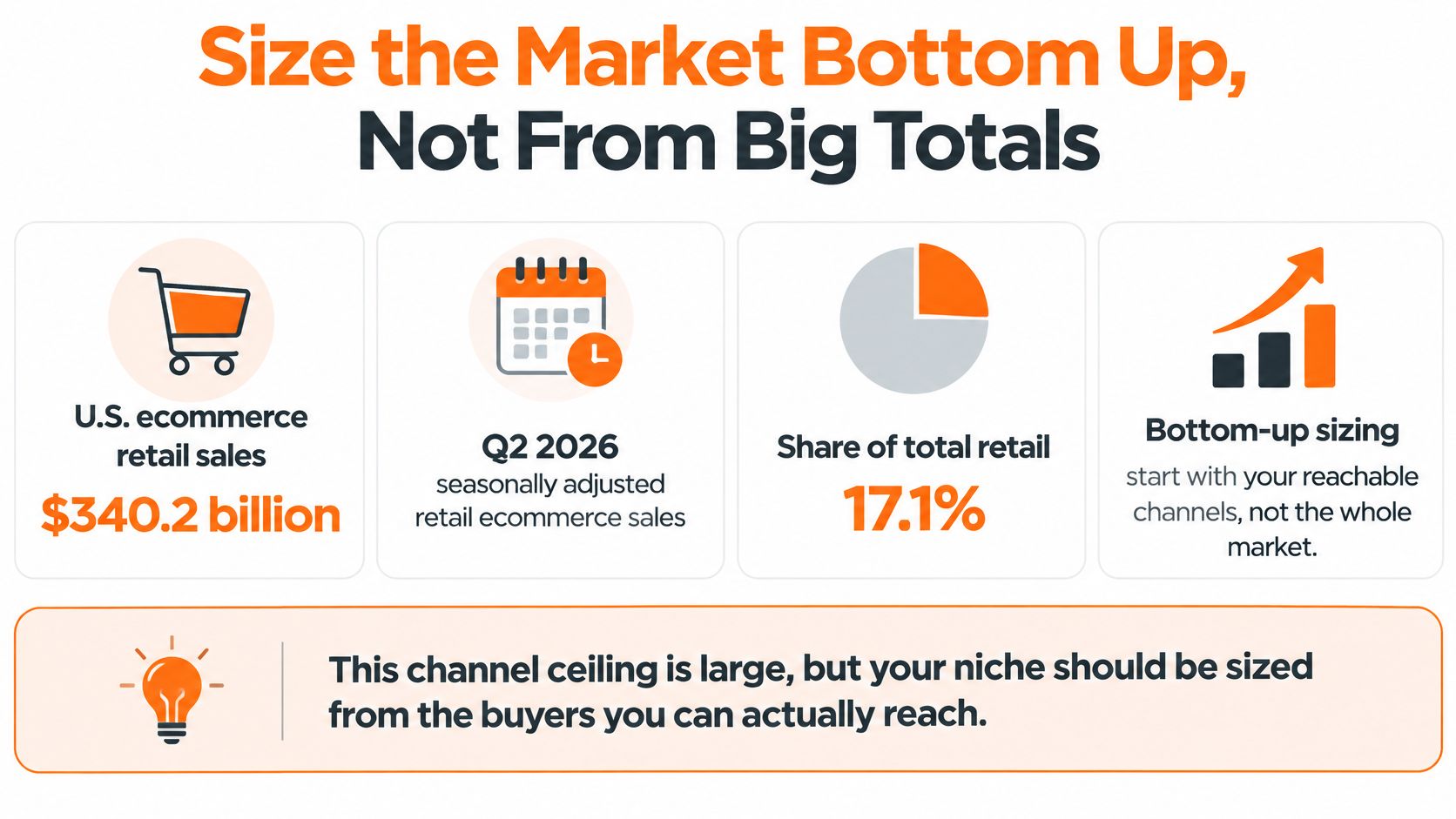
Size the slice you can reach:
Reachable buyers × purchases per year × average order value.
Run the gardener numbers
Say 20,000 reachable gardeners buy 1.5 times a year at an average of $48.
20,000 × 1.5 = 30,000 orders. 30,000 × $48 = $1.44 million in segment spend per year.
A new brand that wins 2% of that spend earns about $28,800. Check that number against your ad budget and your margin. Don't check it against the channel total.
The same 2% share in a giant category only works if you can reach far more buyers. If your real list is a 4,000-person forum, 2% of a fantasy market is a story you tell yourself.
Count reachable buyers from places you can open today.
- Community size: member counts in the groups where your one-sentence niche already fits.
- Marketplace ranks: how many listings in the subcategory show recent reviews.
- Problem keywords: volume for the specific complaint, not the parent category.
Write three numbers on one line: buyers, frequency, order value. Then ask whether the share you need is plausible. If you need 40% of every gardener in the country to pay rent, the niche is too thin or your costs are too high. A smaller audience can still work when people reorder or accept a healthy price. A large category fails when ads, shipping, returns, and product cost eat the selling price.
Read Demand Signals Before You Spend Money
A spike on a chart feels like permission. Most of the time it is a holiday or a news week.
Shopify's guide to Google Trends draws the limit clearly. The index shows relative interest, not the number of searches or purchases. You can compare products, places, and time. You cannot read revenue off the line.
Set the test like this. Compare the term in regular Web Search and in Google Shopping. Use a five-year range. Check several related phrases, not one lucky keyword.
A steady line across months is a better start than one spike. Search interest still can't prove a purchase. Confirm it with marketplace search volume, ad platform data, store analytics, or actual sales.
Our notes on market research methods show how to stack those checks so one chart doesn't run the decision.
Ask what they already paid
When you talk to buyers, ask four things. What workaround do they use now? What do they spend? How often do they buy? What made them switch last time?
Someone who says they would buy gives you weak evidence. Someone who describes a past purchase gives you strong evidence.
A chart is a thermometer. It shows pressure. It does not show a paid order.
Take replacement hinges for vintage kitchen appliances. The search line jumps once, around a design article, then goes quiet. Forum posts about a broken hinge show up every month. Buyers describe paying a repair shop about $90 and waiting weeks for a part that doesn't match the screw pattern.
I move a niche forward only when three independent signals agree. The demand shape is not a one-week spike. Absolute volume shows up in a marketplace or an ad account. Buyers already spent money on a workaround. One green light is a maybe. I don't buy stock on a maybe.
Find the Gap in Competitor Reviews
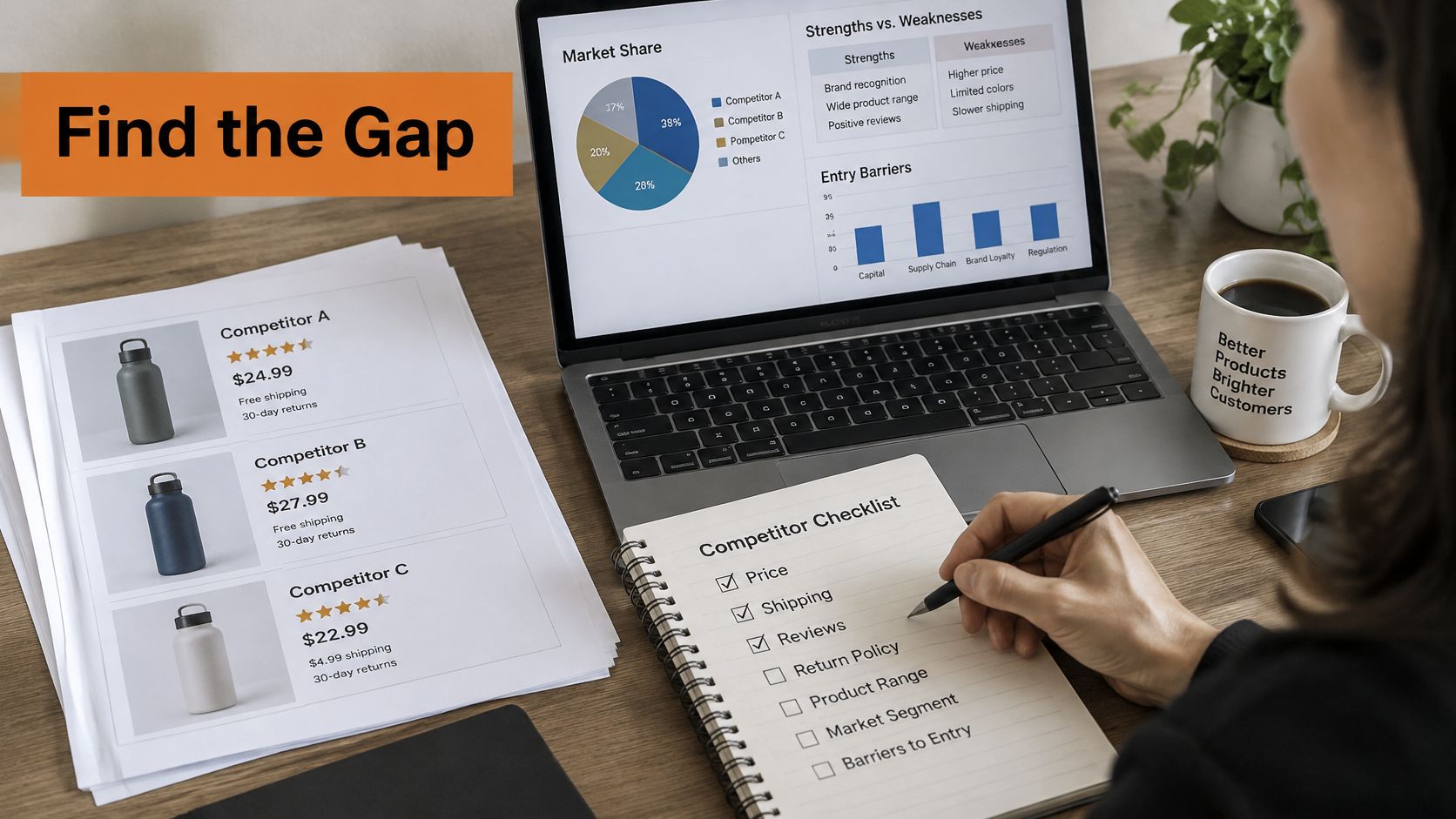
A yoga mat can have hundreds of reviews and still leave a door open. The U.S. Small Business Administration recommends identifying competitors by product line and market segment, then checking market share, strengths, weaknesses, entry odds, barriers, indirect rivals, and how much the target market matters to incumbents.
Build one sheet per niche. For each direct competitor, log price, variants, review count, delivery promise, guarantee, and the main complaints. Put indirect competitors on the same sheet: a reusable bottle competes with disposable bottles and the workplace water dispenser, not only other bottles.
Mine the low stars
Sort 1-star and 2-star reviews. Tag complaints as sizing, durability, setup, delivery, returns, compatibility, or trust. Count the three themes that repeat. Those themes are the first product brief, and the shipping and returns tags often tell you whether a niche will bleed margin before you commit to stock.
Say a yoga mat brand's 1-star reviews keep saying the mat slips on hardwood and the carry strap is heavy. The gap is a lighter mat with a grippier surface. You did not invent a category. You answered two sentences buyers already wrote.
Gift products need the same discipline. Before "custom" sounds like enough differentiation, read how buyers spot durable personalized photo blankets and note where print quality, wash results, and whether the item matches the photo drive refunds or relief.
Barriers can close a gap that looks wide. Entrenched brands, supplier limits, switching costs, and regulation belong on the sheet. A fit complaint is useful. A complaint you cannot legally or profitably fix is a closed door.
Then decide. If repeat complaints point to one change you can make, delivery and returns will not erase the margin, and a buyer can switch without huge cost, the gap is wide enough to build around. If every complaint is price and three brands already own the search results, I leave the niche closed.
Check Unit Economics and Run a Small Test
Start with one $40 order. I want the leftover cash, not a vibe.
The picture below is a first cut. It stops at gross margin before ads, using marketplace fees and a simple mailer. Your go or no-go uses the fuller sheet after it, because returns and ads are what usually flip the sign.
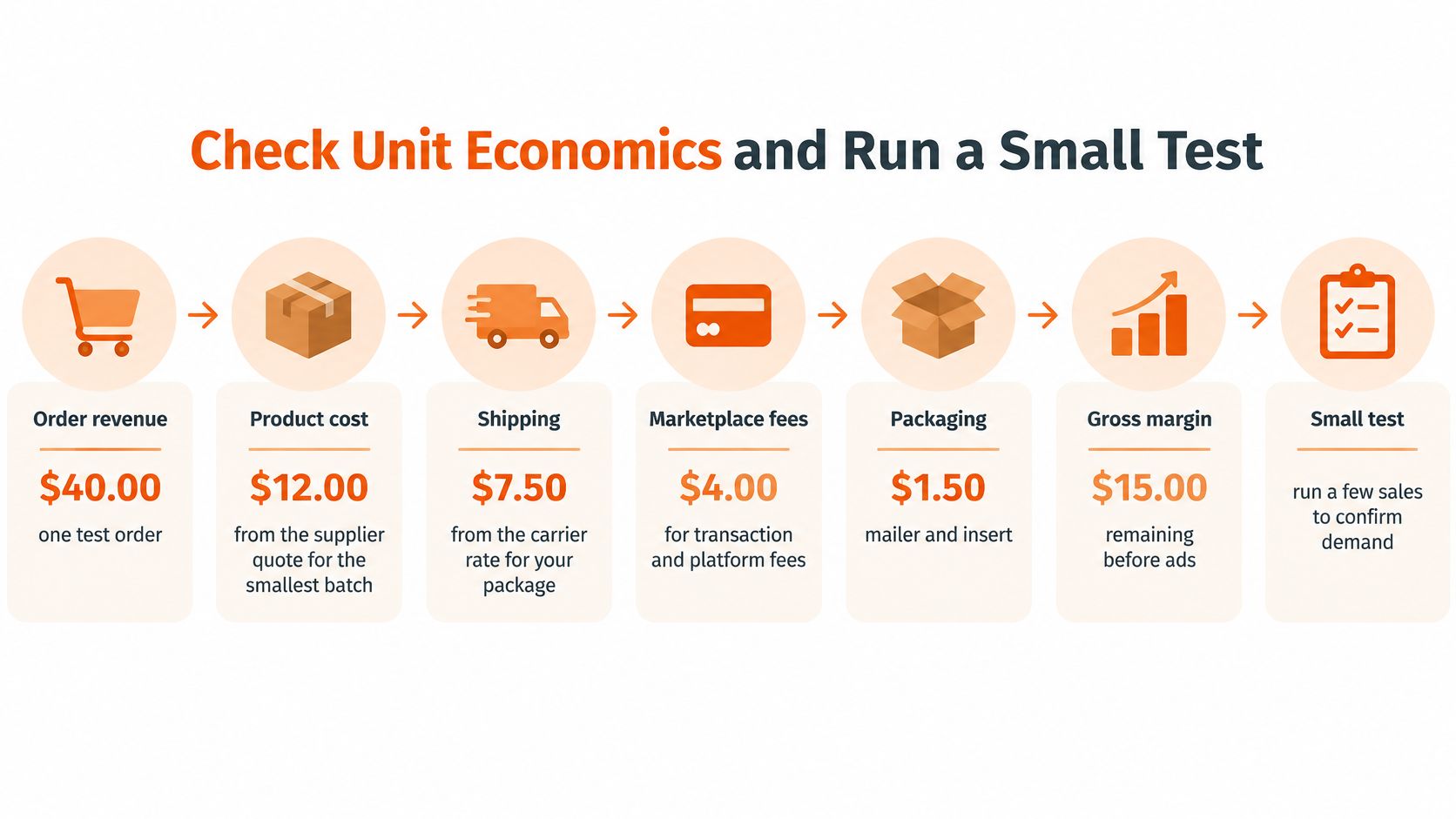
MNB Research frames the check as a staged funnel before you buy inventory. You define a narrow buyer and a painful job, interview people about the workaround they pay for now, triangulate demand, estimate contribution margin, run a small pre-sell, and only then buy the smallest batch. Contribution margin per order is selling price minus variable product, logistics, payment, return, and marketing costs. Scale only if that margin stays positive under conservative conversion, return-rate, and ad-cost assumptions.
Walk one order
- Selling price is $40.00, the average after discounts.
- Product cost is $12.00, from the supplier quote for the smallest batch.
- Shipping in and out is $7.50, from the carrier rate for your package size and weight.
- Payment fees are $1.20, about 3% of the price.
- Return allowance is $2.00, the category return rate times the value you lose on each return.
- Packaging and pick and pack are $2.50, from a warehouse or 3PL quote.
- Ad cost is $9.00, the cost per paid order in your test campaign.
After those costs, $5.80 is left, or 14.5% of the price. If you want the percent form of margin before you stress the ads, use our walk-through of gross margin percentage.
| Cost line | Example on a $40 order | How to estimate it |
|---|---|---|
| Selling price | $40.00 | Average price after discounts |
| Product cost | $12.00 | Supplier quote for the smallest batch |
| Shipping in and out | $7.50 | Carrier rate for your package weight and size |
| Payment fees | $1.20 | About 3% of the selling price |
| Return allowance | $2.00 | Return rate from category reviews, times lost value |
| Packaging and pick and pack | $2.50 | Warehouse or 3PL quote |
| Ad cost per order | $9.00 | Test campaign cost per paid order |
| Contribution per order | $5.80 | Selling price minus all costs above |
Stress the number before you celebrate. If ad cost rises to $12.00, contribution falls to $2.80. I would not scale a niche that only works at the rosy ad cost.
Run the small test
Pick one acquisition channel. Run it for two to four weeks. Write the stop and continue rules before you spend a dollar. I use a minimum number of paid orders, a maximum cost per order, and a positive contribution margin.
Put a deposit or a pre-order on the landing page. An email signup is stated interest, and stated interest is weak. A buyer who describes a past purchase is stronger. A deposit or a completed order is the strongest signal you can get before you own inventory. Repeated "where can I buy this?" comments can support the demand check. They do not replace a paid order.
A rising trend by itself can be a holiday, a news blip, or a manipulated rank. Treat the niche as validated only when the interviews, the demand checks, and this margin sheet agree.
Pick One Niche and Test It This Month
Pick the niche with the highest score that also cleared the margin check and the stop rule. Drop any niche that failed either one, even if the score looked strong. A niche that wins on demand but loses on shipping or returns will drain cash later, so the order of these filters matters.
A peer can question your reasoning before you commit. The numbers still have to come from your own test. Run that test on a four-week clock.
Week 1: Interview ten buyers and code their complaints by theme. Ask what they bought last, what shipping cost them, and whether they ever sent a purchase back. Return and delivery answers tell you as much about niche quality as the complaints do.
Week 2: Finish the competitor and review audit for the niche you kept.
Week 3: Launch a landing page with a pre-order. Track conversion against the rules you wrote before you spent.
Week 4: Compare the results with those rules. Buy the smallest batch only if you cleared them.
If the test fails, go back to your candidate list and take the next niche. Don't cut the price to rescue this one. A lower price hides weak demand instead of fixing it, and it shrinks the contribution you already measured.
Write the niche in one sentence today, and book the first five buyer conversations before the week ends.
Chicago Brandstarters is a free, vetted community for kind, bold, hard-working Chicagoans and Midwesterners building brands from the idea stage to seven figures, through small private dinners and an active group chat. If you want founders who will share honest tactics and war stories from their own businesses, visit Chicago Brandstarters and apply to join.
Leave a Reply