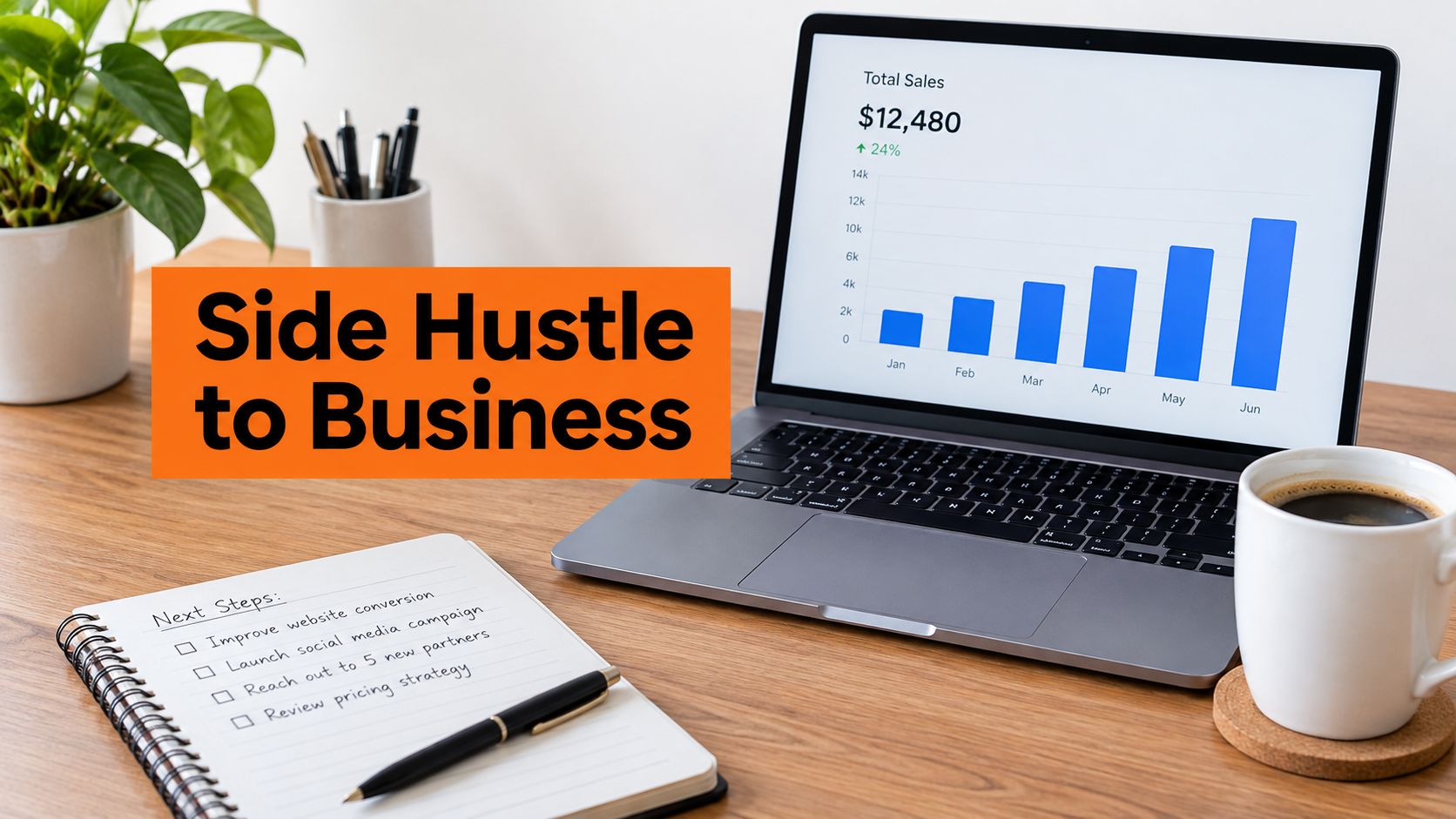
You made your first sale after work, then checked the order three times before bed. The money felt like proof. By morning, you were already calculating how quickly you could quit your job.
That reaction makes sense. A sale can validate an idea, but it can't validate a company. Moving from side hustle to business requires repeat demand, healthy margins, clean records, enough cash, and a plan for the risks your paycheck currently absorbs.
The Honest Truth About Quitting Your Day Job
Many people want to leave employment after their first strong month. They see customer interest, imagine freedom, and underestimate everything their salary covers, including taxes, insurance, slow sales weeks, and mistakes.
A founder I know sold custom products through referrals. The first month looked excellent. The second month looked similar. Then referrals slowed, one large order arrived late, and the business had to refund part of it. Revenue had looked like a trend. It was only a small cluster of lucky buyers.

Before you plan your exit, separate proof of interest from proof of dependable demand. Ask yourself:
- Repeat orders: Do customers return without personal reminders?
- Contribution margin: Does each sale leave money after direct fulfillment costs?
- Customer concentration: Would one lost buyer damage your household budget?
- Owner pay: Can the business pay you consistently after taxes and operating costs?
- Time required: Does each sale require your personal effort, or can you repeat the process?
The Kauffman Foundation tracked early-stage entrepreneurship across the United States from 1996 through 2017. Its rate of new entrepreneurs rose from 0.31% of the adult population in 2016 to 0.33% in 2017, the highest level recorded during the prior two decades, according to its early-stage entrepreneurship indicators. That pattern tells you entrepreneurship has a measurable path, not that your first month justifies resignation.
Practical rule: Quit when the business can carry the risk your job currently carries, not when the business gives you an exciting story.
If you need technical help to reduce manual work, evaluate specialists carefully. For example, a product founder may eventually need hire developers from Mexico to build a customer portal or automate order handling. Hire that help after you understand the workflow and economics, not to avoid learning what customers want.
Use a written plan for quitting your job with specific financial and demand gates. A calendar date creates pressure. Evidence gives you a reason.
Understanding Survival Rates and Entrepreneurial Reality
Entrepreneurship has a wide entrance and a narrow path to durable operations. The difference matters because a side hustle can produce income without developing the systems needed for employees, payroll, inventory, or dependable owner compensation.
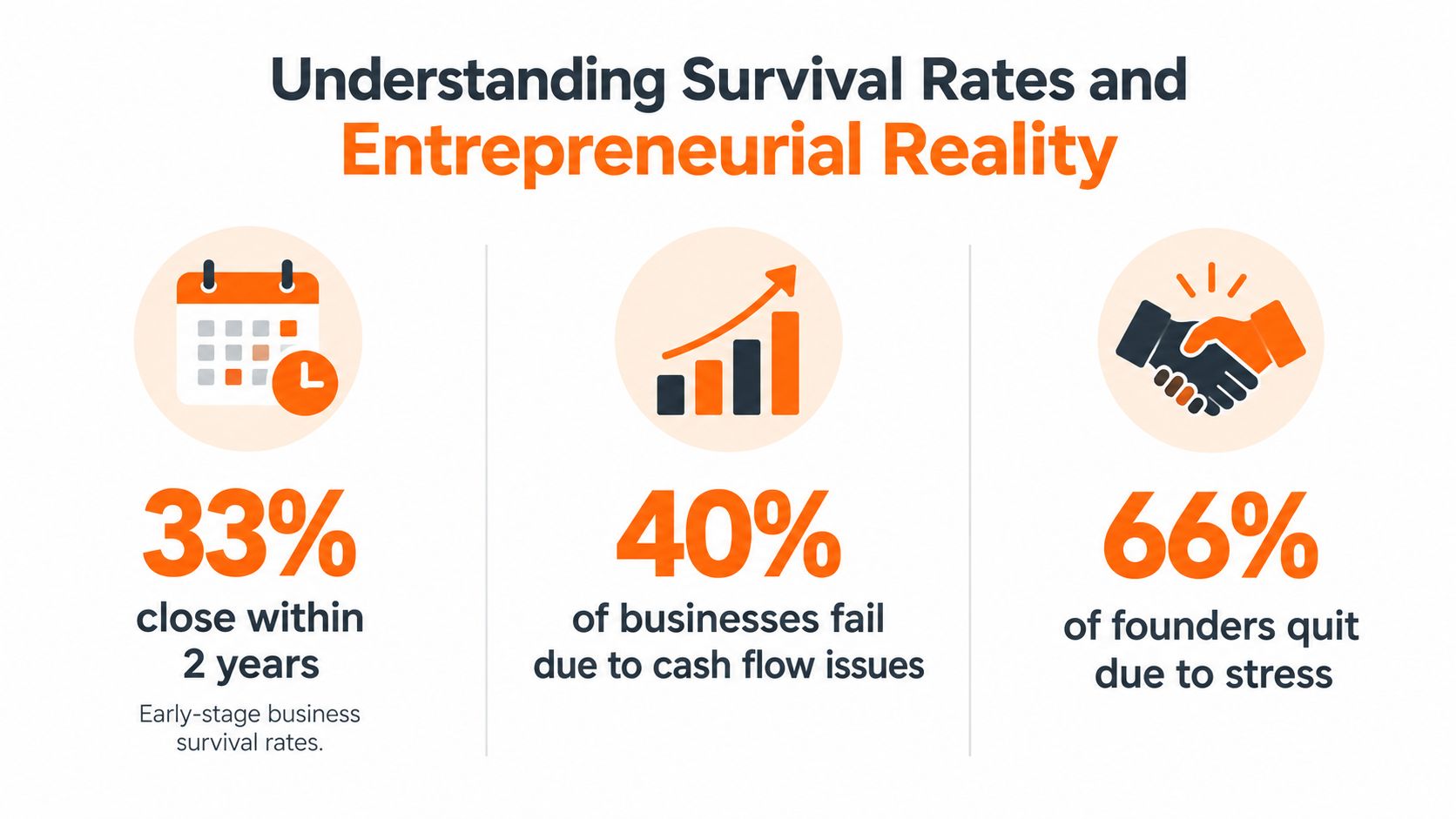
The Census research cited in the study of nonemployer and employer startup survival found that only 1.8% of firms that began as nonemployers later transitioned into employer firms. Nonemployer startups had a 27% survival rate, compared with nearly 49% for employer startups. Treat those figures as planning evidence, not a prediction about your own company.
What the numbers change
Many solo founders never need employees. A profitable consulting practice, design studio, or specialist service can remain a nonemployer business by choice. The mistake comes from assuming that personal sales automatically prepare you for a larger operation.
Hiring changes the cash cycle. You pay people before customers pay you. You manage quality through others. You take on employment obligations, scheduling problems, and a larger monthly break-even point. A founder who wants to hire should first prove that demand can support payroll through weak periods.
The same Kauffman data found that first-year startup survival stayed around 79% to 80% since 2012. It also found that immigrant entrepreneurial starts in 2017 occurred at twice the rate of native-born Americans, while opportunity entrepreneurship among people aged 55 to 64 rose from 15% in 1996 to 26% in 2017. These figures show that founders enter through different backgrounds and career stages.
The practical lesson is simple. Use the side hustle to gather evidence while employment gives you room to test. Treat the move into a company with employees as a separate decision that needs its own sales, margin, cash, and management proof.
A Staged Approach to Validating Demand
Run your side hustle like a controlled experiment. You don't need a perfect brand, a large inventory order, or an elaborate website before you ask people to pay.
Start with one customer and one problem
Choose a narrow group with a problem you understand. “Small businesses” is too broad. “Independent Chicago retailers that need product photography before a seasonal launch” gives you a customer, a situation, and a reason to buy.
Interview potential buyers, but don't confuse compliments with demand. Ask what they do today, what the problem costs them, and what they already pay for a workaround. Then present a minimum viable offer with a clear price, delivery date, and result.
Paid validation matters because enthusiasm costs nothing. A deposit, preorder, or paid pilot forces the buyer to make a real trade-off. Resources on startup validation experiments can help you design small tests without turning every idea into a full launch.
Track the gates
Keep a simple weekly sheet. Record:
- Qualified leads: People who fit your customer definition and have the problem.
- Conversion rate: The share that buys after a real sales conversation.
- Gross margin: Sales less direct product or delivery costs.
- Customer-acquisition cost: What you spend to acquire each customer.
- Repeat purchase rate: The share that buys again within a useful period.
- Delivery time: Hours and materials required to complete the promise.
Set promotion gates before emotion takes over. Continue testing when contribution margin improves and repeat demand appears. Pause when sales depend on one-off buyers, discounts, personal favors, or unpaid labor. Expand only after you can repeat the sale without relying on your excitement.
A side hustle becomes a business when the process can produce revenue again without your constant improvisation.
You can use a business idea validation process to pressure-test the offer before you spend on packaging, software, contractors, or inventory. Keep the first version small enough that a failed test teaches you something without damaging household cash.
Mastering Capital Discipline and Cash Flow
Revenue can rise while your bank balance falls. That happens when you collect late, buy inventory early, pay for advertising before retention works, or mistake gross sales for usable cash.
Build a 13-week cash-flow forecast. List the cash you expect to receive and the cash you must pay each week. Separate fixed costs, variable fulfillment costs, taxes, owner draws, inventory commitments, and receivables. Update the forecast with actual cash, not booked revenue.
Use contribution margin as your guardrail
Calculate break-even units by dividing fixed costs by contribution margin per unit. Contribution margin means the money left after direct costs tied to the sale. If shipping, materials, payment fees, and fulfillment consume most of the sale, more volume can make the problem larger.
The Federal Reserve reported that 72% of firms aged 0 to 2 years experienced financial challenges, 92% of startup firms relied on the owner's personal credit score for financing, and 28% of startup applicants were denied all requested financing in its startup-firm data. You should treat financing as uncertain, not as a rescue plan.
Use deposits, preorders, paid pilots, or low-minimum inventory to test demand before borrowing. Keep a tax reserve in a separate account. Don't use personal credit to hide negative unit economics, because debt can delay the decision you need to make.
Your weekly dashboard should include:
- Cash runway: How long current cash can cover planned expenses.
- Orders or contracts: What customers have committed to buy.
- Gross margin: Whether each sale creates room for overhead.
- Refunds or churn: Whether customers leave or demand money back.
- Hours per sale: Whether the model can support your intended owner pay.
The cash-flow management approach for small business should become a weekly habit, not a task you remember during tax season. Reduce employment hours only after recurring cash can cover projected operating costs and taxes. Add contractors only when demand supports the commitment for several months.
Navigating Legal and Tax Requirements
Formalization should match risk. A digital service with no contractors has different needs from a food business, physical-product brand, regulated service, or company signing large customer contracts.
Start by separating your household and business records. Use dedicated bookkeeping, document expenses, track payments, and review insurance needs. Then compare choosing your business structure with a tax professional who understands your activity. An LLC may provide liability protection in some situations, but it doesn't automatically remove self-employment tax. The Small Business Administration explains that LLC owners generally remain self-employed for Social Security and Medicare purposes, subject to applicable tax elections.
Chicago home-business rules
If you operate a home-based side hustle in Chicago, you generally need a City of Chicago business license before operating from your home. The city requires zoning approval, a completed license application, payment, and government-issued identification showing the owner's home address, according to its home-based business requirements.
Chicago also limits home activity. No more than one nonresident employee may work inside the home, no more than two patrons may be present at once, and no more than ten patrons may visit during a 24-hour period. The city allows one bulk delivery per day, between 8 a.m. and 6 p.m. Check the exact rules before accepting customers, storing inventory, or hiring help at home.
Plan for tax obligations
The IRS generally expects estimated tax payments if you expect to owe at least $1,000 when filing. The standard due dates are April 15, June 15, September 15, and January 15, covering their respective income periods. The IRS guidance on estimated tax for gig work explains how these payments can cover income and self-employment tax.
The IRS generally requires self-employed people to pay self-employment tax when net earnings reach $400 or more. Net earnings mean profit after allowable expenses, not total sales, as explained in the IRS small-business tax FAQs. Keep records throughout the year, and ask a qualified professional to review your structure and filing obligations.
Accelerating Growth with Peer Communities
Founders often make expensive mistakes in isolation. A customer problem that takes three months to solve alone may take one honest conversation to clarify. The right peer group doesn't replace an accountant, lawyer, or operator with direct expertise. It helps you notice blind spots before they become bills.
Chicago Brandstarters is a free, vetted community for Chicagoans and Midwesterners building brands from the idea stage toward seven figures. Members join private 6 to 8 person dinners every two weeks and an active group chat where they discuss tactics, difficult decisions, and real operating problems.
The group uses identity verification and LinkedIn vetting to reduce self-promotion and service selling. Founder Kevin Tao leads the community, which prioritizes candid conversation over polished founder performance. Members have used the group to work through stubborn business problems and gain access to practical opportunities, including factory tours.
A useful peer group should make you more precise. Bring your cash forecast, customer objections, product samples, or hiring question. Ask for criticism you can act on. As companies grow, members can receive direction toward programs such as Goldman Sachs 10KSB, EcomFuel, and Million Dollar Sellers.
You can learn more about how the community works through this short video.
Your Path Forward
The standard timeline says you should quit once revenue reaches a personally exciting level. That advice ignores customer concentration, contribution margin, taxes, insurance, cash runway, and the hours required to deliver each sale.
Use a promotion gate instead. Keep your job while you narrow the customer, sell a paid minimum offer, and measure repeat demand. Build the 13-week forecast, separate business cash, reserve for taxes, and fix weak unit economics before you add debt or payroll.
Then choose the least risky transition that fits your evidence. You might leave employment, reduce your hours, hire limited help, or keep the job while the business gains stability. The right choice depends on dependable owner compensation and manageable risk, not on how badly you want a new identity.
Entrepreneurship has a real path, but the path rewards operating discipline. Make your next move from a spreadsheet, customer behavior, and documented demand. That approach gives your side hustle a better chance to become a business you can actually live on.
Chicago Brandstarters gives Chicago and Midwest founders a free, vetted community with private dinners every two weeks and a practical group chat for working through side-hustle decisions. Visit Chicago Brandstarters to meet other kind, hard-working builders and turn your next business decision into a clearer plan.
Leave a Reply