You've just celebrated $40K in monthly recurring revenue, but the celebration feels strange. Every new signup still costs money, repeat orders arrive slowly, and your ad account keeps asking for more budget. You don't need a complicated retention department yet. You need a simple system that gets buyers through the first purchase, gives them a reason to return, and shows you where customers disappear.
Customer loyalty comes from repeated proof. Your product works. Your service responds. Your brand remembers what matters. The system below is built for founders under seven figures who still have to write the emails, read support tickets, and check the numbers themselves.
The Loyalty Math Every Founder Should Know First
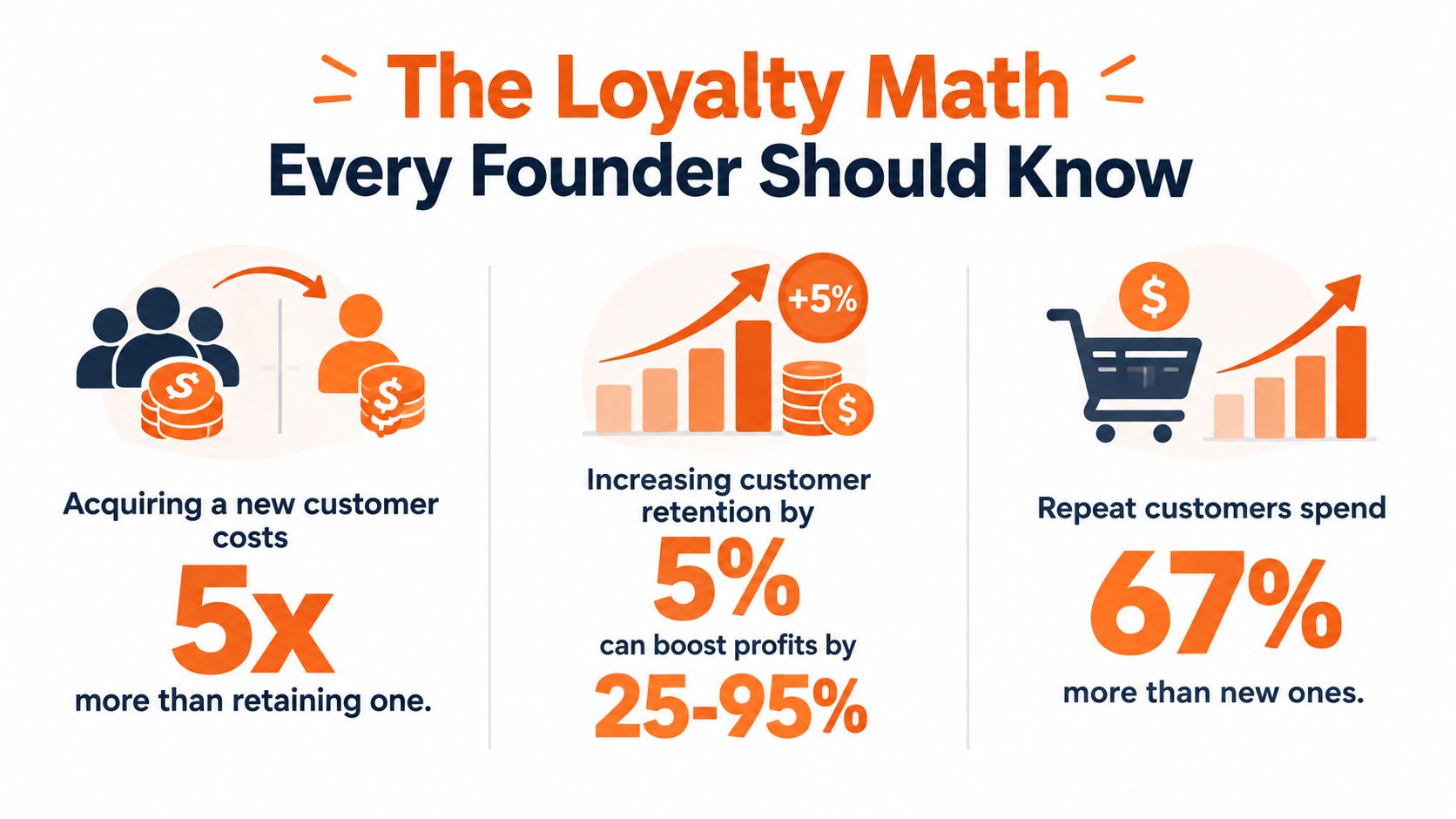
Retention math changes how you spend your next dollar. A 2026 benchmark puts online B2B acquisition at about $145 for a new customer versus $18 to retain an existing customer. That same benchmark says existing customers spend 67% more than new customers during their first 6 months, and the probability of selling to an existing customer sits at 60–70%, compared with 5–20% for a prospect.
That doesn't mean you should stop acquiring customers. It means you should stop treating acquisition as the only growth engine. If you run a sub-seven-figure brand, one founder-led retention sprint can often beat another round of ad experiments because you already have the buyer, the payment history, and permission to improve the next interaction.
Three numbers should change your priorities
The first number is the 5-to-1 retention gap often used in retention economics. A 2026 summary says acquiring a new customer costs 5 to 25 times more than retaining an existing one. Use the retention cost formula to keep your own math honest: total sales and marketing spend divided by new customers acquired in the same period.
The second number comes from the conversion gap. Past purchasers convert at 60–70%, while prospects convert at 5–20%, according to the benchmark linked above. Build your next campaign around customers who already bought, then compare its revenue with a cold acquisition campaign.
The third number is the 67% higher spending level from existing customers during the first 6 months, also reported by the 2026 benchmark. For a small brand, that can fund better support, better packaging, or a stronger product without asking paid media to carry every sale.
You'll build the system in this order: fix onboarding, design a reward around real value, personalize with restraint, create a listening loop, track a small dashboard, and run a 90-day plan. Loyalty starts with fewer broken promises, not a points widget.
Onboarding and the First 30 Days After Purchase
The order confirmation is where most founders stop. I treat it as the first day of the retention relationship. The buyer has already taken a risk, so your job is to remove doubt, help them use the product, and make the next purchase feel obvious.
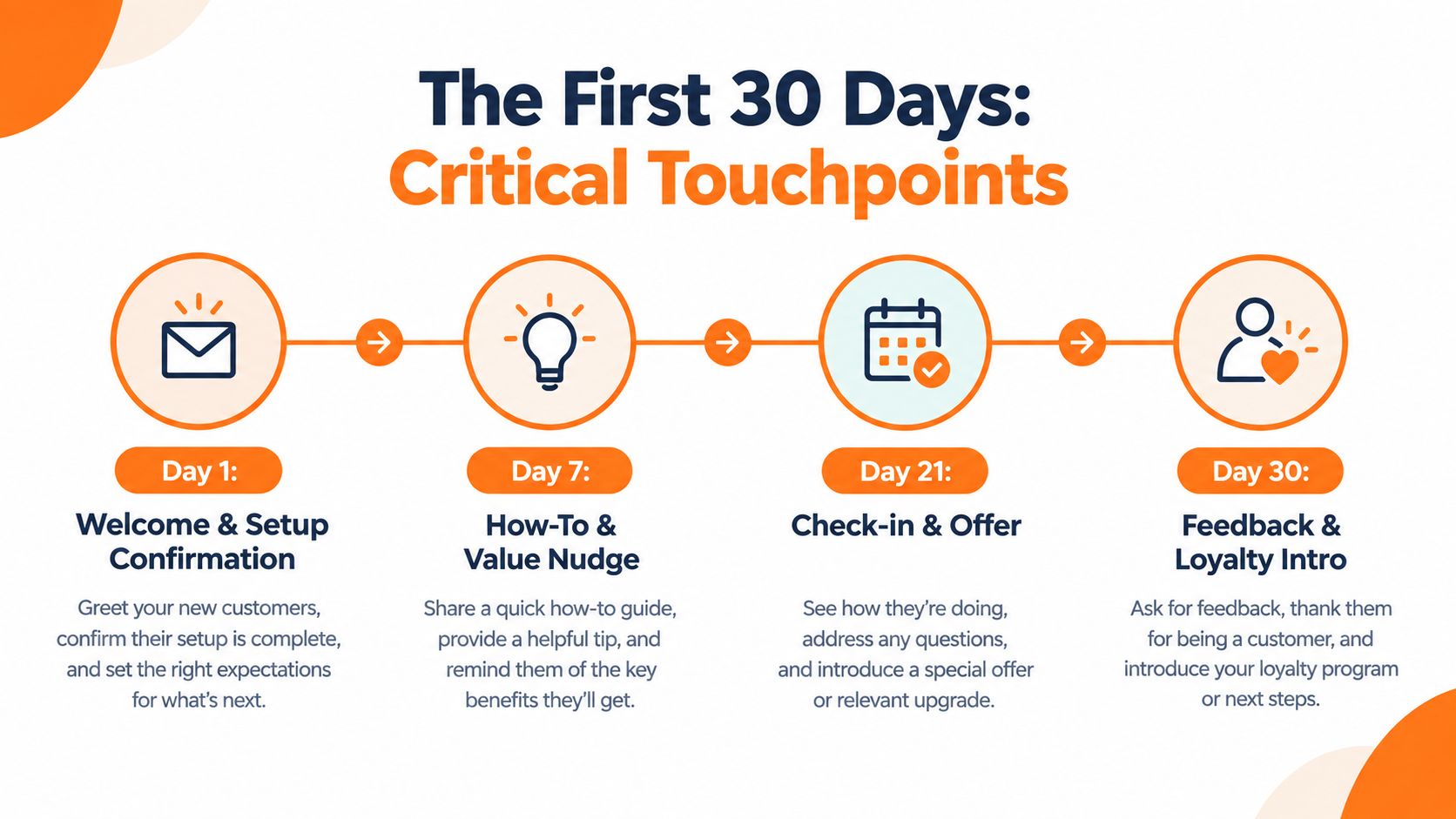
Send four important touchpoints:
- Same day: Confirm shipping, access, delivery expectations, or setup steps. Keep the message practical.
- Day 2 to day 3: Send one usage tip that prevents early frustration. Show the first action, not the whole manual.
- Day 7: Ask for a testimonial, review, or quick reaction after the buyer has had time to experience the product.
- Day 21 to day 30: Prompt the next purchase based on the product's natural use cycle.
The reorder window changes by category. Consumables often need a 14-day reminder, supplements often fit 30 days, apparel and accessories may fit 45 to 60 days, and higher-consideration purchases may need 90 days. One 2026 summary reports that 70% of repeat purchases happen within 30 days of the first purchase, so early follow-up deserves a real place on your calendar. Review the repeat-purchase timing data.
A five-email sequence you can copy
| Timing | Subject line | Goal |
|---|---|---|
| Same day | Your order is confirmed, here's what happens next | Reduce uncertainty |
| Day 2 | Start with this one step | Prevent setup friction |
| Day 5 | Three ways to get more from your purchase | Drive useful product behavior |
| Day 7 | How is it going so far? | Invite feedback and social proof |
| Day 21 to 30 | Ready for your next one? | Create a timely second-purchase prompt |
Keep each email focused on one action. A candle brand might explain how to get an even burn. A software company might guide the first workflow. A skincare brand might explain product order and usage. Helpful details beat louder promotions.
Send the second-purchase prompt from actual reorder behavior, not an arbitrary automation rule. If someone had a delivery problem, resolve it first. You can't email a customer into loyalty while leaving the original frustration untouched.
The visual timeline gives you a simple sequence to put into Klaviyo, Mailchimp, Shopify Email, or your existing CRM. You don't need a new stack. You need clear ownership and a weekly check that every message still matches the product.
Designing a Loyalty Program Around Real Value
Discounts are easy to copy, easy to forget, and expensive when you give them to customers who would have purchased anyway. A loyalty program should make the customer feel recognized while reinforcing the behavior that helps your business, usually a repeat purchase, a referral, useful feedback, or product adoption.
Deloitte reports that factors beyond price can account for up to 40% of perceived brand value. Its 2025 Consumer Loyalty Program Survey places price, value, and quality at the top of loyalty drivers, with loyalty programs close behind. Read Deloitte's analysis of loyalty program design.
Start with one behavior. If you want more second purchases, reward the second purchase. If you want referrals, reward a completed referral. Don't launch points, tiers, badges, missions, and VIP access at once.
Redemption tells you whether the program works
One 2026 benchmark says only 44% of loyalty points get redeemed. The redemption benchmark gives you a useful warning: a large points balance can hide weak perceived value. Customers may forget the program, fail to understand the earning rules, or decide that the reward isn't worth the effort.
I'd start with a reward customers can explain quickly:
| Mechanic | Cost to launch | Repeat purchase lift | Complexity | Best for |
|---|---|---|---|---|
| Points per dollar | Low | Possible when rules stay simple | Low | Products with frequent reorders |
| Tiered status | Medium | Useful for status-driven categories | Medium | Brands with visible customer milestones |
| Referral bonus | Low | Depends on customer advocacy | Medium | Products people naturally discuss |
| Surprise perk | Low | Useful for appreciation and delight | Low | Small customer groups and VIPs |
| Mission-driven reward | Medium | Depends on emotional connection | Medium | Brands with a clear social purpose |
A study indexed in EconPapers found that points and rewards, personalization, challenges, and social interaction didn't directly affect repeat purchase behavior in a statistically significant way, while customer engagement did. Read the indexed study. That's why I'd measure whether customers participate and return, rather than celebrating signups.
Practical rule: If a customer can't explain your program to a friend in one sentence, redesign it.
Service quality belongs inside the program. Before adding another reward, improve CX for Shopify stores by fixing unanswered questions, delivery confusion, and failed recovery. For referrals, use a simple structure and review how to create a referral program only after repeat buying has a healthy base.
Personalization That Builds Trust Instead of Creep
Personalization should mean relevance, not surveillance. You already have useful first-party information in purchase category, acquisition channel, and support history. Use that information to improve one moment, then stop.
Ask for permission in the welcome flow:
“Want tips matched to what you bought? Choose your preference: getting started, advanced use, or product care. You can change this anytime.”
Store the answer in one clean customer field. Don't mine private messages for clues or build a profile no one on your team can explain.
A second-time buyer might receive:
“Thanks for coming back, Maya. You bought the daily cleanser last time. If you want a simpler routine this time, use it after washing and reply if you'd like help choosing the next product. You can opt out of product tips anytime.”
For a customer who has gone quiet for 45 days, keep the message plain:
“You haven't ordered recently, so I wanted to check whether the product worked for you. Reply with what went wrong, what you need next, or ‘stop' and I'll remove you from these reminders.”
Useful personalization names a known behavior. Creepy personalization guesses a sensitive attribute, infers identity from browser signals, or combines data without disclosure. Customers should understand why you used the information and how to stop receiving the message.
Enforce three rules before any new personalization ships:
- Use only data the customer gave you or created through a clear interaction.
- Explain the benefit in the message itself.
- Give the customer an easy opt-out and honor it immediately.
Deloitte's survey places price, value, and quality above personalization, while KPMG's 2025-2026 CXE research ranks personalization as its strongest loyalty pillar at 20.3%. Review the loyalty data and personalization context. The practical answer is restraint. Personalize where it helps, not everywhere you can.
Community, Events, and the Feedback Loop
A points tier can remind customers to buy. A real conversation can tell you why they stopped buying. For a founder under seven figures, that information often has more value than another layer of gamification.
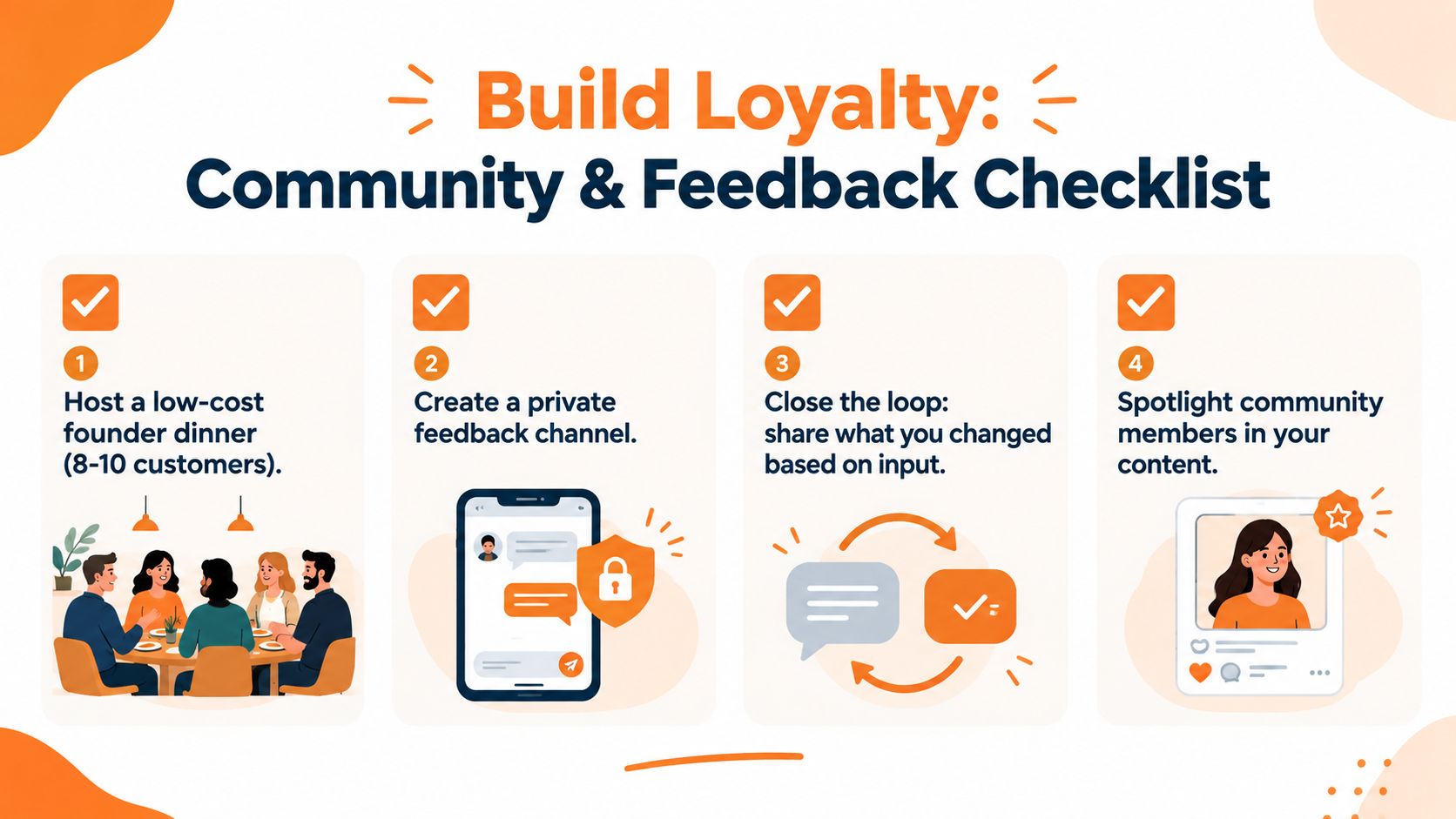
Host a small founder dinner with 8 to 10 customers. Give it two hours, invite one observer to take notes, and ask three open questions:
- What made you choose us the first time?
- Where did the product or service disappoint you?
- What would make you recommend us without being asked?
Don't turn dinner into a product presentation. Let customers compare experiences. Take notes on exact language, repeated obstacles, and moments of excitement. A private Slack, WhatsApp, or Circle channel can recreate the format for customers who can't attend in person.
Keep the weekly loop small
Drop one question into email or your private channel each week:
- Behavior: What did you use, skip, or struggle with this week?
- Emotion: What part felt easier or more frustrating than expected?
- Invitation: What else should I understand before I change the product?
Log answers in a shared sheet with columns for customer, date, product, exact comment, theme, owner, and status. Tag recurring themes once a month. Close the loop publicly once a quarter with one update: what you heard, what you changed, and what you didn't change yet.
Customers trust the process when they see their input produce a clear response. That response might improve packaging, support instructions, or the product itself. It can also reveal the story customers use when they refer friends.
Use a review-based NPS metric if you want to connect review language with advocacy signals. You can also borrow a simple structure from customer feedback collection.
Events aren't marketing stunts. They're listening instruments with a product, referral, and retention signal in the same room.
Retention Metrics You Should Track Weekly
A founder dashboard should fit on one screen. Track the measures that tell you whether customers return, how often they buy, and where the experience breaks.
- Repeat purchase rate: Customers with more than one purchase divided by customers in the chosen cohort. Review weekly, then confirm monthly. Treat under 25% as a churn warning for an early-stage brand.
- Purchase frequency: Total orders divided by purchasing customers. Review weekly by product and cohort. A falling number means your reorder message, product fit, or use cycle needs attention.
- Churn rate: Customers who stop buying within the expected purchase window divided by customers due to buy. Review monthly because the window differs by category.
- Customer lifetime value: Average order value multiplied by purchase frequency multiplied by customer lifespan, then adjusted by gross margin. Review monthly. Gross margin keeps you from calling unprofitable revenue loyalty.
- Net Promoter Score: Promoters minus detractors from your survey responses. Review monthly. Below 20 should trigger customer interviews, not a new discount.
- Product usage signal: Choose one action that predicts value, such as a completed setup, a refill, or a core workflow. Review weekly.
| Metric | Cadence | Churn risk threshold | Action if breached |
|---|---|---|---|
| Repeat purchase rate | Weekly and monthly | Under 25% | Interview recent buyers and inspect onboarding |
| Purchase frequency | Weekly | Downward trend | Check reorder timing and product usage |
| Churn rate | Monthly | Above your normal category pattern | Segment by product, channel, and complaint |
| Customer lifetime value | Monthly | Falling gross-margin value | Fix margin, frequency, or product mix |
| NPS | Monthly | Below 20 | Personally contact detractors |
| Product usage signal | Weekly | Core action declining | Find the first usage obstacle |
A monthly review needs four answers: what changed, who churned, which segment dropped, and what single experiment comes next. Use a spreadsheet. You don't need a data warehouse.
If retention slips, start a 48-hour save flow. Identify at-risk customers, read their support history, check delivery and product issues, then send this message personally:
“I noticed you haven't returned for your usual purchase. Did something go wrong, or is there something I can fix?”
Wait for the answers before automating. These customer retention tactics work best when they respond to a real cause.
A 90-Day Loyalty Plan and Common Traps to Skip
Founders waste retention budget by rewarding behavior they would have received anyway. They also build complicated programs before fixing the first purchase experience.
A 15% reorder discount can train customers to wait for a code. A Starbucks-style points system can become silly when your average order value sits under $40. A referral program can pull in more first-time buyers while your existing buyers still fail to return. A gamification feature won't rescue an onboarding email that 60% of new buyers never open. Those figures come from the supplied operating scenario, so treat them as your own audit prompts rather than universal benchmarks.
| Trap | Why it fails | Better alternative |
|---|---|---|
| Discounting every reorder by 15% | It reduces margin and trains waiting | Use early access, support, or a surprise perk |
| Copying a points program below a $40 order value | Customers may see little practical reward | Use one clear milestone reward |
| Rewarding automatic buyers | You pay for behavior you already had | Reward incremental actions |
| Launching referrals before retention works | You add acquisition before fixing experience | Repair repeat purchase first |
| Chasing gamification | Features distract from broken onboarding | Improve the first useful product action |
Your 90-day sequence
Week 1 to 2: Audit churn. Read recent complaints, inspect delivery issues, and walk through the first-purchase flow as a customer. Fix the most common point of friction.
Week 3 to 6: Ship the five-email onboarding sequence and start the weekly feedback question. Assign one person, even if that person is you, to review replies.
Week 7 to 10: Launch one lightweight loyalty mechanic. Add restrained personal follow-ups for second-time buyers and quiet customers. Measure behavior, redemption, and margin.
Week 11 to 12: Hold your first customer dinner or private feedback session. Review the retention dashboard, choose one product or service change, and tell customers what you changed.
Protect 30 minutes each week for this work. Spend 10 minutes reading customer feedback, 10 minutes checking the dashboard, and 10 minutes choosing the next experiment. That cadence will beat most shiny retention tools because it keeps you close to the actual reasons customers stay or leave.
Chicago Brandstarters connects kind, hardworking founders through free small-group dinners, a private group chat, and practical support for brands growing from idea stage toward seven figures. Visit Chicago Brandstarters to meet other operators who can help you test retention ideas, solve stubborn business problems, and keep building with people who value honesty over performative networking.
Leave a Reply