
Confidentiality is the duty to protect information someone shared in trust, and one breach can cost an organization millions. Privacy is your choice about what to reveal, while confidentiality is my obligation to keep your disclosure from spreading without permission.
You may be dealing with this right now. A founder shares a difficult hiring problem in a private group chat. Someone sends a revenue figure during an investor conversation. A teammate pastes a customer complaint into an AI tool to get help drafting a response. Each moment creates a decision about who may see the information, how long they may keep it, and what they may do with it.
I've run private peer groups long enough to learn that trust rarely disappears after one dramatic betrayal. It usually wears down through small acts: repeating a story without a name, forwarding a screenshot, mentioning a private struggle at a public dinner. Understanding what confidentiality means gives you a practical way to stop those leaks before they damage a relationship.
The Promise You Make When Someone Opens Up
A founder once shared a fragile pre-launch idea at a small peer dinner. The concept still had rough edges, and the founder wanted honest reactions from people who understood the pressure of building with limited resources. A week later, someone echoed the idea in a public conversation. They left out the founder's name, but the details made the source obvious.
That founder learned the obligation in the moment. The group didn't need a dramatic contract to understand the boundary. Someone had shared information because the room felt safe. Everyone who heard it had a duty to protect it.
Confidentiality means you protect information another person gave you in confidence. You don't forward it, repeat it, publish it, or use it for a different purpose without permission. The duty follows the disclosure, so it can apply even when nobody signed a document.
Privacy starts from a different place. Privacy gives you control over your own information, including what you reveal, what others collect, and where your personal details travel. Confidentiality begins when someone else gives you information and you accept responsibility for handling it carefully.
The founder version of the distinction
Suppose you choose to post your monthly revenue in a public founder forum. That decision concerns your privacy. If another founder sends you their revenue numbers in a private chat, your responsibility concerns confidentiality. You may hold identifiable information while still keeping it confidential, because confidentiality protects access and disclosure rather than removing identity altogether. Guidance on protecting personal information explains this boundary in practical terms.
The same pattern appears with hiring struggles, customer complaints, pricing experiments, health information, and investor conversations. A private group only works when members can speak without calculating how their words might travel.
Practical rule: Treat every disclosure as having a boundary, even when the speaker doesn't state it perfectly.
You can learn more about vulnerability in leadership while building that habit. The promise becomes useful when you turn it into behavior: ask what may be shared, limit who receives it, and correct yourself quickly when you cross the line.
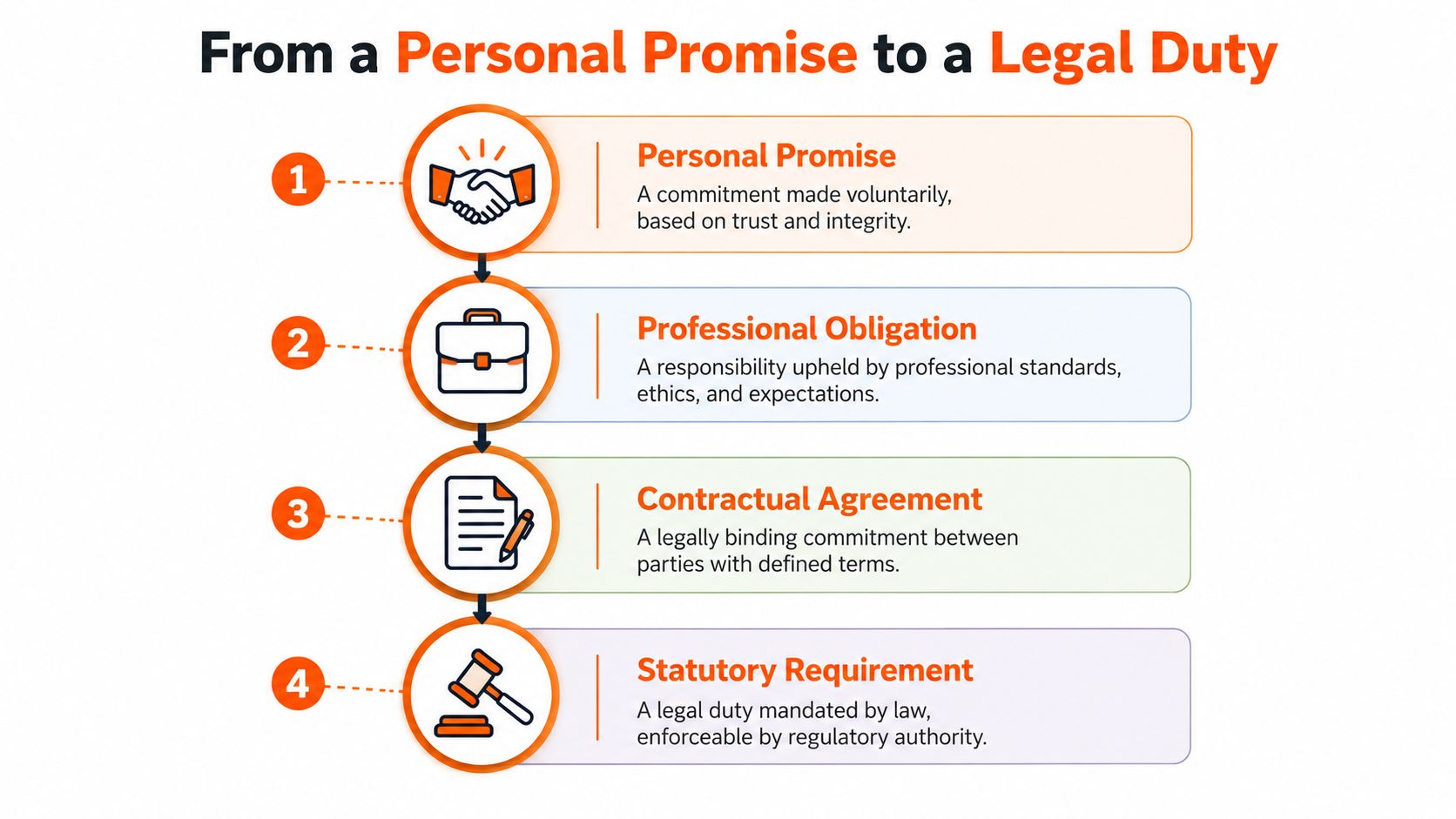
From a Personal Promise to a Legal Duty
Confidentiality often begins with a simple sentence: “I'll keep this between us.” That sentence creates a personal duty. The obligation grows when the information involves a job, a contract, company ownership, legal advice, health data, or valuable intellectual property.
A founder may casually promise to keep a pitch deck private. If the deck contains trade secrets, customer information, or material shared under an NDA, the founder now faces more than a social expectation. Contract terms may define who can access the deck, how the recipient may use it, and what happens after the relationship ends.
The duty ladder
Think of confidentiality as a ladder rather than a single rule.
- Personal promise: You agree to protect a friend's disclosure or a peer's unfinished idea.
- Professional obligation: Your role may require careful handling of client, patient, employee, or company information.
- Contractual agreement: An NDA, employment agreement, services contract, or partnership document creates written duties.
- Statutory requirement: Laws can restrict disclosure and impose duties around particular kinds of information.
These layers stack. A contract doesn't erase your professional ethics, and an informal promise doesn't disappear because a written agreement also exists. A breach can create relationship damage, employment consequences, contract disputes, or legal exposure at the same time.
Common examples include NDAs for confidential business information, employment duties around company records, fiduciary duties for officers and directors, HIPAA obligations for protected health information, and attorney-client privilege for legal advice. The exact rule depends on the facts and the jurisdiction, so legal counsel should address high-risk situations.
The United Nations Statistical Commission treats confidentiality as Principle 6 of the Fundamental Principles of Official Statistics. It says individual data collected for statistical compilation must remain strictly confidential and serve statistical purposes only, as described by Australia's national statistical agency. That example shows how a moral promise can become a formal operating rule.
When you evaluate a platform, partner, or community, inspect its written explanation of how it protects your data. Look for access limits, permitted uses, retention practices, and contact details for concerns. Plain language won't replace a contract, but it helps you see whether the organization understands the duty.
What Breaks When Confidentiality Breaks
A founder shares a failed launch in a private group, then hears the story repeated by a prospect. The breach creates two problems at once: a financial exposure and a relationship rupture. IBM reported a global average breach cost of USD 4.44 million in 2025, while its 2025 report placed the U.S. average at USD 10.22 million. IBM's Cost of a Data Breach research connects those costs with investigation, response, lost business, legal work, and recovery.
Verizon's 2024 breach reporting counted 22,052 incidents and 12,195 confirmed data breaches across 139 countries, as summarized by CSO Online's breach-cost coverage. Those figures do not describe every organization, yet they show why confidentiality needs daily controls rather than good intentions alone.
| Incident Type | Average Cost (USD) | Primary Cause |
|---|---|---|
| Global average breach in 2025 | USD 4.44 million | Weak or failed confidentiality and security controls |
| U.S. average breach in 2025 | USD 10.22 million | Unauthorized access, disclosure, or misuse |
| Global average breach in 2024 | USD 4.88 million | Data breach response and recovery costs |
The damage inside a small company
A large company may have legal teams, public-relations staff, and incident responders. A small company may have one founder answering customer emails while trying to learn how a private file reached a competitor.
A leaked customer list can strain relationships. A forwarded fundraising deck can change a negotiation. A repeated hiring concern can make a candidate question the company's judgment. In a peer group, one screenshot can make every member replace useful specifics with cautious generalities.
Healthcare shows the human cost clearly. Research on medical confidentiality notes that a breach can harm dignity, enable misuse of personal information, and interfere with autonomous decisions. Patients need room to disclose sensitive facts without fearing casual exposure, so confidentiality supports the doctor-patient relationship.
AI tools create another route for information to travel. A confidential prompt may enter a vendor's processing system, appear in logs, or remain available under the provider's settings. Screen-sharing software can capture a private discussion, while an external model may retain inputs according to its terms. Treat these tools as outside recipients until you have checked the controls and received permission.
How Founder Communities Earn the Right to Hear the Truth
A private founder dinner earns trust through repetition. Members attend consistently, learn each other's context, and see what happens after someone shares a hard problem. A founder might admit that a product pivot failed, that cash feels tight, or that a co-founder conversation went badly. The room becomes useful only when the person can speak without performing confidence.
The group's unwritten contract has practical parts:
- No name-dropping: Don't use another member's story to improve your status in a different room.
- No story recycling: Keep war stories inside the group unless the person who shared them gives permission.
- No screenshots: A private thread should stay private, including when the message seems harmless.
- Need-to-know access: Share details with people who can help, not with everyone who happens to ask.
- Gentle correction: If someone repeats a story, address it quickly and clearly before the habit spreads.
Verification protects the room
Identity verification works like a gate at the entrance. Before admission, a group can confirm that a prospective member is a real founder, learn what they're building, and check whether their reasons for joining fit the community. LinkedIn vetting and direct conversation can reduce the chance that a fake profile enters to collect business intelligence or sell services.
Verification won't make betrayal impossible. It gives the group a basis for accountability. Members know who sits across the table, and community leads can remove someone who treats private information as content.
This is why I prefer small groups to oversized networking rooms. In a mastermind group for entrepreneurs, people have enough continuity to notice patterns. Someone who listens carefully, avoids self-promotion, and respects boundaries earns deeper access over time. Someone who constantly extracts contacts or repeats stories loses it.
A confidential room doesn't ask people to trust strangers instantly. It gives them repeated evidence that the room can hold hard truths.
The same mechanics apply in client work, board meetings, and partnerships. Confirm who belongs, set the boundary before people speak, and make correction normal. Confidentiality grows through behavior that others can observe.
Practical Tools to Keep Confidential Information Safe
You don't need legal theatre around every conversation. You do need a clear decision about the sensitivity of the information, who needs access, and what happens after the conversation ends.
Use an NDA when you're sharing trade secrets, product plans, technical material, customer information, or financial details with a new partner, contractor, investor, or prospective buyer. A verbal commitment may fit a trusted peer conversation where the group already has established norms. Neither tool replaces judgment. A signed document can't stop someone from taking a screenshot, and a warm relationship doesn't remove legal duties.
Set the room before the room starts
Use simple meeting controls:
- Close the setting: Hold sensitive conversations behind a closed door or in a private virtual room.
- Control the view: Keep laptops away from windows and public seating areas.
- Name the speakers: Decide whether comments are private, attributable, or on the record.
- Block unapproved recording: Ask for consent before recording audio, video, or screens.
- Create an exit procedure: Pause the meeting, remove unrelated attendees, or move the sensitive topic to a smaller channel.
For digital access, verify new members before granting entry, use two-factor authentication for shared documents, and watermark decks with the recipient's name. Log who received each file and remove access when the project ends. After a sensitive meeting, debrief privately and follow up if information appears outside the agreed circle.
Device disposal also matters. If old laptops, drives, or paper files contain confidential material, use documented confidential data destruction methods rather than placing them in ordinary recycling.
Write the rules into a short operating procedure that people can follow under pressure. A practical standard operating procedure guide can help turn good intentions into repeatable actions.
Treat AI prompts like emails to an outside party. Don't paste customer records, unreleased pricing, private employee details, or a partner's confidential material into a chatbot unless the organization has approved the tool and the discloser has authorized that use.
Confidentiality, Privacy, and Anonymity Explained
People often use these three terms as if they describe the same protection. They don't.
Confidentiality concerns the duty you owe after someone gives you information in trust. Privacy concerns a person's control over personal information, including what they choose to reveal and how others collect or use it. Anonymity removes the link between information and the person who supplied it.
| Concept | Focus | Who Holds the Duty | Founder Example | What Breaks It |
|---|---|---|---|---|
| Confidentiality | Preventing unauthorized disclosure | The recipient or authorized handler | Keeping an NDA-protected pitch inside the agreed group | Forwarding the deck without consent |
| Privacy | Controlling personal information | The individual and the organization handling it | Choosing whether to share personal contact details | Collecting or using details outside the agreed purpose |
| Anonymity | Removing identity linkage | The system or person managing the information | An anonymous employee survey | Revealing who submitted a response |
An NDA-protected pitch may identify its creator, yet remain confidential. A customer list with names removed may look anonymous, but other details can still identify people. An anonymous survey can protect respondents from direct exposure, but it can lose useful context if the organization removes too much information.
Why the distinction changes your decision
Ask three separate questions before sharing. Who controls the information? Who has a duty to protect it? Can someone identify the person behind it? Those questions prevent sloppy promises.
A confidentiality breach can violate privacy at the same time when a recipient exposes personal information. An anonymous dataset can still create risk if someone combines it with other details and restores the identity link. Anonymity reduces identity exposure, but it doesn't automatically protect the underlying data from theft, misuse, or poor storage.
A platform's policy can help you evaluate its handling practices. For example, you can review the AONMeetings India privacy policy when assessing what a meeting service says about personal information. Read the policy before you place sensitive material into a platform, especially if the service records, stores, or shares meeting data.
Use precise language with your team. Say, “This stays within the partnership group,” when you mean confidentiality. Say, “I'm choosing not to share my phone number,” when you mean privacy. Say, “Remove my name from the response,” when you mean anonymity.
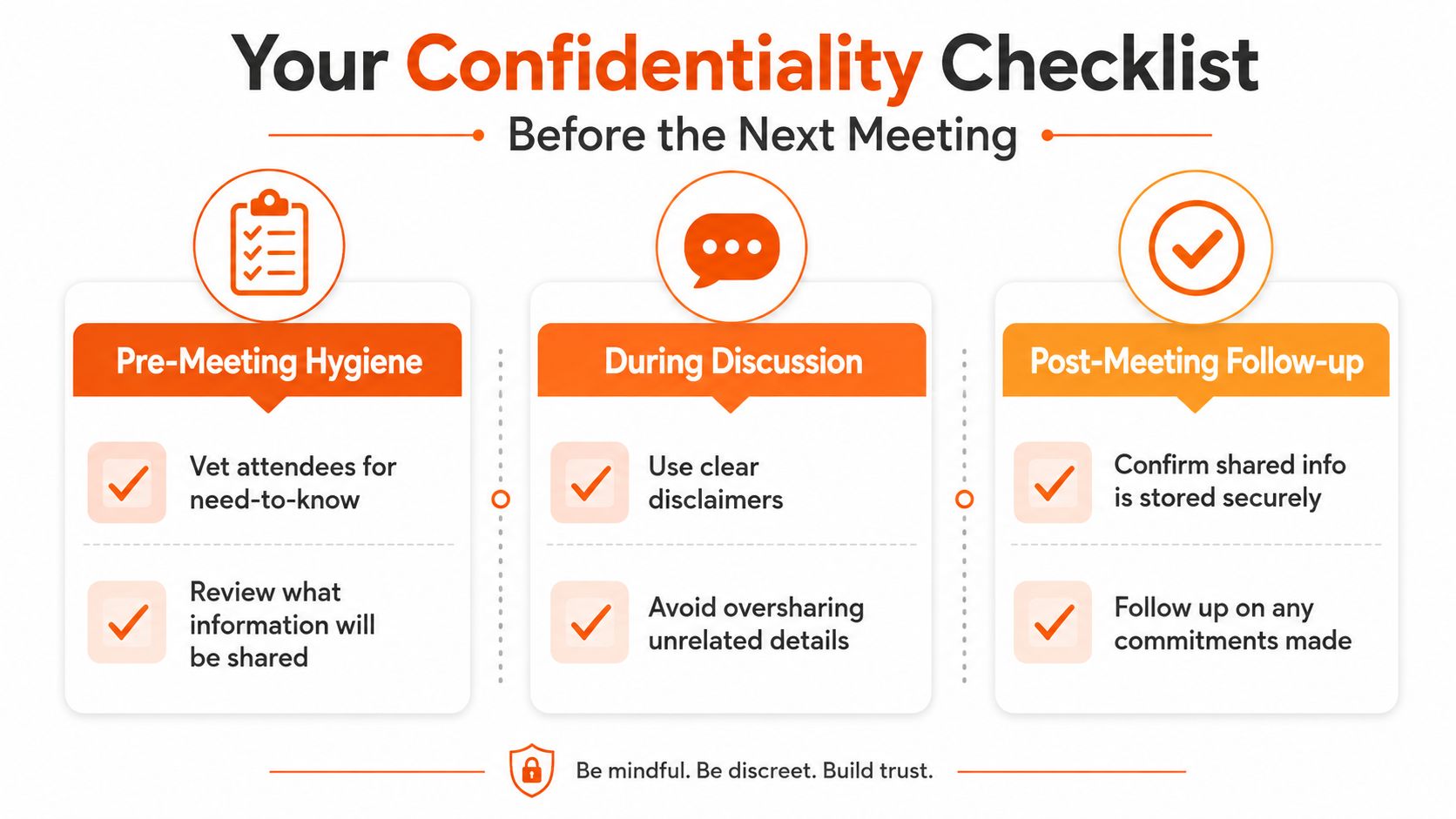
Your Confidentiality Checklist Before the Next Meeting
Use this before a peer call, investor dinner, partner sync, or employee conversation. It should fit on one page and live where the meeting organizer can find it.
Pre-meeting hygiene
- Vet attendees for need-to-know: Confirm each person's identity, role, and reason for joining. Remove anyone who doesn't need access to the discussion.
- Review the material: Mark sensitive pages in a deck, remove unrelated customer details, and decide what you can share if the conversation leaves the room.
- Agree on ground rules: State whether the discussion is private, attributable, anonymous, or on the record.
- Choose the channel: Use a restricted folder, approved meeting account, and access controls that match the sensitivity of the information.
- Prepare your devices: Lock your screen, close unrelated tabs, and disable automatic previews that could expose messages during screen sharing.
During the discussion
Speak plainly before you disclose anything sensitive. “This is confidential, please don't forward it or repeat the numbers outside this room” gives people a usable boundary.
- Use named framing: Identify who may see a file or hear a detail.
- Avoid accidental detail: Don't reveal a customer name when the problem can be explained without it.
- Refuse silent recording: Ask who records, where the file goes, and who can access it.
- Move one-to-one matters aside: Handle personal follow-ups privately instead of replying to a broad group.
- Stop drift early: If someone begins repeating a private detail, interrupt politely and reset the boundary.
Post-meeting follow-up
Document what you shared, who received it, and any limits you agreed to. Store sensitive notes in a password manager or restricted workspace, not in a broadly accessible folder. Remove access when the project or relationship ends, and set a reminder for commitments that involve private information.
Don't echo fundraising numbers to someone who wasn't in the room. Don't leave printed notes in a conference room. Don't assume a deleted message disappeared from every device or backup.
Run the checklist with your co-founder or community lead this week. Confidentiality becomes reliable through small repeated actions, clear boundaries, and fast correction when information travels farther than intended.
Chicago Brandstarters brings kind, hardworking Chicago and Midwestern founders into vetted, private peer groups where people share honest business problems under clear confidentiality norms. Visit Chicago Brandstarters to learn how the community handles identity verification, private dinners, and founder conversations built on trust.
Leave a Reply