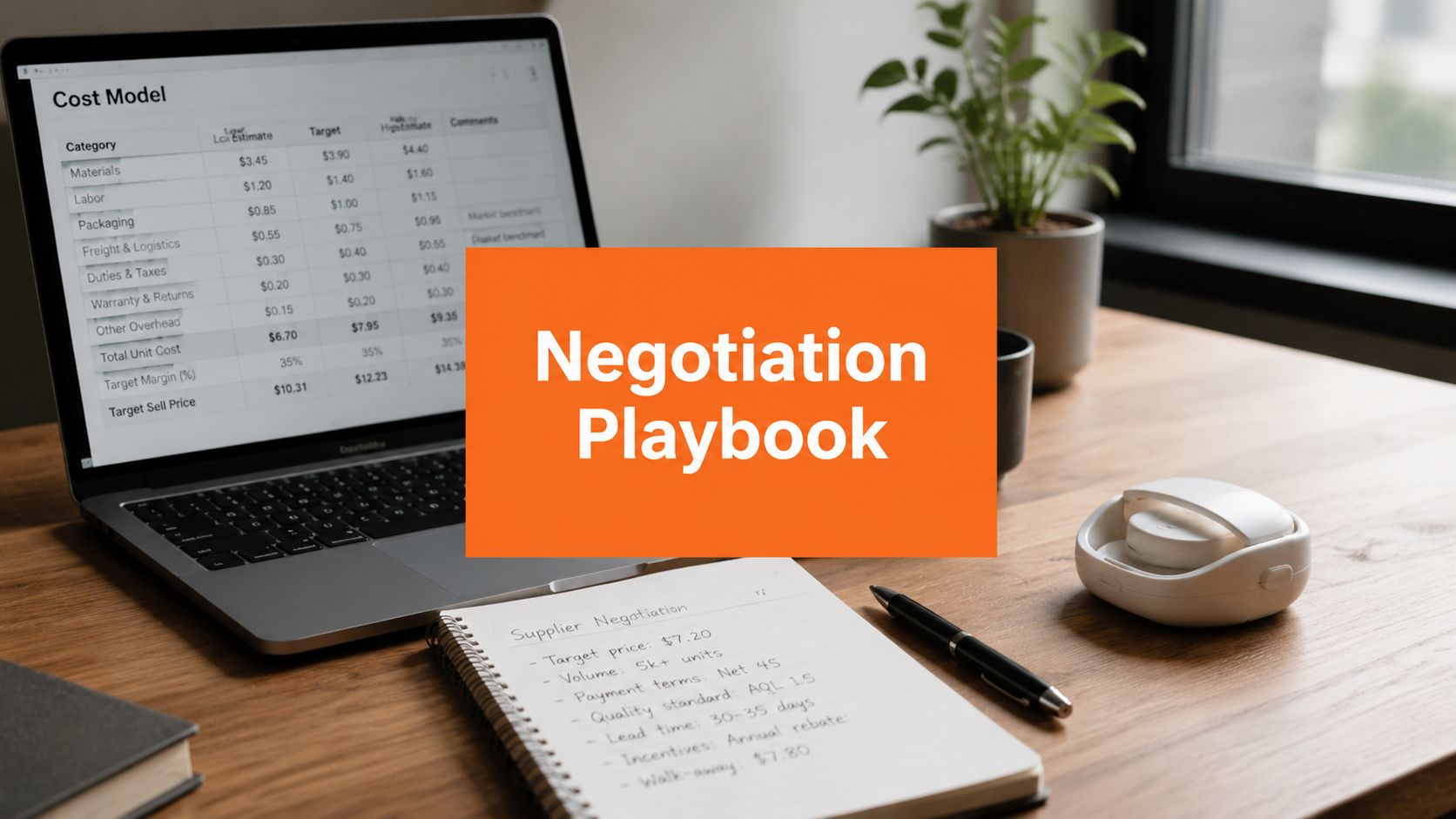
You're staring at a supplier quote that looks fine on paper, your inbox is full, and the factory wants an answer by Friday. You want to move fast, because the product is ready and cash is tight. That's where founders get burned, they treat supplier negotiation like a quick yes-or-no phone call, then wonder why the first purchase order starts eating margin before the boxes even land.
I've lived through that mistake. More than once, I signed too early, accepted a slick quote, and paid for it later in freight, defects, bad payment terms, or silence when I needed support. The hard lesson is simple, negotiation is a system, not a personality trait, and the money you lose usually disappears after the signature, during execution. A major customer-supplier study found that buyers realized only 54% of expected contract value during implementation, while suppliers said they delivered 66% of potential value, which shows how much gets lost after the deal is signed, and the same research later said global buy-side leaders could realize 95% or more of total potential value, 42% more value than the average customer-supplier negotiation study.pdf).
A founder with a 14-unit MOQ can still negotiate like a grown-up. You just need prep, language, and follow-through that don't depend on size. The companies that do this well treat every supplier call like a repeatable play, with notes, scripts, and a clear walk-away line.
Why Supplier Negotiation Is a Founder Skill, Not a Talent
The worst supplier deals usually start with relief. The quote arrives, the founder feels momentum, and the first instinct is to celebrate instead of probe. I've seen a Chicago CPG founder do exactly that with a co-packer, sign fast, then watch margin bleed over the next six months because the actual costs showed up in the details they skipped.
The mistake is treating a supplier like a customer service rep
Founders often show up polite, vague, and grateful. That's a mistake. A supplier is selling capacity, risk, and time, and if you act like you're asking for a favor, you'll get priced like you're easy to ignore.
Practical rule: The first call is not a friendship test. It's a trade negotiation.
Negotiation gets better when you treat it as a routine. You prepare your position, ask better questions, write down your concessions, and check what happened after the contract goes live. That's how you stop losing value in the gap between agreement and execution.
The 2026 Vantage Negotiation Study reported that 42% of deals were considered adversarial in the 2025 survey, up from 29% in 2018, while organizations were losing 60% of deal value on average Vantage Negotiation Study 2026. Those numbers matter because they describe what happens when people improvise. The top negotiators won 3X more value for their organizations, and the top 25% secured roughly 60% more value than the bottom quartile in that study, which tells me this is a learnable skill, not a magic trick.
The founder mindset is simple
I don't need you to become some polished dealmaker. I need you to stop winging it. If you can run a product launch, you can run a supplier conversation with the same discipline.
A useful frame comes from fact-based negotiation, which starts with facts, not hunches and uses collaboration and bargaining guided by analysis Springer chapter on fact-based negotiation. That's the founder version of common sense. Don't argue from vibe. Argue from cost, workflow, market options, and cash flow.
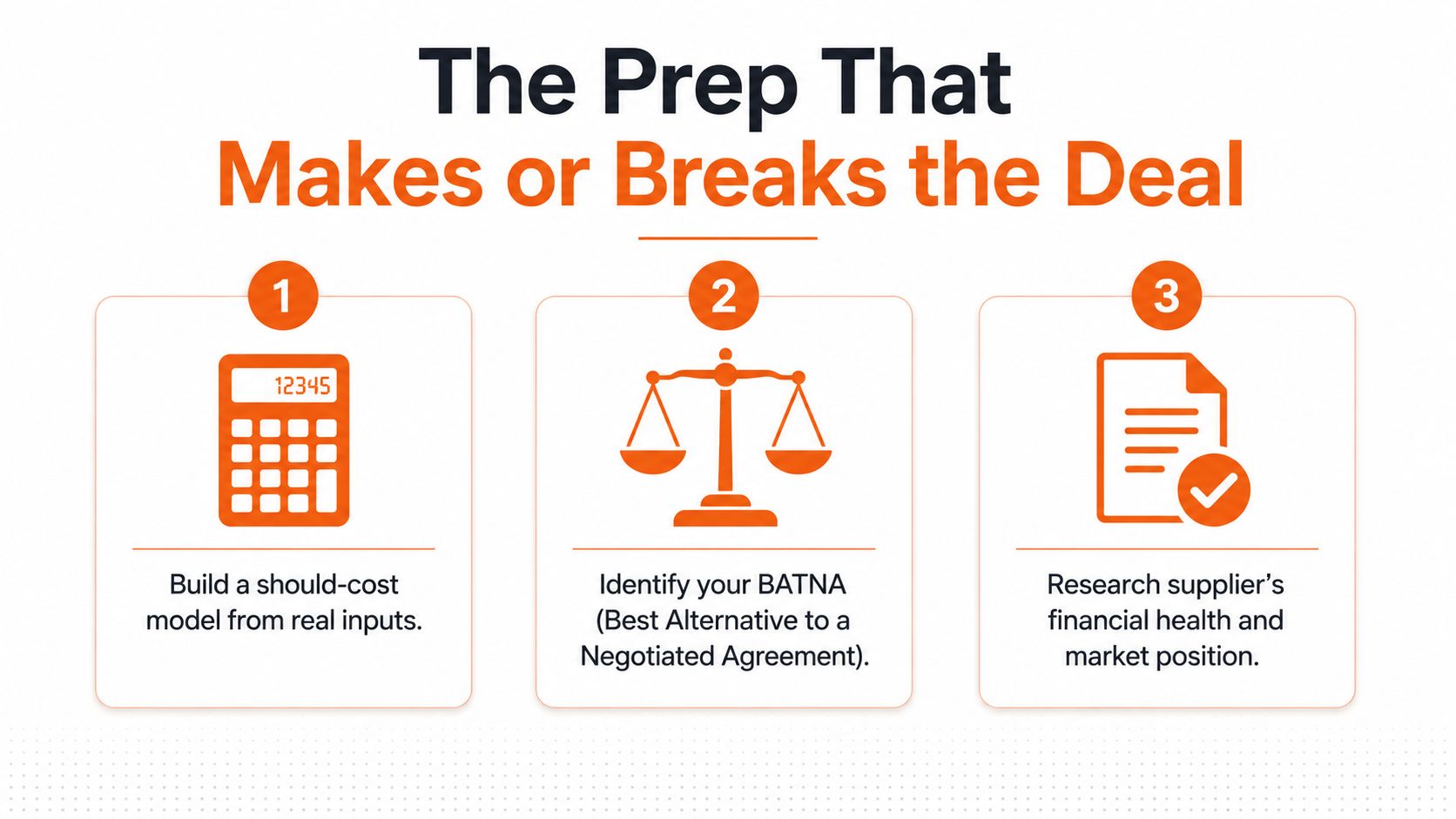
The Prep That Makes or Breaks the Deal
Most founders skip prep because it feels slow. Then they spend twice as long cleaning up a deal that looked fine in the call and fails in practice. I'd rather see a plain one-page prep sheet than a clever conversation that ends with a weak contract and a supplier who knows you never did the math.
Build your number before you build your pitch
Start with a should-cost model. Build it from the product design, labor, materials, packaging, freight, and any process bottlenecks you can verify. A supplier negotiation video from Apriori says strong prep starts with verifiable benchmarks, accurate global costs, and digital models of supplier capabilities.
That is the number you bring to the table. You are not asking, “What do you charge?” You are asking, “What should this cost if I compare regions, processes, and capability?” That framing gives you a number that can hold up under pressure.
Use that approach on a small skincare run of 1,000 units. If the quote feels high, break it into pieces and ask which part moves with volume, which part moves with packaging, and which part moves with process time. The goal is to find the cost drivers, not accept a polished headline price.
Know your BATNA before the call starts
Your BATNA is your Best Alternative to a Negotiated Agreement. If you do not know it, the supplier controls your fear. If you do know it, you can walk away without drama.
I use a blunt question. If this deal dies, what happens next week? If the answer is “I lose launch timing and have no backup,” your BATNA is weak. That does not mean you are stuck, it means you need another supplier in the mix before you push hard on terms.
Split must-have terms from nice-to-have terms before the call. Must-haves are the terms that break the business if they fail, like quality standard, lead time, or payment structure. Nice-to-haves are the extras you want, like cosmetic packaging tweaks or a small branding concession.
Do the MOQ math before you fall in love
MOQ math is where founders lie to themselves. A low MOQ sounds friendly until it wrecks your cash cycle or forces bad unit economics. Before the call, calculate what you can commit to without starving inventory, marketing, or payroll.
I keep one clean page with these lines:
- Your target unit economics: what margin you need to stay alive
- Your cash ceiling: what you can pay without stress
- Your walk-away point: the price or term that kills the deal
- Your fallback option: the next supplier if this one does not work
For contract language and negotiation prep, I point founders to the Kons Law negotiation guide. It reminds you to prepare before you talk, not after you have already made a promise.
If you are sourcing products in Chicago or the Midwest, keep your research organized in one place like this sourcing tag. That is better than digging through old emails the night before a call.
Running the Actual Supplier Conversation
The live call is where founders start talking too much. They explain, justify, and over-share. I do the opposite. I open clean, ask for the supplier's view, and let silence do some of the work.
Open like you mean business
Don't start with a long story. Start with the frame.
“I want to understand your pricing, your constraints, and where we have room to work.”
That line is calm, direct, and it tells the supplier you are not there for theater. If they rush into a quote, slow them down and ask what assumptions sit behind it. You want their structure before you discuss your target.
A practical supplier-negotiation workflow starts with planning objectives, separating must-haves from nice-to-haves, and aligning internal stakeholders before the live conversation Art of Procurement. That logic holds. If your cofounder, ops lead, and finance lead all want different things, the supplier will spot it fast.
Use the 70/30 rule without sounding weird
One expert rule says to spend 70% listening and 30% talking during the negotiation. I use that as a discipline, not a slogan. When you talk less, you hear where the supplier has room, where they are bluffing, and where they need something from you.
Use silence after a quote. Do not rush to fill the gap. Ask, “What would need to change for that number to come down?” Then wait. A lot of founders give away ground because they are uncomfortable with a quiet room.
Scripts you can actually use
For a price-only conversation:
“Your number is higher than I can justify today. Walk me through what drives it, then tell me which part is flexible.”
For a broader conversation:
“I care about price, payment timing, shipping terms, and defect risk. If we move one area, I want to see movement in another.”
Keep concessions off the table in the first pass. Do not volunteer better terms before the supplier shows their hand. That includes payment timing, volume promises, and any story about how badly you need this deal.
If the supplier anchors first, answer with data, not emotion. A simple response works:
“That is not where my numbers land. I came in with a should-cost view, and I want to compare assumptions.”
That keeps the discussion grounded and stops the call from turning into a sales pitch.
A founder sitting on a 14-unit MOQ has less room to bluff, so every sentence has to carry weight. Use the call to learn where the supplier really bends, then press only on the points that change your business.
If landed cost is part of the trade, review your landed cost computation before you say yes to a quote that looks cheap on paper.
The same discipline matters if you are negotiating your crowdfunding price. Small buyers do not win by sounding desperate. They win by being prepared, specific, and hard to distract.
Pricing, Payment, Shipping, and Quality Concessions
Founders waste time fighting over unit price because it is the easiest number to point at. That is the wrong instinct. A slightly higher unit price can be the better deal if it buys cleaner payment terms, lower shipping risk, or fewer quality headaches later.
The four concession buckets
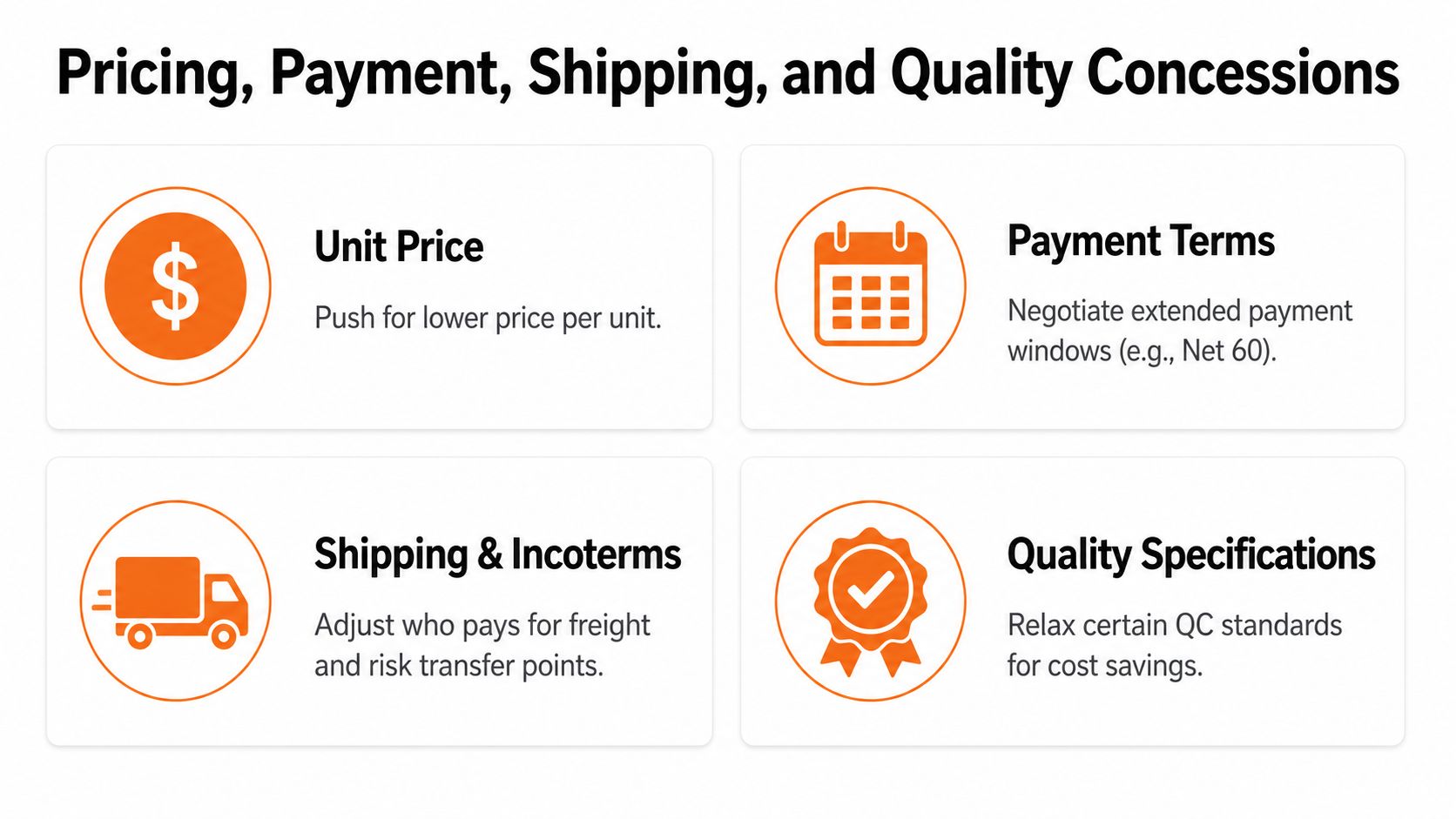
Keep the discussion in four buckets.
| Bucket | What I push on | Why I care |
|---|---|---|
| Unit price | Per-unit cost | It shapes headline margin |
| Payment terms | Due date and deposit timing | It protects cash flow |
| Shipping and Incoterms | Freight responsibility and risk transfer | It controls surprise costs |
| Quality specifications | Defect tolerance, inspection, cosmetic standards | It affects rework and returns |
A real concession is one that changes your business, not one that looks good in a spreadsheet row. If a supplier gives you a tiny price break but tightens payment timing or pushes freight risk back onto you, you did not improve the deal.
Two founder examples that make the trade-off clear
A coffee brand pushing from net-15 to net-30 keeps cash inside the business longer, which can matter more than a small unit-price cut if inventory sits before sell-through. A candle brand might trade MOQ flexibility for free custom molds. That sounds expensive at first, but if the molds improve packaging economics later, it can be the smarter move.
The reverse also happens. A lower unit price with harsh payment terms can choke growth faster than a slightly higher price with room to breathe. Founders who only chase the cheapest quote usually discover that later, after cash is already tied up.
A good reference point for how founders think about price trade-offs in crowdfunding is PledgeBox's guide to negotiating the right price for your crowdfunding project. The logic carries over. You are not chasing the lowest number, you are protecting the business.
If landed cost is part of the decision, use a landed cost computation before you say yes to a quote that looks cheap on paper. A clean breakdown shows whether the cheaper offer is cheaper after freight, duties, and handling. Keep the worksheet next to the supplier terms and compare them in the same file, not in separate tabs.
Building Leverage When You Are the Smallest Buyer in the Room
A founder with a tiny MOQ still has room to get better terms, but only if they stop talking like the supplier holds all the cards. Your size does not decide the deal. Your options do.
Rank your leverage moves by effort
Start with the easiest moves first.
- Commit to future volume carefully: Offer a second-order path or a seasonal follow-on only if you can support it.
- Pay early for a discount: Cash often speaks louder than a long email thread.
- Offer referrals or testimonials: Some suppliers care more about reputation than a tiny price cut.
- Bundle SKUs: If you can combine products or runs, you look more serious.
- Quote multiple suppliers in the same window: Real competition changes the tone fast.
None of that is bluffing. It is giving the supplier a reason to move without kneecapping your own business. If you want better terms, you need to trade something the supplier values.
Make yourself the easy client
Suppliers remember which buyers are organized, responsive, and clear. Send clean files, answer quickly, and keep the scope tight. That makes you the buyer they want to keep, even if your first order is small.
A more advanced procurement method segments suppliers by strategic importance and negotiation complexity, then feeds outcomes like pricing, compliance, cycle time, and performance back into future decisions Ivalua on supplier negotiation. Founders should use the same logic in a simpler way. Track what each supplier does, then reward the ones who behave well in the next round of talks.
That same approach helps you separate the suppliers worth building with from the suppliers worth testing once. For a practical example of how founders think about manufacturing relationships, see Chicago Brandstarters on manufacturing partnerships. The point is simple. Keep the suppliers who make your life easier and stop overinvesting in the ones who create cleanup work.
A Midwest apparel example
I worked with a Midwest apparel founder who had weak negotiating power on her first run. She did not pretend otherwise. She used her second-season volume as the carrot and asked for better payment terms on the first order. That gave the supplier a reason to cooperate now, because the future deal sat right there on the table.
That is how small founders win. They stop trying to dominate the room and start building a path to the next order. One clean promise to reorder, one referral, or one well-timed volume commitment can move a deal more than a loud pitch ever will.
Red Flags Founders Always Rationalize Away
I've ignored every one of these red flags at least once. That is why I'm blunt about them now. A supplier can sound reasonable while pushing risk onto you, taking control away from you, or asking you to trust promises that never make it into the contract.

Watch the line, then read the message behind it
- “We can match the price if you waive the audit clause.” That usually means they do not want scrutiny. Ask, “What part of the process makes an audit a problem?”
- “We're flexible on payment if you commit to a forecast.” That often means they want your commitment before they have earned it. Ask, “What happens if the forecast changes?”
- “We're a family business, so trust is built in.” I do not buy that line. Trust lives in paperwork and follow-through. Ask, “What is your process for documenting changes and defects?”
- “We can't do a small sample run.” That can signal weak process control or a shop that only wants easy volume. Ask, “What would you need from me to make a sample feasible?”
Structural red flags matter too. If contact info keeps changing, if a factory tour gets delayed forever, or if nobody wants to show you how a small run moves through the line, slow down. A supplier should be able to explain its process without hiding behind vague answers.
Read the contract, not the mood
A friendly call can hide a bad contract. That is why you need to slow down before signature. I would rather annoy a supplier with one more question than spend months cleaning up a mess I should have caught early.
If the deal depends on trust alone, it is weak. If the supplier resists documenting defect terms, shipping responsibility, or exit language, I assume the risk is sitting on your side. That is not paranoia. That is experience.
A founder with a tiny MOQ still has more advantage than they think if they can walk away cleanly, compare quotes, and force terms into writing. The smallest buyer in the room can still make the supplier work to keep the order. The mistake is acting grateful for basic professionalism. Demand it.
Choose the deal that leaves you room to move. The supplier who fights clarity on day one will fight every fix later.
Your Supplier Negotiation Checklist and Contract Checklist
I keep two checklists in my head, and I write them down when the deal gets serious. One is for the call. One is for the contract. Use both, and you stop improvising. You start running the deal like an operator.
Pre-call checklist
- Define the objective: Know the one outcome you need.
- Set your BATNA: Know what happens if the deal dies.
- Run MOQ math: Check what you can absorb.
- Bring the three inputs: Verifiable benchmarks, accurate global costs, and a model of supplier capability.
- Split must-haves from nice-to-haves: Protect the business first.
Contract-point checklist
| Contract Point | What to Confirm | Red Flag |
|---|---|---|
| Price | Unit price, volume breaks, change triggers | Hidden surcharges |
| Payment terms | Deposit, due date, late fees | Pressure for faster cash |
| Shipping terms | Freight ownership, risk transfer, timing | Vague responsibility |
| Defect rates | Inspection method, rework, returns | No written standard |
| IP | Ownership of designs, molds, files | Supplier claims shared rights |
| Exit clauses | Termination notice, run-off, file handoff | Locked-in dependence |
A 30-day action plan
This month, schedule one supplier call for each active category. Quote at least two suppliers against each other in the same window. Draft your pre-call sheet before every conversation, then write the contract terms you will accept before the supplier sends final paper.
Do that, and you stop losing deals by accident. You also stop confusing friendliness with power.
Chicago Brandstarters helps founders trade real sourcing notes, supplier questions, and contract lessons with other people who have had to learn the hard way. If you want a place to compare notes on your next supplier conversation, visit Chicago Brandstarters and use it as a practical peer network before you sign the next deal.
Leave a Reply