You finally got the product made. Maybe it's in boxes by your couch. Maybe it's still a polished prototype sitting on your kitchen table. Either way, the same question hits every founder at the same time.
Where the hell do I sell this?
I've watched Midwest founders freeze at this point. They start thinking they need Amazon, Target, distributors, a 3PL, trade shows, retail reps, and some expensive software stack before they can make a single sale. That's backward. A distribution channel strategy is just your plan for getting your product from you to the customer. Nothing more fancy than that.
If you're building in Chicago, Milwaukee, Indianapolis, Columbus, Des Moines, or anywhere else outside the usual startup bubble, you need a strategy that fits real constraints. You probably don't have a giant budget. You probably don't have a warm intro to a national buyer. And you probably don't have time for PowerPoint nonsense.
So You Have a Product Now Where Do You Sell It
I know this moment well. You've spent months wrestling with packaging, sourcing, margins, samples, and timing. Then the product becomes real, and the problem changes. Before, you were asking, “Can I make this?” Now you're asking, “Can I move this?”
That shift messes with people.

A lot of founders in the Midwest get bad advice right here. Most writeups assume you already have capital, software, and partner networks. They skip the reality that existing content rarely addresses how early-stage, resource-constrained founders in non-major hubs like the Midwest can build effective distribution without relying on costly intermediaries or established retail networks (Sales Layer).
That's why I like to keep this simple.
Your channel is just the path.
Your strategy is the map.
Your job is to pick a path you can walk.
Stop trying to look big
I've seen founders in Chicago try to act like a national brand before they've sold enough units to fill a hatchback. They build for scale before they build for proof. That usually ends with dead inventory, channel confusion, and a bruised bank account.
Practical rule: Pick the simplest path that gets your product into a real customer's hands fast.
For some of you, that means your own Shopify store. For others, it means a local boutique, a market stall, a neighborhood gym, a salon, a specialty grocer, or a trusted reseller who already has your buyers.
If you already have one eye on selling outside the U.S., get the basics straight first and then learn about business internationalization before you expand your mess across borders.
Start With Your Customer Not The Channel
The first bad question founders ask is, “Should I sell on Amazon?”
The better question is, “Where does my customer already buy stuff like this?”
If you start with the channel, you're guessing. If you start with the customer, you're hunting.
Find the places your buyer already trusts
A lot of solo founders think direct-to-consumer is the purest path. I get the appeal. You own the site, the emails, the brand, the whole thing. But ego is expensive. If your buyer already shops somewhere else, don't make them work harder just because you want control.
A useful contrarian point is that for early-stage ecommerce and product brands, pursuing “natural partners” such as retailers already serving your target customer yields 3x faster ROI than building direct channels (Zigpoll).
That tracks with what I've seen on the ground.
If you sell a premium dog treat, your first win might come from an independent pet shop in Andersonville, not from a polished DTC funnel. If you sell a kitchen product for busy parents, maybe your best first channel is a local boutique with a customer base that already buys practical household gear. If you sell a specialty food item, maybe your first repeat buyers come from neighborhood grocers, weekend markets, and niche online communities.
Build a customer profile you can actually use
Skip the fake persona exercise where you invent some nonsense about “Sarah, age 34, who loves brunch.” Write down what matters for distribution.
Use this short list:
- What problem are they solving: Is this impulse, convenience, status, health, hobby, gift, or routine replenishment?
- Where do they already shop: Local stores, Instagram, TikTok Shop, Amazon, Etsy, farmers markets, trade associations, salons, gyms, specialty retailers.
- How much trust do they need first: Some products need explanation. Some don't.
- How do they want to buy: Self-serve online, in person, through a recommendation, or through a business buyer.
- What stops them from buying: Shipping cost, product confusion, shelf comparison, lack of reviews, slow delivery, or price shock.
You don't need a research department. You need conversations. If you haven't done enough of those, go read this guide on customer discovery interviews.
Your buyer already has habits. Your job is to ride those habits, not rewire them from scratch.
You can also sharpen the demand side by researching startup market validation. I like that kind of work because it keeps you from building your whole channel plan around your own assumptions.
A fast Midwest gut check
Ask yourself these three questions:
| Question | If the answer is yes | What it points to |
|---|---|---|
| Do people need to touch, taste, smell, or try it? | You need trust and physical proof | Local retail, pop-ups, markets |
| Do people already search for this online? | They know the category | DTC or marketplace |
| Do buyers rely on a curator? | Someone else filters options for them | Wholesale, reseller, specialty partner |
That's the game. Start with the customer. The channel comes second.
Map Your Channel Options From DTC to Wholesale
Once you know who you're selling to, you can map the actual routes. I like to think of channels the way I think about CTA trains. Different lines can get you downtown. The ride, cost, speed, and hassle are different.
One useful reality check is this: the vast majority of successful companies strategically use between 2 and 4 primary distribution channels, and relying on a single channel often limits your reach across customer types (Arfadia).
That does not mean you should launch all of them at once. It means a healthy business usually ends up with a few lanes, not one.
Here's the visual map.
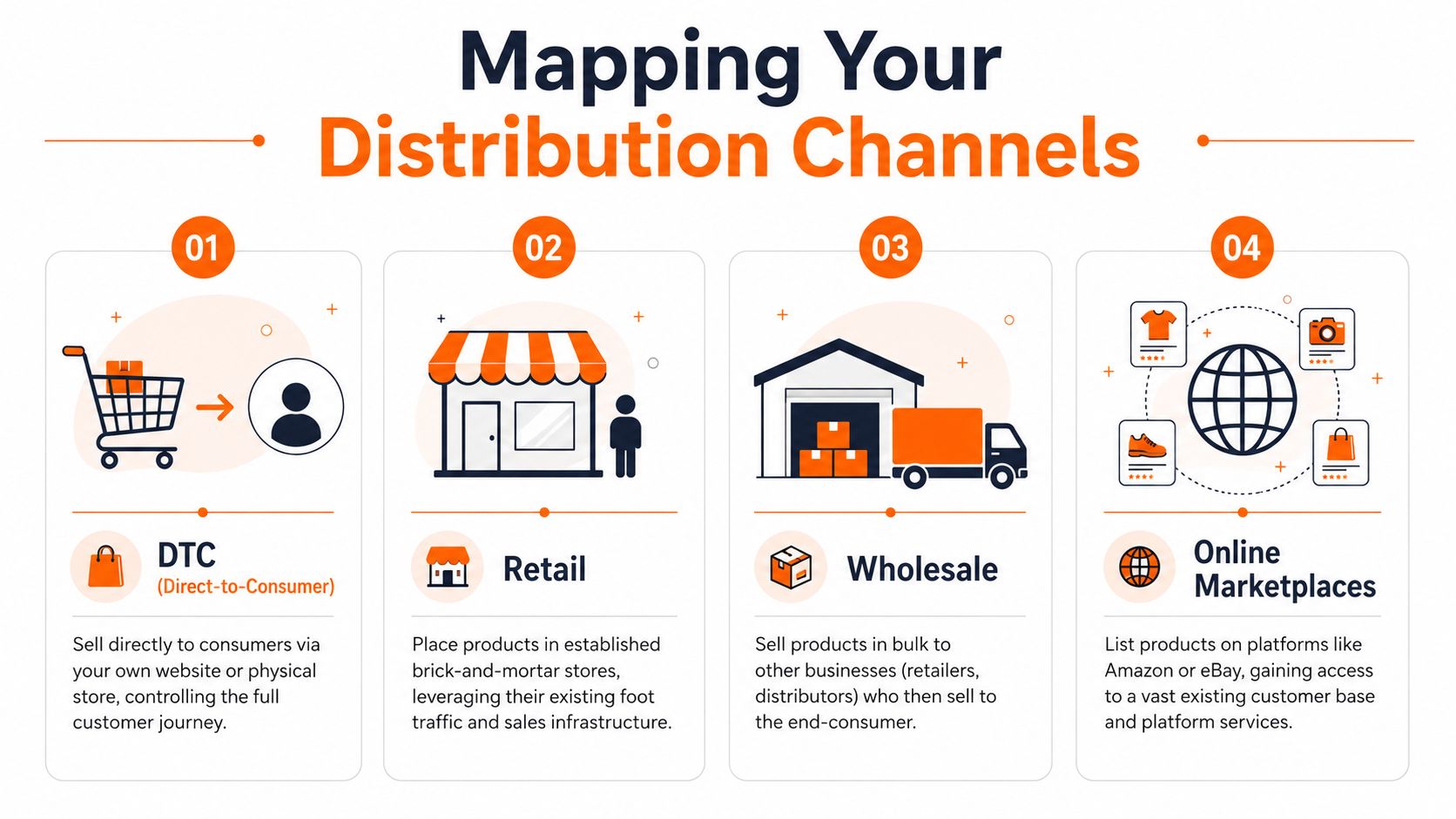
Direct to consumer
This is your own site, your own checkout, your own customer relationship.
What I like about it
- Control: You own the story, pricing, and customer experience.
- Margin: No retailer taking a cut out of every sale.
- Feedback: You hear customer objections fast.
What bites founders
- You create the traffic: Nobody is coming just because your site exists.
- Fulfillment gets annoying fast: Packing one box is fun. Packing fifty is a job.
- Conversion pressure is real: If the site is weak, sales stall.
DTC works well when your product has a clear story, decent demand capture, and enough margin to support customer acquisition.
Online marketplaces
Amazon, Etsy, Walmart Marketplace, Faire in some contexts. These are rented shelves with built-in traffic.
A lot of founders use marketplaces because they want speed. Fair. Just remember that speed comes with rules.
What I like
- You can get in front of shoppers who already intend to buy.
- The platform handles a lot of the buying friction.
- Search demand can do some heavy lifting.
What gets ugly
- You live inside someone else's system.
- Fees, competition, and copycat pressure are real.
- The customer often belongs more to the platform than to you.
If you're weighing Amazon specifically, this breakdown of Amazon FBA vs FBM is useful because fulfillment changes the math and the workload.
A quick explainer helps here too:
Wholesale and retail
You sell to stores, chains, boutiques, distributors, or other businesses that sell onward.
For Midwest founders, this route is often more realistic than people think. You don't need a national account on day one. You need one store owner who believes in the product and has your customer walking through the door.
Selling wholesale is like dating someone with an existing friend group. You borrow trust, but you share the attention.
Pros
- Volume: Bigger orders than most early DTC days.
- Trust transfer: The store's reputation helps you.
- Less daily marketing grind: The retailer already has foot traffic or repeat buyers.
Cons
- Lower margin: The buyer needs room to make money too.
- Longer sales cycle: Buyers move slower than consumers.
- You need consistency: Late shipments and sloppy packaging kill repeat orders.
Use a mix, but earn the right to expand
Don't build four channels because a blog told you diversification matters. Build one that works, then add the second. Good founders usually dominate one lane before they widen the road.
If I were starting from zero with limited cash, I'd usually choose one primary lane and one backup lane. For example:
- DTC plus local retail
- Markets plus Shopify
- Wholesale plus a light DTC site
- Amazon plus email capture elsewhere
That's enough complexity for most early brands.
Do the Math Before You Commit
A channel can feel exciting and still be a bad business.
Founders often get themselves into trouble. They confuse revenue with margin. They celebrate a wholesale order, then realize the discount, packaging requirements, freight, and samples ate the profit. Or they launch online, run ads, ship fast, and learn that every order loses money.
Your distribution channel strategy needs math. Boring, plain math.
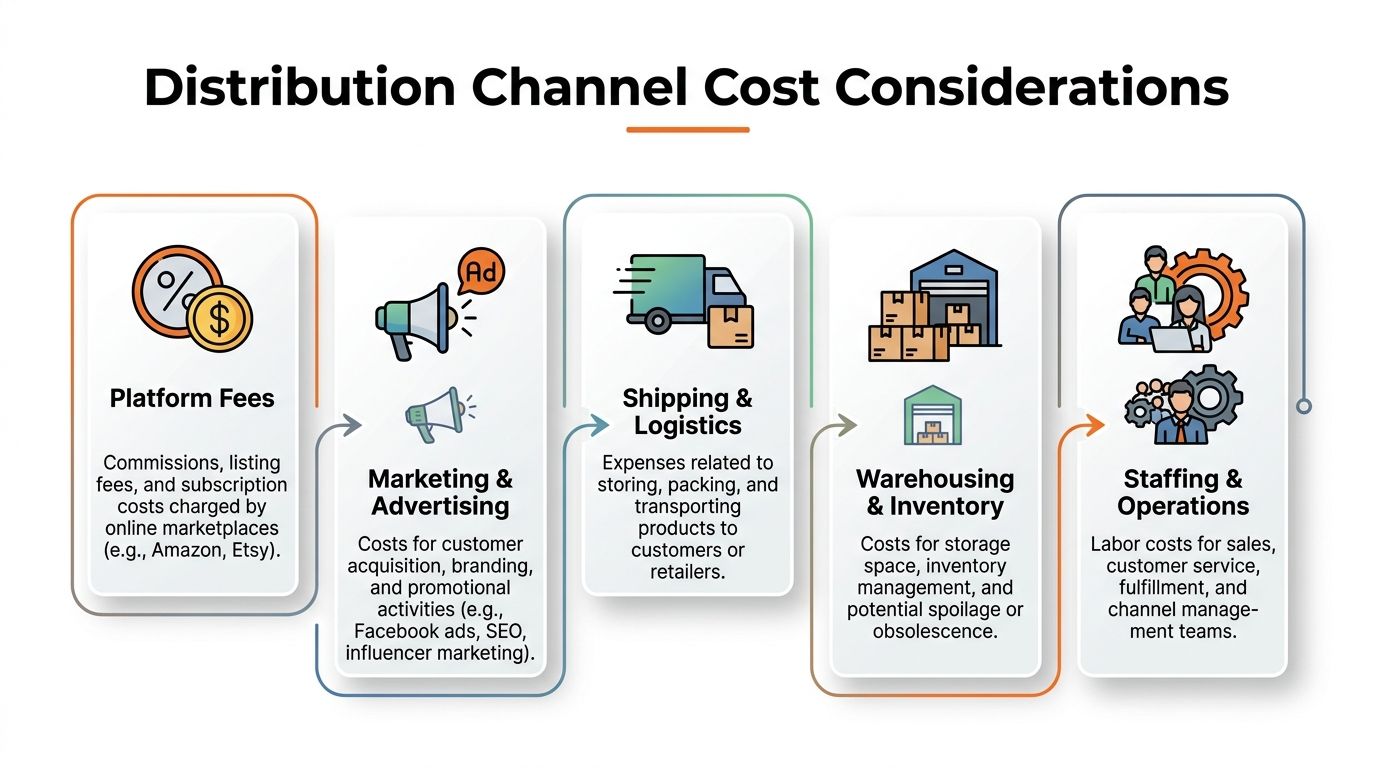
Use a simple channel margin worksheet
Think of this like checking your own monthly budget. You don't need finance jargon. You need to know what comes in, what goes out, and what's left.
For each channel, list:
Selling price
What the customer pays, or what the retailer pays you.Cost of goods sold
Product cost, packaging, inserts, labels.Channel-specific fees
Marketplace fees, wholesale discounts, sales commissions, payment processing.Shipping and logistics
Inbound freight, outbound shipping, packing materials, storage.Marketing cost
Ads, samples, promos, influencer seeding, trade show samples if you use them.Labor and operating drag
Your time counts. So does contractor help, fulfillment labor, customer support, and returns handling.
Then ask one question.
After all that, what's left per order?
Compare channels side by side
| Channel | Main upside | Main trap |
|---|---|---|
| DTC | Better control and direct customer data | You pay to create demand |
| Marketplace | Built-in buying intent | Fees and weak customer ownership |
| Wholesale | Bigger order sizes | Lower margin and slower payment cycles |
| Local events and pop-ups | Immediate feedback | Hard to repeat if the model depends on you showing up every time |
A lot of shipping mistakes show up after you start promising speed you can't sustain. If you're tempted to slap “fast delivery” on everything, read this piece on avoiding next day delivery pitfalls. The examples are UK-focused, but the operating pain is universal.
The numbers I actually care about early
I don't want founders buried in spreadsheets. I want them to know whether a channel deserves more energy.
So I care about:
- Gross dollars left after the sale: If the order doesn't leave enough cash behind, stop romanticizing it.
- Cash timing: Wholesale can look good on paper and still choke you if payment takes forever.
- Repeat potential: Some low-margin first sales make sense if reorders are clean.
- Operational pain: A channel that creates endless exceptions drains you.
If gross margin math still feels fuzzy, this explainer on calculation of gross margin percentage is a solid refresher.
Reality check: A channel that grows revenue while draining cash is a trap, not traction.
You don't need a perfect forecast. You need honest inputs and the discipline to walk away from channels that flatter your ego and starve your business.
Run Small Tests to Learn Fast
I don't trust channel strategy until customers prove it.
A lot of founders try to think their way to certainty. They spend months comparing Shopify themes, marketplace guides, broker lists, distributor lists, and ad ideas. That's just expensive procrastination wearing a work shirt.
The better move is a pilot.
According to a practical implementation approach for channel building, you should run a controlled pilot with 2-week iteration sprints before scaling, and the quick-win track should show visible ROI within 60 days (Scala AI).
That's a smart operating rhythm for scrappy founders because it forces a decision.
What a useful test looks like
A useful test is small, specific, and cheap enough that failure won't hurt much.
Good examples:
- A weekend market test: Can you get strangers to stop, ask questions, and buy?
- A local retail trial: Can one store sell through a starter order without you begging customers to go there?
- A DTC test: Can your site convert the traffic you can realistically drive?
- A marketplace test: Can your listing earn sales without turning into a fee swamp?
- A partner test: Can a gym, salon, coffee shop, or niche retailer move the product because their customers already fit?
My favorite pilot structure
I like a test that fits on one page.
Pick one question
Don't test “distribution” in general. Test one thing.
Examples:
- Will neighborhood boutique buyers reorder this product?
- Will cold traffic buy this on our site at this price?
- Will a market environment create enough demand to justify more events?
Define success before you start
You need a pass or fail condition. If you decide success after the test, you're lying to yourself.
Write:
- What channel you're testing
- What result would count as good enough
- What result means stop
- What you need to learn even if sales are weak
Keep the test window tight
Two weeks is good because it stops drift. A pilot shouldn't become a lifestyle.
I've seen local brands prove more in two weekends at a neighborhood market than in two months of “planning.” You hear objections. You watch hands reach for one SKU and ignore another. You notice what price makes people pause. That's field data. That's worth more than your spreadsheet guesses.
If customers won't buy in a small test, scale won't rescue you. It usually just scales the mistake.
A Midwest founder advantage people ignore
If you're in the Midwest, you often have easier access to close customer contact than founders in bigger coastal scenes. You can get in front of buyers at community events, niche retailers, local trade circles, and word-of-mouth networks without burning piles of cash.
Use that.
Chicago Brandstarters is one example of a founder group where people trade tactics on channel selection, local tests, and early distribution choices. That kind of peer feedback matters because somebody else has usually already made the mistake you're about to make.
What to watch during a test
Don't only count sales. Watch behavior.
- Who stops and why
- What objections repeat
- Which SKU gets attention
- How people describe the product back to you
- Whether the partner effectively pushes the product
- How annoying fulfillment becomes at small volume
A good test gives you one of three answers. Push harder. Change something. Kill it.
That's enough.
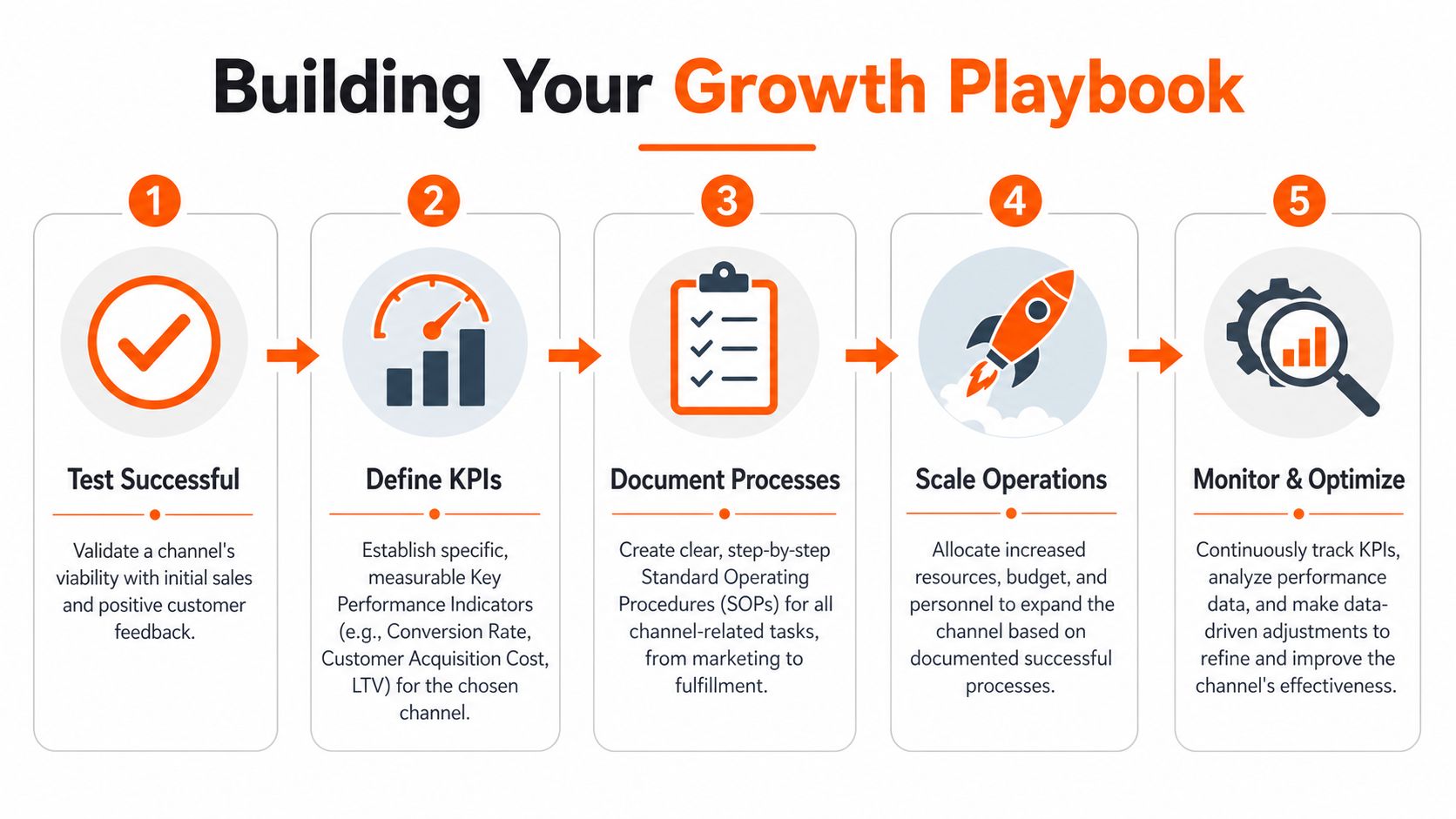
Set Your KPIs and Build Your Growth Playbook
Once a test works, don't wing it. Turn it into a system.
A lot of founders stay in permanent improvisation mode. That works when you're tiny. Then one retailer reorders, your site picks up, a marketplace starts moving, and suddenly the whole thing feels like trying to carry groceries, open a door, and answer a phone call at the same time.
You need a playbook.
Track the numbers that keep you out of trouble
One of the biggest operational problems in longer channels is the bullwhip effect, where small swings and bottlenecks amplify upstream. To prevent that, you need dashboards that track inventory turnover, fill rate, and order accuracy (IJMMM).
You don't need enterprise software to do that early. A clean Google Sheet is enough if you maintain it.
Here are the KPIs I'd put on the first dashboard.
Sales health
- Sales volume by channel
- Repeat order pattern
- Average order quality, meaning whether the orders are healthy enough to keep
Operational health
- Inventory turnover
- Fill rate
- Order accuracy
- Time to delivery
Economic health
- Channel margin
- Promo or sample drag
- Returns or replacement pain
Build a playbook that another person could run
If the channel only works because you remember everything in your head, it doesn't really work.
Write down:
How an order comes in
Email, Shopify, wholesale PO, marketplace portal.How you confirm and fulfill it
Pick, pack, ship, update, invoice.What can go wrong
Stockouts, damaged units, delayed shipment, pricing conflict, bad retailer fit.What you do when it goes wrong
Refund, replace, partial shipment, reorder timing, customer message.When you review the channel
Weekly is fine at the start.
Keep channel conflict from turning into chaos
When you sell in more than one place, conflict shows up fast. A retailer gets mad because your site has a better promo. A marketplace price drops and undercuts a boutique partner. Your own buyers ask why shipping is faster somewhere else.
Often, small founders get sloppy.
Use basic rules:
- Keep pricing logic clean
- Decide who gets which SKU or bundle
- Set promo windows on purpose
- Communicate stock reality before somebody gets burned
A dashboard isn't a report card. It's a windshield. You use it so you don't drive into a ditch.
My bias on scaling
I don't like adding new channels just because the first one worked. I like squeezing more out of a working channel before I complicate the business.
That means:
- Tighten the ops
- Clean up the reorder process
- Fix stock planning
- Improve your merchandising or listing
- Make fulfillment boring and repeatable
Then expand.
A solid distribution channel strategy is rarely flashy. It's usually a few channels you understand well, a few numbers you check every week, and a willingness to cut what doesn't earn its keep.
If you're building a product brand in Chicago or anywhere in the Midwest and want honest feedback on channel choices, Chicago Brandstarters is a free founder community where operators talk through real distribution problems, customer discovery, margins, retail tests, and early growth without the fake networking routine.
Leave a Reply