

You place your first serious inventory order. The pallets arrive. The boxes are real. Your brand suddenly feels legitimate.
Then the money starts leaking.
I’ve watched founders celebrate a full shelf while their bank account gets tighter every week. They think the pain came from paying the supplier. It didn’t. The pain keeps going after the inventory lands. Every unit sitting in your garage, warehouse, or 3PL has a meter running.
That meter is inventory carrying cost.
If you’re bootstrapping, this number matters more than most founders realize. Carrying costs can consume 15% to 30% of inventory value annually for founders making decisions about minimum order quantities, warehousing, and pricing, and many businesses become unprofitable once they account for these holding costs, according to MRPeasy’s breakdown of carrying cost for founders. That’s why I tell early operators to learn the difference between profit and actual cash in the bank early. If you want a clean primer on that trap, read this guide for startup financial planning.
Inventory is not just stock. It’s cash wearing a cardboard costume.
Your Inventory Is Costing You Money While It Sits
The biggest mistake I see is emotional. You look at inventory and see progress. I get it. Product on a shelf feels safer than money in a checking account. It feels tangible. It feels like momentum.
But unsold inventory acts more like a parked truck with the engine on. It burns money while going nowhere.
The quiet rent your products pay
I think of inventory carrying cost as rent for owning stock. You already paid to buy the product. Now you keep paying to store it, insure it, manage it, and absorb the risk that it gets damaged, stolen, or outdated before it sells.
That’s why founders get blindsided. The costs are scattered across bills and categories. One charge sits in your 3PL invoice. Another sits in insurance. Another hides in the fact that you can’t use that tied-up cash for Meta ads, a better photographer, or your next production run.
Inventory feels like an asset on paper. In a cash crunch, it behaves like a bill.
Why bootstrapped founders feel this harder
If you raised a lot of money, you can survive bad inventory decisions longer. If you’re self-funded or running lean, inventory carrying cost hits your runway fast.
Here’s the hard truth. Most founders don’t die because they had a bad product. They die because they bought too much, too early, and then had to keep feeding the pile.
That’s why I want you to treat inventory like a loan you gave yourself. Every extra unit has to earn its place. If it can’t sell in a reasonable window, it’s not “being prepared.” It’s crowding out better uses of cash.
The Four Components of Inventory Carrying Cost
Carrying cost works like the total cost of owning a car. The sticker price is only the beginning. After that, you pay for gas, insurance, repairs, registration, and depreciation. Inventory has the same problem.
For DTC and ecommerce brands, real inventory carrying costs are often 22% to 41% of total inventory value, not just the old 20% to 30% rule of thumb, according to OpenSend’s inventory carrying cost statistics for ecommerce. That same source breaks the total into cost of money 6% to 12%, taxes 2% to 6%, insurance 1% to 3%, warehouse expenses 2% to 5%, physical handling 2% to 5%, clerical and inventory control 3% to 6%, obsolescence 6% to 12%, and deterioration or theft 3% to 6%.
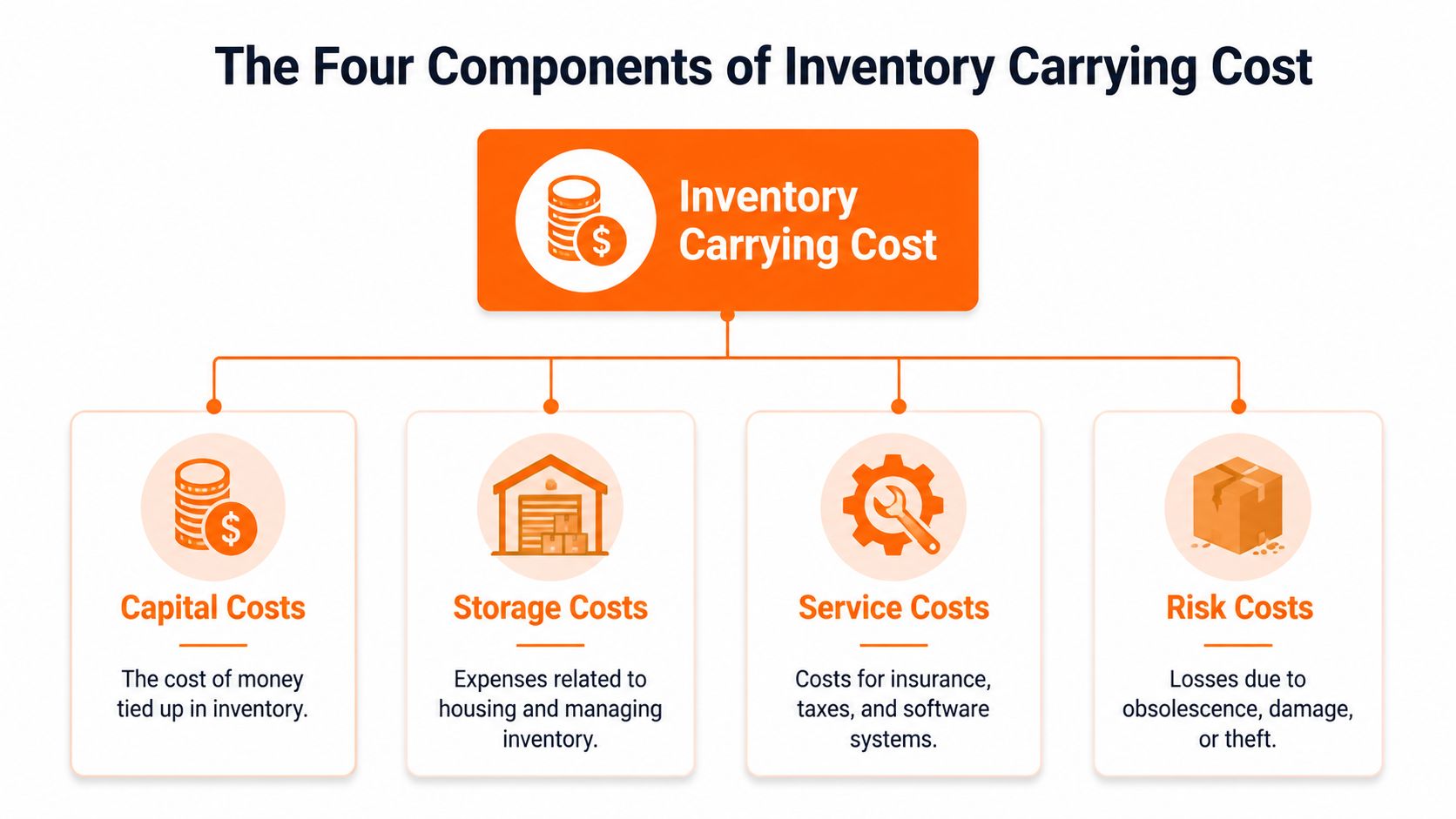
Capital costs
This is the one I want you to obsess over first.
Capital cost is the money trapped in inventory instead of working elsewhere. If you sink cash into six months of stock, that cash can’t fund customer acquisition, packaging fixes, product development, or payroll. The accounting label sounds clean. The founder experience is messy. You feel it when sales are decent but you still can’t breathe.
If your margin is thin, capital cost can turn “we’re growing” into “why is my account empty?”
Storage and service costs
These are the bills founders expect, but usually undercount.
Storage costs include warehouse rent, 3PL storage fees, utilities, equipment, and labor tied to moving and managing inventory. Service costs include insurance, taxes, and the admin layer needed to keep inventory visible and controlled.
A lot of founders make the mistake of viewing these as overhead unrelated to unit economics. Wrong. If inventory drives the spend, inventory owns the spend.
Risk costs
This bucket is where sloppiness gets expensive.
Risk costs cover obsolescence, damage, spoilage, markdowns, shrinkage, and theft. Apparel founders feel this when styles miss. Beauty founders feel it when products age out. Seasonal brands feel it when timing slips and they’re left holding inventory that belongs to last quarter.
Practical rule: The longer a unit sits, the more ways it can hurt you.
What I’d watch first
If you’re early, don’t try to build a perfect cost accounting system in week one. Start with these questions:
- Cash tied up: How much money is stuck in inventory that isn’t turning fast enough?
- Storage pressure: Are your storage fees rising because you ordered for confidence instead of demand?
- Admin creep: Are software, counting, and handling costs rising with complexity?
- Aging inventory: Which SKUs are becoming harder to sell at full price?
You don’t need fancy software to ask these questions. You need honesty.
How to Calculate Your Carrying Cost The Right Way
You can lose a month of runway with one bad PO. That usually starts with a bad carrying cost number.
The formula itself is straightforward:
(Total Carrying Costs / Average Inventory Value) × 100
What matters is getting the inputs right, especially average inventory value. If you use a random inventory snapshot from one date, you will undercount what inventory is costing you and overestimate how much cash you really have to work with.

Use average inventory value, not a one-day number
Founders pull the inventory value sitting in Shopify, QuickBooks, or a spreadsheet on one day and call that the denominator. That shortcut gives you a bad answer.
The right method is to add beginning inventory to ending inventory and divide by two. Using a point-in-time value can understate carrying costs by 15% to 25%, according to Unleashed Software’s explanation of inventory carrying cost.
For a bootstrapped brand, that mistake is expensive. If your carrying cost looks lower than it really is, you reorder too early, buy too deep, and convince yourself your cash position is stronger than it is.
A clean way to run the math
If you started the period with $300,000 in inventory and ended with $500,000, your average inventory value is $400,000.
Then do the calculation in this order:
- Add up total carrying costs for the period. Include storage, insurance, taxes, handling, admin, and inventory-related losses.
- Calculate average inventory value using beginning inventory plus ending inventory, divided by two.
- Divide carrying costs by average inventory value and multiply by 100.
- Track the percentage every month so you can spot cash flow problems before they pile up.
That monthly habit matters more than founders think.
Annual numbers are too slow for a business that is still fighting for oxygen. If your carrying cost rate jumps for two months in a row, you need to know now, not after year-end when the cash is already gone.
The number to watch like a founder
Don’t stop at the percentage. Track the dollar amount too.
A 25% carrying cost on $80,000 of average inventory means you’re spending $20,000 a year to hold that stock. For a bootstrapped founder, that is not an accounting detail. That is ad budget, payroll cushion, product development, or your own paycheck.
This is the operating question that matters: How much cash is my current inventory position burning every month?
If your calculation is sloppy, every decision built on top of it gets worse. You keep weak SKUs alive. You justify oversized POs with a lower unit cost. You mistake bulk buying for margin improvement when it is really a runway hit.
A cheaper landed unit can still be a worse cash decision.
If your sales swing by season, launch cycle, or promo calendar, average values keep you grounded. One-day snapshots do not.
Real World Examples for Ecommerce Founders
Numbers get real when you attach them to products sitting in actual boxes.
I want you to think like an operator, not a student. Don’t ask, “What is my carrying cost percentage?” first. Ask, “What is this inventory stopping me from doing with cash?”
A founder running a t-shirt brand
Say you run a t-shirt brand and your average inventory value is $50,000. If you use a 25% carrying cost rate, you’re spending $12,500 per year just to hold that inventory.
That’s not abstract. That’s cash that can’t go into content, ad testing, samples, or your own paycheck.
At that level, I’d ask a few uncomfortable questions:
- Did you buy too deep in too many sizes?
- Are you keeping low-velocity colorways alive because you like them?
- Did a supplier discount tempt you into a larger MOQ than your demand justified?
Founder ego becomes costly. You don’t need “enough inventory to feel real.” You need enough inventory to serve demand without choking your cash flow.
A founder selling premium skincare
Now take a skincare brand with $200,000 in average inventory. If carrying cost lands closer to 35%, that’s $70,000 per year to hold it.
That number hurts because skincare has more ways to punish bad inventory decisions. Packaging changes. formulas change. Expiration risk is real. Slow lots don’t just sit there. They age.
If I were advising that founder, I’d care less about squeezing a slightly better unit cost from a factory and more about whether inventory is turning into sales before risk costs pile up.
The wrong inventory strategy can eat the salary of your next hire before you make the hire.
The point is not the percentage
The point is what the dollars do to your options.
That t-shirt founder might postpone a creative project because cash is boxed up in a 3PL. The skincare founder might delay a restock of the winning SKU because too much money is trapped in slower movers. In both cases, inventory carrying cost acts like drag on the business.
And drag matters more when you’re trying to get to seven figures without outside capital. Every dollar that sits on a shelf is a dollar that can’t go back into motion.
Smart Ways to Lower Your Carrying Costs
You lower inventory carrying cost by fixing behavior, not by hoping for better math. The answer is almost never “buy a giant batch and pray it moves.” The answer is tighter decisions, faster feedback, and better terms.
For bootstrapped brands, this matters because carrying costs are a direct threat to working capital. Clear Spider’s write-up on inventory carrying cost notes that improving demand forecasting and safety stock can reduce these costs by up to 30%, freeing cash otherwise trapped on shelves for 90 to 150 days during the cash conversion cycle.
Start with forecasting that is boring and honest
Most inventory mistakes start with optimism.
You tell yourself the launch will hit hard. You assume the influencer post will convert. You count interest as demand. Don’t do that. Base your orders on what has sold, what is currently selling, and what lead times force you to commit to.
If you want a practical checklist for tightening your process, I like Menza's inventory management tips because they focus on day-to-day execution instead of theory.
What I’d do first:
- Review SKU velocity: Which products move consistently, and which only move when you discount them?
- Separate hope from evidence: Don’t use likes, compliments, or wholesale “interest” as if they were purchase orders.
- Order narrower: Go deeper on proven winners and shallower on experiments.
Fix reorder points before you chase advanced tactics
A lot of founders swing between panic buying and panic stockouts. That usually means reorder points are loose or nonexistent.
Your reorder point should reflect actual sales pace and supplier lead time. Even a simple spreadsheet beats “I think we should reorder soon.” When your process is vague, you build safety stock on fear. Fear is expensive.
I’d also look hard at your supplier relationship. If your terms are bad, your cash gets squeezed from both sides.
If you need help preparing for those conversations, read this guide on how to negotiate with suppliers. Better terms won’t fix bad forecasting, but they can buy you breathing room.
Use selective low-inventory models
Not every SKU deserves the same inventory strategy.
Some products should be stocked normally because they move fast and predictably. Others are better handled with lighter inventory positions, preorders, limited runs, or a more just-in-time approach. I’m not ideological about this. I care about cash.
Here’s a simple way to explain it:
- Core bestseller: Keep tighter but reliable stock.
- Experimental SKU: Buy small and learn fast.
- Bulky slow mover: Question whether you should stock it at all.
- Custom or long-tail item: Consider a model that lowers on-hand inventory.
A short explainer can help if you want another angle on the operational side:
The founders who get this right don’t obsess over full shelves. They protect optionality. They keep cash available so they can react when demand changes, a supplier slips, or a winning ad suddenly needs more budget.
The Overstock vs Stockout Tightrope Walk
If this article makes you want to slash inventory across the board, slow down.
Inventory carrying cost is real, but stockouts are not free. When you run out, you lose the sale in front of you. You may also waste the ad spend that brought the customer there in the first place. Worse, some customers won’t bother coming back.
Balance beats extremes
The game is not “carry as little inventory as possible.” The game is to hold the right amount.
That’s where safety stock earns its keep. Safety stock is your buffer against supplier delays, messy forecasts, and random spikes in demand. Too much safety stock turns into overstock. Too little turns your business into a backorder apology machine.
Good operators don’t eliminate inventory risk. They choose which risk they can afford.
How I’d think about the tradeoff
I’d split SKUs into three groups:
- Reliable winners: Keep enough safety stock to avoid easy misses.
- Unpredictable items: Stay lean and reorder carefully.
- Problem children: If a SKU sells slowly and ties up cash, stop defending it.
If you sell across multiple channels, this gets more complicated fast. Inventory can look healthy in total while one channel suffers a hidden stock shortage. That’s why clean multichannel inventory management matters. You need one view of what’s available, what’s reserved, and what’s pretending to be available.
The best inventory strategy usually feels slightly uncomfortable. You won’t feel “fully safe.” That’s normal. You’re trying to avoid two expensive mistakes at once.
Your Founder KPI and Inventory Health Tracker
You do not need an ERP to start. You need a spreadsheet you’ll update.
If you track a few numbers every month, patterns show up early. You’ll see when inventory is bloating, when aging stock is getting worse, and when carrying cost is starting to choke your cash. If you want a broader dashboard beyond inventory, Arlo Inc.'s guide to ecommerce KPIs is a useful companion read.
What to track every month
I’d start with a simple sheet like this:
| Metric | Jan | Feb | Mar | Formula / Note |
|---|---|---|---|---|
| Beginning inventory value | Use inventory value at start of month | |||
| Ending inventory value | Use inventory value at end of month | |||
| Average inventory value | (Beginning inventory + Ending inventory) / 2 | |||
| Storage costs | 3PL storage, warehouse rent, utilities tied to inventory | |||
| Service costs | Insurance, taxes, software, admin tied to inventory | |||
| Risk costs | Damage, shrinkage, markdowns, write-offs | |||
| Capital costs | Cost of money tied up in inventory | |||
| Total carrying costs | Sum of storage, service, risk, and capital costs | |||
| Inventory carrying cost | (Total carrying costs / Average inventory value) × 100 | |||
| Slow-moving SKUs | Count or list SKUs you need to review | |||
| Stockouts on core SKUs | Note where missed sales may have happened | |||
| Action for next month | Reorder less, discount old stock, renegotiate terms, etc. |
One more metric I’d pair with this
Track inventory carrying cost alongside turnover. They work together. If carrying cost is high and turnover is weak, that’s your warning light. If you need a refresher, this guide on the inventory turnover formula is worth bookmarking.
Don’t overcomplicate the first version. Fill it out monthly. Review it with brutal honesty. Make one decision from it every month. That’s how this turns from finance homework into cash control.
If you're building a product or ecommerce brand in the Midwest and want honest conversations with founders who’ve lived through these cash flow mistakes, check out Chicago Brandstarters. It’s a free community for kind, hard-working builders who want real operator advice, not performative networking.
Leave a Reply