
Most Amazon advice to new sellers is lazy. It goes like this: "Just use FBA." Easy, familiar, done.
I think that's bad default advice for a lot of founders.
If you're asking what is FBM, the plain-English answer is simple. FBM means Fulfillment by Merchant. You sell on Amazon, but you handle the storage, packing, shipping, returns, and customer service yourself, or through a partner you choose. Amazon is the storefront. You run the back room.
That isn't some fringe workaround. FBM has been around since Amazon's marketplace launch in 2000, and by 2025 it accounts for about 60 to 70% of total Amazon listings, even though FBA handles over 50% of sales units, according to Seller Assistant's Amazon FBM overview. I read that as a blunt market signal: a lot of sellers still want control.
Why Everyone Talks About FBA but Smart Founders Use FBM
Amazon has done a great job selling founders on convenience. That does not mean convenience is the smart first move.
If you're new, FBA can pull you into the wrong habits fast. You send inventory in, accept the fees, accept the rules, accept the delays, and slowly build a business that works only as long as Amazon keeps the machine friendly. I would not choose that setup by default if you're still testing products, protecting cash, and trying to learn what customers want.
FBM gives you something more useful than convenience. It gives you control.
With FBM, Amazon is a channel, not your operator. You decide how inventory is stored, how orders go out, what the package looks like, and how customer issues get handled. If you want the plain-English version of what is fulfillment service, it comes down to who owns the work after the sale. With FBM, you do, or a partner you choose does.
That matters because real brands are not built by outsourcing every hard part on day one.
Why smart founders start here
I like FBM for new brands because it forces clean thinking. You see your costs. You see where returns come from. You see which products are worth restocking and which ones are lying to you. FBA can hide bad economics for a while. FBM exposes them early, which is exactly what a founder needs.
It also keeps your business from getting trapped inside one channel. If you are serious about growth, you need inventory systems that work across Amazon, your own site, and wholesale. That is a big reason to set up multichannel inventory management for growing brands before your operations get messy.
What FBM gives you that FBA does not
Good founders usually care about the same four things in the early stage:
- More control over margin. You can make smarter decisions when fulfillment costs are visible and adjustable.
- More control over the customer experience. Packaging, inserts, speed, and problem-solving stay in your hands.
- More flexibility with inventory. Your stock is easier to move across channels instead of sitting inside Amazon's network.
- More business resilience. You are building operating muscle, not just renting Amazon's infrastructure.
That last point gets ignored. I think it's the whole game.
FBA is great at helping you sell through Amazon. FBM is better at helping you build a company that can survive outside of Amazon. For a new brand, that is often the smarter bet.
How Fulfillment by Merchant Actually Works
FBM is basically running your own restaurant instead of renting space in a ghost kitchen.
With FBA, Amazon cooks, plates, and sends the meal out. With FBM, you run the kitchen. You choose where ingredients sit, how orders get packed, what the customer sees when the box opens, and how problems get fixed.
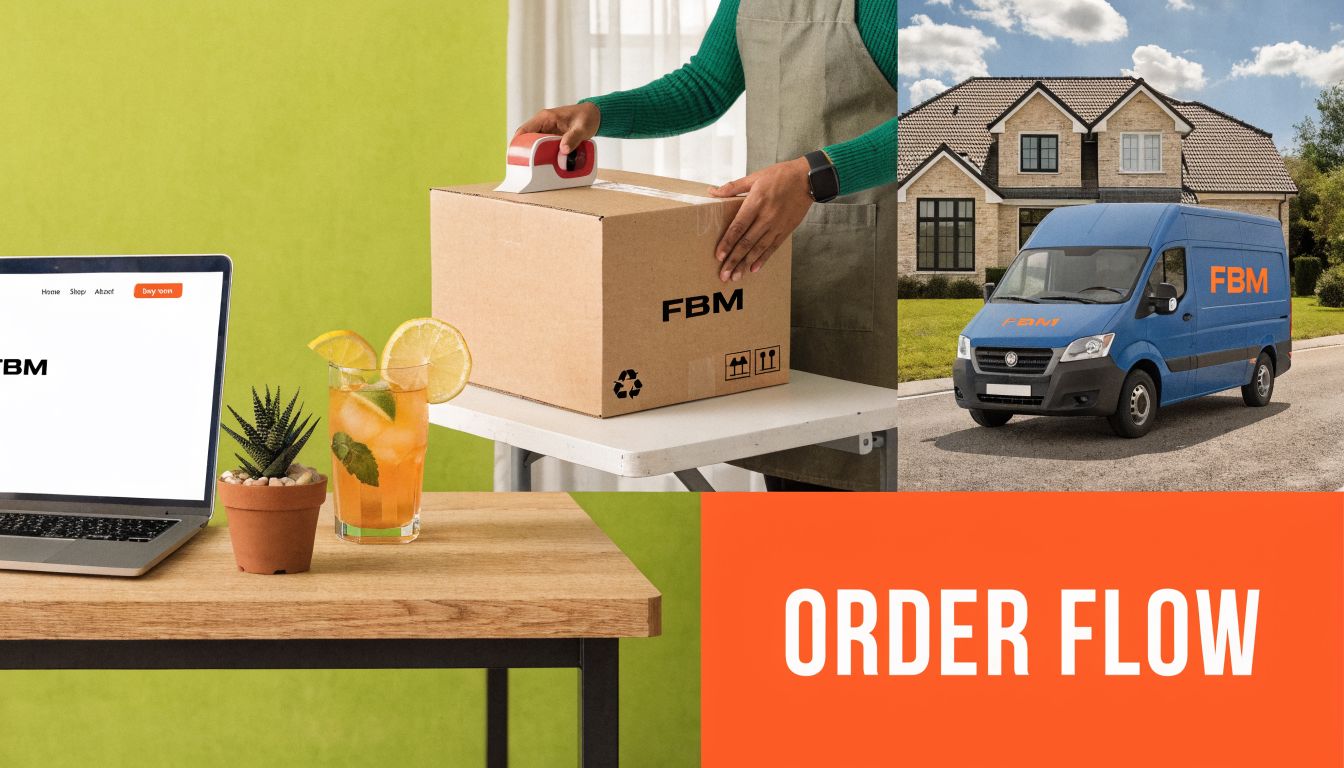
The five jobs you own
FBM isn't complicated. It's operational.
You store inventory
Your products sit at home, in your office, in your warehouse, or with a 3PL. You decide where stock lives and how much you keep ready.You pick the order
Amazon sends the order. You or your team pull the unit from inventory.You pack it
Brand control is apparent at this stage. You choose the box, inserts, tape, protection, and presentation.You ship it
You buy the label, confirm the shipment, and make sure tracking moves fast enough to keep your account healthy.You handle the after-sale mess
Customer messages, delivery issues, refunds, and returns land on your desk.
That's the deal. More work, more control.
Why some founders prefer that
According to Smart Warehousing's FBM versus FBA guide, FBM gives sellers full operational control and zero Amazon fulfillment or storage fees, unlike FBA's fee structure, which includes $3.22+ per standard item. The same source says FBM can lead to 20 to 40% cost savings on bulky goods and customizable packaging can boost repeat purchase rates by 18%.
Those are not small advantages if you're selling products where presentation matters.
Practical rule: If packaging is part of your brand promise, don't outsource it too early.
If you're still sorting out the basics of warehousing and shipping, this explainer on what is fulfillment service is worth reading because it gives you the plain mechanics without the usual jargon dump.
The operational catch
You can't wing this. FBM rewards process.
You need clean SKU labeling, accurate stock counts, shipping templates, and a simple way to avoid selling something you don't have. If you're selling in more than one place, your inventory has to stay synced, or you'll create a mess fast. That's why I tell founders to learn the basics of multichannel inventory management before volume starts climbing.
A sloppy FBM setup feels cheap to the customer. A tight FBM setup feels like a real brand.
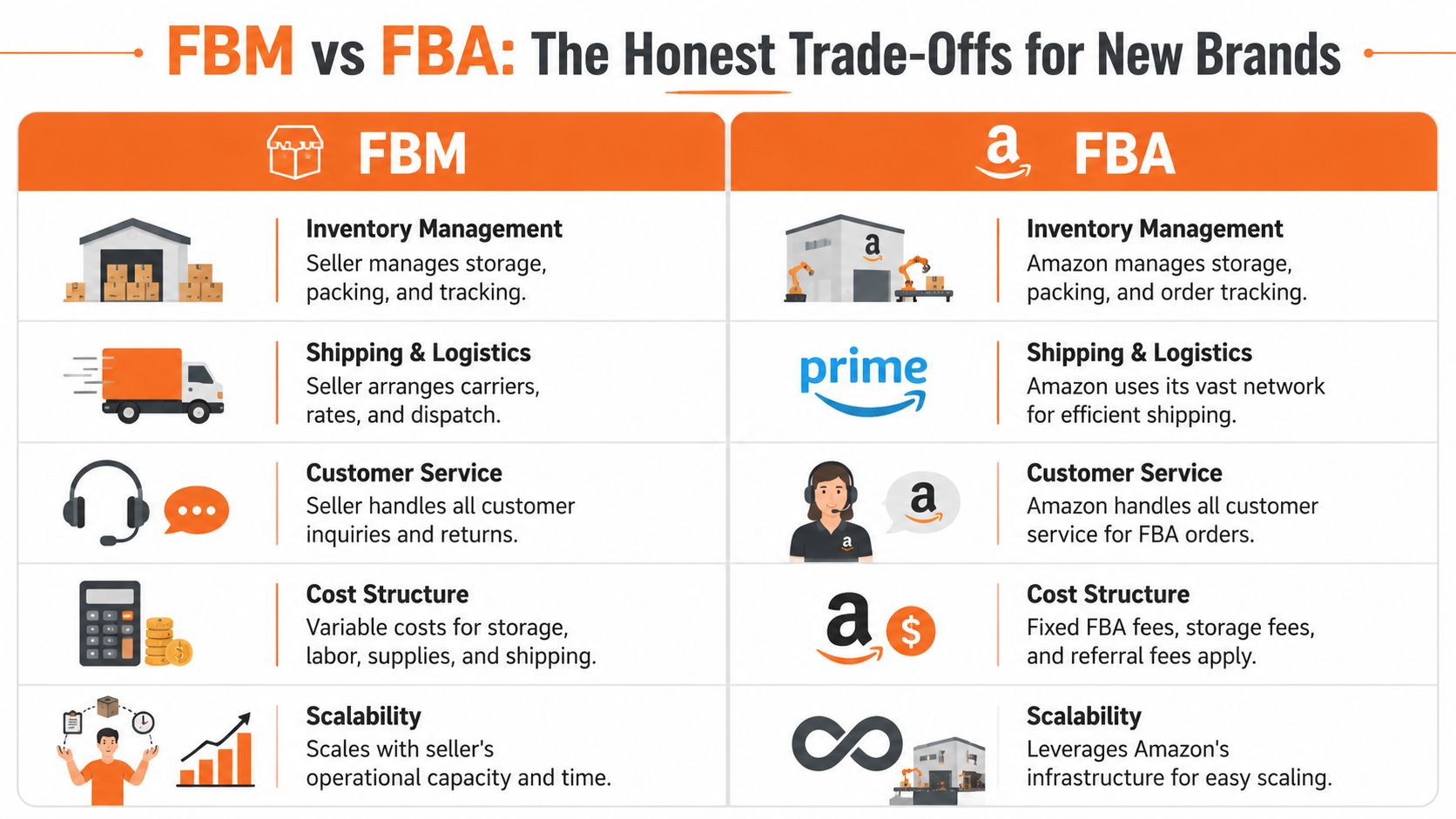
FBM vs FBA The Honest Trade-Offs for New Brands
In this situation, people want a winner.
There isn't one. There is only the right choice for your business right now.
The blunt version
FBA buys convenience. FBM buys control.
If your product is moving fast, fits Amazon's system cleanly, and you don't care much about the unboxing or using the same inventory elsewhere, FBA can make sense. If you want one pool of inventory across channels, more say over the customer experience, and tighter cost control, FBM is often the better call.
Here's the side-by-side I wish more people gave straight.
| Factor | Fulfillment by Merchant (FBM) | Fulfillment by Amazon (FBA) |
|---|---|---|
| Brand control | You control packaging, inserts, and presentation | Amazon controls the fulfillment experience |
| Margin structure | You manage shipping and ops directly | You pay Amazon fulfillment and storage fees |
| Operational load | You do the work or manage a 3PL | Amazon handles most fulfillment tasks |
| Customer relationship | You handle post-purchase support | Amazon handles much of the customer-facing fulfillment support |
| Prime access | Not automatic | Built into the model |
| Inventory use | Easier to use one pool of stock across channels | Inventory is more tied to Amazon's system |
| Scaling style | Scales with your systems and partners | Scales with Amazon's infrastructure |
Where FBM has gotten better
A lot of old anti-FBM advice is stale.
Amazon says its 2022 FBM tool upgrades helped top performers reach 99% on-time delivery and keep order defect rates below 1%. The same Amazon page says 65% of FBM sellers use FBM to fulfill orders from other channels like Shopify, and notes Amazon's 37.6% share of US ecommerce in that broader context at the time of reporting, which matters if you don't want your whole business trapped in one marketplace. That's in Amazon's own Fulfilled by Merchant program page.
That multichannel point is the one I care about most. If Amazon is one lane of traffic, FBM lets you keep building the highway.
The video below gives a visual walkthrough if you want another angle before deciding.
If you want to build a brand with its own gravity, don't let one marketplace own your inventory logic.
The trade-off people feel immediately
The biggest downside is obvious. FBA is easier.
The biggest upside of FBM is also obvious. Your business stays yours.
That trade matters most when you're still small. Once you've lived through inventory mistakes, fee creep, and channel risk, FBM stops looking like the "hard way" and starts looking like the grown-up way.
Calculating the All-In Cost of Fulfilling Your Own Orders
FBM cost gets butchered by bad math.
Founders love to compare one Amazon fee line to one shipping label and call it analysis. That shortcut will burn you. If you want to know whether FBM works, count every cost tied to getting a unit off your shelf and into a customer's hands.
Your FBM cost is your all-in cost
I break it into four buckets:
- Shipping label
- Packaging materials
- Labor or your own time
- Storage and software
Miss one, and your margin story is fiction.
That matters most for new brands, because FBM wins on control only if you price that control correctly. If you run lean, keep packaging simple, and stay disciplined on operations, FBM can protect margin while giving you more say over how the business runs.
Stop comparing labels to fees
A shipping label can look expensive next to an FBA fulfillment fee. That's the trap.
You are not buying the same thing. FBA bundles convenience inside Amazon's system. FBM pushes those costs into your own workflow, where you can manage them, improve them, and use the same setup across Amazon, Shopify, and any other channel you add later. That is why I keep saying FBM is not a fallback. It is infrastructure for a brand that plans to exist outside Amazon.
My rule is simple. Calculate cost per order, by SKU, using your own operation, not Amazon's default assumptions.
The costs founders avoid counting
Your time is a cost.
Five orders a day is easy. Thirty a day, plus support tickets, product work, marketing, and bookkeeping, is a different business. At that point, sloppy fulfillment starts eating profit through wasted labor, late shipments, bad reviews, reships, and preventable mistakes.
Then there is channel risk. If you also sell on Shopify, chargebacks can erase the margin you thought you had. Disputely's Shopify chargeback solution fits here for a reason. Fulfillment errors often turn into payment disputes a few weeks later.
Storage is another quiet leak. Slow inventory costs you money whether it sits in Amazon's network, a 3PL, or your spare room. If you have not worked through your inventory carrying cost calculation, do that before you decide FBM is cheaper.
The cost model I recommend
Use a spreadsheet with one line per SKU and track:
- Unit size and weight
- Average shipping label cost
- Packaging cost per order
- Minutes to pick and pack
- Monthly storage cost
- Return handling burden
- Expected monthly order volume
Then answer the only question that matters.
Does this SKU make more money under FBM, with your process and your constraints, or are you just undercounting the work?
When You Should Absolutely Choose FBM
Sometimes this decision is close.
Sometimes it isn't.

Choose FBM when you're still validating demand
If you haven't proven the product yet, don't rush to send a pile of inventory into someone else's network.
Early on, you need flexibility more than speed. You may tweak packaging, update inserts, change bundles, or kill the SKU entirely. FBM lets you do that without friction. That's why I like it for founders launching new products with uneven demand.
Choose FBM when the product is awkward
Heavy, bulky, fragile, weirdly shaped, or slow-moving products are often better candidates for FBM.
Those products punish sloppy fulfillment choices. When the item doesn't fit the standard neat little box, control starts to matter more. You get to decide packaging method, protection level, and shipping partner instead of forcing the SKU into Amazon's default logic.
Choose FBM when your brand experience matters
If your product lives or dies by presentation, FBM is the move.
A premium skincare brand, giftable food product, or design-forward accessory should care about what lands in the customer's hands. With FBM, you can include the right insert, use branded packaging, and create an unboxing experience that feels intentional instead of generic.
A brown box can ship a product. It usually can't build a brand.
Choose FBM when you're building outside Amazon too
This is the one I'd push hardest.
If you plan to sell on your own site, Amazon, and maybe another marketplace, FBM gives you one cleaner inventory pool and one cleaner operational brain. You don't want Amazon stock over here, website stock over there, and both sides lie to you at the worst possible time.
FBM also makes more sense if you already have a small warehouse, office stockroom, or a reliable 3PL relationship. In that case, using your own setup is often smarter than paying for duplication and losing control of the fulfillment layer.
When I would not choose FBM first
I wouldn't start with FBM if you're terrible at operations, hate customer service, and have no place to store product.
I also wouldn't force it if your top priority is pure convenience and your SKU fits FBA cleanly. This isn't religion. It's economics and execution. But if you're a founder who wants to own the customer experience and keep your business portable, FBM is a strong choice.
Your First 30 Days with FBM A Simple Startup Guide
You don't need a massive setup. You need a clean one.
The first month with FBM should be boring. Boring is good. Boring means orders go out on time, stock counts stay accurate, and nobody panics.
Week one gets the basics right
Set up your Amazon shipping settings carefully. Your handling times and delivery promises need to match what you can do, not what you wish you could do.
Start with a small product set. Don't launch your whole catalog under FBM on day one unless you enjoy chaos.
Do these first:
- Create shipping templates: Group products by size, weight, and handling complexity.
- Choose your carrier flow: Pick one main carrier and one backup so you aren't scrambling when rates or pickup schedules shift.
- Buy a label printer if you're serious: Consumer printers work, but they slow you down and create dumb friction.
- Set one packing station: One table, one shelf for packaging, one place for labels, one place for finished orders.
Week two fixes your packaging and process
Order a small run of shipping supplies and test your pack-out.
That means boxes, mailers, tape, void fill, inserts, and labels. Pack a few fake orders and time yourself. If the process feels clumsy, customers will eventually feel that too.
Do this early: Write a one-page packing SOP with photos. Even if you're solo, future-you needs it.
You should also define your returns policy in plain English. Keep it clear, fair, and easy to follow. Most return drama comes from confusion, not malice.
Week three stress-tests reality
By this point, run a few live orders through the full cycle.
Check that tracking uploads correctly. Check that delivery timing matches what you promised. Check that packaging survives normal abuse. If something breaks, fix the system, not just the order.
If you're already wondering whether to keep doing fulfillment yourself or bring in help, review a few shipping and fulfillment companies and compare them against your current workload. Don't outsource because you're tired for one week. Outsource when the math and the process both say it's time.
Week four makes it repeatable
By the end of the first month, you want a repeatable rhythm.
Track the basics in one sheet or dashboard:
- Orders shipped on time
- Inventory count accuracy
- Average pack time
- Return reasons
- Customer messages that repeat
Those repeating questions are gold. If buyers keep asking the same thing, fix the listing, packaging, insert, or post-purchase email.
FBM works when you treat fulfillment like product design. Tighten the process, remove friction, and make the experience feel intentional. That's how you stay small without looking small.
If you're building an ecommerce brand and want honest advice from founders who ship products, Chicago Brandstarters is worth your time. It's a free community for kind, hard-working Chicago and Midwest builders who want real conversations, not fake networking. If you want sharper feedback, better operator friends, and fewer avoidable mistakes, join them.
Leave a Reply