

Your supplier hasn't confirmed delivery. A customer wants a refund, and you're rewriting a message to someone who might help because you don't want to sound needy. You have plenty of contacts. You're less sure who you can count on.
Your relationship with business becomes easier to manage when you stop treating relationships as a networking exercise. Treat each one as a working agreement: what do you need, what does the other person need, and what can you reasonably promise?
The Five Business Relationships Founders Manage
Every sale, deal, and hire involves a relationship. You ask people to give you money, time, effort, or trust. In return, you owe them something specific.
I use five categories to sort those obligations: customers, partners, investors, employees, and founder identity. That last category means your relationship with yourself as an owner. If you treat every disappointing sales day as a judgment of your worth, you'll struggle to make calm decisions about everyone else.
Five business relationships and what they need
| Relationship | What it gives you | Main risk | Early sign it works |
|---|---|---|---|
| Customer | Revenue and honest product feedback | Building for the loudest buyer | Repeat orders or referrals without asking |
| Partner | Shared channels, vendors, or work | Unclear split of work or credit | Both sides deliver on small promises |
| Investor | Capital and outside guidance | Pressure toward fast growth over stable profit | Regular updates that include bad news |
| Employee | Execution and ownership of tasks | Unclear roles and pay expectations | Staff raise problems early |
| Founder identity | Clear decisions and self-trust | Tying self-worth to revenue | Steady decisions after a bad week |
Think of these as the legs of a stool. Remove one that your business relies on, and you wobble even when the others look fine. You don't need outside investors or employees immediately, but you do need to recognize the obligations you take on when you add them.
The map below separates suppliers from other partners because you rely on them for materials and services. Keep them visible even if you manage them under your partner category.
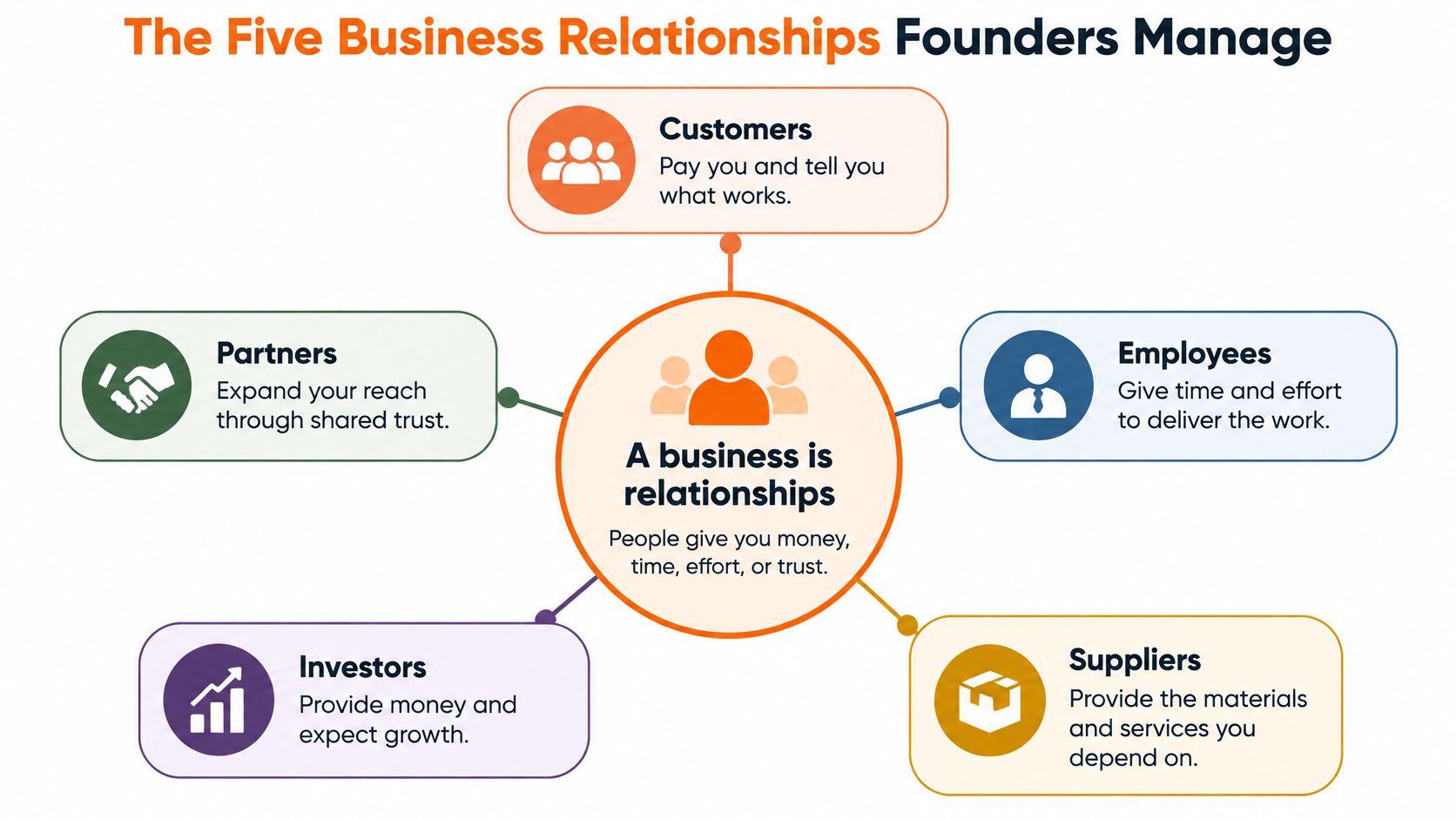
Test the exchange, not the mood
A pleasant conversation doesn't tell you whether a relationship works. Ask what each person can now do better. Your customer gets a reliable product; you get payment and usable feedback. Your employee gets clear expectations and fair pay; you get completed work.
Before you share ownership or distribution responsibilities, use our guide to finding business partners to frame your questions. If you need outside guidance for a software company, Big Moves Marketing's advice for B2B SaaS founders gives you a more focused starting point than a general search for mentors.
Copy the table into Google Sheets. Add names, write the result each relationship should produce, and mark your weakest relationship this month.
Why Relationships Decide Who Survives Early
Only about half of new employer establishments reach their fifth anniversary. The U.S. Small Business Administration's survival figures, covering establishments that started from 1994 through 2022, report the milestones below.
Survival rates for new employer establishments
| Milestone | Share surviving |
|---|---|
| Survived 2 years | 67.7% |
| Survived 5 years | 49.2% |
| Survived 10 years | 33.9% |
| Survived 15 years | 25.5% |
| Of those reaching 5 years, reached 10 years | 69.5% |
You must solve demand, cash, hiring, and production problems before you've built much experience. Someone who has already handled a late shipment or a cash shortfall can help you ask better questions before you commit money.
Say you're choosing between manufacturers. An experienced operator might suggest checking how each supplier handles rejected batches, rather than comparing unit prices alone. You still make the decision, but you make it with a clearer view of the risk.
Look beyond your closest circle
Your closest friends may care about you without knowing anyone who can manufacture your product or finance an order. You need room for weak ties: people you know less closely who connect you to different circles.
A longitudinal study using Kauffman Firm Survey and community social-capital measures found an association between founders' weak ties, rather than strong ties, and higher startup survival odds. Community social capital also had a positive association, particularly when founders obtained funding through weak ties.
That finding doesn't prove networking causes survival. The SBA figures measure establishments, not founders' network quality, and neither source promises that a helpful contact will rescue a weak business.
Practical test: Name the problems that could end your business this year. Beside each, write someone who has solved a comparable problem.
Make the problems concrete: an unreliable manufacturer, insufficient working capital, or no repeat customers. Then check whether each person has relevant experience rather than impressive credentials.
Start with the names you can't fill in. Those gaps tell you whom to look for more clearly than another invitation to a general networking event.
How to Build Trust Step by Step
Generic networking gives you little direction. In MarketStreet's SMB Insider report announcement, 66% of U.S. small-business owners didn't meaningfully participate in networking or lead-generation groups, and 71% said chambers of commerce provided little or no value; businesses most commonly collaborated through referrals (36%) and shared vendors (21%).
Those responses don't prove every networking group fails. They give you a useful filter: will this interaction lead to practical help?
Use this flow to keep your outreach focused.
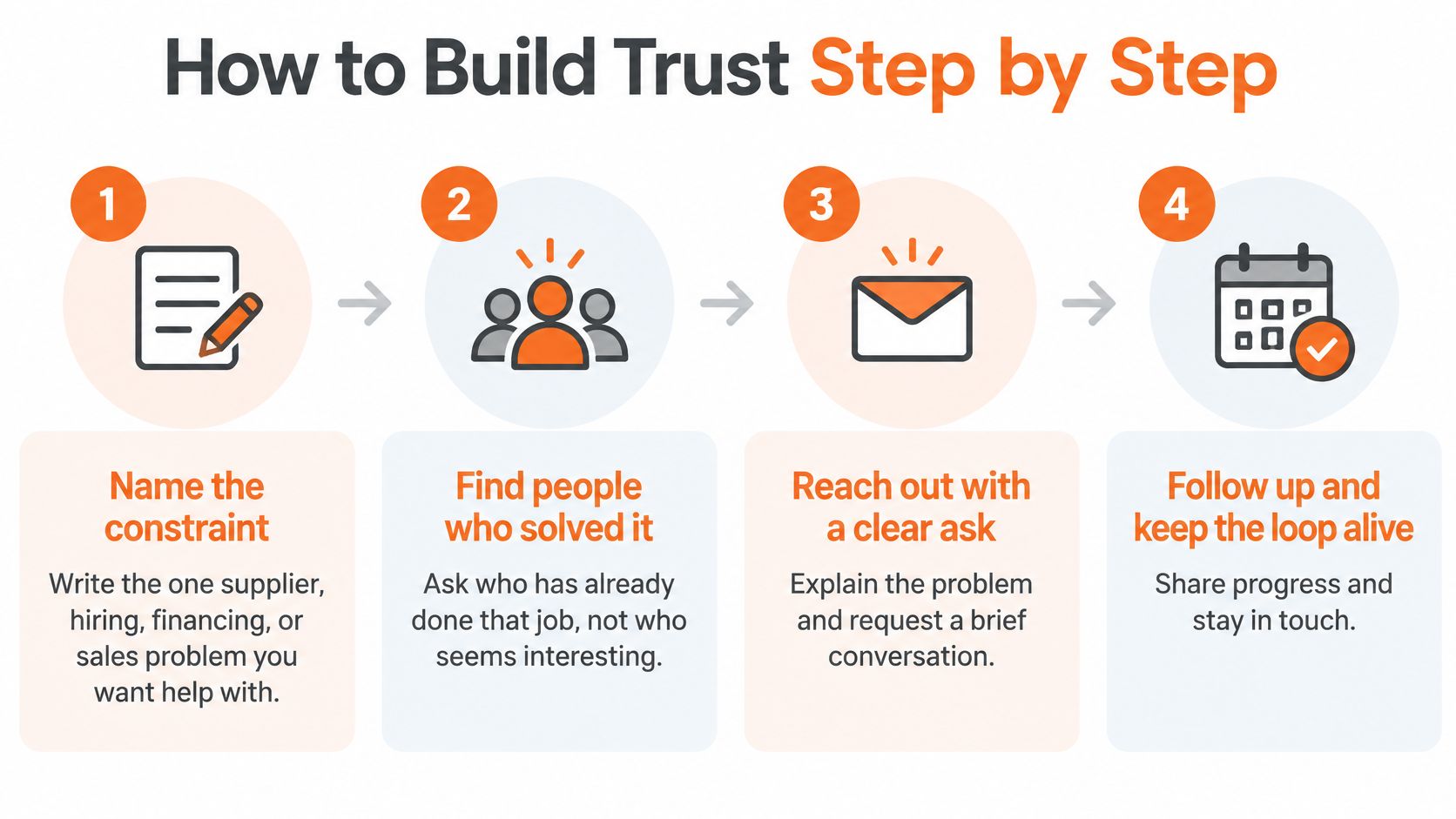
Make a small exchange you can both complete
Name the constraint. Write the supplier, hiring, financing, or sales problem you want help with. A precise problem lets someone judge whether they can help.
Find people who solved it. Ask who has handled the job you face, rather than who seems interesting. Someone who recently changed packaging suppliers may help more than a famous founder in an unrelated field.
Give before you ask. Share a relevant lead, test their checkout, or make an introduction with permission. Choose something useful, not an unsolicited task that creates more work.
Make a specific request. Ask for a 20-minute call or a named introduction instead of general advice. Explain the question you want to resolve so the person can accept, decline, or redirect you.
Follow up within seven days. Thank them and report what you tried, even if it didn't work. You show that you respect their effort when you close the loop.
Record the outcome. Use a simple spreadsheet to note the help, your contribution, and the next action. Track completed exchanges rather than collected contacts.
An analysis of founder social capital and small-business productivity associated participation in business or social networks with a 34% increase in productivity, with access to supplier credit and financing from friends and family among the proposed mechanisms. That's an association, not a promised return from attending events.
When cash runs short, you can still reciprocate through time, honest feedback, or a suitable customer referral. Don't treat kindness as a debt you can collect later.
A common mistake is asking for money or a large favor before establishing any working context. For help defining what you can reasonably promise, Acheloa Wellness's expectation-setting for women lawyers addresses a useful adjacent problem: making professional expectations explicit.
After three months, test for substance: do you understand each other's work, and have you both acted on something you discussed?
Where to Draw Boundaries Without Going Cold
You can mistake a warm conversation for earned trust. Then you disclose your cash position to someone who hasn't yet kept a small promise.
Share in proportion to trust. Boundaries work like a dimmer switch, not an on-off light. You can stay friendly while limiting what you disclose.
What to share at each trust level
| Trust level | Share | Keep private | Sample line |
|---|---|---|---|
| New acquaintance | Product launches and public results | Cash position and margins | We launched a new bundle this week. |
| Working contact | Process problems and supplier issues | Customer lists and unreleased designs | Our packaging supplier missed dates twice this quarter. |
| Trusted peer | Failures, cash strain, and tough decisions | Personal finances and private family matters | I may need to move payroll back two weeks. |
| Advisor or lawyer | Full facts for their specific role | Nothing relevant to the case | Here is the signed contract and the dispute timeline. |
Treat those sample lines as disclosure examples, not operating advice. If you face payroll trouble, speak with your accountant and employment lawyer before changing payment timing.
Keep customer data and personal finances out of ordinary networking and peer conversations at every trust level. A professional advisor may need relevant private records to do their job; share those through an appropriate secure channel. Take legal disputes to a lawyer rather than asking peers to interpret your obligations.
Make confidentiality enforceable
At Chicago Brandstarters, what you say in the community stays in confidence. A confidentiality norm requires action when someone breaks it: stop the disclosure, address the breach, and reconsider that person's access.
A study of psychological safety across management teams found that shared expectations of safety mattered alongside individual feelings of safety. A friendly host alone can't make everyone comfortable discussing a difficult decision.
You can be generous without giving someone unrestricted access to your information, time, or money.
Watch for repeated pitches, pressure to invest, or requests that grow whenever you agree to help. Our guide to how to stop being taken advantage of can help you assess those exchanges.
If someone repeats your private detail to another person without permission, lower their trust level by one step and address it directly. Which person on your list currently sits higher than the trust they've earned?
Why Small Trusted Groups Beat Big Networking Events
A crowded event can fill your contact list without giving you a useful answer. A recurring small group gives people time to explain a problem, ask follow-up questions, and see whether anyone takes action.

A study of 1,150 leaders across 160 Norwegian management teams, whose teams had 3 to 19 members, found a correlation between psychological safety and task performance of r = 0.51, p ≤ 0.01. In those teams, people who felt safer were more likely to collaborate, share information, and take shared ownership of decisions.
That finding concerns management teams, not founder dinners, and it does not establish an ideal group size. Treat it as a test of how a group works, not proof that a particular number of seats produces better results. Can members raise unfinished problems and respond without turning the conversation into a performance?
Choose continuity and action
Suppose a founder says a supplier has missed several shipments. Another member suggests a backup vendor and makes an introduction that week. That follow-through is more useful to assess than how many people attended.
Isolation is another reason founders seek peers. A 2025 survey of 120 founders reported by Arabian Business found that more than 80% experienced isolation at least sometimes, and isolated founders were 50% more likely to postpone important decisions. This shows an association, not that joining a group prevents delays.
Use the video as a prompt for considering what makes founder conversations useful.
Compare Find Startup Idea's peer groups for launching startups with Chicago Brandstarters' small dinner parties and community events. Look for recurring faces, identity verification and LinkedIn review, confidential discussions, and outside perspectives that can move a conversation from repeated complaints to practical next steps.
Members describe both problem-solving and learning through shared activities:
“This friendly group helped me solve some problems in my business that had been troubling me for a long time.”, Nathan
“Thanks to the Brandstarters, I have gotten to see factory tours, and many private dinners where I have learned a lot.”, Sujay
Try a group and track useful introductions, decisions completed, and actions taken. Those are better tests of its value than the number of contacts you add.
Pick One Relationship to Build This Week
Choose the weakest relationship on your list and make a small move this week. Don't start by reorganizing your entire network.
Before sending anything, write the person, the constraint, and the request. Choose someone whose experience matches the problem closely enough that you can explain the connection without flattery.
Say your supplier keeps missing deadlines. You know a peer who recently switched manufacturers, and you can contribute a sample from your own project for their product testing. Ask about the checks they used before placing an order, rather than asking them to solve your whole supply chain.
Check your request before you send it
- Who do I need? Name someone with direct experience of the decision you face.
- What do I need from them? Choose a vendor introduction, a document review, or help comparing options.
- What can I give first? Name a relevant contribution you can complete.
Keep your contribution separate from the request. You're making it easier to help each other, not buying consent with a favor.
Kevin Tao created Chicago Brandstarters after helping two friends get their brands up to seven figures. That operator background explains our focus on practical conversations: bring a problem someone can examine, rather than a performance of having everything under control.
Put the conversation on your calendar
Name the session you'll attend this month and the question you'll bring. Leave enough room afterward to act on a suggestion and report the result.
If you can't identify a useful contribution yet, say so. You can ask what the other person needs instead of inventing an exchange that doesn't help them.
Send your first message today. Adapt these two sentences to a real person and a real constraint:
My packaging supplier keeps missing delivery dates, and I'm comparing replacements before my next order. Would you have 20 minutes this week to explain how you checked your new vendor's reliability?
At Chicago Brandstarters, we have free membership that includes small dinner parties and other events where you can build working relationships with fellow founders. Visit Chicago Brandstarters to apply, and bring a specific business problem you're ready to discuss.
Leave a Reply