

You've opened the account, uploaded a logo, written three posts, and then gone quiet. The product still needs customers, your profile still looks unfinished, and every new idea feels like another assignment you don't have time to complete.
Most founders respond by chasing more posts, sharper hooks, and every new platform. That's backwards. A brand grows when people repeatedly see who you help, how you think, and what evidence supports your claims. Social media gives you the room to build that record in public, even before the brand looks polished.
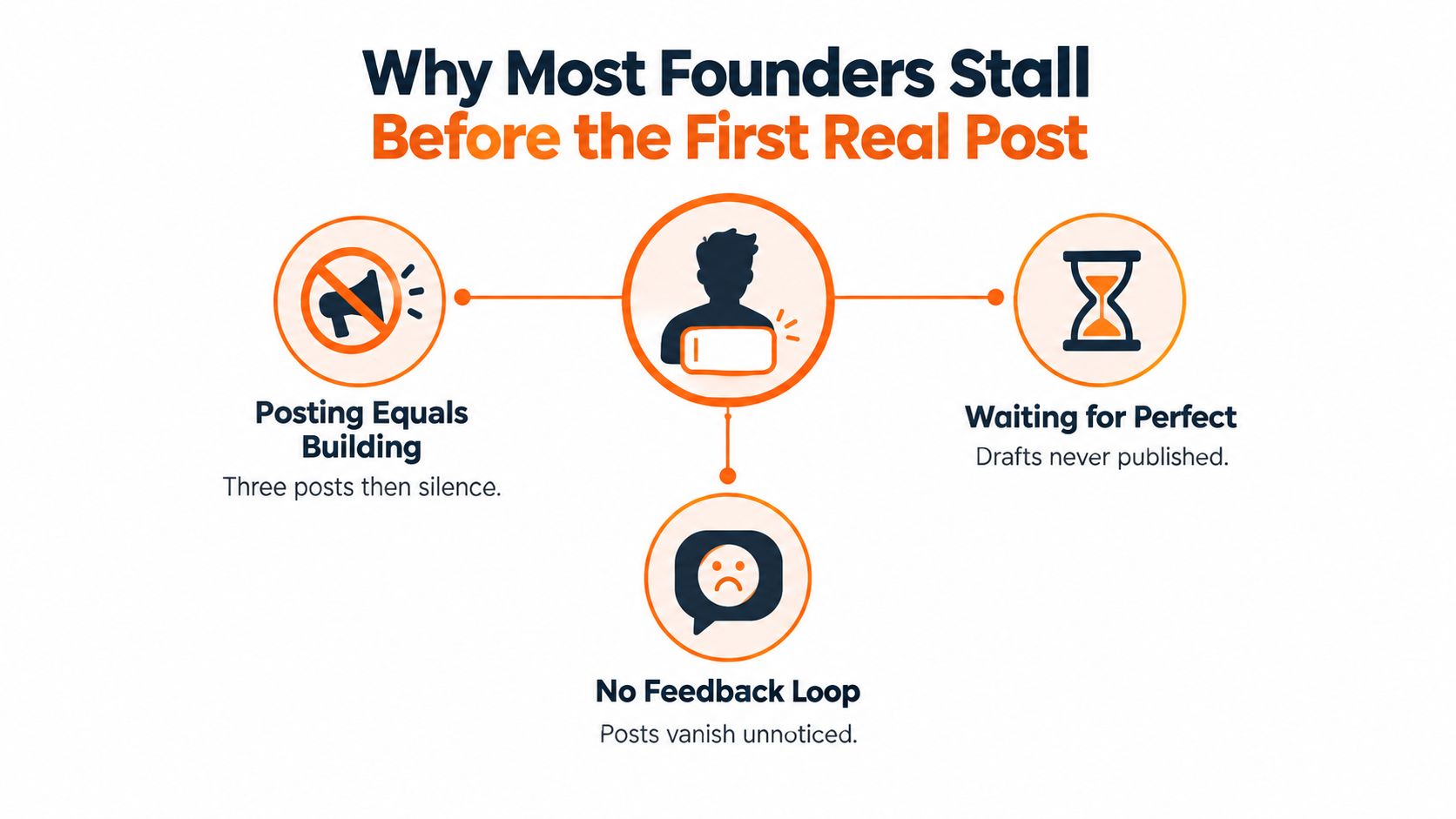
Why Most Founders Stall Before the First Real Post
You open the draft box to write one simple post. Then the job mutates. Now the post has to explain the company, signal credibility, sound sharp, look polished, and bring in customers. So you write something vague, publish it, get little back, and your account turns into a parked car.
That stall happens because founders keep using the wrong rule. They treat posting more as the goal, when the job is to build a pattern people can trust. Volume without proof gives you activity, not recognition. If people cannot tell who you help, how you think, or what backs up your claims, more content will not save you.
Social media is where people size you up before they reply, buy, or refer. Analysts at Pew Research Center tracking show U.S. adult social media use rose from 5% in 2005 to 72% in 2021. That does not mean you need to chase everyone everywhere. You need to become recognizable to the people you can serve.
Replace the posting schedule with a proof system
Stop asking, “What should I post today?” Ask three better questions.
- Who are you for? Pick one audience. “Everyone who wants better products” is not an audience.
- What do you refuse to be? Say it plainly. Maybe you refuse to sound like a polished guru, a coupon feed, or a faceless brand account.
- What will your account prove? Choose the evidence you can show repeatedly, practical expertise, product decisions, customer outcomes, or smart peer conversations.
Here is the test. A Midwest founder could say, “I help early-stage operators make better product decisions. I share the mistakes, experiments, and customer conversations behind the work. I won't pretend every launch goes smoothly.”
That gives the account a spine. It also makes the contrarian move clear. Publish less, prove more.
If your voice still sounds generic, go find your professional voice with RedactAI. Your account should read like a real operator with judgment, receipts, and a point of view. Not a content machine waiting for the next trend.
Positioning Before Pixels
A founder with a sharp logo and a vague point of view still looks vague. Before you touch banners, colors, or post templates, decide who you serve, what problem you solve, and what you refuse to become.
Get specific enough that a stranger could tell, in seconds, whether your account is for them. “Founders” is lazy positioning. “Chicago ecommerce founders testing their first physical product” gives you a real audience with real pressure. Then pick the change you want your content to create. Maybe you help them stop guessing alone and start testing ideas in public, with actual customer input and peer feedback.
Now draw a line. Choose the traits you want your account to stand for, and the ones you will not copy. Practical beats polished. Candid beats loud. Generous beats transactional. That tension is where trust starts.
Here is what that can sound like:
I help early-stage product founders turn uncertain ideas into clear customer tests. I share practical decisions, failed assumptions, and useful introductions. I'm not a motivational influencer, and I won't hide the messy parts of building.
Use a statement like that as a filter, not decoration. If a post does not help your audience test an idea, understand a decision, or trust your judgment, do not publish it. Founders with limited time win by proving more, not posting more.
Skip the usual worksheet format for a minute and write three plain sentences on a sticky note or in your Notes app. Who do you help. What kind of evidence will you show regularly. What kind of founder behavior will you not imitate. That last line matters more than people think, because refusal creates shape. Without it, your account drifts toward startup cliches and broad, forgettable advice.
If you want a stronger framework, study this guide on brand positioning for startups. If writing is the bottleneck, you can delegate with BAMF ghostwriting, but only if the output still sounds like your actual judgment, your actual scars, and your actual way of speaking.
Your visual identity should support your position. It will not rescue weak positioning. Clean design can hide fuzzy thinking for a week or two. It cannot make people trust you.
Three Content Pillars That Travel Across Platforms
Use three repeatable pillars so your account develops a recognizable pattern without sounding repetitive:
- Operator tactics. Give people something they can use today. Explain how you chose a supplier, tested a price, handled a difficult customer, or prepared for a sales call.
- Candid founder stories. Show a real decision, the assumption behind it, and what changed afterward. Leave out private customer details, but don't remove every uncomfortable part.
- Acts of kindness and member wins. Share a useful introduction, a customer's progress, a peer's lesson, or a moment when someone helped another builder.
People trust evidence they can understand and discuss. Nielsen's Global Trust in Advertising research surveyed more than 28,000 internet respondents across 56 countries and found that 92% trusted earned media, including recommendations from friends and family, more than other forms of advertising (Nielsen's trust research). Your job is to make your work easy for other people to validate.

Turn one story into a week of evidence
Say a founder attends a dinner and helps another operator solve a factory-sourcing problem. One story can become several useful pieces:
- LinkedIn post: explain the sourcing question, the options on the table, and the decision rule.
- Instagram carousel: show the steps for comparing suppliers without revealing confidential information.
- Short video: tell the story in plain language, including the mistake that made the conversation necessary.
- Group-chat message: share the checklist and ask members what they'd add.
- Follow-up post: report what the founder tested next.
Each version has a different job. The LinkedIn post can teach, the carousel can save time, the video can create recognition, and the group chat can create participation. You aren't copying one post five times. You're adapting one piece of evidence to different conversations.
Measure each pillar by the action it should create. Tactics should earn saves or qualified profile visits. Founder stories should create replies and direct conversations. Member wins should create shares, referrals, and applications. Use content marketing for brands as a practical reference when you build the system.
The screenshot version: Teach one useful tactic. Show one honest decision. Give another person credit.
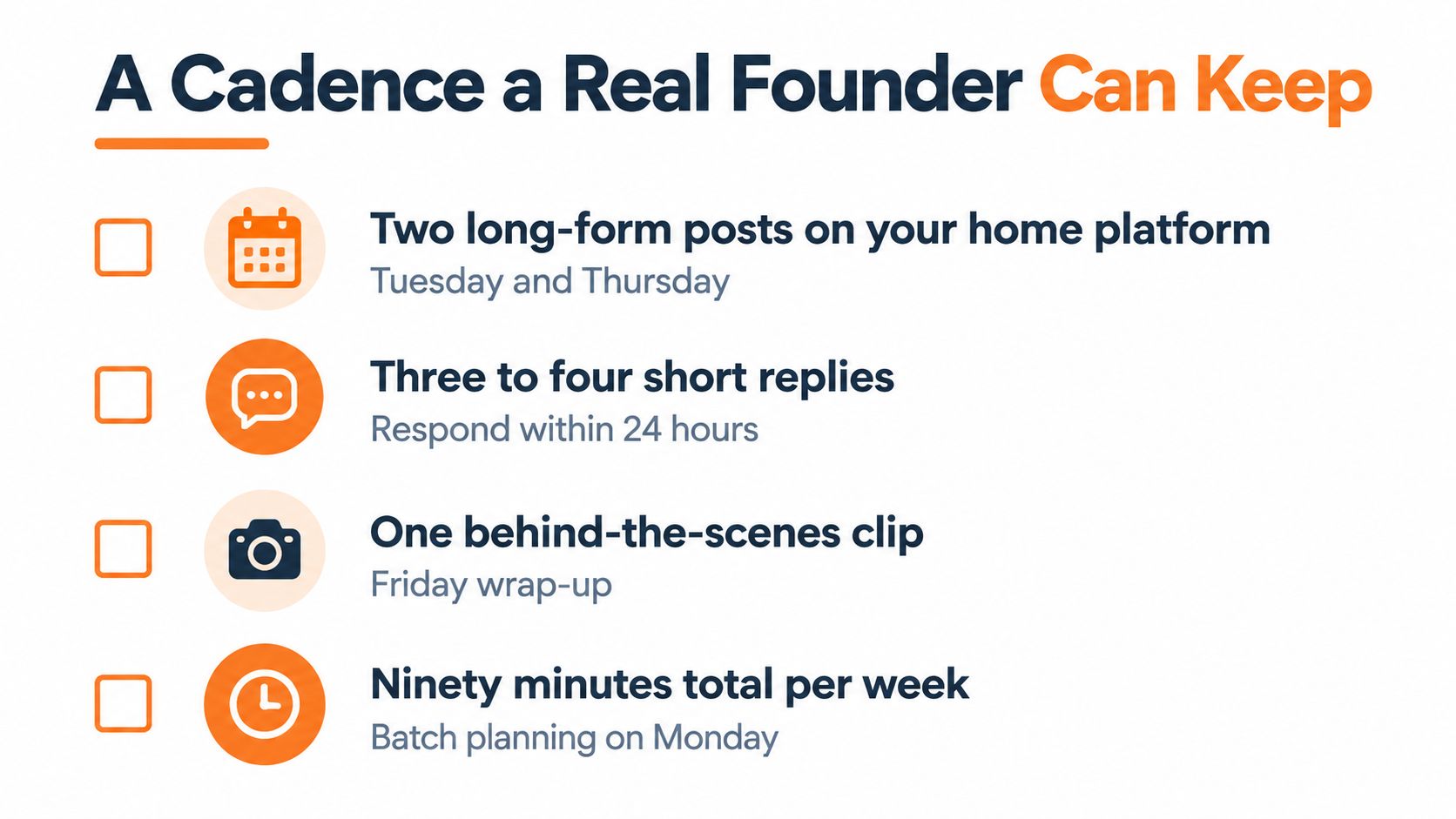
A Cadence a Real Founder Can Keep
Your posting rhythm has to survive real work. A founder who spends every morning feeding social media has built a second job instead of a brand.
Analysts behind the 2025 small-business marketing survey found that 54% of new small-business owners cite time, budget, and skills as meaningful first-year obstacles, and 54% expect unpaid social media to remain their primary marketing channel in 2025. That is exactly why under-resourced founders should publish less and prove more. Daily volume sounds disciplined. In practice, it usually produces forgettable posts and weakens trust.
Use a default week
Start with a week you can repeat without resentment:
- Tuesday: one operator tactic on your home platform.
- Thursday: one candid founder story.
- Friday: one behind-the-scenes clip or member win.
- Across the week: three or four thoughtful replies in conversations where your audience already gathers.
- One experiment: change one format or angle, then record what happened.
Keep production tight. Use one session to capture customer questions, decisions, objections, and small wins from the week. Use a second session to turn that raw material into posts, short clips, and replies. A tool like a creator-focused CMS for Twitter can make publishing easier, but it cannot create evidence you failed to collect.
That is the rule. Fewer posts, more proof.
Use a practical content repurposing strategy so one useful story becomes several platform-specific assets instead of five copies of the same caption. Founders do not need more content ideas. They need a tighter system for turning real work into visible proof.
Treat trends with suspicion. Ask one question before you join in: Will this make my specific audience trust me more? If the answer is unclear, pass. Attention from the wrong crowd makes your account harder to understand and harder to convert into conversations, referrals, or sales.
Some weeks need more customer answers. Some weeks give you one strong post and nothing else. During vacation, schedule only what you can still support in the comments and DMs. Your brand holds up when you post less. It slips when you publish things that prove nothing.
Pick One Home Base and One Experiment
You post on three platforms for two weeks, get a few likes, one vague compliment, and no useful conversations. That is what happens when a founder spreads too early. Pick one place to build proof and one second place to test reach. That setup is enough.
Start with the platform that matches the evidence you can show without forcing your personality into a format you hate.
Instagram works for visual products, process shots, before-and-after proof, and DMs that turn into buying questions. If your offer gets stronger when people can see the details, start here.
LinkedIn works for B2B founders, consultants, operators, and anyone selling judgment. Clear lessons win. Empty motivation dies fast.
TikTok works for raw founder stories, demos, and surprising product moments. It gives you more room to earn attention outside your existing circle, but only if you get to the point quickly and show something real.
A private Facebook group or group chat works after people already understand who you help. It is a trust container, not a discovery engine. Use it for sharper feedback, referrals, and stronger customer language.
Now make the decision with friction, not fantasy.
Your home base should pass three checks. Your audience already uses it. You can make your strongest format there without resentment. You can also reply while running the company. If one of those breaks, the channel will turn into a graveyard.
Then choose one experiment. One. An Instagram-first ecommerce founder can test TikTok founder diaries. A LinkedIn-first B2B founder can test a private customer group chat. Keep the question narrow, such as whether demos beat commentary or whether direct founder notes get better replies than polished carousels.
Here is the contrarian rule. Publish less, prove more.
Social helps people notice you. Your site explains the offer. Direct conversation confirms fit. People rarely trust a founder brand from one touch alone, so stop asking your social profile to do every job. Use it to create recognition and evidence, then give people a clean next step where they can verify what you sell.
Switch your home base only after the pattern is obvious. Your audience has shifted elsewhere. Your current format blocks useful proof. Qualified actions stay weak even after you tighten positioning and test stronger evidence. Until then, stay put long enough to become believable.
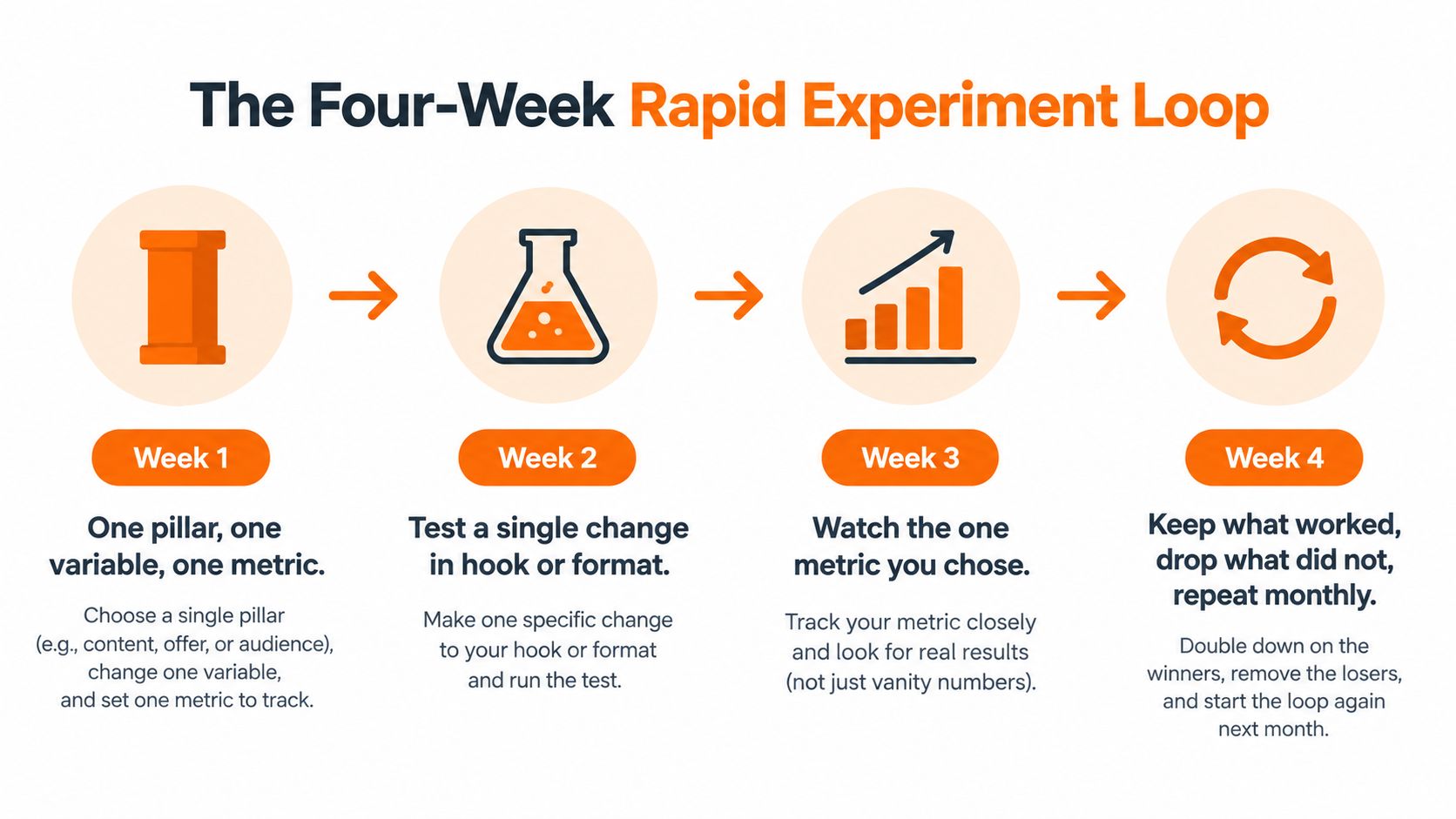
The Four-Week Rapid Experiment Loop
Random posting gives you anecdotes. A controlled loop gives you a working playbook.
Choose one pillar for the month, one variable to change, and one metric to watch. Keep the audience, destination page, and offer stable. If you change the hook, format, audience, and call to action together, you won't know what caused the result.
Run the loop
Week one, choose the test. Take one useful insight, such as factory-tour content creating better conversations than generic motivation. Write two versions of the same idea. Version A can open with the mistake. Version B can open with the practical lesson.
Week two, publish the variants. Keep the destination page and call to action consistent. Give each version enough time to collect meaningful responses. Don't change the test halfway through because one post feels slow.
Week three, watch one signal. If the goal is discovery, watch sends or qualified profile visits. If the goal is community participation, watch applications, replies, or group-chat signups. Likes can provide context, but they shouldn't decide the test alone.
Week four, keep or cut. Record the hook, format, topic, audience, action, and result in a simple spreadsheet. Keep the stronger version, remove the weaker one, and choose the next variable.
A social-branding study found that content marketing strategy strongly predicted content creation and sharing, with β = 0.85, while brand value predicted competitiveness at β = 0.88 and customer satisfaction at β = 0.79 (social-branding study). Treat those findings as support for disciplined testing, not a promise about your account.
Practical rule: Change one thing, measure one business-relevant action, and write down what you learned before you publish the next test.
Measure What a Founder Brand Is For
Your founder brand needs a job. If you cannot say what that job is, you will end up measuring whatever is easiest to see, usually reach, likes, and follower growth. That is how founders burn time producing content that looks active and proves nothing.
Pick the business outcome first. For an early-stage brand or founder-led community, that usually means qualified conversations, dinner applications, email signups, referrals, or social traffic that later helps a conversion. Then define the action that signals real intent.
A qualified action can be simple:
- A profile visit followed by a relevant direct message.
- An email signup from social.
- A vetted group-chat or dinner-event application.
- A referral from a member, customer, or respected peer.
- A website visit that later assists a conversion.
Start with a baseline before you change anything. You do not need a fancy reporting stack. A monthly sheet with post URL, pillar, format, reach, saves, shares, profile-view rate, landing-page conversion, and qualified actions will tell you far more than follower count by itself.
Separate attention from evidence
Attention matters. Evidence matters more.
Reach tells you how many people saw the post. Saves suggest someone wants to return to the idea. Shares show that the idea traveled. Profile visits show curiosity. A qualified application, a useful reply, or a relevant DM shows possible commercial trust.
That distinction matters because the wrong post can train the wrong audience. A post with modest visible engagement can still attract the exact buyer, partner, or member you want. Another can rack up attention from people who will never buy, join, refer, or respond. If you optimize for public engagement alone, you teach the account to entertain strangers instead of helping the right people decide you are credible.
Instagram gives you a practical way to read this. Instagram head Adam Mosseri said watch time, likes, and sends are the three leading ranking signals in 2025, with likes carrying more weight for content from accounts someone already follows and sends carrying more weight for reaching non-followers (Instagram ranking signals explained). Track average watch time to judge retention, likes per reach to judge follower response, and sends per reach to judge whether a post is worth passing on.
Build a one-page scorecard
Review the same questions every month:
- Which pillar created the most qualified conversations?
- Which format produced the clearest proof of trust?
- Which post earned sends from people outside your current audience?
- Which profile visits turned into applications, signups, or replies?
- Which topic attracted attention without useful action?
- What should you stop publishing next month?
Trend participation needs the same filter. Founders usually have limited time, budget, and creative energy, so every post has to earn its keep. The small-business survey cited earlier also reported that 93% of consumers say brands should understand online culture, about one-third consider brand attempts to jump onto viral trends embarrassing, and about half say original content makes favorite brands distinctive (survey details). Use culture when it helps people understand your work faster. Skip the joke-posting when it adds noise and weakens the signal.
Your 90-day minimum viable brand
Keep the system tight:
- Choose one home platform and one experimental channel.
- Write your positioning paragraph with the audience, problem, and refusal.
- Publish two proof-based pillars each week.
- Run one four-week experiment with a controlled variable.
- Review qualified-action metrics monthly.
- Remove posts that create attention without evidence.
This is the contrarian rule that saves under-resourced founders. Publish less. Prove more. A smaller body of credible evidence beats a larger pile of forgettable posts.
You need a public record that helps the right people answer three questions: who is behind this, what problem does this person solve, and why should I believe them?
Chicago Brandstarters gives Chicago and Midwestern founders a free, vetted community with private dinner events and a group chat for sharing honest operator stories, practical tactics, and support. If you want feedback on your positioning, content proof, or next experiment from people building real companies, visit Chicago Brandstarters and apply to join.
Leave a Reply