

Seven figures means an annual amount from $1,000,000 to $9,999,999. For founders, the phrase almost always means annual revenue, not profit, personal income, or take-home pay.
You may be asking because your sales dashboard finally looks serious, yet your bank balance doesn't. Maybe you crossed a milestone, hired your first employee, or watched one product carry the company further than expected. Then payroll, inventory, taxes, advertising, and your own paycheck arrived at the same time.
That gap explains why “what is 7 figures” sounds like a simple math question but rarely is one. You want to know what the number means, what changes after you reach it, and whether the business has enough strength to keep going. I'll give you the blunt version: seven figures is a stage of business, not a finish line.
The Moment You Realize Seven Figures Wasn't the Finish Line
Two years into the business, a founder I know opened the dashboard and saw the number she had chased through long nights, awkward sales calls, and more product revisions than she wanted to remember. Annual sales had reached $1,000,000.
She opened a bottle, called her parents, and posted the news. Friends congratulated her. For one evening, the company looked like the success story she had imagined.
The next morning, she met with her bookkeeper. The conversation felt less celebratory. Returns had reduced collected sales. Inventory bills were due. Advertising had consumed cash. Payroll, software, shipping, rent, taxes, and other operating costs had taken their share. The business had crossed a seven-figure revenue line, but her personal bank account hadn't crossed anything close to a seven-figure line.
Revenue can make a loud announcement. Cash makes the private decision about whether you survive.
That founder hadn't failed. She had reached a new operating stage without yet building the financial and organizational structure that stage demanded. The number gave her proof of demand, but it didn't guarantee margin, owner freedom, or durable cash flow.
The questions now became practical:
- Can the company repeat its customer acquisition without depending on one lucky campaign?
- Can it fund inventory and payroll without constant panic?
- Can someone else handle daily decisions?
- Can the founder take time away without revenue collapsing?
- Does growth create more owner income, or only more work?
I'll start with the literal definition, then separate revenue from profit and personal income. After that, we'll compare the main paths to seven figures, examine the operating milestones that matter, and look at the risks that appear after the celebration.
Crossing the line deserves recognition. It also deserves a harder question: what did the business actually build underneath the sales number?
The Literal Meaning of Seven Figures
Seven figures means any annual amount with seven digits, from $1,000,000 through $9,999,999. The range begins when the number reaches seven digits and ends before $10,000,000, which has eight digits. This seven-figure range follows the basic digit-counting rule.
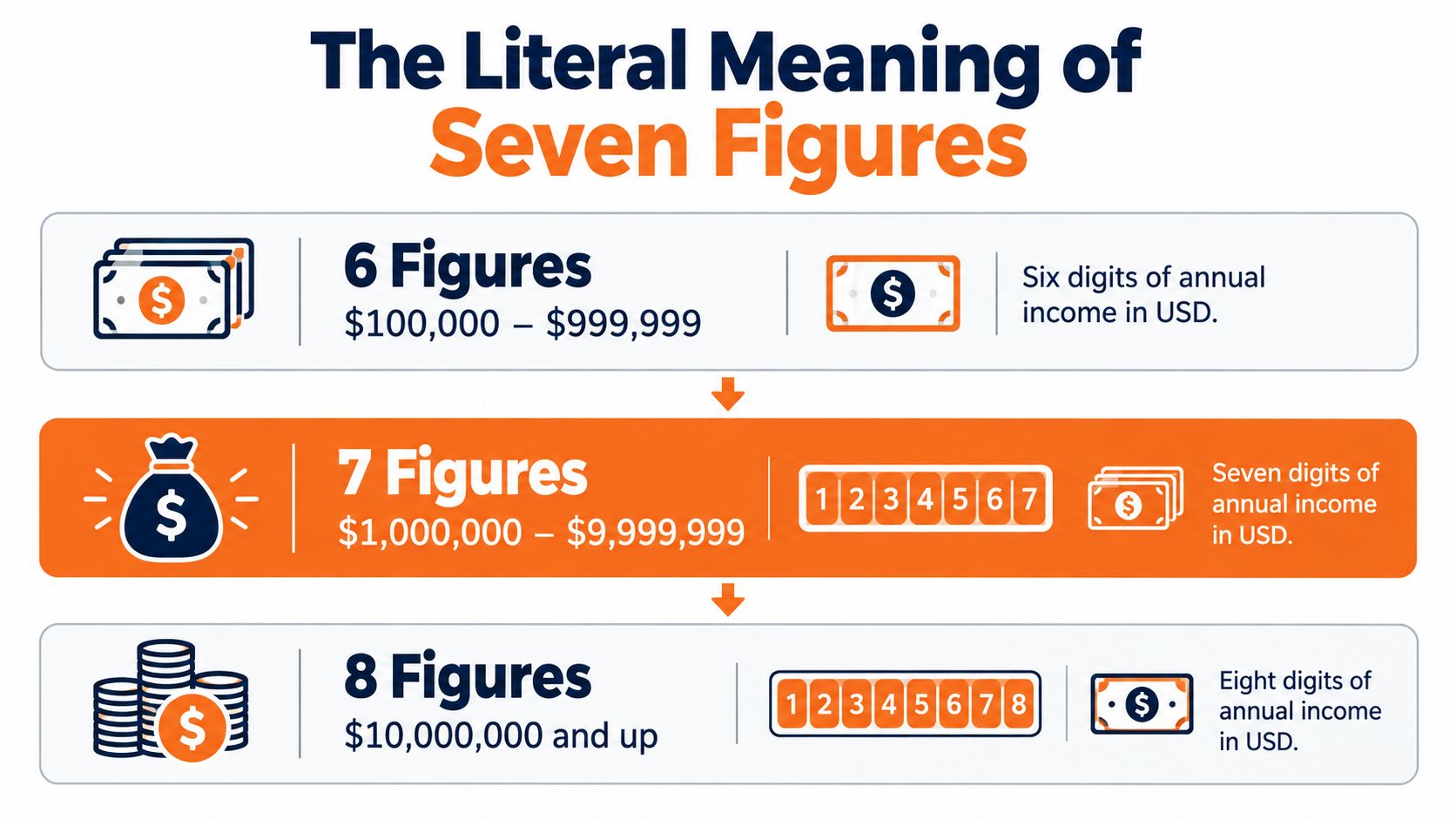
Think of the commas as a quick visual guide:
- Thousands have one comma, as in $10,000.
- Millions have two commas, as in $1,000,000.
- Billions have three commas, as in $1,000,000,000.
The phrase describes a range, not one specific achievement. Someone earning $1,000,000 annually and someone earning $9,999,999 annually both earn seven figures, though their businesses, lifestyles, and financial choices may look very different.
Context matters because “seven figures” can describe several things:
- Personal income, what an individual earns.
- Business revenue, what a company collects from sales and other receipts.
- Business profit, what remains after expenses.
- Sales, often used as another word for revenue.
- Asset value, such as the value assigned to a company or investment portfolio.
Founders usually use the phrase to describe annual business revenue. That convention causes confusion because listeners may assume the founder personally earns the same amount. They don't.
The same numerical threshold also carries different purchasing power in different countries. Inflation changes what a million dollars can buy over time. A founder in the United States reaches the seven-figure range at $1,000,000, while $10,000,000 moves into eight figures. The number stays fixed, but its practical weight doesn't.
So, if someone asks, “What is 7 figures?” answer this: seven figures is an annual amount from $1,000,000 to $9,999,999, and founders usually mean revenue unless they specify profit, income, or another measure.
Revenue, Profit, and the Money You Actually Keep
A sales dashboard tells you how much money customers agreed to spend. It doesn't tell you how much the business kept.
The IRS calculates business gross income by starting with net receipts, which means gross receipts minus customer returns and allowances, then subtracting the cost of goods sold and adding other income. The IRS also calculates gross income before ordinary business expenses, so $1 million in revenue and $1 million in profit describe very different results. The IRS explanation of gross income lays out that distinction.
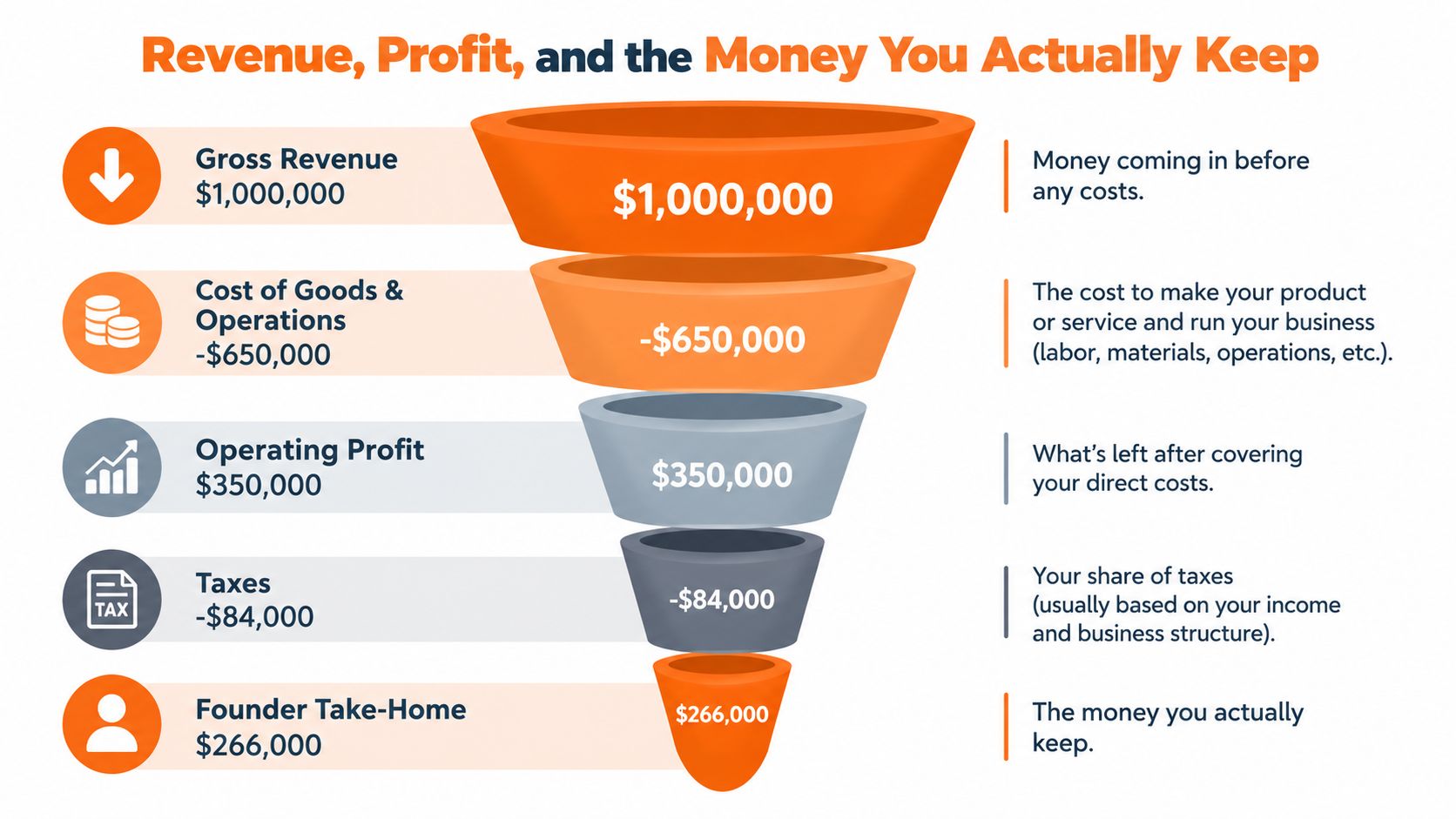
Take a $1,000,000 ecommerce brand. The money moves through several layers:
- Revenue is the top-line sales number.
- Gross profit subtracts product costs, freight, and other costs tied to making or acquiring the product.
- Contribution profit subtracts variable selling costs, including advertising and payment fees.
- EBITDA subtracts fixed operating costs such as payroll, rent, software, and overhead.
- Owner pay and cash available depend on taxes, debt, reinvestment, inventory needs, and the amount the company must keep inside the business.
A 2025 ecommerce benchmark reports median gross margins of about 70% for brands below $10 million, while median EBITDA sits at about 7%. That benchmark means a business with $1 million in revenue might produce roughly $70,000 in EBITDA before taxes, financing, and owner-specific adjustments. It doesn't produce $1 million in personal wealth.
A simple example makes the difference clear. If a company records $1,000,000 in revenue and reaches 7% EBITDA, the operating result is about $70,000. The founder may still need to pay personal taxes, fund inventory, repay debt, replace equipment, or leave cash in the company for growth.
A service business may carry lower delivery costs but higher labor dependence. A consulting firm can generate strong gross margins while the founder remains the salesperson, strategist, and delivery team. A SaaS or information-product company may deliver another customer at a low marginal cost, yet still spend heavily on product development, support, sales, and acquisition.
For the accounting mechanics, use this step-by-step business profit guide when you build your own bridge from sales to profit. Then calculate your product economics with gross margin percentage, because a blended sales number hides weak products.
The number you brag about is revenue. The number your accountant studies is profit. The number that keeps the lights on is cash.
Seven-figure revenue remains a real achievement. It shows that customers bought enough from the business to cross a meaningful sales threshold. It still doesn't mean the founder has seven-figure income, seven-figure profit, or seven-figure net worth.
Three Common Paths to a Seven Figure Business
Founders reach seven figures through different business designs. The path determines what the revenue looks like, where the margin comes from, and which problem keeps waking you up.
An ecommerce brand might sell many orders through one hero product. A service company might combine projects, retainers, and a small team. A SaaS company, course creator, or membership operator might sell access repeatedly while keeping delivery costs relatively low.
| Path | Typical Revenue Shape | Rough Margin Profile | Biggest Bottleneck |
|---|---|---|---|
| Ecommerce brand | Product sales spread across orders, channels, and launches | Product costs, freight, ads, fees, and fulfillment can consume a large share of sales | Cash tied up in inventory and customer acquisition |
| Service business | Projects, retainers, packages, or billable work | Delivery margin depends heavily on founder and team utilization | Capacity, pricing, and dependence on the founder |
| SaaS or information business | Subscriptions, licenses, courses, memberships, or digital purchases | Delivery can have low marginal cost, while product and acquisition costs remain | Consistent demand, retention, and conversion |
The ecommerce route
Consumer brands often begin with one product that customers understand quickly. The founder uses paid social, organic content, email, marketplaces, retail, or a mix of channels to create demand.
The trap sits between the purchase and the next purchase. You need enough margin to pay for the product, freight, storage, advertising, payment fees, fulfillment, returns, and support. Growth can make the cash problem worse because you must pay suppliers before customers pay you.
If you sell physical goods, learn your contribution margin by channel and product. A product that looks profitable before advertising may lose money after the full cost of acquiring and serving the customer.
The service route
Service founders reach seven figures by selling more expensive work, increasing volume, hiring delivery help, or turning custom work into a repeatable package. A founder who once sold personal hours may move toward retainers, audits, implementation programs, or managed services.
The bottleneck usually arrives when every sale creates more work for the founder. Raise prices, document delivery, and assign ownership before the calendar becomes the company's only operating system.
The digital route
SaaS, courses, memberships, and information products can deliver value without shipping another physical unit. That makes the cost structure different, not automatically easy. You still need a useful product, a reliable acquisition channel, customer support, retention, and a payment system that works.
Your diagnosis should be simple: identify the path you operate, then fix the bottleneck that belongs to that path. Don't copy an ecommerce playbook for a service company or a SaaS playbook for a product brand.
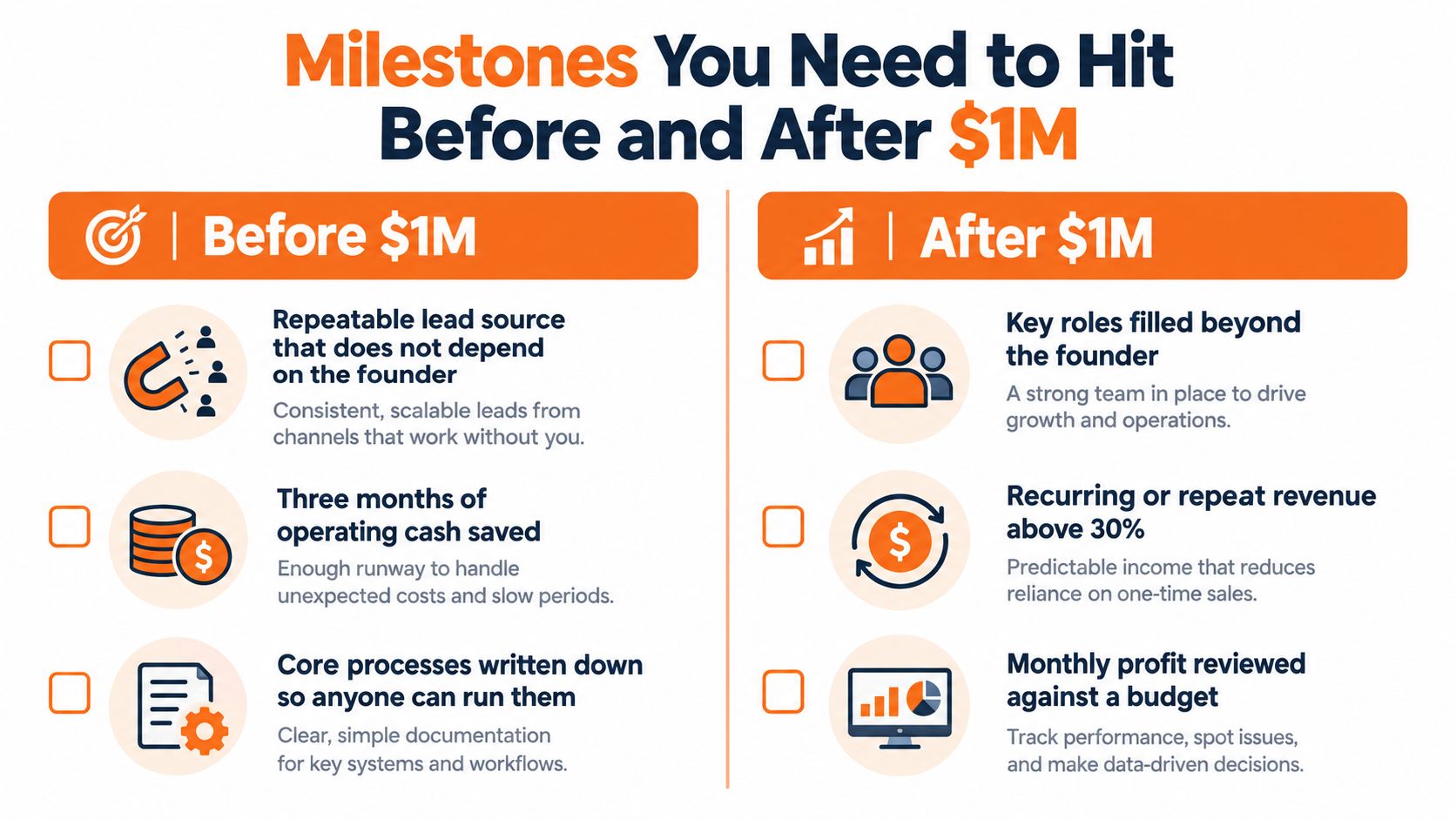
Milestones You Need to Hit Before and After $1M
A seven-figure business needs more than a strong sales month. It needs systems that keep working when the founder stops touching every task.
Run this checklist against your company. Answer each question with evidence, not optimism.
Before the threshold
- Repeatable acquisition: Can you explain where qualified customers come from and repeat the process without relying on one lucky post, ad, referral, or launch?
- Cash conversion: Can the business pay for inventory, payroll, suppliers, and taxes without emergency borrowing or personal cash injections?
- Written processes: Can another person complete core tasks from a document, screen recording, checklist, or training path?
- Clear unit economics: Do you know what each sale contributes after direct costs, payment fees, fulfillment, commissions, and acquisition spend?
- Pricing control: Can you raise prices or remove weak offers without losing the floor beneath the business?
One useful test asks whether your best customer disappeared tomorrow. If the answer is immediate panic, customer concentration needs attention. Another asks whether someone else can answer the top five customer questions without calling you. If they can't, you remain the company's operating bottleneck.
After the threshold
Growth changes the questions. You now need to protect the machine you built.
- Team ownership: Have you assigned outcomes to people who can make decisions without waiting for your approval?
- Channel balance: Would a platform policy, account suspension, supplier issue, or algorithm change erase demand overnight?
- Working-capital planning: Do you know when cash leaves the business and when it returns?
- Management reporting: Do you review revenue, gross margin, contribution profit, EBITDA, cash, and budget variance on a consistent schedule?
- Founder freedom: Can you leave for a meaningful break while the team continues selling, serving customers, and solving ordinary problems?
The answer to that last question matters more than another screenshot of the sales dashboard. A larger business can become a larger job if every decision still routes through the founder.
Your business becomes more valuable when it can make progress without borrowing your nervous system.
Use the checklist as a weekly management tool, not a motivational poster. Fix the two weakest areas first. Seven figures asks you to become an operator who can protect demand, cash, people, and time.
Why Most Seven Figure Businesses Are Quietly Fragile
Social media makes seven-figure businesses look common. Available U.S. small-business data indicates that more than 90% of businesses generate less than $1 million annually, while roughly half fail by their fifth year. A summary of the 2025 Small Business Credit Survey also reports that only 46% of small firms with employees were profitable in 2023. The supporting small-business data puts the milestone in a less glamorous place.
The danger grows when revenue rises faster than the company's controls. Inventory businesses can run out of cash while sales increase because suppliers need payment before the founder collects from customers. Hiring can add payroll before the new team member creates enough output. A large buyer can create concentration risk, while one ad platform can become the only reliable source of demand.
Founders also underestimate the personal cost. A company may reach seven figures through the owner's sales calls, product decisions, customer support, hiring, and late-night problem solving. Revenue rises, but freedom falls. The founder has built a demanding job with a company logo.
Check your cash exposure with days cash on hand, then ask what happens if sales slow while your fixed costs continue. You don't need a dramatic crisis to discover a weak model. A delayed shipment, an expensive return cycle, a lost account, or a bad hire can expose it quickly.
The practical target is a seven-figure business that can handle ordinary disruption. It should have repeatable demand, documented work, more than one meaningful route to customers, sensible inventory planning, and a founder who can step away.
Place the video later in your review process, after you've looked at the numbers and operating dependencies.
The test I trust is simple: can you take a two-week vacation without the business becoming an emergency? If the answer is no, keep building the operating system before you chase the next revenue milestone.
What to Do Next on the Path to Seven Figures
Start with a one-page diagnosis. Write down your path, whether it's ecommerce, services, SaaS, information, or membership. Then calculate revenue, direct costs, contribution margin, fixed expenses, realistic owner pay, and cash available. If you need help finding demand beyond personal referrals, study practical B2B lead generation strategies.
Next, run the readiness checklist from earlier and choose the two weakest milestones. Spend the next 90 days fixing those areas, whether that means documenting fulfillment, separating channel reporting, improving collections, changing pricing, or hiring the first owner for a recurring responsibility. Use ecommerce growth strategies when your product business needs a clearer acquisition and retention plan.
Finally, find people who have operated through this stage. Chicago Brandstarters uses small, vetted, in-person peer dinners and a group chat for founders from idea stage through seven figures. Programs such as Goldman Sachs 10,000 Small Businesses, EcomFuel, and Million Dollar Sellers tend to fit later, once a brand has moved past six figures and needs the next operating jump.
Seven figures is a real stage. You can reach it without sacrificing your margins, your health, or the relationships that matter.
Chicago Brandstarters gives kind, hardworking founders a free place to compare numbers, solve stubborn business problems, and build real peer relationships through private dinners and an active group chat. Visit Chicago Brandstarters if you want practical company while you build toward durable seven-figure revenue.
Leave a Reply