
Most advice on how to hire a CEO is backwards.
It tells you to polish the job spec, call a search firm, and hunt for a polished resume. That's how founders end up hiring someone impressive on paper and miserable in the seat. A CEO hire usually fails long before the first interview. It fails when you haven't decided what power you're giving away, what you're keeping, and who you are after the handoff.
If you want to hire a CEO without losing your company, stop treating it like recruiting. Treat it like a redesign of control, accountability, and your own role. You are not filling a gap. You are changing the operating system.
I'm opinionated on this because founders usually swing to one of two bad extremes. They wait too long and become the bottleneck for every decision. Or they swing the doors open, hand the keys to a “grown-up CEO,” and then panic when the company starts feeling like somebody else's business. Both mistakes come from the same problem. The founder never made peace with the transition.
The Hardest Decision You Will Make as a Founder
Hiring a CEO isn't a trophy. It isn't proof that you've made it. It's more like open-heart surgery on a business that still needs to function while you cut into it.
Most founders think the hard part is finding the person. I don't. The hard part is admitting that the company you built now needs a different shape, and that your old way of running it has hit its limit. That's a personal decision before it's a hiring decision.
Scale and control pull in opposite directions
You built the company by staying close to everything. Product, sales, hiring, customer drama, cash, morale. In the early days, that works because speed matters more than structure. Later, that same behavior starts to choke the company.
The trap is obvious once you see it. The more the business grows, the more you want control. The more you keep control, the more the business depends on your bandwidth.
Practical rule: If the company can only move at the speed of your calendar, you don't have a leadership team. You have a dependency.
That's why this decision feels so loaded. You're not just asking, “Who can run this company?” You're asking, “What parts of me built this place, and which parts now get in the way?”
This is also a founder identity crisis
A new CEO changes reporting lines, meeting rhythms, board behavior, and decision flow. It also changes your identity. Plenty of founders say they want help. Fewer are ready to stop being the center of gravity.
If that tension feels uncomfortable, good. It should. Honest leadership usually starts with saying the quiet part out loud. If you need a place to think through that tension with other operators, I'd spend time on vulnerability in leadership before you start a search. You'll make better decisions if you stop pretending this is only a talent problem.
Here's my blunt view. A CEO hire is successful when the founder redesigns the company before the candidate arrives. If you skip that step, you'll blame the hire for problems you created.
Deciding If and When You Truly Need a CEO
Don't hire a CEO because the title sounds mature. Hire one when complexity has outrun your ability to manage it well.
One useful benchmark is this: the need often gets sharper at about $10 million in annual revenue and around 20 to 25 employees, when founders can no longer directly manage every function, according to ClientWise's discussion of when to hire a CEO. I wouldn't treat that as a law. I would treat it as a warning sign.
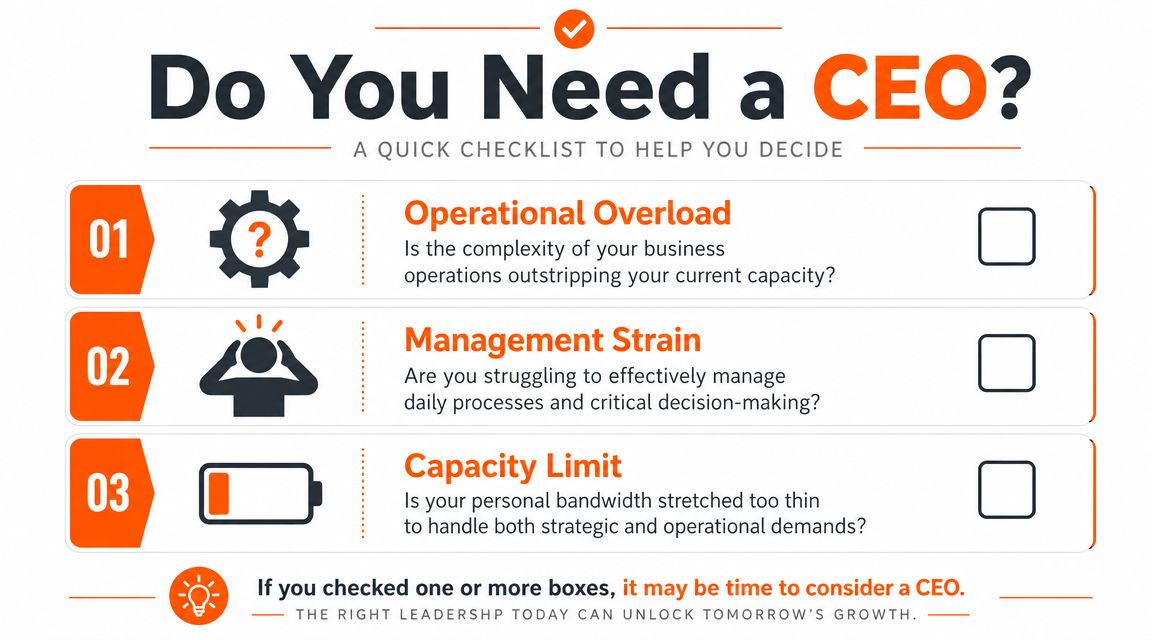
The real trigger is operational overload
I've seen founders obsess over valuation, funding, and optics. None of those tells me whether you need a CEO. I care about operational drag.
Ask yourself three blunt questions:
- Are you the approval layer for everything? If pricing changes, hiring decisions, product tradeoffs, and customer escalations all route through you, you are the bottleneck.
- Are you spending your days reacting? A founder should handle some chaos. But if your week is mostly firefighting, nobody is building the next phase.
- Does every function depend on your translation? If sales can't talk to product, ops can't talk to finance, and leaders only align when you're in the room, your company has outgrown founder glue.
The easiest analogy is a restaurant. At first, you are the chef, buyer, host, and dishwasher. Then the dining room fills up. If you keep doing all four jobs, service collapses. The answer isn't “work harder.” The answer is redesign.
A CEO may be the answer, but only if the problem is leadership bandwidth
Sometimes founders need a COO, chief of staff, or stronger functional heads, not a CEO. Don't use a CEO hire as a lazy fix for your inability to delegate.
A good gut check is this short table:
| What's breaking | Likely issue | Better move |
|---|---|---|
| You can't manage cross-functional execution | Leadership bandwidth | Consider hiring a CEO |
| You need leverage on priorities and communication | Founder operating rhythm | Consider a chief of staff |
| One function is weak, but the business is otherwise clear | Functional gap | Hire the function head |
If you're torn between a CEO and a force-multiplier role, this essential guide for founders is worth reading because it helps separate “I need strategic help” from “I need someone to run the company.”
You don't hire a CEO to feel relieved. You hire a CEO when the company needs a different command structure.
The founder test
Before you search, score yourself on this one question. Are you still the best person to run the company day to day?
If the honest answer is no, act. If the honest answer is “maybe, but I hate admitting it,” act faster. A lot of founders delay this move because they confuse being indispensable with being effective.
If you're still trying to tell whether your company is stretching past your current model, this piece on what business scaling is can help you separate healthy growth from messy sprawl.
Designing the Mission Not the Job Description
Most CEO job descriptions are fiction.
They read like a shopping list written by a nervous board: prior CEO experience, domain expertise, fundraising chops, operating rigor, product instincts, world-class leadership, culture builder, global mindset. That person either doesn't exist or won't want your job.
The fix is simple. Don't write a job description first. Write a mission document.

Build from outcomes and real examples
A stronger executive process starts by defining the role from real examples, screening against a trait matrix, and using staged evaluations rather than a fantasy wish list, as explained in Scope Recruiting's guide to executive hiring. That advice is dead right.
I'd compress it into one page with five parts:
Business context
What stage are you in? What's broken? What must change?Three to five outcomes
These are the scoreboard items for the first stretch of the role. Keep them concrete and hard enough to force tradeoffs.Trait matrix
Pick the traits that matter for this seat. Calm under pressure, ability to simplify, talent density, conflict handling, capital discipline, whatever actually matters in your company.Decision rights
Who owns hiring, pricing, budgets, product bets, and org changes?Failure modes
State how this hire can go wrong. Every founder knows the answer. Write it down.
Governance belongs in the mission document
Most founders get sloppy. They define goals but avoid power. Then the conflict shows up later, in real time, with a payroll to protect and a board watching.
Use a simple split like this:
| Area | CEO decides | Founder decides | Shared with board |
|---|---|---|---|
| Exec hiring | Usually yes | Sometimes input | Rarely |
| Product vision | Sometimes | Usually yes in founder-led product companies | On major bets |
| Budget shifts | Within limits | Input on major changes | Approval on major moves |
| Culture standards | Day-to-day enforcement | Non-negotiables | Oversight |
That table won't solve every conflict. It will expose the conflicts before they get expensive.
If you can't explain what authority the CEO has in plain English, you're not ready to hire one.
A mission document does one more thing. It tells candidates the truth. Serious operators want clarity more than glossy branding. They know a vague seat is a political trap.
Finding and Vetting Your Future Partner
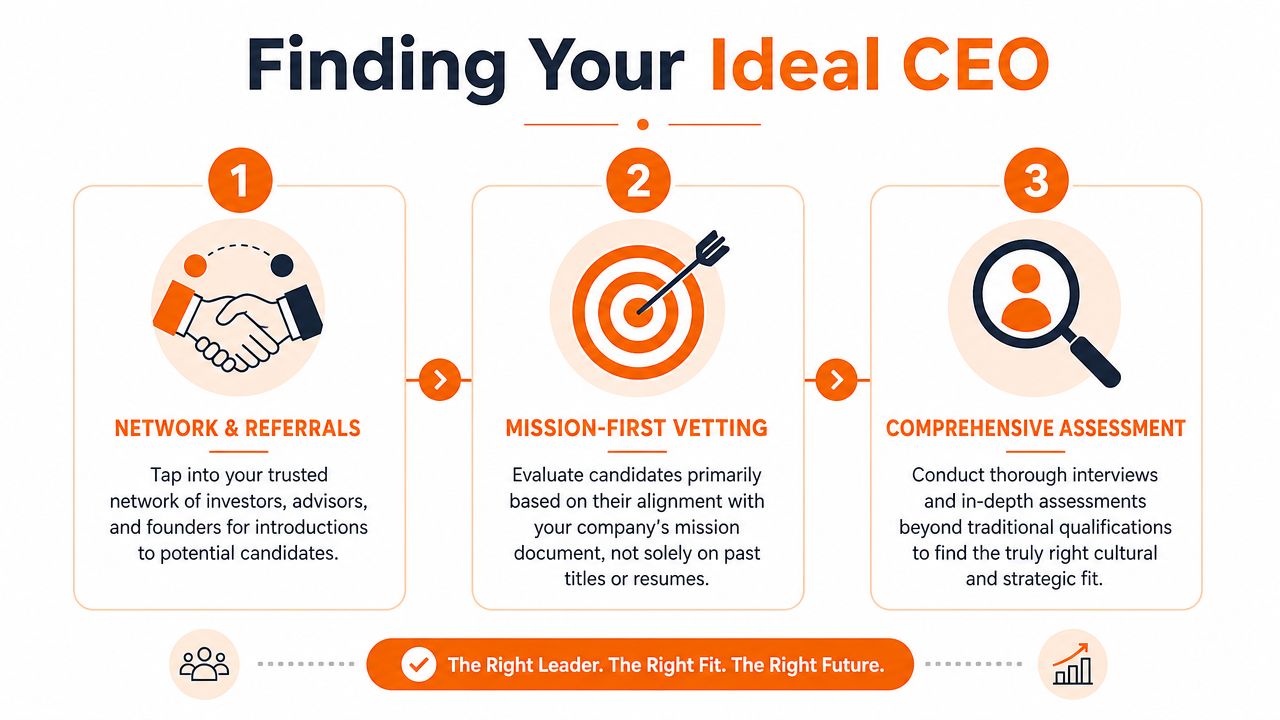
The candidate who changes your company probably isn't cold-applying to a listing.
CEO hiring is a narrow market and a weird one. Indeed's hiring data says U.S. CEO jobs had 92,647 job seekers and were described as moderately competitive, with roughly 85 job seekers per CEO job as of December 2020. The same page lists a common U.S. salary of $113,840 and a typical range of $18,000 to $298,000 per year, which shows how uneven this market is across company types and stages, according to Indeed's hiring page for CEOs. Translation: there are plenty of people who want the title, and far fewer who fit your actual situation.
Stop worshipping the proven CEO
Founders often overpay for familiarity. They want someone who has already had the title because it feels safer. It usually isn't.
I'd rather look hard at the strong number two. The operator who ran a division, built a system, led through chaos, and never got the public credit. Executive hiring advice has pushed founders to widen the funnel, use scorecards, and check references early, with a clear warning that the best hire is often not the most obvious resume. It also argues that founders should consider second-in-command operators, not just prior CEOs, in OpenView's take on hiring executives.
That matches what I've seen. The glamorous candidate knows how to interview. The hungry operator knows how to build.
Make the interview a working session
A CEO interview should feel less like a courtship and more like a stress test.
Give the candidate a real problem. A messy one. Maybe churn is creeping up while sales wants aggressive promises. Maybe gross margin is under pressure. Maybe your leadership team is strong individually and weak together. Then ask them to work through it with you.
Watch for these signals:
Clarity under ambiguity
Do they simplify without getting shallow?Respect for constraints
Do they ask about cash, talent, timing, and tradeoffs, or do they jump into theater?Ego control
Do they need to be the smartest voice in the room?Founder fluency
Can they work with a founder who still has strong views, or do they only know how to rule by title?
If you want a broader primer on search mechanics, this guide to hiring top leaders is a useful complement. It helps if this is your first real executive search and you need language for process without turning the whole thing into HR theater.
References are where the truth shows up
Formal references are polite. Backchannel references are real.
Call former peers. Call people who reported to them. Call the investor who had to clean up a hard quarter. You are looking for patterns, not gossip.
Ask questions like:
- What got better when this person arrived?
- What got harder?
- How did they behave when the numbers turned against them?
- Would you hire them again for this exact stage?
I'd also ask founder friends for intros to people they trust. Search firms can help, but your highest-signal candidates often come through trusted operators. That's one reason communities built around founder candor can help. For Midwest founders, how to find business partners is a useful way to think about relationship-based sourcing instead of resume piles.
Hire the person you can argue with productively, not the person who makes the room go quiet.
Structuring the Deal Compensation and Board Dynamics
A CEO offer is not an employment formality. It is a control document with money attached.
Most founders underthink the package and overthink the personality. That's backwards. If the incentives, authority, and reporting lines are fuzzy, a great candidate turns into a political problem.
Pay for the seat you need
In the United States, the Bureau of Labor Statistics reported a median annual wage of $206,420 for chief executives in May 2024, and projected employment growth for top executives is only 4% from 2024 to 2034, with about 331,000 openings per year across the category, mostly from replacement rather than rapid expansion, according to the Bureau of Labor Statistics page on top executives. That tells you two things. Good CEO talent is expensive, and the market is shaped more by turnover than by a flood of new seats.
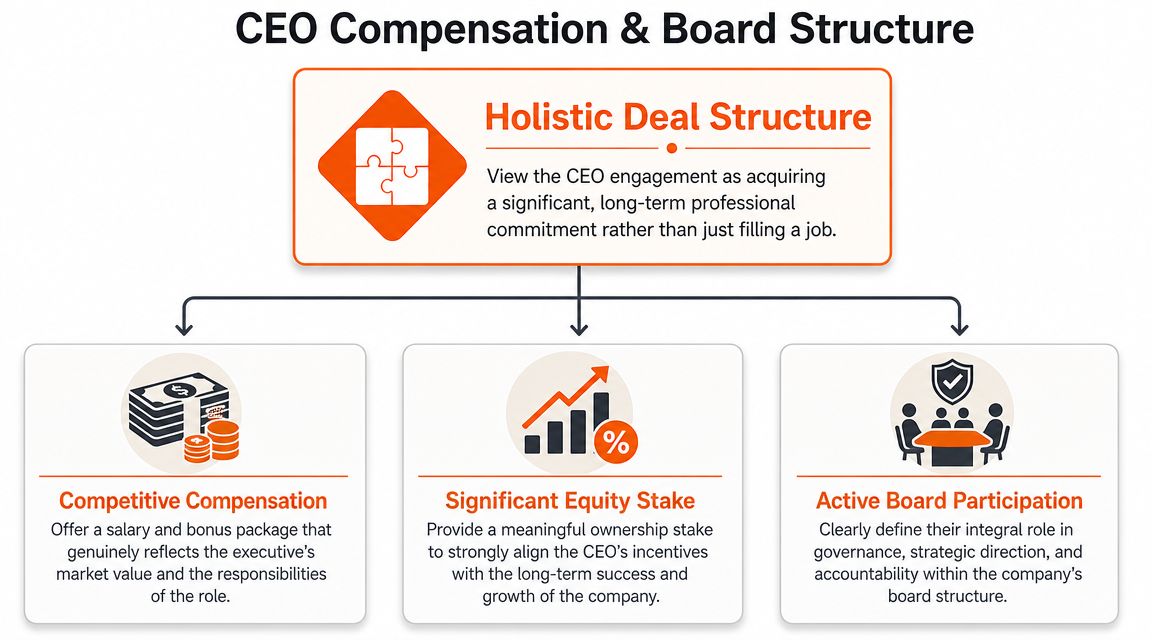
I like a simple package with three parts:
Base salary
Enough that the executive can focus on the job instead of financial anxiety.Performance bonus
Tied to the mission document, not vague “leadership excellence.”Equity
The piece that makes them think in years, not quarters.
The equity piece is where founders get weird. They either give too little and create a mercenary, or they give too much because they're desperate. Tie equity to the size of the mandate and the stage risk. Don't guess. Model dilution, future fundraising, and retention before you start negotiating.
The board structure has to be explicit
Here's the part many founders don't want to hear. Once you hire a CEO, the CEO doesn't report to your mood. The CEO reports into a governance structure.
If you have a board, formalize these items before the offer goes out:
| Governance item | What to decide |
|---|---|
| Reporting cadence | Weekly founder-CEO check-in, monthly board prep, formal board meetings |
| Reserved matters | Which decisions require board approval |
| Founder role | Chair, product lead, evangelist, or something else |
| Evaluation | How performance gets reviewed and by whom |
This is where legal paperwork matters. Employment terms, termination triggers, confidentiality, invention assignment, and D&O coverage need to be clean. If your company has investors, cross-border entities, or messy cap table history, get counsel involved early. If you need a plain-English view of how governance disputes can turn into legal exposure, this note on fiduciary duty allegations in cross-border ventures is a useful reminder that blurred authority lines can become much more than a management headache.
The compensation package gets the CEO in the door. The governance package determines whether they can actually do the job.
Don't negotiate around your own fear
Founders sometimes use compensation as a substitute for clarity. “We'll figure it out after the person starts.” No, you won't. You'll argue about authority under pressure, which is the worst time to define authority.
Put the hard stuff in writing when everyone is calm. Money is one part of trust. Clear power is the other part.
The Transition Onboarding and Your New Job
The first day your CEO starts is also the first day your old founder job ends.
If you keep acting like the founder-who-does-everything, you will sabotage the person you just hired. You may not do it loudly. You'll do it in smaller ways. Side conversations with employees. Quiet reversals. Jumping into decisions that are no longer yours. Every one of those moves tells the team who really runs the place.
Your new role needs a name and a boundary
Founders who succeed in this transition usually pick a lane. Chair. Product leader. Brand face. Capital raiser. Something real. Something that has authority, but not hidden executive control.
One of the biggest risks in a CEO hire is failing to define decision rights and essential cultural principles before the handoff. A founder can hire an excellent candidate and still wreck the fit if they haven't decided how much autonomy the new CEO gets, as argued in Kirk Palmer's guide for founders hiring a CEO.
That matches my experience exactly. Most “bad CEO hires” are bad transitions.
What the first stretch should look like
I like an onboarding rhythm that is heavy on context and light on founder interference.
For the first stretch, the founder should give the CEO:
A full download
The full story on customers, people, debt, politics, product issues, and unwritten history.Cultural translation
Who the company trusts. What behavior gets punished. What values are real and which ones are wall art.Decision map
Where the CEO has full authority, where you want discussion, and what goes to the board.
Then step back enough for the team to reorient around the new leader.
Your job is to protect the handoff, not to hover over it.
Focus on outcomes, not methods
This is the founder discipline that matters most. If you hired a CEO, let them run the company. Judge them on outcomes, judgment, and integrity. Don't judge them on whether they use your favorite method.
You still matter. A lot. But in a different way. You are now the keeper of the mission, the history, the standards, and the long horizon. The CEO handles the machinery. You watch whether the machinery is producing the right result.
If you can do that, hiring a CEO won't feel like losing your company. It will feel like finally giving the company room to grow beyond your own bandwidth.
If you're wrestling with the founder side of this transition, Chicago Brandstarters is one place to talk it through with other builders in small, private dinners and an active group chat. It's a vetted community for Chicagoans and Midwesterners building brands, and the format is built for honest operator conversations rather than performative networking.
Leave a Reply