You can have a full calendar, a decent ad account, and three Slack channels open, then still end the night staring at one broken problem with nobody to call. The supplier stops replying. The Shopify migration breaks. The launch you pinned your week on slips again. That's the lonely part most founder advice skips, and it's why community involvement matters when you're still small enough to feel every mistake in your stomach.
For founders, community involvement isn't about collecting contacts or showing up where people can see you. It's about building a room where people swap real tactics, tell the truth, and pick up the phone when your week goes sideways. In Chicago and across the Midwest, that usually works better in tight circles than in big, noisy rooms full of people performing confidence.
The Loneliest Part of Building a Brand
At 11 p.m., the hard part rarely feels strategic. It feels personal. You're refreshing a dashboard that won't move, or waiting on a supplier who has gone quiet, and the urge to quit starts sounding practical.
I've watched a lot of early founders try to solve that loneliness with bigger networks. They go to broad mixers, collect business cards, and leave with more names than help. That route usually fails because it rewards surface energy, not trust.
Practical rule: if a room makes you feel like you have to pitch, it probably won't help you when you need honesty.
The people who need community involvement most are usually at the idea stage, pre-prototype, or somewhere near the first $10K in revenue. They don't need a polished corporate network. They need peers who understand the same messy middle, the same cash pressure, the same feeling that every decision might be the wrong one.
That's why founder communities work best when they feel small and human. They need repetition, not spectacle. They need a reason to show up again next week.
If your current circle doesn't let you be blunt about what's broken, it's not doing its job. If you want a sharper lens on founder stress and mental load, I'd start with this founder mental health collection, because the emotional side and the business side don't separate cleanly in real life.
What Community Involvement Actually Means for Founders
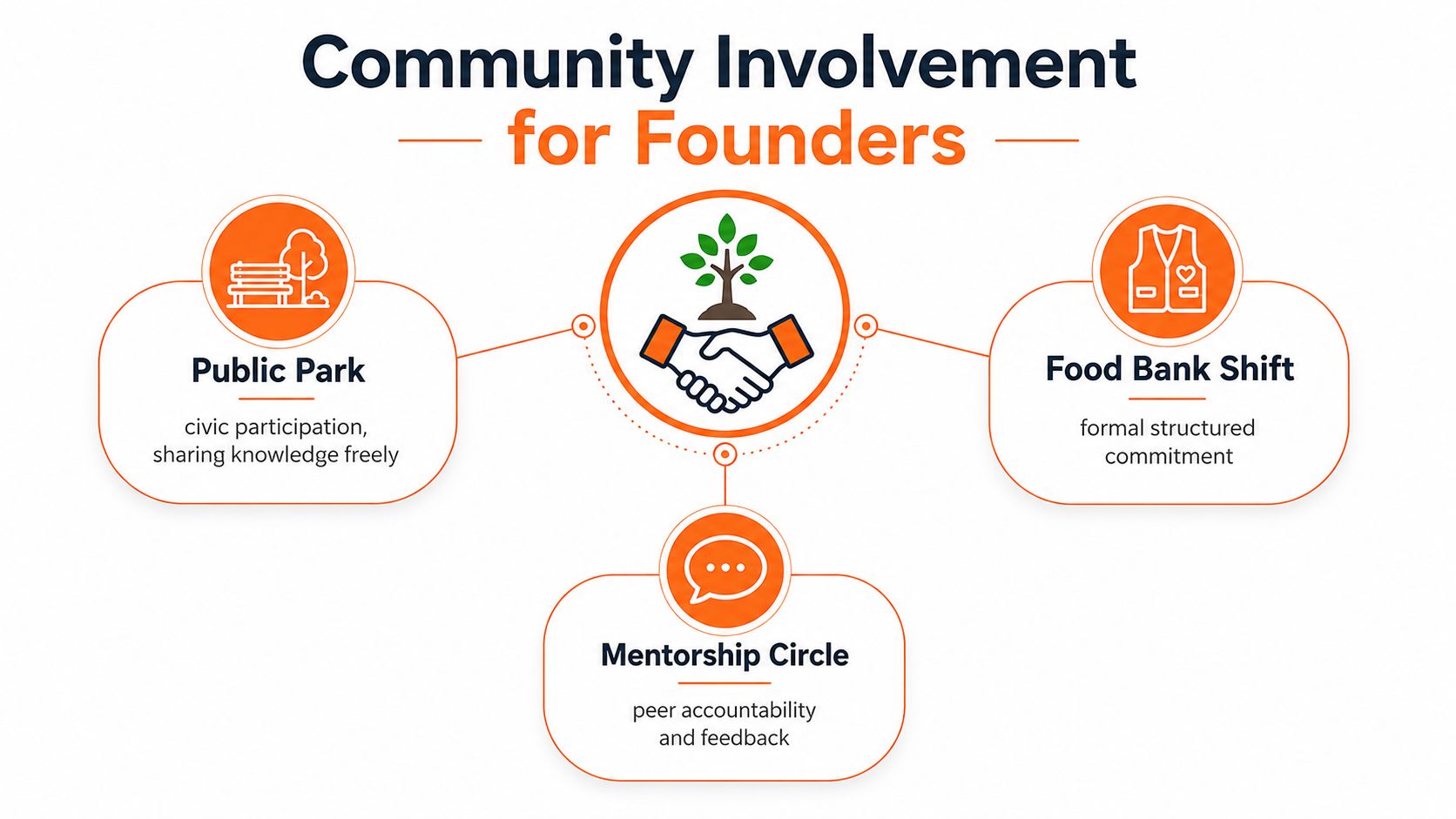
For founders, community involvement usually works in three layers, and each one asks for a different level of trust.
Start with the public park
A public park is the widest layer. People pass through, talk, and sometimes leave with a useful connection. That lines up with civic participation, the public-facing kind of involvement the UK government's UK government survey tracked when it found participation in civic life, consultation, and activism was active across the people it surveyed.
For founders, this layer matters when you want a read on the city around you, not just your own niche. In Chicago, that can mean learning how neighborhoods talk about your category, what local operators care about, and which issues people will make time for. By itself, though, it stays broad.
Move to the food bank shift
A food bank shift is more structured. You show up on time, do the work, and stay for the full commitment. That maps to formal volunteering, the kind of organized participation that the U.S. Census Bureau and AmeriCorps have measured in civic life.
That level of involvement tells you something founders often miss. People are willing to commit when the setting is clear, the role is real, and the expectations are visible. I see the same pattern in Midwest founder circles, where reliability matters more than polish and people remember who showed up without making a scene.
Finish at the mentorship circle
A small dinner table is different. Everyone has skin in the game. Nobody is there to perform, and the conversation gets honest fast.
That is the layer where peer founder involvement starts to matter for early-stage brand builders. It looks less like public service and more like a private war room, with shared context, confidential feedback, and repeated contact that builds trust over time. Chicago Brandstarters fits that model through small vetted dinners, confidential group chats, and clear norms about who gets invited in and why.
If you want a toolset that helps communities collect participation without turning every interaction into a formal process, AI-assisted participation tools can help groups keep responses organized and keep the conversation moving.
A simple test helps. If a group gives you visibility, it's park-level involvement. If it gives you duty, it's shift-level involvement. If it gives you honesty, feedback, and repeat contact with people who understand your work, it's the kind of community a founder can use.
Why Involvement Changes What Your Brand Can Reach
Community involvement changes what your brand can reach because it changes who trusts you, who introduces you, and who stays engaged when the work gets messy.
Referrals and access don't come from empty networking
Warm referrals usually come from people who have watched you operate over time. They have seen how you handle a delayed shipment, a supplier call that goes sideways, or a last-minute problem you did not cause. That history matters more than a polished elevator pitch.
A useful reference point is the scale of organized civic participation. Many people already take part in community life, so founder communities are not asking anyone to learn a strange new habit from scratch. They are meeting people where they already are, then giving those relationships a tighter, more useful setting.
That matters in Chicago, where a lot of founder relationships still start through people who know how you show up, not what your LinkedIn profile says. One dinner can lead to a supplier intro, a factory walk-through, or a mentor who answers the text you were too hesitant to send. The value comes from repeated exposure, not from a loud introduction.
Trust helps when your brand is still small
The Pew Research Center found 57% of Americans took part in at least one community group or organization in a December 2017 survey, and 11% took part in four or more groups Pew Research Center. The same survey showed clear gaps by education and income, with 70% of college graduates involved in at least one group compared with 48% of adults with only a high school education, and 66% of households earning at least $75,000 involved versus 47% of households earning $30,000 or less Pew Research Center.
That split matters for founders because the people who need community most often have the least slack in time, money, and energy. If your room filters them out, you lose the very people who would benefit from it.
Chicago Brandstarters uses a vetted format that keeps the room tight enough to be useful, and its mastermind groups for entrepreneurs follow the same logic. The point is not volume. It is trust, consistency, and enough shared context that people can give real feedback instead of broad advice.
When founders keep showing up in the same room, people stop asking whether they are serious.
Emotional durability is a real asset
I have seen this part get dismissed because it sounds soft. It is not. A bad launch hits differently when you have two peers who know the backstory and do not flinch.
For a founder, that kind of durability keeps you shipping. It also keeps you from making frantic decisions just because one week went badly.
How a Vetted Founder Community Actually Runs
A good founder community feels simple from the outside and deliberate from the inside.
Vetting protects the room
Chicago Brandstarters uses an application process and LinkedIn vetting to keep out people who are mainly there to sell services or collect leads. That sounds small, but it changes the tone of every conversation. If nobody has to worry about being pitched, people talk more openly.
The logic is plain. Trust drops fast when a room turns into a prospecting list. The vetting step cuts that off before it starts.
Small dinners force real conversation
The biweekly 6 to 8 person dinner format matters because it gives everyone airtime. In a room that size, nobody can hide behind noise. You can't coast on charisma. You have to contribute.
That's why small founder dinners tend to produce better questions than bigger events. A founder can ask, “How did you handle this?” instead of “What do you do?” That's a different conversation.
Here's the kind of format that works:
- Right-size the group: Keep the table small enough that everyone speaks.
- Keep the cadence steady: Repetition matters more than novelty.
- Make the chat active: A group chat works best when members can ask for help in real time.
- Hold confidentiality tight: People tell the truth when they know the room stays private.
The active chat matters because the dinner isn't the whole experience. Someone can ask a tactical question on Tuesday morning, then get three grounded replies before lunch. That kind of rhythm keeps momentum between events.
If you want a second lens on this structure, these mastermind groups for entrepreneurs show the same logic in a more formal frame.
Later-stage programs can still sit in the path, but they should come after trust, not instead of it. In practice, that means a community can point members toward Goldman Sachs 10KSB, EcomFuel, or Million Dollar Sellers once the brand is ready, while staying focused on peer support rather than becoming a funnel.
What to Measure So Involvement Stays Real
Headcount lies. Depth tells the truth.
Use participation depth, not just signups
The cleanest way to judge community involvement is to watch how people behave after they join. The Hivebrite measurement framework points to DAU/WAU/MAU, response time, posts and comments per member, and the share of user-generated content as better signals than simple registration counts Hivebrite. Those metrics tell you whether people are contributing or just sitting there.
The CDC and ATSDR use a similar logic in public-sector work. They track event frequency, attendance rate, attendance composition, and input take-up rate because they want evidence that outreach reached the right people and that the input changed something CDC/ATSDR.
A practical way to think about it, if you run or join a founder room, is to ask whether people are talking to each other without needing a prompt.
| Depth Metrics That Predict Real Community Involvement | What It Measures | Healthy Signal |
|---|---|---|
| DAU / WAU / MAU | How often people return | Members keep coming back between events |
| Response time | How fast the room reacts | Questions get answered quickly |
| Posts and comments per member | How much people contribute | Members speak more than admins |
| Member-generated content share | Who drives the discussion | The room doesn't depend on one organizer |
| Input take-up rate | Whether feedback changes decisions | People can point to a real follow-through |
Don't confuse motion with meaning
A busy channel can still be shallow. A room full of notifications can still produce nothing useful. That's why event engagement strategies for 2026 are worth reading alongside your own measurement plan, because attendance alone never tells the whole story.
Practical rule: if the admin has to keep the room alive every day, the community is probably not carrying itself yet.
For founders, the question is simple. Did the room create a faster answer, a better decision, or a stronger relationship? If the answer is no, the metric stack needs to change.
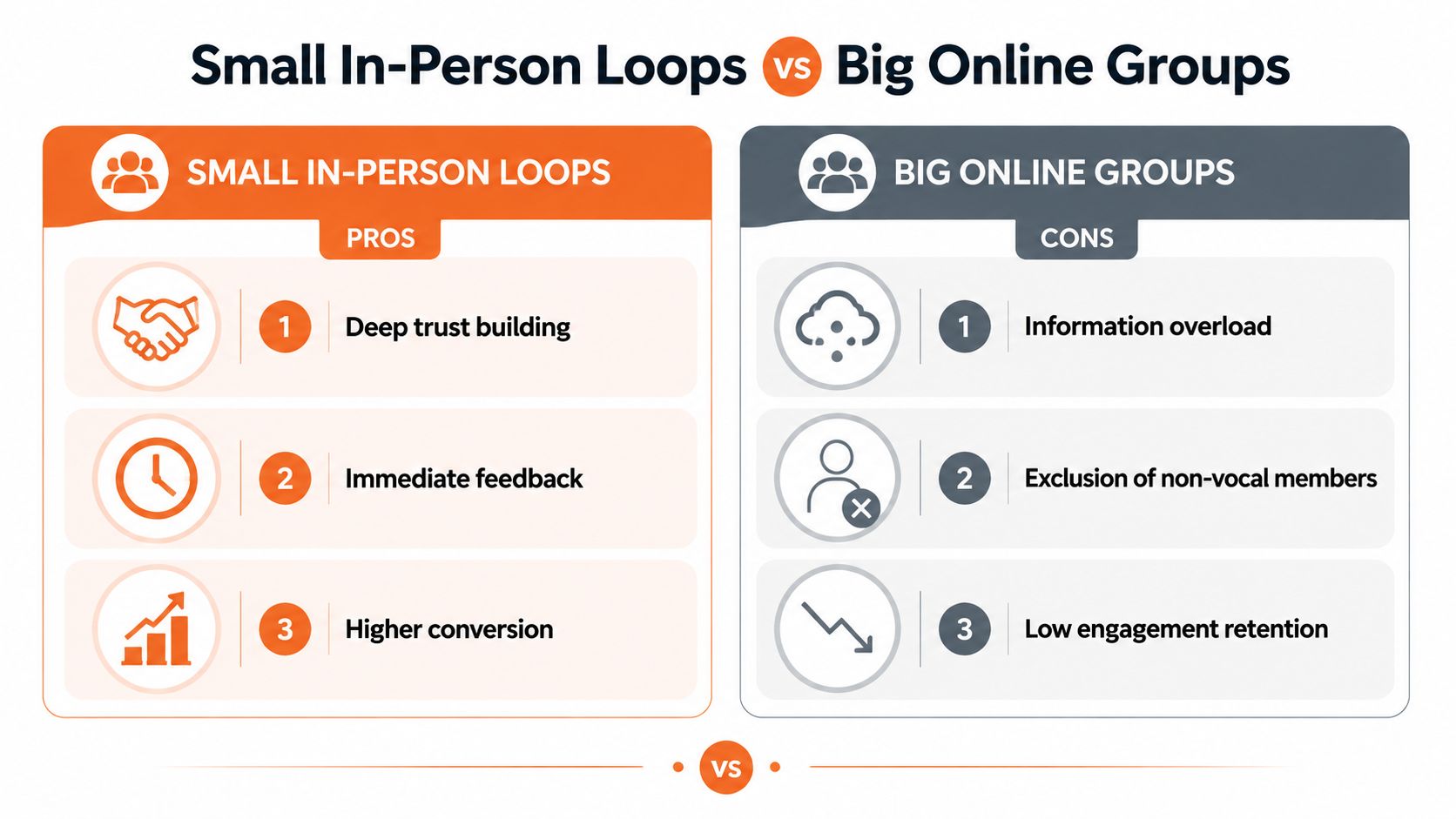
Why Small, In-Person Loops Beat Big Online Groups
The default move for a busy founder is to join a giant Slack or a wide-open Discord. That feels efficient. It usually isn't.
Big groups lose people in plain sight
The access barriers are real. Research and guidance on underserved groups keep pointing to digital exclusion, language barriers, mobility limits, and distrust of institutions as reasons people stay out of community programs underserved community guide. When a community moves online and optimizes for scale, the quiet people often disappear first.
That matters for founders in the Midwest because many of us are already stretched thin. We're running businesses around family, jobs, commutes, and cash flow. A firehose of messages is not the same thing as participation.
Small loops solve the trust problem
Repeated informal contact works because people stop treating the room like a stage. They know the faces. They know the norms. They know who will answer and who won't.
The most effective models in the research lean on in-person trust-building, co-design, and repeated contact rather than one-off campaigns or generic digital forums PMC review of community engagement. That matches what I've seen in Chicago. If you want people to stay involved, give them a predictable table, not a blast of content.
An in-person group also cuts down on the social cost of speaking up. A lot of founders won't type a question into a giant channel because they don't want to look uninformed in front of hundreds of strangers. They will ask at dinner.
If you want a local format that keeps the room human, this in-person workshop is the kind of setting that fits the small-loop model better than a sprawling online feed.
What Involvement Has Actually Unlocked for Members
The cleanest wins are rarely dramatic. They're specific.
A group chat can save a bad week
A founder hits a Shopify migration wall, drops the problem into the group chat, and gets two replies that point to the issue. That saves time, but more than that, it saves momentum. The fix came from people who had already seen the same mess.
That only works when the chat is built on trust. If members think someone is watching for an angle, they keep quiet. Confidentiality changes that.
A dinner can open doors you can't cold email
I've seen one introduction lead to a factory visit that changed the math on a product line. I've seen another lead to a first hire who came up naturally after a few dinners, not after a forced recruiting pitch. That's what happens when people sit together long enough to move past surface talk.
The small group size matters here. Six or eight people leave room for real memory. People remember what you said last month, not just what you posted today.
The quieter wins matter too
A lot of people join for business and stay because they found a few people who answer when life gets weird. That friendship layer isn't fluff. It's part of what keeps a founder from drifting out of the room after one rough quarter.
Chicago Brandstarters gives that kind of structure in a free, vetted setting for Chicagoans and Midwesterners who want peer support without the usual networking theater. The model works because it keeps the room small, private, and honest.
Your Next Step Into a Community That Actually Helps
Start with a quick audit. Look at every group you spend time in and ask whether you're contributing or performing. If you're mostly polishing your image, drop it.
Then vet one new community using the depth signals above. Ask who talks, who returns, how fast people respond, and whether the room has a real confidentiality norm. If the answers feel vague, keep looking.
If nothing local fits, make the room yourself. Six people, dinner, a clear norm that no one is there to sell. That alone solves more founder loneliness than another giant online signup ever will.
As you grow, keep an eye on the next-stage paths that fit a stronger brand, including Goldman Sachs 10KSB, EcomFuel, and Million Dollar Sellers. If you want to learn how online scale can still stay human, this guide to scaling a community on any platform is a practical companion to the small-room model.
Boldness and kindness are the filter I'd use in Chicago. If a room wants your attention but not your honesty, skip it. If it helps you build, tell the truth, and leave with more energy than you brought in, that's worth your Tuesday night.
Chicago Brandstarters is built for that kind of room, small, vetted, and made for founders who want real support instead of empty networking. If you're building a brand in Chicago or the Midwest and you want a place where people share honest war stories, tactics, and follow-through, visit Chicago Brandstarters and see whether the next dinner is the right one for you.
Leave a Reply