Author: Kevin Tao

  • 10 Powerful Examples of Product Differentiation That Work in 2025

    10 Powerful Examples of Product Differentiation That Work in 2025

    Standing out in a crowded market can feel impossible. You have a great idea, but others are doing something similar. How do you break through? It's not about being louder; it's about being different.

    Imagine a music festival full of burger stands. Now, imagine one truck selling gourmet grilled cheese. It’s not just a sandwich; it’s a unique, comforting choice. This is product differentiation. It's how you build a brand people choose on purpose.

    This article is a playbook, not a lecture. It’s full of real examples of product differentiation. We'll explore 10 clear strategies, from quality and community to unique delivery and honest sourcing.

    For each example, we'll cover:

    • The Strategy: What makes the brand's approach unique.
    • Why It Works: How it connects with customers.
    • The Playbook: Simple steps you can take for your own business.

    Whether you're a kind builder in a community like Chicago Brandstarters or just sketching ideas, this guide is here to help. It will show you how to build a brand that truly matters. Let’s dive in.

    1. Quality & Craftsmanship Differentiation

    This strategy is about making something better. Better materials, better construction, better durability. You compete on excellence, not price. This is a powerful example of product differentiation because it builds trust and justifies a higher price. It speaks to customers who want things that last.
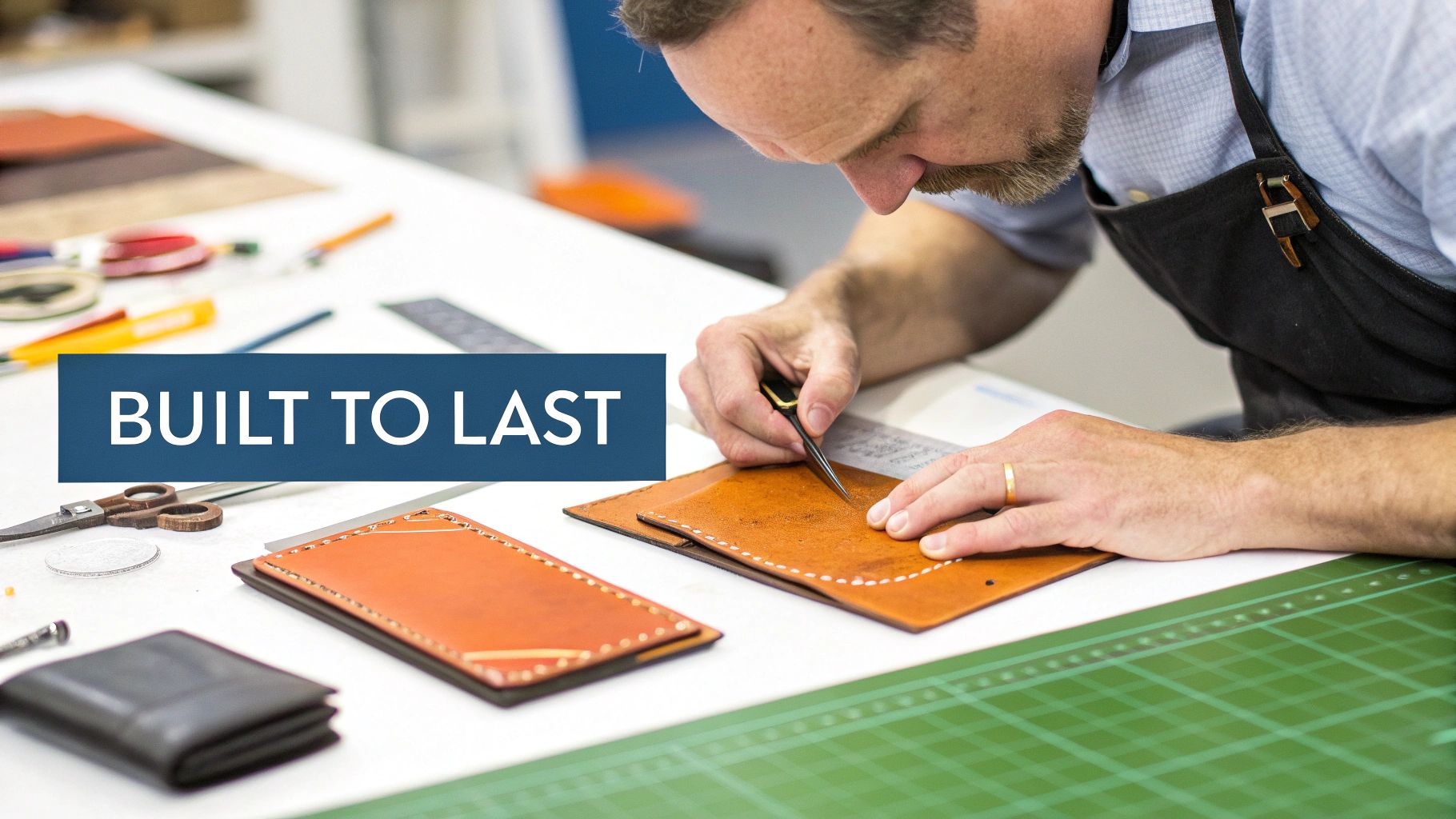
    A craftsman meticulously hand-stitching a leather wallet on a workbench, with 'BUILT TO LAST' text visible, emphasizing quality.

    Think of it like building a house. You can use solid oak beams or cheap particleboard. Both look fine at first, but only one will stand for generations. Quality turns your product from a purchase into an investment.

    Strategic Analysis

    • Brand Example: Patagonia
      Patagonia sells more than outdoor gear; it sells a promise of resilience. Their "Ironclad Guarantee" and Worn Wear repair program are marketing genius. But they only work because the products are high-quality to begin with. They prove their craftsmanship by standing behind it for life.

    • Why It Works:
      This approach connects with people tired of things designed to break. By promising durability, Patagonia builds intense loyalty. They attract a community that values sustainability, creating a strong defense against cheaper competitors.

    Key Insight: Quality is more than the product. It’s the guarantee, the repair services, and the story you tell about how it’s made.

    Your Quality Playbook

    Here are simple steps to use this strategy:

    • Source Superior Materials: Your product is only as good as its parts. Research your suppliers carefully. Quality starts with the right partners.
    • Show Your Work: Create content that shows your process. Film your makers, explain your material choices, and be open about your standards. This shows why your price is fair.
    • Use Social Proof: Highlight reviews that talk about durability. Let your happy customers become your best salespeople.

    2. Community & Values-Based Differentiation

    This strategy is about what you stand for, not just what you sell. You build a brand around a shared mission or core values. You compete on belonging, not features. This is a meaningful example of product differentiation because it creates an emotional bond with customers.

    Think of it like going to a concert versus streaming a song. One is a transaction; the other is a shared experience. This approach turns customers into advocates. They don't just buy your product; they join your movement.

    Strategic Analysis

    • Brand Example: TOMS Shoes
      TOMS started with a simple "One for One" promise: buy a pair, and they donate a pair. This wasn't a feature of the shoe; it was the reason to buy it. They sold a simple, tangible way for people to do good.

    • Why It Works:
      This connects with our desire for purpose. By building a social mission into their business, TOMS created a loyal tribe. Customers felt like part of a solution, which protected the brand from competitors focused only on style or price.

    Key Insight: Values-based differentiation works best when the mission is simple. The story becomes the product's most powerful feature.

    Your Values-Based Playbook

    Here are simple steps to use this strategy:

    • Be Authentic: Your mission can't be just a slogan. It must be part of everything you do. Be honest about your journey, including your struggles.
    • Show Your Impact: Don't just say you make a difference; prove it. Use clear data and stories to show customers the result of their support. (e.g., "You helped us provide 1,000 meals this month.")
    • Partner for Credibility: Work with trusted local organizations that share your mission. For Chicago brands, this builds community trust and extends your reach.

    3. Price Differentiation Strategy

    This approach uses price to set your product apart. It’s not just about being cheap or expensive. It’s about using price to send a clear message about value. This is a very direct example of product differentiation because price is often the first thing a customer notices.

    Think of price like the volume on a speaker. A high price shouts "luxury," while a low price says "accessible." Your price tells a story before a customer even touches the product.

    Strategic Analysis

    • Brand Example: Dollar Shave Club
      Dollar Shave Club (DSC) didn't invent a better razor. They changed the price and the experience. For a few dollars a month, they delivered a simple, good razor. They challenged overpriced giants like Gillette with a model that was honest and predictable.

    • Why It Works:
      DSC tapped into customer frustration. People felt ripped off by the "razor and blades" model. DSC's simple, low price made them feel like a champion for the customer, building a massive following overnight.

    Key Insight: Price differentiation is powerful when it breaks an old industry rule. It’s not a race to the bottom. It’s about matching your price to a value that customers are hungry for.

    Your Pricing Playbook

    Here are simple steps to use this strategy:

    • Match Price to Brand: Your price must fit your story. A premium brand needs a premium price. A disruptive brand needs an aggressive but sustainable price.
    • Understand Customer Value: Price is what someone is willing to pay. Learn about how to price a new product to understand what your solution is worth to your customers.
    • Know Your Numbers: Understand your costs. Make sure your price allows for profit, marketing, and growth. A low price is useless if it puts you out of business.

    4. Design & Aesthetics Differentiation

    This strategy is about creating a product that is beautiful, memorable, and a joy to use. It competes on feeling and experience, not just function. This is a powerful example of product differentiation because great design creates an instant emotional connection.

    A gold ring in a black box, a white bottle, and orange patterned boxes on a stone ledge, emphasizing product design.

    Think of the difference between a generic plastic water bottle and a sleek S'well bottle. Both hold water, but one is a statement piece. Great design turns everyday items into personal expressions.

    Strategic Analysis

    • Brand Example: Glossier
      Glossier sold an aesthetic, not just makeup. From its minimalist pink packaging to its sticker-filled boxes, every detail was crafted to be shared on Instagram. The design was as important as the product, turning customers into fans who proudly displayed the brand.

    • Why It Works:
      This approach bypasses feature comparisons by appealing to emotion and identity. Glossier’s design made customers feel like they were part of a cool club. This aesthetic is hard for competitors to copy because it’s so tied to the brand's core identity.

    Key Insight: Great design isn't just decoration; it’s a business strategy. It communicates your values, raises your product's perceived worth, and can create its own marketing buzz.

    Your Design Playbook

    Here are simple steps to use this strategy:

    • Invest in Design Early: Your product’s look is its first impression. Hire a professional to create a cohesive identity, from your logo and packaging to your website.
    • Create a Shareable Unboxing: Design your packaging to be an experience worth sharing. This turns a delivery into free, user-generated marketing.
    • Tell Your Design Story: Share the "why" behind your look. Explain your choices in materials and colors. This builds a deeper connection with your audience.

    5. Direct-to-Consumer (DTC) & Distribution Model Differentiation

    This strategy is about how you sell, not just what you sell. Instead of using traditional retailers, you sell directly to customers online. This is a powerful example of product differentiation for modern brands because it gives you total control over your story, customer relationships, and profits.

    Imagine you're a farmer. You could sell your produce to a huge, impersonal supermarket. Or, you could run your own farm stand. At your stand, you tell your story, build relationships, and keep all the earnings. DTC turns a transaction into a direct brand experience.

    Strategic Analysis

    • Brand Example: Warby Parker
      Warby Parker disrupted the eyewear industry by cutting out retailers. Their "Home Try-On" program brilliantly solved the biggest problem with buying glasses online. By owning the entire process, they offered stylish glasses for less while building a direct line to every customer.

    • Why It Works:
      The DTC model creates a direct feedback loop. Brands can innovate based on real customer data, not retailer guesses. This direct connection builds a loyal community and provides insights that other brands can't get.

    Key Insight: DTC is not just about cutting costs. It's about owning the customer relationship. The data and brand control you gain are priceless.

    Your DTC Playbook

    Here are simple steps to use this strategy:

    • Build Your Own Channels: Your website and email list are your most valuable assets. Focus on growing your email list from day one. To get started, you can learn more about how to start an ecommerce business.
    • Master Your Metrics: Track your Customer Acquisition Cost (CAC) and Lifetime Value (LTV). A DTC model only works if the math makes sense.
    • Invest in Customer Experience: Since you are the only touchpoint, your customer service must be fantastic. Every interaction is a chance to create a loyal fan.

    6. Personalization & Customization Differentiation

    This strategy lets customers make a product their own. You offer a creative experience, not just a finished item. This is an engaging example of product differentiation because it turns a buyer into a co-creator, creating a deep sense of ownership.
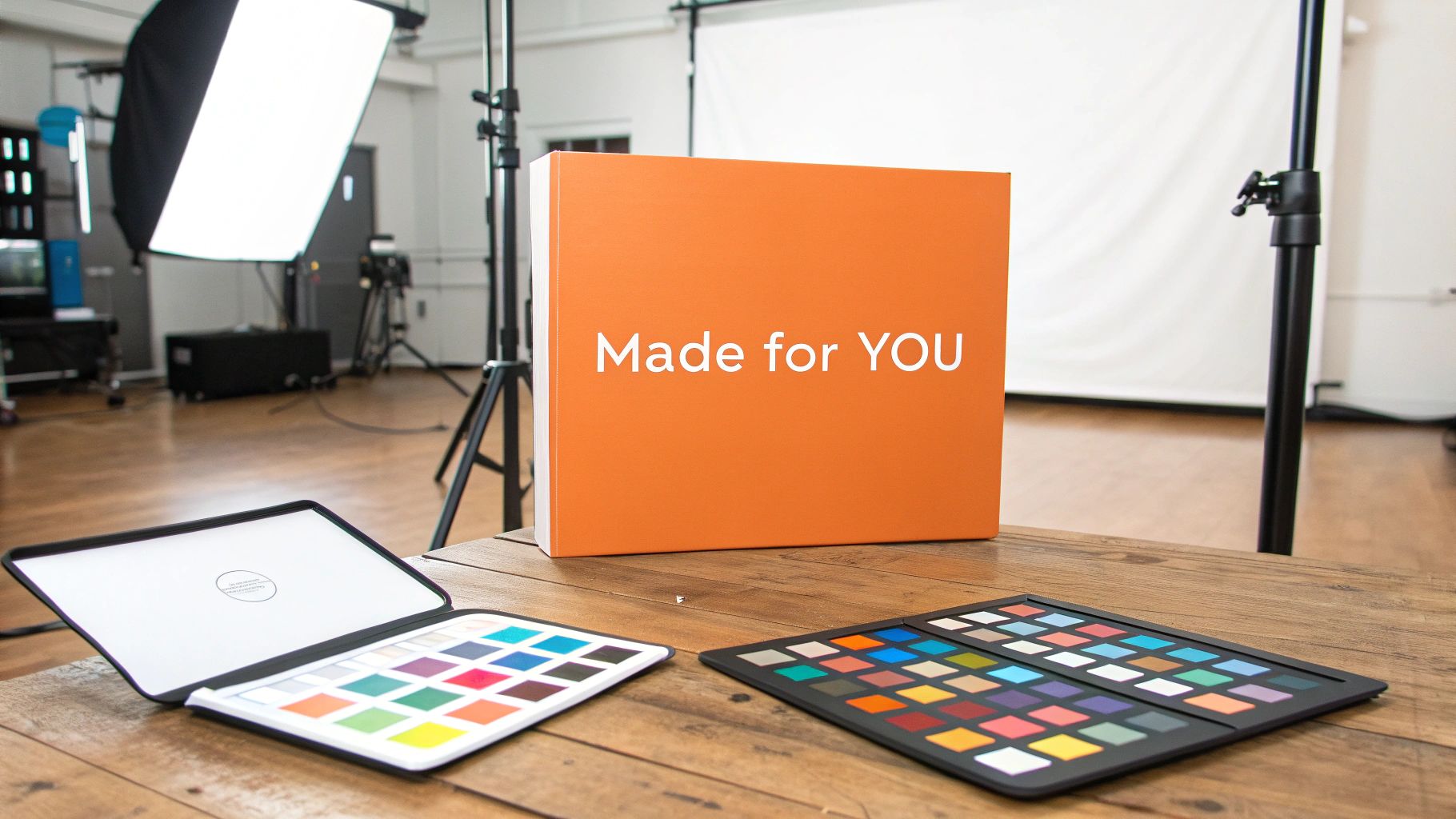
    A product photography setup featuring an orange box with text, color swatch books, and a color checker on a wooden table.

    Think of it like getting a custom suit versus buying one off the rack. The final product is a reflection of the individual. This approach elevates your product from a generic item to a personal statement.

    Strategic Analysis

    • Brand Example: Nike By You
      Nike’s customization platform lets customers become shoe designers. They can choose colors, add text, and create a one-of-a-kind sneaker. This isn’t just a gimmick; it’s a brilliant way to engage customers and collect data.

    • Why It Works:
      This uses the "IKEA effect"—we value things more when we help build them. By giving customers creative control, Nike builds a powerful emotional bond. The final product feels more meaningful than a standard shoe from a competitor.

    Key Insight: Good customization isn't about offering endless choices. It's about providing a curated set of options that allow for self-expression without being overwhelming.

    Your Customization Playbook

    Here are simple steps to use this strategy:

    • Start with Curated Options: Don't offer a blank slate. Begin with 2-3 key customizable elements (like color, material, or an engraving) that make a big impact.
    • Design for Modularity: Build your product with interchangeable parts. This makes customization easier to manage and scale.
    • Showcase Customer Creations: Create a gallery or social media campaign featuring your customers' personalized products. This gives others inspiration and celebrates your community.

    7. Innovation & Technology Differentiation

    This strategy is about creating something new that makes competitors look old. You create a new standard instead of just improving the old one. This is a potent example of product differentiation because it lets you define the market and attract customers who want the latest and greatest.

    Think of the difference between a faster horse and the first car. One is an improvement; the other is a revolution. This approach makes your product the only choice for people on the cutting edge.

    Strategic Analysis

    • Brand Example: Oura Ring
      Oura didn’t just make another fitness tracker for your wrist. It created a new category—the smart ring—with best-in-class sleep and recovery tracking. It solved the problem of clunky wearables while providing deeper health insights.

    • Why It Works:
      Oura's tech-first approach attracts a specific type of customer who wants data without bulky hardware. Their unique sensors and algorithms create a high barrier for competitors to copy.

    Key Insight: Tech differentiation is powerful when the innovation solves a real problem or creates a much better experience. It can't just be a gimmick.

    Your Innovation Playbook

    Here are simple steps to use this strategy:

    • Solve a Specific Problem: Don’t innovate for its own sake. Find a real user frustration and engineer a unique solution. Your tech should have a clear "why."
    • Simplify the Complex: Explain your tech in simple, benefit-focused terms. Customers don’t buy "photoplethysmography sensors"; they buy "the most accurate sleep tracking."
    • Build a Legal Moat: If your tech is truly new, protect it with patents. This stops copycats and secures your position as the original creator.

    8. Niche & Audience Specialization Differentiation

    This strategy focuses on serving a specific, overlooked group with a product made just for them. Instead of trying to please everyone, you become the best solution for a small, passionate audience. This is an effective example of product differentiation for new brands because it builds a loyal, tight-knit following.

    Think of it like a general doctor versus a heart specialist. The general doctor helps many people, but the specialist is a hero to a few with a critical need. This approach makes your brand a place where customers feel truly understood.

    Strategic Analysis

    • Brand Example: Rothy's
      Rothy's didn't just make another shoe. They made a sustainable, comfortable, machine-washable flat for the modern, eco-conscious woman. They targeted a niche of people who wanted style without compromising their values.

    • Why It Works:
      This approach creates a strong sense of identity. Rothy's customers aren't just buying shoes; they're joining a movement of sustainable fashion. This builds a strong defense against mass-market competitors and turns customers into advocates.

    Key Insight: Niche specialization isn't about excluding people; it's about deeply including a specific group. When you solve their unique problem, they will become your biggest fans.

    Your Niche Playbook

    Here are simple steps to use this strategy:

    • Go Deep on Research: Talk to at least 50 potential customers in your niche. Understand their lives, their frustrations, and the words they use.
    • Create Niche-Specific Content: Make blogs, podcasts, or videos about their unique interests. Become their go-to source for information, not just products.
    • Build a Community: Host events or start online groups for your niche. Give them a space to connect with each other and your brand.

    9. Customer Experience & Service Differentiation

    This strategy is about how customers feel when they interact with your brand. You compete on support and genuine care, not just product features. This is a very defensible example of product differentiation because it builds deep emotional loyalty that competitors can't easily break.

    Think of the difference between a generic coffee shop and your favorite spot where the barista knows your name. The coffee might be similar, but the feeling of being valued makes you come back. This turns customer service from a cost into a powerful marketing tool.

    Strategic Analysis

    • Brand Example: Zappos
      Zappos built its empire on delivering "WOW" through service. Their legendary support stories—like 10-hour customer calls—are not stunts. They are the result of a culture that empowers employees to create a personal, emotional connection.

    • Why It Works:
      This approach builds an almost unbreakable bond. Zappos knew that in a crowded market, the human element was the ultimate differentiator. By investing in its team, it created an army of fans who spread the word.

    Key Insight: Differentiating through service isn't about scripts. It's about giving your team the freedom to solve problems and create genuine human connections.

    Your Service Playbook

    Here are simple steps to use this strategy:

    • Hire for Empathy: You can train for product knowledge, but you can't easily train for kindness. Make empathy a key hiring requirement for all customer-facing roles.
    • Empower Your Front Line: Give your support team the authority to fix problems on the spot. An empowered employee can turn a complaint into a moment of delight.
    • Create a Service "Bible": Document your service philosophy. Share stories of great service to reinforce your culture and guide your team.

    10. Supply Chain & Sourcing Transparency Differentiation

    This strategy is about sharing your product's origin story. Instead of hiding how it’s made, you make that process your biggest asset. This is a powerful example of product differentiation today because it builds deep trust and connects with customers who care about ethical practices.

    Think of it like choosing a restaurant. One has an open kitchen where you can see fresh ingredients being prepared. The other keeps its kitchen hidden. The open kitchen instantly builds confidence. This approach makes your supply chain a core feature.

    Strategic Analysis

    • Brand Example: Everlane
      Everlane built its brand on "Radical Transparency." They don't just say their products are ethically made; they show you. Their website breaks down the true cost of each item and shows photos of the factories where they are made.

    • Why It Works:
      This approach speaks directly to modern consumers who are skeptical of big brands. By revealing its pricing and partners, Everlane builds an honest relationship with its customers. This makes them feel like they are investing in a better system.

    Key Insight: Supply chain differentiation isn’t just about being ethical; it's about proving it. Showing your work builds a level of trust that traditional marketing can't buy.

    Your Transparency Playbook

    Here are simple steps to use this strategy:

    • Map Your Tiers: Start by documenting your direct suppliers. As you grow, trace your materials back to their source. Transparency is a journey.
    • Humanize Your Partners: Create content that highlights your suppliers. Share their stories and values. This turns your supply chain into a network of people.
    • Use Certifications: Earn third-party credentials like B Corp or Fair Trade to add credibility to your claims. They are a trusted shortcut for customers.

    10 Product Differentiation Strategies Compared

    Strategy 🔄 Implementation Complexity 💡 Resource Requirements ⭐ Expected Outcomes 📊 Ideal Use Cases ⚡ Key Advantages
    Quality & Craftsmanship Differentiation High — precision processes & strict QC High — premium materials & skilled manufacturing Strong brand trust, premium pricing, longevity Premium goods, durable consumer products Durability-led retention, premium margin
    Community & Values-Based Differentiation Medium — ongoing engagement & governance Medium — partnerships, programs, storytelling Deep advocacy, PR, loyal lifetime customers Mission-driven brands, social impact products Emotional connection, earned media
    Price Differentiation Strategy Low–Medium — pricing models & data Low–Medium — market research, analytics Clear market positioning, margin or penetration Commodities, subscription services, mass market Fast market signal, flexible tiers
    Design & Aesthetics Differentiation Medium — design systems & consistency Medium — design talent, packaging spend High recognition, shareability, perceived value Lifestyle, giftable, social-first products Shelf impact, social virality
    Direct-to-Consumer (DTC) & Distribution Model Medium–High — tech, fulfillment & ops High — e‑commerce stack, marketing, logistics Higher margins, first‑party data, faster iteration Startups building brand-owned channels Margin control, direct feedback loop
    Personalization & Customization Differentiation High — modular production & configuration High — flexible manufacturing & software Strong attachment, fewer returns, premium price Apparel, gifts, bespoke goods Unique product fit, repeat purchases
    Innovation & Technology Differentiation Very High — R&D, IP management Very High — engineers, capital, patents Proprietary moat, press attention, premium pricing Deep tech, hardware, new categories Defensible IP, investor appeal
    Niche & Audience Specialization Differentiation Low–Medium — targeted research & messaging Low–Medium — content, community resources Fast traction, strong loyalty within niche Underserved markets, community-first brands Less competition, focused advocacy
    Customer Experience & Service Differentiation Medium–High — people, processes & training Medium–High — CX teams, CRM, policies High retention, referrals, brand advocacy Competitive markets, service-centric products Word-of-mouth, customer forgiveness
    Supply Chain & Sourcing Transparency Differentiation High — traceability, audits & compliance High — supplier management, certifications Trust, premium positioning, reduced scandal risk Ethical fashion, food, conscious consumer goods Brand trust, risk mitigation

    Your Next Move: Choose Your Difference

    We’ve explored many ways to stand out. We've seen how brands use quality, service, or transparency to build a loyal following. The lesson is clear: in a crowded market, blending in is the fastest way to fail.

    These examples of product differentiation are blueprints. They prove you don’t need a revolutionary invention to succeed. You need to make a deliberate, authentic choice about how you will be different.

    The Myth of Doing It All

    The biggest trap is trying to be everything to everyone. The cheapest, the highest quality, and the best service. This leads to a generic product and an empty bank account.

    The strongest brands don't do everything. They do one or two things exceptionally well. Think of differentiation as a spotlight. You can’t light the whole stage. You must choose where to point it.

    • Is your strength in craftsmanship? Focus on materials and story.
    • Is your passion building community? Create shared experiences.
    • Are you a master of logistics? Innovate how you deliver.

    Your choice becomes your north star. It guides every decision you make.

    From Idea to Action: Your Differentiation Playbook

    So, where do you start? It begins with asking the right questions.

    1. Identify Your Superpower: What can you do better than anyone else? Is it design? Tech? Connecting with people? Your best differentiator often lies where your skills and passions meet.

    2. Find the Gap: Look at your competitors. Where are they failing their customers? What needs are being ignored? A frustrated customer is a huge opportunity.

    3. Align with Your Audience: Your difference must matter to your ideal customer. Serving a niche so well that they become your advocates is a powerful strategy.

    4. Commit and Amplify: Once you choose your path, go all in. Every part of your brand should reinforce what makes you unique. This is how you build a memorable brand.

    For the kind, hardworking builders out there, differentiation is more than a strategy. It's the expression of your vision. It's how you build a business that not only survives but thrives. Don't just build another product. Build a difference.


    Tired of trying to figure it all out alone? At Chicago Brandstarters, we connect kind and ambitious founders with the peer support and resources they need to turn these examples of product differentiation into their own success stories. Join a community that believes in building brands that matter, not just making a quick buck. Learn more and join us at Chicago Brandstarters.

  • Your Product Launch Checklist Template (and How to Actually Use It)

    Your Product Launch Checklist Template (and How to Actually Use It)

    Launching a new product is like trying to cook a gourmet meal for the first time. You have a dozen ingredients—engineering, marketing, sales, support—and they all need to come together at the right moment. Forget one thing, or get the timing wrong, and you end up with a mess. For founders and small teams, the pressure is real. The mix of terror and thrill is universal, but the outcome doesn't have to be a gamble.

    How do you make sure every part of the recipe works? You don’t guess. You use a plan. A great product launch checklist template turns a chaotic process into a clear sequence of steps. Think of it as your mission blueprint. It ensures nothing vital gets missed, from the first marketing whisper to the final post-launch review. A solid plan isn't just nice to have; it's how you compete and win.

    This guide cuts through the noise. We've gathered the best, most useful product launch checklist templates from places like Asana, Notion, and HubSpot. We’ll break down each one, showing you its structure with screenshots and direct links. Let's find the right blueprint to get your product ready for a successful liftoff.

    1. Smartsheet

    Smartsheet is for founders who love the clean, simple structure of a spreadsheet. It offers a library of downloadable product launch checklist templates, making it a great place to start if you want a no-frills foundation. The platform focuses on giving you truly free, editable files you can use right away.

    The best part about Smartsheet's templates is their simplicity and directness. You can download them in formats you already use—Excel, Google Sheets, PDF—without creating an account. This is perfect for an early-stage founder who needs to draft a plan quickly without getting tangled up in new software.

    Key Features and Offerings

    Smartsheet's templates cover the basics well, giving you a solid starting point for almost any launch.

    • Multiple Formats: Download and use templates in software you know: Excel, Google Sheets, PDF, and PowerPoint.
    • Variety of Templates: It’s not a one-size-fits-all deal. You'll find a general product launch plan, a software-specific checklist, a marketing launch checklist, and more.
    • Gantt Chart Integration: Some templates come with built-in Gantt charts. This visual timeline is a huge help for seeing how tasks depend on each other.
    • Pre-built Structure: The checklists include key fields like task owner, due date, status, and notes, saving you from building a tracker from scratch.

    Pros and Cons for Midwest Founders

    Pros Cons
    No-Cost Access: The templates are genuinely free to download, which is a big win for bootstrapped startups. Requires Customization: The templates are generic and need a lot of tailoring to fit your specific business.
    Familiar Interface: Using Excel or Google Sheets means there's no learning curve. Your team can jump right in. Limited Collaboration: Real-time collaboration and automation are locked behind a paid Smartsheet plan.
    Offline Capability: You can download the files and work on your launch plan without being tied to the internet. Manual Updates: Without the full platform, you have to update progress and check off tasks by hand.

    Practical Tip: Download the "Product Launch Plan Template" in Google Sheets. Right away, add two columns: "Phase" (Pre-Launch, Launch Week, Post-Launch) and "Goal/Metric." This small tweak turns a generic list into a strategic tool tied to your business goals. This structured approach is key, and you can learn more about building this foundation by exploring how to start a product business.

    Find the templates here: Smartsheet Product Launch Checklists

    2. HubSpot

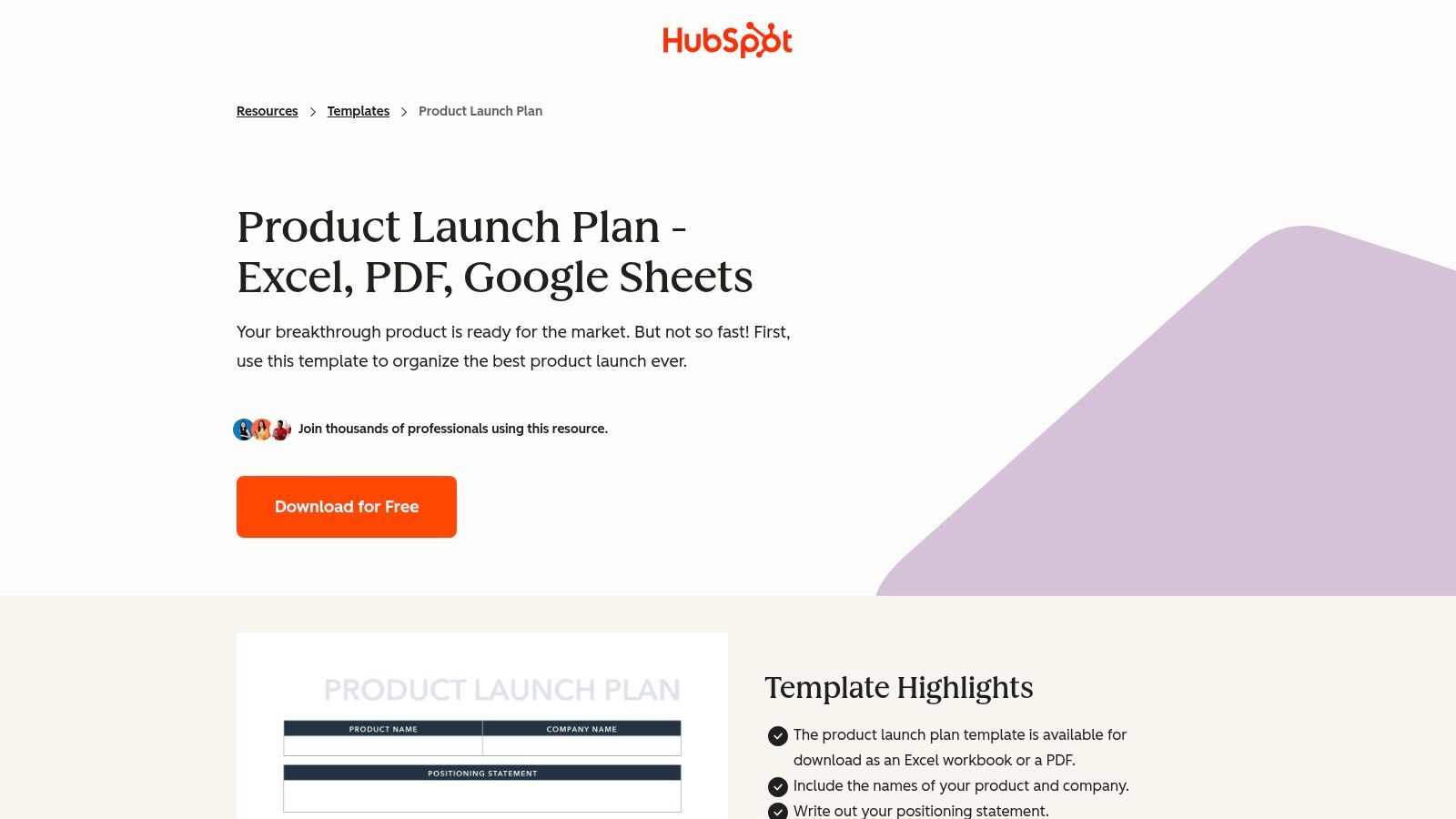
    HubSpot gives you a 'Product Launch Plan' template pack that’s all about marketing strategy. It’s for founders who need more than a task list; they need a guide for positioning, market analysis, and messaging. This is your go-to if you want a solid file to shape your go-to-market plan without buying new software.

    A screenshot of the HubSpot website's landing page for its free Product Launch Plan template, showing the download form.

    HubSpot's strength is its focus on the "why" behind your launch, not just the "what." It pushes you to think deeply about your audience, competitors, and value. You do have to give your email to get it, but the files land in your inbox in standard formats, ready to use immediately.

    Key Features and Offerings

    HubSpot's templates act as a strategic workbook, making sure you cover your marketing bases.

    • Multiple Formats: The pack is available to download as an Excel, Google Sheets, or PDF file, offering flexibility.
    • Strategic Planning Fields: The template has sections for product positioning, competitive analysis, market research, and messaging.
    • End-to-End Structure: It guides you from high-level goals down to your promotional timeline and budget.
    • Educational Support: HubSpot backs up the template with tons of helpful articles, giving you context for each section.

    Pros and Cons for Midwest Founders

    Pros Cons
    Strong Marketing Focus: Perfect for founders who need to build a go-to-market strategy from the ground up. Gated Access: You have to share your contact info, which means you'll get marketing emails from HubSpot.
    No Software Commitment: You can use the files in Excel or Google Sheets without a HubSpot subscription. Less Granular on Tasks: This is more of a strategic plan than a daily to-do list.
    Great for First-Timers: The clear sections provide a roadmap for anyone planning their first product launch. Requires Complementary Tools: You’ll still need a project management tool to track the actual tasks.

    Practical Tip: In the Google Sheet, use the "Competitive Analysis" tab to dig into your competitors' pricing. Add a column for "Pricing Model" (e.g., subscription, one-time) and another for "What Customers Get." This deep dive will be a huge help when you figure out your own pricing. This is a critical step in learning how to price a new product in a crowded market.

    Find the templates here: HubSpot Product Launch Plan

    3. Notion

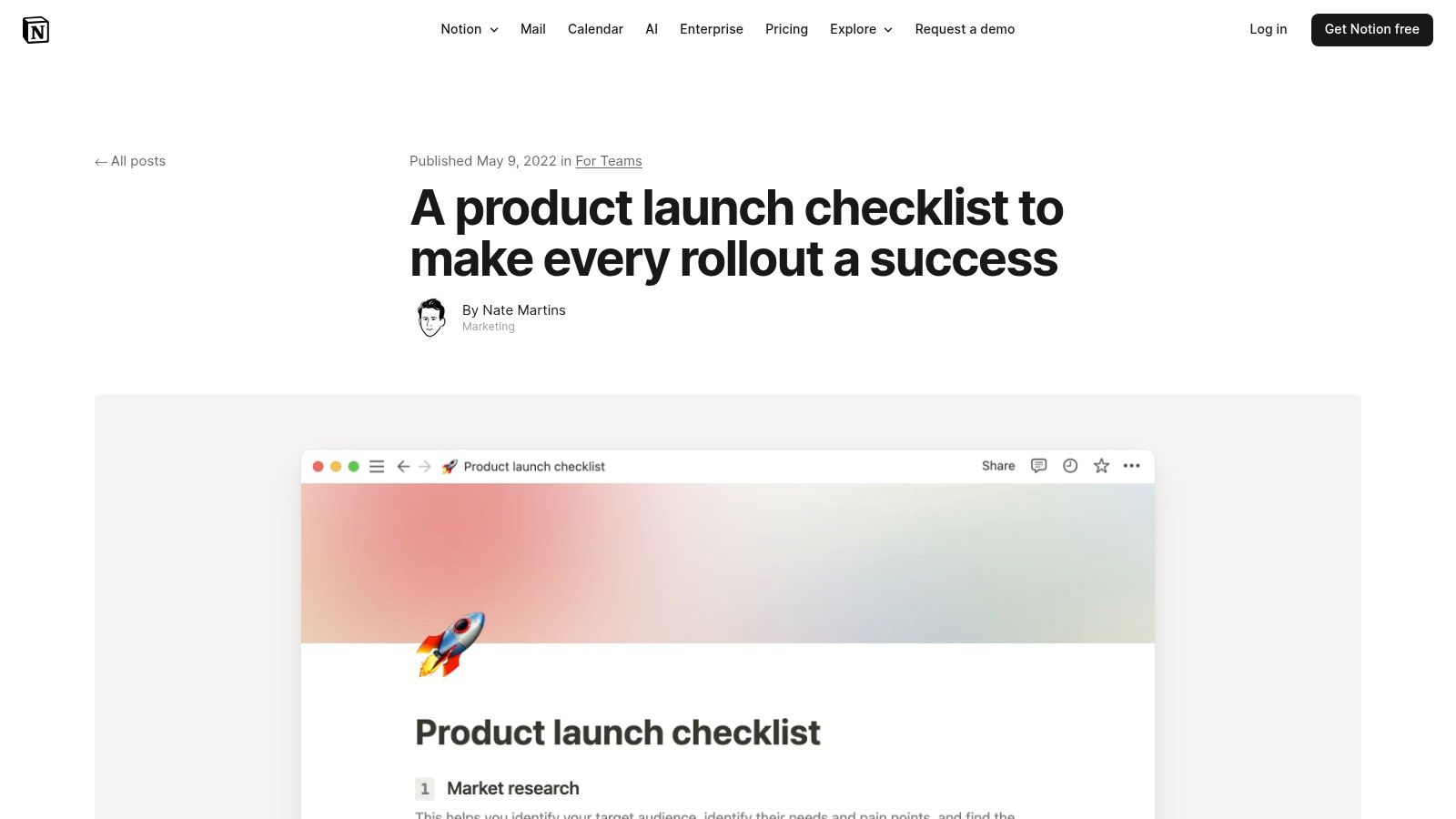
    Notion is an all-in-one workspace where you can mix documents, plans, and tasks. Think of it as digital LEGOs for your business. The official "Product Launch Checklist" template lets you copy a full launch plan into your workspace, turning a static list into a living, collaborative hub. It’s perfect for founders who want to keep product specs, marketing plans, and launch tasks all in one connected place.

    A screenshot of the Notion website blog post, which includes a product launch checklist template that users can duplicate into their own workspace.

    The biggest win with Notion is its flexibility. If your team already uses it for notes or wikis, adding this template is a breeze. It brings everything together, so you're not jumping between different tools to manage your launch.

    Key Features and Offerings

    Notion’s template is more than a list; it’s a powerful database you can shape to fit your needs.

    • Centralized Launch Hub: The template gives you a central page with tasks, owners, and deadlines, so everyone knows what's happening.
    • Customizable Views: Easily switch how you see your launch plan. Use a Table for a detailed overview, a Kanban Board to see progress, and a Timeline to manage deadlines.
    • Integrated Documentation: Link tasks directly to other Notion pages, like your marketing strategy or customer feedback notes.
    • Free and Immediate Access: The template is free to copy for anyone with a Notion account, and the free plan is very generous.

    Pros and Cons for Midwest Founders

    Pros Cons
    Combines Collaboration and Docs: Keeps your plans and the work itself in one place, so you waste less time switching apps. Best for Existing Notion Users: You get the most out of it if your team is already using Notion.
    Highly Adaptable: The template is a great starting point you can easily change for a simple MVP launch or a complex software rollout. Potential for Complexity: Notion’s flexibility is also its challenge. It's easy to over-engineer your checklist.
    Excellent Free Tier: Notion’s free plan is strong, making this a powerful, no-cost option for bootstrapped startups. Advanced Features are Paid: Things like Notion AI, better permissions, and longer version history cost money.

    Practical Tip: After copying the template, add a "Validation" checkbox property to each task. Before you spend time or money on a big launch activity, this forces you to ask: "Have we proven the assumption behind this task?" This mindset is crucial. You can learn more about how to validate a business idea to be sure you're building something people really want.

    Find the templates here: Notion Product Launch Checklist

    4. ClickUp

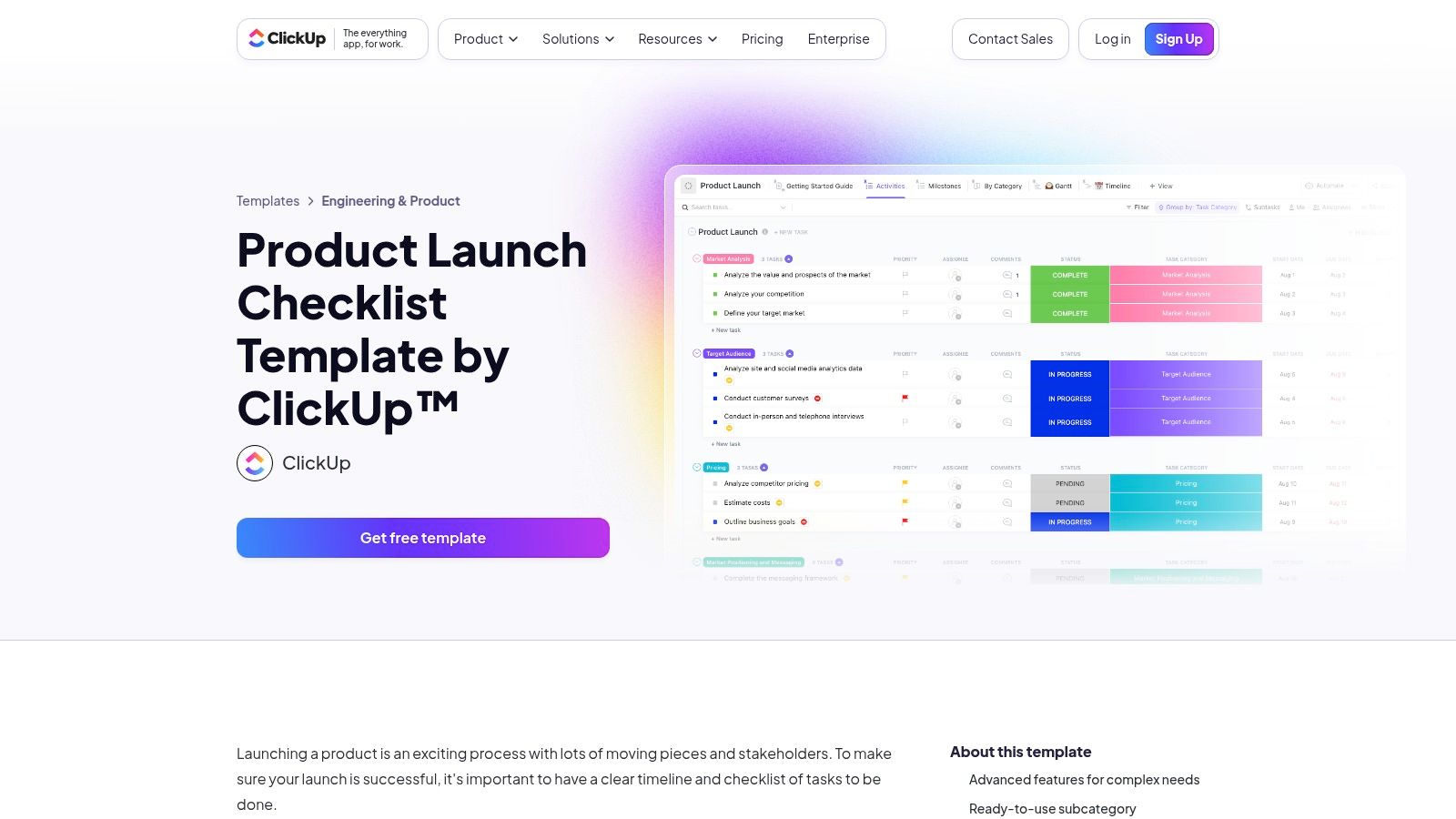
    ClickUp is for founders ready to move beyond spreadsheets into a powerful, all-in-one project tool. It offers a "Product Launch Checklist" template that acts less like a list and more like a command center for your entire launch. It’s built for teams managing complex projects where tasks, timelines, and chats need to live in one spot.

    A screenshot of the ClickUp interface showing a product launch checklist template organized by tasks, assignees, and due dates within a list view.

    The key difference with ClickUp is that the template isn't just a file; it's a complete workspace you add directly to the platform. This is perfect for a growing team trying to coordinate marketing, development, and operations all at once. It turns a simple checklist into a truly collaborative plan.

    Key Features and Offerings

    ClickUp’s template is packed with features to help manage the messy details of a launch.

    • Pre-configured Views: It comes with multiple built-in views, like a Gantt chart, a Kanban board, and a classic list. Your team can see progress in the way that works best for them.
    • Custom Statuses: Go beyond "to-do" and "done." Use statuses like "In Progress," "For Review," and "Complete" to get a clear, real-time picture of where every task stands.
    • Integrated Collaboration Tools: Assign tasks, set dependencies, add tags for easy filtering (e.g., #marketing, #dev), track time, and even manage emails within a task.
    • Robust Free Tier: You can import and use the template on ClickUp's generous "Free Forever" plan, letting you test its power before you pay.

    Pros and Cons for Midwest Founders

    Pros Cons
    All-in-One Solution: Brings planning, task management, and team communication together, so you need fewer tools. Significant Learning Curve: If you're new to this kind of software, the number of features can feel like a lot at first.
    Scalable for Growth: The platform can easily grow with your startup, from a two-person team to a larger organization. Evolving Pricing Tiers: ClickUp's plans change. It's smart to check the current offerings to see if they fit your budget.
    Powerful Automation: Set up automations for repetitive work, like assigning tasks when a status changes. Can Be Overkill for Simple Launches: For a very simple launch, the platform's complexity might be more than you need.

    Practical Tip: Once you import the template, use the "Dependencies" feature right away. Link your "Finalize Packaging" task to your "Place First Order" task. This creates a smart, automated workflow that prevents costly mistakes, like ordering inventory before the design is even approved. This small step uses the tool’s power to make your launch plan stronger.

    Find the template here: ClickUp Product Launch Checklist

    5. Asana

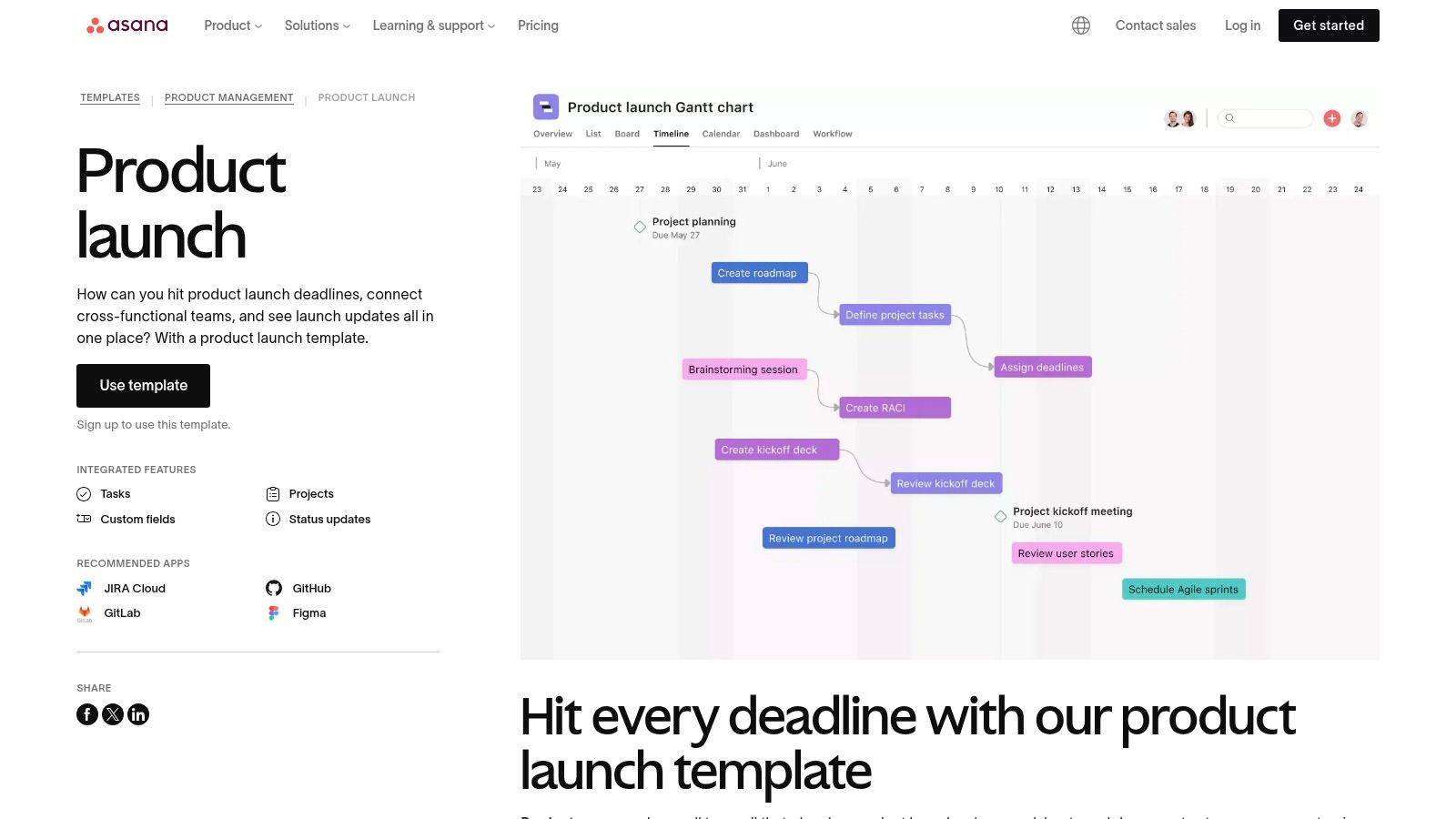
    Asana takes you from static files into a living, collaborative project. For teams needing to coordinate many moving parts, Asana's official product launch template offers a powerful, central command center. It’s designed to manage everything from pre-launch marketing to post-launch bug fixes in one shared space.

    A screenshot of the Asana interface showing a product launch checklist template with tasks organized by stage in a Gantt chart view.

    The template's real power is in creating clarity and accountability. A spreadsheet can get outdated fast. In Asana, tasks are living items that can be assigned, commented on, and updated in real time. This is a game-changer for a startup where the marketing lead needs to know the exact moment a new feature is live to send the announcement email.

    Key Features and Offerings

    Asana’s template leverages the platform's full toolkit, turning a simple checklist into an interactive plan.

    • Multiple Project Views: Instantly switch how you see your plan. Use the List view for a simple to-do list, Boards for a Kanban workflow, Calendar for deadlines, and the Timeline for a Gantt chart that shows dependencies.
    • Centralized Asset Management: Attach key documents and designs directly to tasks. With integrations like Google Drive, your final ad creative is linked right to the "Launch Social Campaign" task.
    • Cross-Functional Coordination: The template comes pre-structured with sections like "Planning," "Engineering," and "Marketing," making it easy to see how different teams' work overlaps.
    • Status Reporting: Use built-in tools to give progress updates to stakeholders without pulling everyone into another meeting.

    Pros and Cons for Midwest Founders

    Pros Cons
    Scalable Structure: The template works for a two-person team but scales easily as your company grows. Requires Team Buy-In: The tool only works if the whole team uses it. If half your team sticks to email, it creates confusion.
    Clear Accountability: Every task has a clear owner and due date, which means fewer things fall through the cracks. Paid Plan for Advanced Features: While the template is free, key features like custom fields and advanced reporting require a paid plan.
    Excellent for Collaboration: Real-time updates and task-specific chats keep everyone on the same page without messy email threads. Learning Curve: For teams new to project management software, there's a learning period to get the hang of all the features.

    Practical Tip: When you load the template, immediately create a "Launch Comms" section. Inside, add a task for every channel you'll use (e.g., "Draft Email Announcement," "Schedule Product Hunt Post"). Attach the draft copy directly to each task. This creates a single source of truth for all your messaging, which keeps everything consistent.

    Find the template here: Asana Product Launches Template

    6. Airtable

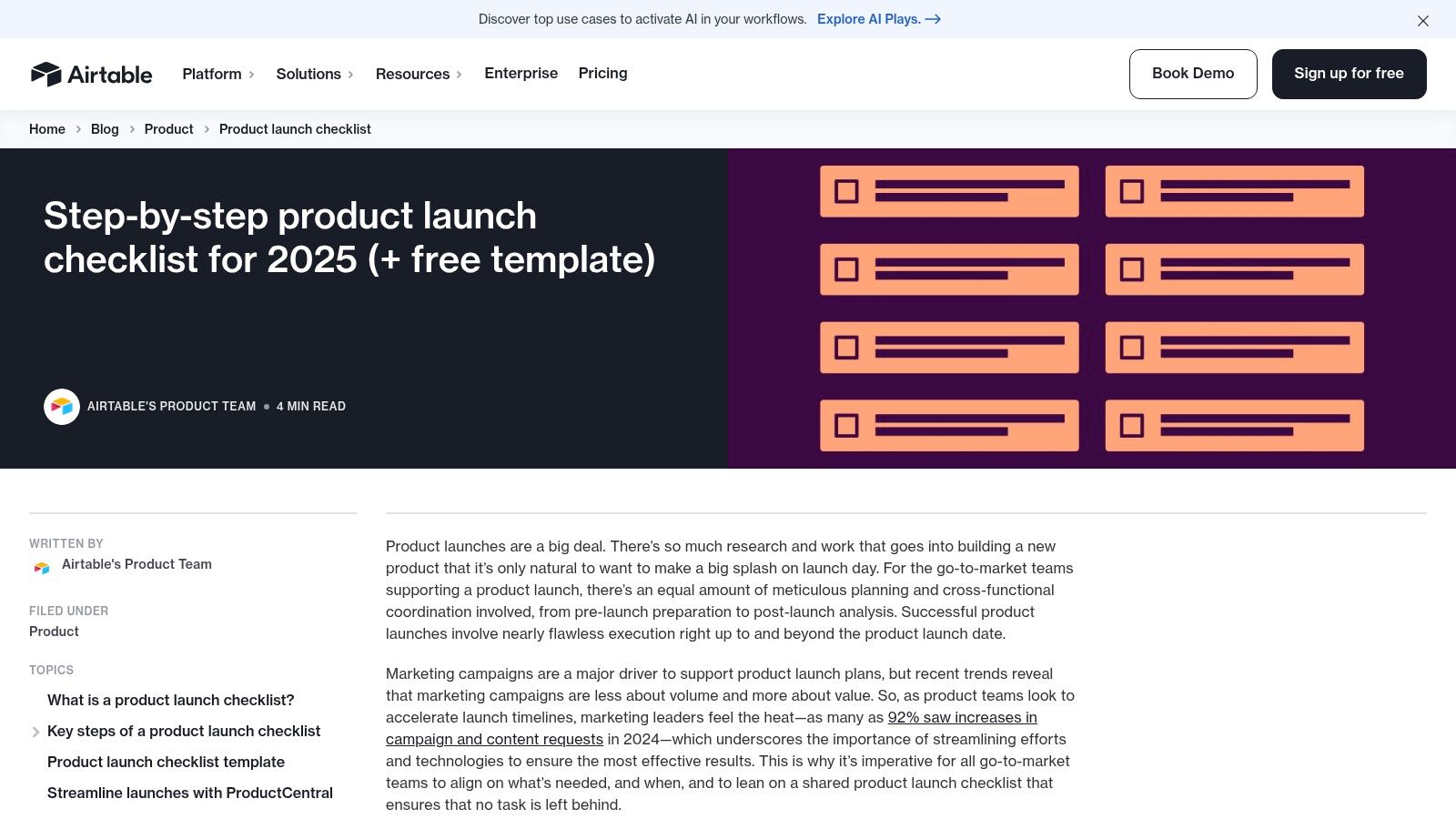
    Airtable turns a product launch checklist from a flat document into a smart, connected database. It’s the perfect choice for founders who need more than a simple to-do list. Airtable gives you a customizable product launch template you can copy, providing a powerful base for tracking tasks, managing handoffs, and seeing your whole launch timeline.

    Airtable

    Airtable’s magic is how it blends the ease of a spreadsheet with the power of a database. You can link tasks to team members, marketing assets to campaign goals, and launch dates to a master calendar. This is perfect for a startup managing dependencies between a design firm, a manufacturing partner, and a PR agency. Everyone works from the same playbook.

    Key Features and Offerings

    Airtable's template is a starting point you can shape to fit your exact needs.

    • Flexible Schema: You can easily add, remove, or change fields. Need to track influencer outreach, ad spend, or link to Figma mockups? You can create custom fields for all of it.
    • Multiple Views: Go beyond the grid. See your launch timeline on a Calendar, manage tasks with a Kanban board, or group tasks by owner. This lets everyone see the information in the way that helps them most.
    • Record Templates: If you have recurring task sets for every launch, you can create a template to clone them instantly. This saves a ton of setup time for future products.
    • Scalability: Your Airtable base can grow with your company. It can become the central hub for your entire product operation, connecting roadmaps, user feedback, and launch plans in one place.

    Pros and Cons for Midwest Founders

    Pros Cons
    Strong for Cross-Team Handoffs: The database structure is great for tracking how work moves between marketing, product, and sales. Requires More Setup: You'll need to invest time upfront to customize the base, set up views, and define your workflow.
    Scales Into Broader Operations: Airtable can grow from a simple checklist into a full-blown product operations hub. Paid Tiers for Heavy Usage: The free plan has limits. As your team grows, you'll likely need to pay, so check the current pricing.
    Visually Intuitive Interface: The clean, colorful UI makes it easier to manage complex projects than a dense spreadsheet. Learning Curve: While easier than a traditional database, there's still a learning curve for concepts like linked records and automations.

    Practical Tip: After you copy the template, immediately create a "Linked Record" field that connects your tasks to a separate "Team Members" table. This lets you assign tasks and, more importantly, create a personal "My Tasks" view for each person. This simple tweak turns a master checklist into a personalized action plan, boosting clarity and accountability.

    Find the templates here: Airtable Product Launch Checklist

    7. Miro

    Miro changes the idea of a product launch checklist from a linear list to a dynamic, visual workspace. It’s for founders who think visually and need to get everyone on the same page. The platform offers a "Product Launch Lifecycle" template, which is an interactive whiteboard for mapping out every phase of your launch.

    Miro's strength is its focus on collaboration and shared understanding. Instead of just a list of tasks, you get a bird's-eye view of how marketing, sales, and product development all connect. This is super valuable for a team spread across different locations; everyone can see the whole plan and their part in it at the same time.

    Key Features and Offerings

    Miro’s template is built for interactive planning sessions that keep everyone aligned.

    • Visual, Infinite Canvas: The template gives you a flexible, drag-and-drop space to map out launch phases, create task cards, and draw connections between activities.
    • Pre-filled and Blank Versions: It includes a filled-in example board to show you what’s possible, plus a blank template you can customize from scratch.
    • Interactive Task Cards: Each task can be assigned an owner, a due date, and a status, turning your visual map into a real plan.
    • Optional Unito Integration: If your team uses tools like Jira or Asana, an optional integration can sync your visual plan in Miro with the tasks in your project management tool.

    Pros and Cons for Midwest Founders

    Pros Cons
    Excellent for Visual Workshops: Perfect for collaborative brainstorming, whether your team is in the same room or spread out. Not a Standalone Execution Tool: While great for planning, daily task management might still be better in a dedicated project tool.
    Improves Stakeholder Alignment: The visual format makes it easy to share the strategy with investors or advisors so everyone gets it quickly. Collaboration Features Gated: Advanced features like private boards and unlimited collaborators are part of Miro's paid plans.
    Flexible and Adaptable: The freeform canvas lets you tailor the plan to your product's specific needs. Potential for Overwhelm: An infinite canvas can get messy fast if you're not careful. It helps to have someone keep it organized.

    Practical Tip: Use the Miro template for your launch kickoff meeting. Start by having each team lead add sticky notes for all their expected tasks. Then, as a group, drag and drop them into the right phases (Pre-Launch, Launch, Post-Launch). This hands-on, visual exercise builds instant team buy-in and helps you spot dependencies you might have otherwise missed.

    Find the template here: Miro Product Launch Lifecycle Template

    Product Launch Checklist: 7-Tool Comparison

    Tool 🔄 Implementation complexity ⚡ Resource requirements 📊 Expected outcomes 💡 Ideal use cases ⭐ Key advantages
    Smartsheet Low–Medium: downloadable spreadsheets; Smartsheet features add complexity ⚡ Minimal to download; paid plan for collaboration/automation 📊 Structured checklists; some templates include Gantt 💡 Spreadsheet-first teams, offline use, simple launches ⭐ Truly free, multi-format templates (Excel/Google/PDF/ PPT)
    HubSpot Low: gated download; files are ready-to-use templates ⚡ Minimal file use offline; email/form required to access 📊 Marketing-centric end‑to‑end launch plan (positioning, messaging) 💡 Founders or marketing teams needing strategic plan files ⭐ Well-structured marketing templates with supporting content
    Notion Medium: duplicate into workspace; customizable databases/views ⚡ Low for core features; advanced features/AI need paid tiers 📊 Centralized docs + task tracking with multiple views 💡 Teams already using Notion who want docs and tasks together ⭐ Combines documentation and task management in one place
    ClickUp Medium–High: importable template with dependencies and time tracking ⚡ Free tier available; paid plans for full PM features 📊 Robust PM execution: milestones, dependencies, time tracking 💡 Complex, cross-functional launches requiring PM controls ⭐ Comprehensive project-management features and views
    Asana Medium: template inside Asana; requires team adoption ⚡ Free tier; paid plans for advanced coordination at scale 📊 Centralized timelines, status reporting, asset linkage 💡 Cross-functional teams scaling coordination and reporting ⭐ Clear structure and integrations for enterprise workflows
    Airtable Medium: customizable schema and record templates; setup required ⚡ Medium–High: paid tiers for heavy use and automations 📊 Flexible tracking of deliverables, handoffs; scales to product ops 💡 Teams tracking handoffs or building product operations ⭐ Highly customizable schema and cloning of common task sets
    Miro Low–Medium: ready visual board; syncs (Unito) add complexity ⚡ Low for workshops; paid for advanced collaboration and integrations 📊 Visual alignment and planning; less suited for execution tracking 💡 Visual workshops, stakeholder alignment, early-phase planning ⭐ Infinite canvas with pre-filled examples and strong shareability

    The Checklist Is Just the Start. Your Community Is the Fuel.

    You've seen seven powerful tools, each offering a different way to organize your launch. From the neat grid of Smartsheet to the creative canvas of Miro, you now have a full toolkit. We've looked at templates for all kinds of products and broken them down by phase. The goal was to give you more than a list; it was to give you a map.

    A product launch checklist template is like the blueprint for a house. It shows you where the walls go and how everything connects. It stops you from putting on the roof before you’ve laid the foundation. Following the blueprint is how you build something that lasts. But a blueprint can't hammer the nails for you, and it won't be there when an unexpected storm hits.

    That’s where you come in. Your checklist is your starting point, your source of truth. But the real work begins when you start checking off boxes—and, more importantly, when things don't go according to plan.

    From Plan to Reality: Choosing Your Tool and Making It Your Own

    Your first step is to pick the right tool. Don't get stuck overthinking it. Just match the tool to how your team already works.

    • For spreadsheet lovers: Airtable or Smartsheet will feel like a powerful upgrade.
    • For all-in-one business hubs: If your CRM is your command center, HubSpot plugs right in.
    • For total customization: Notion and ClickUp are blank canvases, perfect for building a unique system.
    • For straightforward project management: If you just want clear, simple task management, Asana is a champion that gets the job done.

    Once you’ve chosen your platform and template, the most important work begins: making it your own. A generic template is a starting point, not the destination. Sit down with your team and be ruthless. Delete tasks that don't apply. Add steps that are unique to your product. And assign a single owner to every single task. A task without an owner is a task that will never get done. This isn't just busywork; it's how you take a generic map and mark your own trail on it.

    Your Unfair Advantage: Moving Beyond the Tasks

    The checklist manages the what. It tells you to "Draft launch day social media posts." It makes sure no detail is forgotten. But it can’t prepare you for the how and the why. It won't help you decide whether to delay your launch because of a last-minute bug, or how to handle that first piece of tough customer feedback.

    This is the human side of building. It’s a journey of incredible highs and lonely lows. The most successful founders know that building isn't a solo sport. They surround themselves with people who are on the same path, people who just get it.

    Your launch plan will get you to launch day. But your community of trusted peers will get you through it, and on to the next challenge, and the one after that. They are the ones who will celebrate your wins, help you fix your failures, and remind you why you started this in the first place. So, pick your tool, customize your template, and get organized. Then, take the most important step of all: find your people.


    At Chicago Brandstarters, we build those communities. We connect kind, ambitious founders in the Midwest through small, private peer groups to share the real stories behind the checklist. If you’re ready to build alongside people who will support and challenge you, check out our community.

    Learn more about Chicago Brandstarters

  • 8 Brilliant Product MVP Example Ideas for Founders in 2025

    8 Brilliant Product MVP Example Ideas for Founders in 2025

    Building a business can feel like trying to solve a puzzle in the dark. You pour time and money into the "perfect" product, only to launch to silence. What if you had a compass? A simple tool that points you toward what customers actually want, long before you build it.

    That compass is the Minimum Viable Product (MVP). An MVP isn't a cheap, buggy version of your dream. It's the smallest, simplest experiment you can run to see if your big idea is true. Think of it like sending a scout ahead to check the path before committing your whole army. This simple step helps you avoid building something nobody needs.

    In this guide, we'll explore eight powerful product mvp example ideas. These are clear, actionable strategies you can use today to find what works and build a business that lasts. Let's stop guessing and start learning.

    1. Concierge MVP – The Personal Service Approach

    The Concierge MVP is a hands-on approach where you act as a personal assistant to your first customers. You deliver the value of your product manually, with no automation. Imagine a tailor crafting a custom suit by hand for one client before building a factory. The goal isn't to be efficient; it's to learn by doing everything yourself.

    This method gives you a front-row seat to your customer's problems. It helps you answer the biggest question: "Is this a problem people will pay to solve?" You do the work your future product will automate, gathering priceless insights along the way.

    A man assists a woman writing at a table with a laptop, against a backdrop of 'Concierge Service'.

    Strategic Breakdown & Examples

    • Core Question: Do people have a problem they are willing to pay someone to solve? Zappos founder Nick Swinmurn asked this. He didn't build a huge website. He went to local stores, took photos of shoes, and posted them online. When an order came in, he bought the shoes and shipped them himself. He manually acted as an "online shoe store."
    • Minimum Scope: Zero tech. It's just you and a simple way to talk to your user (email, phone, a spreadsheet). The founders of Stripe, the payment giant, started by personally installing their code on their first customers' websites.
    • Key Learnings: This approach reveals why people act the way they do. By walking through the process with them, you find pain points and details a survey would never uncover. This direct feedback is the raw material for a product people will love.

    Actionable Takeaways

    • Document Everything: Every chat, email, and complaint is a piece of the puzzle. Use a simple spreadsheet to track everything and look for patterns.
    • Charge a Small Fee: This isn't about profit. It’s about commitment. Charging even a little ensures you're helping serious customers who truly need a solution.
    • Focus on the "Job to be Done": Your service is a stand-in for the product. Just get the job done for your customer. Efficiency comes later. This hands-on product MVP example is perfect for testing services or complex ideas before writing any code.

    2. Wizard of Oz MVP – Faking It Until You Make It

    A Wizard of Oz MVP looks like a fully automated product on the outside, but a human is secretly pulling the levers behind the curtain. It’s like a restaurant with a beautiful storefront, but the chef is cooking every order in their home kitchen. This lets you test a complex idea and user experience without the heavy cost of engineering.

    The goal is to see if customers want a specific automated result before you invest in the technology to create it. You offer a polished user interface, but the work on the back end is powered by you. This type of product mvp example is great for ideas that rely on complex algorithms or automation.

    Strategic Breakdown & Examples

    • Core Question: Will people use and value this automated solution, even if a human is faking the automation for now? The founders of Zapier initially connected apps for customers by hand. A user would fill out a form, and the founders would manually build the connection, proving that the demand for automated workflows was real.
    • Minimum Scope: A believable front-end (a landing page or simple app) and a human-powered back-end. You are the "automation." Early personal shopping services had a sleek app, but a real stylist manually picked and sent recommendations based on what users entered.
    • Key Learnings: This MVP shows you which features are most important to automate first. By doing the work yourself, you discover the real challenges and complexities, creating a clear roadmap for your engineers. It helps you understand the perceived value of the magic you're promising.

    Actionable Takeaways

    • Prioritize the User Interface: Unlike a Concierge MVP, the user experience here must feel real and automated. Create a simple, clean front-end that looks like the final product.
    • Use Off-the-Shelf Tools: Use tools like Airtable or Zapier to manage your manual work. This helps you handle early demand more easily before building custom software.
    • Set Clear Expectations: Be honest with early users. Let them know they're part of a beta test. This builds trust and turns them into partners who are more forgiving of any manual delays.

    3. Landing Page + Waitlist MVP – Measuring Demand First

    The Landing Page MVP is the simplest way to test an idea. You create a single webpage that describes your solution and collect emails from interested people. That's it. Think of it as putting a "Coming Soon" sign on a restaurant to see how many people knock on the door asking for a table. Your only job is to see if there's real interest.

    This approach directly answers the question, "Do people want what I'm planning to build?" by measuring signups. It's the fastest and cheapest way to find out if you've found a problem people are eager to solve.

    Laptop displaying 'Join Waitlist' page, with a notebook, pen, and smartphone on a wooden desk.

    Strategic Breakdown & Examples

    • Core Question: Is there a real market for my solution? The team behind Buffer asked this. They created a landing page explaining their idea for a simpler way to schedule social media posts. Enough people signed up, so they took another step: they added a pricing page to see who would click "buy," confirming real demand before writing any code.
    • Minimum Scope: Just one webpage with a clear promise and an email signup form. Dropbox famously used this product MVP example with a simple video on a landing page. The video showed a product that didn't exist yet, driving thousands of signups overnight and proving people desperately wanted it.
    • Key Learnings: This shows if your message connects with your audience. You can test different headlines and descriptions to see what works best. The number and quality of signups give you a strong signal on whether to move forward, change course, or stop.

    Actionable Takeaways

    • Focus on the Transformation: Don't list features. Talk about the problem you solve and the better life your customer will have because of it.
    • Use No-Code Tools: Build your page quickly with tools like Carrd or Webflow. The goal is speed and learning, not a perfect design. You can learn more about how to validate your business idea on chicagobrandstarters.com.
    • Engage Your Waitlist: Don't just collect emails and disappear. Send updates and ask for feedback. This starts building a community and turns a simple list into your first loyal customers.

    4. Minimum Feature Set MVP – Build Only What Matters

    The Minimum Feature Set MVP is the art of "less is more." Instead of building a product with all the bells and whistles, you build only the core features that solve the most critical user problem. Think of it as serving a perfect steak without any side dishes. It delivers the essential value, proving people want the main course before you build the rest of the menu.

    This approach gives users a real, working product that solves a painful problem. It cuts away everything else. The goal is to confirm that your solution is a must-have, not just a nice-to-have.

    Strategic Breakdown & Examples

    • Core Question: Can a small set of features create enough value for people to use and love our product? Instagram launched with a simple idea: make mobile photos look better and share them easily. The first app was just filters, likes, and comments. No DMs, no Stories, no video. Just the core loop that proved their idea was a hit.
    • Minimum Scope: Just 3-5 essential features that form the product’s backbone. Gumroad, a platform for creators, started with one simple function: it gave you a link where people could pay to download a file. The entire process of how to start a product business can be simplified by focusing on this core value.
    • Key Learnings: This MVP quickly shows which features matter and which are just noise. By launching with less, you get clear data on what users actually do. This direct feedback is key for building a roadmap based on real needs, not just your assumptions.

    Actionable Takeaways

    • Ruthlessly Prioritize: List every feature you can think of, then force-rank them and build only the top few. A good rule of thumb is to build about half the features you originally think are needed.
    • Charge from Day One: Even a small price proves the problem you're solving is painful enough for someone to pay for. This is the strongest signal that you have a real business.
    • Use a Public Roadmap: Be open about your limited features. A public roadmap manages expectations and makes early users feel like part of the journey, turning them into your biggest fans. This product MVP example is perfect for software and apps where a focused, high-value experience is everything.

    5. Hybrid Human + Code MVP – Smart Automation

    The Hybrid Human + Code MVP balances manual service and full automation. You build the core, repeatable parts of your product with code, but you use real people for high-value moments like onboarding, support, and relationship building. It’s like an automated car factory that still has master craftspeople for the final quality checks and custom details.

    This approach lets you deliver a premium experience from day one without having to automate every little thing. It combines the power of software with a personal touch that builds deep customer loyalty. It helps you learn what’s truly important before you build it into the product.

    Strategic Breakdown & Examples

    • Core Question: Can a better, human-supported experience give us an edge and drive growth? The early team at Intercom built a powerful messaging tool but paired it with amazing human support. They proved that businesses wanted more than just software; they wanted a partner in customer communication.
    • Minimum Scope: A working core product that handles the main job automatically, with humans using simple tools (email, chat) for support and onboarding. Many early software companies offer "white-glove onboarding," where a team member personally walks new customers through the setup.
    • Key Learnings: You discover which parts of the customer journey need a human touch and which are ready for automation. This insight is critical for your roadmap and for building a service that feels personal, even when you grow. You learn where people get stuck and what "aha!" moments require a helping hand.

    Actionable Takeaways

    • Map the Customer Journey: Find key moments (like sign-up or first use) where a personal email or call can make a huge impact.
    • Build the Core, Staff the Edges: Focus your engineers on the core automated product. Hire customer success people to handle the rest. They will become a valuable source of feedback for your product team.
    • Don't Automate Too Soon: If a human process is working well, resist the urge to replace it. The stories and insights you gather from these conversations are priceless. This product MVP example is ideal for B2B or premium brands where customer relationships are everything.

    6. Marketplace MVP – Connecting Supply and Demand

    A Marketplace MVP solves one core problem: connecting two different groups of people, supply and demand. Instead of making a product yourself, you build the simplest possible bridge to let suppliers find customers. Imagine being a town square organizer; you don't bake the bread, you just create the space where bakers can meet villagers who need their goods.

    This approach avoids the huge challenge of making things yourself. Instead, you focus on solving the "chicken and egg" problem. Your core question is whether one group (like artists) is looking for another group (like art buyers) and if a dedicated platform would help them connect.

    Strategic Breakdown & Examples

    • Core Question: Can we successfully build a network of both buyers and sellers? Etsy started by asking if craft makers needed a better way to reach a national audience. Their first version wasn't a complex e-commerce site but a simple forum where makers could post items for sale.
    • Minimum Scope: Just the matching mechanism. This could be a simple directory, a landing page with a form, or even a newsletter. Early versions of Uber were a basic mobile app that connected riders with a small group of pre-approved drivers in San Francisco. It only solved the core problem of finding and booking a ride.
    • Key Learnings: A marketplace MVP shows you which side of the market is harder to find and what features are needed to build trust. By personally onboarding your first suppliers, you learn their needs, pricing, and quality standards. This is vital for creating a platform that buyers will want to use.

    Actionable Takeaways

    • Go Hyper-Local: Start in one city or one small niche. It’s easier to create a busy marketplace for a small, dense group than for a large, scattered one.
    • Manually Recruit Supply: Personally onboard your first 50 suppliers. Build real relationships, understand their problems, and give them great support. This initial quality control sets the tone for your entire marketplace.
    • Measure Both Sides: Track how many suppliers and customers stick around each week. A healthy marketplace is one where each side helps the other grow. This product MVP example is the blueprint for any business built on connecting people.

    7. Pre-Sale MVP – Revenue Before the Product

    The Pre-Sale MVP flips the old "build it and they will come" model upside down. Instead, you ask customers to pay for your product before it's fully built. It's like a concert promoter selling tickets based on a great band lineup before the stage is even set. The goal is to prove demand with the most honest signal there is: real money.

    This approach directly answers the question, "Will people pay for this?" by getting financial commitments upfront. The pre-order money can then fund development or manufacturing, which lowers your financial risk. It’s a powerful way to build a business with very little starting cash.

    Strategic Breakdown & Examples

    • Core Question: If we build this specific product, will enough people pay for it now? Crowdfunding platforms like Kickstarter are built on this idea. A great example is Thigh Society, which used a pre-sale campaign to fund its first production run of anti-chafing shorts.
    • Minimum Scope: A compelling offer, a landing page that works, and a way to take payments. You don't need a finished product, but you need to show exactly what people are buying with detailed mockups, a video demo, or a prototype.
    • Key Learnings: This gives you undeniable proof of market demand. It also helps you understand how much people are willing to pay and who your most committed early customers are. The feedback from this first group of paying customers is incredibly valuable because they have a real stake in your success. This is a fantastic product mvp example for taking the risk out of a launch.

    Actionable Takeaways

    • Be Radically Transparent: Be very clear that this is a pre-order for a product still in development. Set realistic delivery timelines and send regular updates to maintain trust.
    • Offer an Early-Bird Incentive: Reward your first customers for believing in you. Offer a big discount or exclusive features to show your gratitude and encourage quick commitments.
    • Leverage Scarcity: Limit the number of pre-sale spots or offer a special price for a short time. This creates urgency that can drive sales and help you hit your funding goal faster. For more ideas, you can learn how to start a business with no money by using pre-sale strategies.

    8. Community-Powered MVP – Lean on Your Network

    The Community-Powered MVP makes product development a team sport. You build your first version with your early supporters instead of for them. Imagine inviting a group of passionate foodies into your kitchen to help create the perfect recipe before opening a restaurant. The goal is to co-create the solution by using a network for feedback, ideas, and even content.

    This approach tests your idea while building a loyal base of users who feel a real sense of ownership. By making your community feel like co-founders, you tap into a powerful source of ideas and create genuine word-of-mouth marketing from day one.

    Strategic Breakdown & Examples

    • Core Question: Can an engaged community help us build a better product than we could alone? Notion built its early success by empowering a community of "ambassadors" who created templates and tutorials. They effectively co-created the product's value.
    • Minimum Scope: A place to talk (like Discord or Slack) and a basic, working prototype or beta. Figma famously involved its design community in testing new features, using their expert feedback to decide what to build next. The community became their outsourced R&D team.
    • Key Learnings: This method shows what users actually do, not just what they say they'll do. By watching community chats and feature requests, you get an unfiltered view of the biggest problems and highest-value features. This ensures you don't waste time building things nobody wants.

    Actionable Takeaways

    • Build the Campfire First: Start a Discord or Slack community before you launch. Use it to share your journey, ask questions, and build relationships. The product will grow from these conversations.
    • Create a Public Roadmap: Use a tool like Trello to show what you're working on. Let community members vote on features. It creates buy-in and helps you set priorities.
    • Credit and Reward Contributors: When you build a feature suggested by a community member, give them a public shout-out. Reward early believers with lifetime discounts or special access. This makes them feel valued and deepens their loyalty. This collaborative product MVP example is ideal for tools and platforms where user engagement is key.

    8 Product MVP Examples Compared

    MVP Type Implementation Complexity 🔄 Resource & Time Investment ⚡ Expected Outcomes ⭐ / 📊 Ideal Use Cases 💡 Key Advantages
    Concierge MVP – The Personal Service Approach Low tech, high manual complexity (founder-led) 🔄 Low cash, very high founder time ⚡ Deep qualitative insights ⭐⭐⭐📊 Limited scalability Service brands, relationship-driven offerings Rapid validation, strong early relationships
    Wizard of Oz MVP – Faking It Until You Make It Low visible tech, complex hidden operations 🔄 Low dev cost, high operational time ⚡ Validates demand & feature priorities ⭐⭐📊 Short-term illusion Early product-market fit tests before engineering Fast launch, reveals true user needs
    Landing Page + Waitlist MVP – Measuring Demand First Minimal (single page) 🔄 Minimal cost/time (hours to days) ⚡ Signals interest; builds audience ⭐⭐📊 No payment proof Idea-stage validation, messaging tests Cheapest & fastest way to test demand
    Minimum Feature Set MVP – Build Only What Matters Moderate (focused dev) 🔄 Requires development resources, moderate time ⚡ Working product with real usage & revenue potential ⭐⭐⭐📊 Product startups ready to sell core value Validates core value; revenue from day one
    Hybrid Human + Code MVP – Smart Automation High (product + people) 🔄 Significant dev + hiring; medium-high time ⚡ Scalable with personalized retention ⭐⭐⭐📊 Mid-market B2B, premium B2C, high-touch SaaS Balances scale and customer intimacy
    Marketplace MVP – Connecting Supply and Demand High (two-sided ops & trust) 🔄 Moderate-high effort to recruit both sides ⚡ Transactional validation; network effects over time ⭐⭐📊 Marketplaces, platforms connecting suppliers/customers No inventory risk; potential defensible moat
    Pre-Sale MVP – Revenue Before the Product Moderate (commerce + comms) 🔄 Low dev, high marketing & fulfillment planning ⚡ Strong demand proof via revenue ⭐⭐⭐⭐📊 Physical products, crowdfunded launches Funds development; secures committed customers
    Community-Powered MVP – Lean on Your Network Moderate (community building & moderation) 🔄 Low monetary cost, high ongoing time ⚡ Loyal user base & viral advocacy ⭐⭐⭐📊 Creator tools, content platforms, niche products Free feedback, co-creation, strong evangelism

    The Right MVP for You Isn't an Answer—It's a Question

    As we've looked at each product MVP example, from Dropbox’s simple video to Zappos’ manual service, a powerful pattern appears. These founders didn't start with a perfect product. They started with a critical question. They weren't just building something; they were trying to learn something essential.

    This is the most important lesson. Choosing the right MVP isn’t about picking a template. It’s about looking at your own idea and asking with honest curiosity: “What is my biggest, scariest assumption right now?”

    From Theory to Action: Ask the Right Question

    Your MVP is a tool made to answer that single, crucial question. Think of it less like a blueprint for a house and more like a compass. It doesn't show you the final destination, but it points you in the right direction for your next step.

    To find your question, think about your biggest risks:

    • Market Risk: Do people actually want this? A Landing Page MVP or a Pre-Sale MVP tests this by asking for an email or a credit card.
    • Product Risk: Do I even know what to build? A Concierge MVP is your best bet here. It lets you serve customers by hand to learn their exact needs before writing any code.
    • Usability Risk: Can I design an experience that truly solves the problem? A Minimum Feature Set MVP focuses on this by getting a simple but working version into users’ hands to test the core idea.

    The goal isn't to launch a flawless product. The goal is to start a conversation with the people you hope to serve. Your first MVP is simply the opening line of that conversation.

    You Don't Have to Build Alone

    This journey can feel lonely, especially for hardworking founders. You’re pouring your heart into a project and wrestling with uncertainty, often by yourself. But the very idea of an MVP—centered on learning and feedback—shows us a better way.

    By choosing an MVP that prioritizes connection, you’re not just building a product; you are building a community. You are building relationships, one small experiment at a time. This process is about being kind to your customers by truly listening and kind to yourself by not trying to build everything at once. Stay curious, start small, and just begin.


    The journey from your first product MVP example to a thriving business is filled with questions. You don't have to find the answers alone. Join a community of kind, ambitious builders at Chicago Brandstarters who are on the same path, ready to share insights and support each other. Learn more and connect with your peers at Chicago Brandstarters.
  • A Startup Business Plan Template for Founders Who Get Things Done

    A Startup Business Plan Template for Founders Who Get Things Done

    I've seen countless startup business plan templates. They're all useless without one thing: the right mindset. Most founders treat a business plan like homework—a boring document to please investors.

    That's a huge mistake.

    Why Your Business Plan Is More Than Just a Document

    Think of your business plan as your startup's operating system. It’s the blueprint that turns an idea into a real company. This planning process is your first competitive advantage.

    A man outlines a strategic blueprint on a whiteboard in an office with a laptop and notepad.

    Imagine you're building a custom race car. You wouldn't just start welding pieces together, would you? Of course not. You’d start with a schematic—a blueprint showing how every part works together to hit top speed.

    Your startup business plan is that schematic. It’s where you engineer success before you write a line of code or place your first order.

    A Framework for Clarity and Confidence

    Writing a business plan forces you to confront the tough questions. It’s an exercise in structured thinking that brings incredible clarity. Vague ideas become concrete strategies.

    This blueprint helps you:

    • Uncover Blind Spots: Spot weaknesses in your model or cash flow problems before they become expensive disasters.
    • Align Your Team: Ensure everyone—from your co-founder to your first hire—is rowing in the same direction.
    • Make Confident Decisions: A clear plan simplifies daily choices. You can weigh opportunities against your core goals and stay focused.

    A business plan is your business's story—where it is, where it’s going, and how you'll get there. It’s less about predicting the future and more about creating it on purpose.

    Turning Hope into a Tangible Game Plan

    Hope is not a strategy. A great idea is a starting point, but the path from idea to impact is paved with deliberate planning. The data is clear.

    Entrepreneurs who write a formal business plan are 152% more likely to launch their companies. Better yet, businesses with plans grow 30% faster than their competition. This isn't just theory. Nearly 7 out of 10 VCs won't invest in a startup without a plan. Those that have one secure 133% more investment capital. You can explore more business plan statistics and see for yourself.

    At the end of the day, this document is for you. It’s your guide, your reality check, and your roadmap for building something that lasts. It turns your vision into an actionable game plan.

    Crafting Your One-Page Executive Summary

    Before anyone reads your full business plan, they read this. The executive summary is your startup's first handshake. Think of it as your movie trailer. Get it right, and doors open. Get it wrong, and the conversation is over.

    Overhead shot of a wooden desk with a notebook, pen, coffee, plant, and 'Executive Summary' banner.

    Picture this: an investor gets dozens of pitches a week. They don't have time to wade through a 30-page document. Your summary is their filter. In just a few hundred words, you must convince them your idea is worth their most valuable asset—their attention.

    This single page is a test. It proves you can distill complexity into a clear, compelling story. It shows you know what matters. Pro tip: write it last, after you’ve wrestled with every other section.

    The Anatomy of a Winning Summary

    Your goal isn't just to list facts. It's to tell a story that makes your startup feel inevitable. A great one-pager from your startup business plan template must hit four key points with absolute conviction.

    Here’s the breakdown:

    • The Problem: Paint a vivid picture of a real, painful problem. Who is struggling? Why do current options fall short? Make the reader feel the urgency.
    • Your Solution: Introduce your company as the hero. How do you uniquely solve this problem? Ditch the jargon and focus on the "magic" of what you do.
    • The Market Opportunity: Zoom out. Show them how big this problem really is. Prove there's a significant market ready for what you've built.
    • The Vision and Ask: End with a glimpse of the future. Touch on your business model, traction, team, and what you need to hit the next milestone. State your "ask" with confidence.

    Your one-page summary is the heart of your plan. It’s not about cramming in every detail; it’s about connecting the most important dots into a picture of inevitable success.

    Putting It Into Practice: A SaaS Example

    Let's make this real. Imagine a Chicago SaaS startup called "ConnectLocal" that helps small retail shops compete with e-commerce giants. Their plan is solid, but it all hinges on this summary.

    Here’s how they could lay it out:

    ConnectLocal Executive Summary

    Section Content Snippet
    The Problem Main Street retailers lose $200 billion annually to e-commerce. They lack the tools to offer the personalized, on-demand service modern customers expect, leaving them unable to compete.
    Our Solution ConnectLocal is a simple mobile platform giving independent shops big-box power. Our app lets them manage inventory, offer same-day local delivery, and run text campaigns—all from one dashboard.
    Market Opportunity The target market includes over 300,000 independent retailers in the Midwest, a $1.2 billion addressable market for our software. We're initially focused on the 15,000 shops in the Chicago metro area.
    Traction & Team We have 50 shops on our waitlist and a successful pilot with 5 boutiques, driving a 15% average sales increase. Our team is led by a former Shopify product manager and a logistics expert.
    Financials & Ask We project $1M in annual recurring revenue within 24 months. We are raising a $500,000 pre-seed round to expand our sales team and onboard our first 500 customers.

    This example works. It's specific, data-packed, and tells a complete story. It flows from a massive problem to a clear solution, a defined market, and a tangible ask. This is the kind of summary that gets you a meeting.

    Defining the Problem You Uniquely Solve

    Every great startup begins with a painful problem, not a cool product. Get this right, and your business plan falls into place. Your goal is to define the problem with such clarity that anyone who reads it instantly gets it.

    Think of yourself as a doctor. Your patient doesn’t care about your fancy medical device; they just want a diagnosis. They need to feel you understand their pain completely before they trust your cure. Your plan must diagnose a market pain point with that same precision.

    You want the reader nodding, thinking, "Yep, I know exactly what that feels like."

    Stop Building Solutions in a Vacuum

    The biggest mistake founders make is falling in love with their solution before confirming anyone has the problem. You might build the world’s most elegant key, but if it doesn't fit a single lock, it’s worthless.

    This is where you shift from assuming to gathering evidence. Get out of your head and talk to real people. This process, customer discovery, is non-negotiable. It’s the difference between building something people will pay for and building a hobby.

    Your mission is to validate that the problem is real, urgent, and widespread enough to build a business around. Before you sketch your product, you need answers:

    • Who is your customer? Get specific. "Small businesses" isn't an answer. "Independent coffee shop owners in Chicago struggling with unpredictable foot traffic" is.
    • What are they trying to do? What outcome are they trying to reach?
    • How do they solve this now? Map their current workarounds. Clunky spreadsheets? Duct-taped tools? This is your real competition.
    • What does this problem cost them? Put a number on the pain. Wasted time? Lost revenue? A problem that costs someone $10,000 a year is one they'll gladly pay to solve.

    Your solution doesn't have to be perfect on day one, but your understanding of the problem absolutely does. The deeper you dig here, the more you de-risk your entire venture.

    This initial research is everything. For practical advice, see our guide on how to validate a business idea before you commit serious time and money.

    Frame Your Solution as the Perfect Key

    Once you've defined the problem with clarity, introduce your solution. This isn't about listing features. It's about showing how your solution makes your customer's life better.

    Your solution should be the perfect key for the specific lock you just described. It’s not a Swiss Army knife; it's a specialized tool that does one thing incredibly well. This focused story is your value proposition.

    Let’s use a Chicago example.

    The Problem: Local breweries in neighborhoods like Logan Square waste hours manually tracking keg inventory in messy spreadsheets. This leads to lost kegs (costing over $100 each) and missed sales when they can't restock fast enough.

    The Solution: We're building "KegFlow," a simple QR-code app that lets brewers track every keg. With a quick scan, they know where their assets are, get alerts for returns, and can forecast demand. This saves them an average of 10 hours a week and cuts keg loss by 90%.

    See the difference? The solution isn't just "an inventory app." It's the direct, powerful answer to the painful problem you just laid out. This problem-solution fit is the foundation of a compelling startup business plan template.

    Mapping Your Market and Proving Traction

    A brilliant solution is useless without a hungry market. Too many founders build something incredible, only to realize nobody was waiting to buy it. This section proves your idea isn't just clever, but necessary.

    Think of yourself as a chef. You can craft the most exquisite dish, but if you open your restaurant in a town where everyone is allergic to your main ingredient, you're going out of business. This section is you confirming that the town is starving for what you're cooking.

    First, map out the size of your opportunity. Show investors you're not just chasing a niche hobby but a massive market.

    Demystifying Your Market Size

    You’ll hear investors use acronyms like TAM, SAM, and SOM. It sounds like jargon, but it's just a simple way to zoom in on your real customer base.

    Let’s use an analogy. Imagine you're launching a new cold brew in Chicago:

    • Total Addressable Market (TAM): This is the biggest pie. It's the entire global coffee market. It’s a huge number, but you're not going to capture all of it.
    • Serviceable Available Market (SAM): Now we're zooming in. This is the slice of the market you could realistically serve—perhaps all coffee drinkers in the Chicago metro area.
    • Serviceable Obtainable Market (SOM): This is your real-world target for the next few years. It’s the piece of the Chicago market you can realistically win with your current team and resources. This is the number that truly matters.

    Your goal isn't to present the biggest number, but the most believable one. A well-researched SOM shows you’re a realist with a concrete plan, not just a dreamer.

    This diagram shows how a deep understanding of the customer problem is the real starting point.

    A diagram illustrating the Customer Problem Hierarchy, showing the flow from Problem to Solution to Value.

    It all flows from the problem. Nail that, and you can create a solution that delivers real value.

    Proving You Have Traction

    Market size is theory. Traction is proof. It's the most powerful thing you can have in your business plan because it turns your story from "this could work" to "this is working."

    Traction is early evidence that people want what you’re building.

    For early startups, traction isn't always revenue. Investors look for signals of momentum—proof you're making real progress. If you need help getting those first sales, our guide on how to start a product business is a great place to start.

    Traction is the story of your progress told through data. It's tangible evidence that you're building something with momentum in the real world.

    So what counts as traction? Here are powerful examples:

    • A Growing Waitlist: Showing that 500 people have signed up to be notified when you launch is huge. It demonstrates real demand.
    • Successful Pilot Programs: Ran a test with a small group? Share the results. "Our 10 pilot users reported a 40% reduction in time spent on weekly inventory." Numbers talk.
    • Letters of Intent (LOIs): Have potential customers signed non-binding agreements saying they intend to purchase your product? An LOI from a known company is gold.
    • Key Strategic Partnerships: Landing a partnership with an established player in your industry is a massive validator.
    • Positive User Feedback: Glowing quotes from your first users provide social proof. They tell a human story that makes the opportunity feel real.

    Your job is to connect the dots. Start with the big-picture market, then bring it down to earth with tangible signs of progress that prove you're the right team to win.

    7. Showcasing Your Team and Financials

    Investors bet on people, not just ideas. I’ve seen brilliant concepts fail under a weak team and scrappy founders pivot a mediocre idea into a massive success. This section is where you prove you have the right crew to win.

    Think of your team as seasoned sailors and your idea as the ship. Investors know that even the best ship will sink in a storm without a capable crew. They're looking for proof that your team has the skills, grit, and insight to handle whatever comes.

    This is your chance to go beyond resumes.

    More Than Just Resumes

    Forget just listing job titles. Tell the story of why this specific group is uniquely qualified to solve this problem. What’s your origin story? What led you to this mission?

    A great team section connects the dots, showing a clear line between each founder's background and the company's future success.

    • Highlight Complementary Skills: Show how your team covers the critical bases. Maybe one founder is a product genius, while the other is a marketing pro. That's the balance investors love.
    • Demonstrate Industry Experience: Have you lived the problem you're solving? If you’re building a tool for restaurant owners and a co-founder managed a busy Chicago restaurant for a decade, that’s a massive advantage. Mention it.
    • Showcase Grit: Early-stage startups are a grind. Share a brief story of how your team overcame a tough obstacle. This proves your resilience.

    For solo founders, this section is just as crucial. Highlight your advisory board, mentors, or early hires who fill your knowledge gaps. If you're still looking, our guide on how to find a co-founder has practical steps for finding the right partner.

    Your team slide isn't just about who you are. It’s about why you—and only you—are the team that will make this venture succeed. It’s a statement of capability and shared purpose.

    Your Financial Sketch Not a Full-Blown Audit

    Let's talk financials. Many founders get spooked here, picturing complex spreadsheets. Relax. At this early stage, nobody expects a perfect five-year forecast.

    The real goal is to provide a clear, honest financial sketch.

    Think of it this way: you're not creating detailed architectural plans for a skyscraper. You're making a simple floor plan that shows the basic layout and how the rooms connect. It proves you've thought through how your business will make and spend money.

    Your financial sketch in the startup business plan template should clearly outline three core things.

    1. Your Business Model: In one sentence, how will you make money? A monthly subscription (SaaS)? A one-time product sale (e-commerce)? Be direct.
    2. Key Revenue Streams and Major Costs: What are your top 1-3 ways to generate income? On the flip side, what are your 3-5 biggest expenses? Usually, this includes salaries, marketing, and software.
    3. Your Use of Funds: If you're raising money, be explicit about how you'll use it. Break down your ask (e.g., "$500k") into key buckets like "40% for two engineers, 30% for marketing, and 30% for inventory."

    This simple sketch gives investors confidence. It shows you understand the economic engine of your business and that you'll be a responsible steward of their capital. It's about demonstrating thoughtfulness, not predicting the future perfectly.

    Pitching Your Plan and Building Momentum

    Think of your business plan as a living document, not a final exam. It's a conversation starter—a key you’ve forged to open important doors. Once you’ve nailed it down, the real work begins: turning that plan into powerful conversations.

    This is especially true in the Midwest. Investors in hubs like Chicago value a practical, grounded mindset. They want a real story backed by a sustainable business model. Your plan isn't a script; it's the foundation for a genuine dialogue.

    The startup journey is tough. More than two-thirds of new companies fail within 10 years, and 21.5% don't make it past their first year.

    But here’s the flip side: businesses with detailed plans grow 30% faster. That’s a critical edge, especially when 82% of business failures come from cash flow issues—a problem a good plan tackles head-on. A solid startup business plan template is your lifeline. You can read more about these entrepreneurship statistics and how to beat them.

    Adapting Your Story for the Room

    Your pitch is never one-size-fits-all. A formal VC meeting is different from a casual coffee with an advisor. Learn to read the room and adapt your narrative while staying true to your core mission.

    For a VC, you might lead with traction and market size. When talking to a mentor, you might focus more on the problem and your team.

    Your business plan gives you the core components of your story. Your job is to be the storyteller, reassembling those components to connect with whoever is across the table.

    Getting Connected in the Midwest

    Building a company is a community sport. You need to get out there and connect with people who can help. Here in Chicago and across the Midwest, the ecosystem is incredibly supportive, but you have to show up.

    Here are a few places to start:

    • Incubators and Accelerators: Programs like 1871, mHUB, and MATTER in Chicago offer incredible mentorship and resources.
    • Local Events: Keep an eye on Built In Chicago and local tech meetups for pitch nights, founder panels, and networking.
    • Peer Groups: Joining a community of fellow founders, like Chicago Brandstarters, provides a confidential space to get honest feedback on your plan.

    A Few Common Questions About Startup Business Plans

    When you’re facing your first business plan, a few questions always pop up. Let's get them out of the way. Don’t be afraid to ask the tough questions—that’s how you get to the good stuff.

    How Long Should This Thing Be?

    Clarity beats length. Every time.

    There’s no magic number, but a sharp 15-page plan destroys a rambling 50-page one. For most early-stage startups, 15-25 pages is the sweet spot.

    Your one-page summary gets your foot in the door. After that, make every page count.

    Think of it like a great presentation. It needs to be long enough to tell a compelling story but short enough that no one's eyes glaze over.

    Should I Write It Myself or Hire Someone?

    You need to hold the pen. Writing the plan isn't just about putting words on paper; it's the process of wrestling with every detail of your business. It forces you to think strategically. You can't outsource that.

    Sure, bring in a pro to help with financial modeling or deep market research. That’s smart. But the core vision, strategy, and story? That has to come from you. Investors bet on your brain, not a consultant's.

    How Often Should I Update My Business Plan?

    Your startup business plan template isn't a historical document you frame on the wall. Treat it like a living guide for your business. It's your map, not a museum piece.

    Give it a refresh:

    • Quarterly: Check your progress against your goals and tweak what isn't working.
    • Before a new funding round: Show off your latest traction and lay out what you need next.
    • After a major pivot: If you're changing direction, your plan needs to change with you.

    Keeping it current transforms the plan from a simple document into your most valuable strategic weapon.


    Ready to build your brand alongside founders who actually value kindness and hard work? Join Chicago Brandstarters, a free, vetted community for Chicago and Midwest founders. We skip the transactional networking and focus on real support. Learn more and apply at https://www.chicagobrandstarters.com.

  • How to Find a Co-Founder for Your Startup

    How to Find a Co-Founder for Your Startup

    Googling "how to find a co-founder" is a rite of passage for almost every entrepreneur. But this isn’t just about filling a skill gap. Finding the right partner is like adding a turbocharger to your engine. It changes everything.

    Think of it less like hiring and more like a business marriage.

    Your First Big Win Is the Right Partner

    Two smiling men shake hands at a table, symbolizing a successful co-founder meeting or partnership.

    Before we jump into the "how" and "where," let's be clear on why this choice matters so much. Getting this right is your first real victory. It sets the tone for your entire journey.

    Imagine your startup is a small boat on a vast, stormy ocean. A co-founder is the person rowing with you, sharing the night watch, and helping you read the maps when you're lost. Going it alone is possible, but you’ll move slower, and the exhaustion can be overwhelming.

    The Statistical Edge of a Founding Team

    The numbers don't lie. Startups with co-founders consistently outperform their solo-led peers. This isn't a fluke. It’s the power of shared burdens and complementary skills.

    In fact, research shows that startups with co-founders are 3x more likely to succeed, pull in 30% more investment, and grow their customer base three times faster. Wharton School data even found that solo founders take 3.6 times longer to scale than a two-person team. You can find more startup success stats on DesignRush if you want to dig deeper.

    Here’s a quick look at how the two paths compare.

    Solo Founder vs Co-Founder Team at a Glance

    This table breaks down the realities of building alone versus with a partner.

    Metric Solo Founder Co-Founder Team
    Speed to Scale Often 3.6x slower to move past the startup phase. Significantly faster growth and market penetration.
    Fundraising Can secure 30% less investment on average. Attracts more investor interest and larger checks.
    Decision-Making Fast and autonomous, but prone to blind spots. Slower, but benefits from diverse perspectives.
    Resilience High risk of burnout; carries all emotional weight alone. Shared psychological burden; built-in support system.
    Skill Gaps Limited by one person's expertise; must hire or outsource. Can cover more ground with complementary skills.
    Investor Perception Often seen as a higher risk. Viewed as a more stable, de-risked investment.

    While going solo offers total control, the data suggests a strong team builds a more resilient and high-growth company.

    A bad co-founder is infinitely worse than no co-founder. Rushing this is a classic startup mistake. Take a few extra months to find the right person. It's a small price to avoid years of misery with the wrong one.

    Beyond the Balance Sheet: The Psychological Lifeline

    The benefits aren't just in funding and growth. Building a company is a heavy lift. Doing it alone makes every challenge, doubt, and failure feel ten times heavier.

    A great co-founder is a lifeline. They provide:

    • Shared Resilience: Someone to lean on when a launch flops or a client walks away.
    • Balanced Perspective: A sounding board who challenges your ideas and saves you from your own echo chamber.
    • Mutual Motivation: The person who celebrates small wins with you and reminds you why you started.

    This search is about finding a foundation of shared vision and trust. You're looking for someone as obsessed with the outcome as you are—a partner in the trenches, ready to build something that matters.

    Know Who You're Looking For Before You Start Looking

    Two people reviewing a document, one writing with a pen, the other pointing, with a 'Co-Founder Scorecard' overlay.

    Before you hit a single networking event, you need a blueprint. Seriously.

    Searching without a clear picture of who you need is like trying to build a product without talking to a single customer. You’ll burn time, energy, and end up with a partnership that doesn’t work.

    The first move isn't outward; it's inward. Get brutally honest with yourself about what you bring to the table and, more importantly, what you don’t.

    The Self-Assessment Mirror

    Time for some real talk. This isn't a wish list for a superhero co-founder. It's about drawing a realistic map of your skills, blind spots, and non-negotiable values.

    Open a doc and draw two columns: Strengths and Weaknesses.

    • Under Strengths, list what you're genuinely great at. Are you a product visionary? A natural salesperson? A wizard with a financial model?
    • Under Weaknesses, be just as honest. What do you dread doing? What skills do you lack? Maybe you hate fundraising, get lost in technical details, or think marketing is dark magic.

    This isn't an exercise in self-criticism; it's strategy. You're looking for someone who fills your gaps, not a clone. Two brilliant product people with zero sales ability are just as doomed as two amazing salespeople who can’t build a thing.

    Before you go further, make sure your core mission is solid. Our guide on how to validate a business idea can help you nail that down.

    Go Beyond Skills—Look for a Personality Match

    Your perfect partner is more than a LinkedIn profile. You need someone who complements you on two levels: their skills and their personality. One without the other is a ticking time bomb.

    Skill complementarity is the easy part. It’s the classic hacker/hustler or visionary/operator duo. If you can build an amazing product, you need someone who can get it to paying customers. Simple.

    Personality complementarity is trickier, but it’s where most co-founder relationships live or die. This is the stuff that doesn't show up on a resume:

    • Risk Tolerance: Are you the type to bet the farm on a big idea, while your potential partner needs six months of cash in the bank to sleep at night?
    • Work Ethic: Does "hustle" mean a focused 40-hour week to you, but a caffeine-fueled 90-hour grind to them? Neither is wrong, but a mismatch is brutal.
    • Vision vs. Execution: Are you the dreamer thinking five years out, while they live and breathe this week's sprint goals? You need both, but you must be on the same page.

    A clash in these core traits creates more friction than any skill gap. It’s why diverse founding teams often win. Research shows that things like age diversity can be a huge asset, and a shared passion for the mission is just as critical as raw talent.

    The point isn't to find someone you always agree with. It’s to find someone you can have productive disagreements with. The right partner challenges you, stress-tests your ideas, and makes the final product better through healthy debate, not constant war.

    Create Your Co-Founder Scorecard

    Let's turn this self-reflection into a practical tool. Build a "Co-Founder Scorecard" to objectively measure everyone you talk to. This keeps you from being distracted by a charming personality or an impressive resume that doesn't actually fit what you need.

    Your scorecard should have three simple sections:

    1. Must-Have Skills: Based on your weaknesses, what abilities are non-negotiable? (e.g., "Proven experience scaling a B2B sales team," "Deep expertise in native iOS development.")
    2. Core Values: What principles are essential? (e.g., "Fanatical about customer feedback," "Unquestionable integrity," "Biased toward action over endless debate.")
    3. Personality Traits: What personal qualities will make for a healthy, resilient partnership? (e.g., "Stays calm under pressure," "Insatiably curious," "Communicates directly but with kindness.")

    This scorecard becomes your North Star. It turns your search from a vague "I need a technical person" into a focused mission. Trust me, when you know exactly who you're looking for, finding them gets a lot easier.

    Where to Hunt for Your Future Co-Founder

    Let's be real: your perfect co-founder won't just appear at your door. Finding them takes deliberate, obsessive effort. Stop thinking of this as casual networking and start treating it like a high-stakes marketing campaign. You're the product, and you're searching for your single most important hire.

    The secret is to go where the builders hang out. Immerse yourself in environments where people are doing, not just talking. This means looking past the usual professional networks and digging into the niche communities where the real work gets done.

    The Best Digital Hunting Grounds

    The internet makes finding talent easier, but it's also noisy. Generic platforms are often a waste of time. You need to focus on specialized communities built for founders and makers.

    These platforms are like magnets for ambitious, proactive people.

    • Y Combinator's Co-Founder Matching: This is a free, high-quality platform open to anyone—not just YC alumni. Think of it as a curated database of aspiring founders who are actively looking for a partner. The profiles are detailed, letting you filter by skills, industry, and location. It's a gold mine.
    • Indie Hackers: This community is for bootstrappers and solo entrepreneurs building profitable online businesses. It’s a fantastic place to find scrappy, product-obsessed people who know how to ship. Don't just lurk—get active, share your progress, and you'll attract like-minded builders.
    • Specialized Slack & Discord Groups: Almost every niche has a dedicated community server these days. Whether it's a group for AI developers, DTC brand owners, or FinTech nerds, joining these conversations puts you directly in touch with experts. Contribute value, answer questions, and make a name for yourself.

    When you create profiles on these sites, be specific. Don't just say you're "looking for a technical co-founder." Instead, lay out the problem you're solving, any traction you have, and the exact skills and personality traits you need. Use that scorecard you made. Clarity is a powerful filter.

    Offline Is Where Real Connections Are Forged

    Online platforms are great for sourcing leads, but nothing beats face-to-face interaction for building real rapport. Meeting someone in person lets you gauge their energy, communication style, and passion in a way a Zoom call never can. You get a feel for the actual person, not just their digital resume.

    The goal is to find events that attract doers, not just talkers.

    Your best bet is to show up where people are solving problems under pressure. That's where you'll see someone's true character, work ethic, and ability to collaborate—qualities you can't screen for on a LinkedIn profile.

    For those of us in the Midwest, it’s worth doubling down on local options. An in-person dynamic is hard to replicate remotely. For more ideas, check out our guide on how to find business partners in Chicago.

    High-Impact Offline Venues

    Prioritize events focused on building and learning, not just schmoozing. These environments let you see potential partners in their element.

    Accelerator and Incubator Programs
    These programs are intense experiences that attract motivated founders. Even if you don't get in, their demo days and public events are great places to meet people who have been pre-vetted for ambition and grit.

    Industry Meetups and Conferences
    Get specific. A generic "startup mixer" might be okay, but a conference on supply chain logistics or a meetup for SaaS marketers will be packed with people who have the deep domain expertise you might be missing. Go to learn and ask smart questions.

    Hackathons and Startup Weekends
    These are the ultimate trial runs. Working shoulder-to-shoulder with someone for 48 hours straight on a high-pressure project will tell you more than months of coffee chats ever could. You'll see how they handle stress, collaborate, and contribute when the clock is ticking. It's a real-world chemistry test.

    The Vetting Process That Filters for True Fit

    Alright, you've found a few promising candidates. Now the real work begins—separating the good from the great. The goal is to move past casual chats and into a structured process that reveals character, resilience, and compatibility.

    Think of it like dating. The first few conversations are exciting, but you wouldn't get married after two dinners. You need to see how they act in different situations—when things are fun, when they’re stressful, and when you just have to do boring tasks together.

    This process is your filter. It’s designed to simulate startup pressures before you sign any legal documents. It takes patience, but it’s the best way to avoid a catastrophic partnership later.

    The search for a partner usually involves a mix of channels, from online platforms to offline events and accelerators. Each one brings a different type of candidate to the table.

    Infographic detailing a three-step process for finding a co-founder through networking and incubators.

    Finding potential co-founders is a multi-channel effort. Your vetting process must be robust enough to fairly evaluate people from completely different backgrounds.

    Questions That Reveal Real Character

    Your initial calls are for screening, not just a job interview. You need questions that peel back the layers of a rehearsed professional persona. Forget the easy questions.

    Instead of asking, "Are you a hard worker?" try a question that forces a story:

    • "Tell me about a time a project you were leading went completely off the rails. What happened, and what did you do?" This reveals their problem-solving skills, accountability, and how they handle failure.

    • "Describe a professional disagreement where you were sure you were right, but you were wrong. How did you handle it?" This uncovers humility, self-awareness, and the ability to accept feedback—all non-negotiable traits.

    These aren't trick questions. They are windows into how a person thinks and behaves under pressure. You’re looking for evidence of resilience, not just a perfect track record.

    The most important quality to screen for is how someone handles adversity. Startups are a long series of challenges. You need a partner who gets stronger—not defensive or defeated—when things get hard.

    Simulate the Real World with a Trial Project

    After a few good conversations, it's time to move from talking to doing. The most effective vetting tool is the trial project. This is a small, well-defined task you work on together for a short period—maybe a weekend or a single week.

    The project itself is less important than the process. It could be building a small feature, mapping a go-to-market strategy, or creating a customer survey. The key is that it forces you to collaborate under a deadline.

    This trial period reveals things you can’t see in an interview:

    • Communication Style: Do they go silent when they hit a roadblock or communicate proactively? How do they give and receive feedback?
    • Work Ethic: When the deadline nears, do they step up or fade away? Do their actions match their words?
    • Problem-Solving: How do they react to unexpected obstacles? Do they get flustered or resourceful?

    Think of this as a "work sample" for your business marriage. It’s a low-stakes way to test your partnership dynamics before making a life-altering commitment. If it feels like you're dragging them across the finish line, that's a massive red flag.

    A Framework for Deeper Interview Questions

    As you move through the process, your questions should get more specific. Shift from general character probes to deeper assessments of skills, values, and vision.

    Here’s a simple framework to guide those deeper conversations.

    Co-Founder Interview Question Framework

    A structured set of questions designed to assess skills, values, and vision in potential co-founders.

    Category Sample Question What You're Looking For
    Resilience & Grit "Walk me through your biggest professional failure. How did it change you?" Accountability, self-awareness, and the ability to learn from setbacks. Avoids blaming others.
    Values Alignment "What's a professional decision you made that wasn't popular but was the right thing to do?" Integrity, an ethical backbone, and a willingness to prioritize principles over easy wins.
    Vision & Ambition "If we succeed beyond our wildest dreams, what does that look like to you in five years?" Alignment on the scale of ambition. Are they aiming for an acquisition, an IPO, or a lifestyle business?
    Conflict Resolution "Tell me about a time you had a major disagreement with a colleague. How did you resolve it?" Communication skills, empathy, and the ability to have productive conflict without damaging the relationship.

    This structured approach ensures you aren't just swayed by charisma. It forces you to gather actual data on the traits that truly matter for a long-term partnership.

    By the end of this process, you won't just think you've found the right person—you'll have evidence to back it up.

    Talking Equity and Getting the Legal Stuff Right

    Alright, you’ve found your person. The vibe is right, the trial project went great, and you’re ready to make it official. Now comes the first real test of your partnership: talking about equity.

    This conversation feels heavy because it is heavy. It’s about money, ownership, vision, and commitment. But dodging this talk is one of the biggest mistakes you can make. Think of your company’s equity like a pie you’re baking from scratch together. How you slice it says everything about your partnership.

    Why 50/50 Is a Trap

    The default for many founders is to just split everything 50/50. It feels fair and it’s easy. But "equal" isn't always "fair." An even split can lead to total deadlock later and often ignores different contributions.

    Picture this: one founder quits their job to go all-in. The other keeps their 9-to-5 and helps on weekends. Or what if one founder puts $50,000 of their own savings into the company? A rigid 50/50 split doesn't account for that.

    A healthier way is a dynamic conversation based on what each person brings to the table. Get real about these factors:

    • The Idea & IP: Who came up with the core concept? Who built the first prototype?
    • Time Commitment: Who is working full-time versus part-time? Be honest about the hours.
    • Cash on the Line: Is one partner putting in their own money? Capital is a tangible risk.
    • Experience & Connections: Does one of you have a game-changing network or a decade of rare industry expertise?

    Having this conversation openly builds trust. It proves you can navigate hard, practical stuff together. If you're wrestling with the financial side, our guide on how to start a business with no money has some solid advice.

    Your New Best Friend: The Vesting Schedule

    I’m serious. No matter how you split the equity, you must have a vesting schedule. This is non-negotiable. A vesting schedule is a safety net that protects the company if a co-founder leaves early.

    It’s simple: equity is earned over time. The industry standard is a four-year vesting schedule with a one-year "cliff."

    • Four-Year Term: A founder earns their full equity stake by staying with the company for four years.
    • One-Year Cliff: This is critical. If a founder leaves before their one-year anniversary, they walk away with zero equity. The minute they cross the one-year mark, 25% of their shares "vest" instantly. The rest is earned monthly over the next three years.

    A vesting schedule with a cliff is the single best tool for ensuring commitment. It protects the company and the founders who stick around from someone leaving after six months but still owning a huge chunk of the business.

    Put It In Writing: The Legal Docs You Can't Skip

    A handshake agreement is worthless in business. You need legally binding documents. This isn’t about mistrust; it’s about professional clarity. Getting this right now prevents catastrophic fights later.

    You’ll need two key documents at a minimum:

    1. Founders' Agreement: This is the constitution for your partnership. It spells out roles, responsibilities, the equity split, the vesting schedule, and how major decisions get made. It should also cover what happens if a founder wants to leave, becomes disabled, or passes away.
    2. Intellectual Property (IP) Assignment: This agreement makes it clear that all work—the code, designs, brand name—is owned by the company, not the individuals who created it. This is critical for fundraising and protecting your assets.

    Don't use a template you found online. Spend the money and hire a lawyer who specializes in startups. It will be one of the best investments you ever make.

    Burning Questions on the Co-Founder Search

    The hunt for a co-founder is a strange journey full of tough calls. Getting clear on the big questions is your best defense against making a huge mistake. Here's my straight-up advice on the most common dilemmas.

    How Long Does This Actually Take?

    Look, there’s no magic number. Prepare for a marathon, not a sprint. This process can take a few months or even more than a year.

    Giving yourself that runway is critical. Rushing this decision is one of the most damaging mistakes you can make.

    Think about it: you wouldn't scramble to code your entire product in a weekend just to launch something. You'd take the time to build it right. Finding your partner deserves that same patience. It's a direct investment in your company's foundation. A few extra months of searching is nothing compared to years of misery with the wrong person.

    What Are the Biggest Red Flags to Watch Out For?

    Every situation is unique, but some red flags are universal. These are neon signs pointing to deep issues that will poison a partnership.

    Keep a sharp eye out for these warning signs:

    • A Lack of Real Commitment: This is the big one. If you’re all-in and they're treating this like a side project, that imbalance will eventually sink you. You need someone who matches your fire.
    • Awful Communication Habits: Do they go dark for days? Do they dodge tough conversations? If they can’t handle a little stress during a trial project, imagine what happens when real pressure is on.
    • Obsessing Over Title and Equity: Be wary of anyone more hung up on their title or the equity split from day one, before any value has been created. A real partner is obsessed with building the business.
    • Zero Curiosity or Coachability: The best partners are sponges for knowledge. If a candidate isn’t asking questions about your industry, your customers, or your point of view—or gets defensive with constructive feedback—that's a huge problem.

    A bad co-founder is infinitely worse than no co-founder. Trust your gut. If something feels off during the vetting process, don't ignore it. It’s always better to walk away from a "pretty good" fit to keep searching for a truly great one.

    Is It Better to Partner With a Friend or a Stranger?

    This is the classic dilemma, and both paths have landmines. There’s no single right answer, just what’s right for you.

    Bringing on a friend means you start with built-in trust and rapport. The downside? The intense pressure of a startup can strain—or destroy—a great friendship if you’re not careful. It can also be harder to have the brutally honest conversations your business needs.

    Partnering with a stranger lets you build a purely professional relationship. This can make things like equity splits and role definitions more straightforward. The trade-off is that it takes a lot longer to build the deep trust you'll need to survive the storms.

    The only solution? Put every candidate—friend or stranger—through the exact same rigorous vetting process. A strong friendship is an asset, but it is never a substitute for proven professional compatibility and a rock-solid legal agreement.

    How Do I Break Up With a Potential Co-Founder After a Trial?

    This is a tough conversation you have to learn how to have. The key is to be direct, respectful, and kind. You've both sunk time into this, and handling it with class protects your reputation.

    First, schedule a specific call or meeting. Never do it over text or email.

    Start by genuinely thanking them for their time and effort. Then, just get to it. Calmly and clearly state that you've decided the fit isn't right for a long-term partnership.

    It’s better to frame this around compatibility—"I think we have different working styles that would create friction down the road"—than to make it a personal attack. Wish them the best. By handling the "breakup" with grace, you close the door on the partnership but keep the door open on your professional network.


    Finding the right people to build with is everything. At Chicago Brandstarters, we connect kind, bold, and hardworking founders in the Midwest through a vetted community built on real support, not just transactional networking. If you’re tired of going it alone, join us to share war stories, solve tough problems, and build lasting friendships that will move your business forward. Learn more about our free community.

  • How to Find Business Partners: A Practical Guide to Growth

    How to Find Business Partners: A Practical Guide to Growth

    Finding the right business partner is like building an arch. You need two strong, perfectly aligned sides to hold real weight. It breaks down into three simple steps: define what you need, find people who fit, and then make it official. Get this blueprint right, and you'll build a partnership that multiplies your efforts, not drains them.

    Your Blueprint for a Strong Partnership

    Searching for a business partner feels huge. But it’s not about finding someone to grab a beer with; it’s about finding a counterpart who completes your business’s DNA. Think of it like casting a movie. You wouldn’t hire just any good actor. You’d hire the right actor for the role—someone whose skills make the whole production better. Your search needs that same clarity.

    This is a deliberate process, not a lottery ticket. It starts with honest self-reflection before you even look. What are your weaknesses? Are you the product visionary who sweats at the sight of a spreadsheet? Or an operations wizard who hates sales calls? Be brutally honest. A partner should be your missing half, not your echo.

    If you're starting from scratch, it’s vital to understand how to start a business with no money. This reality shapes the kind of partner you need.

    This visual shows the simple, three-stage flow of a partner search. You move from internal strategy to external action, and finally, to a real commitment.

    An infographic showing a three-step Partner Discovery Process: Define, Find, and Formalize for business partnerships.

    The key takeaway? Defining your needs is the foundation. Without it, your search is guesswork, and any agreement will be built on shaky ground.

    Stages of the Partnership Journey

    Each phase has a clear goal and a common trap. Rushing any step is a recipe for future disaster. The biggest mistake founders make is jumping straight to the "find" stage, driven by excitement or desperation, without mapping out what success looks like. This shoot-from-the-hip approach leads to partnerships based on surface-level chemistry instead of true strategic alignment.

    The goal isn't to find a clone of yourself. It's to find someone whose strengths make your weaknesses irrelevant. A great partnership is like two different musical notes forming a powerful chord—stronger together than either could be alone.

    To keep you focused, here is your strategic map. It will help you do the right things at the right time.

    The Partnership Journey at a Glance

    Finding a co-founder requires a clear head. This table summarizes the stages, their goals, and the common missteps that can derail your efforts.

    Stage Primary Goal Common Pitfall to Avoid
    1. Define Create a crystal-clear profile of your ideal partner, focusing on complementary skills, shared values, and specific roles. Assuming you know what you need without a thorough self-assessment of your own strengths and weaknesses.
    2. Find Systematically search for and connect with potential candidates through targeted channels, online and offline. Relying only on your immediate network or getting distracted by charisma instead of proven competence.
    3. Formalize Vet candidates rigorously, define expectations legally, and establish a clear framework for working together. Avoiding tough talks about equity, roles, and exit plans, leading to a weak or vague agreement.

    Use this framework to stay honest and methodical. A great partnership is built, not stumbled upon.

    Where to Find Your Ideal Business Partner

    Finding the right business partner isn't about luck. It’s about fishing in the right ponds. You can't just wander through networking events hoping for a chance encounter. You have to be strategic and go where high-quality candidates already gather.

    A focused man in a suit works on a laptop at a white desk, an orange wall with “FIND IDEAL PARTNER” visible in the background.

    Think of it this way: if you wanted to find an expert chef, you wouldn't hang out at McDonald's. You'd go to culinary schools, fine dining restaurants, and gourmet food festivals. The same logic applies here. Put yourself in environments where driven, vetted people already are.

    Tap Into Established Tech Ecosystems

    A powerful, often overlooked strategy is to dive into established tech ecosystems. They are like well-stocked lakes, full of potential partners already aligned with major players like Amazon, Salesforce, or Shopify.

    Platforms like the AWS Partner Network, Salesforce AppExchange, or the Shopify Partner Program are more than just directories. They are active communities of vetted builders and experts looking to collaborate. They understand the value of growing together.

    Here’s how to make these platforms work for you:

    • Get Certified: Becoming certified in a relevant tech (like AWS or Salesforce) boosts your credibility and gives you insider access to their partner communities.
    • Look for Co-Sell Opportunities: Many ecosystems have programs to help partners sell together. It’s a direct path to finding collaborators serious about making money.
    • Jump into Forums: Participate in discussions. Answer questions, offer help, and become known as a useful expert. You'll build trust long before you ask for anything.

    Finding a partner inside a pre-built ecosystem is like drafting a top player from a major league team. They've already been scouted, trained, and proven. You're starting with a massive advantage.

    Go Beyond Obvious Networking Events

    Traditional networking has its place, but the real magic happens in smaller, focused settings. Hunt down communities and events that align with your specific industry, values, and business stage.

    A local, curated founder group is a perfect example. In these intimate settings, the focus is on genuine connection and problem-solving, not just swapping business cards. Members are often vetted to ensure they are active builders, creating an environment of trust. The connections you make in a small dinner group are often more durable than those from a crowded conference hall.

    The data backs this up. Targeting established partner ecosystems is a proven path to finding high-impact collaborators. Leaders like AWS, Microsoft Azure, and Salesforce are masters at fostering this growth. It's no surprise that 73% of companies now align their partnership goals with their overall business strategies. With many organizations getting 30-60% of their total revenue from partnerships, it's clear these collaborations are central to business today.

    And this isn't just for tech. If you're building a physical product, knowing how to find a manufacturer for your product is everything. Industry-specific trade shows for manufacturing can be a goldmine for finding partners with the operational expertise you're missing.

    Find Your Partner on Specialized Online Platforms

    Finally, don't overlook online platforms designed to connect founders. These digital matchmakers can dramatically expand your reach, connecting you with talent you would otherwise never meet.

    Here are a few places to start:

    • CoFoundersLab: Uses profile-based matching to help you find co-founders, advisors, and team members based on skills, experience, and goals.
    • Wellfound (formerly AngelList): Known for hiring and fundraising, it's also a powerful tool for connecting with entrepreneurs looking to join or build new ventures.
    • Niche Slack & Discord Communities: Find the digital watering holes for your industry (e.g., SaaS growth, e-commerce brands). Active, helpful participation can lead to organic connections with potential partners.

    The key with any of these channels is to be a giver first. Share what you know, offer help, and build relationships without an immediate agenda. The right partner will be drawn to your competence and generosity.

    Making a Genuine First Impression

    Okay, you’ve found someone who looks like a perfect fit. Now for the tricky part.

    That first message is your one shot to cut through the noise. We all get dozens of DMs and emails a day, and most are garbage. A generic, copy-paste template is the fastest way to get ignored. It's like showing up to a job interview in your pajamas—you won't be taken seriously.

    A great first impression has nothing to do with flashy sales tactics. It’s about respecting the other person’s time and showing you’ve put thought into why you're reaching out. Be direct but thoughtful. Prove you’ve done your homework.

    The Anatomy of a Standout Outreach Message

    Think of your first message as a super-short, personalized business plan. It needs a clear structure to spark curiosity and build rapport. Any message that gets a reply usually has these four things:

    • A Curious Subject Line: Ditch boring lines like "Partnership Opportunity." Try something that makes them want to click, like "Idea for your work with [Their Recent Project]" or "Connecting on [Shared Interest]."
    • A Hyper-Personalized Opening: Start by mentioning something specific. Did you like their recent article? Admire a project they launched? Have a mutual connection? This shows you're not just blasting a list of names.
    • A Clear Value Proposition: In one or two sentences, get to the point. What do you bring to the table, and why would it be valuable to them? Frame it as mutually beneficial, not a one-sided ask.
    • A Low-Friction Call to Action (CTA): End with an easy next step. Instead of the high-commitment "Let's get on a call," try something softer like, "Would you be open to a 15-minute chat next week to see if there's a fit?"

    A clean, focused workspace can help you get into the right headspace for this kind of thoughtful communication. It's all about clarity and intention.

    Person typing on a laptop with a smartphone and notebooks on a clean white desk, 'AUTHENTIC OUTREACH' text.

    Good vs. Bad Outreach Examples

    Let’s see what this looks like. The difference between a thoughtful message and a lazy one is night and day. Imagine you're trying to connect with a successful e-commerce founder.

    The Bad Example (Generic & Self-Serving)

    Subject: Business Proposal

    Hi Jane, I am the founder of a new SaaS company and I am looking for business partners. I think my product could help your business grow. Are you free for a call sometime? Thanks.

    This is all about the sender. It's vague, offers no value, and screams "I sent this to 100 people." This gets deleted instantly.

    The Good Example (Personalized & Value-Driven)

    Subject: Your recent interview on the 'Ecom Masters' podcast

    Hi Jane, I just listened to your interview on the 'Ecom Masters' podcast and loved your insights on sustainable supply chains—especially your point about last-mile delivery challenges.

    *I'm the founder of a small logistics startup focused on exactly that problem. We've helped brands like [Similar, Non-Competing Brand] reduce their delivery emissions by 20%. Given your focus on sustainability, I thought there might be an interesting alignment.*

    Would you be open to a brief 15-minute chat next week to explore this idea?

    See the difference? This message is respectful and specific. It proves you did your research and frames the conversation around her known interests. This is how you start a real dialogue and find the right people to build with.

    Vetting Partners to Ensure True Alignment

    So you've found someone promising. The initial chats are exciting. It’s easy to get swept up in the momentum. But building a partnership on a gut feeling is like building a house on sand.

    Now comes the most critical phase: due diligence. This isn't about being cynical. It's about being a professional.

    You have to move past coffee chats and into a structured evaluation. This is where you find out if your potential partner’s values, work ethic, and communication style actually align with yours. Skipping this step is a gamble you can't afford to take.

    Going Deeper Than a Coffee Chat

    A casual conversation is great for checking chemistry, but it won’t reveal how someone handles pressure or conflict. For that, you need a methodical approach to uncover what makes them tick.

    Think like a journalist investigating a story—ask the right questions to get past the easy answers.

    This is where a structured interview becomes your best friend. Don't "wing it." Prepare thoughtful, open-ended questions to explore three core areas: their values, work habits, and past experiences (good and bad). The goal isn't to catch them in a lie, but to see how they think and what they prioritize when the chips are down.

    A partnership is a business marriage. You wouldn't marry someone after one date. You’d want to know their dreams, fears, and how they react when things get tough. Apply that same curiosity to your business partner search.

    This process is about collecting data, not just feelings. The more objective you can be now, the clearer your decision will be. You're building a foundation for a long-term relationship that will be tested by market shifts, financial stress, and personal challenges. A strong vetting process ensures that foundation is made of rock, not dust. This is also the perfect time to pressure-test the original concept, a key part of our guide on how to validate your business idea.

    Key Questions to Uncover True Alignment

    Your questions should pull out stories, not "yes" or "no" answers. Real-world examples reveal far more than hypotheticals ever will.

    Here are a few powerful questions to start:

    • Values & Motivation: "Tell me about a time you had to make a difficult ethical decision. What did you do, and what was the outcome?" This question gets to their moral compass under pressure.
    • Work Ethic & Style: "Describe your ideal work week. Are you a 9-to-5 person with firm boundaries, or do you work until the job is done?" There's no right answer, only what aligns with your style. A mismatch can be a disaster.
    • Conflict Resolution: "Walk me through a past disagreement with a colleague or partner. How did you handle it, and what did you learn?" This shows their ability to navigate tension without blowing things up.
    • Resilience & Failure: "Tell me about a professional failure that taught you a significant lesson. What was it, and what was the lesson?" This uncovers their capacity for self-awareness, humility, and growth.

    Your job is to listen more than you talk. Pay attention not just to what they say, but how they say it. Do they take ownership of past mistakes or blame others? This process is as much about observing character as it is about gathering information.

    Using a Partnership Scorecard

    To take some emotion out of the equation, use a simple 'Partnership Scorecard.' This tool helps you systematically assess each candidate against the criteria that matter most to you. It turns a subjective feeling into a more data-driven decision.

    Just create a simple table and score each potential partner on a scale of 1-5 for the qualities you need.

    Compatibility Metric Candidate A Score (1-5) Candidate B Score (1-5) Notes
    Shared Vision & Goals 4 5 Candidate B has a clearer long-term vision.
    Complementary Skills 5 3 Candidate A's technical skills are a perfect fit.
    Work Ethic 5 4 Both are hard workers, but A is more aligned.
    Communication Style 3 5 B is a much more direct communicator.
    Financial Alignment 4 4 Both are on the same page with bootstrapping.
    Total Score 21 21 A close call—decision depends on priorities.

    This systematic process matters. Data from the Association of Strategic Alliance Professionals (ASAP) reveals a massive difference in outcomes. While the average success rate for partnerships is just 53%, companies using structured vetting methods hit an 80% success rate. This "80% rule" is a world away from the dismal 20% success rate for partnerships thrown together on a whim.

    This scorecard doesn't make the decision for you, but it forces you to clarify your thinking. It makes you define what's non-negotiable versus what's just "nice-to-have," helping you choose a partner set up for success from day one.

    Structuring Your Partnership for Long-Term Success

    A handshake and a good vibe are great starts, but they won't hold up when you hit your first major roadblock. And you will hit roadblocks. A lasting partnership needs a solid foundation built on clear agreements and honest communication. This is where you turn excitement into something that can withstand the pressure of business.

    Two business people shake hands over a laptop and documents, symbolizing clear agreements and partnership.

    Think of it like this: you wouldn't build a house by just grabbing some wood and nails. You'd obsess over the blueprints, planning every detail before the first shovel hits the dirt. Your business partnership deserves the same meticulous planning.

    Define Everything Before You Sign Anything

    More partnerships crumble from misaligned expectations than from any single event. It's usually a slow burn of unspoken assumptions that eventually explodes. The only way to prevent this is to have the tough, awkward conversations before you're legally tied together.

    Get brutally honest and specific about these things:

    • Roles and Responsibilities: Who has the final say on marketing? Who’s managing the bank account? Fuzzy titles like "Co-CEO" are a recipe for stepping on each other's toes. Define clear domains of ownership.
    • Time Commitment: Is this a 40-hour-a-week grind for both of you? What if one person wants to take a two-month sabbatical? Talk about it now, not when resentment is already building.
    • Financial Contributions: Who's putting in cash? Is that a loan or an equity buy-in? How will you handle future funding needs?

    This isn’t about a lack of trust; it's about building a shared rulebook. This clarity lets you both focus on the work instead of worrying about fairness.

    The Equity Conversation Demystified

    Talking about equity feels like a minefield, but it doesn't have to be. The goal is a split that fairly reflects each person's contribution—past, present, and future. A 50/50 split is almost never the right answer, because no two founders bring the exact same value.

    Here's a simple framework to guide the discussion:

    1. Initial Capital: Hard cash is the easiest to quantify. Who is funding the launch?
    2. Intellectual Property: Is someone bringing a game-changing idea, a patent, or software they already built? That has immense value.
    3. Sweat Equity: This is all about the work. Who is grinding in those early, pre-revenue days to get this thing off the ground?
    4. Future Roles: The partner taking on the CEO title, with all its stress and responsibility, often warrants a larger share.

    A partnership agreement isn't for when things are going great. It’s your emergency plan for when things go horribly wrong.

    As businesses grow, formal structures become even more critical. A recent PwC outlook shows a major uptick in global M&A deal values, meaning more companies are forming large, structured partnerships. It's a clear signal that formal agreements are the backbone of high-value collaboration. You can see more of their deal-making trend analysis on PwC.com.

    The Power of a Trial Project

    Before you sign a legal document that binds you together for years, take the partnership for a test drive. A small, well-defined trial project is a brilliant, low-risk way to see how you actually work together under pressure.

    Pick a project with a clear goal and a short timeline—like launching a landing page or running a small ad campaign. You'll learn more from this one experience than from a dozen coffee meetings. You'll see how they handle deadlines, how they communicate when something breaks, and if they pull their weight. It’s the ultimate compatibility test before you go all-in.

    Common Questions About Finding a Partner

    Trying to find a business partner opens up a lot of tough questions about money, friendship, and trust. It's normal to feel a bit lost. Let's tackle some of the most common questions head-on.

    How Much Equity Should I Give a Business Partner?

    Whatever you do, don't just default to 50/50. That's almost always the wrong answer. Equity isn't about being "equal"; it's a reflection of what each person brings to the table—past, present, and future.

    Think of it like baking a cake. One person brings the expensive ingredients (capital). The other has the secret recipe and skill to bake it perfectly (the idea and execution). Both are essential, but their contributions aren't identical. A 50/50 split doesn't capture that nuance.

    To get to a fair number, have an honest conversation about a few key things:

    • Initial Capital: Who's putting in the cash?
    • Intellectual Property (IP): Is someone bringing a patent, a unique algorithm, or a fully-baked brand? That’s worth a lot.
    • Time Commitment: Is this a full-time gig for both of you, or is one person moonlighting?
    • Experience & Network: Does one person have a golden rolodex or a track record that will open doors?
    • Roles & Responsibilities: The CEO role, with all its pressure, often justifies a larger stake.

    And please, whatever you decide, include vesting schedules. This is non-negotiable. It means equity is earned over time (usually four years). If someone leaves after six months, they don't walk away with a huge chunk of a company they barely helped build. It keeps everyone committed for the long haul.

    What Are the Biggest Red Flags in a Potential Partner?

    Spotting red flags early will save you from years of misery. Your gut is a powerful tool, but you also need to watch for specific behaviors.

    Here are the warning signs I’ve learned to never ignore:

    1. Mismatched Core Values: If they're all about a quick buck and you're building a mission-driven brand, it's a ticking time bomb. You'll fight over every major decision.
    2. Awful Communication: Do they ghost important emails? Talk over you? Avoid difficult conversations? These little annoyances become giant, business-killing problems under pressure.
    3. No Accountability: Listen to how they talk about past failures. If it's always someone else's fault—a bad partner, bad market, bad luck—they won't take ownership when things go south with you, either.
    4. Hates Written Agreements: This is huge. If they say things like, "Let's just keep it simple," or "A handshake is good enough for me," run. They're either naive or trying to leave themselves an escape hatch. Get everything in writing.
    5. General Flakiness: If they're consistently late to meetings or miss deadlines now, imagine how they'll act when the real pressure is on. This won't magically get better.

    Trust is built on consistent, reliable action. Pay attention to their patterns, not their promises. How someone handles small commitments tells you everything about how they'll handle the big ones.

    Should I Partner With a Friend or Family Member?

    This is the ultimate high-risk, high-reward move. On one hand, you have a foundation of trust that could take years to build with a stranger. On the other, a business failure could destroy a relationship you cherish.

    If you're considering this, you must be more formal than you would be with a stranger. There's zero room for assumptions.

    You absolutely must treat them like any other professional candidate:

    • Do Your Due Diligence: Vet their actual skills and experience. Don't assume you know what they can do just because you've known them forever.
    • Have the Money Talk: Talk about equity, salaries, and who's contributing what with brutal honesty. If you can't have this awkward conversation now, you have no business being in business together.
    • Get a Legal Agreement: Hire a lawyer and draft a real partnership agreement. It needs to spell out roles, responsibilities, how decisions are made, and what happens if one of you wants out.
    • Set Clear Boundaries: At Thanksgiving dinner, are you cousins or business partners? You have to be able to switch hats. Letting those lines blur is a recipe for resentment.

    Here's the bottom line: if you're afraid to have these formal, tough conversations with a friend or family member because you don't want to offend them, that's your answer. Don't do it.


    Finding the right people to build with is one of the hardest parts of the entrepreneurial journey. At Chicago Brandstarters, we believe you shouldn't have to do it alone. We are a free, vetted community for kind, bold founders in the Midwest, focused on building real relationships and sharing honest advice. If you're tired of transactional networking and want to connect with peers who truly get it, learn more at our website.

  • How to Find a Manufacturer for Your Product: A Simple Guide

    How to Find a Manufacturer for Your Product: A Simple Guide

    Deciding how to find a manufacturer for your product comes down to one big question: do you make it here or overseas?

    This choice is the bedrock of your supply chain. It shapes your product's cost, its quality, how fast it reaches your customers, and frankly, how much you'll worry about it.

    Choosing Your Manufacturing Path

    Think of this like hiring someone to build a deck. You can hire a local crew you can watch every day. Or you can hire a team across the world that might save you money but adds layers of complexity. Neither is wrong, but one is right for you.

    There's no single "correct" answer. The only right answer is the one that fits your product, budget, and comfort level with risk.

    Be honest with yourself. What matters most? Is it the lowest possible unit cost? Or is it launching a new color in six weeks instead of six months? Does your product need such precise quality that you must be there in person?

    The difference between a factory in your state and one in another country is more than just price. It's a different world of communication, shipping, quality control, and even how customers see your brand.

    Domestic vs. Overseas at a Glance

    Let's break down the major trade-offs. This isn't everything, but it covers the big picture.

    Factor Domestic Manufacturing Overseas Manufacturing
    Unit Cost Generally higher Generally lower
    Lead Time Shorter (weeks) Longer (months)
    Shipping Faster, cheaper, simpler Slower, more expensive, complex
    Quality Control Easier; you can visit Harder; needs a third party
    Communication Same time zone, language Time differences, language hurdles
    IP Protection Stronger legal shield Higher risk of theft
    Minimum Order Often lower Often much higher
    Payment Terms More flexible (Net 30/60) Less flexible (50% upfront)

    This table shows that "cheaper" overseas often has hidden costs in time and risk. "Expensive" domestic manufacturing buys you speed and control.

    This flowchart helps visualize how your priorities point you one way or the other.

    Flowchart illustrating a manufacturing location decision process, considering cost, volume, and intellectual property.

    As you can see, how much you're making and how unique your product is are the major forks in the road.

    Why Make It Here?

    Working with a domestic manufacturer has huge, real advantages. It’s more than a "Made in the USA" sticker.

    Lead times can shrink from three agonizing months to four manageable weeks. Shipping is a breeze—no container ships, customs brokers, or surprise tariffs.

    Most importantly, you can be there. You can drive to the factory, hold the product, and talk directly to the person in charge. For a complex product or for founders who need that hands-on control, this is priceless. If you're just getting started, our guide on how to start a product business can help you think through these early stages.

    Domestic manufacturing often means higher unit costs, but it buys you speed, control, and peace of mind. It’s the right move for brands that live and die by quality.

    Why Make It Overseas?

    Let's be real: the number one reason to go overseas is cost. The dramatically lower labor costs in countries like China or Vietnam are a powerful magnet.

    That cost difference can mean better profit margins or a more competitive price. Factories abroad are also built for massive scale, able to produce volumes that would overwhelm most smaller US shops.

    But this path isn’t for the faint of heart. You'll deal with different languages, business cultures, and a 12-hour time difference. Shipping is its own world of freight forwarders, customs holds, and port delays that can leave your inventory stranded for weeks. It demands rock-solid systems and crystal-clear communication.

    Finding Your Manufacturing Partners

    Okay, you've chosen a direction. Now, the real work begins: building a shortlist of potential factories.

    Think of yourself as a scout for a sports team. You don't just pick the first person who looks good. You build a deep list of 10-20 potential partners to put through their paces. This is how you find a champion for your product.

    But where do you actually find these factories? The best partners come from a mix of smart online searching and good old-fashioned human connection.

    Mastering Online Marketplaces

    The easiest place to start is with large online supplier directories. Think of these like different fishing spots. Some are massive lakes where you can catch anything. Others are small streams known for a specific type of fish.

    • [Alibaba] & AliExpress: These are the giants, mostly for sourcing from Asia. Alibaba is for bulk orders and custom manufacturing. AliExpress is better for smaller quantities or testing an existing product.
    • [ThomasNet] & Maker's Row: These are gold mines for US manufacturing. They help you find specialized American factories, from a metal fabricator in the Midwest to a textile mill on the East Coast.
    • [MFG.com] & Kompass: These sites are great for industrial or technical products. They connect you with partners who have specific engineering skills all over the globe.

    When digging through these sites, use the filters. On Alibaba, look for suppliers who are "Verified" or have "Trade Assurance." This is your first line of defense. It shows a third party has confirmed they're a real business, which cuts down your risk.

    That "Verified Supplier" badge isn't just a shiny icon. It means someone has walked the factory floor and confirmed it’s real. Never skip this filter.

    Beyond the Screen: Where the Real Gems Are

    Online directories are a great start, but they are only half the story. The best manufacturing leads often come from real-world connections. You have to get out from behind your computer.

    Think about it: anyone can create an online profile. It takes commitment to show up in person. The manufacturers you meet at a trade show or through a friend are often the most reliable players.

    Your Factory Hunting Plan

    Here’s a practical breakdown of the best places to find your ideal factory.

    1. Industry Trade Shows
      This is where the magic happens. A single day at the right trade show is more valuable than weeks of online searching. You can talk directly to factory reps, hold their samples, and get a true feel for their work.

    2. Professional Networks and Referrals
      Tap into your network. Ask other entrepreneurs who they use. A referral from a trusted source is gold because it comes with built-in vetting. It lets you skip the line.

    3. NAICS Code Searches
      This is a secret weapon. The North American Industry Classification System (NAICS) gives every industry a code. Searching for your product's NAICS code plus "manufacturer" (e.g., "NAICS 315220 manufacturer") will uncover qualified factories that general Google searches often miss.

    4. Sourcing Agents
      If going overseas feels overwhelming, a sourcing agent can be your guide. They have existing relationships with factories and help with communication, negotiation, and quality control for a commission. They can save you from a world of headaches.

    By blending these strategies, you’re not just making a list. You're building a curated portfolio of potential partners. This ensures you aren't putting all your eggs in one basket. For more on these steps, check out our guide on how to start an ecommerce business.

    Vetting Factories to Avoid Costly Mistakes

    So you have a list of potential suppliers. That’s just the starting line. Now comes the hard part: figuring out who you can trust to build your product. Vetting a manufacturer is like hiring a key employee—you have to go way beyond their resume.

    Your manufacturer isn't just a vendor. They're your partner in creation. A bad partner can sink your business with delays and poor quality. A great one becomes a massive competitive advantage.

    A laptop on a wooden desk displays a "Find Suppliers" webpage with a world map and pins.

    First Impressions Matter

    How a factory replies to your first email tells you almost everything. Are they prompt and professional, or do you get a one-line reply three days later? That first interaction sets the tone.

    Your first message should be short and direct. Introduce yourself, briefly describe your product, and ask a few simple questions. You're not negotiating yet; you're just seeing who’s serious.

    Pro Tip: A huge red flag is a factory that says they can make anything. True experts specialize. Vague claims usually mean you're talking to a middleman, not a specialist.

    The Must-Ask Questions

    Once you’ve made contact, it’s time to dig in. Your goal is to understand their experience and process. Ask direct questions and expect clear answers.

    Here are the non-negotiables:

    • Experience with Similar Products: Ask for examples of products they've made that are similar to yours. Check the material, complexity, and quality.
    • Key Certifications: Request copies of their quality certifications, like ISO 9001. This proves they have documented processes for quality.
    • Subcontracting: Do they handle all production in-house? You need to know exactly who is touching your product.
    • Defect Policy: What happens when things go wrong? And they will. Clarify their policy for handling defective units before you sign anything.

    A great factory welcomes these questions. A sketchy one gets defensive. Trust your gut.

    Verifying They Are Real

    Sadly, scams exist. Verifying that a partner is a legitimate business is a step you cannot skip.

    For overseas suppliers, ask for their business license and use a third-party service to confirm it's valid. For domestic manufacturers, checking with the Better Business Bureau (BBB) is a smart move.

    This isn't paranoia; it's professionalism. You're protecting your investment. For more firsthand stories, check out these posts on local manufacturing and sourcing.

    The Power of a Tour

    Seeing is believing. Nothing replaces a factory tour, whether in person or over a live video call. It's your chance to see their operation with your own eyes.

    During the tour, look beyond the shiny machines. Pay attention to the details:

    1. Cleanliness: Is the factory floor tidy or a mess? A clean space often means a disciplined process.
    2. Worker Conditions: Do employees seem engaged and safe? A factory that treats its people well is more likely to treat your product with care.
    3. Quality Control Stations: Look for dedicated areas where products are actively being inspected. This shows quality is built into their workflow.

    A factory's refusal to give you a tour—even a virtual one—is an immediate deal-breaker. A transparent partner has nothing to hide. This vetting process protects you from expensive mistakes.

    From Prototype to Final Handshake

    The leap from a design file to a physical product is where the magic happens. It’s also where a tiny mistake can become a huge headache.

    A person with a tablet device conducting a factory vetting inspection in a brightly lit industrial setting.

    Think of it like baking a complex cake for the first time. You wouldn't just guess the ingredients. You'd follow the recipe exactly and taste-test along the way. Prototyping and sampling are your taste tests.

    The Tech Pack: Your Product's Blueprint

    Before any work starts, your factory needs clear instructions. This is your tech pack. It is the single most important document you will create. It's the blueprint for your product, leaving zero room for guesswork.

    A good tech pack is radically clear. It should tell the manufacturer everything they need to know without them ever having to ask a question.

    What goes into a rock-solid tech pack?

    • Detailed Schematics: Technical drawings with precise measurements for every component.
    • Bill of Materials (BOM): A complete list of every single raw material, down to the exact screw or thread color.
    • Color Codes: Don't just say "blue." Use a universal system like Pantone to ensure your navy doesn't become baby blue.
    • Reference Images: Photos and renderings from every angle, highlighting key features.

    Without a detailed tech pack, you are inviting expensive mistakes. "Use a strong fabric" is worthless. "16 oz. 100% organic cotton canvas, color Pantone 19-4052 TCX" is an instruction they can execute perfectly.

    The Two Samples You Must Get

    Once the tech pack is done, get physical samples. It's tempting to rush this, but you must see and feel the product before committing to a full order. You need two types of samples.

    1. The Prototype: This is the very first version. Its only job is to test form and function. It proves the design works.
    2. The Production Sample: This sample is made with the final materials on the actual production line. This is what your customers will receive.

    Do not skip the production sample. It is your last chance to catch issues before you’ve paid for thousands of units.

    Key takeaway: Approving the production sample is your point of no return. Once you sign off, you agree that any unit matching that sample is acceptable. Keep one for your records as a "control sample" to compare against the final shipment.

    Nailing the Deal

    With an approved sample, you’re ready to talk numbers. A great negotiation isn’t about squeezing your partner. It’s about building a fair deal that works for both of you.

    Your goal is a win-win partnership. A manufacturer who feels squeezed on price will find ways to cut corners. Focus on these three areas.

    Finding Your MOQ Sweet Spot

    The Minimum Order Quantity (MOQ) is the smallest order a factory will produce. For a new brand, a high MOQ can kill your cash flow. But MOQs are often a conversation, not a command.

    If a factory's MOQ is 1,000 units but you can only manage 500, don't walk away. Explain your situation. Often, you can negotiate a lower MOQ on your first order if you pay a slightly higher unit price.

    Structuring Fair Payment Terms

    Here’s a rule to live by: Never pay 100% upfront. A reputable manufacturer won't ask for this. A standard deal is 50% upfront and 50% upon completion. This splits the risk and keeps both sides motivated.

    Setting Realistic Timelines

    Get a firm production timeline in writing. Ask for a breakdown: how long for material sourcing? For production? For packing? This schedule helps you manage your launch and holds them accountable. This handshake on the details builds the foundation for a long, profitable partnership.

    A Deep Dive into Manufacturing in China

    When you look for a manufacturer, many roads lead to China. It’s a massive manufacturing ecosystem. To think of it as just "the cheap option" is a huge mistake.

    It’s better to see it as a sprawling city of specialists. One district excels at electronics, another is the go-to for textiles. Your job is to find the right neighborhood—and the right artisan—for your product.

    Two people shaking hands over a table with a 'Prototype to Production' sign and a product prototype.

    Navigating the World's Factory

    Let's talk numbers. China holds 27.7% of worldwide manufacturing output. Platforms like Alibaba list over 40 million suppliers. It's no surprise that 80% of US importers source from China. You can dig into more stats about the global manufacturing sentiment on blogs.opentext.com.

    The sheer scale means you can find a factory for almost anything. But it also means you need a smart approach to cut through the noise.

    Two people shaking hands over a table with a 'Prototype to Production' sign and a product prototype.

    The Alibaba dashboard is your gateway. The real work starts when you use filters like "Verified Supplier" and "Trade Assurance." These are your first line of defense against sketchy operators.

    Your China Sourcing Playbook

    Getting it right with Chinese manufacturers comes down to a few core rules. Think of these as your non-negotiables.

    • Communicate with Extreme Clarity: The language barrier is real. Use simple, direct English. Better yet, use visuals. Send detailed drawings, annotated photos, and short videos to explain what you want. Apps like WeChat are great for quick, direct chats.

    • Always Get Multiple Samples: I'll say it again: never commit to production based on one sample. It’s a rookie move. Shortlist your top three to five factories and get a sample from each. This is the only way to compare quality side-by-side.

    • Don't Let High MOQs Scare You: Many factories are more flexible than their listed MOQs suggest. If their page says 1,000 units but you can only start with 300, make an offer. You’d be surprised how often they’ll agree to a smaller first run.

    A common mistake is accepting the first quote and MOQ as final. Treat it as an opening offer. A good factory wants a long-term partner, not a quick sale. They will often work with you.

    The Non-Negotiable Final Check

    If you remember only one thing, make it this: hire a third-party inspection service.

    This is critical. Before your final payment goes out, you need an independent inspector to go to the factory and check your products. They pull random units and compare them against your approved sample.

    This service is surprisingly affordable—usually a few hundred dollars—and it is the best insurance you can buy. They are your eyes on the ground. Skipping this step is a gamble you cannot afford to take.

    The Case for US Domestic Manufacturing

    While going overseas seems like the default, there's a powerful case for making your product right here in the US. Choosing a domestic partner is a strategic decision rooted in speed, quality, and protecting your ideas.

    Think of it this way: managing an overseas factory is like a long-distance relationship. Communication is a hassle, and shipping takes forever. Working with a local manufacturer is like dating someone in your city. You can meet for coffee to solve a problem and get things done today.

    Speed and Agility Are Your Secret Weapons

    This is the biggest win for domestic manufacturing: speed. A production run that takes months to arrive on a ship from Asia can often be done and delivered in weeks from a US factory.

    This speed is a real competitive edge.

    • Launch Faster: Bring new products to market without the long wait.
    • Cut Inventory Costs: No need to tie up cash in months of inventory.
    • Pivot Quickly: Respond to market trends or restock a bestseller with incredible speed.

    Better Quality Control and IP Protection

    Nothing beats being able to walk your own factory floor. When your partner is a drive away, you can personally oversee production and solve issues in real-time. That hands-on control is impossible when your factory is thousands of miles away.

    Plus, US manufacturers operate under strong intellectual property laws. The risk of your design getting copied is much lower. That peace of mind is priceless.

    Choosing a domestic manufacturer is an investment in a resilient supply chain. You might pay a higher unit cost, but you get lower shipping fees, less risk, and the ability to pivot quickly.

    The numbers don't lie. The US manufacturing output recently hit $2.91 trillion. You can tap into this powerhouse through platforms like ThomasNet or MFG.com, which list over 500,000 suppliers.

    Sure, unit costs can be 25-40% higher, but domestic production can slash lead times in half. You can dive deeper into these global manufacturing trends on Safeguard Global.

    The Big Questions: MOQs, Samples, and Lawyers

    When you're new to this, a few questions always come up. Let's tackle the ones that trip up most people.

    How Much Should I Expect to Pay for Samples?

    It varies. Think of it like a test drive. A simple sample might be $50, but a complex one needing custom molds could easily pass $500.

    I suggest budgeting $500 to $2,000 for the entire sampling phase. Why so much? Because you'll rarely get it perfect on the first try. You’ll go through a few versions, and that buffer saves you from stress and surprise costs.

    What Is a Realistic Minimum Order Quantity?

    A "good" Minimum Order Quantity (MOQ) depends on your product. A simple item from a huge factory might have an MOQ of 500-1,000 units. Don't let that number scare you.

    Many suppliers, especially on platforms like Alibaba, are flexible. It's not uncommon to find MOQs as low as 50-100 units. The goal is to find a number you can afford that still lets you make a profit.

    Your first MOQ is a negotiation, not a command. Many factories will agree to a smaller test run to build a long-term relationship. Don’t be afraid to ask for what you need.

    Do I Really Need a Lawyer for My Manufacturing Agreement?

    Yes. It's tempting to use a template, but hiring a lawyer with manufacturing experience is one of the smartest investments you can make. This agreement is your safety net.

    It protects your intellectual property (IP), defines your quality standards, and locks in payment terms. The legal fee upfront is nothing compared to the money you could lose from a weak agreement when a deal goes wrong.


    At Chicago Brandstarters, we believe that kind, bold founders deserve a community that has their back. If you're building a brand and value honest support over transactional networking, we’d love to connect. Learn more about joining our free community at https://www.chicagobrandstarters.com.

  • How to Price a New Product Confidently

    How to Price a New Product Confidently

    Pricing your new product feels like a mix of dark art and hard science. Nail it, and you're golden. Get it wrong, and you could cripple your launch before it even starts.

    Here's the truth: you need to know your costs to stay afloat. You have to understand what customers actually value to make the price stick. And you must keep an eye on your competitors to find your sweet spot. Get these three things working together, and you’ll have a price that works.

    Foundations of Smart Product Pricing

    A professional workspace with a laptop, plants, a notebook, and a pencil, featuring an orange banner with 'Pricing Foundations' text.

    Let's be honest, pricing a new product can feel like walking a tightrope in the dark. Price it too high, and you scare off your first customers. Go too low, and you leave money on the table, signaling your product is cheap. It’s one of the biggest decisions you'll make.

    But you don't have to guess. The trick is to see price not as a number you pull from thin air, but as the result of a thoughtful process. It’s built on three core ideas.

    The Three Pricing Pillars

    Think of pricing like a three-legged stool. If one leg is wobbly, the whole thing falls over. You need all three for a price that feels right for your customer and works for your business.

    • Cost-Plus Pricing: This is your floor. It’s simple math: figure out your costs, then add a markup. It ensures you make money on every sale.
    • Value-Based Pricing: This is your ceiling. It’s all about what your product is worth to the customer. What big, expensive problem does it solve for them?
    • Competitor-Based Pricing: This is your reality check. Look at what similar products sell for to understand what the market expects to pay.

    Each one gives you a piece of the puzzle. Cost-plus tells you the minimum you must charge to survive. Value-based shows you the maximum you could possibly charge. And competitor-based tells you where you fit in. If you're just starting, this framework is a must-have first step in figuring out how to start a product business.

    To make this clearer, here’s a quick breakdown.

    Three Core Pricing Strategies At-a-Glance

    Strategy Focus Best For
    Cost-Plus Your internal costs & profit margin Ensuring every sale is profitable, especially for physical goods.
    Value-Based Customer's perceived value & ROI Innovative products where the value delivered is much higher than the production cost.
    Competitor-Based The existing market landscape & prices Crowded markets where you need to position yourself against known alternatives.

    Seeing them side-by-side, it’s clear why you can’t just pick one and call it a day. They each offer a totally different perspective.

    Why You Can't Just Pick One

    This is a classic rookie mistake. Relying on just one of these is a recipe for trouble.

    If you only look at costs, you might price game-changing software at $20 when it saves a company $2,000 a month. Focus only on value, and you might set a price your ideal customer can't afford. And if you just copy your competitors? You're assuming their business is exactly like yours—same costs, same goals, same audience. It never is.

    Pricing is the exchange rate you set for your value. It’s not just a number on a tag; it’s the most direct way you communicate your product's worth.

    A durable pricing strategy blends these ideas. Today, this is more important than ever. Studies show that 64% of consumers are more price-sensitive now. In this climate, you need a price that's both defensible from a cost perspective and justified by real value.

    A balanced approach helps you find a price that is:

    • Profitable: It covers your costs and then some.
    • Justifiable: You can confidently explain why it costs what it does.
    • Competitive: It makes sense within your market.

    Mastering this blend isn't just about picking a number; it's about building a core piece of your business strategy.

    Know Your Costs Cold, Or Don't Bother Pricing

    Trying to price a new product without knowing your costs is like flying blind. You might get lucky, but you’re setting yourself up for a crash. Before you can even think about profit, you need a rock-solid understanding of every dollar that goes into making and selling your product.

    This isn’t just about the big expenses like materials. It’s about digging into the details. Small, forgotten costs are the silent killers that can bleed a new business dry.

    COGS vs. Operating Expenses

    Let's break your costs into two simple buckets. First is your Cost of Goods Sold (COGS). These are the direct costs tied to producing one unit of your product.

    Imagine you're launching a line of handmade leather wallets. Your COGS would be:

    • The cost of the leather.
    • The thread, snaps, and zippers.
    • The labor cost to assemble one wallet.

    If you're building software, COGS might be server costs per user or API fees.

    Everything else goes into the second bucket: Operating Expenses (OpEx). These are the fixed costs of keeping the lights on, whether you sell one unit or a thousand. Think rent, marketing, and salaries. Getting this right is fundamental. For a deeper look, check out our guide on how to start an ecommerce business.

    The Magic of Unit Economics

    Once you’ve sorted your costs, you can figure out your unit economics. Don't let the jargon scare you. It’s just the revenue and costs tied to one single sale. This puts your business under a microscope to see if it's healthy.

    Investopedia has a great visual that nails the basic formula for unit cost.

    This image shows that unit cost is your fixed and variable costs divided by total units produced. This is the foundational math for pricing a new product.

    From here, you can find your break-even point. This isn't just an abstract number; it's your survival number. It tells you the exact number of wallets you must sell to cover all your costs (COGS and OpEx). Sell less, you're losing money. Sell more, you're finally profitable.

    Your break-even point is your line in the sand. It turns pricing from a guessing game into a calculated decision about what your business needs to survive.

    Set a Real-World Profit Margin

    Survival is great, but we’re here to thrive. That’s where your target profit margin comes in. A profit margin is the percentage of revenue you keep after all costs are paid.

    Don't just pull a number from thin air. Look at your industry. A solid margin for an ecommerce brand might be 30-40%, while a software company could shoot for 70-80%.

    Let’s go back to our leather wallet example.

    1. Total Cost Per Unit: Let's say COGS are $15. You allocate $5 of OpEx to each wallet. Your total cost is $20.
    2. Target Profit Margin: You want a healthy 40% profit margin.
    3. Calculate Your Price: The formula is simple: Price = Total Cost / (1 - Target Margin). So, $20 / (1 - 0.40) is $20 / 0.60. That gives you $33.33.

    Boom. Pricing your wallet at $33.33 hits your 40% margin goal. This isn’t a guess; it’s a data-backed starting point. Now you can move forward with confidence.

    Choosing the Right Pricing Model for Your Product

    You've done the hard work on costs. Now for the fun part: deciding how to charge people. This choice is just as important as the price itself. It's like deciding to sell a car or lease it—the customer experience and your cash flow change completely.

    How you package your price sends a huge signal about your product. Is this a one-time transaction, or are you building a long-term relationship? Your pricing model is the answer.

    Before you choose a model, your costs must be dialed in. This decision tree is a great way to see that process.

    A flowchart diagram illustrating a Product Cost Decision Tree, classifying costs into COGS or OpEx, and leading to the Break-Even Point.

    It maps the journey from total expenses to your break-even point, separating production costs (COGS) from overhead (OpEx).

    The One-Time Purchase Model

    This is the classic approach. A customer pays you once, they get the product, and that's it. It's simple to understand and works well for physical goods (like our wallet), digital downloads, or lifetime software licenses.

    The biggest upside is immediate cash. You make a sale, you get paid. The downside? You're always hunting for new customers because there’s no recurring revenue. The pressure is always on.

    The Power of Subscription Pricing

    Subscriptions have taken over, especially in software, for good reason. Instead of one big upfront payment, customers pay a smaller amount regularly, usually monthly or yearly. This turns a transaction into a relationship.

    Think about the sales pitch. What’s an easier sell? A $1,200 software license, or a $100 per month fee? The lower barrier to entry makes it easier for customers to say "yes." For your business, this creates predictable revenue—which is gold for forecasting and growth.

    A one-time sale earns you a customer; a subscription earns you an audience. It shifts your focus from hunting for new sales to keeping current customers happy.

    This model also keeps you honest. It forces you to deliver value month after month. If you don't, customers will cancel. It aligns your success with their needs.

    Tiered Pricing for Different Customer Needs

    You'll quickly realize that one size never fits all. This is where tiered pricing becomes your best friend. You create different packages at different price points, each offering more features, usage, or support.

    It's the standard playbook for most software companies. You'll often see tiers like this:

    • Basic: For individuals or small teams just starting out.
    • Pro: For growing businesses that need more power.
    • Enterprise: A custom solution for large organizations.

    This approach is powerful because it lets you serve a wide range of customers. A tiny startup can afford your basic plan, while a Fortune 500 company pays a price that reflects the massive value they get. It lets your product grow with your customers.

    For example, a new food startup could use this strategy. The USDA's food price outlook findings show that while food prices are rising, fresh vegetable prices are flat. This insight could lead them to price a new veggie-based snack defensively in a "Basic" tier to attract budget-conscious shoppers.

    Ultimately, the best model aligns with how your customers use your product and the value they get over time. Don't be afraid to start simple and evolve as you learn.

    How to Test and Validate Your Price Before Launch

    You’ve crunched the numbers, checked the competition, and have a good gut feeling about your product's worth. That’s a great start, but it's still just a hypothesis. The real test is when you ask someone to actually pay for it.

    Launching without testing your price is a huge gamble. You need to gather real-world data first. This isn't about finding a magical number. It's about collecting enough evidence to make a confident decision and reduce the risk of your launch.

    Just Ask Them: The Power of a Good Survey

    One of the most direct ways to start is to simply ask. Price sensitivity surveys can paint a clear picture of what people are willing to pay. The gold standard here is the Van Westendorp Price Sensitivity Meter.

    Instead of a blunt "What would you pay?" it asks four specific questions:

    1. At what price would this be so expensive you wouldn't consider it?
    2. At what price would this be so cheap you'd question the quality?
    3. At what price would this be a bargain?
    4. At what price is this getting pricey, but you'd still consider it?

    When you plot the answers, you find a pricing range that shows you the sweet spot. It’s a practical way to ground your theory in real human perception.

    Get Early Feedback with Beta Pricing

    Another great strategy is offering beta pricing. The idea is simple: you launch to a small, hand-picked group of early adopters at a serious discount. In return, you get brutally honest feedback and your first testimonials.

    This is a total win-win. Your first users get a great deal and feel like insiders. You get priceless insights into how people use your product and what they truly value. Even better, you build a community of champions who are invested in your success. It's a low-stakes way to test the waters and build buzz.

    Validating your price shrinks the zone of uncertainty. Every conversation, survey, and beta user adds confidence to your launch strategy.

    This whole process is a core part of confirming your business concept. To see how this fits into the bigger picture, check out our full guide on how to validate a business idea.

    Let the Data Decide: A/B Testing on a Landing Page

    If you have an ad budget, A/B testing can be incredibly powerful. You set up two identical landing pages with just one difference: the price. Then, you drive traffic to both and see which one converts better.

    You could test a $49/month plan versus a $59/month plan. What if you find the $59 price converts almost as well? Boom. You just learned you can charge more without scaring people away. This direct market feedback is priceless.

    And this agility matters. The ability to actually get the price you ask for has dropped by 5 percentage points to just 43%. Why? The biggest reasons are 23% customer resistance and 22% competitive pressure. Running small tests helps you launch with a price the market has already accepted. For more details, check out the full report on global pricing strategy findings.

    Time to Talk Money: How to Frame Your Price and Launch with Confidence

    A smiling woman shares information on a tablet with a client, communicating value.

    Okay, you've done the math. You've landed on a price that feels right. Now comes the part that makes most founders nervous: telling the world what it costs.

    Let's be clear: this isn't just about putting a dollar sign on your website. It's about storytelling. How you frame your price can make the difference between a customer seeing it as an expense or as a smart investment.

    You're not selling features; you're selling an outcome. Your price is the ticket to get there. If you've done the work, this part shouldn't be scary. It's your chance to show people exactly how you’ll solve their problem.

    It's Not a Cost, It's an Investment

    First rule: never apologize for your price. If you believe in the value you're offering, communicate that with confidence.

    Think of it this way. You don't pay a great personal trainer for an hour of their time. You invest in your health and energy. Your product does the same for your customer's business or life.

    So, frame your pricing page around that transformation. Ditch feature lists and focus on benefits. A project management tool doesn't just "offer Gantt charts." It "saves your team 10 hours a week on pointless meetings."

    See the difference? One is a line item. The other is a clear return on investment.

    People don't buy products; they buy better versions of themselves. Your pricing page should tell a clear story about how your product helps them get there.

    This shift changes everything. It moves the customer's thought from "How much is this?" to "What will this do for me?" When you get that right, the price itself becomes a smaller part of the decision.

    Your Pricing Page Is Your Best Salesperson

    Your pricing page is one of the most critical pages on your website. It needs to be simple, persuasive, and clear. Any confusion is a guaranteed lost sale.

    A great pricing page does three things:

    • Explain What They Get: Spell out what’s included in each plan. No jargon.
    • Make the Choice Easy: Guide people to the right plan. Highlighting a "Most Popular" option works wonders.
    • Build Trust: Use testimonials, case studies, or logos of companies they recognize. This quiets the doubt in their head.

    Think about who is landing on this page. A solo founder has different needs than a 50-person team. Your page should speak to each of them directly, making it obvious which path is theirs. A well-designed page makes buying feel like a no-brainer.

    Handling Launch-Day Jitters and Special Offers

    When you launch, get ready for questions about your price. Don't see these as objections—they're buying signals! A question means someone is seriously considering your offer. Have your value-focused answers ready, always bringing the conversation back to the problem you solve.

    A great way to build early momentum is to create an introductory offer. Maybe it's a discount for the first 100 customers or an extended free trial. This creates urgency and rewards the early believers taking a chance on you. Make it feel special and time-sensitive to drive action now without cheapening your product long-term.

    Wait, I Still Have a Few Questions…

    You've done the hard work, but even the best plans come with a few nagging "what ifs." It's totally normal. Let's walk through some common questions founders have after setting their price.

    How Often Should I Mess With My Price?

    This is a big one. The honest answer? It depends.

    If you raise your price a month after launch, you’ll annoy your first supporters. But if you set it once and never touch it again, you're leaving money on the table.

    Pricing isn’t a "set it and forget it" task. Think of it like tuning a guitar. It might sound perfect today, but it needs small adjustments to stay in tune. Your pricing works the same way.

    A good rule of thumb is to review your pricing every six to twelve months. This doesn't mean you have to change it, but it forces you to ask the right questions.

    Look for these signals:

    • You've added serious value. If your product is much better than it was six months ago, your price should reflect that.
    • Your own costs have changed. Have your material costs gone up? Did you hire more support staff? If your unit economics have shifted, your price might need to as well.
    • The market has shifted. Did a major competitor go out of business? Did a new one appear? Big market moves can create new opportunities.

    Look at a company like Microsoft. They regularly update their Microsoft 365 pricing, but they don’t do it randomly. When they add new features, they announce price changes well in advance. This shows that price adjustments tied to real value are a normal part of a product’s life.

    How Do I Run a Sale Without Looking Cheap?

    Discounts are a powerful tool, but they're also a dangerous one. Use them too often, and you train customers to never pay full price. It cheapens your brand and hurts your margins.

    The key is to make discounts feel like a special event, not business as usual.

    A discount should be a celebration, not a compromise. Use it to reward loyalty or create urgency, not to apologize for your price.

    Here's how to do it right:

    1. Tie them to a moment. Use discounts for holidays like Black Friday, your product's anniversary, or a company milestone. This gives the sale a clear reason and a clear end date.
    2. Reward specific people. Offer a special price to your first 100 customers, loyal subscribers, or community members. This makes them feel valued.
    3. Bundle instead of cutting. Instead of slashing the price of your main product, bundle it with something complementary. This keeps the perceived value of your core offer high while still creating a great deal.

    What if I Get the Price Completely Wrong?

    First, take a deep breath. It happens to everyone. Realizing your launch price isn't working isn't a failure—it's just new data. The worst thing you can do is panic. The best thing is to learn from it.

    If your price is too high…
    You'll know this quickly. Sales will be slow, and you'll get feedback like, "I love it, but I can't afford it."

    The fix isn't always to lower the price. First, ask if you're communicating the value properly. Could you offer a lower-tier version? Or a monthly payment plan? Dropping the price should be your last resort.

    If your price is too low…
    Honestly, this is a much better problem to have. The signs are clear: you're selling out instantly, you get no pushback, or customers tell you, "I would have paid more for this!"

    The solution is simple: raise the price for all new customers moving forward.

    But—and this is critical—you absolutely must let your early adopters keep their original price. Always. They took a gamble on you. Rewarding that loyalty will turn them into your biggest fans for years to come.

    Remember, your first price is just your best-educated guess. The market will always have the final say. Your job is to listen carefully and have the courage to adjust.


    Building a brand is tough, especially when you feel like you're going it alone. At Chicago Brandstarters, we connect kind, hardworking founders in the Midwest so you can skip the guesswork and build lasting relationships with people who get it. Join our free community and find your people.

  • Mastering How to Validate a Business Idea: A Practical Guide

    Mastering How to Validate a Business Idea: A Practical Guide

    You have an idea. Maybe it’s a game-changer rattling in your head. The urge is to jump in, build it, and wait for customers.

    Hold that thought.

    Before you spend a dime on a website or a weekend on a prototype, you must test if people will actually buy what you're selling. This isn't about doubting your vision. It's about swapping a hunch for hard evidence. It’s running small, smart experiments to prove a real market needs your solution.

    A man in a denim shirt writes in a notebook at a desk, next to a laptop displaying diagrams. An orange wall says "Validate First".

    Why Smart Founders Validate Ideas First

    Imagine pouring your life and savings into something you love, only to launch to silence. This isn't a bad dream. It’s the number one reason startups die. It’s rarely a bad product or a lack of passion. It’s almost always a lack of customers.

    This is the gut-wrenching moment we’re trying to avoid.

    Think of it like a chef testing a new dish. They don’t change the whole menu without feedback. They offer samples, ask trusted guests what they really think, and listen. They aren't fishing for compliments. They're searching for honest signals that people are hungry for what they're making.

    The Real Cost of Skipping This Step

    The startup graveyard is full of brilliant ideas nobody wanted to pay for. It’s a harsh truth. Data from CB Insights shows a staggering 42% of startups fail because they built something with no market need. Let that sink in. Nearly half.

    Validation is your way of stacking the deck in your favor. Instead of building in the dark, you gather clues to light the path ahead. This doesn't have to be expensive. The most successful companies often start by testing their ideas with almost no money.

    You can check out our guide on how to start a business with no money for scrappy, real-world strategies.

    Validation isn't a hurdle to clear. It’s a compass that points you toward building something people genuinely want and will happily pay for.

    From Guesswork to Evidence

    The goal is to shift from, “I think people will love this,” to “I know people want this because they’ve shown me.” This evidence-based approach has huge upsides:

    • You dodge a huge bullet: Confirming demand early minimizes the risk of losing your savings and a year of your life.
    • Your idea gets better: Honest feedback from potential customers will shape your product in ways you never imagined.
    • You build momentum early: Early sign-ups or pre-orders create your first tribe of supporters before you even launch.

    To give you a clear roadmap, here’s the framework we'll walk through. This is your journey from a simple idea to solid proof.

    Your Idea Validation Framework

    Phase Objective Key Activity
    Problem Discovery Uncover a real, painful problem people face Customer interviews, observation
    Solution Ideation Brainstorm a specific solution to that problem Create a unique value proposition
    MVP & Experimentation Test your solution with a lightweight prototype Landing pages, paid ads, concierge tests
    Analysis & Iteration Measure results and decide what to do next Track success metrics, get community feedback

    By the end of this guide, you'll see validation not as a chore, but as your greatest tool for building a resilient, customer-obsessed business that has a real chance to succeed.

    Find the Pain Before You Build the Cure

    A man in a light blue shirt reviews content on a tablet to find pain points in a busy cafe.

    Here’s a hard truth: great founders don't fall in love with their solutions. They get obsessed with their customers' problems. Your first mission is to be a detective, not an inventor. This is the core of validating a business idea before you get too attached to your own genius.

    It's like a doctor prescribing medicine before listening to the patient's symptoms. Absurd, right? But that's what most first-time entrepreneurs do. They build the "cure"—the app, the product, the service—before they know what the pain is.

    Your job is to find a genuine, nagging problem that a specific group of people is desperate to solve. A problem so annoying they’ve already tried to fix it with their own makeshift solutions.

    Become a Problem Detective

    Forget brainstorming in a quiet room. The best ideas aren't in your head. They're out in the wild, waiting to be found. You need to get out there and just listen.

    Where do you look for these clues? The internet is a goldmine of raw, unfiltered frustration.

    • Dive into Reddit Threads: Find subreddits where your people hang out. Look for titles like, "How do I deal with X?" or "Does anyone else hate when Y happens?" These are honest cries for help.
    • Analyze 1-Star Reviews: Go to Amazon or Yelp pages for products related to your idea. The 5-star reviews are nice, but the 1-star reviews are gold. Here you find unmet needs and huge market gaps.
    • Observe People in Public: Seriously. Go to a coffee shop and watch how people work. You’ll see tangled spreadsheets, clunky workarounds, and quiet sighs of frustration. You'll find problems people don't even know how to describe.

    The most powerful business ideas don't come from a flash of genius. They come from deep curiosity about a specific, nagging problem that won't go away.

    From Vague Idea to Sharp Hypothesis

    Listening is the start. Next, translate those messy observations into something you can test. Move from a fuzzy concept to a razor-sharp hypothesis.

    A weak idea is: "I want to build a better project management tool." It's vague. It’s impossible to validate. Who is it for? What does "better" mean?

    A strong, testable hypothesis is specific: "Freelance designers struggle to manage client feedback in one place, leading to missed revisions and delayed payments."

    See the difference? The second one gives you a clear target. You know who to talk to (freelance designers) and what pain to ask about (managing client feedback). This clarity is everything.

    Define Your Customer Archetype

    You can't solve a problem for "everyone." The more you narrow down who you're helping, the deeper you can understand their pain. Create a simple customer archetype—a quick snapshot of the person you’re trying to help.

    Don’t overthink it. Just answer these questions:

    • Who are they? (e.g., A freelance graphic designer in their late 20s)
    • What is their primary goal? (e.g., To deliver great work on time and get paid without hassle)
    • What's getting in their way? (e.g., Clients send feedback through email, Slack, and text, making it impossible to track changes)

    This simple exercise turns a faceless "user" into a real person with a real problem. Now you're building a solution for someone you genuinely understand. This is the bedrock of your validation process.

    How to Actually Talk to Customers (Without Being Awkward)

    Surveys and spreadsheets are great. They show you the what. They’re like a map of all the roads. But they won’t tell you why someone takes the bumpy route instead of the highway. For that, you need a real conversation.

    That's the point of a customer discovery interview. It’s not a pitch. It’s not about getting them to say nice things. It’s a genuine conversation to dig into their workflows, frustrations, and pain points.

    Be a therapist for their work problems. Just listen. Ask good, curious questions. Get to the root cause. Seriously, the less you talk about your solution, the better.

    Finding People Who Will Give You the Unvarnished Truth

    First rule, and this is critical: Do not interview friends or family. They love you. And because they love you, they will lie. They’ll say your idea is a game-changer because they don't want to hurt your feelings. That’s sweet but useless.

    You need strangers who are neck-deep in the exact problem you think you can solve. People with no personal investment in your feelings.

    • LinkedIn is your secret weapon: Find people with the right job title. Send a simple, honest message: “Hi [Name], I'm researching how [job titles] handle [problem area]. Not selling anything, just trying to learn. Would you be open to a 15-minute chat about your experience?”
    • Go where they hang out online: Remember those Reddit threads or Facebook groups? Jump back in. Be helpful, then politely ask active members if they’d talk more about a problem they mentioned.
    • A little bribe goes a long way: Offer a $10 coffee gift card for 15 minutes of their time. It shows you value their input and dramatically bumps up your response rate.

    The goal isn't to find cheerleaders for your idea. It is to find people who will rant about their problems. That’s where the real opportunity is buried.

    How to Ask Questions That Don't Suck

    The quality of your conversations depends on your questions. Most founders blow it here by asking leading questions that beg for a compliment. You need to do the opposite. You're a detective looking for hard evidence of past behavior, not a fortune teller.

    Avoid hypothetical questions. People are horrible at predicting what they’ll do.

    Instead, dig into specific, real moments from their past. The truth is in their stories.

    Questions That Lead You Astray (Leading & Hypothetical)

    • "Wouldn't it be awesome if you had an app that did X?" (Of course they'll say yes.)
    • "How much would you pay for a solution that solved Y?" (They'll pull a number out of thin air.)
    • "So, do you think this is a good idea?" (You're just asking for a pat on the back.)

    Questions That Uncover Gold (Open-Ended & Past-Focused)

    • "Walk me through the last time you dealt with [problem area]."
    • "What was the most frustrating part of that?"
    • "What have you tried, if anything, to make that easier?"
    • "How are you currently handling this?"

    Those last two questions are absolute gold. If they haven’t tried anything to solve the problem, it might just be a minor annoyance, not a business opportunity. But if they've cobbled together a janky spreadsheet or use three different tools to solve it… you’ve hit a massive signal for a “must-have” need.

    Spotting a "Hair-on-Fire" Problem

    After five or ten of these chats, patterns will emerge. Your mission is to listen for signals that separate a small headache from a full-blown, hair-on-fire problem people will happily pay to put out.

    Keep your ears open for these three indicators:

    1. High Emotional Energy: When you bring up the problem, do they lean in? Does their voice get louder? Do they go on a mini-rant? Emotion is a sign of real pain. Polite, indifferent answers are a huge red flag.
    2. Existing Workarounds: Did they describe a clumsy "hack" they built to deal with the issue? People who build their own janky solutions are actively trying to solve the problem. That’s the strongest validation you can get.
    3. Measurable Cost: Can they tie the problem to a loss of time, money, or opportunity? If you hear, "That process costs me about five hours a week," or "We lost a client because of that," you've struck gold.

    When you hear these things repeatedly from different people, you're no longer operating on a hunch. You're building a case on solid evidence. This is what separates a founder with a dream from an entrepreneur with a real insight.

    Your Lightweight Experiment Toolkit

    Customer interviews give you clues, but real experiments give you hard evidence. You do not need a finished product to test your idea. In fact, you shouldn't build one yet. The game is maximum learning for minimum effort and cost.

    This is where you shift from what people say they'll do to what they actually do. Think of it this way: someone might say they’ll start eating healthy next week, but their grocery cart tells the real story. Your experiments are the grocery cart.

    The Landing Page Test

    The simplest, scrappiest way to validate an idea is with a single webpage. A landing page is a one-page site with one job: explain your idea clearly and get someone to take a single action, like joining a waitlist.

    Forget fancy design. This is about the message. Your page needs to answer three questions in five seconds:

    1. What is it? A dead-simple headline. No jargon.
    2. Who is it for? Speak directly to the person from your interviews.
    3. What problem does it solve? Focus on the benefit, not features.

    Dropbox is the classic example. Before writing any code, they put up a simple landing page with a short video showing how the product would work. Thousands of people signed up overnight. That was all the proof they needed.

    An idea is just a hypothesis. A landing page that gets sign-ups is the first piece of hard evidence that you're onto something real.

    Running a Small, Smart Ad Campaign

    Once your landing page is live, you need to get eyeballs on it. Not your friends, but total strangers who have the problem you're trying to solve. This is where a small, targeted ad campaign comes in.

    Set a tiny budget—think $50 to $100 on a platform like Facebook, Instagram, or LinkedIn. Your goal isn't a flood of sign-ups. You're just measuring one key thing: the click-through rate (CTR). A decent CTR is your first signal that your message is interesting enough to make someone stop scrolling.

    This is your first real-world gut check. If you can't get people to click an ad, it's a long shot they'll ever pull out a credit card. For more on turning clicks into customers, our guide on how to start a product business has solid pointers.

    The graphic below shows a simple framework for your customer interview questions, which gives you the raw material for your ad copy.

    A flowchart showing an interview question strategy to assess candidate problem-solving, motivation, and role fit.

    The key takeaway is to keep asking "why?" until you uncover the genuine pain point. That's the gold you'll use in your messaging.

    The Concierge MVP: A Hands-On Approach

    What if your idea is more of a service? You can test it with a Concierge MVP. This is where you manually deliver the service yourself for your first few customers. You become the "product," doing all the work by hand.

    Say you have an idea for an AI meal planning app. Instead of building software, you find five people willing to pay a small fee. Each week, you personally create their meal plans in a Google Doc and email it to them.

    This approach is powerful for a few reasons:

    • You test willingness to pay immediately. Getting someone to hand over even $20 is a thousand times more validating than a hundred "free" email sign-ups.
    • You learn the process inside and out. Doing everything manually reveals all the messy details you'll eventually need to automate.
    • You build deep relationships. Your first customers become co-creators. Their feedback is priceless and will directly shape the final product.

    The numbers don't lie. One 2025 study found that a whopping 70% of startups that use MVP tests report higher success rates. That's a massive edge when so many unvalidated ideas crash and burn.

    Choosing Your Validation Experiment

    So, which test should you run? It depends on your idea, budget, and what you need to learn next. Here’s a quick breakdown to help you pick the right tool.

    Method Best For Cost Key Metric
    Landing Page Testing a clear value proposition for a digital product or service. Low ($) Sign-up conversion rate
    Paid Ad Campaign Gauging interest and message resonance with a specific audience. Low ($) Click-through rate (CTR)
    Concierge MVP Validating demand and process for a service-based business. Very Low ($) Willingness to pay
    Explainer Video Demonstrating a complex or novel product idea simply. Medium ($$) Views and sign-ups

    Think of these as tools in your kit, not a rigid checklist. The best founders are scrappy and curious. They run small experiments, learn, and pivot quickly. This is your starting point for turning an idea into a business with real potential.

    How to Measure What Truly Matters

    Validation isn’t about collecting feel-good opinions; it’s about gathering cold, hard evidence. Once you run experiments, you must learn to separate a strong signal from noise. This is where you shift from relying on your gut to validating your business idea with data.

    Many founders get hooked on vanity metrics. These are numbers that look amazing but mean nothing for your business, like social media likes, page views, or a flood of "that's a great idea!" comments from friends.

    They give you a warm feeling but don't prove anyone will ever open their wallet.

    True validation comes from metrics that show commitment. These are the only numbers that matter.

    Moving Beyond Vanity Metrics

    Forget chasing superficial numbers. Focus on actions that show genuine intent. Measure how many people will give you something valuable—their email, time, or money—in exchange for your offer.

    Here are the signals that prove you have real demand:

    • Landing Page Conversion Rate: Of everyone who saw your idea, how many were compelled enough to sign up? A rate of 5-10% is a solid sign you’re onto something.
    • Pre-Order Commitments: This is the ultimate validation. Asking people to pay for something before it’s built is the strongest proof you've found a real, painful problem.
    • Active Pilot Participation: For a service or community, are people actually showing up? Are they engaging without you constantly poking them? Active, consistent participation is a huge green light.

    First-time founders face brutal odds, but this ruthless focus on real metrics is the game-changer. Stats show first-time founders have just an 18% success rate, while successful repeat founders hit 30%. That 12% edge comes from learning these hard lessons. You can see more insightful startup failure stats at Exploding Topics.

    How to Spot the Red Flags

    Knowing what to measure is as important as knowing when the data is screaming "stop." Red flags aren't failures. They are priceless information saving you from a massive mistake.

    Think of them as your compass, telling you it’s time to pivot or rethink your approach.

    A "no" from the market is not a rejection of you as a founder. It’s a gift of clarity, telling you exactly where not to spend your time and money.

    Be brutally honest with yourself if you see these signs:

    1. Low Engagement or Conversion: You drive 1,000 targeted visitors to your landing page and only two sign up. The message isn't working. Don’t blame the ad; question the core value you're promising.
    2. Feedback Points to a Different Problem: During your concierge MVP, do customers keep saying, "This is nice, but what I really struggle with is…"? Listen. They are handing you a map to a bigger, more painful problem.
    3. Total Unwillingness to Pay: People say they "love the idea" but then balk at a tiny $10 pre-order fee. They don’t truly value your solution. Compliments are free; credit card numbers are validation.

    Making decisions with data can feel cold, but it’s what separates a hobby from a business. For a deeper dive into this evidence-based approach, you can explore more on market validation. Be curious enough to let the evidence guide you, even when it’s not what you wanted to hear.

    Common Questions About Validating Your Idea

    Even with a solid plan, testing your idea can feel… weird. It’s normal to have questions. Let’s tackle a few of the big ones.

    So, How Much Validation Is "Enough?"

    This is the big one. The honest answer is that validation isn't a finish line. It’s like tuning a guitar—you don't do it once. You keep tweaking it.

    For your first round, "enough" means you have solid, repeatable proof of a real "hair-on-fire" problem. The goal is a genuine willingness to pay. A great benchmark is getting 10-15 people—who aren't your mom or best friend—to either pre-pay for your product or use a clunky, manual version of your service.

    Validation isn't about finding 100% certainty. It’s about building enough confidence to justify taking the next, slightly bigger risk.

    What Do I Do with Negative Feedback?

    First, take a deep breath. Negative feedback isn’t failure. It's a gift. Someone just saved you months of pain and thousands of dollars by being honest.

    Get curious, not defensive. Dig in. Is the issue with the problem you're solving, or the solution you designed? Often, people agree the problem sucks but aren’t sold on your specific fix. That's pure gold. It gives you clues to pivot toward a solution they'll actually love.

    Can I Really Validate an Idea with No Money?

    Absolutely. Some of the most powerful validation methods don't cost a dime. Talking to people is free. Digging through Reddit threads and old forums costs nothing but your time.

    You can create a simple landing page or survey with free tools. The heart of validation is listening and watching, not burning cash. A willingness to be scrappy is far more valuable than a big budget.


    Ready to stop guessing and start building with a community that gets it? The Chicago Brandstarters is a free, vetted group of kind, bold founders who share honest advice and support. Join our private dinners and group chat to learn faster and build something that truly matters.

    Learn more and apply at https://www.chicagobrandstarters.com.

  • How to Start a Product Business: A Practical Roadmap

    How to Start a Product Business: A Practical Roadmap

    Here’s a quick playbook for launching a physical product: spot genuine demand, craft a lean prototype, secure dependable suppliers, shape a memorable brand, choose high-margin channels, and set clear launch targets. Each phase builds on the last—early wins protect your budget and fuel momentum.

    Roadmap To Start A Product Business

    Think of this as your guiding map from first spark to that first purchase.

    • Demand Validation: Test with simple landing pages or pre-order offers to confirm interest.
    • MVP Development: Build a no-frills prototype to learn fast.
    • Supplier Sourcing: Negotiate with manufacturers to balance quality and cost.
    • Brand Positioning: Pin down your story, tone, and pricing so you stand out.
    • Channel Selection: Weigh direct-to-consumer, retail, and marketplaces for reach vs. margin.
    • Launch Planning: Define milestones for pre-orders, marketing pushes, and fulfillment.

    Each phase has a goal and clear outcome, so you avoid blind alleys.

    Infographic about how to start a product business

    Key Steps To Start A Product Business

    Phase Objective Outcome
    Demand Confirm real customer interest Validated product need
    MVP Gather honest user feedback Data-driven feature roadmap
    Suppliers Secure production partners Predictable supply flow
    Brand Define voice and pricing Distinct market identity
    Channels Choose sales outlets Efficient distribution plan
    Launch Execute go-to-market steps First revenue and learnings

    Running lean? Check our zero-budget playbook on how to start a business with no money.

    Small experiments early on saved one founder over $10,000 by spotting a mismatch before full-scale production.

    Pro Tips To Stay On Track

    • Run quick feedback loops at each stage to refine features and trim costs.
    • Hold biweekly check-ins to pivot before small issues grow.
    • Tap into local communities like Chicago Brandstarters for advice and connections.

    Next Steps

    Start with a basic demand test—no fancy site required. Listen closely, tweak your idea, then move on to prototyping.

    Dive into Chicago Brandstarters for dinners, member chats, and a network that pushes you forward. Stay curious, keep iterating on real feedback, and you’ll gain traction faster than you think.

    Validate Market Demand Early

    Diving into production without confirming an audience is like building a bridge before testing the water below. Instead, run small experiments that surface real interest before you commit cash.

    Market demand test example

    • Simple landing page tests: drive Facebook ads or emails to collect sign-ups and see which headline draws the most clicks—no inventory needed.
    • Limited pre-order runs: offer a set number of units at a fixed price, gather candid design or packaging feedback, then tweak before bulk production.
    • Paid pilot deals: charge a modest fee or subscription and track usage, refunds, and satisfaction—these are real revenue signals.

    Landing Page Testing

    Think of headlines like lures—tweak until fish bite. A clear headline and single CTA can reveal whether your idea resonates. I once ran two variants and saw a 6.2% conversion on my pre-launch waitlist.

    Key Insight: Genuine orders carry more weight than clicks or likes.

    • Identify your audience before spending a dollar on ads.
    • Aim for a 5–10% sign-up rate as your benchmark.
    • Rotate headlines and CTAs until you hit your engagement sweet spot.

    Small Batch Pre-Orders

    Pre-orders are like dipping a toe in the water before diving in. One founder sold ten custom notebooks at $25 apiece in 24 hours—proof the price and concept worked.

    Stat Highlight: Lack of market need causes 42% of startups to fail, and running out of capital accounts for 29%—making customer validation and cash management top priorities. Learn more about these startup failure drivers here.

    • Offer a small quantity that aligns with your budget.
    • Survey buyers on their must-have features.
    • Thank early customers with discounts or exclusive add-ons in exchange for feedback.

    Paid Pilot Offers

    Paid pilots prove billing works. Collect cash, monitor refund rates, and review usage patterns. It’s the fastest way to see if people will stake real money on your solution.

    • Experiment with pricing tiers on a small cohort.
    • Monitor daily trial-to-paid conversion rates.
    • Analyze drop-off points to fix checkout friction.

    Budget Cash Runway Wisely

    Every experiment eats cash. Map your monthly burn (fixed + variable costs) against projected test revenue.

    • Calculate your monthly burn rate.
    • Project average revenue per conversion.
    • Divide total runway by net burn to see how many tests you can fund.

    Decide When To Pivot

    If your pre-orders linger under 3% after several tweaks, it’s time to steer in a new direction. One founder paused at a 3% uptake rate, interviewed ten non-buyers, rewrote the pitch—and saved about $12,000.

    • Conversion rates stuck under 3% after multiple A/B rounds.
    • Ad costs exceed projected profit.
    • Feedback shows a disconnect in perceived value.

    Repeatable Validation Blueprint

    Loop these tactics: landing pages → pre-orders → paid pilots. Log your conversion rate, average order value, and test ROI. After five mini-cycles, winners scale and losers get culled.

    Main Takeaway: Real-world feedback early on saves capital and sanity.

    Build Prototypes And MVP

    Prototype mockup on foam-core and digital designs

    A working model is like a 3D sketch—fast and cheap. It proves form and function before you invest in tooling. Mix and match these paths based on budget and goals:

    • 3D Printing: Functional parts, quick iterations, $10–$100 per print.
    • Foam-Core Models: Rough size and ergonomics checks for under $20.
    • Low-Code Digital Mockups: Click-through UI/UX demos at $0–$50/mo.

    Cost Effective Prototyping Methods

    Method Cost Range Best Use Case
    3D Printing $10–$100 Detailed part fit validation
    Foam-Core $15–$25 Rough form, grip, ergonomics
    Digital Mockup $0–$50/mo UX/UI flow and interaction testing

    "Practical prototyping teaches more in a week than months of guessing." – Founder Jenny Lee

    Real World Prototyping Example

    A Chicago entrepreneur ran five housings through a desktop printer for $40 total. One tweak fixed a vent alignment and boosted airflow by 15%, saving about $4,200 in later tool-and-die costs.

    Structuring Customer Interviews

    Hand a foam-core model to five target users. Ask open questions on comfort, control, and first impressions. Track:

    • Time to Insight: Seconds until they identify the product’s purpose.
    • Task Success Rate: Percentage completing an action unprompted.
    • Feature Impact Score: Rating on a 1–5 scale.

    When It’s Time For A Pilot Run

    Plan a pilot of ~50 units once your prototype hits 80% of target metrics. This exposes assembly bottlenecks, supply-chain hiccups, and quality quirks.

    Proceed when:

    • The prototype passes at least 3 core usability checks.
    • Supplier quotes fit your per-unit budget.
    • Early testers give a net promoter score above 7/10.

    Budget And Timeline Checklist

    • Budget Cap: Add a 10% buffer over estimated prototyping costs.
    • Timeline Milestones: Set dates for concept, build, test, and review.
    • Data Logs: Record metrics each round.
    • Reserve 2–4 weeks per build-test iteration.
    • Assign responsibilities for design tweaks and interview analysis.

    Next Steps

    With prototypes validated, shift into supplier sourcing and manufacturing planning. In the next section, you’ll learn how to find reliable partners and launch cost-effectively.

    Plan Manufacturing And Sourcing

    Moving from prototype to production is like assembling a relay team—everyone must sync. Here’s how to zero in on manufacturers whether you search online, attend trade shows, or tap referrals.

    Supplier Discovery Methods

    • Alibaba: Filter by verified suppliers, ratings, and capacity.
    • ThomasNet: Find North American manufacturers with certifications.
    • Global Sources: Ideal for electronics and specialty parts.
    • Local Chambers: Connect with regional vendors for lower MOQs and faster shipping.

    Review Supplier Responses

    Send a concise email with specs, expected volume, and deadlines. Ask for:

    • Sample quotes
    • Factory certifications
    • Lead times

    Here’s how one Alibaba listing lays out ratings, MOQs, and delivery estimates.

    Comparing Quotes And Negotiation

    Supplier Type Price per Unit MOQ Lead Time
    Overseas $2.50 500 6–8 weeks
    Local $4.20 100 2–3 weeks

    Ask:

    • Can you lower the MOQ on the first order?
    • What payment terms do you offer new brands?
    • How do you handle quality issues and reworks?

    Build in extra days for shipping hiccups and customs holds. For deeper guidance, check out our product sourcing guide from Chicago Brandstarters.
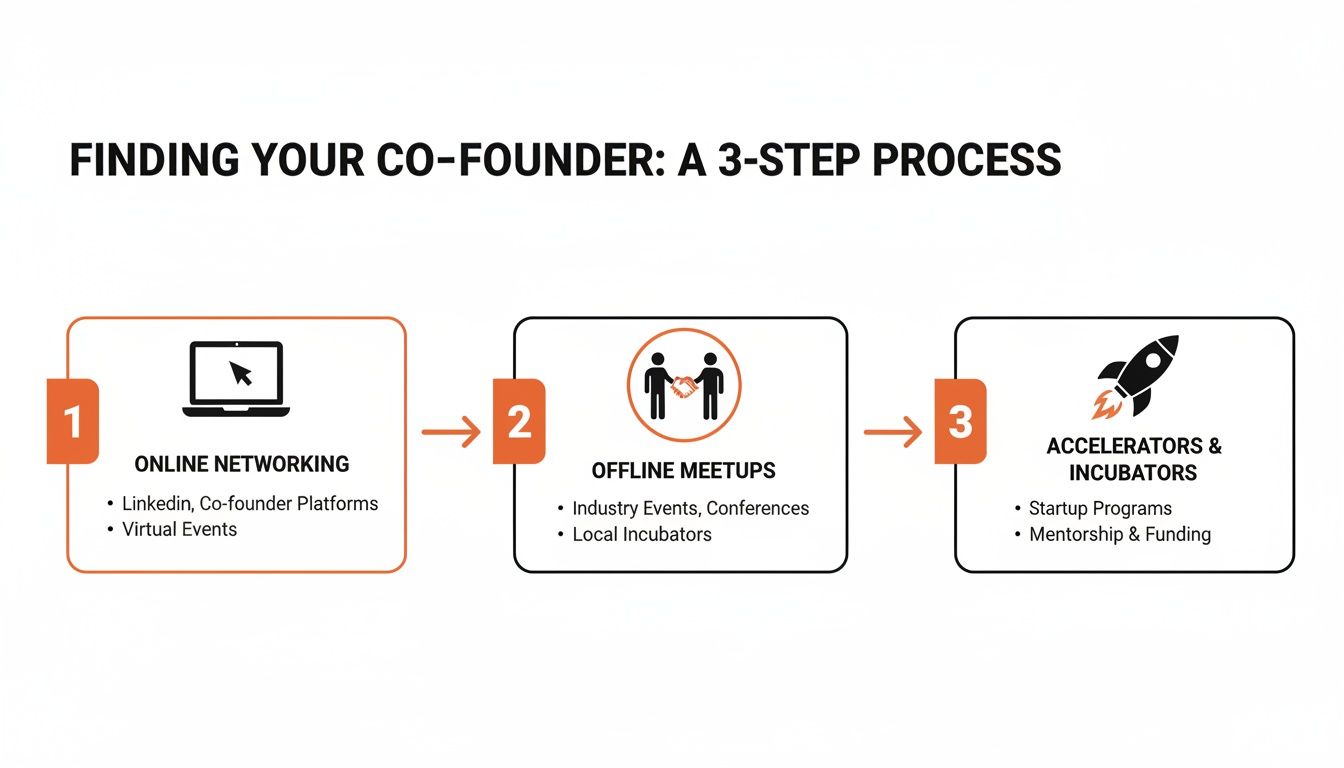
    Managing Lead Times And Quality

    A realistic timeline is worth its weight in gold:

    • Sample production: 3–5 weeks.
    • Small pilot run: up to 8 weeks if tooling is complex.

    Pad each phase by 15–20% for customs delays and minor fixes. Quality checks at milestones catch defects before they snowball.

    Spotting Red Flags In Audits

    Watch for:

    1. Vague or inconsistent tooling photos
    2. Certificates without verifiable details
    3. Suppliers who dodge live video tours

    Verify ISO or CE certificates, request high-res images of assembly lines, and talk to other small brands they’ve supplied.

    Early audits cut defect rates by up to 25% in my experience.

    Drafting Your Purchase Order

    Your purchase order is your safety net. Include:

    • Item Codes with revision numbers to prevent mix-ups
    • Unit Prices and currency terms matching your quotes
    • Delivery Schedule with buffer days and penalties for delays
    • A quality clause capping acceptable defect rates

    Don’t overlook Incoterms like FOB or CIF—they clarify who handles shipping, insurance, and duties.

    Position Your Brand And Select Sales Channels

    Brand packaging example

    Your value proposition is a beacon that draws in the right customers. Packaging becomes your promise of quality, and pricing balances appeal with profit.

    • Pinpoint the unique feature or benefit that sets you apart.
    • Source packaging that matches your brand’s story.
    • Set a price that covers costs and feels fair to buyers.

    Craft Your Value Proposition

    Listen to feedback from validation tests. One founder highlighted durability as non-negotiable and built messaging around a lifetime guarantee.

    • Jot down quotes from interviews to spot themes.
    • Test headline variations on landing pages.
    • Tweak copy until click-throughs or signups jump.

    Design Packaging That Resonates

    First impressions matter. Think texture, color, and small surprises.

    • Use materials that echo your story—recycled stock for eco-minded lines.
    • Keep labels concise and benefits-driven.
    • Add a personal touch like a handwritten note or sticker.

    Set Profitable Pricing Strategies

    Balance cost, perceived value, and market norms:

    • Cost-Plus: Add a 30–50% margin over production costs.
    • Value-Based: Ask customers what feels fair.
    • Tiered Pricing: Offer bundles or volume discounts.

    Comparison Of Sales Channels

    Channel Pros Cons Best For
    Direct To Consumer Full control and 100% of customer data Requires upfront marketing investment Building direct relationships
    Retail Partnerships Instant credibility and foot traffic Margins shrink by 30% and contracts can be strict Broad consumer appeal
    Online Marketplaces Access to 73% of online shoppers instantly Referral fees stack up and competition is intense Niche products that stand out visually

    Learn more on how to start an ecommerce business.

    Blend Channel Strategies

    Think of channels as a relay team—each handoff must be smooth:

    • Launch exclusively on your own site to capture full data.
    • Test local appetite with pop-up shops.
    • Rotate promo codes on Amazon and Etsy to see which audience converts best.

    Use Worksheets For Alignment

    • Match customer pain points to channel features.
    • Score channels on cost, control, and conversion.
    • Review and update monthly to keep tactics fresh.

    Plan Your Launch And Drive Early Growth

    A launch unfolds like a well-paced relay: sneak peeks, live demos, swift follow-ups—curious folks turn into customers.

    Craft A Launch Calendar

    Lay out every outreach, event, and post:

    • Press pitches start 6 weeks before go-live.
    • Influencer seeding begins 8 weeks out.
    • Local pop-up events drop 3 weeks prior.
    • Social countdown starts 10 days ahead.

    Set Metrics And Goals

    Numbers keep momentum measurable:

    • 100 pre-orders in week one.
    • 500 email sign-ups before launch.
    • 10% average engagement on social.

    “Momentum is a measurement, not a feeling,” says Kevin Tao of Chicago Brandstarters.

    Engage Community And Partners

    Chicago Brandstarters dinners and chat sessions offer mentors and peers who share live feedback.

    • Private dinners every two weeks for strategy feedback.
    • Active chat for Q&A and quick tips.
    • Mentor-led intros to press and retailers.
    “A mentor’s feedback shaved $5,000 off our ad budget,” recalls Annie, a Brandstarters alum.

    Tactic Cost Impact
    Dinner Events Low Direct feedback and bonds
    Chat Group Free Real-time Q&A
    Local Pop-Up Low Immediate sales and learnings

    At a Chicago Maker Fair, one demo generated 30 sign-ups and retailer leads in a weekend. Yet, roughly 21.5% of startups fail in year one and two-thirds fold by year ten. Learn more about ecosystem trends here.

    Early Growth Tactics

    Turn launch buzz into growth with small, scalable experiments:

    • Launch a referral program with 10% discounts.
    • Test social ads in $50 increments to find top audiences.
    • Tour local shops with pop-ups for shopper feedback.
    • Create a content series showcasing user stories and hacks.

    Track cost per acquisition and cut tactics that don’t deliver. Engage early adopters:

    • Offer launch discounts to Brandstarters members.
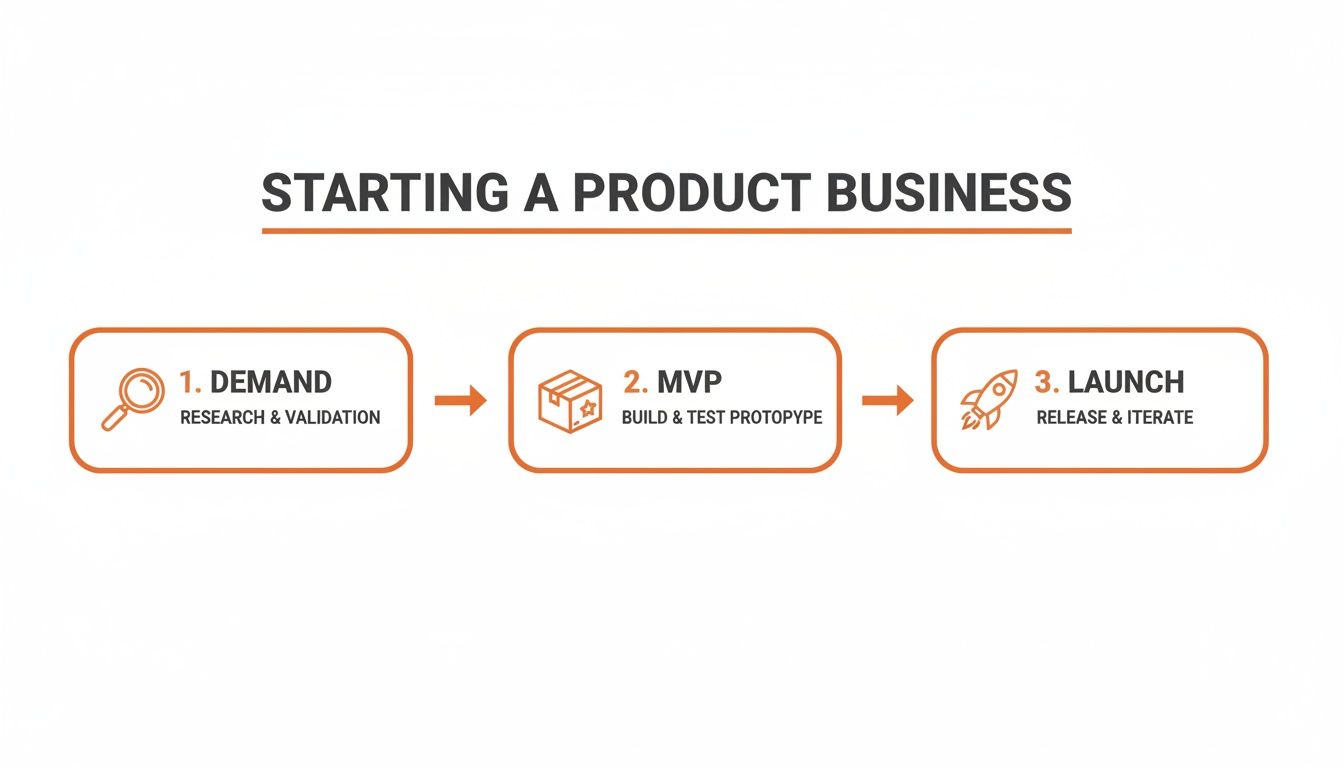
    • Retarget visitors with dynamic ads.

    “Our post-launch tweak cut CPL by 20%,” says Kevin Tao.

    FAQ

    Picking Your Legal Structure

    Choosing an entity is like picking a toolbox—use the one that fits your needs.

    • LLC: Shields assets with minimal paperwork.
    • S Corporation: Cuts self-employment taxes once profitable.
    • C Corporation: Investor-friendly but double-taxed.

    Planning Your Cash Runway

    Aim for 12–18 months of runway to cover tweaks, marketing tests, and surprises.

    1. Calculate monthly burn (fixed + variable).
    2. Forecast early-stage revenue from pre-orders and pilots.
    3. Multiply burn rate by 12–18 to set your target runway.

    Safeguarding Your IP On A Budget

    Protect your ideas without a big law firm.

    IP Tool Cost Range Protection Level
    NDA $0–$50 Confidentiality (1 year)
    Provisional Patent $70–$200 (filing) One-year priority date
    Trademark $225–$400 per class Brand-identity rights

    Key Insight: NDAs cost under $50, yet they’re crucial for keeping prototypes and secrets under wraps.

    Tapping Peer Communities

    Real-world feedback beats solo work. In Chicago, Brandstarters runs small dinners and active group chats:

    • Intimate dinners every two weeks for honest feedback.
    • A members-only chat to swap war stories and quick tips.

    Plug into Chicago Brandstarters for peer support and real-time guidance.