

You opened your contact list, saw plenty of names, and still had nobody to call about a stuck supplier or a decision you might regret. You are not short on people. You are short on people who will tell you the truth and follow through.
That is how to build business relationships. A name in a spreadsheet is not a relationship. A relationship is someone who shares a warning, an introduction, or a hard opinion before you burn a month. I treat it as a trust system. I would rather have a small set of people who answer than a huge list that stays silent.
Start with a map, then a first note that gives something, then a middle range of ties, then a group that meets again. Test trust in small steps. Fix one bad habit before you try to rebuild everything.
Map Your Network Before You Reach Out
You build business relationships when an acquaintance starts sharing information, introductions, and honest feedback. A longer contact list does not create that. I would not add a single new name until the current ones have a job.
List 20 to 30 people who already touch the business. Sort them into layers before you write anyone.
Vertical contacts are mentors, investors, and senior operators. They can open a door you cannot open from your desk.
Horizontal contacts are peer founders at a similar stage. You swap feedback and leads because you live the same constraints.
External contacts are customers, suppliers, and operators in adjacent industries. They carry facts your niche friends repeat back to you in different words.
Trusted core means two to four peers you call for hard decisions. I keep this circle small on purpose. A crowd cannot hold a confidential problem.
Rank each person by relationship quality and relevance, not by title. A buyer who answers beats a famous investor who has never written back. I rewrite the sheet every quarter. Roles move as the company grows. A peer becomes a customer. A mentor goes quiet. A frozen map keeps you calling the wrong people.
Who you contact and how often
| Layer | Who fits | What you offer | Contact rhythm |
|---|---|---|---|
| Vertical | Mentors, investors, senior operators | A sharp market question or a useful benchmark | Every 60 days |
| Horizontal | Peer founders at a similar stage | Honest feedback on a test or a shared lead | Every 2 weeks |
| External | Customers, suppliers, adjacent-industry operators | A supplier name, customer insight or introduction | Monthly or quarterly |
| Trusted core | 2 to 4 peers you call for hard decisions | Candid problem-solving | Weekly or biweekly |
Treat the rhythm as a ceiling. Vertical people do not want a weekly diary. Horizontal peers go cold if you only write when you need a favor. External contacts stay useful on a monthly or quarterly beat when each note carries one concrete gift.
Practical rule: If every name sits inside your niche, the network repeats what you already know. Add one external contact this month.
How to Make a First Contact That Sticks
A first conversation can end with a pleasant exchange and no next step. Make the contact stick by offering something useful, following through promptly, and setting a specific reason to talk again.
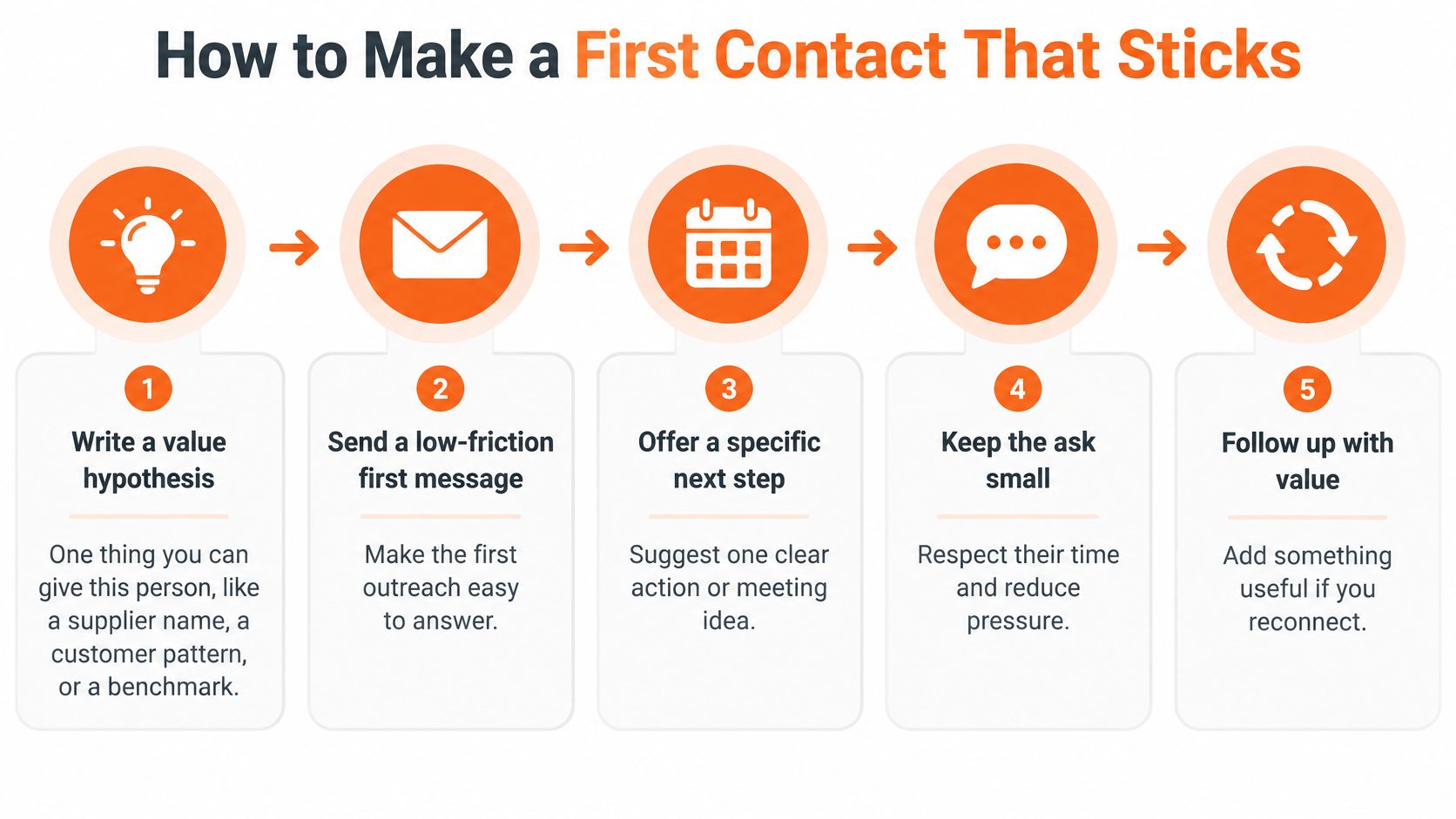
- Write a value hypothesis. Name one useful thing you can offer: a supplier name, a customer pattern, or a benchmark. A specific offer gives the other person a reason to reply and lets you test whether the exchange feels reciprocal.
- Send a low-friction first message. Two lines about their recent launch are easier to answer than a paragraph asking for a favor. For a cold introduction, use this pattern to write introduction emails that get replies. If you meet in person, agree on a simple way to exchange contact details.
- Send the promised resource within 48 hours. A quick follow-through makes your offer credible. If you cannot deliver on time, say when you can.
- Book a useful next interaction within 30 to 60 days. Suggest a call, a shared dinner, or one specific introduction. A clear purpose and date turn “we should catch up” into a real next step.
- Log the reply, the promise, and the next date in one sheet. Record what the person responded to and what each of you agreed to do. That makes it easier to follow through without relying on memory.
Why the timing matters
The value hypothesis gives them a reason to open your note. Delivering within 48 hours shows that you keep small promises. A booked next interaction gives the relationship a chance to develop through repeated, useful contact.
A study of 282 American men, summarized in research on the strength of weak ties, found that 56% of job changers obtained work through a personal contact, and 84% of those contacts were people they saw only occasionally or rarely. The finding points to the value of maintaining ties beyond your closest circle.
The common slip is asking for a favor before offering anything. Start with a concrete follow-through instead:
Thanks for the time yesterday. Here is the supplier I mentioned, with the lead time they quoted me. Which of these two packaging options are you testing next?
Why Mid-Strength Ties Beat Both Extremes
Close friends are a room where everyone owns the same furniture. You trust them, and you also hear the same stories. Strangers are an open window onto the street. The view is new, and nobody owes you a reply. A moderately weak tie is the neighbor you chat with at the mailbox. You know their name, you do not live in their house, and they notice things your household misses.
A study summarized by MIT found that very weak connections with one mutual friend were more likely to lead to job changes than strong ties with 25 or more mutual friends, while ties with about 10 mutual friends nearly doubled the job-change probability compared with ties having only one mutual friend. The gain rises, then falls. Weaker is not always better.
Pick a target before you ask
| Tie type | Mutual friends | Job-change likelihood | Best use for founders |
|---|---|---|---|
| Cold contact | 0 | Outside the compared range | New information, low trust |
| Weak tie | 1 | Baseline for comparison | Cold introduction, one-time exchange |
| Productive middle | About 10 | Nearly double the one-friend baseline | Repeat meetings and shared projects |
| Close circle | 25 or more | Less likely than a one-friend tie | Emotional support and candid advice |
Before you ask for help, count mutual friends or shared groups. Zero means you are still a stranger, so lead with information and expect little trust. One mutual friend is a cold introduction, fine for a single exchange. About ten is the range I chase for a shared project. Twenty-five or more usually means you already sit in the same circle, which is better for candid advice than for a new market.
Get into that middle with a warm introduction, then meet two or three times in a small setting. A helpful follow-up does more than another event badge.
Keep the close core small. Put most new effort into the middle range.
Build a Repeat Meeting Group Around Follow-Through
One dinner creates a pleasant memory. A second dinner creates a place where unfinished work can come back. I would rather run a small group that returns than host a big night nobody remembers.
Set the group up in five steps.
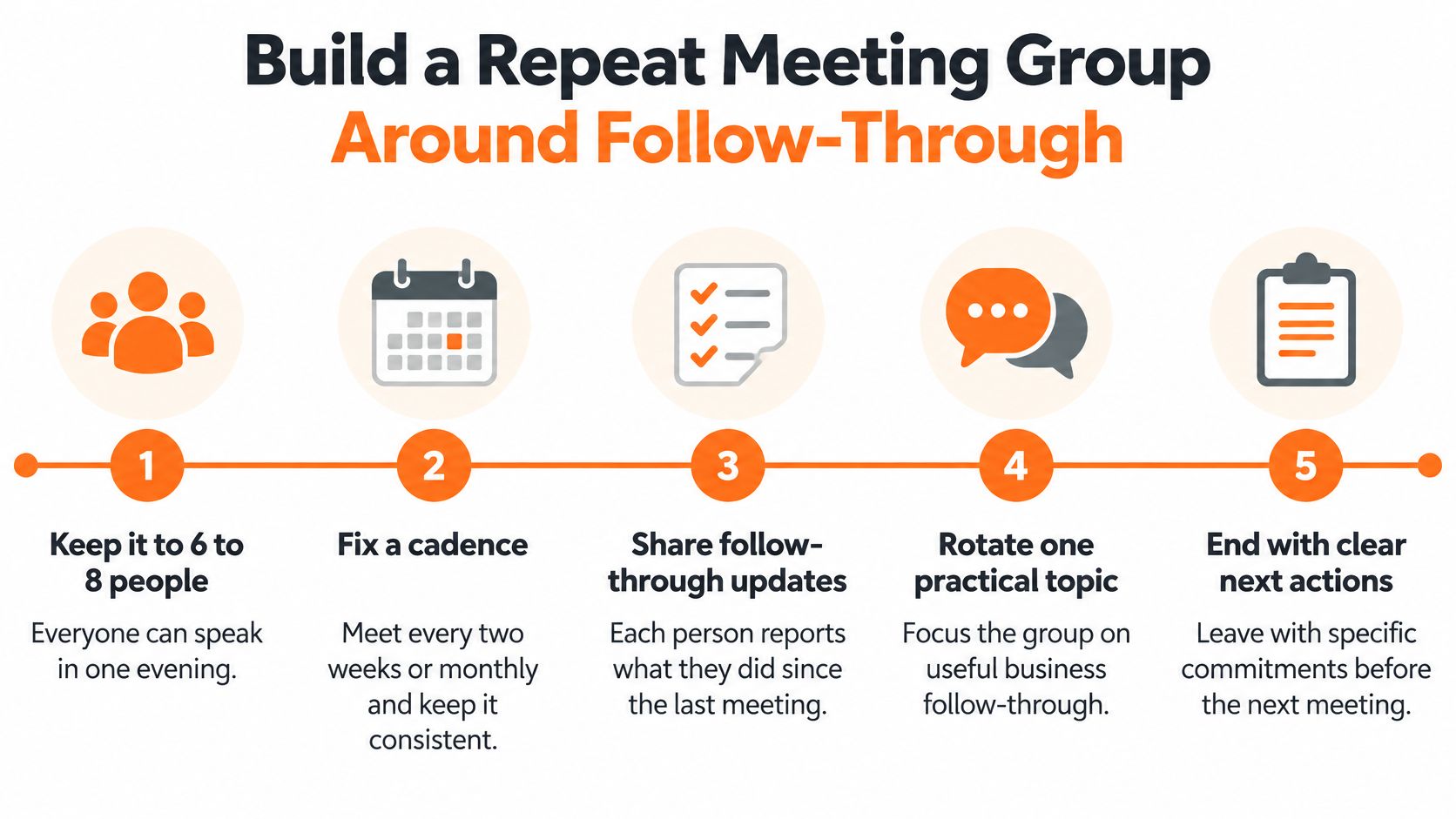
- Cap it at 6 to 8 people. Everyone can speak in one evening. Past that, two voices take the table and the quiet founder leaves with nothing.
- Fix the cadence. Every two weeks or monthly, and keep the date. A moving calendar trains people to treat the group as optional.
- Require one concrete item. Each person brings a problem, a resource, or an introduction request. "How is everyone?" is not an agenda.
- Write the promises down. A shared note, read aloud at the next meeting, makes a shrug expensive.
- Score the quarter. Count qualified introductions, completed collaborations, revenue you can tie to the group, and requests still open.
Research on entrepreneurial peer support links founder-to-founder groups with candid space for accountability and strategic thinking, less isolation, a buffer against stress, lower burnout risk, and support for persistence, learning, and venture performance. A one-off mixer rarely gives you a second look at the same problem. Repeated contact does.
What a returning table looks like
Every two weeks, we run small private dinners of 6 to 8 people. The mastermind group format is that table, not a stage. Nathan put the result in plain words.
"This friendly group helped me solve some problems in my business that had been troubling me for a long time."
The pitfall is counting events and business cards. Commitments are the metric. If introductions are how you win work, a referral tracking guide for boutique consultancies is a clean way to record who sent whom and whether anything closed.
Pick your size, a first date, and one opening prompt. Mine is simple. What broke since we last sat down, and who here can help by next time?
Test Whether a Connection Is Safe to Trust
A pleasant contact will smile, take your idea, and vanish. A trustworthy one leaves evidence. I watch four signals before I share anything that could hurt the business.
- They do what they said. A small follow-up counts. A missed "I'll send that tonight" counts too.
- They share a problem, not only a win. Someone who never struggles is performing.
- They keep a casual detail private. Mention a supplier issue in passing. See if it shows up in someone else's mouth next week.
- They give advice before they ask. Reciprocity that starts with their request is a pitch.

Then run a small test. Share a minor, low-stakes problem. Watch whether a useful note comes back within a few days. No note, or a note that turns into a sales pitch, tells you to stop. You do not need a dramatic betrayal to learn this.
Say the boundary early. What you share stays private. Decline requests that expect exclusive deals or equity in exchange for ordinary advice. Our note on what confidentiality is and why it matters is the standard I want in the room before anyone opens a spreadsheet.
When someone only takes
Name the pattern once, in a friendly sentence. "I have sent three introductions and I have not seen one come back." Then cut the time you spend. Do not write a speech. Do not keep feeding the pattern because the coffee was pleasant.
The EY Global Belonging Barometer found that 85% of employees feel excluded at work, while strong, trusting relationships with colleagues ranked among the leading contributors to psychological safety. Separate 2025 U.S. findings in that research put isolation at 45% of professionals at least sometimes, nearly twice the prior year's level, and at 67% among remote workers. A founder working alone feels that gap faster. One honest conversation can beat a month of shallow chats.
Members who have lived early-stage mistakes are happy to share those stories with other members. That norm only works when the four signals are already visible.
Common Relationship Mistakes and How to Fix Them
The mistake that wastes the most time is asking for a favor in the first message. People do not owe a stranger a meeting, a lead, or a critique. They owe you nothing until you have given them a reason to care.
Find the symptom you see. Do not rebuild the whole network because one thread went quiet.
| Symptom | Likely cause | Fix |
|---|---|---|
| Contacts never answer your first message | You asked for a favor before giving value | Lead with a resource or insight, then ask later |
| Replies are polite but nothing moves | No second interaction was booked | Book a call or shared event within 30 to 60 days |
| Group talks but nobody follows through | Commitments were never recorded | Log each promise and read the list at the next meeting |
| Every new contact sits in your niche | Horizontal overload in your map | Add two external contacts each quarter |
| You regret sharing a problem | Trust was tested too late | Start with a low-stakes detail and watch the response |
| A contact keeps asking and never gives | One-sided pattern | Name the pattern once, then reduce the time you spend |
Three habits that prevent most of this
- Send a thank-you within one day of every meeting. Name the specific help. "Thanks for the packaging lead" beats "great to connect."
- Introduce two people each month. Do it even when you gain nothing directly. Reciprocity builds trust faster than a higher contact count.
- Review the map each quarter. Move people between layers as their value changes. A current sheet shows where you are thin.
Fix one symptom this week. A founder who changes one habit sees movement sooner than one who plans a grand rebuild and starts next quarter.
Pick Three People to Contact This Week
Pick three people before Friday. One vertical contact. One horizontal peer. One external contact. That mix stops you from only talking to founders who look like you.
Write one value hypothesis for each name. One sentence is enough. A supplier, a customer pattern, or a benchmark you already have.
Send the first message within 48 hours of choosing them. Put the follow-up date on your calendar the same afternoon. Log every reply in the sheet so the map stays current.
Then decide whether you want a group that returns. Chicago Brandstarters is a community for kind, bold, hard-working Chicagoans and Midwesterners who are building brands. You can apply to join. Membership is free, at $0, and it includes small private dinners plus the group chat.
The first week matters more than a perfect plan. Momentum keeps the map alive. A beautiful system you never open is just another file.
Open a blank sheet and write the three names before you leave this page.
We host small private dinners and a group chat where Chicago and Midwest founders trade real problems, introductions, and follow-through instead of collecting cards. If you want that kind of table while you build, apply through Chicago Brandstarters and tell us what you are making.
Leave a Reply