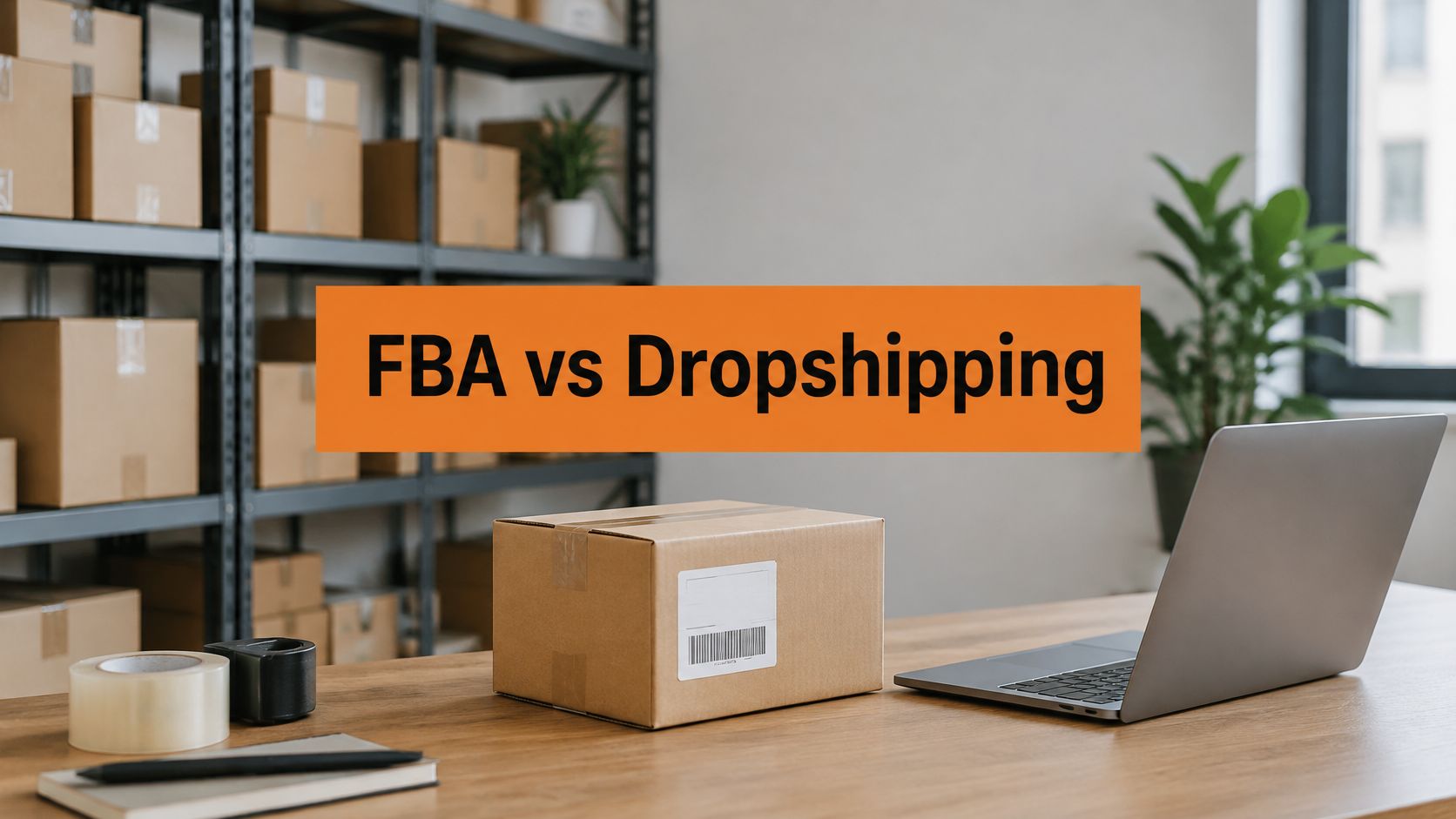
You have a product you believe in, a thin bank balance, and two models fighting for that cash. One asks you to buy stock and ship it to Amazon before a stranger pays you. The other lets you list today and pay a supplier only after the order lands. I would not treat that second path as free money. In FBA vs dropshipping, you are choosing where the cash sits and who gets blamed when a box is late, wrong, or ugly.
I would not pick a winner for every founder. If you can leave cash in stock for two or three months, FBA can be the cleaner machine. If you can't, dropshipping is how you learn without a warehouse bill. The rest of this is how I separate those cases with real fees, a per-order margin, and a 90-day test.
FBA and Dropshipping Side by Side
FBA and dropshipping differ first on when cash leaves your account and who carries the customer-experience risk. The product can be identical; the operating model changes the cash timing, the fee stack, and the person who answers when a box arrives late.
| Factor | FBA | Dropshipping |
|---|---|---|
| Timeline to first sale | Buy, prep, ship, and receive stock before the listing sells | Sign a supplier, list the product, and sell |
| Upfront cash | You buy and ship stock to Amazon before any sale | Little or none; the supplier holds stock |
| Per-unit fulfillment | $2.43 to $2.62 for a small-standard item up to 2 oz, depending on season | Supplier shipping is built into the product price |
| Monthly storage | Charged on daily average inventory volume | None |
| Aged stock | Surcharge applies at 181 days or more | None, but the supplier may run out |
| Shipping and packing | Amazon picks, packs, and ships | Supplier controls, and quality varies by vendor |
| Returns handling | Amazon processes standardized returns | You handle returns and refunds |
| Control over stock | Inventory ledger and sell-through data | Synced supplier feeds; stockouts are possible |
| Seller-of-record duties | You own the stock and the listing | Supplier ships, but confirm seller-of-record terms in writing |
| Best fit | Proven products with repeat sales | Testing new products |
Amazon Seller Central's 2026 FBA fee schedule lists a U.S. FBA fulfillment fee of $2.43 for a small-standard item weighing 2 ounces or less from January 15 through October 14. The same tier rises to $2.62 from October 15 through January 14. Storage is a separate monthly charge on top of that handling fee.
The table shows operating mechanics, not margin. A low upfront cash number in the dropshipping column can hide a higher cost per bad order.
The hidden cost in dropshipping is not the unit price. It is the failure you cannot see until the supplier ships late, sends the wrong variant, or refuses a return. On Amazon, that failure usually becomes a refund and a review. On your own site, it becomes a chargeback, a processor fee, and a customer who calls the bank instead of you. Dropshipping's lower upfront cost does not remove that bill; it moves the bill to after the sale.
If you also take orders on your own site, a late box often becomes a chargeback rather than just a bad review, so tie every dispute back to the supplier that shipped the order. Set up dispute notifications for Checkoutchamp merchants so a chargeback surfaces while the supplier trail is still fresh.
Where Your Money Sits in Each Model
Think of FBA as renting a shelf and stocking it before anyone walks in. You pay for the goods, the inbound truck, and the shelf, then you wait. Dropshipping is the counter down the hall. You take the order, the customer pays, and only then do you place that one unit with a wholesaler.
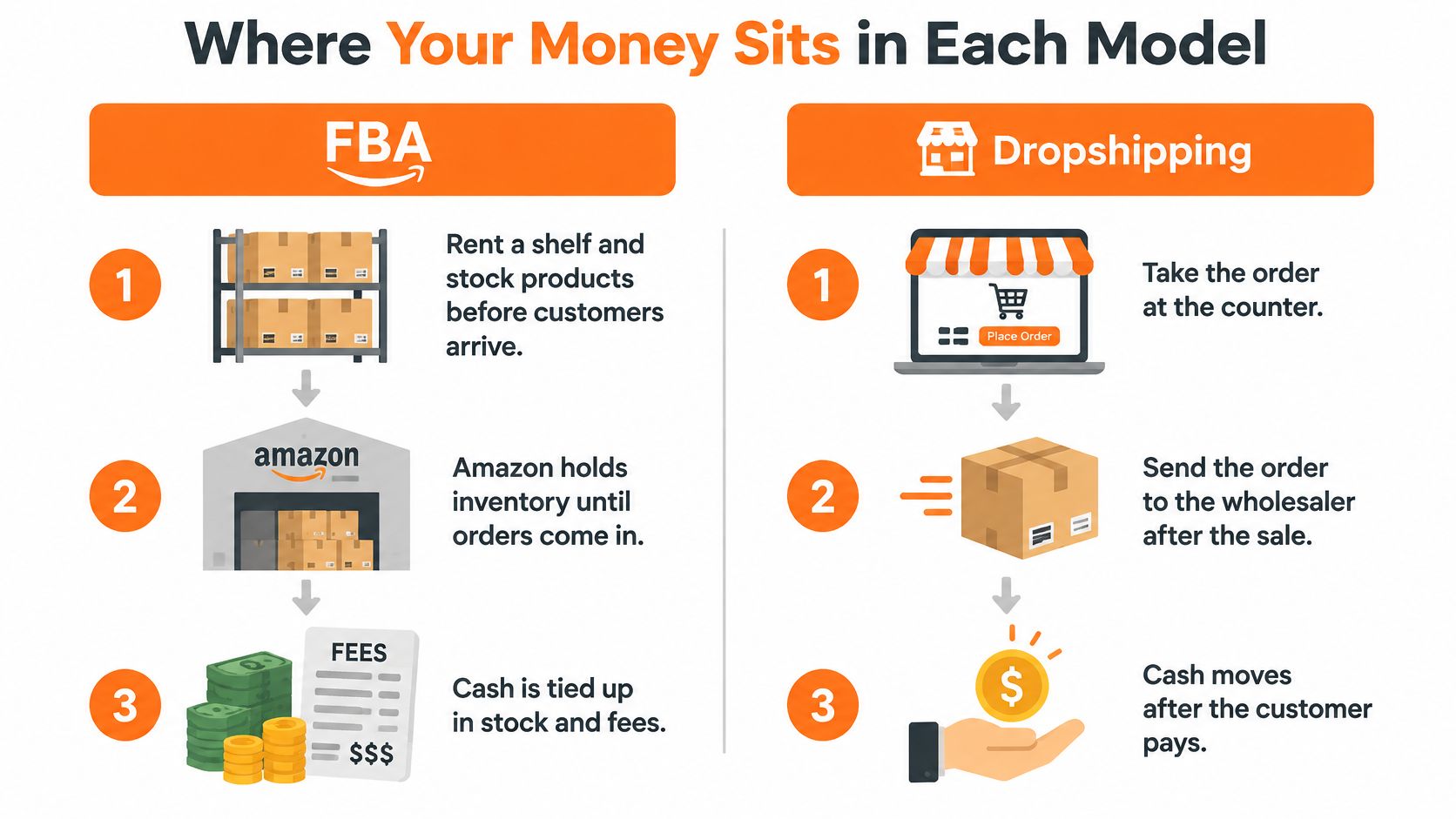
You send FBA units to Amazon before a buyer exists. Amazon Seller Central charges a per-unit fulfillment fee based on product size and shipping weight, plus monthly storage from the inventory's daily average volume. That fee bundle covers picking, packing, shipping, returns processing, and customer service. Slow stock is where the shelf bites. Amazon flags inventory stored 181 days or more for an aged-inventory surcharge, using a snapshot on the 15th of each month.
Dropshipping flips the clock. You market, you collect the order, and the supplier ships to the customer. You skip the pre-buy. You also give up packaging, stock accuracy, speed, and the return. The quiet costs move into the supplier's margin, your ads, and refunds. I treat inventory carrying cost as part of the product price, not as overhead you notice later.
A 200-unit cash timeline
Say you like a small home item with an $18 landed cost. 200 units means $3,600 before the first sale. These dates are illustrative so you can see the gap, not a promise from Amazon.
FBA, three spans:
- Purchase to receiving: You pay the supplier on day 0. The cartons reach the fulfillment center around day 30.
- Receiving to first sale: Units sit while the listing earns its first orders. Call that day 30 to day 50 if ads work.
- Sale to payout: Amazon pays on its cycle, so cash may return around day 64.
Your $3,600 is out of reach for about two months, and storage accrues while you wait. Ask this of any SKU: how many days until this cash comes back as profit, not as revenue?
Dropshipping, the same three spans:
- Purchase to receiving: You don't buy on day 0. The supplier holds the goods.
- Receiving to first sale: There is no inbound receiving on your side. The first sale can be day 1.
- Sale to payout: The customer pays you, then you pay the supplier. Your cash gap is days, not a pallet.
Practical rule: If you can't name the day your cash returns, you don't have a model yet. You have a hope.
The shelf model risks unsold stock and storage. The counter model risks a supplier who ships late after you already took the customer's money. Pick the risk you can afford to sit with.
Working Out Real Margin Per Order
Margin per order is selling price minus product cost, shipping, marketplace and payment fees, advertising, expected returns, and fulfillment. Product cost gets the attention. The other lines decide whether the order made money.
One $35 order, both ways
Run these figures with your own quote. The structure matters more than the exact dollars.
FBA on a $35 sale:
- Product cost: $9
- Inbound freight share: $1.20
- Fulfillment fee: $2.43 for that small, light unit in the non-peak window
- Storage share: $0.40
- Marketplace and payment fees: $4
- Ad cost: $6
That leaves about $11.97 before a return. One refunded unit can wipe out several of those orders once you count the refund and return shipping.
Dropshipping on the same $35 sale:
- Supplier price, shipping included: $14
- Ad cost: $6
- Refund reserve: $2, because some orders will come back or never arrive cleanly
That leaves about $13 before you pay yourself for support time. The $1 advantage over FBA disappears fast when the supplier shipment is late and you refund shipping, reship, or absorb a chargeback. Two failed orders in every ten sales can push that $13 below the FBA result. The margin looked better because the supplier's failure had not reached your refund line yet.
Amazon's 2026 FBA fee schedule says fulfillment fees rise by an average of $0.08 per unit sold, or less than 0.5% of an average item's selling price. For standard-size products priced from $10 to $50, small-standard fulfillment fees increase by $0.25 per unit on average, and large-standard fees by $0.05. Above $50, the averages are $0.51 for small-standard items and $0.31 for large-standard items. A 3.5% fuel and logistics surcharge on U.S. and Canadian FBA fulfillment fees begins April 17, 2026.
Where the dollars actually land
| Cost line | What changes the FBA order | What changes the dropshipping order |
|---|---|---|
| Product | Your landed unit cost | A higher supplier price that hides shipping |
| Fulfillment | A published per-unit fee plus the 2026 surcharge | Supplier shipping, which can jump without a fee table |
| Holding | Storage and aged stock if units sit | No storage, but a stockout can force a refund |
| Demand | Ads plus a return you process inside Amazon | Ads plus refunds, reships, and your own support time |
A product can look profitable on product cost alone and lose money after fulfillment, storage, surcharges, returns, and marketplace fees. Compare margin per order at your real numbers, not at the fee in a blog screenshot. Our notes on the cost of selling on Amazon are a useful checklist when you build that sheet. If you sell jewelry, supplier markups are harsh, and a margin guide for jewelry resellers is worth reading before you assume a shiny photo equals a healthy order.
Who Controls Stock, Shipping and Returns
FBA gives you one ledger. Dropshipping gives you a pile of supplier tabs. I trust the ledger more once a product has proved it can sell every week.
What you can see in FBA
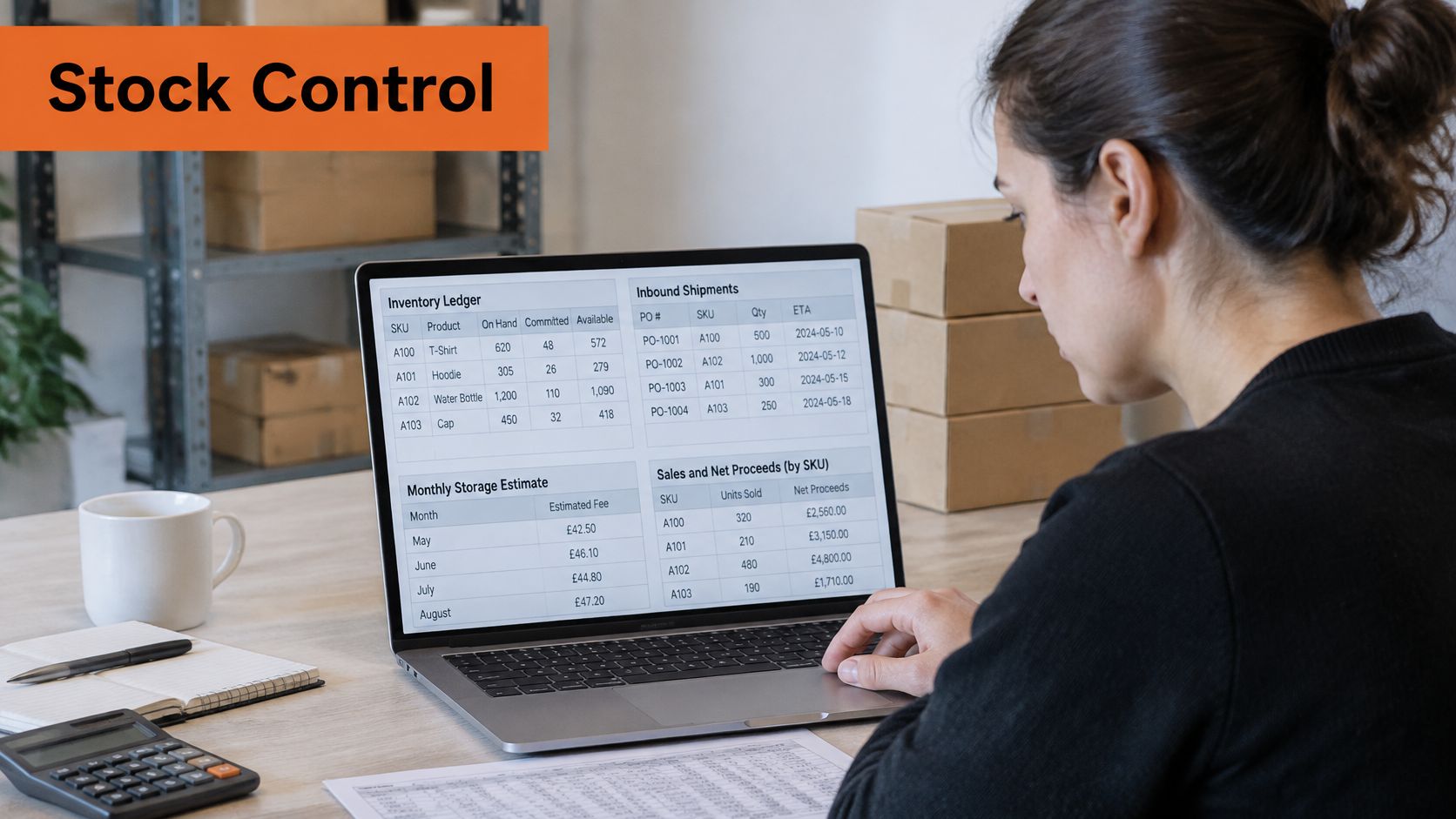
Amazon shows fee previews, an inventory ledger, inbound performance, monthly storage estimates, and SKU-level sales and net proceeds. You replenish from those records instead of from a gut feel.
Amazon's FBA guidance calculates sell-through as units shipped during the previous 90 days divided by the average units held in fulfillment centers. Days of supply is the planning check I run beside it. Amazon Seller Central treats more than 90 days of forecasted supply as excess inventory, so I use a 90-day forecast as the ceiling before I send a big inbound. Amazon's inventory requirements also cap how much you may send and store, and they estimate storage from your sales rate, including monthly storage, storage utilization, and aged-inventory charges. Forecasting is part of the FBA decision, not a chore you add later.
Send six months of a slow item and you pay for space. Send too little and you go out of stock. I would rather hold a conservative 60 to 90 days on a proven SKU than guess at half a year.
What you have to build in dropshipping
There is no single inventory ledger. You sync each supplier feed, check available-to-sell quantities, and watch order confirmation, dispatch, delivery, cancellation, and return rates by vendor. A listing can say "in stock" at 9 a.m. while the supplier is already out at 9:05. The customer still checks out. You still own the email that says the item is gone.
That is an integration job. Map the feed, set a buffer so you stop selling the last few units, and keep a second supplier for any SKU that matters. Our rundown of e-commerce fulfillment solutions walks through how those handoffs work when you aren't the one holding the carton.
I move a product to FBA only when three things are true together. Demand can support a 60 to 90-day replenishment plan. Margin stays positive after fulfillment and storage. Supplier quality data says the SKU can survive a bulk buy without a spike in defects.
This walkthrough is the operational picture I want you to have before you argue about fees again.
Who Owns the Failure When Suppliers Ship
You do. The customer bought from you. A supplier delay, a wrong item, a sudden stockout, or a tracking number that never scans is still your refund, your review, and your account health.
Amazon's dropshipping policy lets a third party fulfill only while you stay the seller of record. The supplier must identify you, not itself, on packing slips, invoices, external packaging, and other order materials. Amazon bars you from buying a product from another seller and having that seller ship to your customer when the other seller's information is visible. You can't use a random retailer as a hidden warehouse. Strip supplier branding and paperwork when you have to. You also handle returns and support under your own seller identity. FBA sidesteps that packaging problem because Amazon ships stock you already sent in, and you still have to meet labeling and prep rules on the way in.
Amazon's fee guidance makes the same point from the customer's side. FBA fees bundle storage, picking, packing, shipping, returns, and customer service, and those costs change with size, weight, and season. Dropshipping skips much of the upfront inventory, but you remain responsible when the supplier ships late, sends the wrong item, changes availability, or gives weak tracking. That hurts a branded product more than a short-lived arbitrage listing. Bad delivery and sloppy packaging show up in reviews, repeat purchases, and account health.
Supplier checklist before you list
- Stock sync: The feed updates often enough that you don't sell a unit the warehouse no longer has.
- Delivery record: You have actual transit times, not a slogan on a wholesale site.
- Branded packaging: The supplier can ship without its own brand on the box and the slip, or you have a prep step that removes it.
- Returns address: You have a place that will accept a return without making the customer call a factory overseas.
If a supplier can't document those four items, I would not put my brand name on the listing. For products where trust and a predictable delivery date drive the sale, I would rather hold inventory in FBA or in a regional third-party warehouse than chase the lowest upfront cost. The cheap path gets expensive the week a supplier misses a Friday cutoff and your reviews pay for it.
Matching Each Model to Your Product and Stage
Ask one question: who holds the risk, you or the supplier?
| Situation | Better fit | Why |
|---|---|---|
| New product with no sales history | Dropshipping | No stock is bought until orders arrive |
| Proven product with steady weekly sales | FBA | Predictable delivery and standard returns |
| Branded product where reviews drive repeat sales | FBA or a regional third-party warehouse | You control packaging and delivery times |
| Seasonal product with an uncertain peak | Dropshipping first | Avoids aged stock if the peak misses |
| Bulky or slow-moving item | Dropshipping for testing | Storage and aged-inventory charges can exceed the margin |
| Growing brand needing redundancy | FBA plus a second supplier | One supplier failure no longer stops sales |
A bulky item that sells slowly is the row people skip. You don't need a huge ad budget to lose money. You need cubic feet sitting in a building while sales trickle. I would test that item as dropshipping, or I would not test it at all.
A branded product is the opposite problem. You can show a perfect listing and still lose the second purchase if the mailer looks like a stranger's warehouse. Clean photos help the first click. Picjam's guide to AI product photography is a practical way to get those shots before you spend on a full studio, but the unboxing still has to match the picture.
The question is not which model is cheaper, but who carries the cost when something fails.
Match your product to one row before you set a test budget. If you are early, dropshipping on the unproven row is enough. If weekly sales are already steady, the FBA row is the one I would fund. At Chicago Brandstarters we stay with founders through that climb, and once members reach 7 figures, the community encourages them to apply to EcomFuel and Million Dollar Sellers.
Choose Your Model and Set a 90-Day Test Budget
Don't fund a catalog. Fund a test you can afford to lose.
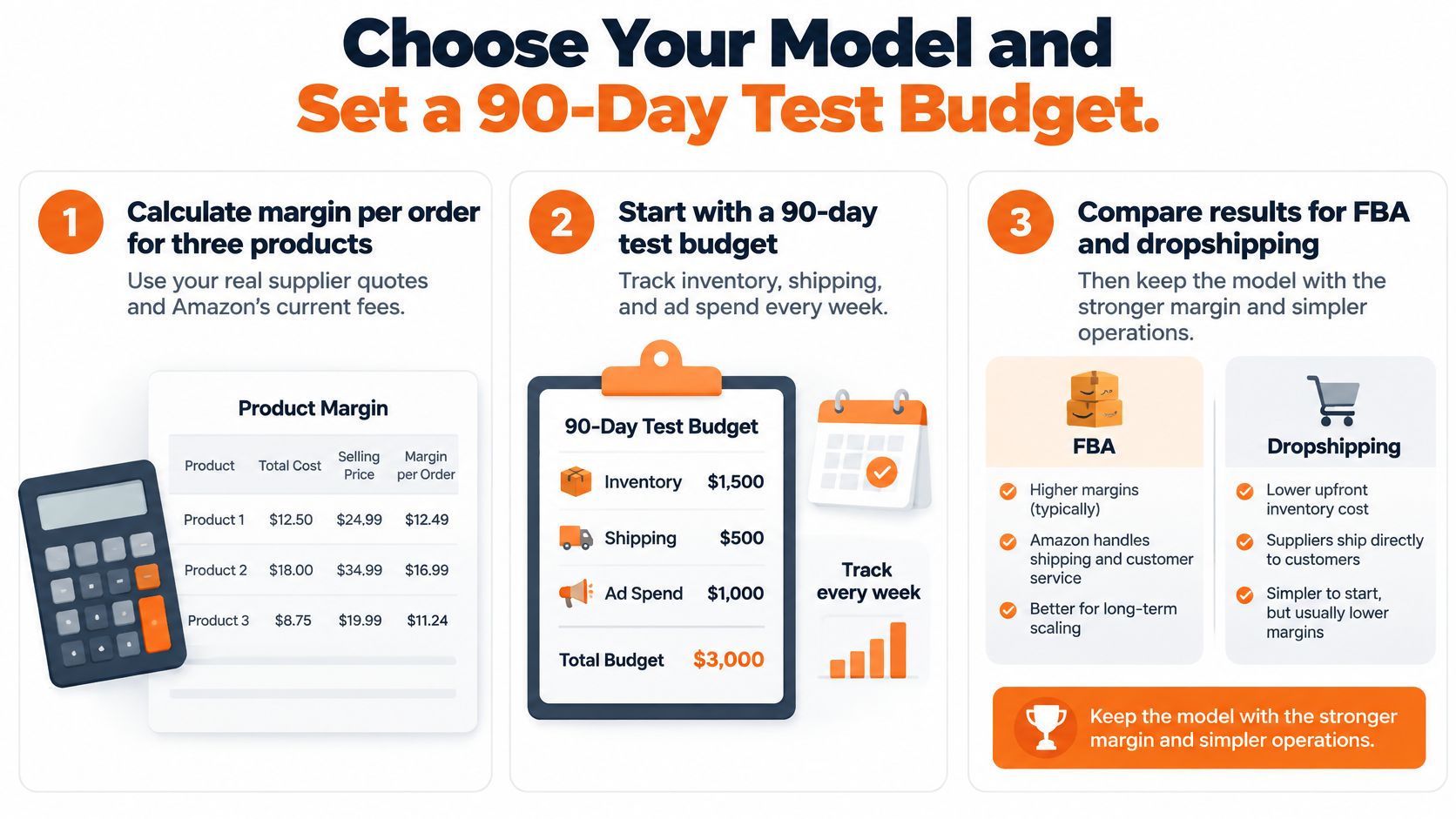
- Calculate margin per order for three products using your real supplier quotes and Amazon's current fees. If a line is a guess, mark it as a guess and get the quote before you buy.
- Start every unproven product on dropshipping with a signed supplier agreement that names you as seller of record. No agreement, no listing.
- Move a product to FBA only when it has 60 to 90 days of forecasted demand, positive margin after fulfillment and storage, and a supplier that accepts bulk orders.
- Set a test budget equal to cash you can lose, capped at 60 to 90 days of spend. Membership in Chicago Brandstarters is free, at $0, and free membership includes access to the Chicago Brandstarters groupchat, which is where I would pressure-test that budget with other operators before you scale ads.
- Review at day 90 against margin per order, return rate, and days of supply. Then each product moves to FBA, stays on dropshipping, or stops.
Which row in the situation table matches your product, and what does margin per order look like at real numbers this week? If you can't answer both, you are not ready to send a purchase order.
Chicago Brandstarters is a free community for Chicago and Midwest founders who are building product brands, including the FBA and dropshipping decisions that tie up cash. You get small dinners and a group chat where operators share supplier problems and margin math without a pitch. Visit Chicago Brandstarters and bring the SKU you are stuck on.
Leave a Reply