

The usual advice about Amazon is to get your product listed, tap into the traffic, and figure out the rest as you grow. I think that's backward. You can grow Amazon sales while earning less per order and tying up more cash. Before you send inventory, work through the pros and cons of selling on Amazon with a unit-cost spreadsheet, not a revenue target.
The Trade You Make on Amazon
Think of Amazon as a stall in a food hall. Hungry people already walk through the building. You don't have to persuade them to visit the neighborhood, install the checkout system, or build the delivery operation.
You still pay for your place. You follow the building's rules, and you can't assume everyone who buys lunch will remember your name.
What Amazon gives you and what you give up
| Question | What you gain | What it costs you |
|---|---|---|
| Reach | Amazon search and buyer traffic | You do not own the demand |
| Fees | Checkout and payment handling | A selling plan plus a referral cut |
| Fulfillment | Prime-speed shipping through FBA | Storage bills on stock that sits |
| Brand | A fast public test of the product | Listing rules shape how you show up |
| Policy | A path to appeal a complaint | Sales can stop during review |
For a Midwest founder, that swap can make sense. You can reach buyers beyond the farmers market, neighborhood shop, or circle of friends who already know you. You can test whether strangers understand your product without first building an entire ecommerce operation.
But access doesn't guarantee visibility. You still need a clear listing, competitive positioning, and a product that gives shoppers a reason to choose you.
Judge the channel by what you keep
Amazon's seller fee guidance describes the layered charges behind that access, including category-based referral fees and size- and weight-based fulfillment fees. I would judge the channel by landed contribution margin, the money you retain after the costs of getting and fulfilling an order.
The opportunity is real. According to Amazon's seller statistics, more than 75,000 independent sellers surpassed $1 million in Amazon-store sales in 2025, a 36% increase from 2024. Amazon's 2025 Small Business Empowerment Report also puts independent U.S. sellers' average annual Amazon-store sales above $375,000 that year.
Those figures describe sales. They don't tell you what those sellers took home, how much inventory they financed, or what they spent to win each order.
I'd rather own a modest channel that pays me than manage a busy channel that needs another cash injection.
Compare Amazon with the alternative you could operate. Your own website gives you more control, but you must attract shoppers. Local retail gives you direct feedback, but you must earn shelf space or staff the table.
Don't compare Amazon with an imaginary business that has free traffic and effortless logistics. Compare realistic choices, then price a real unit.
Fee Layers in One Unit of Margin
I start with the selling price and subtract every cost that follows the order. Factory cost alone tells you almost nothing about whether you should sell a product on Amazon.
Use this stack:
Selling price minus referral fee, fulfillment, inbound freight, product cost, advertising, returns, storage, and expected aged-inventory costs equals contribution profit per unit.
That remainder still needs to support your business overhead and owner pay. Don't confuse it with money you can immediately spend.
Build the bill before you choose the price
Amazon's U.S. selling-plan pricing lists the Professional plan at $39.99 per month and the Individual plan at $0.99 per item sold; Amazon calculates referral fees from the total sales price, including delivery and gift wrapping, or applies the category minimum when that amount is greater.
Amazon charges to model on one unit
| Cost layer | How Amazon charges | What you plug in |
|---|---|---|
| Professional plan | $39.99 per month | Spread across expected monthly units |
| Individual plan | $0.99 per item sold | Add to each unit if you skip Professional |
| Referral fee | Percent of price plus shipping and gift wrap, or a category minimum | Use whichever is greater |
| FBA fulfillment | Per unit by category, size, and weight | The fee for that exact SKU |
| Monthly storage | Average daily cubic-foot volume | A per-unit storage estimate |
| Returns and removal | Extra charges in some cases | A return-rate allowance and removal provision |
Amazon's FBA fees guide explains the storage calculation and possible additional charges for returns processing, removal, disposal, inbound placement, and aging stock. Treat those as separate spreadsheet rows rather than hiding them in a miscellaneous allowance.
For another explanation of the fulfillment-cost categories, use Amazon fee insights from Adbrew. Then replace every estimate with the applicable fee for your product's packaged dimensions, weight, and category.
Put a hypothetical unit through the stack
Say you sell an item for $25 and pay $9 to manufacture it. For this hypothetical example only, assume a 15% referral fee, $5.50 fulfillment, $1 inbound freight, $2.50 advertising, $1 return allowance, and $0.25 storage.
You retain $2 per unit, or 8% of the selling price, before plan allocation, overhead, taxes, and other applicable costs. These are illustrative assumptions, not Amazon rate quotes.
That's positive contribution, but you have little room for mistakes. A damaged shipment, expensive campaign, or heavier package could change your decision.
- Model each SKU separately. Don't let a compact bestseller hide a bulky product's losses.
- Allocate realistically. Spread monthly costs across units you expect to sell, not units you hope to sell.
- Keep taxes separate. Build the relevant obligations into your cash plan rather than treating the contribution remainder as take-home pay.
Use our cost of selling on Amazon guide to organize the full expense list. Your spreadsheet should explain where the money goes without requiring a hopeful interpretation.
Sales Up and Profit Down
Only 23% of respondents were growing while maintaining healthy margins in the 2026 Seller Index survey reported by beBOLD Digital, which covered 181 merchants representing more than $2 billion in revenue; 38% were increasing sales while margins declined, 24% were consolidating, and 15% were distressed.
I wouldn't turn that survey into a prediction for your product. I would use it to challenge the idea that a rising sales dashboard proves you have a healthier business.
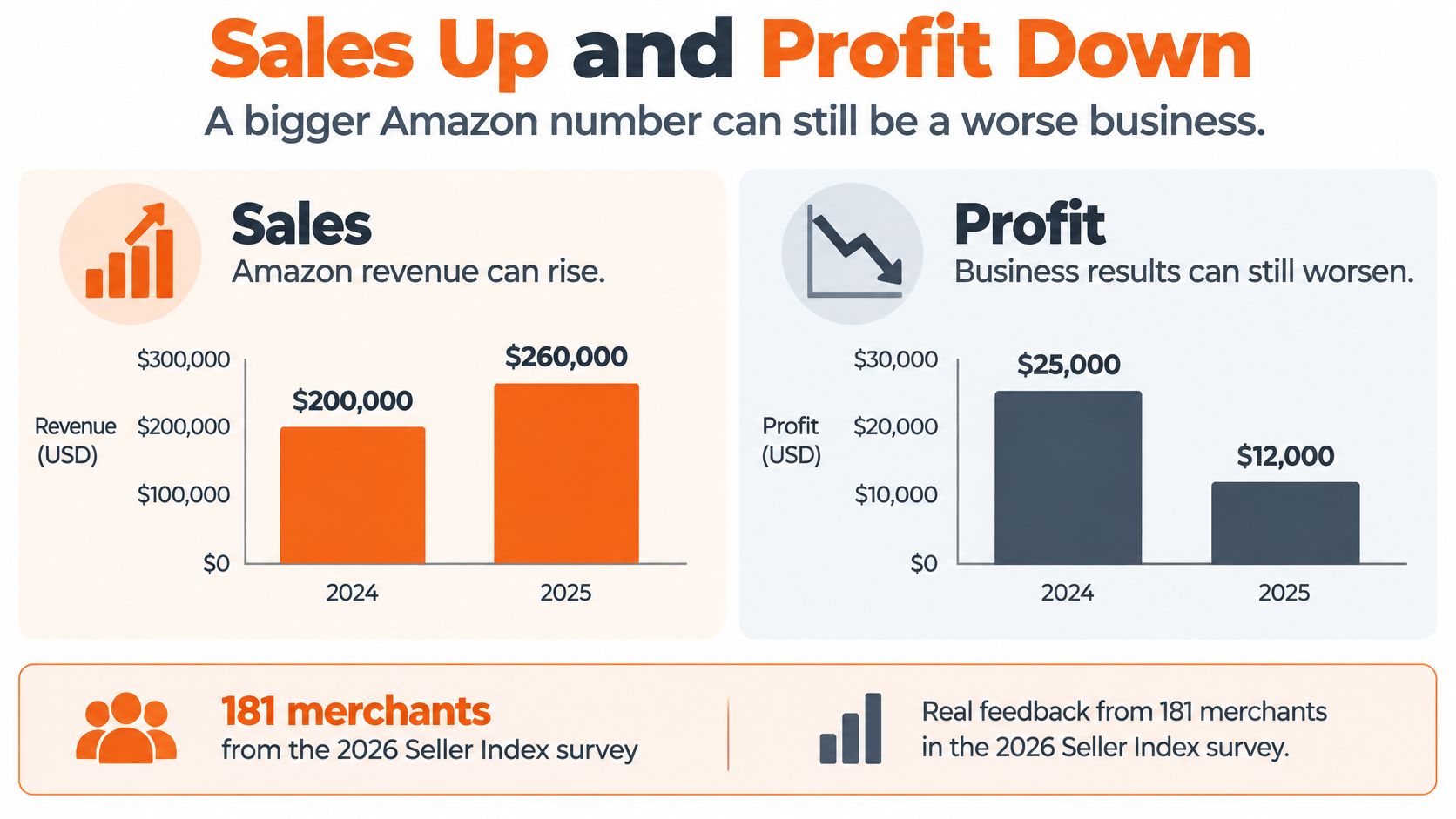
You can buy more orders through ads and discounts while retaining less from each purchase. You can also spend that smaller remainder on a larger inventory order before you've recovered the cash from the last shipment.
Think of filling a cracked bucket. You turn up the hose and watch more water enter, but you still need to check how much stays.
Track business health separately from sales
I want these numbers beside your revenue report every month:
- Contribution profit per order. Include every variable cost, including advertising and expected returns.
- Cash tied up in inventory. Count stock at the factory, in transit, and waiting for buyers.
- Advertising-attributed sales versus total sales. Check how much revenue you depend on paid campaigns to generate.
- Return rate. Investigate the product, packaging, and listing expectations behind the returns.
- Amazon's share of revenue. Calculate how much business you'd lose if the account stopped selling.
Don't treat a lower advertising-cost ratio as an automatic win. Check whether you improved total contribution profit or merely changed which orders the advertising dashboard claims.
Likewise, don't celebrate a large purchase order because the factory gave you a lower unit price. Compare the savings with the extra cash you'll commit and the time you expect to hold the stock.
Cash rule: Don't fund a bigger inventory order with confidence you borrowed from a sales chart.
In SmartScout's 2024 seller survey, 67% of respondents said they raised prices during 2024, while 50.8% of large sellers reported lower profits. You can't assume a price increase will solve the squeeze.
Before you leave your job or expand the ad budget, decide what happened to the business underneath the sales growth. Did you retain more money? Did you recover inventory cash sooner? Can you repeat the result without another discount?
If you can't answer those questions, hold the expansion. More activity isn't enough.
What FBA Does to Your Cash
Say you're packing orders at the kitchen table after work. Fulfillment by Amazon can remove that daily shipping job: you send inventory into Amazon's network, and Amazon picks, packs, ships, handles customer service, and processes returns.
Amazon's seller FAQ says the FBA fulfillment charge includes shipping, with no extra charge for eligible Prime two-day shipping or eligible free shipping. You can give buyers a delivery experience that you couldn't easily build alone.
I compare FBA to handing a professional warehouse the keys. You stop managing every parcel, but you still decide how much stock to send and when to replenish it.
The warehouse clock keeps running
Amazon's FBA fee guidance says inventory held for 181 days or longer incurs an aged-inventory surcharge on top of regular storage; for 2026, Amazon stated an average U.S. FBA fee increase of $0.08 per unit sold, less than 0.5% of an average item's selling price, with some standard-size products priced from $10 to $50 seeing average fulfillment-fee increases of $0.05 to $0.25 per unit.
A small fee change doesn't automatically ruin a product. But you need enough room to absorb changes without depending on a perfect selling price.
Now consider a seasonal item. You send an optimistic quantity, the season ends, and you still have cartons waiting for buyers. You've already paid the supplier, and you must decide whether to discount, remove, or keep storing the remainder.
Underbuying creates a different problem. You run out before the next shipment arrives and can't serve buyers while you wait.
Give each shipment an exit plan
Before you send stock, write down:
- Your reorder point. Base it on expected demand during supplier production and transit, with a buffer for uncertainty.
- Your inventory review trigger. Review slow-moving units while you still have practical choices.
- Your exit route. Estimate discounting, removal, disposal, or selling through another channel.
Amazon's FBA storage guidance supports modeling storage and inventory exposure at the SKU level. I'd pay particular attention to bulky, seasonal, slow-moving, and low-priced products.
Use our Amazon FBA versus FBM comparison when you decide who should handle fulfillment. Choose the arrangement that fits your inventory pattern and available labor, rather than assuming outsourcing always costs less.
Suspensions and the Customer You Do Not Own
You can have good margins and still lose access to the channel. Amazon's intellectual-property policy says Amazon may suspend an account after receiving infringement notices involving products or content; you can appeal through the account dashboard or by replying to the suspension notice, and Amazon decides whether to reinstate you.
You might believe a complaint has no merit. You still need records that let you respond clearly while marketplace revenue may stop.
Build an evidence pack before launch
Create a folder for each product and keep the original records. Don't wait until a supplier disappears or an employee leaves to reconstruct the paperwork.
- Purchase invoices and supplier records. Keep documents that connect your business, the supplier, and the actual goods.
- Trademark permissions. Save authorization when you use another company's protected branding.
- Original product photographs. Retain your image files and the permissions for anything you didn't create.
- Authenticity evidence. Keep the records that support your right to sell the product.
Then review the customer-facing material. Check the product name, packaging, images, title, and bullet points for branding or content you don't have permission to use.
A competitor's photograph isn't a shortcut. Neither is adding another company's trademark to attract searches without checking your right to use it.
Plan for an interruption
Use our Amazon account suspensions guide to prepare your response process. Decide who monitors account notices, where the evidence lives, and who will pause spending if a listing goes offline.
Keep the proof with the product records. Your sourcing paperwork is part of operating the business.
Account access and customer access are different problems. Even when you sell smoothly, you don't gain the same follow-up freedom you have with a customer who buys directly from your own store.
Build an email or SMS audience through lawful, permitted methods. Don't assume that an Amazon purchase gives you permission to add someone to a marketing list or redirect their transaction.
I'd make the distinction practical: keep marketplace communications within Amazon's rules, and build direct relationships through your own legitimate acquisition channels. Ask for clear consent where required.
If an account interruption would prevent you from paying ordinary bills, you need more than a tidy evidence folder. You need a cash contingency and a channel you can operate while you resolve the problem.
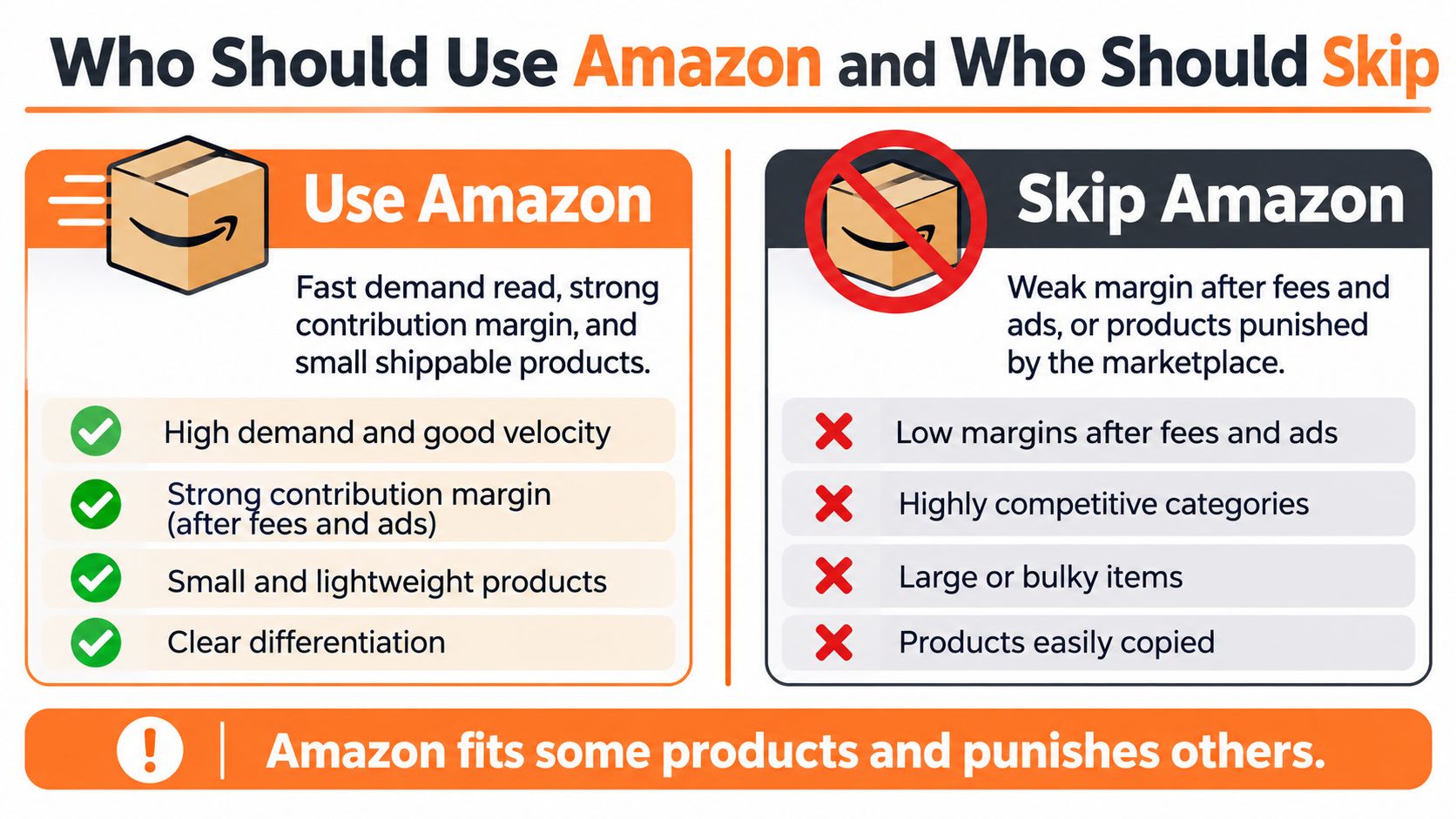
Who Should Use Amazon and Who Should Skip
Amazon fits some products and punishes others. I'd use it to test a small, straightforward product with enough contribution profit to support advertising, returns, and fee changes.
I'd keep the test tiny, or choose another channel, for a bulky, seasonal, low-priced item that needs optimistic assumptions to work.
Choose based on your room to maneuver
Modern Retail's marketplace reporting puts third-party seller services, including commissions, fulfillment, shipping, and advertising, at $172 billion in 2025, up 11% year over year, and describes those costs as consuming roughly half of a typical transaction's revenue.
That isn't a fee quote for your SKU. It's a reason to check how much freedom you retain when costs increase.
- Use Amazon when you can absorb friction. You can fund replenishment, tolerate a slower launch, and keep acceptable contribution after a difficult ad test.
- Wait when the product needs explanation. Test whether buyers understand the benefit before you commit to marketplace inventory.
- Skip a large launch when the economics require perfect conditions. Don't finance a container on the assumption that today's search position, ad cost, or Buy Box access will continue.
You can raise prices, but shoppers may choose a cheaper substitute. You can reduce ads, but fewer buyers may find you. Test those choices before you depend on either one to rescue the business.
For another decision checklist, Headline Marketing Agency's is selling on Amazon worth it discussion can help you question the channel fit. Make the final call from your own product economics.
My recommendation is simple: use Amazon when it helps you learn at a cost you can carry. Don't use it because you're afraid that every serious brand must.
Alternatives and Mitigation Steps
Build another way to sell before you commit most of your cash to Amazon inventory. You don't need to launch every channel at once. Choose a route that teaches you something Amazon won't.
Channels to pair with Amazon
| Channel | What you gain | What it costs you |
|---|---|---|
| Own website | You own the customer data and set your price | You pay for traffic and checkout setup |
| Wholesale account | One buyer takes volume in a single order | You accept a lower price per unit |
| Local shop or market table | You meet buyers and hear objections in person | You pay rent and staff time |
| Email or SMS list | You reach repeat buyers directly where law and Amazon rules allow | You must build it one customer at a time |
A website gives you room to explain a product, show demonstrations, and answer objections. But launching a store doesn't create demand. You still need a practical acquisition plan.
A wholesale buyer may simplify order handling, though you'll negotiate pricing and terms. A local market lets you hear the questions shoppers ask before they reach for their wallets.
Choose a backup you'll actually operate
I wouldn't call an unused website diversification. Give your second channel a task: collect consented subscribers, test a bundle, secure a retail reorder, or learn why people hesitate.
Then put guardrails around Amazon:
- Set a concentration limit. Choose how much revenue you're comfortable placing on the platform and plan other channels around that decision.
- Stress-test each purchase order. Recalculate the economics with higher fulfillment and advertising costs before you commit cash.
- Assign compliance ownership. Give someone responsibility for sourcing documents, listing permissions, and account notices.
- Build direct retention properly. Invite people who encounter your own website or events to subscribe. Respect consent requirements and marketplace restrictions.
Don't try to replace Amazon overnight. Build a route you can expand without starting from nothing during an interruption.
I'd rather see you operate a simple second channel consistently than maintain several neglected storefronts. Every channel needs attention, inventory coordination, and a clear reason for existing. Choose deliberately.
Pick a Channel Before You Buy Stock
Make the purchase decision on paper, away from the seller app. I use a contribution test, a stress test, and a backup test.
Decide whether to buy, wait, or skip
- Contribution test. Run the exact packaged SKU through the complete cost stack. Require a positive remainder with enough room to support overhead and the work you'll do.
- Stress test. Increase your modeled referral, fulfillment, and advertising costs. If a modest change makes the order unprofitable, fix the economics before buying stock.
- Backup test. Name another route to buyers and the next action you'll take to develop it. A wholesale account isn't an owned channel, but it can reduce reliance on a single marketplace.
Pass all the tests and buy a short test quantity you can afford to hold. Set your replenishment trigger from lead time, then review cash and actual costs before expanding.
Fail the contribution test and wait. Change the price, packaging, supplier terms, or product. If you need permanent Buy Box access and unusually cheap ads to survive, skip the large order.
Bring the assumptions into the open
If you're in Chicago, bring your spreadsheet to Chicago Brandstarters for a pressure test. Ask people to challenge your return allowance, launch budget, and reorder timing rather than admire your sales target.
Our vetting process removes the selfish, the inauthentic, the service-sellers, the toxic, and the self-promoters. We want honest discussion without a sales pitch attached.
Once members reach 7 figures, we encourage them to apply to EcomFuel and Million Dollar Sellers. For now, your job is narrower: prove that you can sell the product, retain money, and fund the next order without trapping yourself.
We have a free, vetted founder community where Chicagoans and Midwesterners share practical tactics, difficult decisions, and confidential support. Bring your Amazon fee stack and inventory assumptions, and ask for a candid challenge before you commit your cash. Visit Chicago Brandstarters to learn about joining.
Leave a Reply