
You've got an idea, a spreadsheet, and a supplier quote you don't quite trust. You could ask someone for help, but you don't want to sit through a sales pitch or explain why you haven't launched yet. You need a person who'll look at the problem with you and ask a sensible question.
Why Founders Join a Network
Maybe you're planning a small product brand after work. Your supplier wants a larger order than you expected, and your pricing only works if customers accept a premium you haven't tested. You keep changing the spreadsheet because changing a cell feels safer than making a decision.
A founder network is a group of relationships you can turn to for practical judgment, honest feedback, and support while you build a business. I'd think of it as a workshop table: you bring an unfinished problem, and other builders help you inspect it.
You don't need to arrive with a polished pitch. In a useful conversation, you might explain your order minimum, your cash constraint, and what customers have said. Another founder might help you separate a supplier problem from a demand problem.
Bring the uncertainty
For this hypothetical product launch, you could ask:
- About the supplier: What should I verify before sending a deposit?
- About pricing: Which assumptions should I test with customers?
- About the decision: What would make you pause rather than place the order?
Those questions give peers something concrete to work on. A broad request for startup advice leaves everyone guessing about what you need.
Practical rule: Bring the decision you're avoiding, along with the context someone needs to understand it.
You may leave without an answer. That can still help if you leave with a better question, a missing piece of information to collect, or a clearer reason to wait.
I'd also make room for the emotional side. You might need someone who understands why a delayed shipment feels personal when you've put your savings into inventory. You can ask for company without asking someone to fix everything.
Joining a group doesn't guarantee revenue, investment, or growth. Your first useful outcome might feel quieter: you stop circling the same question and know what to do next.
What a Founder Network Actually Does
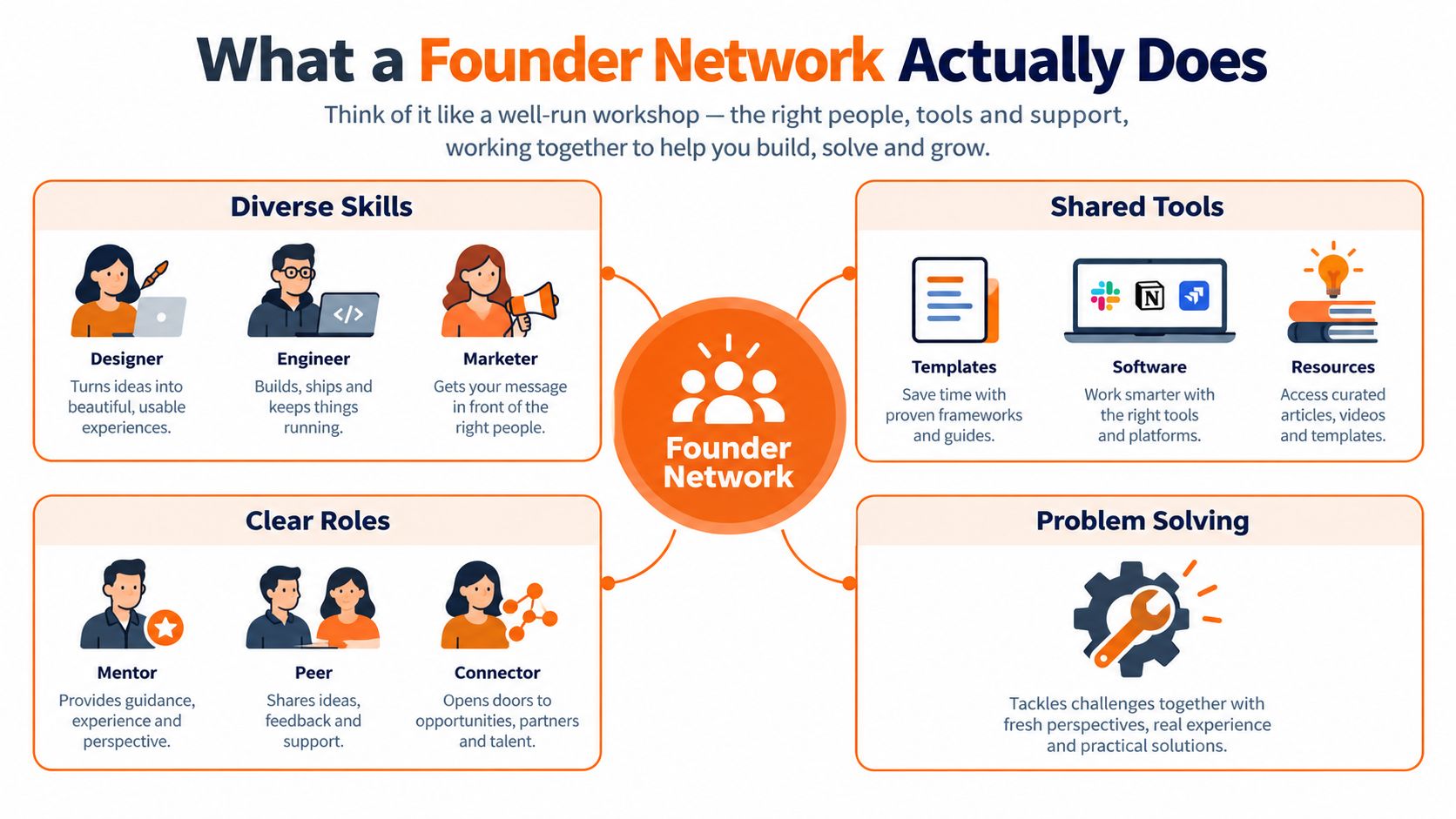
Think about a well-run workshop. You have people with different skills, shared tools, clear responsibilities, and something specific to repair. You wouldn't judge the workshop by how many names appear on its mailing list. You'd look at whether people help you do the work.
The same test applies to a founder network. You might exchange a customer-interview template, compare fulfillment options, question a hiring assumption, or ask someone to introduce you to an operator with relevant experience.
Use this workshop comparison to identify what you need from a group.
Separate the relationships
You can use different relationships for different jobs:
- A contact list: You know whom you could approach, but you may have little shared context.
- A mastermind group: You meet with a recurring peer group around challenges, goals, and accountability. Ask how the organizer runs it, because the label alone tells you little.
- An advisory board: You invite selected people into a more defined advisory relationship, with expectations you should agree on explicitly.
- A circle of friends: You share personal support, though you may not share relevant operating experience.
You can build an active network through any combination of these. The distinction comes from what you do together, rather than what you call the group.
In a Chicago Booth Review survey of 350 University of Chicago alumni across 40 countries, respondents used professional networks for market or opportunity due diligence (42%), management advice (41%), and learning about a new industry (38%), according to the networking survey summary. That's a useful picture of networking as everyday operating work.
Build trust through behavior
I'd look for context, discretion, reciprocity, and follow-through. Does someone ask about your margins before suggesting a discount? Do you report back after testing their suggestion? Can you decline an introduction without creating tension?
Confidentiality needs an explicit conversation. Ask what members may share outside the room, whether anyone records discussions, and how organizers handle breaches. A promise of privacy doesn't remove your responsibility to protect customer information, employee details, or commercially sensitive documents.
You'll recognize useful relationships when you can say what changed since the last conversation and people understand why it matters.
Compare the Main Founder Network Formats
Choose a format around how you'll participate. You might enjoy a dinner yet struggle to attend regularly. You might prefer an online forum but need help turning written replies into deeper conversations. Neither reaction means you're bad at networking.
Founder network formats at a glance
| Format | How access works | Best for | Watch for |
|---|---|---|---|
| Local dinners | Check location, invitations, membership rules, and meal costs | Focused conversation and nearby operating relationships | Travel, evening schedules, and limited seats |
| Online forums | Check registration, moderation, free access, and paid tiers | Flexible questions, searchable discussions, and remote participation | Sales messages, missing context, and shallow replies |
| Accelerators | Check applications, stage requirements, fees, equity terms, and attendance | Defined learning goals, milestones, and program resources | Financing expectations and a demanding schedule |
Local dinners and online forums
At a small dinner, you can explain the awkward details behind a problem and hear follow-up questions immediately. Ask who usually attends, how the host balances conversation, and whether you'll meet the same people again. Travel and caregiving may make an otherwise appealing dinner impractical.
In an online forum, you can write a question after work and return when your schedule allows. Searchable discussions can help you investigate a specific problem before posting. Still, you'll need to assess who answers, what experience informs the advice, and whether moderators stop unsolicited selling.
If you want ongoing peer accountability rather than open discussion, compare mastermind groups for entrepreneurs. Ask about preparation, attendance expectations, and facilitation before you commit.
Accelerators and financing fit
Investigate an accelerator when you can name the gap you want to close. You might need a curriculum, product-development guidance, or a deadline that pushes you to finish customer research. Check the actual program instead of assuming every accelerator expects the same stage or business model.
Your financing preferences matter too. If you're considering funding tied to revenue, Capital Express's revenue-based financing company comparisons give you a place to start comparing options before discussing them with peers. Verify terms directly and make your own cash-flow assessment.
Don't join a program merely because you feel too early or too small for other rooms. Ask whether its activities help with your current work. An impressive calendar can still leave you with less time for the customers you need to understand.
What Early-Stage Founders Can Gain
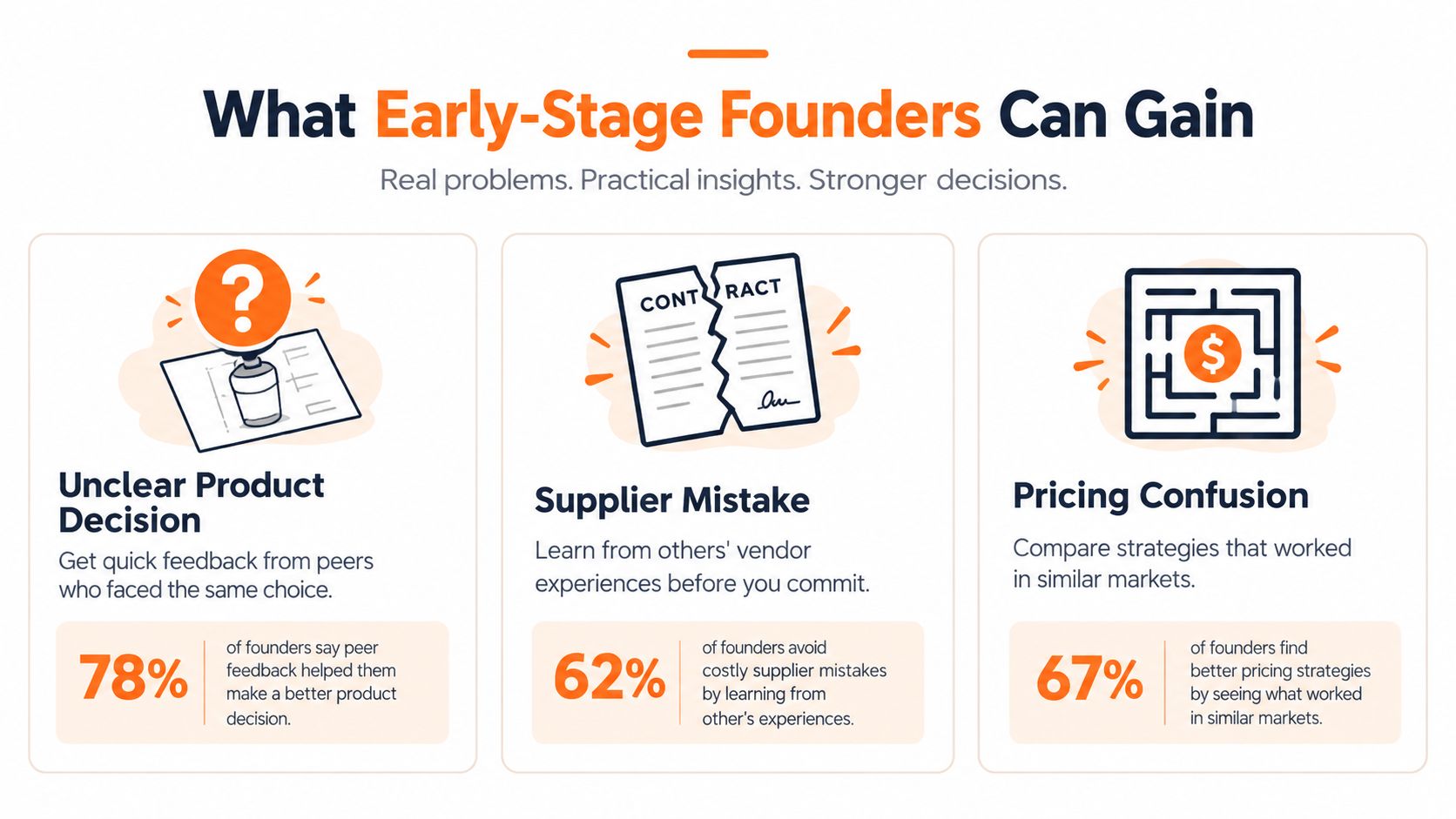
Start with a product decision. You're debating a new feature, but a peer asks what customers do without it. You realize you've collected opinions about the feature and little evidence about the underlying problem. You can now plan a more useful customer conversation.
The practical gains start with questions like these.
Use experience to improve your questions
For a supplier decision, you could ask another operator what they check in samples, purchase terms, or production updates. You still need to investigate your own vendor. Another founder's experience can help you notice what you haven't checked.
For pricing, explain your costs, customer, sales channel, and alternatives. A peer who sells through wholesale may reason differently from someone who sells directly online. You'll learn more by examining those differences than by copying a price.
A 2024 study of 278 small and medium-sized enterprises found positive associations between social networks and customer-perspective performance (β = 0.3585), and between support networks and customer perspective (β = 0.1728, p = 0.0133), as reported in the entrepreneurial-network study. Read those as statistical associations, not proof that joining a particular group will improve your business.
Keep responsibility for the decision
Nearby peers may help you arrange a supplier visit, find a regional referral, or meet someone who understands your distribution route. Treat each introduction as a possibility to investigate. You still need to check suitability, capacity, and terms.
When you need sustained guidance from someone with specific experience, consider how to find a business mentor. You can use peer conversations to identify the questions you'd want that mentor to help you answer.
Keep this decision filter in mind before exploring the video.
Advice gives you a hypothesis. Your customers, finances, and tests help you decide whether to act on it.
You can appreciate someone's generosity and reject their recommendation. You can also borrow the reasoning behind an answer without copying the action. That's how you keep peer support useful while retaining responsibility for your business.
How Different Founders Use Networks
You work full-time and want to launch a household product. A paid evening event promises a room of founders, while a free online discussion fits your Tuesday nights. The better choice depends on which format puts you in front of someone who understands your immediate problem, rather than someone who happens to run a more established company.
Your schedule, budget, and comfort in a room all belong in that decision.

Match the conversation to your work
Stage changes what a useful conversation looks like. At idea stage, you might need help turning a broad ambition into a customer question, and an asynchronous forum could let you compare approaches without arranging travel.
At pre-prototype stage, you might need someone who can challenge your materials, manufacturing assumptions, or testing plan. Look for relevant experience rather than a room full of founders who share your stage. At first revenue, you might need to diagnose returns, supplier reliability, or uneven margins, where a local operator could inspect a physical product and a specialist elsewhere might know the channel better.
Geography matters for physical products. For a Chicago-area option, Chicago Brandstarters runs free, private dinners for six to eight people every two weeks, with identity verification and confidentiality norms. Weigh that format alongside online groups and structured programs, then ask whether you can participate consistently.
Look beyond the introduction
An introduction starts a conversation. An ongoing exchange lets you return with results, explain what failed, and adjust your next attempt. A network works like a problem-solving system: its value sits in repeated contact and psychological safety, not in how many names you collect.
SCORE's analysis of survey responses from 20,000 small-business owners found that 43% of owners who met with a mentor at least five times reported growth, compared with 30% who had one mentoring interaction, according to its business-mentoring analysis. Those figures carry no promise about peer groups, but they support asking whether a format enables continued conversation.
- If you prefer preparation: Bring a written question and the context behind it.
- If crowds exhaust you: Try these approaches to networking as an introvert and look for smaller rooms.
- If you need milestones: Ask a program organizer how they review progress and handle missed goals.
You don't need to become more outgoing to choose a workable format. You need a format honest about its costs, its values, and the kind of conversation it produces.
Choose a Network That Fits Your Stage and Values
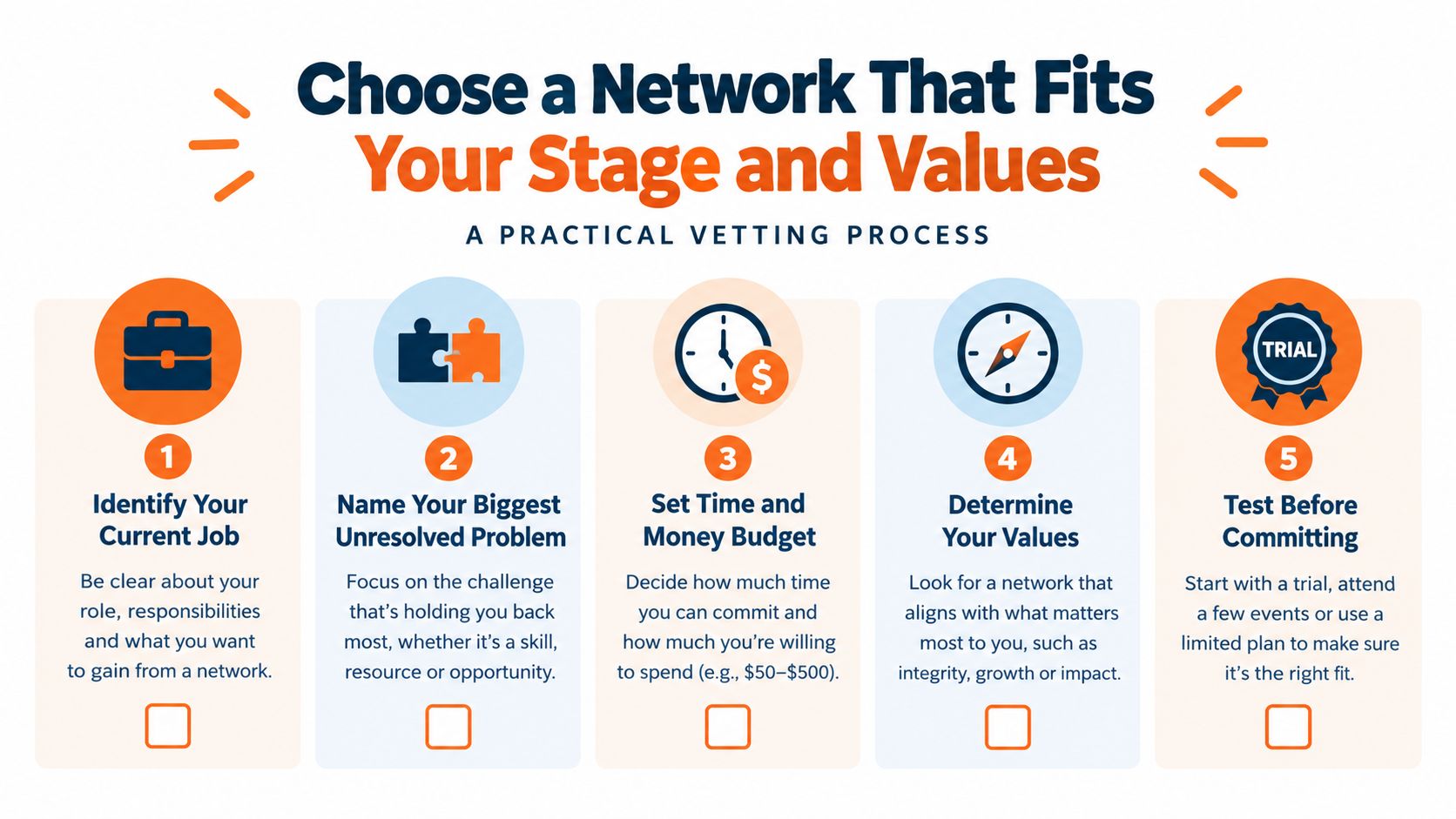
Write down the job you need help with before you evaluate a community. You might need to validate demand, understand manufacturing, or prepare for a first hire. “Meet successful people” gives you little basis for deciding whether a group helps.
Use this checklist to make your criteria concrete.
Set your boundaries first
- Name the unresolved problem: Describe the decision, what you've tried, and where you need another perspective.
- Budget for participation: Include fees, travel, meals, preparation, and time away from work or care responsibilities.
- Decide whether location matters: Separate work you can discuss remotely from work that needs nearby people or physical access.
- Define acceptable behavior: Decide how you feel about unsolicited messages, public storytelling, introductions, and sales follow-ups.
Access barriers deserve attention. A founder survey reported that more than 80% experienced isolation at least sometimes and that isolated founders were 50% more likely to postpone important decisions; respondents also cited time (52%), cost (41%), and caregiving responsibilities (36%) as barriers, according to Arabian Business's account of the survey.
Don't interpret those associations as a diagnosis of your situation. Use them as permission to take practical access limits seriously.
Vet behavior rather than status
Ask the organizer how they verify members, facilitate discussions, and respond to service-selling. Ask what confidentiality means in practice and what happens after someone ignores the rules. You're checking whether the organizer can describe actual boundaries.
Then ask a member about an ordinary meeting. Who gets time to speak? How do people respond when someone admits a mistake? Can you disagree without defending your status?
If you're organizing your own peer circle, explore how Bazzly helps founders build community while considering how you'll handle participation and moderation.
A useful test: Watch how people treat a founder who has little status and an unfinished idea.
Attend a trial session if possible. Ask a focused question, share a relevant lesson, and notice whether you feel pressure to buy, impress, or disclose more than you want.
Afterward, write down what you learned and what you'll do differently. Judge the exchange by that record, rather than by logos, attendance, or follower counts.
Build a Network That Gives Back
Choose your next action according to the work ahead. If you need nearby, hands-on discussion, test a small dinner or peer group. If you need scheduling flexibility, try a moderated online forum and arrange a follow-up conversation with someone relevant.
If you want a curriculum and explicit milestones, investigate an accelerator. Read the attendance and financing terms before applying. Give yourself permission to choose a different format when your needs change.
Make a contribution you can sustain
You don't need a successful exit to help another founder. You can explain how you compared suppliers, share the question that improved a customer interview, or describe an experiment that failed.
- Ask permission: Check before introducing people or sharing someone's story.
- Close the loop: Tell someone what you tried after their advice and what happened.
- Share the limits: Explain your business context so others don't mistake your experience for a universal rule.
- Respect a refusal: Let people decline requests without demanding an explanation.
Generosity doesn't require unlimited availability. State what you can help with and protect time for your own work.
Keep peer support within its limits
In a study of 242 entrepreneurs, 72% reported mental-health concerns, and entrepreneurs were about twice as likely to experience depression as the comparison group, according to this account of the entrepreneur mental-health research. Those findings don't establish that a dinner or group chat prevents mental-health problems.
You can seek honest company from peers while seeking professional care when you need it. Don't ask a founder network to carry responsibilities beyond its abilities.
For now, choose a relevant session, prepare a specific question, and bring something you can share. After participating, ask yourself whether you gained clarity, respected your boundaries, and helped someone else. Reassess that fit as you move from an idea to first revenue and beyond.
Chicago Brandstarters has a free, vetted community where Chicago and Midwest builders can discuss operating problems through private dinners and a group chat. Visit Chicago Brandstarters to explore the format and decide whether you'd like to bring your next question to the table.
Leave a Reply