

You've checked the orders, answered supplier messages, watched an ad campaign spend money, and still don't know whether the next decision will move the business forward. You search for another tactic, join another online group, or attend another event, yet the hard questions remain yours alone.
That's the gap between collecting contacts and building a network. Networking and e commerce work best when relationships help you make better decisions, reach the right partners, and recover faster from mistakes. For most founders, a small circle of trusted operators creates more practical value than a long list of loose connections.
The Lonely Founder Problem in Ecommerce
At midnight, a solo founder can face five unrelated problems at once. A shipment sits in customs, a supplier changes terms, a product page converts poorly, an ad account loses efficiency, and a customer asks for a refund. Every problem feels urgent because no one else owns the decision.
You can learn the mechanics of starting an online store through resources such as this guide to starting an ecommerce business, but information doesn't replace judgment. A checklist can tell you to compare suppliers. It can't tell you whether a low quote hides weak quality control, slow communication, or an unreliable production schedule.

Isolation makes ordinary problems expensive
A founder without trusted peers often repeats mistakes that another operator could have identified in a short conversation. They may select a supplier without checking production samples, spend on ads before fixing the offer, or treat a cash-flow squeeze as a sales problem when the core issue sits in purchasing terms.
One experienced peer can change the quality of that conversation. They might ask for the purchase order, return data, contribution margin, or delivery promise before offering an opinion. That question can save days of speculation.
Practical rule: Find people who will ask for the uncomfortable detail, not people who only praise the idea.
You don't need a large circle at the beginning. You need one manufacturer who explains trade-offs clearly, one marketer who understands acquisition economics, and one founder who can discuss mistakes without turning the conversation into a sales pitch. Those relationships give you context when the next problem arrives.
Build contact before you need rescue
Networking works better before a crisis. Share what you're testing, ask precise questions, and follow up after you act on someone's advice. People remember founders who close the loop.
A trusted connection doesn't remove uncertainty. It gives you a place to process uncertainty with someone who understands the operating reality. That support can turn a lonely decision into a measured one.
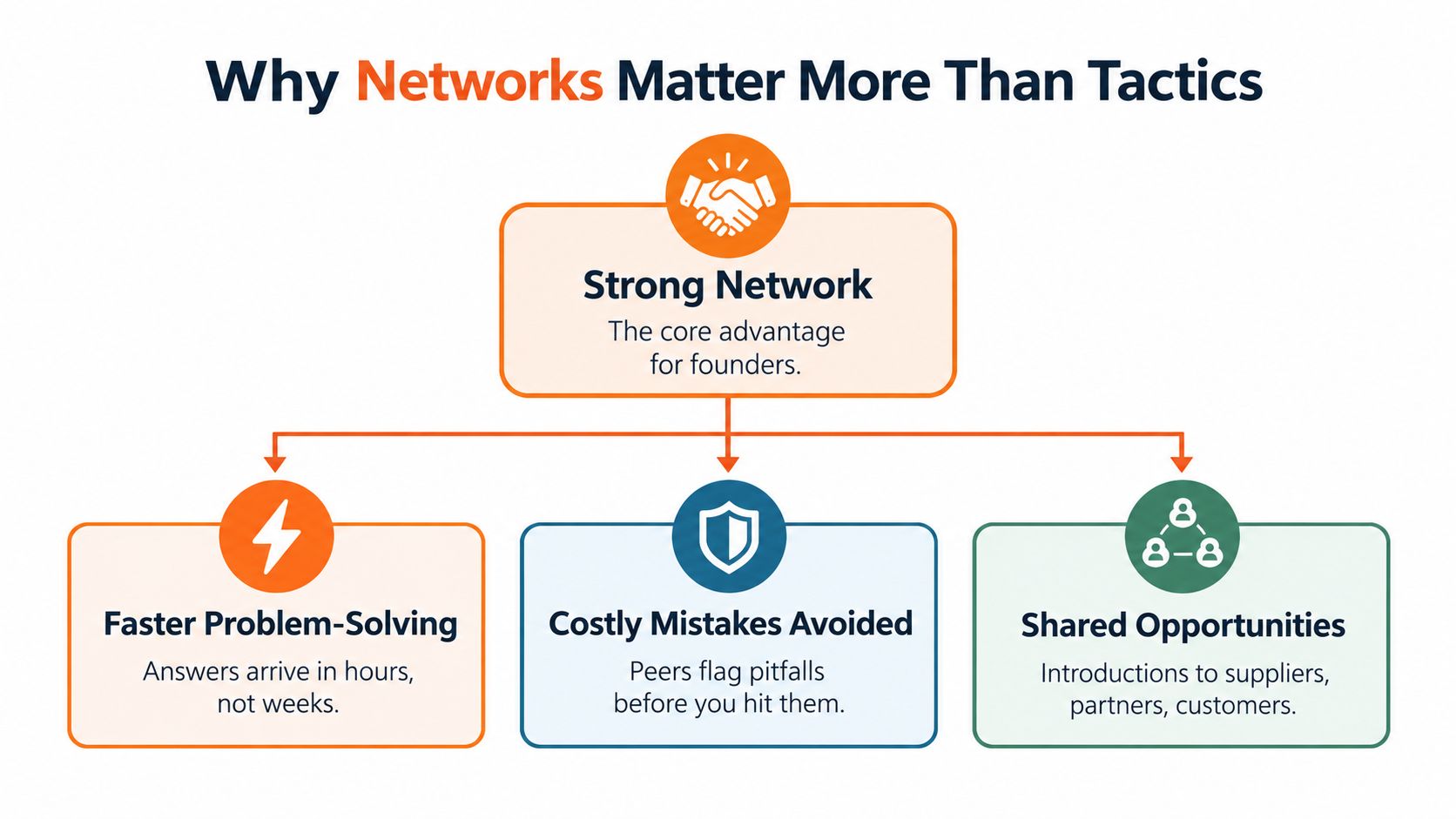
Why Networks Matter More Than Tactics
A tactic tells you what to try. A useful network helps you decide whether the tactic fits your store, category, margin, and stage.
Global retail ecommerce reached roughly $6.3 trillion in 2024, according to the Forbes Advisor ecommerce statistics summary. That scale creates more suppliers, agencies, platforms, marketplaces, and specialist operators. It also creates more noise. You can find advice for almost every problem, but you still need someone who can separate a useful recommendation from a fashionable distraction.
Relationships shorten the learning loop
Suppose your checkout has a payment failure problem. A search engine may give you ten possible fixes. A payments operator can ask which processor you use, where customers live, what the decline message says, and whether the issue affects mobile buyers. That exchange narrows the problem before you change anything.
The same pattern applies to inventory, returns, creative testing, marketplace rules, and supplier negotiations. A person with relevant experience can identify the next useful question faster than a general tactic can.
The internet grew from early research networks into commercial infrastructure that now connects billions of people. One summary estimates 5.3 billion internet users worldwide in 2023, 66% penetration, 5.1 billion mobile subscribers, and 99% global mobile network coverage. Those figures appear in the Worldmetrics global ecommerce statistics overview. Your customers, suppliers, and peers can operate across borders, but reach alone doesn't create trust.
Use the firewall analogy
PCI DSS gives ecommerce teams a useful networking metaphor. The BigCommerce PCI compliance guide says network firewalls should allow only needed traffic into the cardholder-data environment, keep a “deny all” rule for other inbound and outbound traffic, and document each approved port or protocol with its business reason.
Apply that logic to your relationships:
- Allow useful access: Spend time with people connected to your current operating problems.
- Deny noise: Reduce conversations that exist only for pitching, self-promotion, or vague motivation.
- Document the reason: Know what you want to learn, test, share, or build with each connection.
A network creates advantage when it improves your decisions. A contact list creates administration.
Types of Connections That Move Your Business Forward
Different relationships solve different ecommerce problems. Treating every contact as interchangeable leads to shallow conversations and poor timing.
| Connection | What they help you decide | What you should bring |
|---|---|---|
| Manufacturer or supplier | Product quality, minimum orders, lead times, packaging, and terms | A clear product brief and specific constraints |
| Marketer or growth operator | Customer acquisition, creative testing, landing pages, and channel fit | Actual campaign context and a willingness to share results |
| Mentor | Sequencing, judgment, hiring, and founder habits | A focused question rather than a general request |
| Peer founder | Cash flow, returns, customer support, tools, and accountability | Honest details and useful lessons from your own work |
| Platform specialist | Marketplace rules, catalog structure, fulfillment, and policy risks | Questions tied to one platform and one current decision |
A supplier relationship needs precision. Ask about inspection, defect handling, production updates, and what happens when demand changes. A marketer needs commercial context. Share the offer, audience, margin structure, and customer objections instead of asking for a generic growth plan.
Choose the right relationship for the problem
Mentors can help you avoid a poor sequence, such as hiring before you understand the process or expanding the catalog before the first product works. Peers can give you something mentors often can't: a current operator's view of the messy middle. They know what it feels like to chase a delayed shipment while answering customers and watching cash leave the account.
Platform specialists can help when your problem depends on rules that change by channel. A marketplace seller, for example, may need advice about listing restrictions or fulfillment standards that a direct-to-consumer founder won't know.
Replace connect-and-pitch with exchange
Modern social selling relies less on sending a connection request followed by a pitch. Coverage of social selling in 2025 describes a model built around value exchange, private communities, and steady participation across LinkedIn, Slack, Discord, newsletters, and TikTok.
That doesn't mean you need to post everywhere. Choose the places where the right operators answer real questions. Contribute a supplier lesson, review a landing page, share a useful template, or introduce two people who can help each other. Trust grows when people see your judgment over time.
Practical Networking Tactics for Ecommerce Builders
Start with a narrow problem, not a broad ambition. “I want to grow my brand” gives someone nothing useful to answer. “My repeat customers buy once, and I'm trying to understand whether the issue sits in the product, the offer, or the follow-up sequence” creates a real conversation.
Build a small operating room
Invite a few founders with related but non-competing businesses into a recurring private call or dinner. Give each person a fixed amount of time to describe one problem, the evidence behind it, and the decision they need to make. Ask the group to challenge assumptions before suggesting solutions.
A useful meeting ends with an action and an owner. Write down the commitment, send it to the group, and report back at the next meeting. That simple rhythm separates an operating group from a chat room full of links.
Use networking for businesses as a starting point if you want ideas for creating more deliberate business relationships. The format matters less than the discipline. People need repeated contact, confidentiality, and enough structure to move from storytelling to decisions.
Use a value-first outreach note
A strong message has three parts:
- Context: Explain why you chose that person.
- Specific question: Ask about one decision, not their entire career.
- Useful return: Offer a relevant observation, introduction, or resource.
For example, you might write, “I saw that you moved from wholesale into direct sales. I'm comparing fulfillment options for a small product line and would value your view on the trade-off. I can share the returns workflow we built if that helps.”
If short-form video matters to your channel, a practical resource on how to create product videos for TikTok can support a conversation with a creative partner or another seller. Send resources because they solve a stated problem, not because you want to fill the thread.
After a conversation, record the person's expertise, current project, and next follow-up date. Then send a brief update when you use their advice.
Here's a short filter for deciding whether to accept a networking opportunity:
- Relevance: Do the people understand your category, stage, or operating problem?
- Reciprocity: Can you contribute something useful, even if you can't buy anything?
- Repeat contact: Will you see these people again in a setting where trust can grow?
- Practical outcome: Can the conversation produce a decision, introduction, or test?
If the answer stays vague, skip the event.
Real Examples of High-Value Interactions
A founder once described a supplier problem to a peer group instead of asking for a referral. The founder wanted to know whether to accept a lower unit cost from a new factory. One member asked about inspection access and packaging tolerances. Another suggested visiting the facility before changing suppliers. The conversation produced a factory introduction and a better sourcing question.
That kind of result comes from context. A generic event may produce a supplier's business card. A trusted group gives you a place to test the decision before you sign.
Small conversations create practical leverage
A peer who has already faced a cash-flow squeeze can spot the difference between weak demand and bad payment timing. They may suggest renegotiating terms, changing purchase quantities, or separating inventory decisions from advertising decisions. You still choose the action, but you stop guessing in isolation.
Marketing feedback works the same way. Share the product page, the promise, and the customer comments. A direct response from another operator can reveal that your creative attracts attention while your page answers the wrong question. That feedback can prevent you from spending more money on the same mistake.
The best interaction often feels ordinary. Someone asks for the document you avoided sharing, identifies the assumption behind your plan, and tells you where their own approach failed.
Match the room to the channel
Ecommerce audiences now split across LinkedIn, podcasts, Instagram Reels, TikTok, newsletters, and private groups. Reach on one channel doesn't prove that the relationships will continue after the post disappears.
Use public platforms to find people. Use smaller rooms to understand them. A category-specific group for marketplace sellers may produce better advice than a broad founder gathering because members face similar catalog, fulfillment, and policy decisions.
A themed lounge at a large event can help you find the right people, but the value starts after the introduction. Ask for a follow-up conversation, bring a concrete question, and share what happened after you acted. That sequence turns visibility into a working relationship.
Why Small Private Groups Beat Large Networking Events
Many founders measure networking by attendance, badges collected, or new contacts. Those numbers say little about whether anyone will answer when a shipment goes missing or a payment dispute threatens cash flow.
Merchants reported win rates below 20% on fraud-coded chargebacks and disputes, according to the Merchant Risk Council's 2024 Global Payments and Fraud Report. A transactional approach to business relationships creates a similar weakness. You may know many people, but few will understand your records, constraints, or decision history well enough to help.
Compare the formats
| Volume event | Private peer group |
|---|---|
| Many short introductions | Fewer recurring conversations |
| Broad topics | A defined operating problem |
| Easy to pitch | Social pressure to contribute |
| Contact exchange | Follow-up and accountability |
| Public performance | Confidential discussion |
| Unclear fit | Vetted or category-relevant members |
Large events still have a place. They can expose you to suppliers, platforms, investors, and ideas outside your normal circle. They work poorly as your only networking method because a crowded room rewards speed and self-presentation, while ecommerce decisions need detail.
Trust changes the quality of information
Founders rarely share a failed ad test, a supplier dispute, or a cash shortage with someone they met five minutes ago. They share those details after repeated interactions prove that the room won't turn vulnerability into a sales opportunity.
That trust produces better questions. Members can challenge a plan because they know the founder's history and care about the outcome. The group can also notice patterns that a one-off conversation misses.
You can still use resources that list founder networking events UAE 2026 or similar gatherings to find relevant rooms. Choose events by the people you need, then create a follow-up structure that continues after the event.
For founders who dislike transactional introductions, a business networking group can provide a more consistent setting. The test remains simple: do members show up, share specifics, and help each other make decisions?
How to Build a Network That Actually Helps You Grow
Start by defining the support you need in the next stage. You may need sourcing judgment, customer acquisition feedback, marketplace experience, cash-flow perspective, or emotional support during a difficult launch. Write those needs down before you join a community, because vague goals attract vague relationships.
Then inspect the room before you commit. Ask who attends, how often members meet, whether identity checks exist, and what happens after introductions. A community that lets anyone pitch everyone may create activity without trust.
Use structure to create trust
Chicago Brandstarters uses small private dinner events every two weeks, with 6 to 8 people in each group, plus an active confidential group chat. Members share tactics, difficult moments, and operator stories rather than presenting polished success narratives. The community uses identity verification and LinkedIn vetting to keep out self-promoters and service-sellers.
That structure matters because repetition creates memory. You remember the founder dealing with a supplier problem, the marketer testing a new offer, and the operator who helped you think through a difficult customer issue. The next conversation starts with context instead of introductions.
Confidentiality also changes what people say. Founders can discuss weak numbers, bad hires, delayed orders, or failed experiments without turning the discussion into public content. The room becomes a working space rather than a stage.
Create your own version if no group fits
You can build a similar circle with people you trust. Invite founders at nearby stages, avoid direct sales pressure, and agree on simple rules:
- Bring one real problem: Explain what happened and what decision sits in front of you.
- Share evidence: Use customer messages, order patterns, supplier terms, or campaign notes where appropriate.
- Give direct feedback: Ask permission to challenge assumptions, then speak plainly.
- Close the loop: Report what you tried and what changed.
- Protect confidence: Keep private business details inside the group.
A useful network won't solve every problem for you. It will help you frame the problem, find the right specialist, and avoid repeating an error someone else already paid to learn.
Invest time in relationships before you need an introduction. Send the update, make the referral, attend the recurring meeting, and answer the difficult question. Those small actions create the trust that makes networking and e commerce practical rather than performative.
Chicago Brandstarters gives kind, hardworking founders access to private peer dinners every two weeks and a confidential group chat for practical ecommerce and business support. Visit Chicago Brandstarters to find a vetted community where you can trade honest advice, solve current problems, and build relationships that continue beyond a single event.
Leave a Reply