You launch the product, publish a few posts, check the analytics, and find silence. Then you decide marketing “didn't work,” even though you never gave the work a clear audience, promise, channel, or review cycle.
The fix starts with the marketing strategy basics. You need a small set of decisions that you repeat each week, not a slide deck that nobody opens after the planning meeting.
What a Marketing Strategy Actually Is
A marketing strategy is a repeated set of choices about who you serve, what you offer, how you reach people, and how you know the work is paying off. That definition keeps your attention on decisions rather than activity.
Every strategy must answer three questions:
- Who exactly is this for?
- What makes your offer the obvious pick?
- Where will you show up consistently?
If you can't answer those questions in plain language, more posting won't rescue the plan. You need a specific buyer, a reason for that buyer to care, and a place where you can reach them often enough to earn attention.
Strategy is not a channel list
A strategy isn't “LinkedIn, Instagram, email, SEO, paid ads, and podcasts.” That list describes possible tools. It doesn't tell you which buyer each tool reaches, what you should say, or what action should follow.
A strategy also isn't a mission statement. Your mission may guide the company, but it won't tell you whether to sell a starter package or a premium service this week. It won't tell you whether your buyer needs a comparison page, a product demo, or a sample.
The classic framework still helps because E. Jerome McCarthy organized controllable marketing decisions into Product, Price, Place, and Promotion in 1960. Neil Borden had described a wider marketing mix before McCarthy's version reduced the planning problem to four practical levers, as this history of the marketing mix and the four Ps explains.
Practical rule: If your plan can't survive a bad week, a small budget, and a tired founder, you don't have a strategy yet.
Write your answers on one page. Review them every Monday before you choose a topic, launch an ad, or change a headline. Your job isn't to create endless activity. Your job is to keep making the same useful choices until the market gives you evidence that one choice needs to change.
Your website also has to communicate those choices to people and discovery systems. Use these AI website interpretation tips to check whether your pages state the audience, offer, proof, and next action clearly enough for modern search experiences.
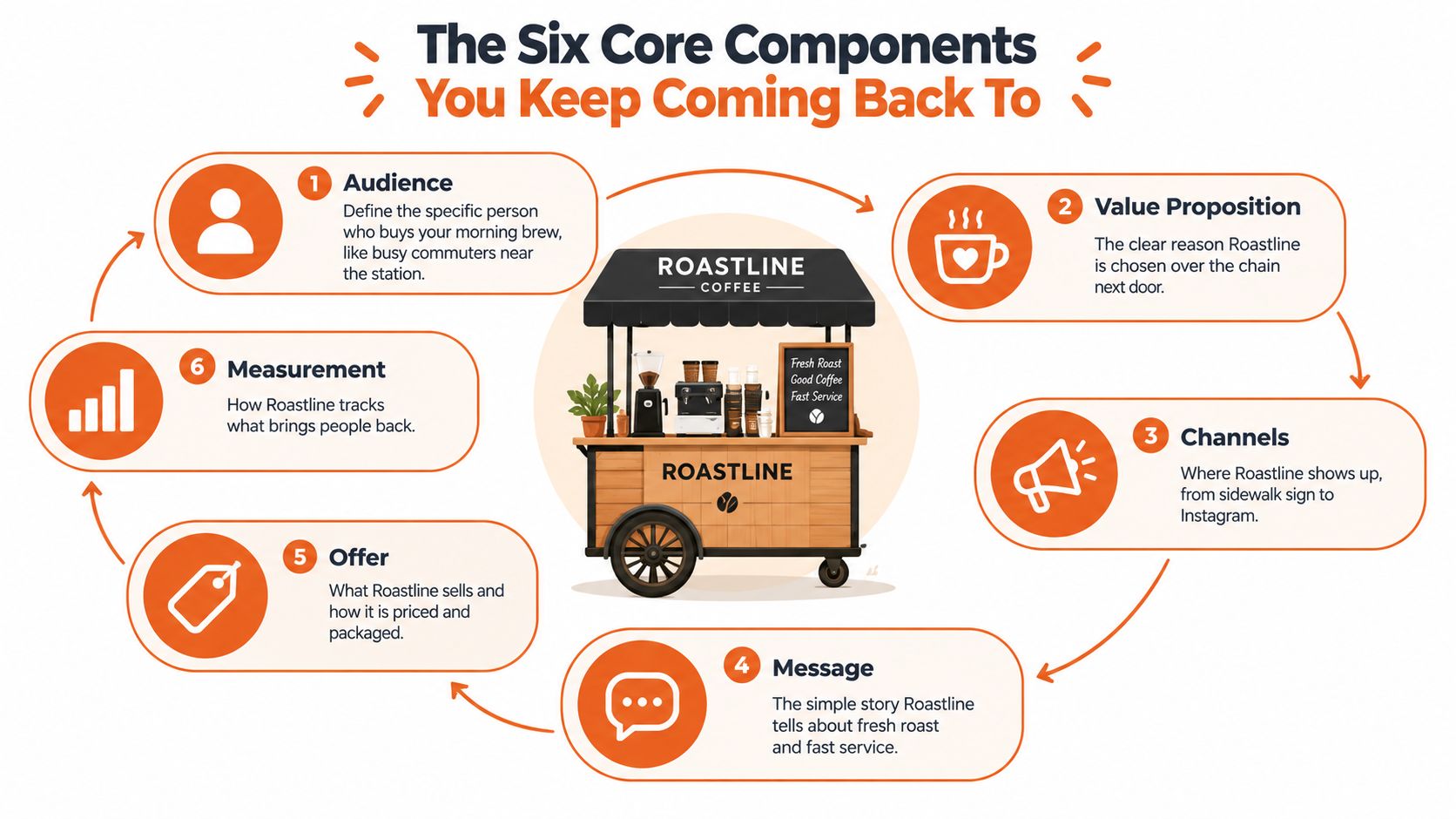
The Six Core Components You Keep Coming Back To
Take a coffee cart called Roastline. The cart doesn't need a giant plan. It needs six connected decisions that guide the sign on the sidewalk, the Instagram post, the morning offer, and the way the owner reviews sales.
Audience
Roastline shouldn't target “coffee lovers.” That phrase includes almost everyone and helps the owner choose nobody.
A better audience might be people walking from the train station to the nearby office park who want a fast, better-tasting morning drink. That description gives Roastline a location, a moment, a need, and a buying context.
Positioning
Positioning explains why a buyer should choose you instead of the closest alternative. Roastline might position itself as the fast specialty coffee cart for commuters who want a fresh pour-over without a café queue.
The sentence draws a boundary. Roastline doesn't need to beat every coffee business. It needs to win against the chain next door for a particular morning customer.
Value proposition
The value proposition turns positioning into a concrete promise: single-origin pour-overs in under 90 seconds.
The promise combines product quality with speed. If Roastline can't deliver both, the founder needs to change the offer rather than write more persuasive copy.
Channels
Roastline should use places where its audience already spends time. That could mean a sidewalk sign near the station, a partnership with the office park, and Instagram posts that show the morning menu.
You don't need every social network. You need a small channel mix that gives the right people repeated exposure and gives you a way to capture interest. For a broader view of coordinated customer touchpoints, review this guide to an omnichannel marketing strategy.
Messaging
The founder needs a few phrases that work during a busy morning:
- Fresh roast: “Today's beans came from a single origin.”
- Fast service: “You'll have your pour-over before you reach the office.”
- Clear choice: “Specialty coffee without the café wait.”
Good messaging sounds like something a founder can say while serving a customer. If the message needs a paragraph of explanation, simplify the offer.
Measurement
Roastline can track cups sold each morning, repeat buyers, and sales by offer. Those numbers connect activity to customer behavior more directly than follower counts.
Each component should change only when evidence gives you a reason. You can use the same six decisions for a new pastry, a seasonal drink, a second cart, or a local partnership. Think of them as a control panel, not a checklist you complete once.
Run the same review every week. Ask whether the audience still looks right, whether the promise still feels specific, whether the channel reaches that audience, and whether the measurement shows healthy behavior. Then make one change instead of five.
A video can help you see how the pieces fit together:
Two Simple Frameworks You Can Steal
You don't need a complex model at the start. Pick the framework that matches your stage and use it until your answers become clear.
Framework A
Audience, Message, Channel works when you're pre-launch or still searching for early traction.
For Roastline:
- Audience: commuters walking from the station to the office park.
- Message: specialty pour-over coffee, ready fast.
- Channel: the station sidewalk, office partnerships, and Instagram.
This model forces a useful sequence. You name the person first, write the promise second, and select the place to communicate third. That order prevents you from choosing a channel because another founder talks about it.
Framework B
Segment, Target, Position, Offer works better once you have early revenue and can separate real customer groups.
Roastline might find three segments: commuters, office managers ordering group coffee, and weekend market visitors. The owner can target commuters, position Roastline around speed and quality, and create an offer that bundles a pour-over with a pastry.
Use Framework A for the first 60 days, then move to Framework B once repeat customers appear and you can name real segments from observed buying behavior. The first model helps you get a message into the world. The second helps you decide where to narrow.
| Framework | Framework A: Audience–Message–Channel | Framework B: STP + Offer |
|---|---|---|
| Best stage | Pre-launch and early traction | Early revenue with clearer customer groups |
| Main job | Create a focused first message | Sharpen the target and package the sale |
| Roastline example | Commuters, fast pour-over, station sign | Commuters, speed positioning, coffee and pastry bundle |
| Main risk | Choosing a vague audience | Splitting attention across too many segments |
If you plan to spend on ads, make the framework do the work before you touch the platform. This guide to building a winning paid media plan can help you turn a defined audience and offer into a paid test. For a concise planning document, use a one-page marketing plan that keeps the decisions visible.
Start with one framework. Don't blend both into a planning maze.
Mini-Plans for Two Early-Stage Brands
The same marketing strategy basics look different in software and ecommerce. The structure stays stable, while the buyer, proof, and activation event change.
Productivity SaaS
This SaaS brand has $2k MRR and sells to independent designers who still manage project work in spreadsheets. Its position isn't “better productivity.” It replaces a familiar but awkward spreadsheet workflow.
The promise is simple: save one hour each week by keeping project status, deadlines, and client updates in one place. The founder uses LinkedIn to share practical workflow lessons and builds one SEO cluster around project management for indie designers. The founder doesn't add every social network.
The messaging should use the buyer's language: “Stop rebuilding the same project tracker,” and “See what needs attention before a client asks.” The activation event is a new customer completing a first project setup and inviting the workflow into regular use.
Skincare ecommerce
This label has $8k monthly revenue and targets sensitive-skin buyers in their 30s. It positions itself as the clean-ingredient option for people who want a short, disclosed formula rather than a shelf full of vague promises.
The offer centers on three disclosed actives and a clear routine. Instagram Reels can demonstrate texture and application, while a niche newsletter can explain ingredient choices in more depth. The phrase “dermatologist-quiet results” gives the brand a calm way to describe the desired experience without making a medical claim.
The activation event is a second purchase. The founder should track repeat purchase behavior and CAC by channel, then compare those figures with the cost of producing each channel's content.
| Component | SaaS Brand ($2k MRR) | Skincare Ecommerce ($8k/mo) |
|---|---|---|
| Audience | Independent designers using spreadsheets | Sensitive-skin buyers in their 30s |
| Positioning | A focused replacement for spreadsheet project tracking | Clean-ingredient care with disclosed actives |
| Value proposition | Save one hour weekly through a simpler workflow | Build a quiet routine around three disclosed actives |
| Channels | Founder-led LinkedIn and one SEO cluster | Instagram Reels and a niche newsletter |
| Messaging | Stop rebuilding trackers, see work before clients ask | Clear ingredients, calm routine, quiet results |
| Weekly habit | Review signups, setup behavior, and sales conversations | Review content response, orders, and repeat buying |
| Number watched | Free-to-paid conversion | Repeat-purchase rate and CAC by channel |
| Assumption under test | Designers will pay to replace spreadsheets | Sensitive-skin buyers will return for the routine |
The weekly habit matters more than the plan's polish. Every Monday, each founder should write the assumption under test, record what happened, and choose the next small adjustment.
Common Traps That Break Good Strategies
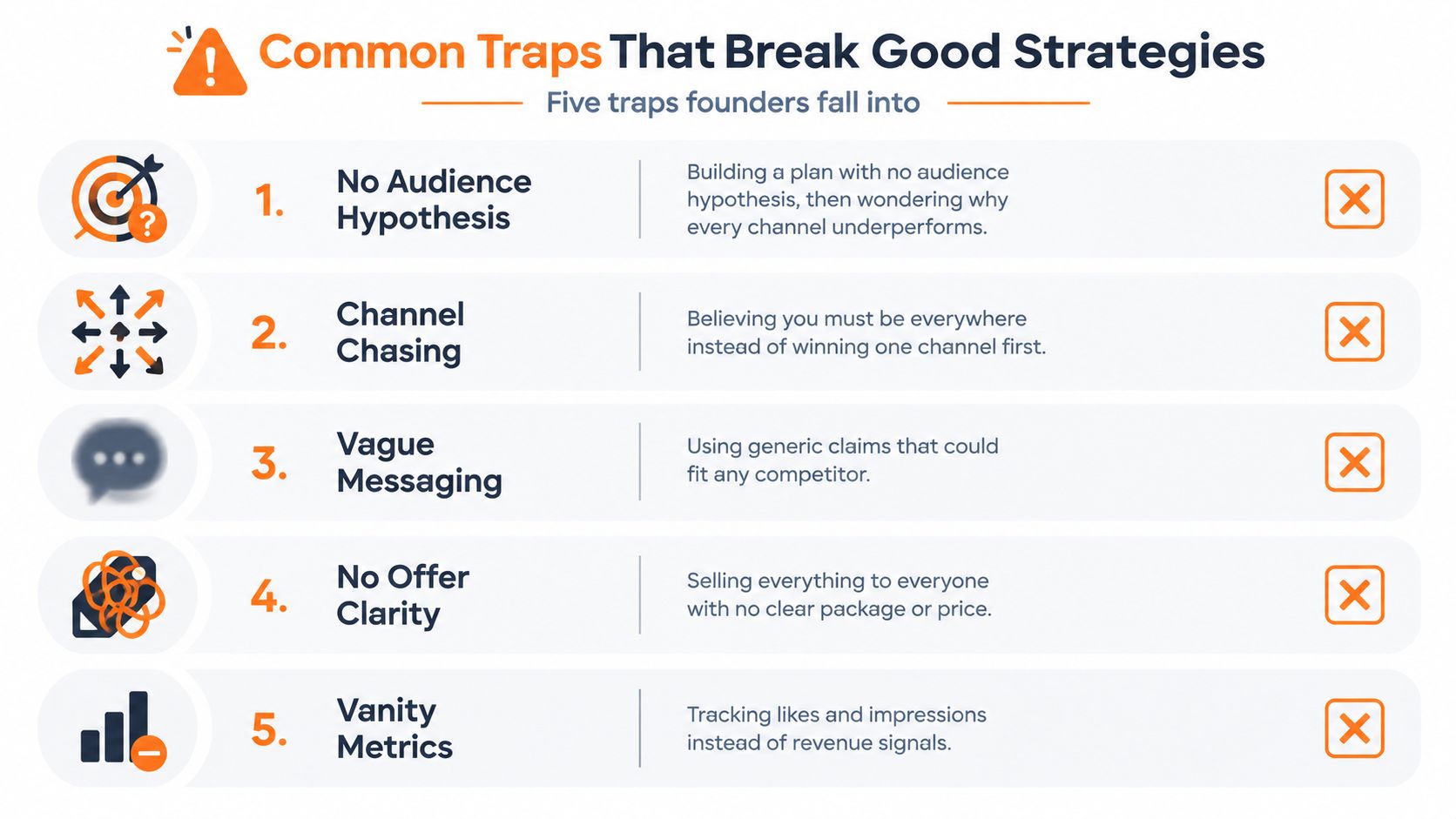
Founders rarely fail because they lack channel ideas. They fail because they make the wrong decision before they choose the channel.
The five traps
No audience hypothesis: The wrong belief says you can pick channels before you pick people. Correction: Lock the ideal customer profile first, then test where that person already spends attention.
Competitor channel copying: The wrong belief says a competitor's channel mix transfers to your product. Correction: Treat the competitor as a source of questions, then test the places your buyer already uses.
Vanity measurement: The wrong belief says reach proves demand. Correction: Choose one qualified action that connects attention to revenue, such as a paid signup, booked call, or repeat order.
Constant plan rewriting: The wrong belief says motion equals progress. Correction: Commit to a 90-day direction and use midpoint reviews to adjust execution without changing the whole strategy.
Offer avoidance: The wrong belief says weak results always come from weak messaging. Correction: Clarify what the buyer gets, how the package works, and why the price makes sense before rewriting the headline.
A vague offer creates a copy problem you can't solve with clever language. If your buyer can't tell what they receive, who it's for, or what happens next, your page asks them to do too much interpretation.
Small businesses often prioritize marketing while struggling to judge its results. One summary reports that 47% of small businesses name marketing as their primary growth strategy, while 73% aren't sure their current strategy works. The same summary says the U.S. Small Business Administration recommends spending 7–8% of gross revenue on marketing. Review the small business marketing statistics and planning guidance before you set a budget.
Measuring What Matters in the First 90 Days
Start with three numbers. A crowded dashboard can hide the decision you need to make, while three useful measures can tell you whether your offer attracts, activates, and retains customers.
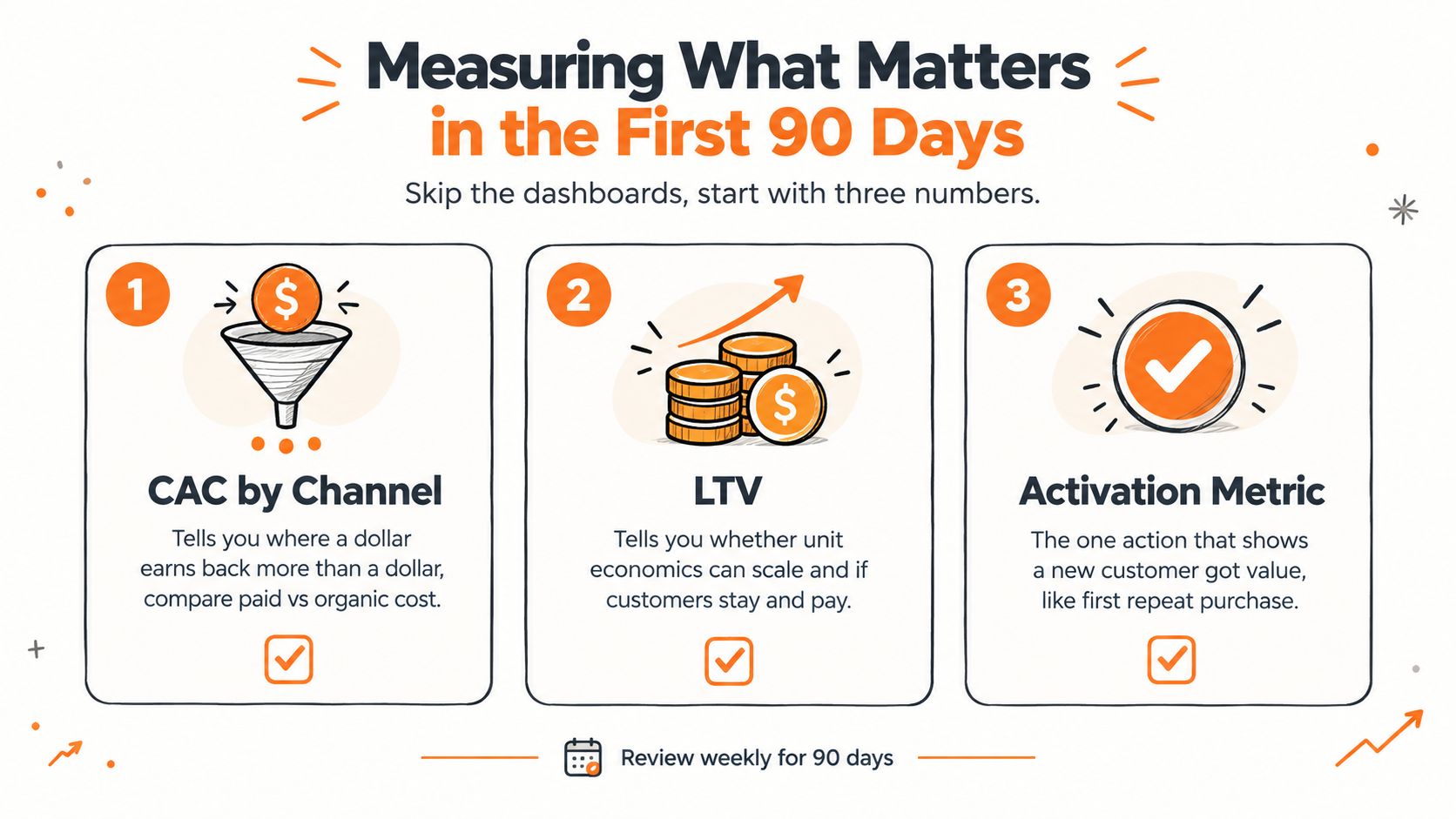
CAC by channel
Customer acquisition cost equals total sales and marketing spend divided by new customers acquired. Calculate it separately for each channel when you can. That distinction tells you whether paid social, founder-led content, search, referrals, or partnerships produce customers at a cost your business can carry.
A commonly cited efficiency target is an LTV:CAC ratio of at least 3:1, meaning a customer should generate at least three times the acquisition cost over the customer's lifetime. See this explanation of customer acquisition KPIs and CAC efficiency for the formula and context.
LTV
Lifetime value estimates the revenue or gross profit a customer generates across the relationship. Keep the first version simple. Use actual order or subscription behavior, state your assumptions, and update the estimate as more customers return.
Activation
Activation is the action that shows a new customer received value. For SaaS, it might mean completing the first useful workflow. For ecommerce, it might mean a second purchase. For Roastline, it could mean returning for another morning order.
Review the same figures every Monday for 30 minutes. Use three columns:
- What ran: Record the campaign, post, email, offer, or sales action.
- What happened: Add spend, new customers, activation behavior, and revenue signals.
- What changes Tuesday: Choose one adjustment and assign the owner.
Use this marketing budget allocation framework to connect your review to spending decisions. You don't need a new tool for this ritual. A spreadsheet works if you update it consistently.
Scaling Beyond First Revenue and What Comes Next
First revenue proves that someone will pay. It doesn't prove that your process can produce customers repeatedly without exhausting the founder.
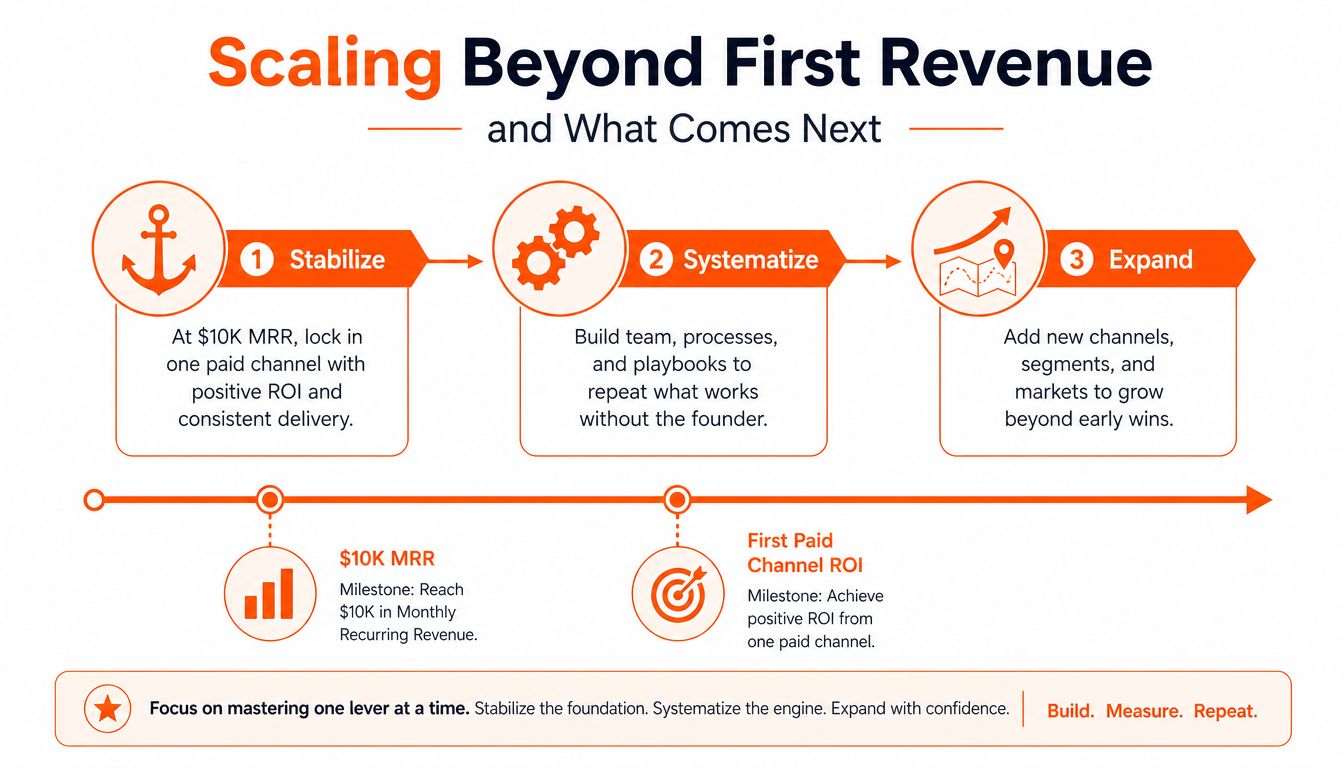
Use three stages.
Stabilize
At $10K MRR, lock the message, document the sales path, and keep the paid channel that produces positive ROI. Don't add a second channel because the first one feels boring. Make delivery consistent and record the questions buyers ask.
Systematize
Once one route works, turn the founder's habits into a playbook. A fractional CMO can organize the strategy, a content lead can run the editorial system, and a growth marketer can manage experiments. Hire for the bottleneck you can name, not for an impressive org chart.
Your 30-day checklist should lock the message and write down the steps. Your 60-day checklist should assign ownership and document the channel process. Your 90-day checklist should measure the gap between current revenue and the next tier.
Expand
Add channels only after you understand what makes the first channel work. SEO and lifecycle email can compound over time because useful pages and customer follow-up can keep working beyond one campaign. Paid acquisition can help you test demand faster, but it needs a clear offer and a tracked CAC.
A community can support this path when customers share language, use cases, and referrals. Their feedback can sharpen positioning, while advocacy can lower the amount of paid attention you need to buy. Build the feedback loop deliberately. Ask what changed, what nearly stopped the purchase, and what customers tell friends.
Chicago Brandstarters gives Chicago and Midwestern founders a free, vetted community with private dinner events and a group chat for sharing practical business problems, tactics, and support. If you want peers who understand the messy work behind first revenue, visit Chicago Brandstarters and see whether the community fits your next stage.
Leave a Reply