
You can make sales, pay bills, and still feel like the money is slipping through your hands. I've lived that version of founder life. The invoices go out, the card gets swiped, the bank balance looks fine for a day, and then one payment lands late or one tax bill hits and the whole picture turns fuzzy.
That's where financial literacy for entrepreneurs starts, at the point where you stop guessing and start reading your business like a machine with a dashboard. I don't mean a pile of jargon or a finance degree. I mean a set of habits that help you see cash, profit, debt, and runway before they surprise you.
Why Most Founders Feel Lost in Their Own Numbers
A lot of founders think they have a money problem. Usually, they have a translation problem.
You can be smart, disciplined, and still stare at your books like they're written in another language. That happens because nobody taught you to read your own business the way a mechanic reads an engine. You don't need to memorize every term on day one. You need to know what the numbers are trying to tell you, and you need to act on that signal fast.
I've watched founders confuse activity with control. Money comes in, money goes out, and the only check they do is the bank balance when stress kicks in. That's not a system. That's a coin toss with extra steps.
Practical rule: if you can't explain where cash came from, where it went, and what it has to do next, your business is driving with part of the dashboard covered.
The fix starts with a mental reset. Financial literacy is an operating skill, not a personality trait. It's closer to learning the controls on a commercial kitchen than learning a vocabulary list. You don't need every term before you can cook. You need to know which knob changes heat, which gauge warns you early, and which alert means stop now.
One useful place to start is a simple resource like stretch cash with startup credits. Use it as a planning aid, not as a substitute for understanding your own numbers. If you want a plain-language companion while you learn the basics of your statements, the guide on how to read a balance sheet is a practical next step.
The rest of this article works like a curriculum, not a glossary dump. I'm going to move in the order I'd teach a first-time operator, because that's how people learn finance. Start with the few concepts that change decisions, then set up your books, then build habits that stick.
The Five Core Concepts Every Operator Must Own
If you learn finance the way I did, you eventually stop asking, “What does this term mean?” and start asking, “What decision does this help me make?” That shift matters.
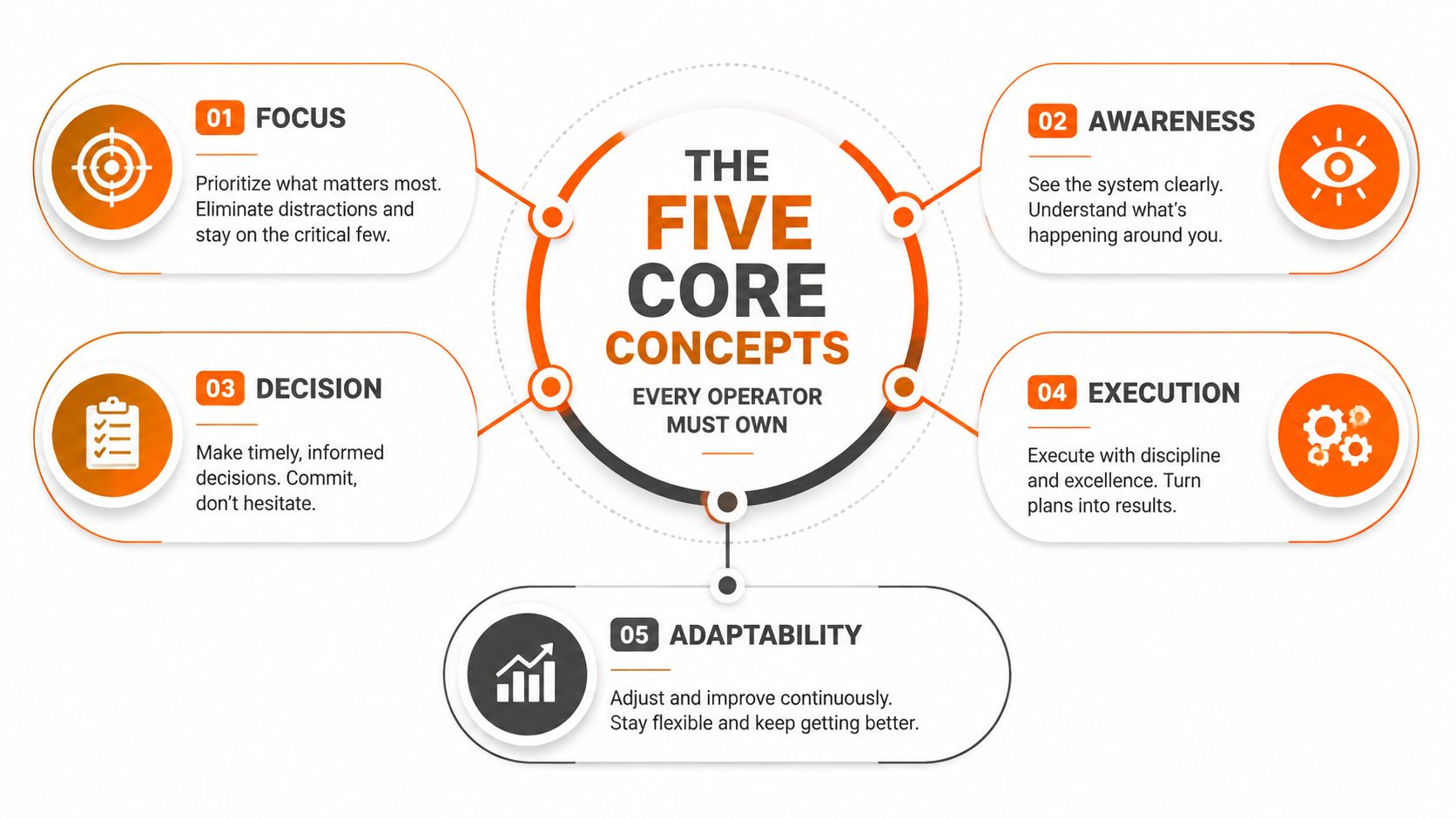
Think of your business like a car. Cash flow is the fuel gauge. Profit and loss is the mileage log. Balance sheet is the snapshot of what you own and owe right now. Unit economics is the cost of each mile. Runway is how far you can go before the tank runs dry.
Cash flow tells you if you can keep moving
Cash flow is money in and money out over time. It answers a simple question, do I have enough cash to pay what's due next? You can show a profit on paper and still miss payroll if collections lag or expenses bunch up.
That's why I always tell founders to watch cash first. Profit matters. Cash decides whether you can sleep.
Profit and loss tells you if the engine earns enough
A profit and loss statement, or P and L, shows revenue, costs, and profit over a period. It answers, did the business earn more than it spent? If cash flow is the fuel gauge, P and L is the record of how efficiently you burned that fuel.
If you want a quick sense of gross margin math, use the guide on calculation of gross margin percentage. It helps you see whether your pricing leaves room for the business to breathe.
Balance sheet tells you what you carry
The balance sheet shows assets, liabilities, and equity at one point in time. It answers, what do I own, what do I owe, and what's left? That's the snapshot you need when you ask for financing, carry debt, or check whether your business is getting too thin on reserves.
If the phrase still feels abstract, use small business accounting basics as a companion read. The point is to understand the structure, not just the labels.
Unit economics tells you whether each sale is worth it
Unit economics asks what happens on one order, one client, or one subscription. It answers, does this single transaction leave enough money after direct costs? If you sell more and still lose more, unit economics is usually where the leak sits.
Runway tells you how long you can survive at the current burn
Runway is how many months you can keep operating before cash runs out, if nothing changes. It answers, how long do I have to fix this? That's the number that matters when you're deciding whether to hire, delay spend, or raise capital.
A quick self-check helps here. Can you explain each concept in one sentence, in your own words? Can you point to the report or spreadsheet that shows it? If you can't, the term lives in your head, not in your operation.
A plain-language test
- Cash flow: do I have enough to pay bills this week?
- P and L: did I make more than I spent last month?
- Balance sheet: what do I own and owe right now?
- Unit economics: does this sale make money after direct cost?
- Runway: how long can I keep going if nothing changes?
One more thing matters here. A strong financial literacy score on a test means little if you never use the concepts. The win is when you can look at a report and change a decision the same day.
Setting Up Books, Accounts, and the First KPIs
The setup work feels dull until the first time it saves you from a bad choice.
Start with separation. Open a business account and stop mixing personal spending with company money. If you do one thing this weekend, do that. Mixed money makes clean decisions hard because you can't tell what belongs to the business and what belongs to you.
Then choose a bookkeeping system that matches your stage. If you're pre-revenue, keep it simple and keep it current. If you're under a modest revenue base, use software that your bookkeeper can read without a long setup fight. If you're scaling, pick a tool that handles multi-channel sales, inventory, or payroll without turning every month-end into a puzzle.
The right tool is the one you'll use every week. Fancy software with dead data is just an expensive drawer.
Keep the system boring. Boring books are easier to trust.
If you want a practical guide while you sort through options, the page on accounting software for ecommerce gives a useful starting point for founders who sell online. For a broader check on what to watch, checking your company health with KPIs is a helpful reference point.
I'd also keep one simple budget. Not a giant model. Just a line-by-line view of expected money in, money out, and the gap between them. If you run a product business, include inventory timing. If you run a service business, include payroll timing. The point is to spot pressure before it becomes panic.
The first three KPIs
Pick only three numbers at first.
- Cash balance: how much money sits in the business account today.
- Sales collected: how much of the sales you booked has reached the bank.
- Gross margin: how much is left after direct cost on each sale.
Those three tell a rough story. Cash balance shows whether you can keep operating. Sales collected tells you whether customers are paying on time. Gross margin tells you whether your pricing leaves room for everything else.
Don't build eighteen dashboards before you build one habit. If you can glance at these three every week, you'll make better choices than the founder who has ten reports and never opens them.
Shortcut: if a metric doesn't change a decision, it's decoration.
I like to think of setup as putting labels on the shelves before the warehouse gets busy. Once the shelves are labeled, you can find things fast. Without labels, every future choice takes longer than it should.
Forecasting and Costing You Can Build Tonight
You don't need a finance team to build a usable cash forecast. You need one sheet, a few honest inputs, and the discipline to update it.
Start with a 13-week cash forecast. Thirteen weeks is long enough to catch problems early and short enough that your guesses don't drift into fantasy. I use four input rows for most small businesses: opening cash, expected cash in, expected cash out, and ending cash. That simple frame forces you to look at timing, not just totals.
A plain 13-week structure
| Row | What to Enter | How Often to Update | Why It Matters |
|---|---|---|---|
| Opening cash | Bank balance at the start of the week | Weekly | Shows where you begin |
| Cash in | Customer payments, deposits, refunds coming back | Weekly | Tells you what can actually land |
| Cash out | Payroll, rent, suppliers, tax, subscriptions | Weekly | Shows what leaves fast |
| Ending cash | Opening cash plus cash in minus cash out | Weekly | Tells you your next decision |
Build that in a spreadsheet tonight. Keep it ugly if needed. Ugly and current beats pretty and stale.
The tricky part is honesty. Founders usually overestimate cash in and underestimate cash out. They count the sale when they send the invoice, then they act surprised when the cash arrives later. Track the date cash moves. That one habit fixes a lot of false confidence.
Now layer in unit economics. For a single product or service, ask what you keep after direct cost. If you sell one item for $40 and the direct cost is $18, you have $22 left before overhead. If direct cost rises by $2, that leftover drops to $20. That small change matters because it hits every sale, every month.
The math is simple. The pressure isn't.
How to price honestly
Build a costing sheet with these lines:
- Materials or direct vendor cost
- Shipping or fulfillment
- Payment processing fees
- Labor you spend
- Returns, defects, or rework
Most founders forget their own labor. I did too. I used to price as if my time were free because I wanted the number to look competitive. That was bad math dressed up as optimism.
Use the embedded video as a companion while you build your first forecast.
The lesson here is simple. Price like a grown-up, not like a hopeful beginner. If your numbers only work when your labor is free, your model is lying to you.
Daily, Weekly, and Monthly Habits That Build the Skill
Financial literacy sticks when you repeat small actions. It does not stick because you read one long guide and feel informed for an afternoon.
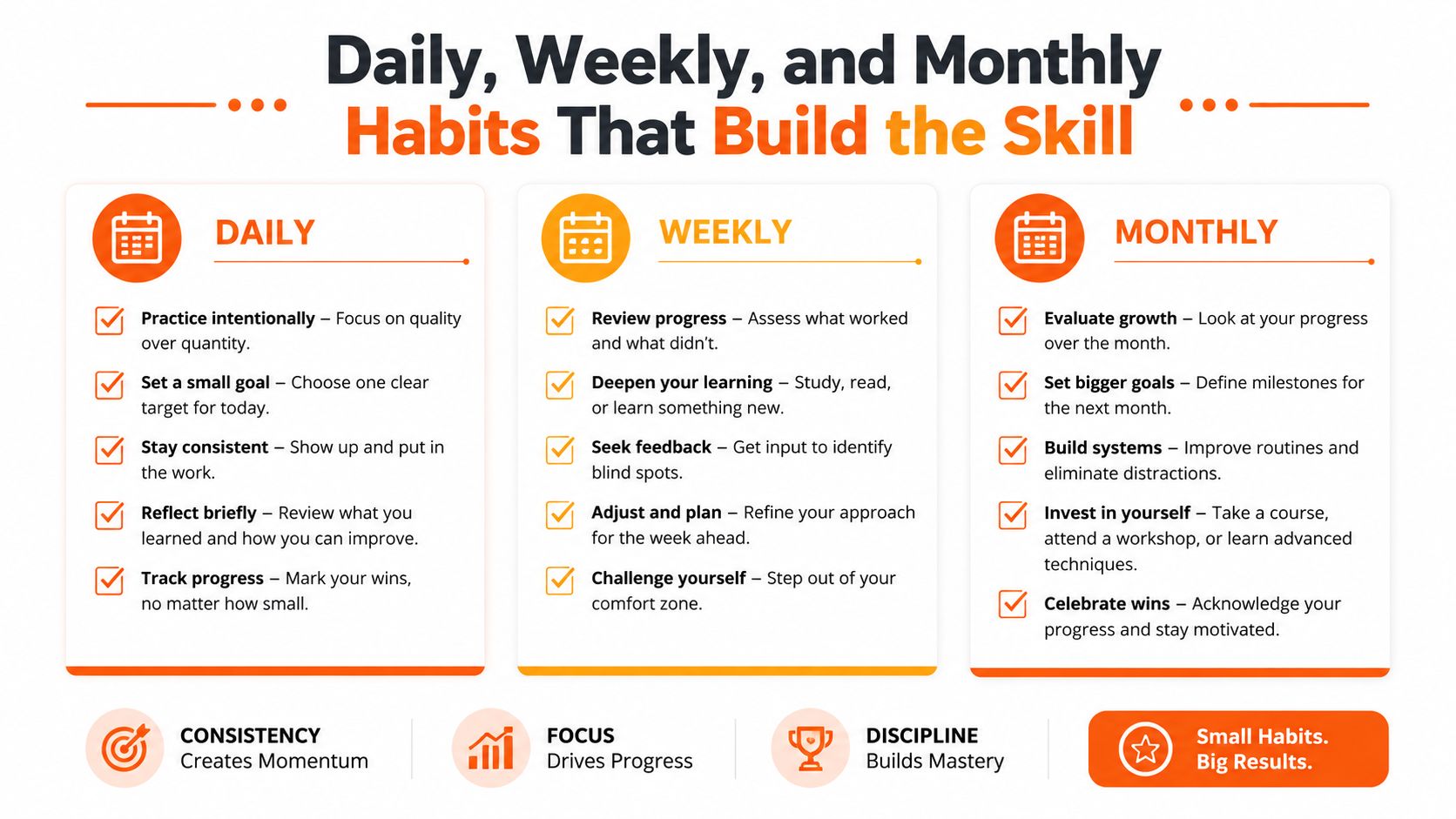
I keep the cadence simple. Five minutes a day, thirty minutes a week, one deeper review each month. That rhythm works because it matches how cash moves in real life.
Daily
Check the bank balance, open invoices, and any urgent outflows. That takes a few minutes if your books are tidy. You are not trying to solve the whole business before lunch. You are asking a narrower question, what changed since yesterday?
Weekly
Update the forecast, review the three KPIs, and scan any bill that might hit soon. Compare what you expected to what happened. If the same surprise shows up two weeks in a row, that is not luck. That is a pattern.
Monthly
Review the P and L, check the balance sheet, and look at one simple question, did I keep more cash than I spent? That month-end habit is where many founders finally notice leaks in pricing, collections, or payroll timing. It also gives you a clean moment to decide whether to cut spend, change terms, or raise prices.
Rule of thumb: the shorter the habit, the more likely you'll keep it.
The BDC survey gives a useful reminder here. In its most recent survey, 83% of business owners answered at least 7 out of 10 financial literacy questions correctly, up from 78% in 2017. Yet only 63% said they were knowledgeable or very knowledgeable about financial matters in 2023, down from 68% in 2017. That gap says a lot. People can know more than they think, and they can still avoid the routines that make knowledge useful. BDC's survey on financial literacy for Canadian entrepreneurs shows that tested knowledge and self-confidence do not always move together.
There is another useful data point in that same BDC work. Business owners spent about 20% of their time managing finances, down from 30% previously. That tells me finance stays in the operating mix even when tools improve. So the answer is not to ignore it. The answer is to make it routine enough that it stops eating your attention.
A good habit stack feels almost too small to matter. That is usually a sign you have picked the right size.
Your 30-Day Financial Literacy Commitment
Knowledge changes little if you never use it. That's the hard part most founders avoid.
The OECD review on financial education for MSMEs and potential entrepreneurs ties behavior to outcomes in a way that matters for operators. It notes that stronger financial literacy led entrepreneurs to produce financial statements more often, which lifted loan-repayment likelihood and lowered venture-failure probability, and it also links better understanding of loan-fund use with lower default rates. If you want results, you have to turn numbers into habits, then turn habits into decisions. The OECD review on financial education for MSMEs and potential entrepreneurs makes that clear.
Week 1
Open a separate business account if you don't have one. Set up your bookkeeping tool. Write down the three KPIs you'll watch every week.
Week 2
Build your 13-week cash forecast. Add opening cash, cash in, cash out, and ending cash. Update it once before the week ends.
Week 3
Price one product or service with honest costing. Include your labor. If the margin feels thin, do the math again before you change the price.
Week 4
Review one month of statements and one month of cash movement. Compare what you thought would happen with what happened. Write down the one habit you'll keep and the one leak you'll fix first.
Keep a short list of references close by. Use your bookkeeping software, your bank dashboard, your forecast sheet, and one plain-language guide you trust. If you learn better in conversation, Chicago Brandstarters is a free founder community with small dinner groups and a private chat where operators trade real notes on building businesses. That kind of room helps when you want feedback from people who have already made some of the mistakes you're trying to avoid.
If you want a place to talk through your numbers with people who get founder stress, visit Chicago Brandstarters. It's a free community for builders who want honest conversation, practical support, and fewer lonely guesses. If finance has felt like a fog, bring your questions there and start turning them into habits.
Leave a Reply