You're probably sitting on the same question most first-time founders ask after a few ugly months of product research, sample orders, and Amazon ad screenshots that look like a bar tab. Is private labeling Amazon still worth it, or is it just a faster way to light cash on fire?
My blunt answer is this. It can work, but only if you treat it like a unit-economics business first and a product hunt second. If you go in thinking it's passive income with a logo, Amazon will eat your margin through fees, shipping, returns, and ads before you ever feel “launched.”
What Private Label on Amazon Means in 2026
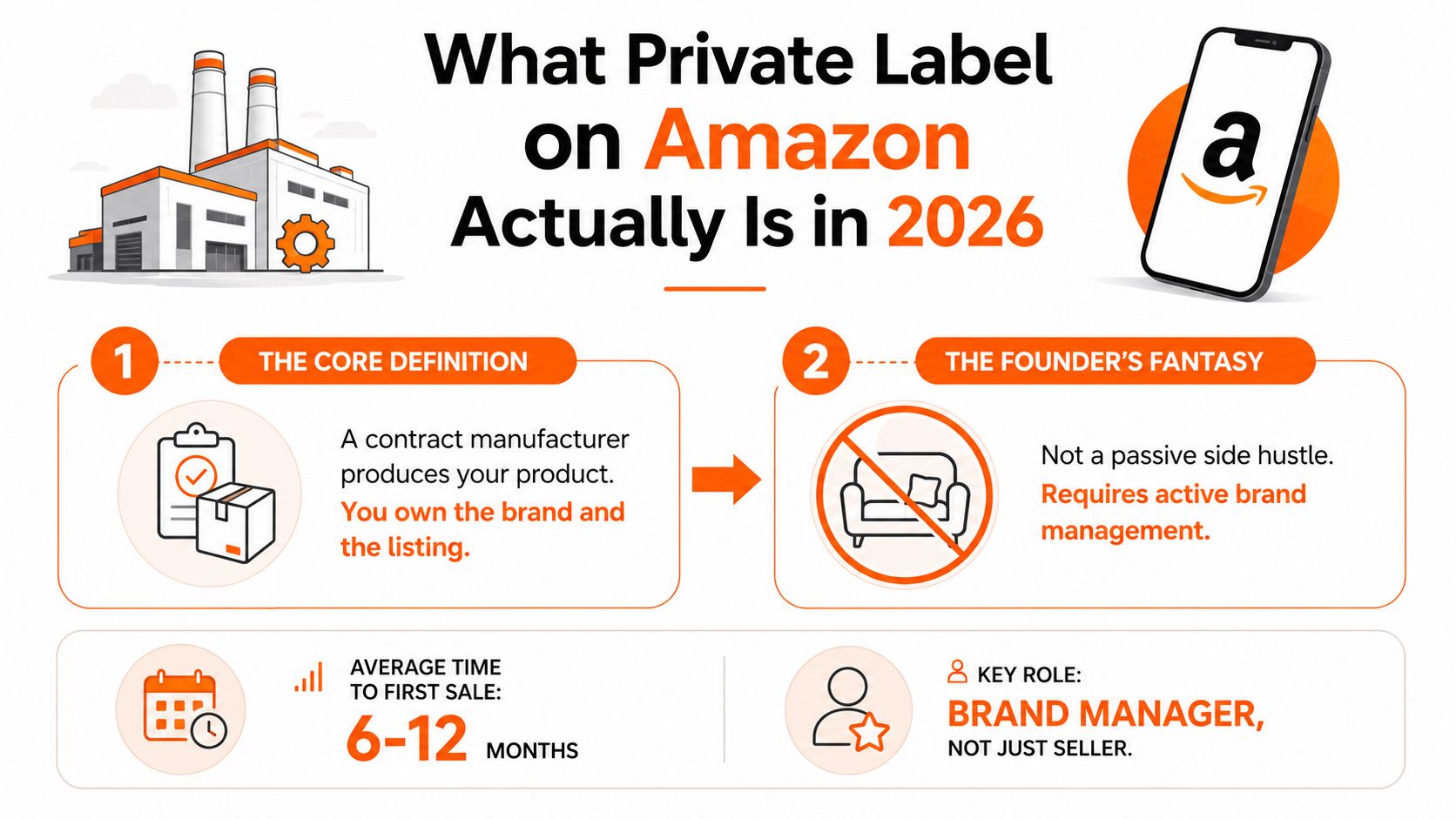
Private label means a factory makes the product, and you sell it under your brand name on Amazon. Amazon defines it plainly, one company manufactures the item, another company owns the brand on the listing (Amazon's private label definition). That is the setup, and that is where most first-time sellers get it wrong.
People still sell the fantasy version. Find a product, put a logo on it, run ads, collect money. That story ignores the full stack, manufacturing cost, freight, referral fees, FBA fees, and PPC. Once you model those line items, the business stops looking like a side hustle and starts looking like a warehouse-backed brand with a thin margin that can disappear fast.
The current channel data backs that up. One industry compilation says 54% of Amazon sellers use a private-label model, which makes it the most common approach on the marketplace, while Amazon's own brands account for about 2% of total marketplace sales according to Numerator-based reporting (private label statistics). That matters because the competition is mostly other independent operators, not Amazon itself. If you want to win, you need to beat sellers who are watching the same fee stack you are.
Practical rule: if your idea only works when ads stay cheap and fees stay low, it is not a business, it is a temporary spreadsheet mood.
Profit is still on the table, but only if you respect the math. A 2025 analysis says over 54% of private-label sellers have profit margins above 20%, with many in the 30% to 50% range, and some reaching six-figure monthly revenues (Amazon private-label profitability in 2025). The same source says Amazon private-label sales were still above $1 billion in Q1 2024, even though the category's share of Amazon U.S. retail revenue slipped from 1.0% to 0.9% year over year. Read that as maturity, not hype. The category is big, but it does not hand out easy wins anymore.
That is why I treat this model like a branded notebook that a factory prints for you, then you have to sell inside a casino. You own the cover, but you still pay for the table. If you want the brand side framed cleanly, a clear private label brand primer helps separate a product from a brand.
Amazon is part of the pressure too. One major analysis reported the retailer operated 100+ private-label brands and often priced them 25% to 40% below national brands (2026 private label Amazon analysis). That means your competitive floor is not just other third-party sellers. You are also dealing with Amazon's own pricing pressure on commodity products.
Private label fits you if you can handle slow cash cycles, paid traffic, and inventory risk. It does not fit you if you want a low-effort income stream or you hate looking at margin math every week. I have watched too many people buy samples before they ever answered the only question that matters, can this product survive after fees, freight, and ads?
Choosing a Product That Can Actually Pay You
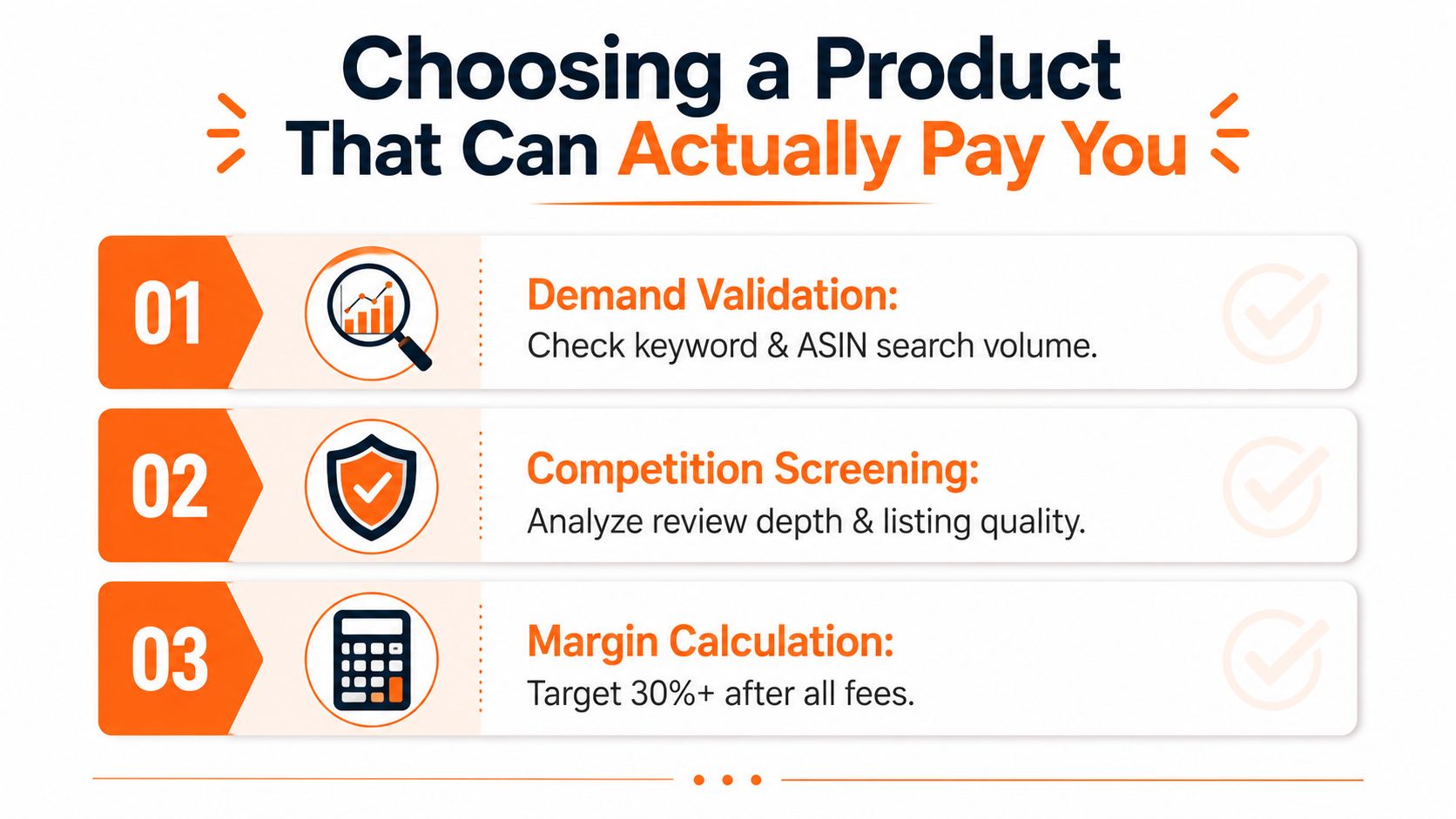
Start with demand, then move to competition, then move to margin. Most beginners do it backward. They fall in love with a product, then ask if people want it. That's how you end up with a garage full of dead inventory.
The easiest screen is price. Jungle Scout says a practical private-label target is $20 to $70 (Jungle Scout private label guide). I agree with that range because it gives you room for Amazon's fee stack. Go too cheap, and referral fees, FBA pick-and-pack, and PPC chew through the sale. Go too expensive, and demand usually gets thinner and trust gets harder to earn.
My shortlist filter
Use these four checks before you even email a supplier:
- Search demand: confirm the niche has real keyword and ASIN demand, not just one oddly ranked listing.
- Review depth: if the top listing has a wall of reviews, you need a real angle, not hope.
- Listing quality gaps: weak photos, sloppy copy, and bad A+ content can give you an opening.
- Price band: stay near the $20 to $70 zone unless you have a clean reason to leave it.
If you want a tool to size opportunity faster, the Product Opportunity Explorer is worth using because it helps you sanity-check a niche before you spend money on samples.
A hard stop for me is a category where the leading listing has 10K+ reviews unless I bring a clear product improvement, bundle, or design difference. That's not a moral judgment, it's a math problem. Heavy review depth means the market has already trained buyers to trust the incumbents.
Walk away from “low competition” advice that only means “low obvious demand.” You want moderate competition with visible listing gaps, not a dead category with no buyers.
Amazon's own search and product data matter here, but the point is simple. You want a niche where demand exists, quality is uneven, and the incumbent listings leave money on the table. That's where a founder can still win. If the category is crowded and price-transparent, you're not building a brand, you're entering a knife fight.
The cleanest way to think about it is with four numbers. Price, review depth, demand, and the rough cost to land the product. If those don't make sense on one page, don't call a supplier yet.
If you want one more filter, use competitor concentration. When one brand owns most of the visible shelf, you're buying a fight you don't need. I'd rather enter a niche with three mediocre listings than one polished winner and nine copies.
Finding and Qualifying a Supplier You Can Trust
I treat supplier sourcing like hiring. You're not just buying a unit cost, you're choosing the person who can wreck your cash flow if they lie, stall, or ship junk. A cheap quote from the wrong factory is just an expensive lesson with better branding.
For a Chicago or Midwest founder, the sourcing map is more practical than people make it sound. You can start on Alibaba and Global Sources, use sourcing agents in Los Angeles or Chicago for bridge support, meet regional reps who already sell into the Midwest retail belt, and go to trade events like the Inspired Home Show in Chicago or ASD Market Week in Las Vegas. If you want a cleaner walkthrough of the search process, this manufacturer-finding guide for product founders is a decent companion.
How I read a supplier quote
A quote is only useful if you know what sits inside it. The big things are FOB vs EXW, MOQ, payment terms, and whether the factory is quoting from a finished spec or just a rough sample. If they can't explain the difference between those terms without dodging, I move on.
The first sample tells you more than a polished sales pitch ever will. I look for build quality, packaging tolerance, labeling accuracy, and whether the product feels consistent across the batch. One bad seam or crooked label doesn't kill a deal, but repeated sloppiness does.
Practical rule: I'd rather pay a little more to a factory that answers fast and fixes mistakes than save a few cents with a vendor who turns every order into a detective story.
Three red flags make me walk away fast. First, the factory keeps changing the quote after you ask basic questions. Second, the sample looks fine at a glance but falls apart on packaging or labeling detail. Third, they push you to order bigger than you're ready for before they've proven consistency.
There's also a Midwest-specific advantage people ignore. If you can tour factories in the Chicago industrial corridor or across the Midwest, you can replace one round of international samples and save four to six weeks. That's not glamorous, but it's real time and cash. I've seen founders get more clarity from one afternoon on-site than from six weeks of email threads.
You're looking for a supplier who acts like a partner, not a vending machine. Ask how they handle defects, how they pack for Amazon, and what happens if the first batch misses spec. If the answers feel slippery, the cheap price is bait.
Branding, Trademark, and Your Listing Foundation
You file the trademark before you sink money into a pile of inventory. I have watched founders buy thousands of units, then realize they cannot cleanly access the brand tools they planned to use. That order is backwards. Get the brand foundation in place first, then commit cash to stock.
Amazon Brand Registry matters, but timing matters more. The clean sequence is trademark first, Brand Registry after the mark is in the right stage, then A+ Content and the rest of the brand tools after that. Skip the sequence and you create paperwork drag, plus avoidable delays at launch.
BigCommerce lays out the listing basics clearly. You need a title with primary keywords and your brand name, five high-quality images, five concise bullet points, and a detailed description, and A+ Content becomes available once Brand Registry is live (BigCommerce Amazon private-label listing guide). That structure is plain, and it works. Weak visuals and bloated copy still kill conversion faster than founders want to admit.
The legal and compliance stack
Amazon also asks for business verification documents, tax information like a TIN or VAT number, and bank account details, and some products need third-party lab testing to meet regulatory standards (Sellermate on Amazon private-label requirements). If you sell cosmetics, supplements, children's products, or electronics, do not treat compliance as a side task. It can stop the launch cold.
For trademark protection, read practical tips on trademarks before you spend on packaging, and use guidance on protecting intellectual property for your brand if you want the legal basics in one place. Too many founders spend on design before they know where the risk sits. That is backwards too.
File the trademark, wait for the right Brand Registry window, then build the listing. Reverse that order and you usually pay twice.
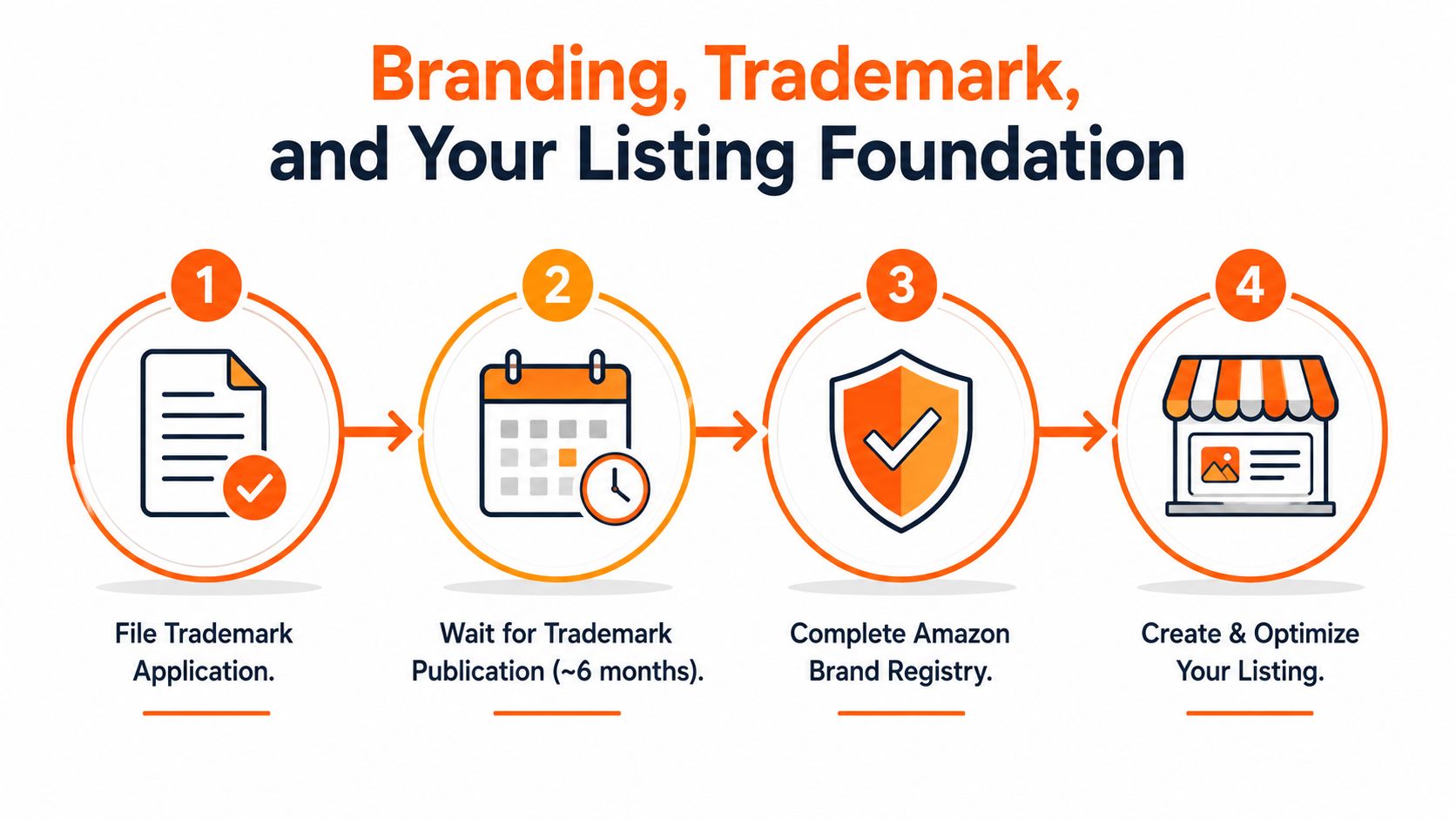
I would plan on a 6 to 8 week runway just to keep your inventory and brand timeline sane, and longer if the trademark system slows you down. Founders usually budget for samples and first inventory, then get surprised by the wait on the brand side. Brand work has its own clock, and your cash needs to sit through it.
I also care about the listing itself. A pretty logo does not fix weak product-market fit. It just makes a bad decision look cleaner. The Midwest lesson is simple, too. If you are sourcing around Chicago or through regional supplier events, use that access to pressure-test the brand early, because a factory tour and a direct conversation usually expose weak packaging, weak compliance, or weak positioning faster than another round of mockups.
FBA Vs FBM and the Real Cost of Getting Inventory to a Buyer
I don't like fake debates about FBA versus FBM. Both can work. The question is which one fits your margin, your time, and your inventory cycle.
Here's the blunt version. FBA gives you Prime eligibility and removes a pile of operational friction, but you pay for referral fees, pick-and-pack, storage, and aging inventory. FBM saves on Amazon's fulfillment layer, but then you own shipping zones, customer service, and the time cost of every mistake. If you're a solo founder, that time cost matters more than the spreadsheet tells you.
| FBA vs FBM at a Glance for a New Private-Label Brand | FBA | FBM |
|---|---|---|
| Prime badge | Usually yes | Usually no |
| Daily operations | Lower effort after inbound shipment | Higher effort, you handle shipping and service |
| Fee pressure | Higher Amazon fee stack | Lower Amazon fee stack, higher self-fulfillment burden |
| Best use case | Hero SKU, launch, fast movers | Slow movers, oversized items, backup channel |
| Cash behavior | More inventory tied to Amazon | More work tied to your own operation |
I recommend FBA first for the hero SKU. You get the Prime badge, faster conversion, and a cleaner way to learn what the market does to your listing. Then layer in FBM for variants, oversize items, or slow movers once you know the product deserves more inventory.
Landed cost now matters as much as FOB price. If you ignore duties, freight, and the rest of the import bill, your “winning product” dies in the actual world. Build unit cost from the landed number, then test if the margin still works after ad spend.
A good mental model is this. FBA usually needs stronger gross margin to survive Amazon's fee stack and PPC pressure, while FBM can limp by on thinner margin if you control shipping tightly. I'd rather launch with a product that has room for ads and mistakes than a tighter margin that looks elegant on paper.
If your product only works when you ignore shipping, returns, or tariffs, it doesn't work.
The worst move is chasing the lowest fulfillment fee without thinking about the customer experience. Amazon rewards speed and convenience. Your job is to use that when it helps, then switch to FBM only when the math and the SKU shape justify it.
Launching With PPC, Promotions, and Review Velocity
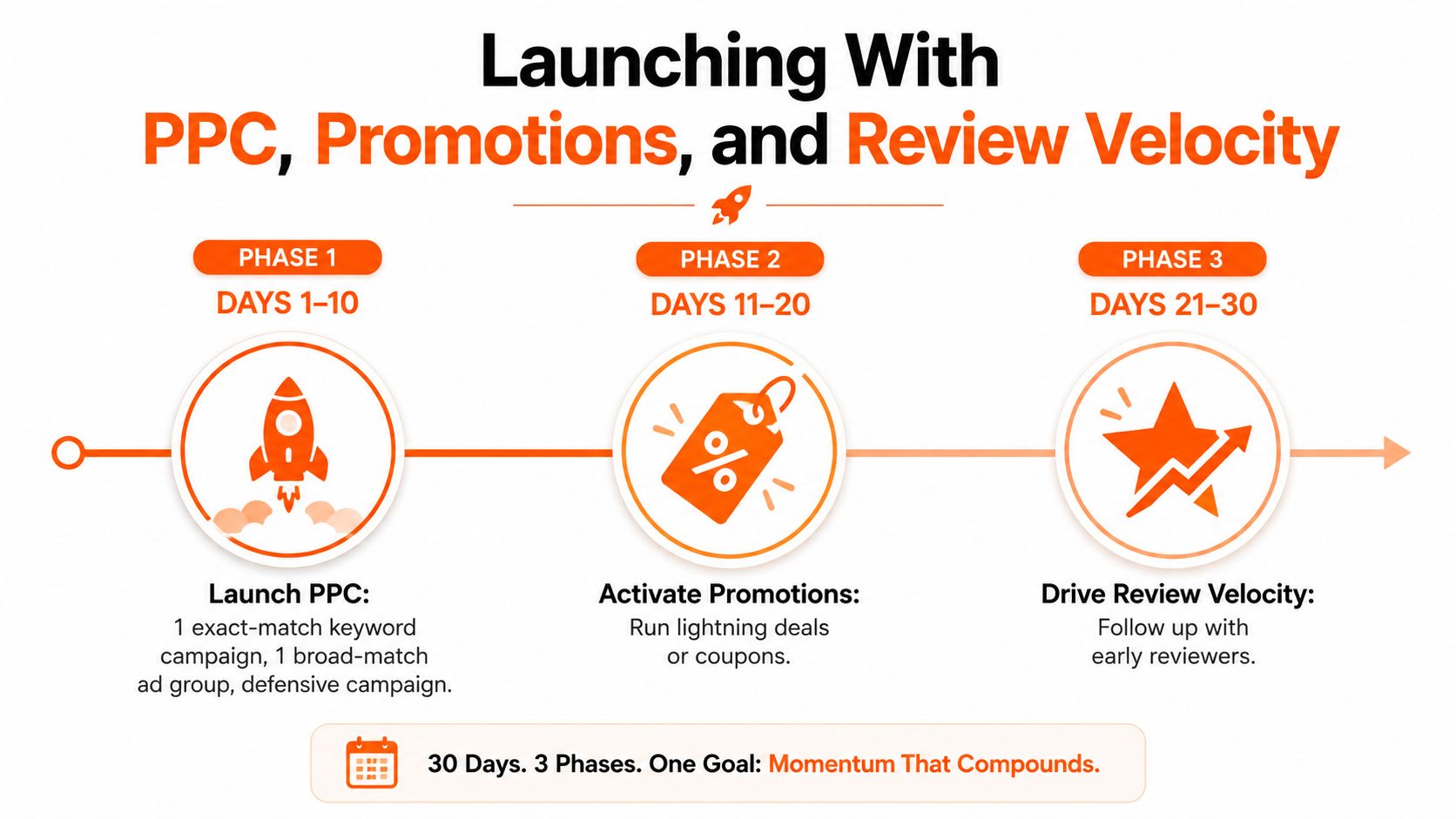
Your launch should look like a 30-day sprint, not a random pile of tasks. I'd keep the structure tight. Start with Sponsored Products, then layer promos, then push review velocity once the product has enough traffic to matter.
My launch setup
I like three ad buckets:
- Exact match campaign: one exact-match group for each core keyword.
- Broad match group: one broad-match group for discovery and search term harvesting.
- Defensive campaign: target competitor ASINs and protect your own visibility once traffic starts.
That's enough to learn without turning your account into confetti. Once Brand Registry clears, Sponsored Brands can come in, but I wouldn't wait around pretending ads will fix a weak listing.
Use break-even ACoS as your ceiling for the first 60 days. If your gross margin is thin, you have no room to be cute with bids. A lot of founders blow the launch because they chase rank while ignoring the fact that every extra click is pulling from working capital.
For reviews, use Amazon Vine where you can, and keep your post-purchase email flow within Amazon's rules. Don't get sloppy with incentives. I've seen sellers torch accounts by trying to game review quality instead of earning it.
Promotions matter, but only when they support the launch math. Coupons on the search results page can move clicks. Lightning Deals can help once stock is healthy. Bundles can lift average order value if the add-on makes sense.
If you want a deeper ad setup guide, this Amazon advertising optimization walkthrough is useful once you're past the first campaign build. I'd still keep the first month simple. Complexity looks smart and usually burns cash.
Chicago founder dinners and seller meetups also help here because promo tactics age fast. What worked last quarter can be stale by the time a blog post gets indexed. I'd rather hear what's converting from another operator over coffee than trust generic advice from a content mill.
Metrics That Tell You When to Scale and When to Kill
I don't look at vanity numbers. I look at the dashboard that tells me whether the SKU deserves another month. If you track the wrong metrics, you end up feeding losers because the top-line sales look exciting.
The weekly numbers I care about
- TACoS: this tells you what ads are doing to the whole business, not just one campaign.
- Session rate and conversion rate by traffic source: if traffic is cheap but conversion is weak, the listing is the problem.
- Review velocity: if buyers like the product, the social proof should grow in a believable way.
- Sell-through rate: if inventory sits while ads spend money, your forecast was wrong.
- Refund and dispute rate: this is your product-quality canary.
These numbers map to three decisions. If TACoS improves and conversion stays strong, I scale ad spend. If traffic is decent but conversion lags, I add a variant or fix the listing. If refunds rise and sell-through falls, I kill the SKU before it drains the business.
Practical rule: I'd rather sunset a mediocre SKU early than fund it for six more months because I'm emotionally attached to the sample.
Once you cross six figures, you'll need more than tactics. Goldman Sachs 10KSB can help with capital and education, EcomFuel can give you operator peer pressure in a good way, and Million Dollar Sellers is the sort of room you want when the playbook gets more serious. I'm not romantic about any of those. I'm practical. When the business gets bigger, you need better rooms.
The work doesn't change much from $0 to $1M. You still source, list, launch, measure, and cut losers. What gets worse is the loneliness in the middle, when the business is real enough to stress you out but not big enough to feel safe. Nobody warns you about that part, and it's usually the part that breaks people.
If you're building a private label brand in Chicago or anywhere in the Midwest, Chicago Brandstarters can help you think like an operator instead of a lonely founder guessing in the dark. Visit Chicago Brandstarters if you want real founder conversations, practical introductions, and a room that takes the work seriously.
Leave a Reply