

You know that late-night feeling. You open your bank account, open your payroll file, glance at next month's rent, and start doing ugly math in your head.
How long can we keep this going?
If you're a founder, that question matters more than almost anything on your dashboard. I've seen smart people obsess over revenue, margin, and growth while ignoring the one number that tells the truth when things get tight. That number is Days Cash on Hand.
I like this metric because it cuts through accounting fog. It tells you how many days your business can keep operating if new money stops showing up. No stories. No spin. Just runway.
Your Business Has a Survival Clock
A lot of founders look at the P&L and think they're fine. Then payroll hits, a client pays late, inventory lands early, and panic shows up fast.
That's because your P&L can look healthy while your cash position is weak. Revenue booked is not cash in the bank. Profit on paper is not breathing room. Days Cash on Hand is more honest because it answers the question you care about: how much time do I have?
The number that ends the guessing
Think of your business like a diver underwater. Revenue is your next breath. Cash on hand is the oxygen still in the tank.
If you don't know how much air is left, you're guessing. Founders make bad decisions when they guess. They hire too early, spend too loosely, and negotiate from fear.
Practical rule: If you can't tell me your days cash on hand from memory, you're flying blind.
A hard fact makes this real. A DCOH of 90 days means your business can operate for exactly three months with zero new revenue or financing, according to StudyFinance's explanation of days cash on hand. The same source says that if your DCOH drops below 30 days, you're in the danger zone where even a single week of delayed payments could trigger insolvency.
That's your survival clock.
Why founders should care more than investors
Investors ask about runway because they want to know risk. You should care because this number changes how you act every week.
When your DCOH is healthy, you negotiate better. You don't chase every bad-fit customer. You don't accept ugly financing terms out of desperation. You can think.
When it's thin, everything gets harder:
- Sales pressure rises because every delayed invoice feels personal.
- Hiring gets dangerous because one extra salary can shorten your clock fast.
- Vendor talks get tense because timing matters more than price.
If you need a basic foundation before you build your own tracker, start with financial planning for startups. Then come back and treat DCOH like your weekly weather report.
This metric doesn't exist to impress anyone. It exists to keep you from driving straight into a wall.
How to Calculate Your Days Cash on Hand
Here's the moment this metric stops feeling academic. Payroll hits Friday. Two customers pay late. You open the bank account and ask the only question that matters. How many days do I have before this gets ugly?
That's what days cash on hand answers.
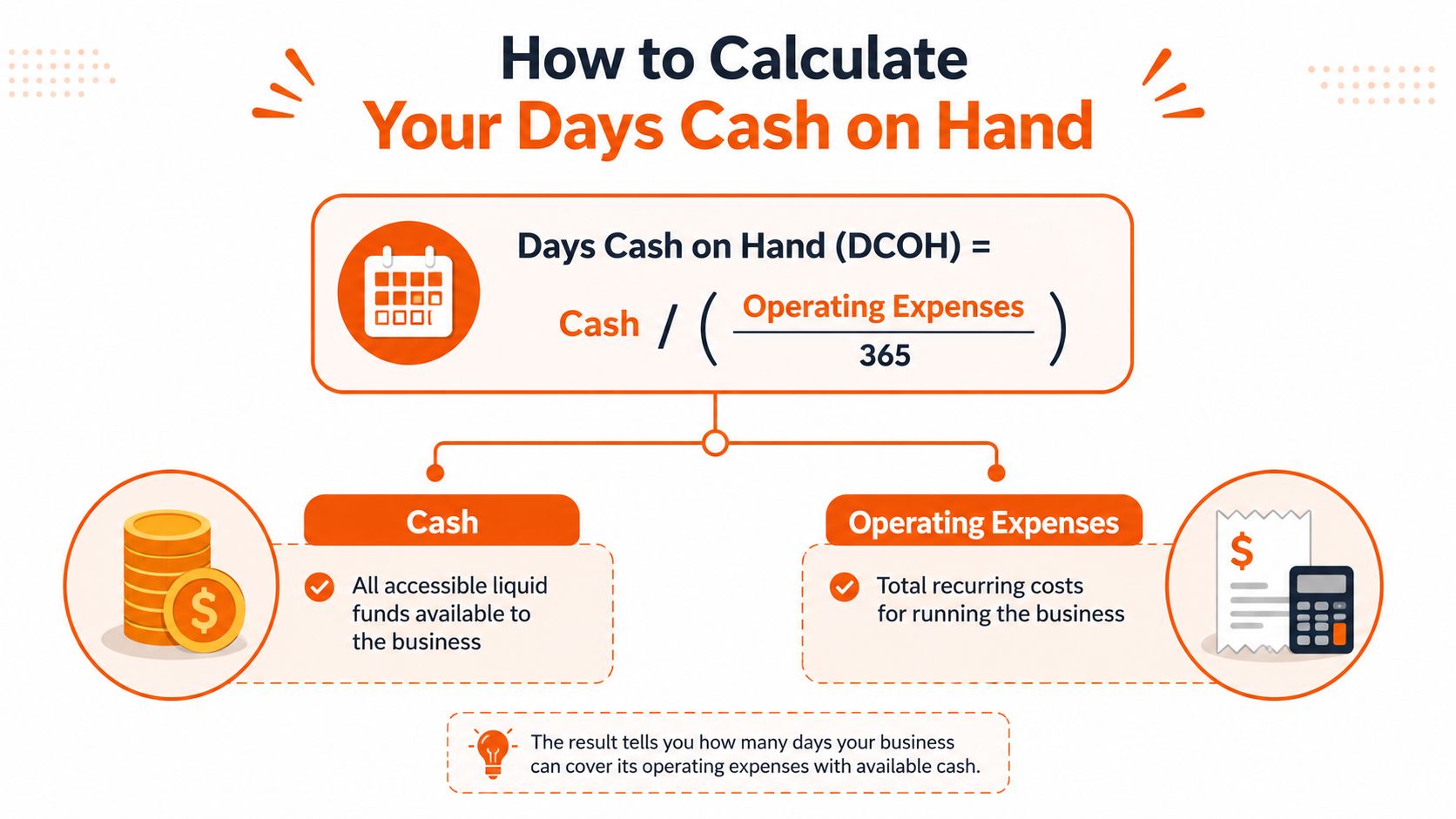
The exact formula
Use this formula:
DCOH = (Cash + Cash Equivalents) ÷ [(Annual Operating Expenses – Non-Cash Items) ÷ 365]
I like it because it measures survival in cash terms. That's the only version founders should care about when the bank balance is getting tight.
Three inputs drive the whole number:
Cash + cash equivalents
Count money you can access now. Checking accounts, savings, and short-term liquid funds belong here. Future receivables do not.Annual operating expenses
Pull the actual costs of running the business. Payroll, rent, software, marketing, contractor spend, insurance, and vendor payments.Non-cash items
Strip out depreciation and amortization. They reduce profit on paper, but they do not leave your bank account this month.
Get this part wrong and the metric lies to you.
Why founders mess this up
I've seen founders use total expenses straight from the income statement and call it done. That shortcut creates a fake burn rate. Then they hire too early, keep ad spend too high, or assume they have less room than they do.
DCOH only works if you use cash operating expenses.
If you want the bigger picture behind the formula, read this breakdown of understanding your company's cash flow. It connects this metric to the actual movement of money instead of the cleaned-up version your financials show later.
A worked example
Use simple numbers and run them clean.
If your business has $500,000 in cash, $1,200,000 in annual operating expenses, and $200,000 in non-cash items, the math looks like this:
Cash operating expenses = $1,200,000 – $200,000 = $1,000,000
Daily cash burn = $1,000,000 ÷ 365 = $2,739.73
Days cash on hand = $500,000 ÷ $2,739.73 = 182.5 days
That means the business has 182.5 days before cash runs out, assuming revenue stopped and expenses stayed flat.
That is the whole point of the metric. It gives you a hard number you can act on.
Where to pull the inputs
Use your balance sheet for cash and cash equivalents. Use your income statement for operating expenses, then remove the non-cash lines before you calculate anything. If you need help finding those line items, review how to format an income statement.
My advice is simple. Calculate DCOH from your current numbers, not last quarter's deck, not your bookkeeper's year-end package, and not the story you tell yourself when sales feel strong.
Your spreadsheet should answer one question fast: how many days until I have a problem if nothing improves?
Building Your DCOH Tracking Spreadsheet
You do not need a giant finance model for this. You need one tab in Google Sheets that tells the truth every time you open it.
I'd build it like a cockpit, not like an investor deck. Clean. Fast. No decorative nonsense.

The core sheet
Set up these columns:
| Line Item | Value |
|---|---|
| Cash on Hand | |
| Cash Equivalents | |
| Annual Operating Expenses | |
| Depreciation | |
| Amortization | |
| Cash Operating Expenses | |
| Daily Cash Burn | |
| Days Cash on Hand |
Then use simple formulas:
- Cash Operating Expenses =
Annual Operating Expenses - Depreciation - Amortization - Daily Cash Burn =
Cash Operating Expenses / 365 - Days Cash on Hand =
(Cash on Hand + Cash Equivalents) / Daily Cash Burn
That's the spine of the whole thing.
Use the cash version of expenses
This is not optional. Your tracker has to use cash expenses, not total accounting expenses.
The clean example is straight from CalcMastery's days cash on hand calculator: if annual operating expenses are $912,500 with $100K depreciation and $50K amortization, your daily cash burn is ($912,500 – $150,000) ÷ 365 = $2,100 per day. Your spreadsheet must use that cash-based expense number.
If you use the wrong denominator, your runway readout lies to you.
A simple weekly workflow
I'd update this sheet on the same day every week. Same rhythm. Same process.
- Pull bank balances from your checking and savings accounts.
- Update cash equivalents if you keep short-term liquid funds elsewhere.
- Check expense changes if payroll, rent, software, or supplier costs shifted.
- Review trend direction instead of staring only at the latest number.
Add one small chart that shows DCOH over time. You're not looking for pretty. You're looking for drift.
A flat or rising line buys you options. A falling line demands action.
Adjust it for your business model
An ecommerce brand and a SaaS company burn cash differently. Don't pretend they're the same.
Ecommerce founder version
Your sheet should pay attention to inventory timing and supplier payments. I'd add rows for:
- Inventory-related operating outflows
- Supplier payment spikes
- Freight or fulfillment changes
If inventory carrying costs are eating your runway, get smarter about what you stock and how long you hold it. Slow inventory erodes cash.
SaaS founder version
A SaaS tracker should focus on recurring costs and payment timing. I'd watch:
- Payroll
- Hosting and infrastructure
- Software stack
- Contractor spend
- Collections on recurring invoices
If you have recurring revenue, that's nice. If customers pay late, your bank account still doesn't care.
What a Good DCOH Number Looks Like
Once you calculate days cash on hand, the next question is obvious. Is this good or bad?
My blunt answer is this. Some ranges are dangerous, some are healthy, and some mean you may be sitting on cash you should probably put to work.
The standard range
A widely used benchmark says businesses should keep 60 to 180 days of Days Cash on Hand, according to Diversification's definition of the metric. That range gives a company roughly two to six months to cover expenses without new revenue.
That's a solid target for most founder-led businesses because it gives you enough room to absorb payment delays, messy months, and bad surprises without instantly reaching for debt or emergency fundraising.
A simple way to interpret your number
I look at DCOH in three buckets.
| Business Model | Danger Zone (Days) | Healthy Range (Days) | Conservative/Inefficient (Days) |
|---|---|---|---|
| Early-stage startup | Under 30 | 30 to 90 | Above 180 |
| Ecommerce brand | Under 30 | 60 to 180 | Above 180 |
| SaaS business | Under 30 | 60 to 180 | Above 180 |
| Seasonal business | Under 30 | 60 to 180 | Above 180 |
This table blends the hard warning threshold with the broader benchmark range. It's not a law of nature. It's a decision aid.
What the zones mean in plain English
Under 30 days
You're too close to the edge. One late customer payment or one ugly month can put you in triage mode.60 to 180 days
Most businesses should aim for this range. You have cushion, but you're not hoarding cash for no reason.Above 180 days
You're safe, but ask a hard question. Should some of that cash fund growth, product work, hiring, or a smarter strategic move?
Cash is protection. Too much idle cash can also be a sign that you're playing defense when you should be taking smart shots.
Context still matters
A pre-revenue startup, a steady service business, and a seasonal ecommerce brand should not all use the same target without thinking. If your revenue is lumpy, you need more cushion. If your collections are reliable and your cost base is lean, you can operate tighter.
A significant mistake is treating DCOH like a vanity stat. It's not. It's your margin for error.
Practical Ways to Improve Your DCOH
If your days cash on hand is weak, don't overcomplicate it. You have two levers.
You can put more cash in the numerator. Or you can lower the daily expense denominator.
That's it.
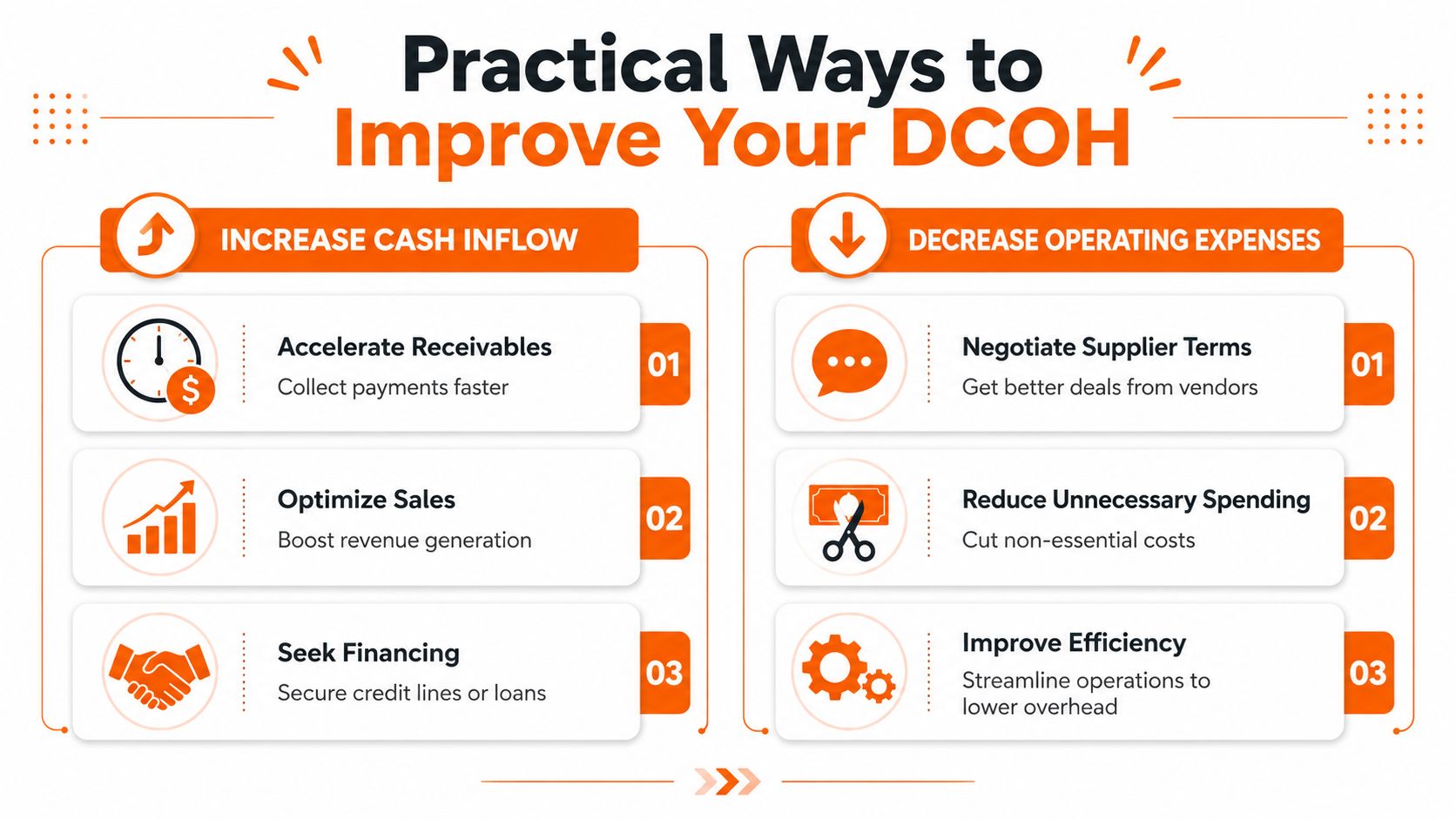
Pull the first lever and get cash in faster
Founders often think cash problems mean sales problems. Sometimes that's true. Sometimes the actual issue is speed.
I'd start here:
- Tighten payment terms if customers take too long to pay.
- Invoice faster the moment work is delivered.
- Ask for upfront payment when the relationship and product allow it.
- Follow up on receivables early instead of hoping people remember.
If you want a broader list of moves, this roundup of practical strategies to boost cash flow is worth scanning.
A lot of DCOH gains come from operational discipline, not heroic finance tricks. You don't need magic. You need tighter habits.
Pull the second lever and spend less cash per day
This one is harder emotionally because it forces honesty. Every founder has expenses they defend out of habit.
Look at:
- Software subscriptions you barely use
- Contractors with fuzzy ownership
- Marketing spend that feels busy but doesn't drive cash
- Inventory decisions that lock up money too long
- Hiring plans that assume best-case revenue
If inventory is a big drag, dig into inventory carrying costs. A lot of ecommerce founders think they have a revenue issue when they really have cash trapped on shelves.
Operator move: Cut costs that don't protect product quality, customer trust, or speed to cash.
Here's a useful explainer if you want another angle on the metric in action:
Track more often when things get weird
Normal periods need regular review. Stress periods need tighter monitoring.
According to Brex's guide to days cash on hand, CFOs should calculate DCOH monthly, and they should move to weekly monitoring during rapid growth or uncertainty. I agree with that. When the ground is moving, monthly is too slow.
Weekly tracking lets you see whether your moves are working:
- Did collecting receivables push the numerator up?
- Did cutting waste reduce the denominator?
- Did a new expense shorten runway more than expected?
That feedback loop is where founders regain control.
Your DCOH Quick Action Checklist
You do not need a finance degree to use this well. You need discipline and honesty.
Here's the checklist I'd follow today.
The founder checklist
Pull your current cash numbers
Get the actual bank balances and liquid cash equivalents.Clean your expense base
Remove depreciation and amortization so your burn reflects real cash going out.Calculate your current DCOH
Use the simple sheet. No excuses.Write down your target range
Pick a number that fits your business model and risk level.Start a recurring review cadence
Monthly is the minimum in normal conditions. If things feel shaky or growth is moving fast, tighten the review cycle.Choose one cash-in move
Faster invoicing, stricter payment terms, or better collections.Choose one cash-out move
Cut dead software, delay a weak hire, renegotiate a vendor, or fix inventory decisions.
The deeper lesson
Most founders don't fail because they can't understand this metric. They fail because they avoid looking at it until it hurts.
Days cash on hand gives you a hard truth. Hard truth is useful. It helps you act early, negotiate calmly, and stop confusing optimism with control.
If your number is ugly today, good. Now you know. You can work with truth.
If you're building in the Midwest and want real conversations with founders who skip the performative nonsense, join Chicago Brandstarters. It's a free community for kind, bold, hard-working builders who want honest feedback, practical help, and the kind of relationships that move a business forward.
Leave a Reply