
Most advice on how to find your niche market is backwards.
People tell you to follow your passion, pick a broad category, then polish a brand. That's how you end up with a cute idea and no customers. Passion is nice. Payment is nicer. If nobody wakes up annoyed enough to fix the problem you're talking about, you don't have a niche. You have a hobby with a logo.
I've learned to start somewhere less romantic and more useful. Find a real problem for people you want to help. Better yet, find a problem with emotional weight. Shame. Confusion. Loneliness. Identity. Those problems create stronger businesses than shallow feature gaps because people don't just buy a solution. They buy relief, progress, and a sense that someone finally gets them.
If you're a kind builder, this matters even more. You don't need a giant faceless market. You need a group of people you respect, understand, and want to stick with for years. That's how you build a niche you care about without becoming a sleazy marketer.
Forget Your Passion Find a Problem
“Follow your passion” is lazy advice.
Your passion doesn't pay the bills unless it connects to a painful problem. I've watched too many smart people spend months building around something they love, only to discover nobody wanted it badly enough to pay for it. Passion without demand is like opening a steakhouse in a vegan food hall. You may care a lot. The room still says no.
The better move is simpler. Pick people first, then find the problem that keeps tripping them.

Start with people you want to help
If you hate your future customers, the business will rot from the inside. So ask yourself:
- Who do you naturally root for? Burned-out parents, first-time founders, freelance designers, immigrant business owners, teachers trying to leave salaried work.
- Whose problems do you understand without needing a translator? You've lived it, sat next to it, or helped with it.
- Whose wins would make you happy? This matters more than people admit.
If you need help narrowing that audience, BAMF has a practical rundown of audience identification best practices that's worth reading.
Chase pain, not vibes
A niche gets real when the problem is specific enough to hurt. “Wellness” is not a niche. “Remote workers with young kids who keep missing meetings because their calendars collapse by noon” is getting closer.
Practical rule: If you can't finish the sentence “I help ___ solve ___,” your niche is still foggy.
I'd rather back a founder who understands well a small, hurting group than one who wants to “serve everyone.” The second person sounds ambitious. The first person usually makes money.
That's the frame I trust for how to find your niche market. Forget the dreamy identity exercise. Find a problem, for people you care about, that stings enough to make them act.
Look Inward Before You Look Outward
Before you start digging through Google, Reddit, or product reviews, look at your own life. Your best niche idea is often hiding in the stuff you barely notice because it feels normal to you.
That blind spot costs people years. They assume a niche must come from trend reports or some genius brainstorm. Usually it comes from scars, obsessions, weird jobs, and annoying problems you had to solve the hard way.
Recent Harvard Business School data from 2025–2026 says 68% of emerging startups fail because they prioritize “problem size” over “problem depth”. They miss the nuanced emotional drivers that create loyal customers (Harvard Business School Online). That lines up with what I've seen. Founders chase a big market, then build something flat and forgettable.
Audit your unfair advantages
I'm not talking about money or credentials. I mean the edge you got from living your life.
Try these prompts and write fast. Don't overthink them.
What do people ask you for help with over and over?
If friends keep texting you about resumes, ADHD systems, Shopify setup, wedding budgeting, or conflict at work, pay attention.What did you learn the hard way?
People pay to skip confusion. If you've already done the painful version, you may have something.What communities do you already belong to?
Parenthood, chronic illness, niche sports, religious groups, immigrant circles, creators, operators, side-hustlers. Access matters.What topics can you discuss for an hour without needing notes?
That's often your “native tongue” advantage.
Find the emotion under the surface
Functional problems are easy to spot. Emotional problems make the niche sticky.
Someone says they need better project management. Maybe. Or maybe they feel embarrassed because they're dropping balls in front of their team. Someone says they want meal planning help. Maybe. Or maybe they're tired of feeling like a failing parent every weeknight.
That second layer is where good niches live.
People stay longer when your business solves how life feels, not just how a workflow functions.
Here is a simple approach:
| Surface problem | Emotional problem underneath |
|---|---|
| Need better time management | Feel scattered and unreliable |
| Need better marketing | Feel invisible and stuck |
| Need a budgeting tool | Feel ashamed and out of control |
| Need networking help | Feel isolated and unsure where they belong |
If you can name both levels, you're getting warmer.
Write one person, not a segment
Skip broad demographics for a minute. Write a single human profile. What does this person worry about at night? What do they hide from coworkers, friends, or family? What do they hope a solution would say about them?
If you need a structured way to do that, Clepher's guide on buyer personas is useful because it pushes you past generic age-and-income nonsense.
Then test yourself with this short filter:
- I know where these people already talk
- I understand the words they use
- I care about the outcome
- I can spot the emotional layer fast
If you can't say yes to at least most of that, keep digging inward. Your niche market usually isn't “out there.” It's sitting inside your own history, waiting for you to notice it.
Find Problems People Will Pay to Solve
You don't need expensive software to find a niche. You need better ears.
Most founders go hunting for ideas like tourists. They skim trends, copy a hot category, then guess what people want. I'd rather you act like a field researcher. Go where people complain in public. Listen long enough to hear patterns. That's where paid problems show up.
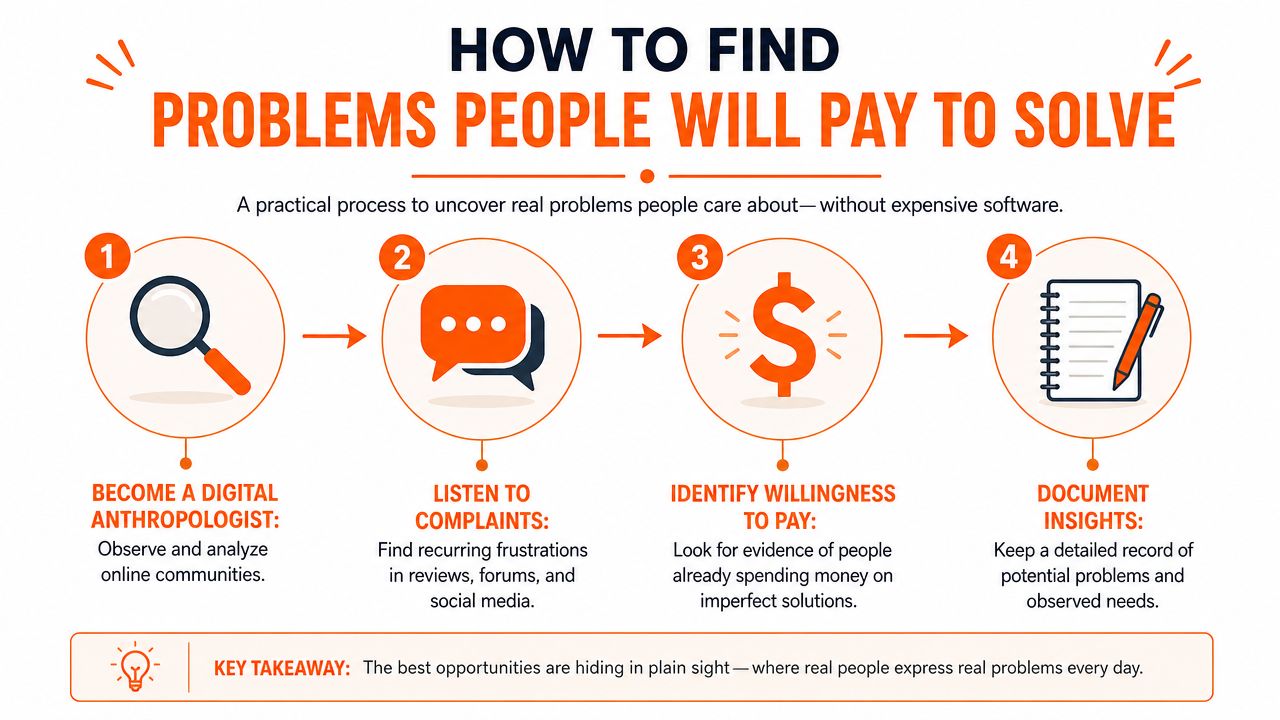
Go where unfiltered language lives
Start with places where people talk like themselves:
- Reddit: Search subreddits tied to your audience and look for repeated frustration posts.
- Facebook Groups: Smaller groups often have blunt, messy, honest questions.
- Niche forums and product reviews: These are gold mines because people compare imperfect solutions out loud.
- YouTube comments and podcast reviews: You'll hear what people still don't understand after consuming free content.
If you want inspiration for categories worth exploring, this roundup of digital side business opportunities can spark ideas. Don't copy the list. Use it to sharpen your radar.
Listen for buying signals
You're not just looking for complaints. You're looking for complaints tied to urgency, money, or identity.
Watch for phrases like:
- “I wish there were…”
- “Does anyone know how to…”
- “I've tried three tools and none of them…”
- “I'd gladly pay for…”
- “This is embarrassing, but…”
Those phrases tell you the problem is alive. If people are already cobbling together spreadsheets, hiring freelancers, buying clunky tools, or wasting hours on workarounds, that's even better.
A good niche rarely starts with a clever product idea. It starts with repeated irritation.
Keep notes in one document. I like a messy spreadsheet more than a fancy tool. Capture the exact words people use, where you found them, what they tried, and what still feels broken.
Do a simple demand check
Once you spot a pattern, run a sanity check. Chris Ducker's rule of thumb is clear: look for keywords with at least 1,000 global monthly searches. Anything lower may be too small, and you also want to avoid hyper-competitive terms where big companies are already flooding ads (Chris Ducker).
That doesn't mean every niche needs a giant keyword. It means you want proof that enough people are actively looking for relief.
A simple workflow works fine:
- List the exact phrases people use
- Check search demand with a basic keyword tool
- Google the phrase
- Look at who ranks and who advertises
- Ask whether you can own a narrower angle
For a deeper process, I like this breakdown of market research methods.
Get painfully specific
Broad categories attract tire-kickers. Specific outcomes attract buyers.
Think in this format:
| Too broad | Better niche angle |
|---|---|
| Time management | Calendar systems for remote workers with kids |
| Fitness | Strength coaching for women returning after burnout |
| Career help | Interview prep for first-gen professionals |
| Productivity | Simple planning tools for ADHD freelancers |
You're not trying to describe the whole forest. You're trying to find one trail people are desperate to walk.
That's how to find your niche market without wasting money on bloated software. Listen first. Document what people keep tripping over. Then confirm there's enough search demand to justify the hunt.
The Is This a Good Idea Framework
Most niche ideas sound decent in a coffee shop. That's a terrible place to judge them.
You need a filter that cuts through your excitement. I use three buckets: Profit, Personal Fit, and People. If an idea is weak in any one of them, it usually turns into a grind.
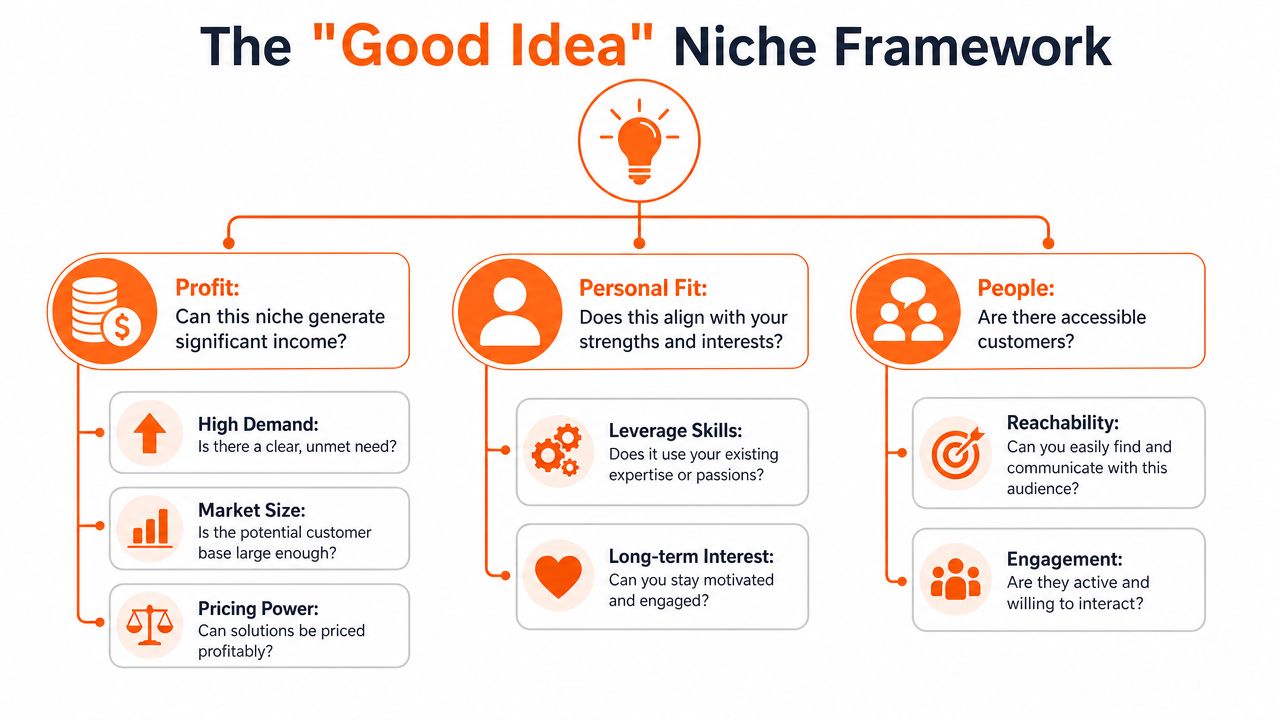
Profit
This is the least romantic bucket and the one people most often fake.
I don't care whether people say your idea is cool. I care whether they already spend money trying to solve the problem. If they buy books, templates, coaching, software, consultants, or ugly workarounds, that's a good sign. Money leaves footprints.
A Reddit entrepreneur put it bluntly: specificity is your friend. Instead of targeting a broad niche like “income,” focus on a high-value problem people are desperate to solve, like “how to get a six-pack in 6 weeks or less.” Customers pay for specific outcomes (Reddit discussion).
Score the idea higher if:
- People buy something already
- The pain is frequent
- The outcome is easy to describe
- You can reach buyers without heroics
Personal Fit
Some ideas can make money and still be wrong for you.
If the customer annoys you, if the problem bores you, or if you can't imagine thinking about it for years, skip it. You're trying to build a business, not sentence yourself to a weird form of self-inflicted office work.
Ask yourself:
- Would I still care about this niche after the novelty wears off?
- Do I have an earned advantage here?
- Can I talk to these people without pretending to be someone else?
If the idea looks good on paper but makes you tired in real life, that's a bad idea wearing makeup.
People
This is the bucket most spreadsheets ignore, and I think that's a mistake.
Can you find these people? Do they gather somewhere? Do they talk to each other? Better yet, do they share an identity?
A niche with a community is easier to grow than a niche with scattered strangers. Shared identity creates trust faster. Think about the difference between “people who need bookkeeping” and “freelance designers who hate dealing with taxes because they feel behind and disorganized.” The second group has sharper language, stronger emotion, and better word of mouth.
Here's the fast scorecard I'd use:
| Bucket | Bad sign | Good sign |
|---|---|---|
| Profit | Vague desire | Active spending on fixes |
| Personal Fit | You're forcing it | You have earned insight |
| People | Hard to reach | Clear gathering places and shared language |
Pick the idea that has the strongest total shape, not the flashiest promise. Good niches are usually narrower, more human, and less glamorous than people expect. That's fine. Glamour doesn't convert. Clarity does.
Test Your Niche Without Building Anything
Here, people light time and money on fire.
They choose a niche, get excited, then disappear for months to build a product nobody asked for. Don't do that. You are not proving you're serious by building fast. You're proving you're stubborn.
Mailchimp recommends validating a niche with a simple landing page and a free sample or trial for 100–200 initial users so you can gather real feedback and measure conversion before going all in (Mailchimp).
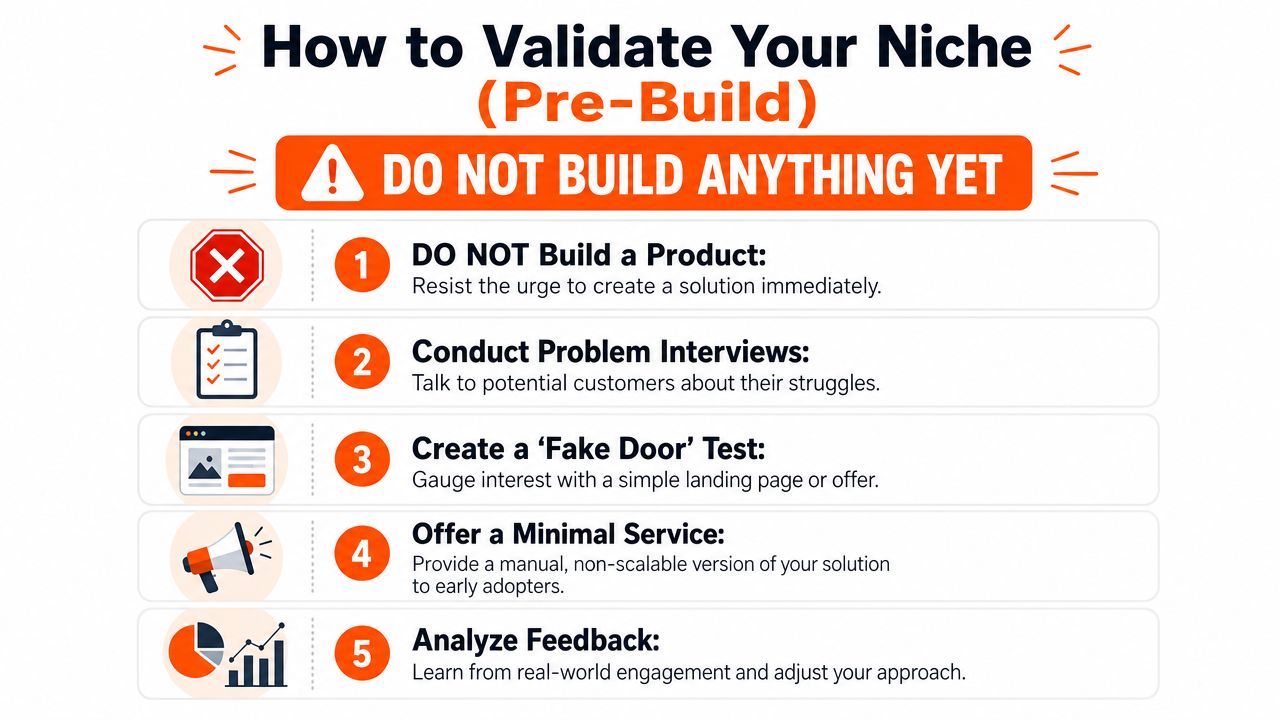
Build a fake door
A fake door test is simple. You create a landing page for the solution before the full solution exists. The page explains the problem, your angle, and what someone gets if they sign up.
Use tools like Carrd, Notion, or Webflow if you want something cleaner. Keep the page short:
- Headline: Name the problem in the customer's language
- Subhead: Explain the specific outcome
- Bullets: What they get, what changes, who it's for
- Call to action: Join the waitlist, apply for a trial, or book a short call
You're not trying to win design awards. You're checking whether strangers care enough to raise their hand.
Later, if you want a stronger process for pressure-testing the idea, this guide on how to validate a business idea is a solid companion.
Talk before you automate
A niche becomes real when you hear the pain out of someone's mouth.
Ask people what they've tried, what annoys them, what feels expensive, and what “fixed” would look like. Don't pitch too early. Let them ramble. Their phrasing is copy. Their frustration is positioning. Their hesitation is your objection handling.
Here's a short explainer if you want a quick reset on validation thinking:
Sell the ugliest useful version
Before software, before packaging, before inventory, try a manual version.
If your niche idea is meal planning for busy parents, do it as a paid concierge service. If it's messaging help for coaches, write a few pages by hand. If it's sourcing support for an ecommerce brand, start with a done-for-you offer. Ugly is fine. Manual is fine. Learning is the point.
Reality check: An ugly service that people pay for beats a polished product nobody wants.
Watch what people do, not what they politely say. If they sign up, reply, pay, refer, or ask for more, you're onto something. If they nod and vanish, the niche still needs work.
Plant Your Flag and Build Your Community
Once the test works, most founders make the same mistake. They rush to build the full product, polish the logo, and act bigger than they are.
That's backwards. Your first job is to plant your flag. Say clearly who you help, what problem you solve, and why your angle is different. Then gather the first small cluster of people who care. A niche gets stronger when customers feel like they're part of something, not just buying from something.
UpSkillist suggests a test budget of $1,000–$5,000 for landing page tests and a small ad spend, with a target Customer Acquisition Cost under $100 (UpSkillist). Fine. Use the numbers if they help. But don't miss the bigger lesson. Validation is not the finish line. It's your invitation to start relationships.
Start smaller than feels impressive
You do not need a giant audience. You need the first handful of people who really care.
Email them. Ask what made them sign up. Share what you're learning. Tell them what you're building toward. Ask them what they'd cut, change, or pay for first.
Try one of these:
- A simple newsletter where you share lessons, mistakes, and customer stories
- A small group chat for early users
- Direct email threads with your first signups
- A lightweight call series with people who matched your niche best
That group becomes your early signal system. They tell you whether your message is clear. They tell you what part of the offer matters. They also tell you whether the niche has real identity, not just temporary curiosity.
Say something people can repeat
A planted flag is a message simple enough that someone else can repeat it.
Bad messaging sounds like this: “I help ambitious people realize their potential through complete support.” Nobody remembers that because it means nothing.
Better messaging sounds like this:
- I help burned-out freelance designers price with confidence.
- I help remote parents get control of chaotic calendars.
- I help first-time founders turn messy expertise into a clear offer.
That kind of message travels.
Build belonging early
If your niche has emotional depth, community is not a side project. It is part of the product.
People stay when they feel seen. They refer friends when the business helps them name who they are or who they're becoming. That's why shared identity matters so much in niche selection. When customers see themselves in each other, trust grows faster and feedback gets better.
If you need help thinking about the people side of that, this piece on how to find your tribe is worth your time.
Don't wait to be polished before you act like a leader. Start the conversation early. Let customers shape the language. Build with them in public enough that they feel ownership.
That's the version of how to find your niche market that holds up. You don't chase a giant category. You pick a real problem, for people you care about, then build trust before you build complexity.
If you're a kind, hardworking founder in Chicago or the Midwest and you want honest feedback from people who are actively building, Chicago Brandstarters is the place I'd point you. It's a free vetted community for builders who want real conversations, small private dinners, and the kind of support that helps you skip dumb mistakes and keep going.
Leave a Reply