

It's late, your laptop is still open, and your to-do list looks like it bred overnight.
You've answered customer emails, fixed a Shopify issue, rewritten homepage copy, chased an invoice, and told yourself three times that tomorrow is the day you'll finally think about growth. Then tomorrow comes, and you're back to being the janitor, operator, marketer, and firefighter.
I know that feeling. I've lived it. Most founders don't have a time problem at first. They have a control problem. Your business feels like your baby, so every handoff feels risky. You think keeping everything on your plate protects quality. Usually it just traps you in work that someone else could do well enough, while the work only you can do sits untouched.
Stop Drowning in Your Own To-Do List
If you want to learn how to delegate effectively, start with the truth most founders avoid. You are not busy because your business is growing. You are busy because you are still acting like the whole company.
That works for a while. Then it becomes a ceiling.

Your to-do list is lying to you
A long list feels productive because it gives you motion. It does not always give you progress.
Founders often keep low-value work because it feels safe. You can answer the inbox. You can tweak the website. You can format the slides. Those tasks give quick closure. They also eat the hours you need for sales, product direction, partnerships, and the uncomfortable decisions that grow a company.
I like to think of delegation as buying back founder time. Every task you hand off well is a little stock purchase in your future attention. Every task you keep out of fear is a tax.
Practical rule: If a task drains your energy and does not require your judgment, your voice, or your authority, it probably should leave your plate.
This isn't airy self-help. There's a business case for it. CEOs with high delegator talent generated 33% greater revenue in 2013 compared to those with low delegation skills, achieving $8 million in revenue according to this breakdown of delegation performance.
That stat matters because it kills the old founder fantasy that grit alone wins. Grit helps. But if you insist on touching everything, your company can only grow as fast as your own hands.
Delegation is emotional before it is operational
The first barrier isn't process. It's identity.
A lot of founders secretly believe, “If I don't do it, it won't be right.” Sometimes that's perfectionism. Sometimes it's fear. Sometimes it's the scar tissue from hiring the wrong freelancer once and deciding nobody can be trusted again.
If that's you, stop pretending this is about standards. It's about attachment.
I've seen that same pattern show up hard in overcoming micromanagement for women leaders, because the pressure to prove competence can turn every handoff into a referendum on your leadership. If that hits home, read it.
You also need a system for reclaiming your hours. A practical starting point is tightening your calendar and task flow before you delegate. This guide to time management for entrepreneurs helps because delegation fails fast when your own priorities are already a mess.
The 3-Bucket System for Deciding What to Delegate
Most founders try to delegate in random bursts. They wait until they're overwhelmed, throw tasks at someone, then get annoyed when the result is messy.
That's backward. First sort the work. Then hand it off.
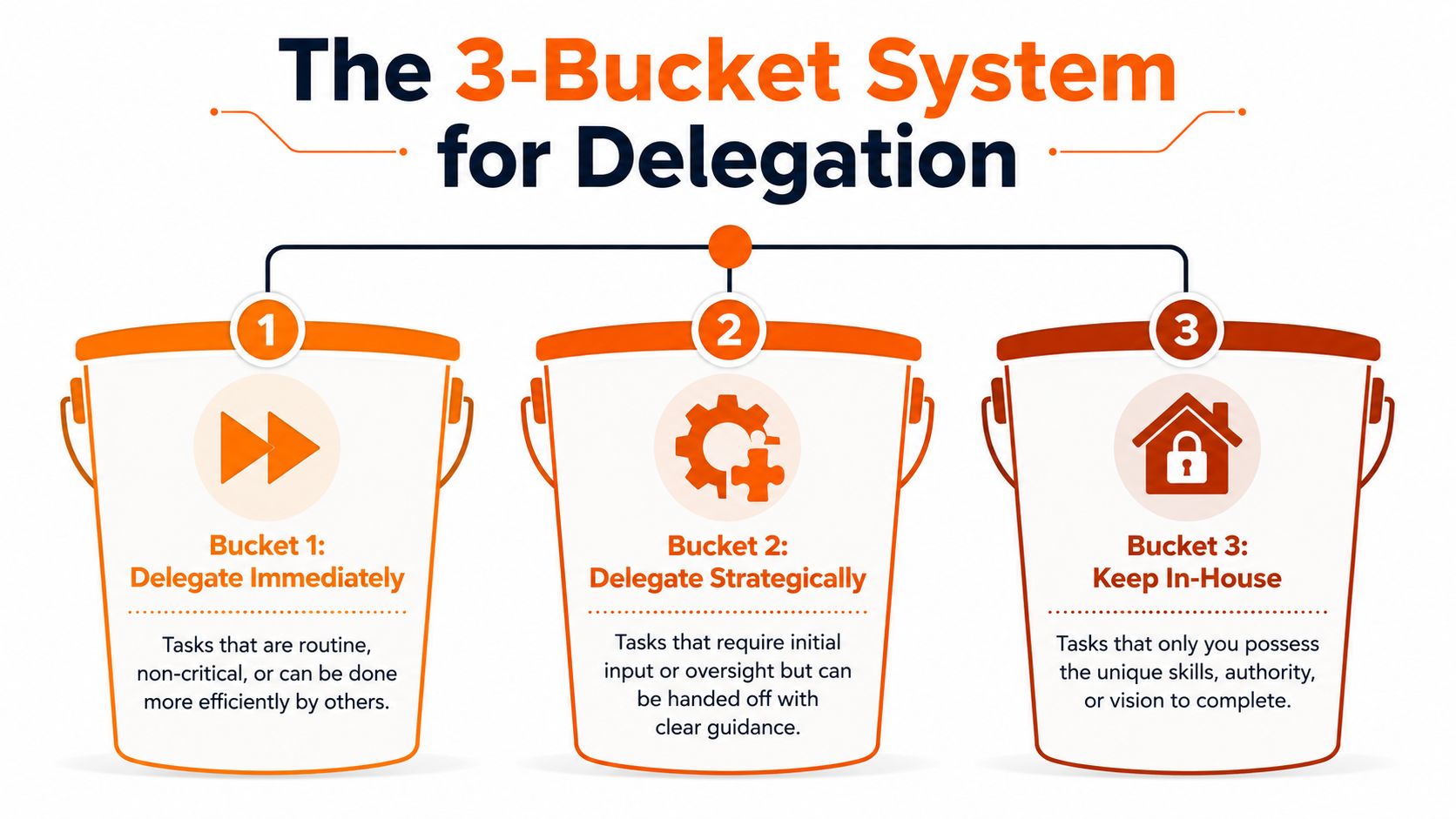
I use a simple filter. Think of your task list like a portfolio. Some assets you dump. Some you assign. Some you keep because they are the engine.
You must categorize every task on your list as “ditch,” “delegate,” or “do yourself” before deciding who will handle it, as explained in this delegation framework.
Bucket one is ditch
Some tasks should disappear entirely.
These are the zombie tasks. Reports nobody reads. Meetings that produce nothing. Tiny admin rituals you keep because “we've always done it that way.” If a task has no clear return, kill it.
A few examples:
- Manual copy-paste work: If Zapier, Airtable, or a simple Google Sheets workflow can handle it, stop doing it by hand.
- Status meetings without decisions: Replace them with a Loom update or a shared Notion page.
- Obsessive formatting: If the work is good, nobody cares whether the margins are spiritually aligned.
Bucket two is delegate
This bucket is where most founder power sits.
These tasks matter, but they do not need your fingerprint on every line. Think customer support replies, inbox triage, research, content formatting, inventory updates, podcast outreach, CRM cleanup, order issue follow-up, and first-draft design work.
Here's a good gut check:
| Task type | Keep or hand off | Why |
|---|---|---|
| Repeatable weekly work | Delegate | Someone else can learn the rhythm |
| Work with a clear checklist | Delegate | Easy to document |
| Work that needs founder judgment | Do yourself | Your call matters most |
| Work with no payoff | Ditch | It steals time |
Later, when you hand these off, use check-ins at a set interval, then fade back so the other person owns the work. That rhythm matters because support is good, hovering is not.
A quick primer if you want another voice on the basics:
Bucket three is do yourself
Keep the tasks that require your judgment, your trust capital, or your taste.
That usually includes closing hard partnerships, shaping brand direction, making hiring calls, handling sensitive money decisions, and deciding what the business says yes or no to.
Delegation works best when you stop handing off randomly and start protecting the few jobs that are actually yours.
If everything feels important, use a ruthless test. Ask, “Would the business get hurt if this were done competently by someone else?” If the answer is no, it belongs in bucket two or the trash.
How to Pick the Right Person for the Job
Founders waste a lot of time waiting for the perfect hire. They think delegation starts after they find a polished expert with flawless experience.
That's nice in theory. Early on, it's usually fantasy.
I'd rather hire for reliability, judgment, and teachability than a shiny resume. A business can survive a skills gap. It gets wrecked by a character gap.
Don't shop for perfection
When you're handing off for the first time, you are not hiring a savior. You are hiring a partner for a narrow slice of work.
That changes the brief. You don't need “the best operations person on the market.” You need someone who replies on time, follows instructions, asks decent questions, and doesn't disappear when a task gets boring.
If you need help understanding role types, pricing, and common tasks, this ultimate guide to hiring VAs is a useful starting point. And if you're moving from freelancers into a true team build, this piece on how to hire your first employee is worth reading before you make a bigger commitment.
Use a trust test, not a résumé test
I use a small paid trial. Nothing dramatic. Just enough real work to reveal how the person operates.
Give them a contained task with a clear finish line. Watch what happens.
- Do they communicate early? Good operators don't wait until the deadline to confess confusion.
- Do they follow the brief? Skill can improve. Carelessness is harder to fix.
- Do they make your life lighter? That's the whole point.
Here's the part most sterile delegation advice misses. Your first handoff isn't scary only because the other person might fail. It's scary because if they fail, you feel exposed. You worry your customers will see the wobble. You worry your standards will slip. You worry you'll have to clean up the mess and regret ever trying.
That fear is normal. But if you let fear choose for you, you'll keep over-hiring on paper and under-building trust in real life.
Pick hunger over polish
I've had better luck with people who say, “I haven't done this exact thing, but I can learn fast,” than people who sell themselves as plug-and-play experts for every task.
That's especially true for repeatable work inside startups and ecommerce brands. A lot of your systems are weird, half-built, and founder-specific anyway. Even a seasoned pro still has to learn your way of doing things.
I trust the person who asks one sharp question and follows through more than the person who talks like a consultant and misses the deadline.
Choose someone who treats your work with care. Then start small enough that both of you can build confidence without betting the company on one handoff.
Crafting a Brief That Actually Works
Most delegation failure starts with a lazy brief.
If you tell someone, “Can you take over social media?” you didn't delegate. You dumped a vague problem into their lap and hoped they'd read your mind.
That's why founders end up saying, “It's easier if I just do it myself.” No. It was easier for you to be unclear.
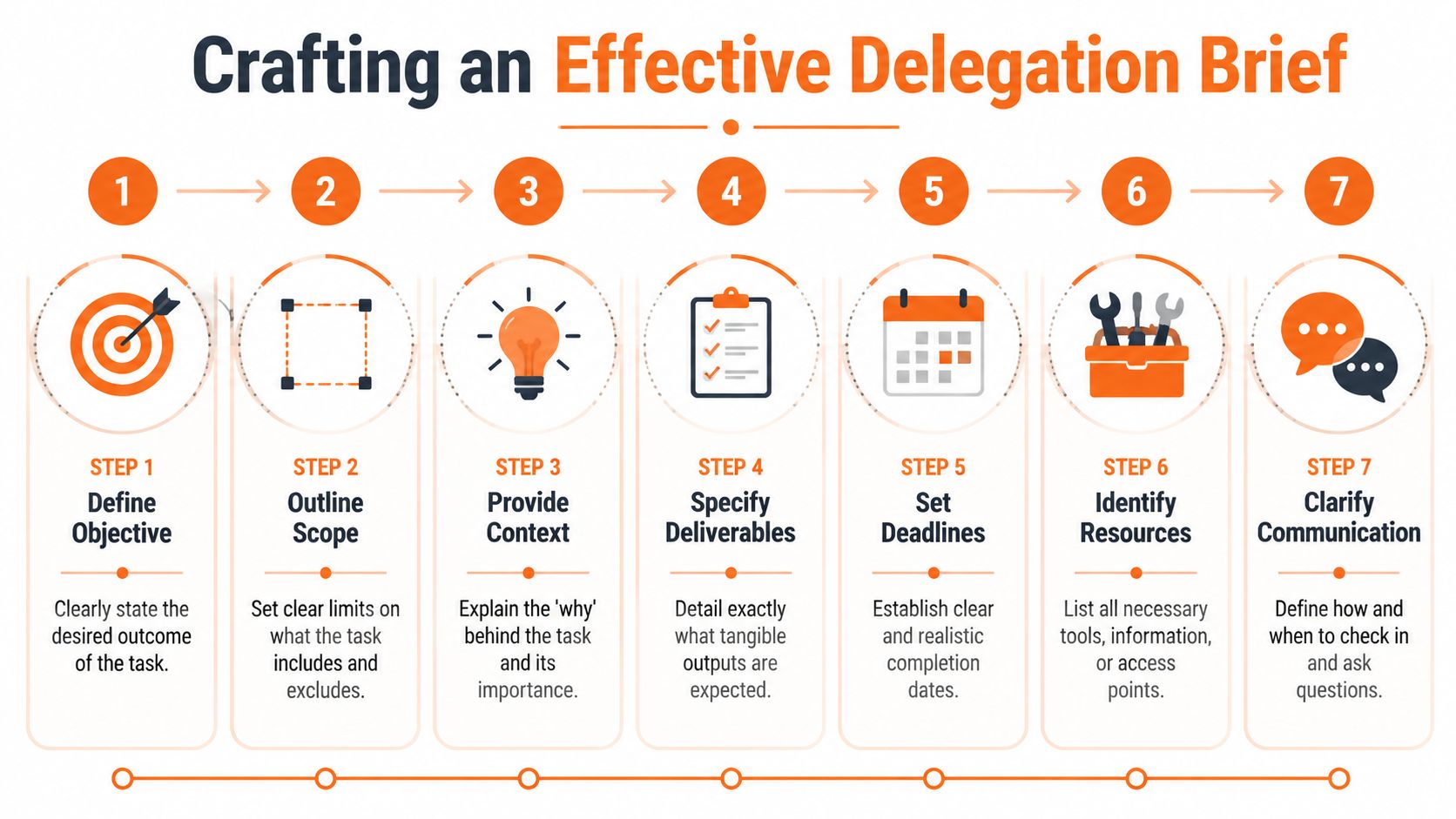
Use SMART and define authority
A working brief has two jobs. It makes the outcome clear, and it makes the decision space clear.
When delegating, you must use the SMART Framework, ensuring every task is Specific, Measurable, Achievable, Relevant, and Time-bound. You must also explicitly define the authority level the person needs to execute the task, as described in this SMART delegation reference.
Here's the difference.
Bad brief:
“Please handle customer support this week.”
Good brief:
“Reply to all customer support emails in Gmail between 9 AM and 1 PM daily this week. Keep first response under one business day. Use our saved replies in Help Scout, refund orders under our standard policy, and flag any angry customer or chargeback risk to me in Slack before acting.”
See the difference? The second version gives a finish line, tools, boundaries, and escalation rules.
My simple delegation brief template
I keep it plain. Usually in Notion or Google Docs.
Objective
What result do you want?Scope
What's included, and what is off-limits?Deliverable
What should the person hand back? A spreadsheet, draft, live update, inbox at zero?Deadline
Exact day and time.Resources
SOP, Loom, login access, examples, brand voice notes.Authority
What can they decide without you? What needs approval?Check-in rhythm
When should they update you, and where?
If your systems are still living in your head, fix that next. This guide on how to create standard operating procedures helps turn “how I usually do it” into something another person can follow.
Clarity beats charisma
You do not need to sound inspiring. You need to be clear.
A strong brief also gives context. Tell the person why the task matters. People work better when they know where their piece fits. But don't bury them in a founder memoir. Give enough background to make better decisions, then stop talking.
My rule of thumb: If a task comes back wrong, I read my brief before I blame the person.
That habit alone will make you better at how to delegate effectively, because it forces you to notice where your own communication is sloppy.
Common Delegation Pitfalls and How to Escape Them
Delegation often breaks after the handoff, not during it.
You assign the task, feel proud for six minutes, then panic when the work doesn't look exactly like your version would have looked. That's when founders grab the wheel back and call it quality control.
It's usually fear.
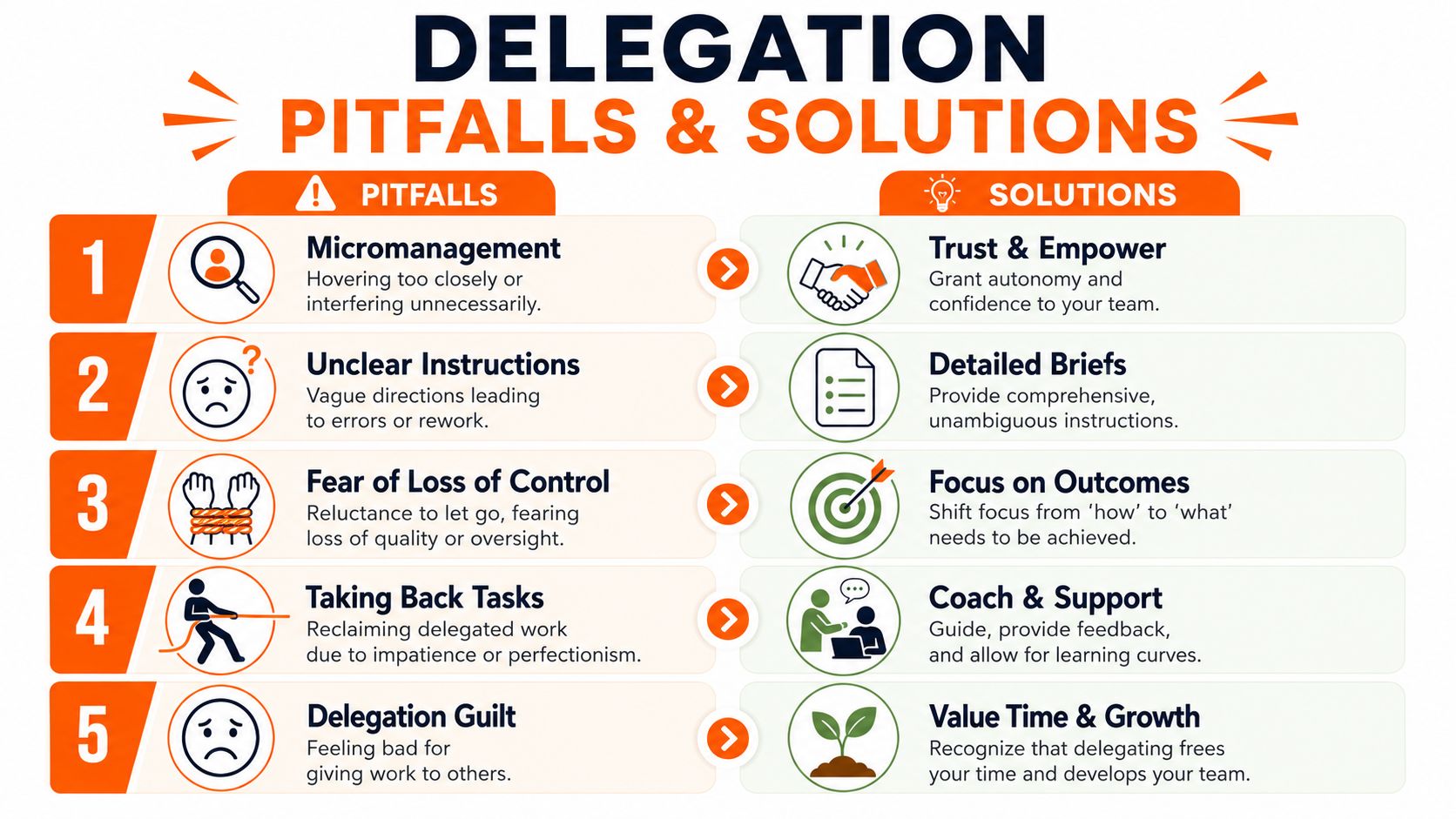
The five traps I see all the time
I've watched founders fall into the same holes again and again.
You take the task back too early
The first draft is clunky, so you rewrite the whole thing yourself. Now your hire learns nothing, and you prove that asking for help only leads to you snatching control back.You confuse support with surveillance
Slack pings every hour. Surprise edits. Random check-ins. Nobody does good work while being watched like a shoplifter.You hand off a task without emotional cover
This one matters more than people admit. If the person believes one mistake will get them blamed, they will protect themselves instead of taking ownership.You delegate the task but not the power
They still need your approval for every tiny move, so you become a bottleneck with extra steps.You react to mistakes like betrayal
A miss becomes proof that “nobody can do this but me.” That story is convenient and expensive.
Psychological safety is not soft
If you're a solo founder, the hardest thing to hand off is usually the thing tied closest to your identity. Customer communication. Brand voice. Sales outreach. Anything public.
That fear leaks into your tone. Your hire can feel it.
In environments with low psychological safety, managers who explicitly frame delegation as “shared ownership with safety buffers” reduce team anxiety by 41% and increase task completion rates by 38%, according to this discussion referencing the psychological safety framing.
So say the quiet part out loud. Try this:
“You own this task. I'm here if you hit a wall. If something goes sideways, we'll fix it together.”
That sentence changes the air in the room. It tells the person they are trusted, and it tells them failure won't become public shaming.
What to do when the task goes sideways
When a handoff goes badly, don't jump straight to blame. Diagnose the miss.
| What happened | Usually means | What I do next |
|---|---|---|
| Deadline slipped | Scope or timing was fuzzy | Tighten deadline and checkpoints |
| Work is off-brand | Context was too thin | Add examples and a Loom walkthrough |
| Person froze | Authority was unclear | Spell out what they can decide |
| Too many questions | Brief lacked structure | Turn the answers into an SOP |
When you respond calmly, you make future delegation easier. When you explode, people stop taking initiative and start playing defense.
That's the hidden cost of founder anxiety. It doesn't stay in your head. It changes how your team works.
Your First Delegation and Making It a Habit
Your first real delegation should be boring.
Don't start with your biggest launch, your most sensitive client, or the task that keeps you awake at night. Start with something small, useful, and repeatable. The point is to build the muscle, not perform a leadership stunt.
That matters because natural proficiency at this skill is uncommon. Only 19% of manager candidates demonstrate strong delegation abilities, according to DDI's burnout and leadership data. So if this feels awkward, good. It means you're practicing a hard skill instead of pretending you already have it.
Start with one small handoff
Pick one task from your delegate bucket this week.
Good first choices are things like inbox triage, podcast outreach, pulling weekly numbers into a dashboard, first-pass customer support, or turning your Loom notes into a draft SOP.
Then do these four things:
Choose the task carefully
Small enough to survive a mistake. Useful enough to matter.Choose the person objectively
Don't pick based on hope. Pick based on reliability.Write the brief like you mean it
Clear outcome, authority, deadline, resources.Stay available without hovering
Agree on one check-in point. Let them work.
Build a repeatable loop
Delegation gets easier when it becomes a system instead of an emotional event.
After each handoff, ask yourself:
- What did I explain badly?
- Where did they get stuck?
- What should become a checklist or SOP now?
- What can I trust them with next time?
That review is where the compounding happens. One clean handoff becomes a repeatable process. One process becomes a role. One role gives you room to think like a founder again.
You do not become good at delegation by reading about it. You become good at it by surviving a few imperfect handoffs and improving the system each time.
If you keep doing everything yourself, your business will keep depending on your mood, your stamina, and your available hours. That is a fragile company.
If you learn how to delegate effectively, you build something sturdier. You make room for better decisions. You give other people the chance to rise. And you stop treating leadership like personal martyrdom.
If you're a kind, ambitious founder in Chicago or the Midwest and you want honest conversations like this with people who are building, check out Chicago Brandstarters. It's a free vetted community for founders and operators who want real tactics, real support, and real relationships, not performative networking.
Leave a Reply