
You shipped the product in your head a hundred times already.
You've pictured the signup spike, the kind replies, the first paying customer, the friend texting “this is slick.” But when the actual launch gets close, your brain stops playing the movie and starts running disaster drills. What if nobody cares? What if people click and bounce? What if the bugs show up right when you post?
I know that feeling. Most founders do. Product launch strategy sounds like something a big company does with a war chest and a room full of specialists. In real life, for small teams, it's simpler and harsher than that. You need a clear message, a tight plan, a way to learn fast, and the nerve to launch before you feel fully ready.
Your Product Is Ready But You Are Terrified to Launch
A founder I know spent months polishing a product, tweaking onboarding copy, fixing edge cases, and moving the launch date every week. The product was fine. The problem was emotional. Hitting publish felt like asking the market a very personal question: “Do you care about this thing I made?”
That's why so many launches drag. Fear dresses itself up as discipline. You tell yourself you're “just tightening the funnel” or “waiting for better timing.” Maybe that's true. Often, it's not.
The better move is to stop treating launch like a public exam and treat it like the first live sales call. You're not trying to impress everyone. You're trying to get a small group of the right people to try the product and tell you the truth.
Launching is less like opening night on Broadway and more like opening a food stall at a market. You want a line of the right hungry people, fast feedback, and enough momentum to stay open tomorrow.
If you're stuck in your own head, spend ten minutes reading other founders talk about the emotional side of building. The posts under what is entrepreneurial mindset get at the part most launch guides skip. The fear is normal. The fix is action with structure.
Here's my blunt take. If you wait until launch feels safe, you'll wait too long. The point isn't to remove fear. The point is to give fear less room to run the company.
Nail Your Foundation Before You Build Anything
Most bad launches don't fail on launch day. They fail weeks earlier, when the founder skips the hard thinking and jumps straight into logos, landing pages, and social posts.
That's like pouring drywall before you've laid concrete. The house looks busy for a minute. Then it cracks.

A practical product launch strategy follows five linked stages: market research, target audience definition, value proposition design, launch-plan orchestration, and KPI measurement, according to Productboard's product launch strategy guide. I like that framework because it forces you to act like an adult. You can't hide behind “marketing” when the issue is that you still don't know who this is for.
Start with two painful questions
Ask these before you touch your launch calendar:
- Who is this for right now
- Why should they care today
If you answer either one with a broad statement, you're not ready.
“Small businesses” is not a target. “Ops managers at small ecommerce brands who lose time reconciling inventory across two sales channels” is closer. “Helps teams work better” is not a message. “Cuts the weekly spreadsheet cleanup that your ops lead hates” is at least usable.
Write a one-page customer brief. Keep it ugly and useful.
- Buyer: Name the person, their role, and what kind of day they're having before they find you.
- Problem: Describe the friction in plain words. No jargon. No category language.
- Current workaround: Spreadsheet, assistant, agency, sticky notes, old software. Buyers already have a system, even if it's bad.
- Buying trigger: What makes them look for a fix now?
- Objection: Why will they hesitate?
Pick one launch outcome
Most founders set goals like “get traction.” That's not a goal. That's a wish.
Choose one concrete outcome that shows early real demand. Tie it to behavior, not applause. For a new product, I care a lot more about whether people complete the first meaningful action than whether they liked my announcement post.
Practical rule: If your launch goal can't tell your team what to do differently tomorrow, it's too vague.
Pricing starts messing with your launch before you realize it. If your price is fuzzy, your offer is fuzzy. If your offer is fuzzy, your landing page gets weird. If your landing page gets weird, your launch gets soft. If you need help thinking through that chain, study examples under pricing strategy for new products.
Write positioning that a tired stranger can understand
Use this simple structure:
We help [specific buyer] do [specific job] without [painful workaround].
That's not poetry. Good. Launch copy should be clear before it's clever.
A few examples:
- We help first-time ecommerce founders build their first reorder plan without wrestling with giant spreadsheets.
- We help agency owners collect client approvals without email ping-pong.
- We help restaurant operators train new staff without printing another binder.
If you can't write one sentence like that, don't buy ads yet. Don't brief a designer yet. Don't schedule a launch yet. Fix the foundation first.
Create Your Pre-Launch Battle Plan
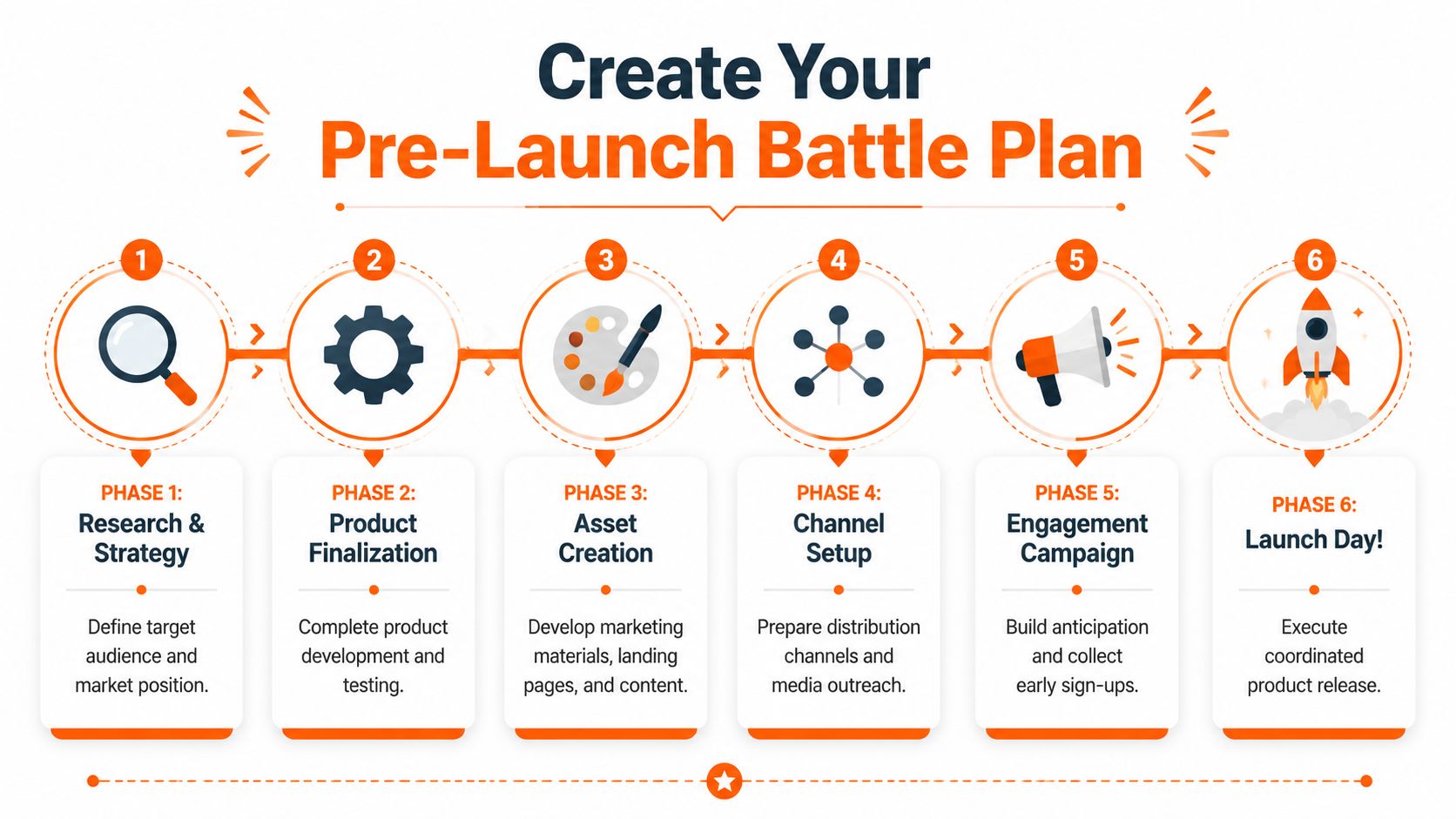
Once the foundation is solid, you need a battle plan. I mean a real one. Not vibes. Not a random Notion page with twenty unchecked boxes. A launch plan is a coordinated system.
That matters because successful launches have long been tied to stronger skills in marketing research, sales force, distribution, and promotion, according to the Industrial Marketing Management study summary. In plain English, the market doesn't care that your product is elegant if your message is muddy, your channels are weak, or your handoff falls apart.
Pick fewer channels than your ego wants
Small teams die from channel sprawl.
You do not need LinkedIn, X, Instagram, TikTok, Reddit, email, paid search, podcast outreach, affiliates, and webinars all at once. You need the one or two places where your buyer already pays attention.
Use this test:
| Channel | Use it when | Skip it when |
|---|---|---|
| You already have warm contacts or a waitlist | You're starting from zero and hoping strangers will care | |
| Your buyer has a job title and talks shop in public | Your product is highly consumer or impulse-driven | |
| Reddit or niche forums | Buyers describe their pain in plain language there | You only plan to drop links and disappear |
| Partnerships | Someone else already has your audience's trust | You need results tomorrow |
If you're trying to keep the process sane, a simple new product launch guide can help you build a checklist without turning your launch into a bureaucracy project.
Build assets that earn the next conversation
Most founders overbuild launch assets and underbuild proof.
You do not need a cinematic brand video. You probably do need these:
- A landing page: One promise, one call to action, one proof point if you have it.
- A waitlist or early access form: Keep fields short.
- A short demo: Loom is enough.
- An email sequence: Welcome, reminder, launch note, follow-up.
- A FAQ doc: Handle objections before they hit support.
For content, keep it simple.
- Pre-launch post: Name the problem. Invite early access.
- Launch post: Show what the product does, who it's for, and what to do next.
- Post-launch story: Share one user reaction, one lesson, or one improvement you made fast.
Make a runbook your team can actually use
A good runbook is boring. That's why it works.
Put it in Google Sheets, Airtable, or Notion. List the task, owner, deadline, asset link, channel, and status. If you have a tiny team, add a “backup owner” column because people get sick, internet dies, and launch week has a weird sense of humor.
Use this product launch checklist template if you want a starting point and don't want to build from scratch.
If a task isn't assigned to a human with a date next to it, it isn't part of your launch plan. It's a hope.
The Launch Day Playbook
Launch day should feel like mission control, not a fireworks show.
I don't like the big-bang launch for most early-stage founders. It creates stress, hides learning, and pushes you toward hype when what you need is signal. A staged rollout is usually smarter. Guidance from Pragmatic Institute on launching a new product leans the same way, with dogfooding, user feedback, and releasing to one segment at a time built into the launch itself.
Run a controlled burn
A staged launch gives you room to think.
Start with the people most likely to care and forgive rough edges. That might be your waitlist, warm contacts, former customers, or a niche community where you've already shown up as a human. Let them in first. Watch where they get stuck. Fix the roughest parts before you widen the door.
Here's how I like to handle the day:
- Morning: Check the product yourself. Signup flow, onboarding, emails, payment, support inbox.
- Mid-morning: Send the launch email and post on your main public channel.
- Midday: Reply to every serious comment and direct message.
- Afternoon: Review bugs, confusion points, and drop-off moments with your team.
- Evening: Follow up with early users personally.
Build a tiny war room
Your war room can be a Slack channel, a WhatsApp thread, or a shared doc with timestamps. Fancy doesn't matter. Fast does.
Track four things in real time:
- What broke
- What confused people
- What made people sign up
- What language users used to describe the value
That last one matters more than founders think. If three users explain your product better than your website does, your website is wrong.
Act like a host, not a broadcaster
The first users are not an audience. They're guests in your house.
Thank people. Ask what they expected. Ask where they got stuck. If someone reports a bug, reply fast and tell them what you're doing about it. If someone loves one feature, ask what job it solved.
That kind of founder-led engagement is your unfair advantage. Big companies can buy reach. They can't fake intimacy.
Measure What Matters After Launch
The day after launch can mess with your judgment.
You'll see a pile of fast feedback. Traffic spikes. Likes. Comments. A few congratulatory replies. None of that tells you whether you launched something people will keep using.
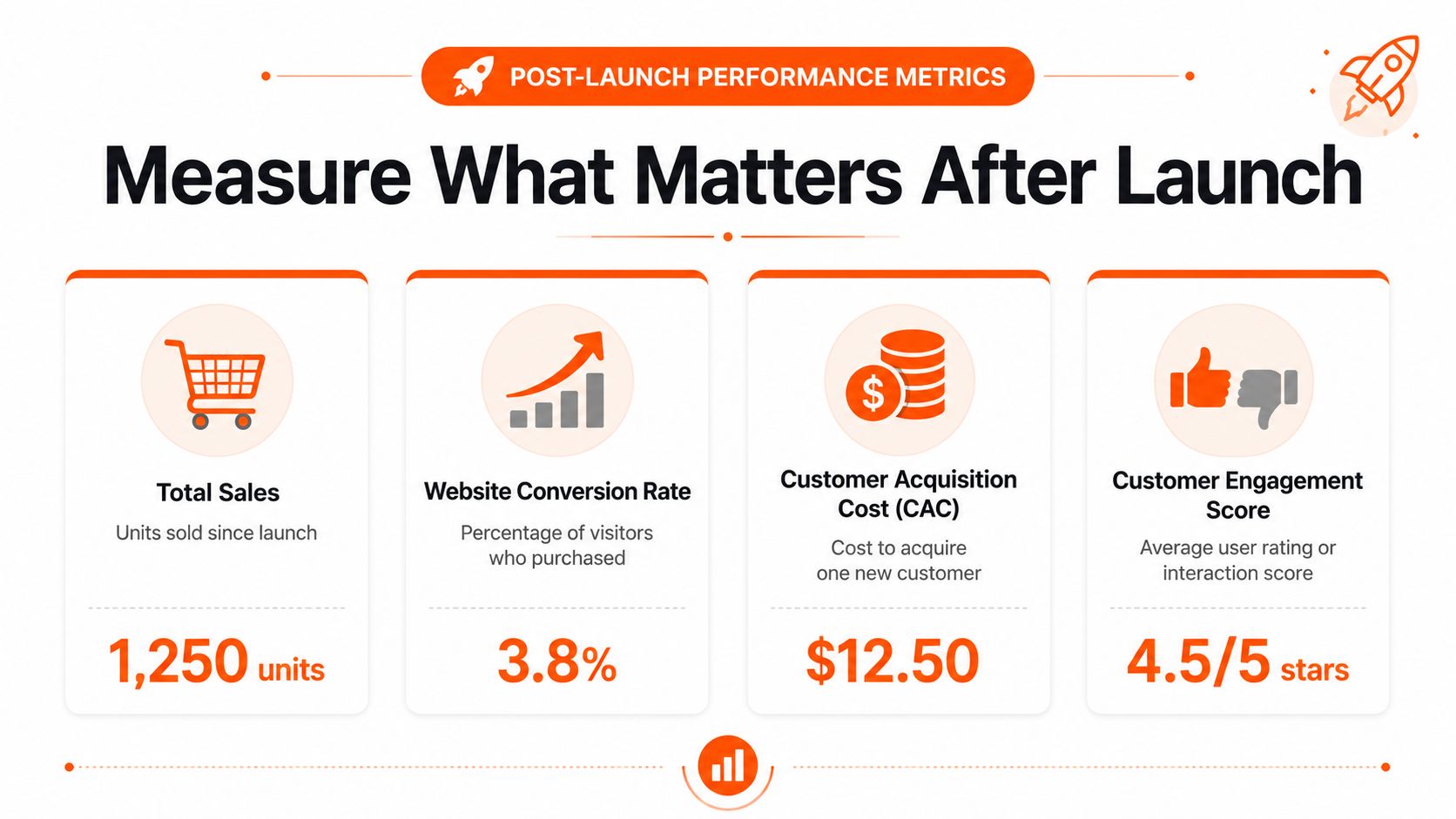
I care about behavior. For recently launched products, the metrics that matter most are sign-up rate, activation rate, user engagement, and user retention, according to Gainsight's guide to product launch metrics. Gainsight defines activation rate as the share of sign-ups who complete a critical event, and time to value as the time between sign-up and activation. For a small team, that's the whole job after launch. Did people sign up, did they reach value fast, did they use the product again, and did they stick?
The four numbers I actually care about
For an early launch, put these on one dashboard or one sheet and look at them every day for the first couple of weeks:
| Metric | What it tells you | Why it matters |
|---|---|---|
| Sign-up rate | Whether your page and message convert interest | Weak performance here usually points to a bad promise, wrong audience, or weak offer |
| Activation rate | Whether users reach the first meaningful win | Many launches die at this stage |
| User engagement | Whether people use the product after first touch | It shows whether curiosity turned into real behavior |
| User retention | Whether they come back | Returning users are harder to fake than launch buzz |
Keep it simple. Stripe, PostHog, Mixpanel, Amplitude, Google Analytics, customer interviews, and a spreadsheet are enough for most scrappy launches. Manual counts beat dashboard theater every time.
Define your critical event
If you don't define activation, you'll start calling random clicks progress.
Pick one action that proves the user got the first real win. For a design tool, that might be “created first project.” For a scheduling product, it could be “published first booking page.” For a B2B workflow app, I'd track “invited teammate and completed one workflow.”
Then measure two things. How many signups reach that point, and how long it takes.
My bias: A launch with modest signups and strong activation is healthier than a noisy launch with weak activation.
Segment early or you'll fool yourself
Average numbers hide the truth.
One acquisition source can produce engaged users while another sends people who bounce in minutes. If you only look at the blended average, you miss the underlying problem. Split early users by source, persona, use case, or plan type. Then compare who activates, who sticks, and who disappears.
If you're doing B2B outreach around launch, this primer on B2B SaaS campaign success metrics is useful for judging campaign quality without drowning in vanity metrics.
Post-launch measurement is not about grading yourself. It's about deciding what to fix next, with limited time and limited money. If signups are healthy but activation is weak, fix onboarding. If activation looks good but retention falls off, the product still isn't solving an important enough problem. If nobody signs up, your message or targeting is broken before the product even gets a fair shot.
Scrappy Tactics and Templates for Small Teams
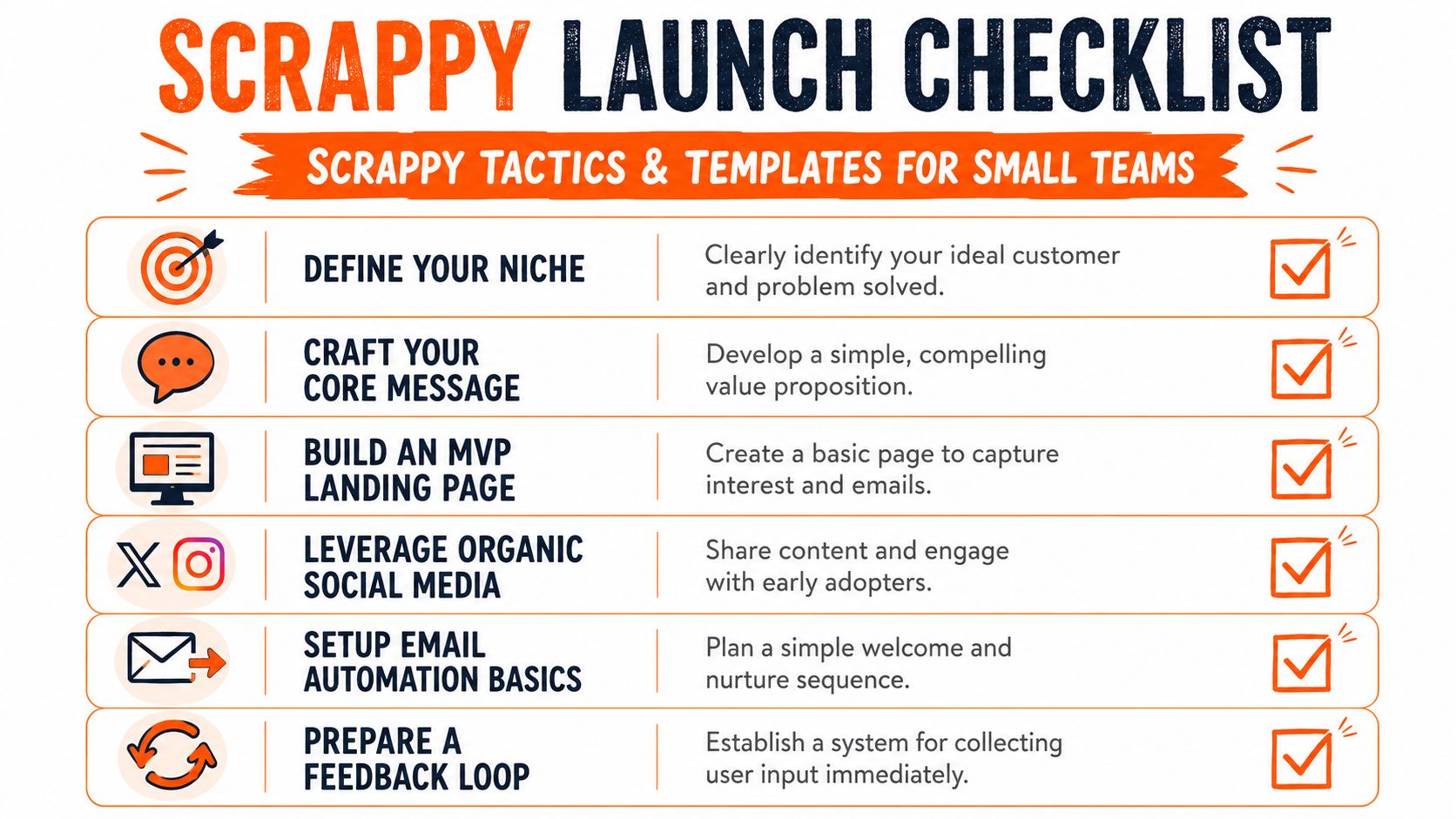
You do not need a launch team of twelve. You need a tight plan, a short list of people to contact, and the discipline to hear the truth fast.
Small teams have one advantage big companies can't fake. You can talk to early users like a human, change the product in days, and follow up without sending people through a support maze. Use that.
Use the founder's unfair advantages
If I were launching with more grit than budget, I'd start here:
- Personal outreach: Send short notes to people with the problem right now. Skip mass blasts. Specific beats broad.
- Manual onboarding: Get on Zoom, send a Loom, or record a voice note. Watching someone get stuck will save you weeks of guessing.
- Fast fixes in public: Tell users when you change something because of their feedback. That builds trust and gives people a reason to come back.
- Niche communities: Show up where your buyers already ask questions. Help first. Share links sparingly.
- Founder-led content: Post the story behind the product, the use case, the demo, and what you're learning. Polished brand content is weaker than clear proof from the person building it.
Copy these outreach templates
Use this for likely early users:
Hey [Name], I built [product] for [specific problem]. I thought of you because you deal with [relevant pain]. I'm opening early access and would love your blunt feedback. If you want, I can send a short demo.
It works because it respects the reader's time and gives them an easy next step.
Use this after signup:
Thanks for trying it. What were you hoping this would help you do first?
I ask this a lot. You'll get better language from that one question than from an hour of internal brainstorming.
Keep your budget tight, not fake-tight
Founders love saying they launched with no budget. I don't find that impressive. A launch still needs a few basic inputs if you want clean learning instead of chaos.
Spend first on the things that remove friction and help you learn faster:
| Spend area | Why I'd fund it first |
|---|---|
| Landing page and copy | Weak copy makes every channel underperform |
| Basic analytics | You need to see where users stall or drop |
| Email setup | Email is still one of the simplest launch tools |
| Short demo assets | A quick Loom closes the trust gap fast |
| Small paid test, if relevant | Useful for message testing, not vanity |
Skip expensive brand work, swag, and broad awareness campaigns. Small teams do better with focused spend and direct contact.
A simple launch runbook you can steal
Keep one working doc with:
- Core message
- Target segment for first release
- Main channel and backup channel
- Landing page link
- Email copy
- Demo link
- Support contact
- Critical event for activation
- Daily check-in notes
- Top user feedback and fixes
That document should be boring. Good. Boring systems keep launches on track when inboxes get messy and users start asking for five different things at once.
Your Launch Is a Starting Line Not a Finish Line
The launch is not the victory lap. It's the first hard rep.
Quiet launches can work really well. In fact, I trust them more. A small set of users who care, activate, and come back will teach you more than a loud launch full of polite attention. If your product launch strategy helps you learn fast, tighten the message, and earn a second wave of users, it worked. That's true even if day one felt smaller than you hoped.
Be brave enough to launch. Be humble enough to learn. That combination beats hype almost every time.
If you're building in Chicago or the Midwest and want honest feedback from other founders before or after launch, Chicago Brandstarters is a free vetted community where builders talk through real problems in small private dinners and an active group chat. It's a practical place to pressure-test your message, pricing, and launch plan with people who are in the arena.
Leave a Reply