You've got a product you believe in. Maybe you're boxing orders on your kitchen table in Chicago. Maybe you're still tweaking the first version in a garage in Indiana, Wisconsin, or Michigan. Either way, you've hit the same wall most founders hit. You need attention, and paid ads feel expensive, crowded, and easy to burn through.
So you start thinking about influencers.
Then the chaos starts. One creator wants free product. Another sends a rate card that makes no sense. A third has a nice-looking feed but followers that don't seem like real buyers. You can absolutely start by DMing creators yourself, but after a few days you realize you've wandered into a flea market with no price tags and no map.
That's where social media influencer agencies enter the chat. Sometimes they save you time and spare you dumb mistakes. Sometimes they just add a middleman and a fat invoice.
Your Brand Needs Eyes But Where Do You Start
I've seen this play out a lot. A founder has a product people like once they try it. The issue isn't the product. The issue is distribution. You don't need more opinions from friends. You need the right people to see the thing.
That's why influencer marketing keeps pulling founders in. The category grew from $1.7 billion in 2016 to a projected $32.6 billion in 2025, and 26% of marketing agencies and brands worldwide allocate more than 40% of their marketing budgets to influencer partnerships, according to Sprout Social's influencer marketing statistics. That tells you one simple thing. This channel isn't a side experiment anymore.
But that doesn't mean you should throw money at the first agency with a polished deck.
The first trap is random outreach
Most early founders start the same way. They search TikTok, Instagram, and YouTube. They make a spreadsheet. They send awkward DMs. Some creators reply. Most don't. A few want terms that don't fit your budget or your brand.
That DIY path can work. I'd even say you should do a little of it before hiring anyone, because it teaches you what creators ask for, how long approvals take, and how messy “simple” campaigns get.
If you've never run a small creator campaign yourself, you're buying blind when an agency pitches you.
Agencies can help, but only if you know what you're buying
A lot of founders hear “agency” and assume it means strategy, relationships, creative direction, reporting, and magic. Sometimes it means that. Sometimes it means somebody emails creators on your behalf.
If you want a quick lay of the land before taking calls, it helps to compare top influencer agencies so you can see how different firms position themselves. Then get your own basics straight first. If your offer, audience, and product story are still fuzzy, fix that before you hire outside help. This guide on how to brand a product is a good place to clean up the message before you pay anyone to amplify it.
Here's my blunt take. If your brand story is mush, an agency won't save you. They'll just package the mush better.
What Do Influencer Agencies Actually Do
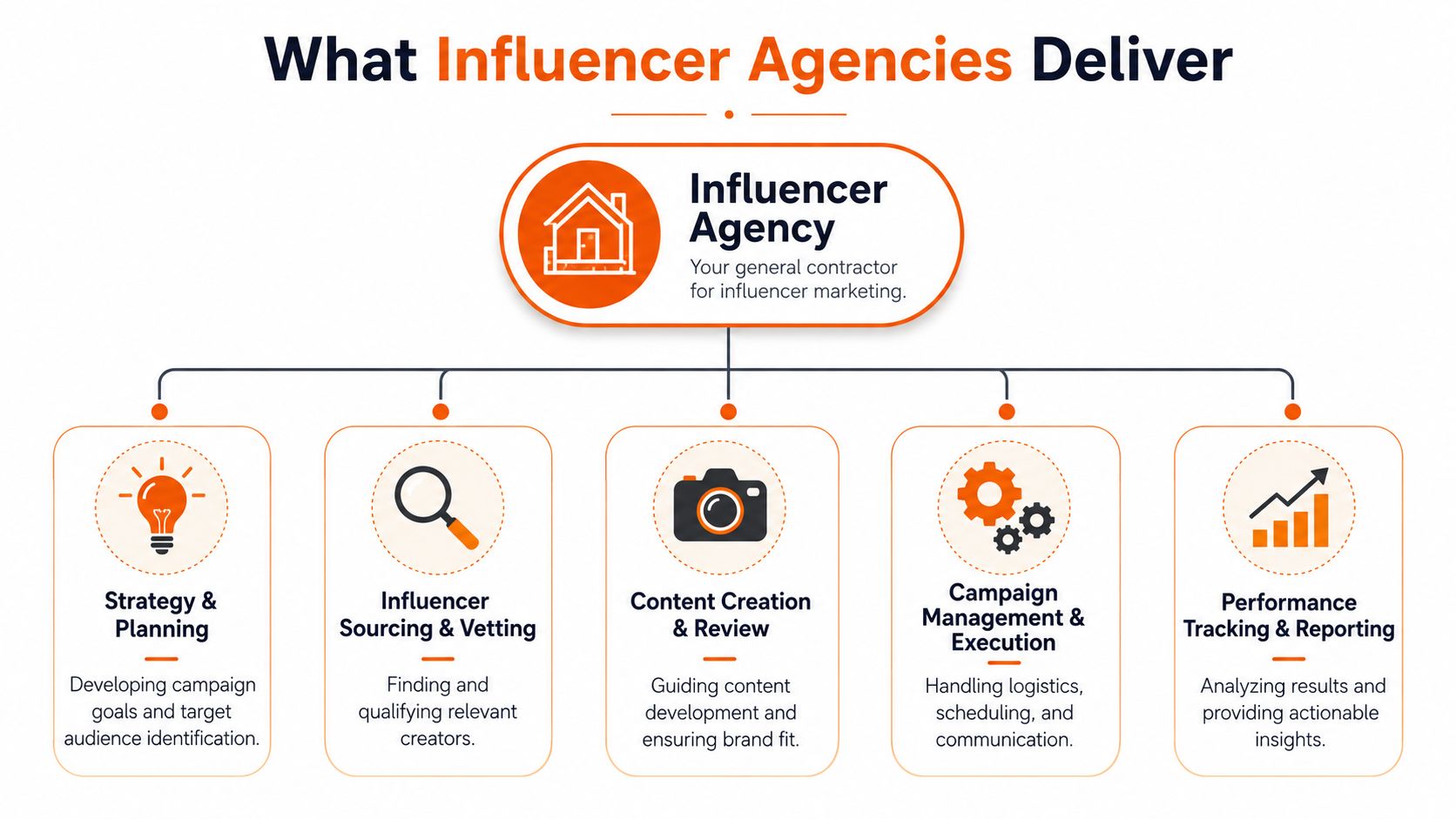
Think of an influencer agency like a general contractor on a house remodel. You could call the electrician, plumber, drywall crew, and inspector yourself. But if you don't know the order, the pricing, or the failure points, the job drags and mistakes pile up.
That's what agencies sell. Coordination.
According to the 2026 Influencer Marketing Benchmark Report, the most commonly outsourced function was creator discovery and vetting at 19.44%, followed by content production at 15.28%. Talent management and long-term creator partnerships, paid amplification, and fraud detection and authenticity checks each accounted for 12.5%. These are the primary tasks. Agencies exist because the grunt work is annoying, specialized, and easy to screw up.
The work you're actually paying for
A decent agency usually handles a mix of these jobs:
- Creator sourcing: They build the first list so you're not manually searching hashtags at midnight.
- Vetting: They look at fit, audience quality, posting style, and whether the creator has worked with brands in a way that makes sense for yours.
- Outreach and negotiation: They ask about rates, deliverables, timing, usage rights, and exclusivity.
- Project management: They chase deadlines, wrangle briefs, and keep approvals moving.
- Content review: They catch posts that go off-brand before they go live.
- Payments and paperwork: They organize contracts, invoices, and creator payouts.
- Reporting: They turn campaign mess into something you can review.
That last part matters more than founders think. Most campaigns fail in the boring parts, not in the flashy kickoff call.
Where agencies can save your sanity
If you're handling product, operations, customer emails, and inventory, adding ten creators into the mix can feel like juggling knives. One creator misses a ship date. Another needs a revised brief. One posts the wrong link. One sends an invoice with no tax form attached.
That's why an agency can earn its fee. It buys back founder attention.
Practical rule: Hire an agency when the operational drag is hurting your speed more than the fee is hurting your cash.
Some teams also use software and workflow tools to keep all this moving. If you want to see one angle on how agencies streamline creator content systems, UGC Copilot for agencies is worth a look.
The mistake is assuming all agencies do all jobs well. Some are great at finding creators and bad at reporting. Some are strong operators and weak strategists. Ask what they personally do versus what they hand off to software, freelancers, or junior staff.
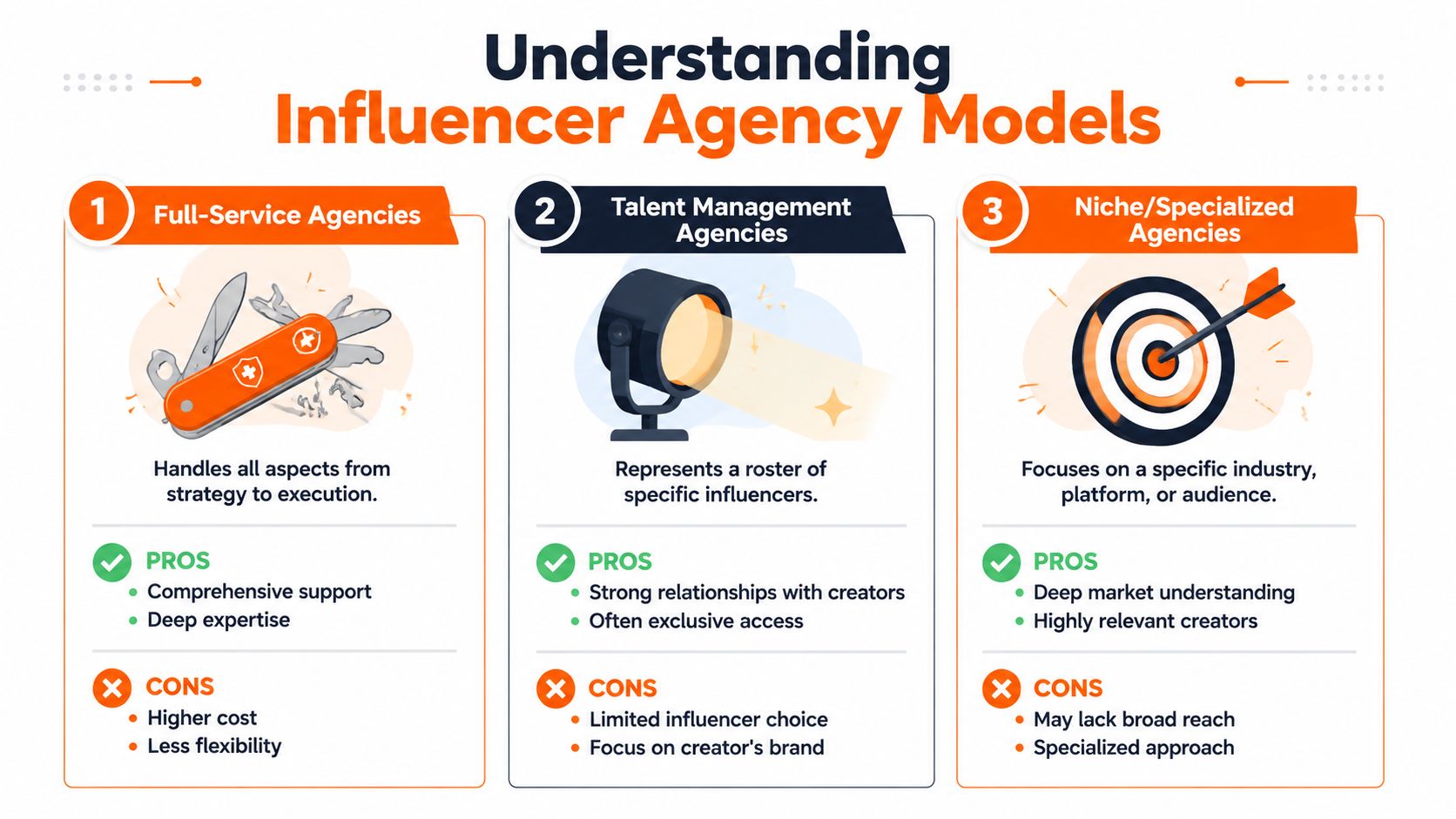
The Three Types of Influencer Agencies
Hiring “an influencer agency” is too vague. That's like saying you need music for an event. Do you need the artist's manager, the concert promoter, or a booking site? Those are different things. Same deal here.
Talent reps
These firms represent creators. Their first loyalty is usually to the talent on their roster, not to your brand.
That doesn't make them bad. It just means their incentives are different. If you already know exactly which creator you want, a talent rep can help close the deal. If you need broad market scouting, strategy, and channel management, this model is too narrow.
Use talent reps when:
- You want a specific creator
- You need access to represented talent
- You already have campaign strategy in-house
Watch out for one thing. A roster-driven shop often recommends who they already represent. That's like asking a barber if you need a haircut.
Full-service influencer marketing agencies
This is the classic model. Strategy, creator research, briefs, content review, contracts, shipping coordination, reporting. They run the whole machine.
For busy teams, this can be useful. For broke startups, it can be overkill. A full-service shop is best when you already know influencer is a repeatable channel for your business and you need execution at a higher volume.
Here's the upside and downside in plain English:
| Type | Best for | Main risk |
|---|---|---|
| Full-service agency | Brands that need end-to-end help | You pay for a lot, even if you only need part of it |
| Talent rep | Brands targeting specific creators | Creator choice is limited by roster |
| Platform or software-led option | Lean teams that can manage campaigns | You still do much of the work yourself |
Platforms and tech-led options
These aren't always “agencies” in the old sense. They're more like marketplaces or operating systems. You use the tool to find creators, assess fit, manage outreach, and track performance.
That can be smart if you've got more time than cash.
A lot of modern shops and platforms also use data-heavy matching. According to Influence Vision's agency report, agencies and platforms use AI-driven systems to evaluate audience relevance, engagement rate, and past campaign performance. That's a better way to think about creator selection. It's a matching problem, not a popularity contest.
Here's a quick explainer if you want another angle on the models before you take meetings:
A creator with the perfect follower count and the wrong audience is like renting a billboard in the wrong town.
My recommendation for early founders
If you're pre-scale, skip the giant generalist agency unless you've already proven this channel works. Start with one of these instead:
- A niche shop that knows your category
- A freelancer or small operator who can run campaigns without huge overhead
- A platform if you're organized enough to manage the workflow
Big agencies are built for bigger teams. Don't rent an airport when you need a bike.
Understanding Pricing and Contracts
Here, founders get fleeced.
Most agency decks look clean right up until the pricing page and contract terms. Then you realize you're not just paying for creator work. You're paying for management fees, content handling, usage rights confusion, revision loops, and terms that lock you in when you still don't know if the channel works.
The common pricing models
You'll usually see one of three setups.
Monthly retainer. You pay a flat fee for the agency's time and management. This is predictable for budgeting, but it can hurt when campaign volume is low. If you only run a light test, a big retainer feels like paying for a whole gym when you just wanted a treadmill.
Percentage-based fee. The agency takes a cut tied to media spend, creator spend, or campaign budget. This can feel fair at first, but it creates weird incentives. If they make more when you spend more, you need to watch whether they push bigger programs before you've earned the right.
Commission or hybrid model. Some mix a base fee with performance upside or creator spend markup. This can work if the terms are clean. It can also become a shell game if you can't tell where their profit sits.
What to read before you sign
Don't skim the contract. Read it like someone trying to take your wallet wrote it.
Pay close attention to:
- Content ownership: If a creator makes a great video, can you reuse it on your own ads, website, email, or product page? For how long?
- Exclusivity: Can the creator promote a competitor next week, or are they blocked for a period that matters?
- Approval rights: Who has final say before content goes live?
- Payment timing: Do you pay upfront, on milestones, or after posts publish?
- Cancellation terms: Can you walk away if the relationship is bad?
- Reporting scope: What exactly do they deliver after the campaign ends?
If a contract is vague on content usage, assume you do not own nearly as much as you think you do.
Clauses that deserve extra suspicion
Founders on tight budgets should be careful with any proposal that has these landmines:
- Long lock-ins: If they want a long commitment before proving fit, be skeptical.
- Blurry deliverables: If “campaign management” is listed without specifics, ask for line-by-line scope.
- Guaranteed virality language: Serious operators don't promise that.
- No test period: Good partners are willing to earn the longer engagement.
A simple way to handle this is to ask for a short pilot. One product, a small creator set, fixed deliverables, clear reporting, and a review date. If they resist that, they may know the economics only work when you commit before you understand what you bought.
My contract rule
I like agreements that answer three questions fast:
- What exactly are you doing?
- What exactly am I paying for?
- What do I still own when this ends?
If you can't answer those in plain English, don't sign it.
How to Measure What Matters
If an agency sends you a report full of likes, views, and comments and acts like that's the finish line, push back. Hard. Those numbers can tell you whether content caught attention. They do not tell you whether the campaign helped your business.
Founders need a fuller picture.
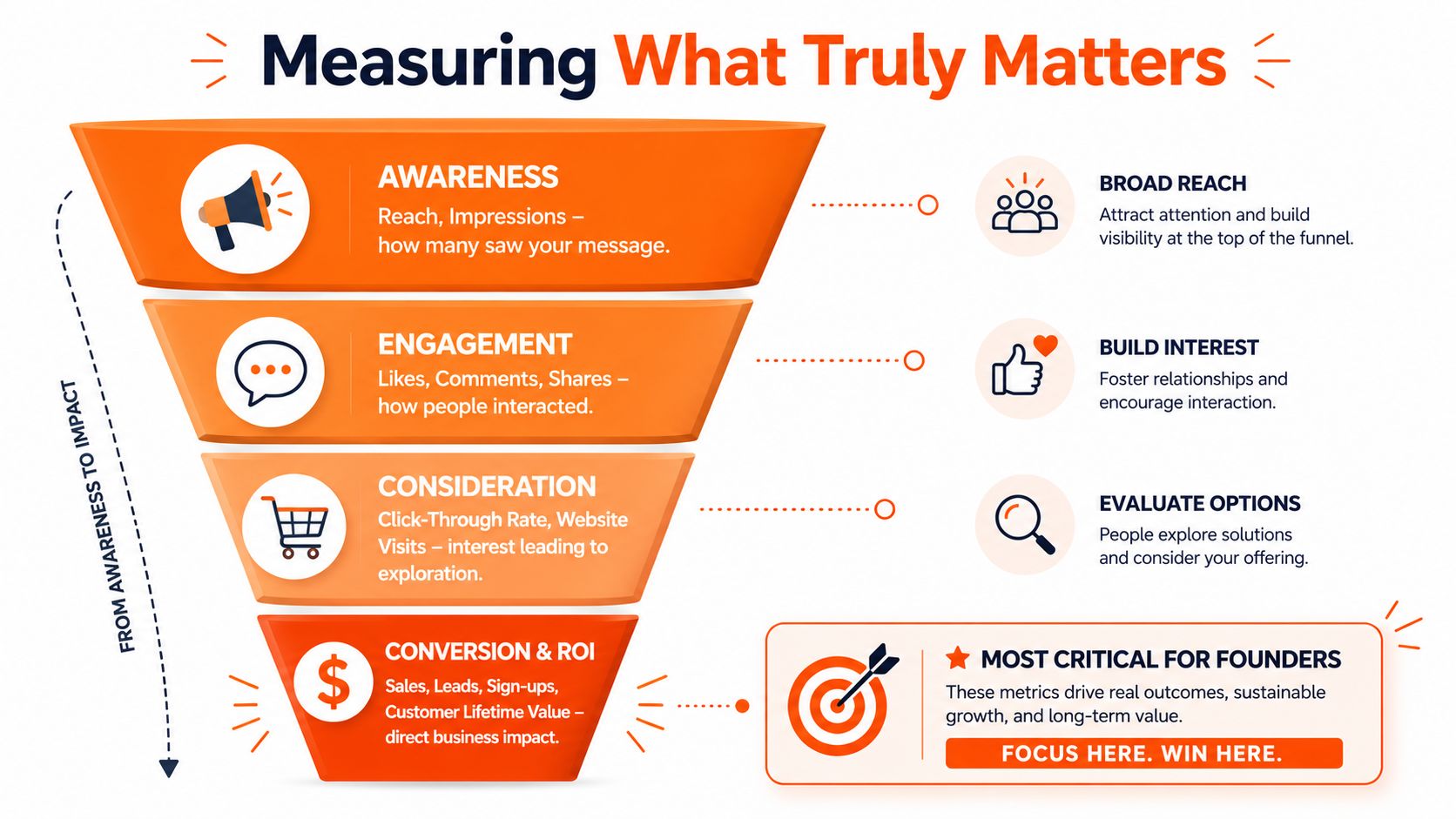
According to Wearisma's guide to complete journey tracking, effective measurement uses UTM links, branded search spikes, referral traffic, campaign-specific landing pages, and control-group tests, then connects those signals to conversions and longer-horizon outcomes over 60 to 90 plus days. That's how you avoid undercounting creator impact when someone sees a post today and buys later somewhere else.
What I'd ask an agency to track
I want reporting that ties creator activity to buyer behavior. That means:
- Traffic quality: Did people visit the site from creator links?
- Branded search movement: Did more people search for your brand name after content ran?
- Landing page behavior: Did visitors bounce, browse, or buy?
- Code usage: If a creator had a code, did anyone use it?
- Repeat behavior: Did buyers come back later?
This doesn't have to be perfect to be useful. Attribution in influencer marketing is messy. But messy is not the same as useless.
Vanity metrics still have a place, just not the top place
Likes and comments can help diagnose creative fit. Saves can hint at purchase intent. Shares can tell you whether the content had social pull. Fine. Use them as clues, not as proof.
The closer a metric is to cash, the more attention it deserves.
A practical reporting stack for a founder is simple:
| Layer | What to look at | Why it matters |
|---|---|---|
| Awareness | Reach, impressions | Tells you whether anyone saw the campaign |
| Consideration | Clicks, site visits, branded search | Shows active interest |
| Action | Sales, leads, sign-ups, code use | Tells you if the campaign moved the business |
The question that cuts through the fluff
Ask this on every agency call:
“Show me how you connect creator activity to business outcomes over time, not just during the first click.”
If the answer is fuzzy, the reporting will be fuzzy too.
Choosing an Agency on a Startup Budget
Most early founders don't need a famous agency. They need the cheapest setup that still gets the job done well.
That's a very different question.
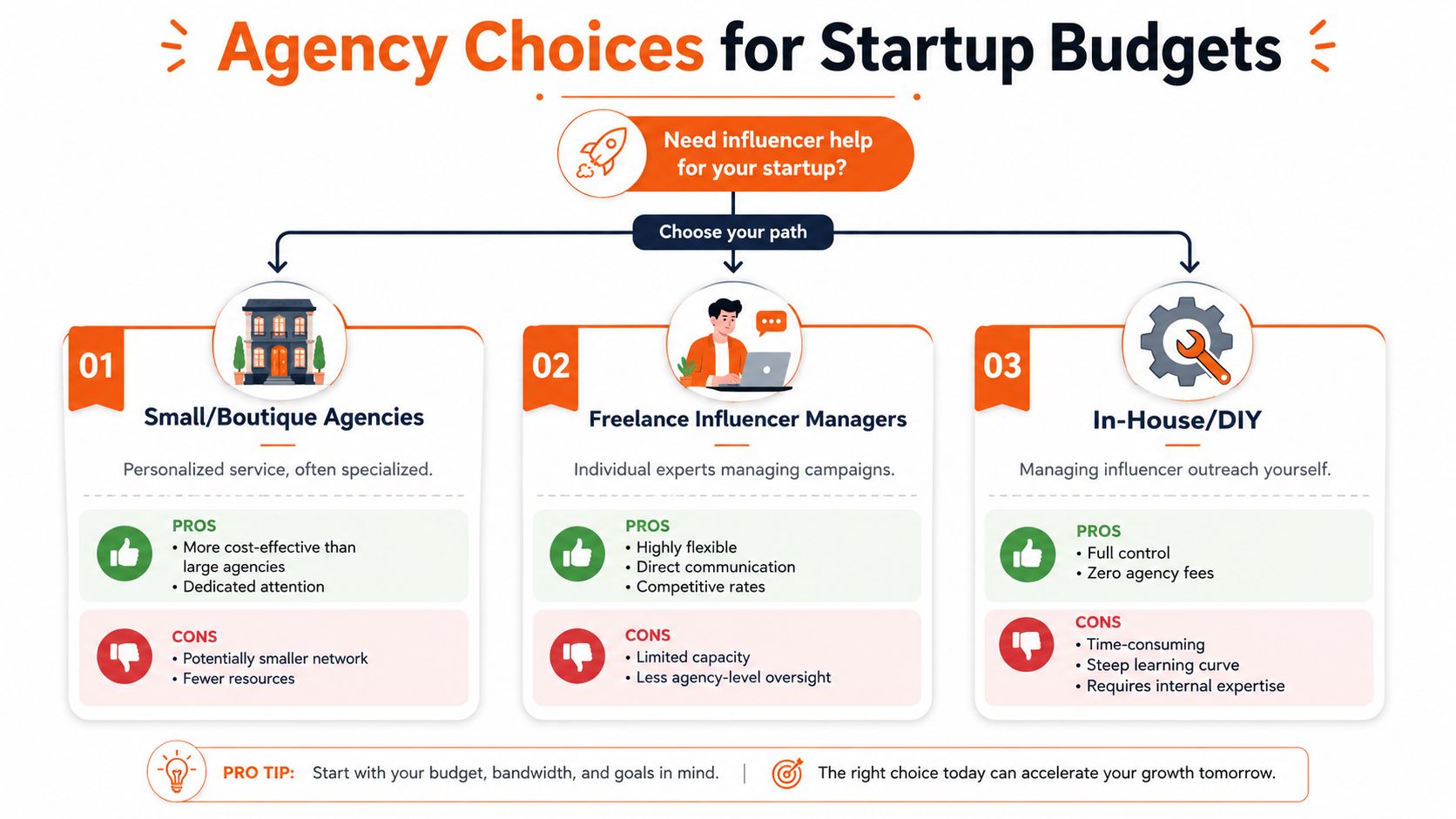
A smart test is simple. Ask whether the agency adds real value or just rents you access. As noted by Scorpion's overview of influencer marketing agencies, a good agency should beat in-house effort on time-to-launch, creator quality, and reporting depth. That's the standard I'd use.
When DIY is the right call
Do it yourself if these are true:
- You're still finding product-market fit
- You can manage a small creator list
- You need to learn the channel before outsourcing it
- Cash is tight and time is still available
DIY is slower, but it teaches you the physics of the game. That knowledge is worth a lot. If you're still in the scrappy stage, this guide on how to start a business with no money fits the mindset you need.
When a platform makes sense
A platform is the middle path. You get tooling, some structure, and usually faster creator search without paying for a full team to hold your hand.
That route works best when you're organized and can own:
- outreach,
- approval flow,
- product seeding,
- and campaign follow-up.
If your internal process is a mess, software won't save you. It just makes the mess faster.
When a small agency earns its keep
A boutique shop can be the sweet spot for Midwest founders. You often get more senior attention, less process theater, and more willingness to shape a lean pilot.
I'd favor a small agency when:
- You've already tested creators manually
- You know the type of creator that fits
- You're too busy to run the workflow yourself
- You want help without enterprise overhead
Red flags I wouldn't ignore
Here's the short list.
- They talk more about reach than fit
- They can't explain creator selection clearly
- They push long contracts before a pilot
- They dodge questions about reporting
- They use generic creator rosters for every client
- They promise outcomes they can't control
Founder filter: If they can't explain why their process beats you hiring a smart contractor and using a tool, they probably don't have much moat.
The best agency for a startup usually isn't the biggest one. It's the one that fits the stage you're in.
Your Next Steps in Chicago and the Midwest
If you're building in Chicago or anywhere in the Midwest, use the geography. Don't apologize for it.
You don't need a glossy coastal playbook to make influencer marketing work. You need creators who speak to your buyers in a way that feels real. For a lot of consumer brands, that starts smaller and closer to home than people think.
Start local and specific
Look for creators whose audience overlaps with your target market. That might mean Chicago food creators, Midwest lifestyle creators, local fitness creators, or creators tied to university communities. A smaller local audience can beat a giant broad one if the followers are people who can buy from you.
A few grounded moves:
- Seed product locally: Start with creators who can try the product fast and post without long shipping delays.
- Use your regional story: Hard work, practicality, value, and founder grit play well when they're real.
- Test message angles: One creator may sell the utility. Another may sell the vibe. Learn which one moves people.
Keep the first campaign boring on purpose
Don't try to engineer a viral moment. Run a clean test.
Pick a small creator set. Give each one a clear brief. Use trackable links or landing pages. Review what happened. Then adjust. This sounds less exciting than “big launch energy,” but it's how you avoid setting money on fire.
If you want live founder conversations and actual introductions in town, spend time around people building real businesses, not just posting about them. Chicago has plenty of in-person options, and a good place to start is this list of small business networking events.
One last point. Don't hire an agency because you feel behind. Hire one because you know what job needs doing, and you've found a team that can do that job better than you can.
If you're a Chicago or Midwest founder who wants honest feedback on your growth ideas, tough-love advice, and real conversations with builders who've been through it, check out Chicago Brandstarters. It's a free, vetted community for kind, bold, hard-working founders who want more than surface-level networking.
Leave a Reply