
You close your laptop after work, eat something quick, and feel that familiar itch. You want income that you control. You want work that can grow without waiting for a manager to approve it. You want a shot at replacing your job instead of renting out your evenings forever.
That's a real instinct. It's also where a lot of people waste a year.
A side hustle while working full time can turn into a real business, but only if you stop treating it like a motivational project. You need a system. You need rules. You need enough discipline to protect your job, your health, and your relationships while you build something that might eventually buy your freedom.
I'm not going to give you a fluffy list of trendy gigs. I'm going to give you the operating manual I wish more people followed.
The Reality of Building on the Side
A lot of people want a side hustle. That part is normal now. A major U.S. survey found that 45% of people currently have one, but only 10.5% earn more than $1,000 per month, and the average is $442.76 per month according to Self Financial's side hustle statistics.
That's the truth most creators and gurus skip. Most side hustles stay small. They stay inconsistent. They stay trapped in the “extra cash” category because the owner never built a real machine behind them.
If you're building a side hustle while working full time, your problem isn't lack of ambition. It's that your time is limited, your attention is fragmented, and your default mode after work is fatigue. If you approach that with random effort, you get random results.
What most people get wrong
Individuals typically do one of three things:
- They chase easy money: They pick something crowded, generic, and forgettable.
- They overbuild: They spend months on logos, websites, automations, and product ideas before talking to buyers.
- They run hot: They stack late nights on top of a demanding job until they hate both.
That approach turns your calendar into a junk drawer. Everything gets thrown in. Nothing works when you need it.
Practical rule: Your side business has to fit inside your real life before it can fund a different one.
What actually works
I'd rather see you build a boring, useful business than an exciting mess. Useful wins. Clear wins. Repeatable wins.
A real side business has a few traits from day one:
| Area | Bad setup | Better setup |
|---|---|---|
| Offer | Vague idea people “might like” | One painful problem for one buyer |
| Time | Work whenever you can | Fixed work blocks on the calendar |
| Money | Mixed with personal spending | Separate tracking from day one |
| Growth | More tasks | Better systems |
If you want to beat the average, don't start by trying to look like a founder. Start by acting like an operator. Solve one problem. Sell it fast. Track your time. Track your cash. Cut anything that drains energy without producing revenue or learning.
That's how a side hustle stops being a fantasy and starts becoming an exit plan.
Find an Idea That People Will Pay For
“Follow your passion” is lazy advice.
If your goal is to make art on weekends, fine. If your goal is to build income that can replace a paycheck, passion is not enough. You need demand. You need a buyer with a problem bad enough to pay for relief.
That matters even more now because many people taking on extra work aren't doing it for self-expression. Bankrate-reported survey coverage says nearly one in three people expect to need a second income just to make ends meet, as covered by the Bay State Banner article on growing side hustle jobs. When money is tight, reliable and time-efficient businesses beat passion projects.
Look for pain, not inspiration
Good side hustle ideas usually sit in one of these buckets:
- You already know the problem: Something at work is slow, messy, or expensive.
- People keep complaining about it: Friends, coworkers, business owners, and neighbors repeat the same annoyance.
- Buyers already spend money badly: They pay for clunky solutions and still feel stuck.
That's where I'd start. Not with “What do I love?” Start with “What annoys people enough that they'll pay to make it stop?”
If you need a structured way to spot patterns, browse something like the Idea Database. Not to copy ideas blindly. Use it to study how strong ideas connect a specific customer, a sharp problem, and a simple paid solution.
Use the Ten Person Test
Before you build anything, talk to ten people who might buy.
Ask simple questions:
- What's the problem?
- How are you handling it now?
- What's annoying about that?
- Have you paid for a fix before?
- If I offered a clear solution to this, would you want to see it?
Don't pitch too early. Listen first. If people get fuzzy, polite, or abstract, the pain probably isn't strong enough. If they get specific fast, you're onto something.
If people can describe the problem in one breath, you may have a market. If they need a monologue to explain why it matters, keep looking.
A lot of first-time founders skip validation because they're afraid the answer will be no. That's expensive fear. You can sharpen your approach with this guide on how to validate a business idea.
What I'd choose first
For a side hustle while working full time, I'd bias toward offers that are:
- Easy to explain
- Fast to deliver
- Bought for practical reasons
- Able to start manually
Think service before software. Think niche before broad. Think “done for you” before “complex platform.” You can always build the bigger version later. Right now, speed to first customer matters more than elegance.
Master Your Week Before It Masters You
Burnout is the tax people pay for sloppy planning. SurveyMonkey found that 67% of side hustlers experienced burnout, and the median side hustle income was only $200, based on SurveyMonkey's side hustle statistics. That tells you something important. More hours don't automatically mean more money.
Failure often isn't due to a terrible idea. They fail because they built a second job with no boundaries.
Build a week with walls
Use this as your first filter. If your side hustle can't live inside a clean weekly schedule, it's too messy.
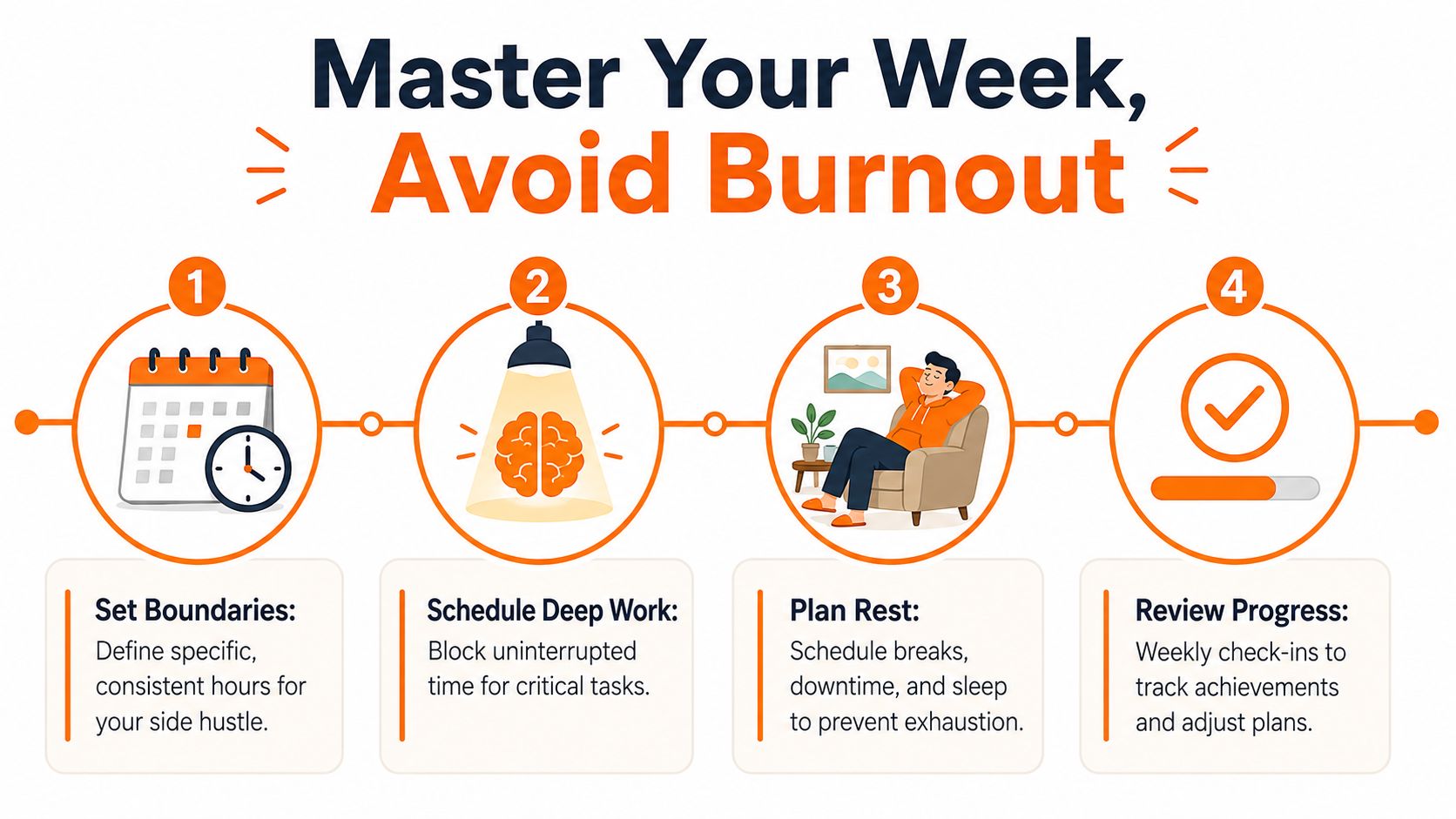
I like two types of work blocks:
- Focus blocks: Deep work. No phone. No meetings. Real output.
- Pocket time: Admin, follow-ups, email, invoicing, small edits.
That's it. Don't pretend every hour is equal. It isn't. Writing a proposal at 8:00 p.m. after dinner is different from clearing inbox clutter during lunch.
A schedule that normal people can follow
Here's a simple weekly shape:
| Block | Purpose | Example |
|---|---|---|
| One evening focus block | Sales or delivery work | Proposals, client work, product build |
| One early morning focus block | Hard thinking | Offer design, landing page copy, pricing |
| Two pocket-time blocks | Maintenance | Email, invoicing, DMs, scheduling |
| One weekend block | Highest-value task only | Sales calls, recording content, fulfillment |
That structure keeps your side hustle while working full time from spilling into every open minute.
A lot of founders need help setting those boundaries. If your calendar is already a mess, Tribble Software's time management advice has useful tactical ideas for protecting work blocks without making your week feel like punishment.
You can also tighten your own system with this practical guide on time management for entrepreneurs.
Protect your energy like inventory
Your energy is stock on the shelf. Waste it and you can't sell anything tomorrow.
A few essentials:
- Set office hours for your side hustle: If you work Tuesday and Thursday nights, stick to that.
- Keep one real off block: No “just checking messages.”
- Group shallow tasks together: Don't interrupt deep work to answer low-value questions.
- Stop when the block ends: Leaving one task unfinished is better than dragging exhaustion into your job.
Watch this with a notebook nearby. It's worth treating like a working session, not background noise.
Your calendar should tell your business what it's allowed to become.
Get Your Money and Legal House in Order
The boring setup work saves careers.
A lot of people start making a little money, feel clever, and ignore the back office. Then tax season arrives, a client dispute shows up, or their employer notices behavior that violates policy. Suddenly the side hustle isn't exciting. It's a mess.
That risk gets ignored all the time. Side hustle guidance often says your main job shouldn't suffer and that tax help matters, but it rarely gives clear compliance rules, even though modern flexible work can hide legal, tax, and burnout problems, as discussed in this Sides Wealth article on full-time work and side hustles.
The first three moves
Start here. No debates.
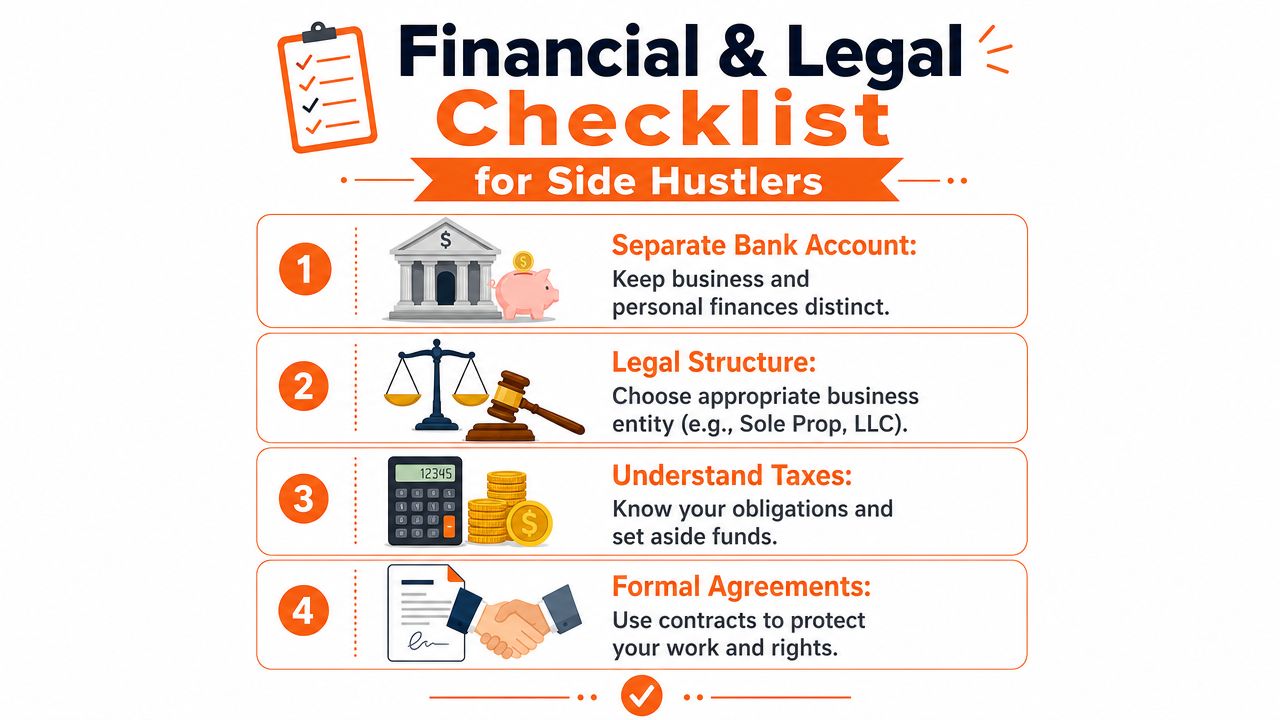
Open a separate bank account
Don't run business money through your personal checking account. You'll lose track of profit, confuse taxes, and make basic decisions harder than they need to be.Track every dollar in and out
A spreadsheet is enough at first. Date, customer, amount in, category, amount out, note. Simple wins.Read your employee handbook
Look for rules about moonlighting, conflicts of interest, use of company equipment, client overlap, and work performed during company hours.
Rules I'd follow without exception
Use these as guardrails:
- Never use your employer's laptop: Not for one email, not for one invoice.
- Never take side hustle calls during your job unless policy clearly allows it: Convenience gets people fired.
- Never sell into a conflict: If your side business competes with your employer or touches their customers, slow down and get clear.
- Never wait too long to ask a tax pro: Clean books cost less to fix than chaotic ones.
If your work setup involves freelance or contract arrangements, learn the basics of independent contractor vs employee status. A lot of people sign agreements they don't fully understand, then discover the problem later.
Keep your money boring
You don't need fancy finance tools on day one. You need visibility.
Operator check: If you can't answer “What did I earn last month?” and “What did I keep?” in under two minutes, your business is still running on vibes.
Pay yourself with intention, not random transfers. This guide on how to pay yourself from your business is a good starting point if you've never set that up before.
Simple systems beat heroic cleanup.
Launch Your MVP Without Overbuilding
Your first version should feel a little embarrassing. That's healthy.
Most new founders hide inside building. They tweak colors, debate software stacks, redesign logos, and call it progress. It isn't. It's productive-looking procrastination. The true test is simple. Will someone pay?
The easiest way to understand an MVP is this: if you wanted to prove people like your tacos, you wouldn't lease a restaurant, design uniforms, and install custom lighting. You'd start with a food truck. Your MVP is the food truck.
What an MVP actually looks like
A smart MVP is the smallest version of your offer that produces one useful outcome for one customer.
Examples:
- Service business: Don't build an agency site with twelve pages. Sell one package to one niche. “I'll write your restaurant's email welcome flow” is better than “I help brands grow.”
- Productized service: Don't automate first. Deliver it manually. If you want to sell lead research, do the first batch by hand.
- Software: Build one painful feature, not a suite. If you can't explain the value in one sentence, it's too broad.
- Physical product: Start with a tight SKU line and direct feedback. You need buyers, not a catalog.
A simple MVP filter
Before you build, answer these questions:
| Question | Good sign | Bad sign |
|---|---|---|
| Can I explain it fast? | One sentence | Long setup |
| Can I sell before perfecting it? | Yes | No |
| Can I deliver manually at first? | Yes | No |
| Does it solve one clear pain? | Yes | Sort of |
If your idea fails this test, shrink it.
Sell the result first. Build the machine second.
What to ship this month
I'd typically recommend one of these launch formats:
- A simple landing page with a clear offer and contact form
- A direct outreach offer to a tight list of buyers
- A paid pilot for a small group
- A manual concierge version of the product
Perfection is expensive because it delays feedback. And feedback is the only thing that tells you whether you're building a business or just entertaining yourself.
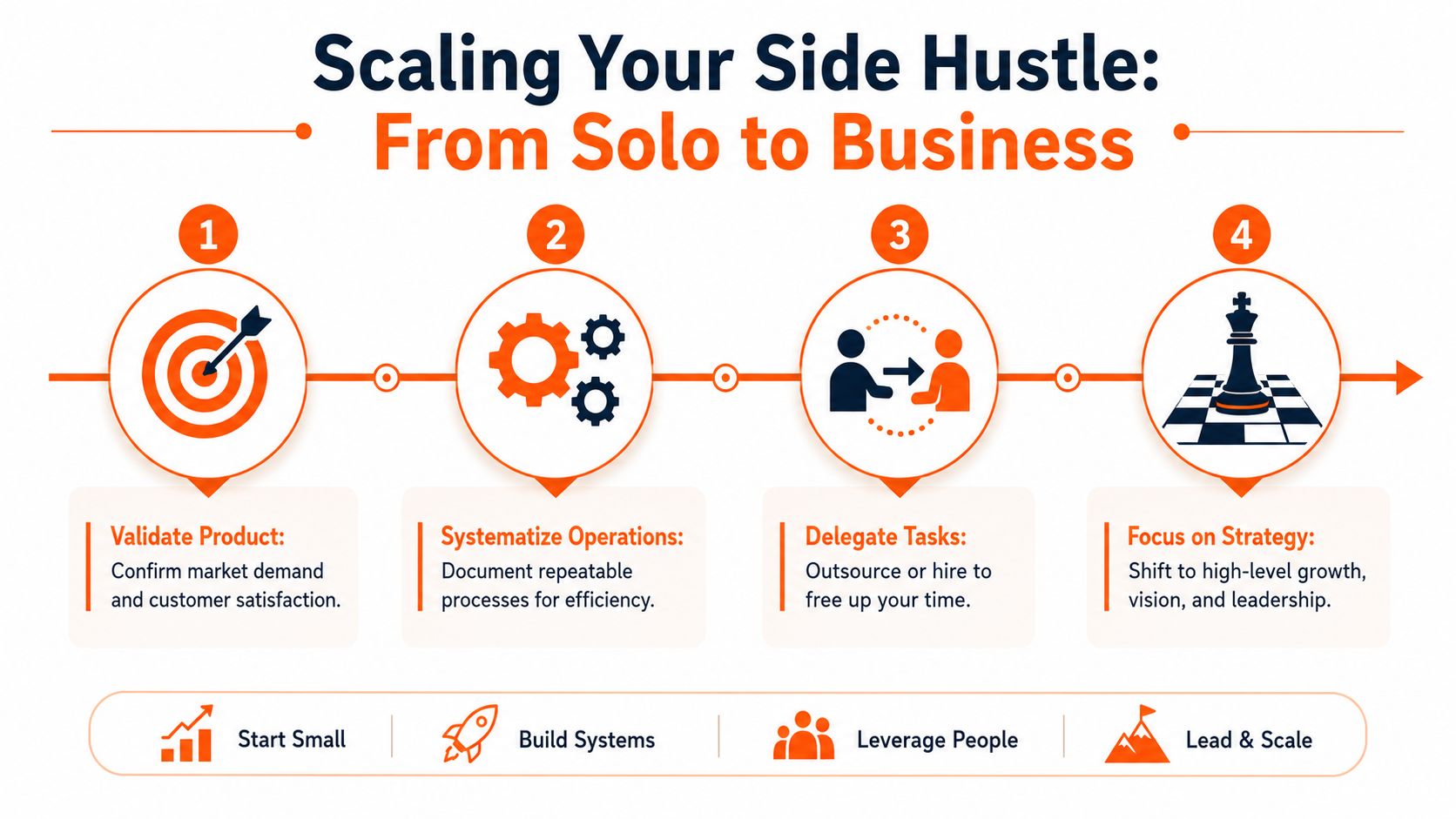
Scaling From Side Hustle to Real Business
You feel the shift when the business starts pulling on you from both sides. Customers want faster replies. Work gets messier. Your day job still owns the calendar. If you do not build structure now, growth turns into a second job with worse boundaries.
The goal at this stage is simple. Make the business work without fresh heroics every week.
That means standardizing delivery, protecting margin, and deciding what only you should do. If every sale creates a custom process, you are not scaling. You are stacking more obligations onto a schedule that is already full.
Put early profit into capacity
Early profit should buy time, control, or reliability. Anything else can wait.
Use the money to remove recurring friction:
- Software that replaces repetitive admin
- Bookkeeping or tax help before cleanup becomes expensive
- Freelance support for design, research, editing, or fulfillment
- Templates for proposals, onboarding, reporting, and follow-up
Skip vanity purchases. A new logo will not fix a sloppy handoff. A cleaner invoicing process might.
Run the next 90 days on purpose
A side hustle stalls when the founder keeps reacting instead of choosing. Set a 90-day operating plan and review it every week.
Keep it focused on three things:
Revenue
Pick one customer acquisition channel and commit to it long enough to judge it fairly.Delivery
Write down the repeatable parts of fulfillment. Turn them into checklists, templates, or SOPs.Retention
Give existing customers a reason to stay, return, or refer. Expansion is cheaper than constantly replacing churn.
Here's the filter I'd use:
| Focus area | Question to answer |
|---|---|
| Sales | Which channel is responsible for the next wave of customers? |
| Operations | What process needs to be documented this quarter? |
| Delegation | What am I still doing that does not require my judgment? |
| Strategy | What asset or system should exist in 90 days that would make this business easier to run? |
Stop being the bottleneck
At first, being involved in everything feels responsible. Later, it becomes the reason the business cannot grow.
Your job changes here. You need to own pricing, positioning, sales conversations, and the few decisions that need founder judgment. Repetitive tasks should move into a process. Then into a template. Then to someone else.
Busy founders often confuse motion with progress. Do not.
If you want this business to replace your job, build it so a normal week works. A real business survives missed days, delayed emails, and imperfect help. A side hustle that depends on your constant rescue does not scale.
Planning Your Escape From the Nine to Five
Quitting too early is just another form of impatience.
People romanticize leaving their job. I get it. A clean break feels powerful. But your rent doesn't care about your founder identity. If you leave before the business is stable, you turn normal pressure into panic. Panic makes people discount badly, chase the wrong customers, and make dumb decisions.
Use a decision checklist
I like simple exit rules. If these aren't true yet, keep building.
- Your side hustle covers your essential living costs consistently: Not one strong month. A repeated pattern.
- You have cash reserves: Enough to absorb slow periods, client churn, and mistakes.
- Your business has a clear growth plan for the extra time: More free hours only help if you know how you'll use them.
- Your demand is real without heroics: If sales depend on constant hustle and unstable luck, don't jump yet.
- Your systems can handle more volume: More time should increase output, not create more confusion.
What changes after you quit
A lot of people think quitting gives them freedom. At first, it gives them exposure.
Your old job gave you structure for free. A paycheck. Deadlines. External accountability. Once you leave, you need to replace that structure yourself.
That means:
- Start the week with a written plan
- Protect business development time
- Keep your personal spending disciplined
- Stay close to people who tell you the truth
Leaving your job doesn't fix a weak business. It removes the cushion around it.
Pick the right moment, not the dramatic one
The right time to leave is usually boring. You're prepared. You've already proven the model. The business has enough traction that your job is now the bottleneck, not the safety net.
If you're still guessing, stay employed a bit longer and keep compounding. A side hustle while working full time is hard, but it gives you one huge advantage. You can build with less desperation. Use that advantage fully before you give it up.
If you're pursuing projects after work and want real conversations with other kind, ambitious operators, join Chicago Brandstarters. It's a free, vetted community for Chicagoans and Midwesterners building brands, with small private dinners and an active group chat where people share honest tactics, mistakes, and support. If you're tired of fake networking and want peers directly involved in the work, it's a smart place to plug in.
Leave a Reply