

You know the feeling. You open your laptop to work on growth, and by lunch you've answered support emails, fixed a supplier mistake, chased an overdue invoice, updated a product page, and rescheduled a contractor call. Then you look up and realize you still haven't done the work only you can do.
That's when founders start searching for business managers for hire.
I think that's often the right instinct. A good business manager is the person who keeps the machine moving while you stop playing human duct tape. If you're still doing every follow-up, every handoff, every “quick” admin task, you don't have a business. You have a job with weird hours.
Your First Real Hire to Stop the Chaos
I've seen this pattern over and over. A founder starts with hustle, which is fine. Then hustle turns into fragmentation. Every day becomes a string of tiny fires. You're in Slack, email, Shopify, QuickBooks, Google Drive, and your DMs, all before noon. You're “busy” all day and still behind.
That's where a business manager earns their keep.
I think of this person as your first mate. You steer. They keep the ship from drifting into rocks. They don't replace your judgment. They stop your day from getting chopped into useless little pieces.
What this hire actually fixes
A strong business manager usually takes ownership of the stuff founders delay, avoid, or constantly revisit:
- Operational follow-through like vendor coordination, meeting prep, task tracking, and chasing loose ends
- Communication cleanup so customers, contractors, and team members stop waiting on you for every answer
- Rhythm and order through calendars, deadlines, recurring processes, and documentation
- Decision support by surfacing what matters instead of dumping raw noise on your desk
That last point matters more than people think. A weak hire forwards problems. A good one narrows them.
You shouldn't be the person reminding everyone else what they said they'd do.
This role isn't some made-up startup luxury. It's a normal business function. In the EU, about 1.7 million business manager job openings are projected by 2035, mostly because workers are leaving the occupation, largely through retirement, according to business manager labor-market data compiled by Zippia and Cedefop. That tells you something simple. Businesses need people who make the whole thing run.
If you're also trying to figure out whether your first hire should lean more financial than operational, I'd read Jumpstart Partners' finance team guide. It's useful when your chaos has a cash-flow flavor to it.
And if you're still earlier than that, this guide on how to hire your first employee is worth reading before you lock yourself into the wrong role.
Defining the Business Manager You Actually Need
“Business manager” is one of those titles that sounds clear until you try to hire one. Then you realize it can mean anything from executive assistant to operator to right-hand person to mini-COO.
If you skip this step, you'll hire a plumber when you needed an electrician.

Start with a blunt time audit
For five workdays, write down what you do in half-hour chunks. Don't clean it up. Don't make it sound strategic. Be honest.
Then sort each task into one of these buckets:
| Bucket | What it includes | What it tells you |
|---|---|---|
| Founder-only | vision, product direction, major partnerships, fundraising | Keep this with you |
| Trainable recurring work | inbox triage, scheduling, vendor follow-up, reporting, project tracking | Great business manager territory |
| Specialist work | bookkeeping, legal review, paid media, design systems, engineering | Hire a specialist instead |
| Waste | context switching, duplicate work, hunting for info, fixing avoidable errors | Build systems to kill this |
You're looking for patterns, not perfection. If the same messy tasks show up every day, that's your scope.
Write the job around outcomes, not vibes
Most founder-written job descriptions are too fluffy. “Need a proactive rockstar with strong communication skills” is junk. It tells the candidate nothing, and it tells you even less.
Write your spec around outcomes like these:
- Own the weekly operating cadence
- Run vendor communication and follow-up
- Maintain one source of truth for projects
- Prepare decision briefs before founder meetings
- Handle customer and team handoffs without dropped balls
That's a real job. Now someone can opt in or out clearly.
Practical rule: If you can't explain the role without using the word “everything,” you haven't defined it yet.
Decide if you need a generalist or an operator with a specialty
Some founders need a broad generalist. Others need an operator who is especially strong in one lane.
You may need:
- Operations-heavy support if deadlines slip, vendors stall, and projects die in the gap between meetings
- Finance-leaning support if cash tracking, invoicing, and margin visibility keep breaking
- Customer-ops support if complaints, refunds, and service follow-ups are eating your day
- Ecommerce coordination if product launches, inventory handoffs, and agency management are a mess
This is why I use the home renovation analogy. You can hire a general contractor, and sometimes that's right. But if your real issue is wiring, don't act surprised when the contractor isn't your electrician.
Hire for the next version of the role
The role is changing fast. Your next operator shouldn't just manage people and tasks. They should manage systems too. A majority of organizations are already using generative AI in at least one function, and the practical question for founders is who can run a business where AI handles part of the coordination work, as discussed in this piece on hiring a business manager.
That means I'd look for someone who can:
- build process docs in Notion
- use Airtable or Google Sheets without getting lost
- work with tools like Zapier or similar automation platforms
- manage vendors who use AI tools
- spot which work still needs human judgment
You don't need an AI theorist. You need somebody who can say, “This step should be automated, this one needs approval, and this one needs a person.”
Where to Find Vetted Business Managers
You post the role on a giant job board Friday night. By Monday, you have 186 applications, 160 of them irrelevant, 20 polished but generic, and maybe 6 worth a call.
That is not hiring. That is inbox cleanup.
If you want a business manager who can handle messy founder reality, start with places where someone can vouch for the person. This hire lives or dies on judgment, follow-through, and calm under pressure. Those traits rarely show up clearly on a resume.
Start with trusted networks, not open funnels
The best candidates usually come with context. Someone says, “She ran point across vendors, client issues, and founder chaos for a year. Solid operator. Low drama.” That gives you more signal than a keyword-stuffed application ever will.
I'd search in this order:
- Founder communities where people share real referrals
- Operator groups with ecommerce, finance, and ops people who know who performs well
- Private Slack groups and niche communities over giant public feeds
- Former startup and agency networks where candidates have already worked in imperfect environments
If you want introductions to peer-vetted operators, Chicago Brandstarters business manager support is one practical option.
Ask for referrals like a founder who knows the assignment
Vague asks get vague candidates.
“Know anyone good?” is lazy. It also guarantees mismatches, because one person's “good” is another person's overbuilt corporate operator who hates scrappy brands.
Give people enough detail to filter for you:
- Company stage so they know whether you need scrappy or highly structured
- Workload so they know if this is full-time, fractional, or project-based
- Core responsibilities so they can picture the day-to-day
- Tools and systems if the role depends on Shopify, QuickBooks, Notion, Airtable, or Klaviyo
A strong referral ask sounds like this: “I need an early-stage business manager for 10 to 15 hours a week. They need to own vendor follow-up, weekly reporting, calendar coordination, and project tracking. Strong in Notion and spreadsheets. Comfortable working with a founder who moves fast.”
That level of specificity saves time.
Match the hiring channel to the shape of the role
This is the part generic hiring guides skip, and it matters more than founders realize.
If your workload is steady and already spilling into every week, hire for a full-time search. If the work is important but still uneven, use fractional talent. If you have one broken area, such as launch coordination or inbox and vendor cleanup, use a project-based operator first.
Your sourcing strategy should follow that decision.
Full-time candidates are easier to find through referrals and tighter communities because trust matters more. Fractional hires often come through specialist networks and operator collectives. Project-based help can come from a narrower freelance search because the scope is contained and easier to test.
If the role is still too light or too admin-heavy to justify a business manager, read this guide on how to find and vet top remote VAs. A lot of founders reach for a business manager when what they actually need is a strong remote assistant plus a specialist in finance, ops, or customer support.
Use job boards last
Job boards are fine for reach. They are weak on trust.
Use them after you've worked your networks, not before. By then, you'll have a sharper scorecard, better language for the role, and a clearer view of whether you need a full-time operator, a fractional adult in the room, or short-term project help.
That order matters. It keeps you from hiring a polished stranger for a job that was never scoped correctly in the first place.
The Interview and Trial Project That Reveals Everything
Resumes are theater. Some people are good at theater.
What you need is evidence.

A structured process works better because it forces you to compare people on the same criteria. High-performing teams report over 80% selection success when they use structured interviews and clear evaluation criteria, and referrals drive 55% faster hiring than job boards, according to Dover's recruiting metrics guide.
The interview should test how they think
I don't care if someone can recite their strengths. I want to know what they do when instructions are incomplete, priorities conflict, and a founder sends a half-baked voice note at 9:12 p.m.
Ask questions that force specifics.
Some of my favorites:
- “Tell me about a time a leader gave you a messy problem. What did you do first?”
- “How do you decide what needs your attention today versus later this week?”
- “Describe a process you built because the old way kept breaking.”
- “What's your method for following up without becoming annoying?”
- “When have you disagreed with a founder or manager, and how did you handle it?”
- “How do you keep projects moving when multiple people are late?”
If you want more prompts to round out your list, these effective interview questions are a solid add-on.
Use a scorecard or your brain will lie to you
After a few interviews, memory turns mushy. The most polished person starts to feel like the strongest candidate, even when they're not.
Use a scorecard with the same categories for every candidate:
| Category | What to look for |
|---|---|
| Judgment | Can they sort signal from noise? |
| Follow-through | Do they close loops without reminders? |
| Communication | Are they clear, concise, and kind? |
| Resourcefulness | Do they solve problems or escalate everything? |
| Systems thinking | Can they document and improve repeat work? |
| Calm under ambiguity | Can they function when the map isn't complete? |
Keep it simple. Numeric score if you want. Written notes are fine too. The point is consistency.
The paid trial is where truth shows up
I would not hire a business manager without a paid trial unless the referral is exceptional and I have firsthand trust in the person.
Give them a one-week project that mirrors the actual job. Not busywork. Real work, in a controlled slice.
A good trial might include:
Inbox and prioritization sample
Give them a batch of founder emails or messages. Ask them to sort what needs action, draft replies, and flag decisions only you should make.Mini operations cleanup
Ask them to build a simple tracker in Notion, Airtable, or Google Sheets for vendors, deadlines, and owners.Follow-up task
Have them draft a clean follow-up message to a supplier, contractor, or partner based on a messy thread.Weekly brief
Ask for a short report on what happened, what's blocked, and what you need to decide.
What you're testing is obvious once you watch closely:
- Do they ask good questions?
- Do they overcomplicate simple things?
- Do they communicate clearly without hiding behind jargon?
- Do they finish on time?
- Do they improve the work or just complete it?
Hire the person who makes your brain quieter.
A business manager should reduce your cognitive load. If the trial creates more confusion than relief, move on.
If you want a benchmark for what this kind of support can look like in practice, business manager services for founders gives you a concrete sense of the scope many early-stage operators end up needing.
Making the Offer and Setting Up for Success
Closing the hire is only half the job. The other half is making sure they don't walk into fog.
Great managers are rare. Gallup says managers account for at least 70% of the variance in employee engagement scores across business units, and about one in 10 people has the talent to manage well, according to Gallup's research on why great managers are rare. That same source notes common U.S. business manager pay data that ranges widely, which is exactly why sloppy scope leads to messy compensation.
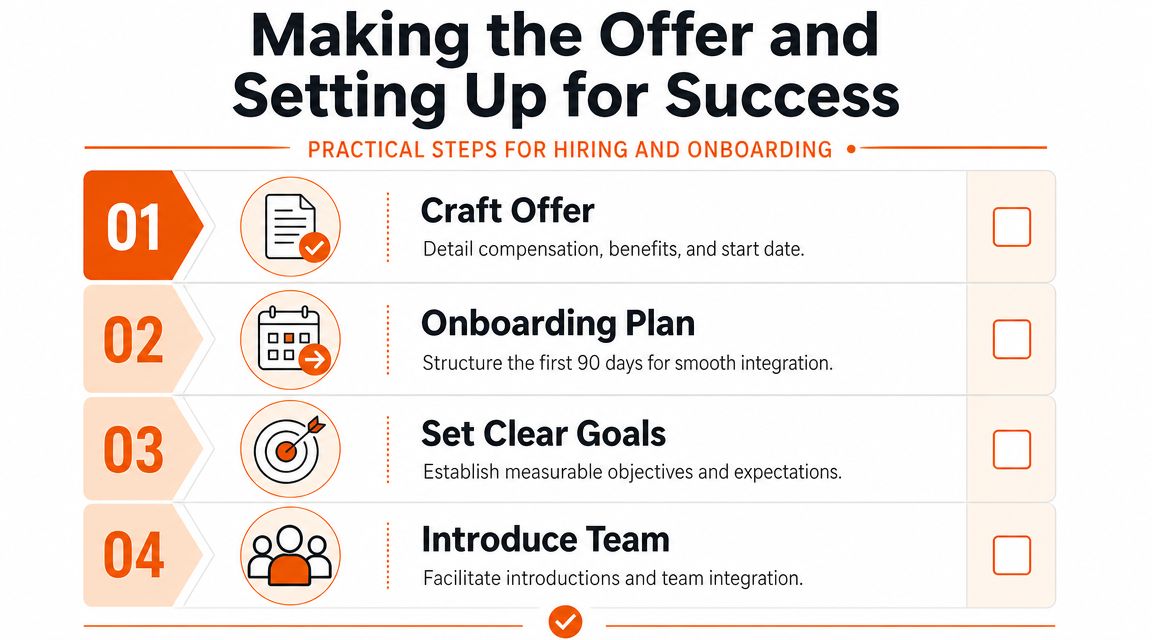
Match the offer to the scope
If your role is broad, high-trust, and decision-heavy, pay like you mean it. If the role is lighter and more task-driven, shape the offer around that reality. Don't mash together executive-level ownership and assistant-level pay, then act confused when strong people pass.
A simple offer should spell out:
- Role scope with the main outcomes they own
- Compensation structure whether salary, hourly, or monthly retainer
- Start date and review points
- Working model such as remote, hybrid, core hours, and communication expectations
- Trial or probation terms if applicable
Short is fine. Vague is not.
Build the first 90 days on purpose
Most onboarding fails because founders transfer information randomly. A Slack message here, a Loom there, a weird Google Doc from last year, and a “just ask me if you need anything.” That's not onboarding. That's dumping.
Use the first 90 days to create rhythm.
First month
Focus on observation and cleanup. Let them map the moving parts, learn the people, and fix the obvious leaks.
Second month
Shift into ownership. Hand them recurring meetings, trackers, vendor follow-up, and reporting.
Third month
Push decision support. They should start bringing you tighter summaries, sharper priorities, and fewer raw problems.
My rule: by day 90, they should own a weekly operating rhythm that does not depend on your memory.
Set goals they can actually hit
Don't hide behind fake KPIs. Early-stage companies need practical goals like cleaner handoffs, fewer dropped tasks, better follow-up, and tighter meeting prep.
Try goals like:
- Running one weekly operations check-in
- Keeping one central project tracker current
- Documenting recurring workflows
- Reducing founder involvement in routine coordination
- Creating clean vendor and contractor communication cadence
That's enough. A good hire will make these feel obvious fast.
Full-Time Hire vs Fractional Help Which Is Right for You
This is the decision most founders skip, and it's where they waste money.
They assume hiring means full-time. It doesn't.
The smarter question is how much management you need right now. The market already supports more flexible working models, and independent work is a real option for startups that can't justify a salaried hire yet, as explained in Indeed's guide to hiring a business manager.
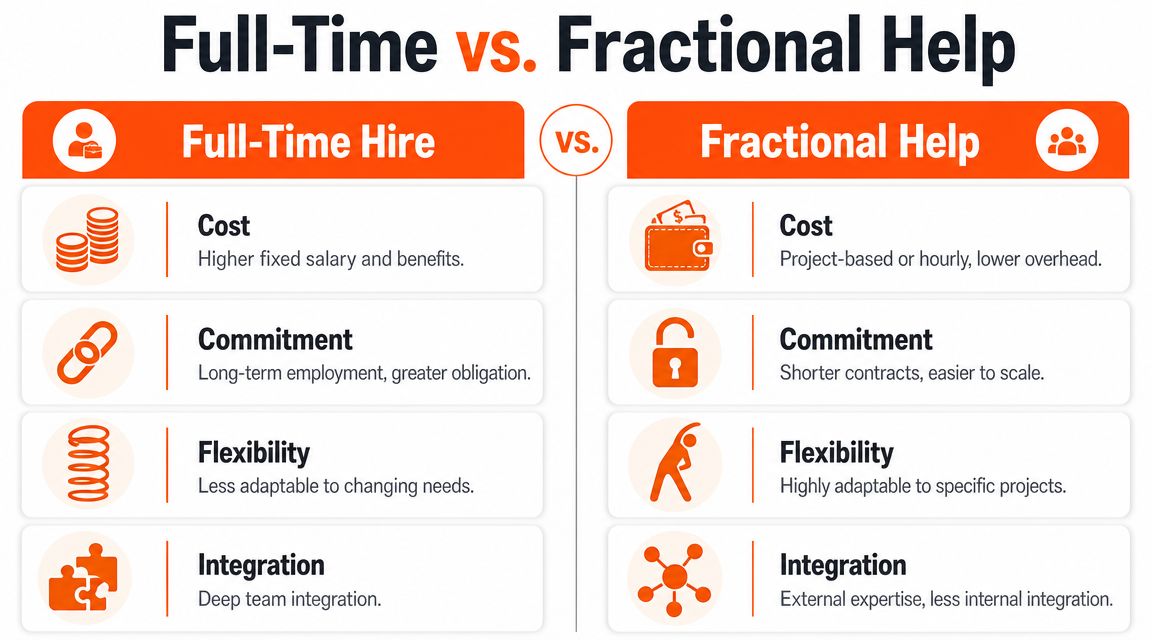
A simple way to choose
| Model | Best when | Watch out for |
|---|---|---|
| Full-time hire | work is constant, broad, and deeply tied to the business | higher fixed cost and harder reversal |
| Fractional manager | you need judgment and ownership, but not all week | less day-to-day immersion |
| Project-based contractor | you need one system built or one mess cleaned up | weak long-term continuity |
Here's my blunt advice.
Choose full-time if the work is there every week, the person needs deep context, and you already know the role scope.
Choose fractional if you need an adult in the room for operations but your workload comes in waves. This is often the right answer for early-stage ecommerce and product brands.
Choose project-based if your problem is narrow. Maybe you need someone to build your operating dashboard, clean up vendor workflows, or document launch processes. Fine. Don't pretend that's a permanent role.
If your store or brand operations already have too many moving parts and you need flexible support around them, this guide on outsourcing e-commerce work helps you think through where outside help fits.
The mistake I see most is founders hiring for aspiration. They hire the person they hope they'll need in a year, instead of the person they need this quarter. That's how budgets get tight and resentment creeps in.
Hire for the primary bottleneck. Then expand.
If you want honest feedback on whether you need a full-time operator, a fractional manager, or no hire at all yet, Chicago Brandstarters is a practical place to get it. It's a vetted community where founders trade real hiring lessons, share referrals, and talk through messy decisions without the usual networking nonsense.
Leave a Reply