You're probably reading this because your store is growing just enough to get annoying.
Orders come in through Shopify. Inventory lives in a spreadsheet that someone swears is current. Your bookkeeper has one version of revenue. Your warehouse or 3PL has another version of what shipped. Customer support asks where an order is, and you open five tabs to answer one email.
That's usually when founders start hearing the magic word: ERP.
My blunt take: most early founders don't need one yet. And a lot of scaling founders buy one too soon, wire it up badly, then spend months paying to automate a mess they should've cleaned up first.
A good ecommerce ERP can absolutely help. It can also become a very expensive traffic jam. The difference is knowing when to keep things simple, when to upgrade, and what parts of your business should stay flexible.
That Feeling When Spreadsheets Start Smoking
I've seen this movie a lot.
You start with Shopify, QuickBooks, a shipping app, and a few Google Sheets. That stack is fine at first. It's cheap, fast, and scrappy. It gets you through the first stretch when you're still figuring out product, pricing, and who wants what you sell.
Then the cracks start.
One day you sell an item that your spreadsheet says is in stock, but your shelf says otherwise. A customer places an order on your site right after somebody buys the last unit on a marketplace. Your support person copies tracking details by hand. Your finance numbers don't match your inventory value. Refunds happen, but the records lag behind reality.
That's the moment your systems stop helping and start charging rent inside your head.
The symptoms are boring, but expensive
This usually shows up in a few ugly ways:
- Inventory drift: your website says “available,” your warehouse says “gone.”
- Order confusion: someone has to re-enter or fix orders by hand.
- Customer support drag: simple “where is my order?” questions take too long to answer.
- Finance fog: revenue looks fine, but margin, returns, and stock value are fuzzy.
- Channel conflict: Shopify, Amazon, wholesale, and retail all tell a different story.
If you're already selling in more than one place, this gets worse fast. Good multichannel inventory management habits can buy you time, but only if you treat them seriously.
You can survive a messy setup for a while. You can't scale one.
Don't confuse pain with readiness
A lot of founders hit this point and jump straight to “we need NetSuite” or “we need a full ERP now.”
Maybe. Maybe not.
Sometimes you don't have an ERP problem. You have a process problem. Nobody agreed on where the truth lives. Nobody documented returns. Nobody set a clean handoff between store, warehouse, and accounting. Buying software before fixing that is like installing a bigger engine in a car with loose wheels.
The question isn't “are spreadsheets annoying?”
It's “are manual workarounds now causing stock mistakes, delayed fulfillment, and bad decisions?”
If the answer is yes, you're getting close.
What Is an Ecommerce ERP Anyway
An ecommerce ERP is the operating system behind the store.
Your storefront is what customers see. Your warehouse packs boxes. Your accounting system tracks money. Your CRM tracks customer history. Your suppliers send product. An ERP is the thing that connects those parts so they stop acting like strangers.
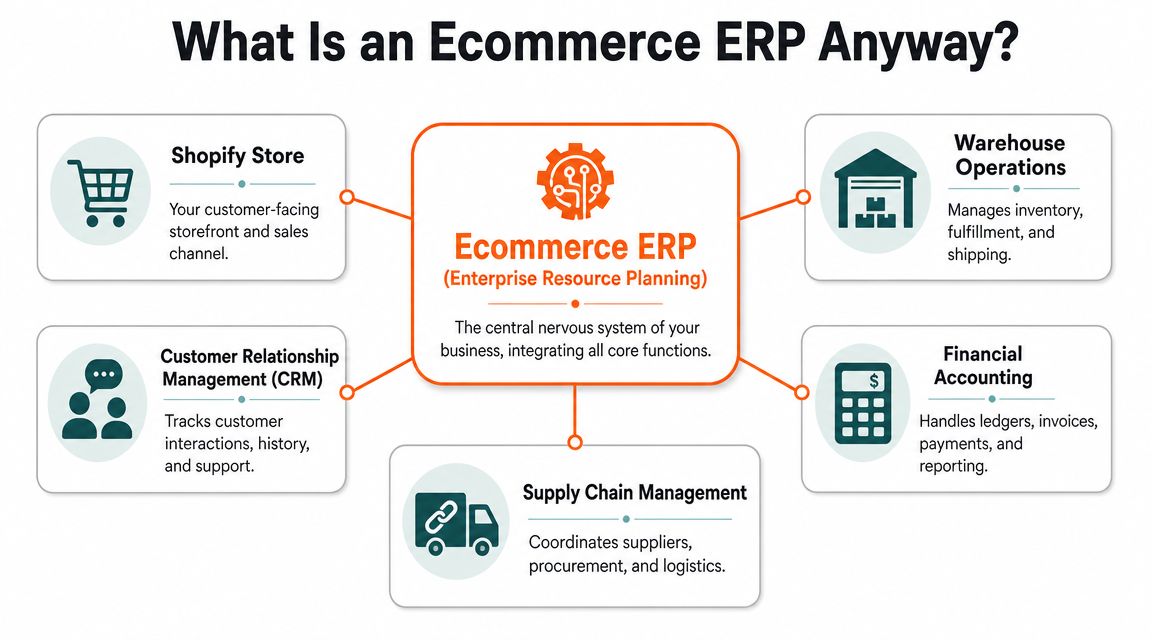
Think of it like your company's nervous system
When someone buys a product, that single event should trigger a chain reaction.
The order should appear in your back office. Inventory should update. The warehouse should know what to pick. Finance should record the transaction. Customer history should reflect what happened. If something gets canceled, refunded, or delayed, every connected system should know.
That's the job.
A good setup uses bi-directional, near-real-time synchronization so product data, pricing, inventory, orders, and fulfillment status stay aligned between the storefront and the back office. The strongest setups rely on API-first connectors, webhooks, and reliability controls so they don't fall apart during a rush or partial failure, as explained in this guide to ERP integration architecture.
What should actually sync
In plain English, these are the big data flows that matter:
- Products and pricing: names, SKUs, variants, pricing, status
- Inventory: what's available, reserved, backordered, or incoming
- Orders: new orders, edits, cancellations, refunds
- Fulfillment: picks, packs, shipments, tracking updates
- Customers: purchase history, addresses, support context
- Financial records: invoices, taxes, payouts, returns
Practical rule: if two systems both let your team edit the same truth, one of them will lie.
That's why founders keep hearing “single source of truth.” The phrase is overused, but the idea is right. Somebody has to be in charge of inventory. Somebody has to be in charge of financial records. If nobody owns the truth, your team invents it as they go.
Integration matters more than branding
A flashy demo means almost nothing. What matters is whether your systems can talk to each other cleanly and keep talking when platforms change their APIs, auth rules, or sync behavior. If you're evaluating connector-heavy setups, this Urgent update on Celigo integration is a useful reminder that integrations are living infrastructure, not a one-time checkbox.
That's the part vendors gloss over. Software is easy to buy. Stable data flow is hard to build.
Why You Should Actually Care About This
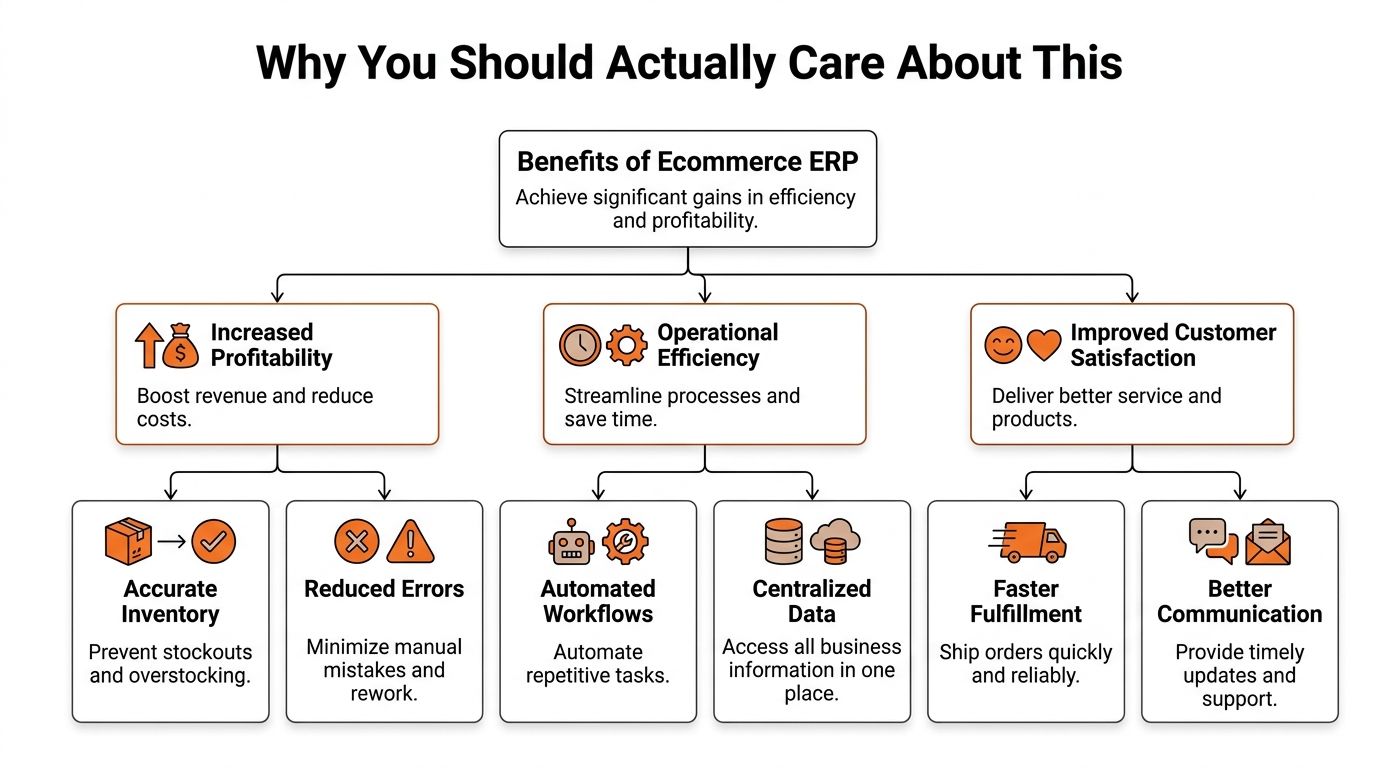
You shouldn't care about ERP because it sounds impressive. You should care because broken operations eat margin, focus, and trust.
The average e-commerce conversion rate is around 2% to 3%, which means most visitors never buy. That's one reason operators watch repeat customer rate, customer lifetime value, and refund and return rates so closely. And by 2025, 54% of total revenue is expected to come from digital channels, up from 42% two years earlier, according to the same NetSuite ecommerce metrics guide. If digital revenue is a bigger part of the business, operational sloppiness gets more expensive.
Inventory accuracy is where the money leaks
For scaling brands, the first win from an ecommerce ERP is usually inventory accuracy. Real-time inventory management across channels reduces overselling, stockouts, and overstocking. Systems can use sales orders and historical data to improve replenishment decisions, as described in Acumatica's ERP commerce management overview.
That sounds dry. It isn't.
If your best seller goes out of stock because your numbers were late, you lose sales. If you overbuy slow movers, your cash gets trapped on shelves. If one channel sells units another channel thought it had, your support team gets dragged into damage control.
Here's a quick explainer if you want a visual break before going deeper:
You buy back founder time
The best operational payoff isn't “automation” in the abstract. It's fewer dumb interruptions.
Instead of checking Shopify, your 3PL portal, your returns app, and QuickBooks to answer one basic question, your team has one place to look. Instead of exporting CSVs at night to reconcile inventory, the system does the boring parts continuously.
That changes how you spend your week.
- Less rework: fewer hand fixes, fewer apology emails
- Cleaner support: your team can answer faster because the order story is visible
- Better purchasing: you stop guessing what to reorder
- Clearer finance: sales, inventory, and returns stop living in separate realities
If your team spends half the day stitching together facts, you don't have a staffing problem. You have a systems problem.
Customer experience gets less fragile
Founders usually think about ERP as a back-office purchase. Customers feel it too.
Faster fulfillment. Fewer canceled orders. More accurate inventory. Better status updates. Fewer support handoffs. Nobody writes a glowing review because your data architecture is elegant. They just notice when the order experience feels smooth instead of chaotic.
That's what you're buying when you buy the right system.
When You Need an ERP and When You Don't
Here's my straight answer.
If you're early, you probably don't need an ecommerce ERP yet. You need a simple stack, clean habits, and documented workflows. If you're scaling across channels, locations, and regions, you probably do.
Global retail e-commerce sales are projected to reach $6.42 trillion in 2025 according to Elementor's ecommerce statistics roundup. That scale is why software stacks got more connected over time. But the existence of a huge market doesn't mean your brand needs enterprise software on day one.
The good enough stack
For a lot of brands, this is enough for a while:
- Storefront: Shopify
- Accounting: QuickBooks
- Light automation: Zapier or native app workflows
- Shipping: your shipping platform or 3PL portal
- Inventory control: disciplined spreadsheets, or a basic inventory app
- Process docs: Google Docs or Notion
That setup isn't glamorous. It works if your SKU count is still manageable, your channels are limited, and one person can still explain how an order moves through the business without drawing a crime board.
ERP decision framework
| Trigger | The 'Good Enough' Stage | The 'Time for an ERP' Stage |
|---|---|---|
| Sales channels | You mostly sell through one primary channel | You sell through multiple channels and inventory mismatches are becoming routine |
| Fulfillment setup | One location or one simple 3PL relationship | Multiple warehouses, stores, or 3PLs create handoff errors |
| Inventory complexity | Small catalog, low variation, manual checks still work | Bundles, variants, kits, or location-based stock make manual tracking unreliable |
| Finance needs | Basic bookkeeping is enough to run the business | You need tighter links between orders, inventory value, purchasing, and reporting |
| Team coordination | One operator knows everything | Different people own ops, support, finance, and supply chain, and nobody sees the full picture |
| Change frequency | You can fix issues manually without much pain | Daily fire drills keep interrupting the business |
If you're in the second column more often than the first, start looking.
You should also tighten your supply chain management practices before you sign anything. ERP won't save a sloppy replenishment process. It'll just make the sloppiness more official.
My rule of thumb
Don't buy an ERP because you're tired.
Buy one because the cost of bad data, stock errors, and team confusion is now higher than the cost and pain of implementation.
That's a different threshold.
Choosing an Ecommerce ERP Without Losing Your Mind
Once you decide you need one, the market gets noisy fast. Every vendor says they can unify your data, automate your workflows, and support growth. Fine. Ignore the pitch deck.
You need to judge three things: integration fit, real cost, and usability.

Start with your ugly reality
Your business doesn't run in a product demo. It runs with your storefront, your shipping tools, your accounting setup, your returns flow, your supplier quirks, and your team's actual habits.
As you grow across channels and borders, the system needs to handle multi-currency payments, fiscal compliance, and unified data governance, not just basic syncs. That's one of the most useful points in Itransition's overview of ecommerce ERP capabilities.
Ask every vendor these questions:
- What breaks first? Ask where clients usually struggle in month one.
- What needs custom work? Don't accept “it depends” without specifics.
- Who owns the connector? Vendor, partner, or you?
- How do they handle failed syncs? You want clear alerting and replay options.
- What can my team change without a developer? This matters a lot.
Total cost is never the sticker price
The monthly fee is the bait. The complete bill often lives somewhere else.
Think about implementation help, connector fees, custom mapping, support, training, data cleanup, ongoing admin time, and future changes. A “cheaper” system that needs constant consultant help can cost more than a pricier one your team can run without drama.
Cheap software with expensive friction is still expensive.
Pick for the next phase, not your fantasy future
Don't buy for the company you hope to be in five years if the system will choke your current team in five weeks.
A small ops team needs something they can learn, trust, and use daily. If every basic adjustment requires a ticket, a partner, or a specialist, you've created dependence instead of self-sufficiency.
I'd rather see a founder choose a system that handles today's real complexity well than one that promises every enterprise feature under the sun and turns into shelfware.
Implementation Nightmares and How to Avoid Them
Good intentions go to die here.
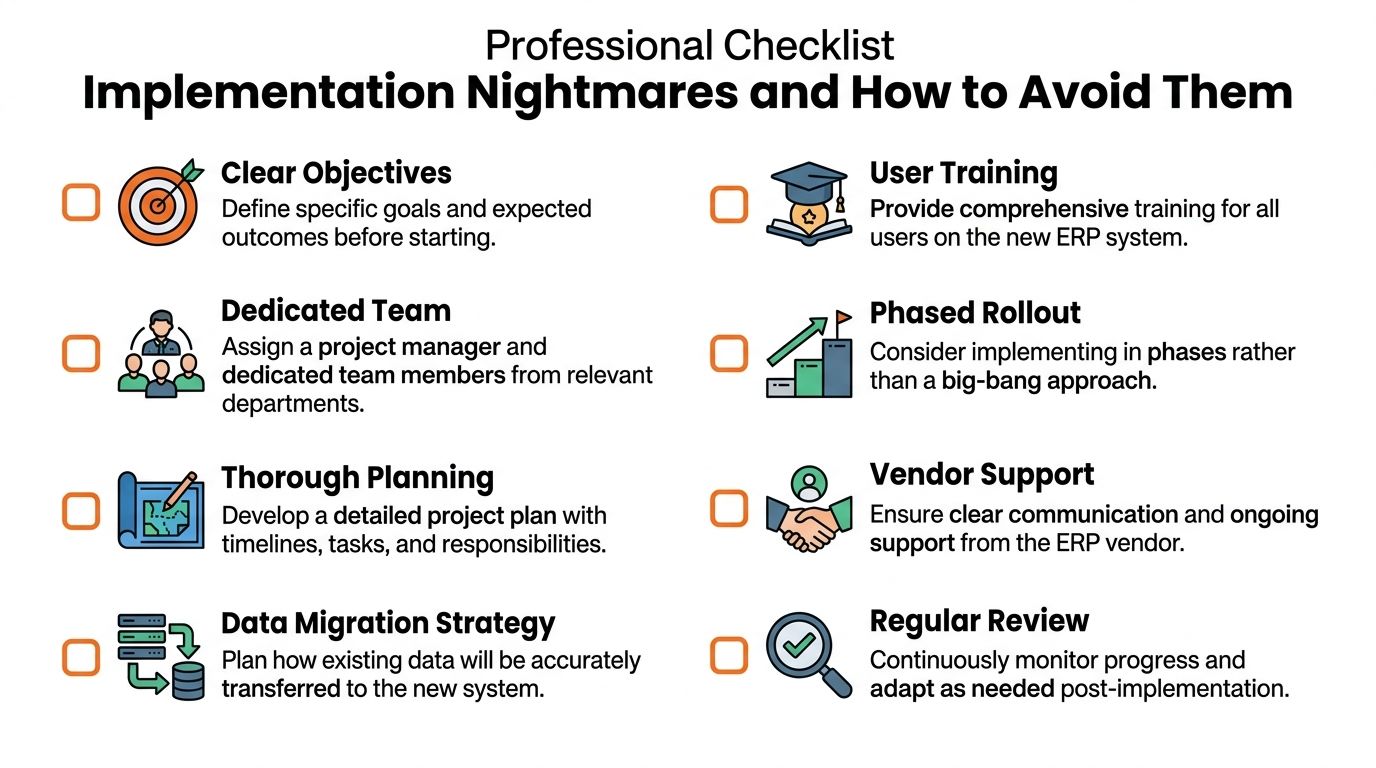
Buying the ERP is a sales process. Implementing it is a behavior change, a data cleanup project, and an operations audit all at once. Most failures aren't caused by the software itself. They happen because the company tries to automate confusion.
Do these before you migrate anything
Your first job is boring. Good. Boring work prevents expensive surprises.
- Clean your data: fix SKUs, naming rules, duplicate products, bad addresses, and messy customer records.
- Map the current workflow: write down how orders, returns, purchasing, and inventory updates work today.
- Choose owners: one person should own ops decisions, even if several teams are involved.
- Roll out in phases: get core order, inventory, and finance flows stable before chasing edge cases.
- Train with real scenarios: don't train in theory. Use actual orders, refunds, and stock problems.
If your process lives only in one employee's head, document it now. A simple standard operating procedures guide will save you more pain than another vendor demo.
The bottleneck nobody warns you about
Here's the trap: founders hear “single source of truth” and decide the ERP should control everything.
That can backfire.
One industry article makes the point clearly: tightly coupling storefront changes to an ERP can slow customer experience improvements and require heavy development. In many cases, it's smarter to decouple the front end so your ecommerce experience can evolve faster, as discussed in this piece on ERP headaches for ecommerce.
That means your ERP can own inventory, orders, finance, and fulfillment logic while your storefront stays flexible enough for merchandising, promotion tests, checkout experiments, and content changes.
Your ERP should control operational truth. It should not become the boss of every customer-facing change.
A better way to think about integration
You want strong back-office control without turning the store into a hostage.
That usually means:
- Keep ERP in charge of operational records
- Let the storefront move fast on experience
- Use integrations that can fail gracefully
- Avoid custom one-off hacks unless they solve a real bottleneck
If you're sorting through architectural tradeoffs, this write-up on Mastering Shopify ERP integration is useful because it forces you to think about flow design, not just tool names.
The right implementation feels a bit like plumbing. Customers shouldn't notice it. Your team should trust it. And when something goes wrong, you should know exactly where to look.
Your Next Move as a Founder
If you're still in the idea stage, or your order volume is low enough that one person can manage the flow without constant fires, forget ERP for now.
Build clean manual systems. Use Shopify, QuickBooks, and a lightweight automation layer if you need it. Write down how you process orders, handle returns, receive inventory, and reconcile finances. A plain Google Doc is fine. What matters is discipline, not software.
If you're in the scaling stage, do one thing tomorrow: map the path of an order from click to delivery.
Write every handoff down. Where does inventory get updated? Who owns refunds? What system decides what is in stock? Where do support agents look for shipment status? Where do finance and ops disagree? You'll learn more from that exercise than from ten sales calls.
Then make a hard call.
If your pain comes from weak process, fix the process first. If your pain comes from too many systems, too many channels, and too much manual stitching, start evaluating ecommerce ERP options with your workflow map in hand.
That's the founder move. Don't buy software to feel grown up. Buy it when it removes a real constraint.
And if you do implement one, protect your agility. Keep the back office stable. Keep the storefront flexible. Don't let a big backend system turn your brand into a slow-moving committee.
If you're building a brand in Chicago or the Midwest and want honest feedback from founders who've lived through messy ops, hiring mistakes, channel chaos, and the “should I buy this software yet?” phase, check out Chicago Brandstarters. It's a free community for kind, serious builders who want real conversations, not networking theater.
Leave a Reply