
You're building something in Chicago, and you already know the hard part isn't only product. It's finding the right room. Go to the wrong room and you get fake enthusiasm, soft advice, and a stack of coffee chats that go nowhere. Go to the right one and somebody saves you six months of stupid mistakes.
I've been there. Early on, most “community” spaces looked the same to me. Nice branding. Vague promises. A lot of people selling to founders instead of helping them. That's why I like treating hubs in Chicago like tools, not status symbols. A good hub has a job. It should help you get customers, build product, solve operational problems, or meet peers who tell you the truth.
This list is my operator's cut. I'm not trying to impress you with a giant directory. I'm telling you where I'd send a new founder depending on what they need right now. If you're also trying to build a real community around your work, this taap.bio creator guide is worth a read.
1. Chicago Brandstarters
You have a half-formed offer, a few early sales, and a long list of questions you cannot answer alone. You do not need another crowded event with generic startup talk. You need a room where people will tell you if your pricing is off, your channel is weak, or your idea needs work. That is what Chicago Brandstarters is for.
I'd send most early brand builders, ecommerce founders, and serious side-hustlers here first. Not because it has the flashiest programming. Because it solves the fundamental early-stage problem. Isolation. You get honest peers, practical operator feedback, and a group that is built for builders instead of service providers hunting for clients.
The setup is simple and useful. It's free, vetted, and built around an active group chat plus private dinners every two weeks with 6 to 8 people. That size is the point. Small groups create accountability. People stop performing and start telling the truth.
Who should join
Join if you fit one of these profiles:
- Idea-stage founder: You need to test the business before you spend money on branding, inventory, or a site nobody wants.
- Early ecommerce operator: You need practical help with sourcing, fulfillment, margins, and customer issues.
- Solo builder with a day job: You want a real founder circle without stuffing your calendar with low-value events.
- Experienced founder or mentor: You want to help people who are building and get pulled into better conversations.
If you are still at the stage of scraping things together, read their guide on how to start a business with no money. It matches the kind of founder this community serves.
The trust model matters more than people think. Members use ID and LinkedIn verification. The rules keep screenshots and self-promotion out. That changes behavior fast. Founders share the actual problem, not the polished version.
Practical rule: Pick the room that makes honesty easier.
What you actually get
Value isn't “access.” That word gets abused. What you get here is context from operators who have already made the mistake you are about to make.
That can mean feedback on an offer, help working through a messy operations issue, local introductions, or conversations that point you toward the next right program when you outgrow this one. I like that it stays Midwest-focused and founder-led. In a city full of startup branding, that specificity is an advantage.
Use Chicago Brandstarters with intent. Show up consistently. Bring one sharp question. Answer someone else's question well. Go to the dinners. If you lurk and wait for value to come find you, you will miss the whole point.
2. 1871
You're a first-time founder with too many tabs open, a vague product idea, and no real operating system for what to do next. That's where 1871 helps. It is the broad, downtown startup hub for founders who need structure, density, and a bigger pool of people than their current circle can provide.
I would send an early-stage tech founder here when the actual problem is not talent or ambition. It's lack of focus. 1871 gives you programs, mentor access, events, and a known startup network in one place. That matters if you need repetition and pressure to stop spinning.
Who should actually use 1871
1871 is best for founders who are still shaping the company, not just scaling one. If you are building software, a marketplace, a tech-enabled service, or you need a general startup environment to sharpen your thinking, this is a strong option.
The PYROS founder curriculum is useful for that stage. Use it if you need guardrails, deadlines, and a clearer view of what good early execution looks like.
Here's my advice. Do not join 1871 for the logo, the address, or the idea of being "in the ecosystem." Join because you have two or three specific gaps you want to close in the next 90 days. Then use the place hard.
A simple way to judge fit:
- Go to 1871 if you need structure: Good for idea-stage and early-stage founders who benefit from curriculum, office hours, and a steady stream of relevant events.
- Go to 1871 if you need breadth: You will meet more people outside your niche, which helps when you are still refining the business model, customer, or go-to-market motion.
- Skip 1871 if you need specialized build infrastructure: If your company depends on fabrication equipment, lab space, or a commercial kitchen, pick a hub built for that work.
- Verify the current setup before you commit: Workspace access, programming, and on-site details can change. Check what is included now, not what someone told you last year.
If you want a broader read on startup programs before picking one, this guide to finding an incubator near you is a useful comparison point. If budget is the bigger constraint, start with this practical read on how to start a business with no money.
Big hubs reward founders who show up with a real question, use the mentor time well, and leave with a decision. That is how you get value from 1871.
3. mHUB
If you're building a physical product, mHUB is one of the few hubs in Chicago where the tools are the point.
Too many early hardware founders try to act like software founders. They make pretty renders, talk about demand, and avoid the ugly work of prototyping. That's a mistake. Hardware gets real when you touch materials, test assemblies, and find out which part of your idea breaks first.
Where mHUB earns its keep
mHUB has a large innovation space with specialized prototyping labs, equipment for 3D printing, electronics, metals, plastics, and testing, plus on-site technical staff and a micro-factory setup for small production runs. That combination matters. It means you can move from concept to physical iteration without stitching together five different vendors.
This is who should go:
- Consumer hardware founders: You need to prototype, revise, and test fast.
- Industrial or manufacturing startups: You need equipment access and technical guidance.
- Physical product teams with limited capital: Month-to-month access is better than buying expensive gear too early.
If you're trying to start with almost no budget, read this guide on starting a business with no money. It won't replace a lab, but it will help you avoid burning cash on the wrong early expenses.
My no-nonsense take
mHUB is excellent if your business has atoms. It's less useful if your whole company lives in Figma, Slack, and Stripe.
Don't join because the building is impressive. Join if you already know your next prototype question. Which material? Which tolerance? Which enclosure? Which assembly issue? That's how you turn a facility into a competitive advantage instead of overhead.
Hardware founders need fewer pitch decks and more test failures.
4. MATTER
Healthcare is its own game. Different buyers, longer sales cycles, more regulation, more politics, and more dead ends for founders who think a slick product demo is enough. That's why MATTER exists.
If you're building in digital health, medtech, devices, or care delivery, I'd push you toward a sector-specific hub like this instead of a generic startup space. You need access to health systems, payers, biopharma, subject-matter experts, and people who understand commercialization in this field.
Where MATTER fits
MATTER has healthcare-focused mentorship, coaching, coworking, conference space, and programs tied to industry partners. That's the right setup if your startup needs clinical, operational, or procurement context.
There's another reason this kind of work matters in Chicago. A Chicago health report on community hubs notes a mismatch between health hub ambition and actual resource distribution, including cases where medically underserved area designations don't track poverty in a simple linear way. You can read that in the Envisioning Health Hubs project. For founders, the lesson is simple. Don't assume institutional maps match real need.
Who gets the most out of it
- Digital health founders: You need partner access and sector coaching.
- Medical device teams: You need healthcare-specific feedback, not generic startup advice.
- Founders building access or care models: You need to understand where the system has blind spots.
If you're outside healthcare, pass. MATTER is specialized, and that's a strength. A chef's knife is great in a kitchen. It's a bad screwdriver.
5. The Hatchery Chicago
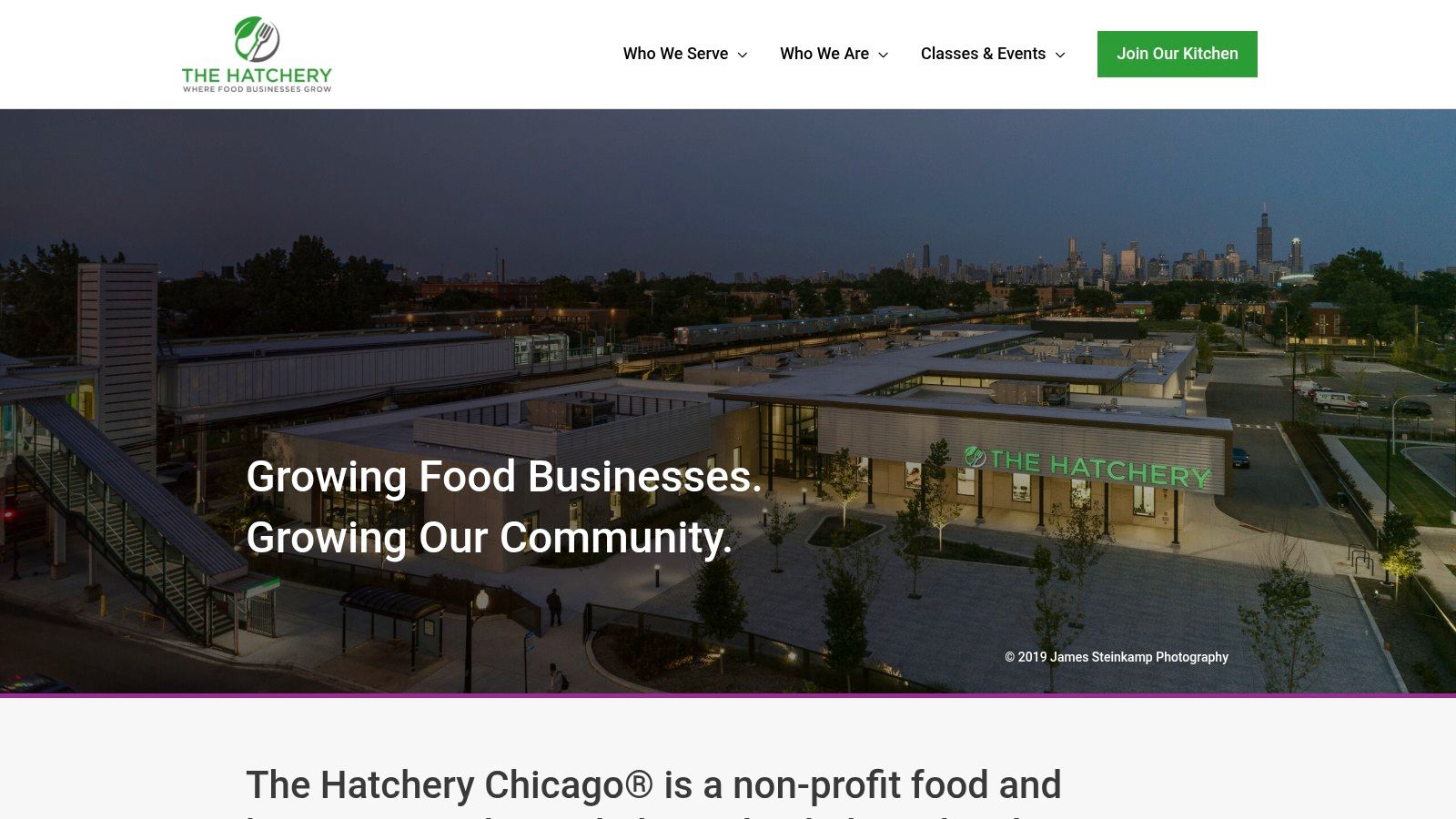
You get your first wholesale yes from a local retailer. Then the substantial problems appear. Where are you producing, how are you storing inventory, who handles compliance, and what happens when your prep schedule collides with everyone else's? The Hatchery Chicago exists for that stage.
I like this hub because it solves operator problems, not founder ego problems. Food businesses die on throughput, storage, scheduling, and licensing long before they die on branding. The Hatchery gives you shared and private kitchens, cold and dry storage, loading access, coworking, meeting space, and coaching. That combination matters if you are trying to make and move product every week.
This is for founders building actual food businesses. Packaged food, baked goods, catering, prepared meals, beverage concepts. If you need a licensed production environment and you are tired of patching together kitchen time from random sources, this is one of the clearest fits in Chicago.
Chicago also works in your favor here. The city is built for distribution and wholesale relationships, which helps once you move beyond small batch selling. If you are already thinking about buyers, margins, and shelf velocity, spend some time studying the broader venture capital market in Chicago too. It gives you a clearer read on how local investors think about scalable categories, including CPG.
My advice is simple. Join The Hatchery when you are ready to produce on a schedule and sell with discipline. Do not use it as a place to hide while you keep tweaking recipes for six months. Kitchen calendars are tight, storage is finite, and food margins punish sloppy planning. Treat it like an operating base. That is how you get real value out of it.
6. TechNexus Venture Collaborative plus TeamWorking by TechNexus
Some founders need peers. Some need tools. Some need distribution. If your company sells into enterprises, TechNexus is worth serious attention because it leans into corporate-startup collaboration.
That sounds abstract until you've tried to sell B2B on your own. Then you realize intros, credibility, and real pilot pathways are everything.
Best for B2B founders who need doors opened
TechNexus has a venture collaborative model, co-investment activity, and TeamWorking as a coworking environment for innovation teams. That mix works best for founders whose products fit corporate use cases. Think workflow software, infrastructure tools, fintech for enterprise, supply chain products, and similar categories.
Chicago has the corporate base to make this kind of hub relevant. The city has 32 Fortune 500 headquarters and nearly 450 corporate expansions or relocations since 2022, according to PwC and ULI's Chicago market profile. If you want to build near enterprise buyers and partners, that matters.
For founders trying to understand the money side of this path, this venture capital in Chicago guide is a practical next read.
My blunt filter
Go here if your startup can help a large company make money, save time, reduce risk, or ship faster. Don't go here if your whole strategy is “maybe a corporation will like us.”
Enterprise hubs reward specificity. “We help operations teams cut manual reconciliation” is useful. “We use AI to transform business” is wallpaper.
This one is selective by nature. That's fine. Corporate collaboration only works when there's a clear fit.
7. 2112 at Fort Knox Studios plus Center for Creative Entrepreneurship
You are building a media company, a creative tool, or a creator-led brand. You walk into a generic startup space and spend an hour explaining why rights, audience, production timelines, and distribution matter. Wrong room.
2112, paired with the Center for Creative Entrepreneurship, is for founders whose business is tied to creative work. That distinction matters. I like niche hubs when the niche changes how companies operate, and creative businesses do not run like standard SaaS startups. Revenue is less linear. Collaboration is more project-based. Your edge often comes from taste, access, talent, and IP, not just product velocity.
That is why this place works.
2112 gives you coworking, day passes, memberships, workshops, mentorship, and a community built around music, media, and creative entrepreneurship inside Fort Knox Studios. Start with a day pass. That is my recommendation. You will know fast whether the people in the room are your people, and you do not need a long commitment to find out.
The best fits are clear:
- Music and media founders who need peers that understand production, releases, partnerships, and audience growth
- Creator-led businesses that want business support without getting pushed into generic startup jargon
- Creative tech startups building tools for people who make, publish, license, or distribute content
Chicago helps because it gives creative founders a real customer base, working talent, agency relationships, production infrastructure, and adjacent industries to sell into. You do not need to treat your company like a Silicon Valley clone to build something serious here.
My operator take
Use 2112 if your company sits between creativity and commerce and you want relevant conversations from day one. Use CCE if you need help turning creative skill into an actual business model.
My blunt advice is simple. Do not join a general founder hub if you keep having to translate your business for everyone around you. Go where people already understand the economics of creative work. That saves time, sharpens your strategy, and puts you around founders solving the same kind of problems you are.
7-Way Comparison of Chicago Hubs
| Name | 🔄 Implementation complexity | ⚡ Resource requirements | 📊 Expected outcomes | 💡 Ideal use cases | ⭐ Key advantages |
|---|---|---|---|---|---|
| Chicago Brandstarters | Low, community onboarding + vetted dinners; selective entry | Low monetary cost; time and in‑person commitment | Peer problem‑solving, faster learning, network elevation | Early-stage ecommerce and solo founders in Chicago/Midwest | Free, founder-led, confidential peer support; strong practical wins |
| 1871 | Moderate, structured curricula and cohort delivery | Moderate, program fees/desk options vary; mentor network access | Founder education, mentor matches, citywide tech connections | Idea‑to‑growth stage founders across industries | Large alumni/mentor network and recognized startup brand |
| mHUB | High, specialized lab workflows and safety procedures | High, equipment access tiers, lab fees, trained staff needed | Rapid prototyping, small‑run production, supplier introductions | Hardware, manufacturing and physical‑product founders | Extensive prototyping labs and on‑site technical support |
| MATTER | Moderate–High, cohort and partner coordination | Moderate, sector partnerships and subject‑expert engagement | Healthcare commercialization, provider/payer introductions | Digital health, med‑tech, care delivery startups | Curated healthcare network and subject‑matter coaching |
| The Hatchery Chicago | Moderate, scheduling and regulatory compliance management | Moderate, licensed kitchen access, storage and class fees | Production readiness, regulatory navigation, marketable CPG products | Food & beverage entrepreneurs and CPG founders | Licensed shared kitchens, regulatory support, community resources |
| TechNexus (TeamWorking) | High, corporate alignment and co‑investment workflows | Moderate–High, selective partnerships; coworking membership | Enterprise pilots, commercialization, potential co‑investment | B2B and enterprise‑oriented startups seeking corporate partners | Direct enterprise access and venture collaboration pathways |
| 2112 + CCE | Low–Moderate, creative workflows and studio scheduling | Low, day passes to memberships; studio access varies | Media production support, creative business development | Music, film/video, creative‑tech founders and creators | Niche creative ecosystem with low‑commitment entry (day pass) |
Your Next Move How to Choose a Hub
It's Monday morning. You have a prototype that still breaks, a pitch that needs work, and three people telling you to “get plugged into the ecosystem.” Here's my advice. Ignore the hype and choose the room that fixes your immediate problem.
Do not join multiple hubs just to feel productive. That's how founders burn time, stack memberships, and avoid the actual work.
Choose based on your bottleneck. If you need blunt founder feedback and real relationships, pick Chicago Brandstarters. If you need startup structure, events, and a broad network, pick 1871. If you need to build and test a physical product, pick mHUB. If you sell into healthcare, pick MATTER. If you're producing food or beverage products, pick The Hatchery. If you need corporate access and enterprise partnerships, pick TechNexus. If you work in music, film, content, or creative tech, pick 2112.
Founders get this wrong all the time. They pick the most famous logo instead of the place that removes friction from the next 90 days. Prestige does not solve a manufacturing problem. A nice coworking floor does not help if you need buyer introductions. If your constraint is equipment, pay for equipment. If your constraint is distribution, get in front of customers and partners. If your constraint is honest feedback, join the room where people will tell you the truth.
Chicago rewards operators who build tangible operations. The city is built for movement, meetings, supply chains, and dense industry connections. That matters if you ship product, sell into established companies, or need to meet partners without turning every conversation into a flight and a hotel bill.
Location matters too. Commute friction drains founders faster than they admit. If getting to your hub takes an hour each way, you will go less often, meet fewer people, and get less value. Pick a place that fits how you work. Near your home, near your customers, or near the collaborators you need every week. Convenience is not a luxury. It affects execution.
My recommendation is simple. Pick one hub and commit for a few months. Show up consistently. Ask specific questions. Offer help before you ask for favors. Build a reputation as someone serious, useful, and easy to work with. That is when a hub starts paying off.
If you want the fastest path to honest founder feedback in Chicago, start with Chicago Brandstarters. It's free, vetted, and built for people who want real conversations instead of performative networking. If you're a kind, hard-working builder in Chicago or the Midwest, it's the room I'd join first.
Leave a Reply