

You might be in a weird spot right now.
You built something. Maybe you sold it. Maybe you shut it down after giving it everything you had. Either way, you're not eager to jump straight into another all-out sprint. But you're also not built for coasting, middle management, or smiling through pointless meetings.
That in-between season is where entrepreneur in residence roles make sense.
I like this path for founders because it gives you a landing pad without dulling your edge. You stay close to deals, products, operators, and new ideas. You get room to think. You keep momentum. And if you pick the right setup, you also get a clean runway into your next company.
For founders in Chicago and the Midwest, this path can be even better than the usual coastal script. Our best opportunities often come through trust, reputation, and usefulness. That fits the EIR game perfectly.
Thinking About Your Next Move
If you're between companies, don't panic and grab the first “Head of Innovation” title someone throws at you.
A lot of founders make that mistake. They confuse motion with direction. An entrepreneur in residence role is better when you want to stay in the arena without locking yourself into someone else's org chart.
Historically, the role became a formal model in venture firms, accelerators, and innovation programs because it lets experienced founders embed inside an organization for a fixed period while keeping autonomy. Contemporary descriptions commonly place the role at about 6 to 12 months, with some arrangements extending longer, and many organizations use EIRs to evaluate opportunities, advise startups, and shape strategy, as LTSE explains in its overview of the EIR model.
Why this path fits a founder brain
A good EIR role is like renting a workshop before you buy land. You get tools, space, and smart people nearby. You don't have to commit to a whole new life.
That matters if you're tired but still ambitious.
You can use the role to:
- Recover without disappearing by staying close to founders, investors, and product problems
- Pressure test your next idea before you go all in
- Build new relationships that can become future customers, investors, or co-founders
- Stay credible in the market instead of looking like you've gone quiet
Practical rule: If you're still emotionally attached to your last company, don't start another one next week. Get proximity to opportunity first.
What to do this week
Start by writing one page. I mean one page, not a deck.
List three things:
- What you know cold
- What kind of problems you want to solve next
- What kind of environment gives you energy
Then go sharpen your language. If you need a reset on how founders think and act under pressure, read this piece on what is entrepreneurial mindset.
If you're still exploring venture-building paths and founder programs, you can also explore Entrepreneur First's resources. It won't hand you an EIR role, but it can help you think more clearly about founder-fit environments.
What an Entrepreneur in Residence Actually Does
You sit down with a partner at a Chicago fund on Tuesday morning. By Friday, they want three things from you. A sharper view of a market, honest feedback for a shaky founder, and a clear answer on whether a new venture deserves more time or should be killed now.
That is the job.
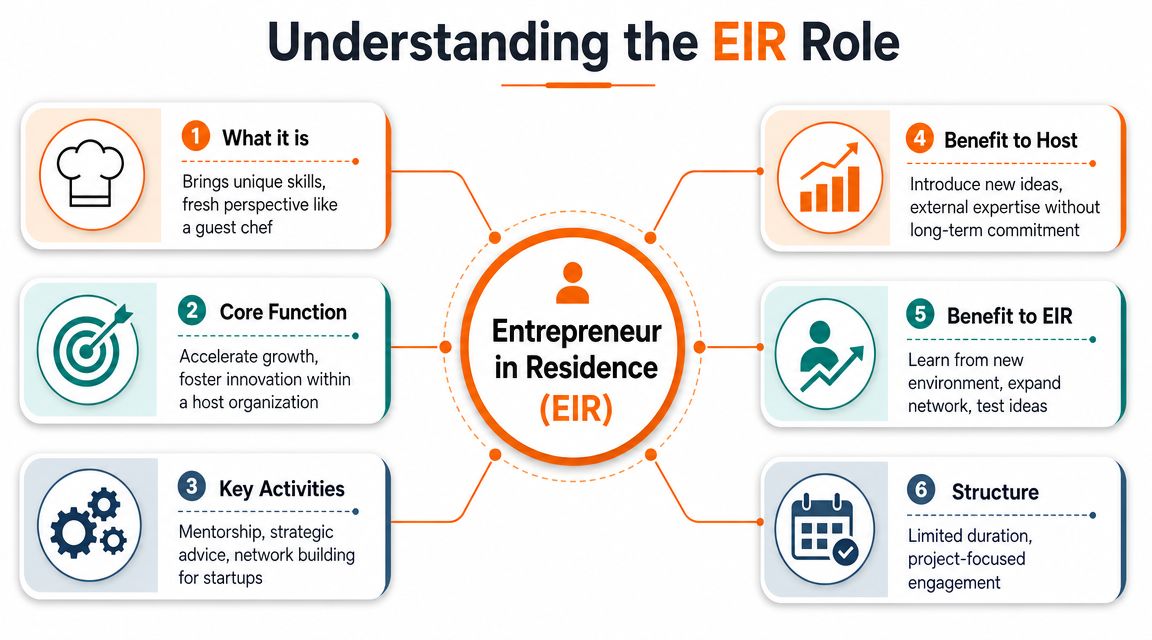
An entrepreneur in residence is a founder brought in for a defined stretch to create clarity and momentum. You are there to test ideas, improve decisions, and help turn loose opportunity into something investable, buildable, or worth stopping.
The three buckets of real work
The title sounds fuzzy. The work is not.
Ideate
You look for opportunities the host has not framed well yet.
That means talking to customers, sizing pain, spotting bad assumptions, and deciding whether a thesis has teeth. In the Midwest, this often matters more than flashy brainstorming. Good EIRs here win by grounding ideas in real operators, real buyers, and industries we know well, from logistics to healthcare to industrial tech.
Advise
You help founders, internal teams, or researchers avoid expensive mistakes.
Your value is judgment under uncertainty. You can hear a pitch and know where the story breaks. You can review a pricing plan and spot the part that will stall sales. You can tell when a founder is hiding from customer truth.
Kind people are often too polite here. Do not be vague. Midwest founders respect clear feedback if it is honest and useful.
Build
Some hosts want more than perspective. They want progress.
You may shape a new company, validate an internal venture, recruit early talent, or help turn a rough concept into something fundable. If part of your job is pattern recognition across markets, it can help to find UK entrepreneurship investors and compare how investors in other ecosystems assess founder-ready opportunities.
What the structure usually looks like
The role is temporary by design. You are usually there for a fixed period with room to move, ask hard questions, and chase signal instead of settling into corporate routine.
A strong EIR is judged on learning speed and decision quality. Did you help the host see the right opportunity faster? Did you save them from a bad bet? Did you help a founder or team get unstuck?
That is the bar.
A weak EIR becomes a friendly extra in the room. A strong one changes the quality of the room.
What your week includes
A normal week can include:
- Founder sessions on positioning, fundraising prep, hiring choices, or customer discovery
- Internal strategy work with investment partners, innovation leaders, or commercialization teams
- Market validation through customer calls, channel checks, and short decision memos
- Relationship building with operators, technical experts, future co-founders, and investors
- Ecosystem mapping through regional networks, accelerators, and Midwest startup incubator communities
If a host wants a mascot with founder credentials, pass. If they want someone who can handle ambiguity, tell the truth, and produce momentum, you are looking at a real EIR role.
The Three Flavors of EIR Programs
Where you do this work matters as much as whether you do it.
A venture capital EIR role feels different from a corporate one. An academic EIR role is different again. Same title. Different game.
Fast comparison
| Attribute | VC EIR | Corporate EIR | Academic EIR |
|---|---|---|---|
| Primary goal | Find, shape, or test investable opportunities | Help the company explore new ventures or speed up innovation work | Turn research or ideas into viable companies |
| Typical pace | Fast, deal-driven, high ambiguity | Slower than startups, faster than normal corporate projects if sponsored well | Uneven pace, often tied to faculty, labs, or commercialization timelines |
| Best fit | Founders who like markets, investors, and company formation | Founders who know how to navigate large orgs without getting trapped by them | Founders who can translate technical work into customer language |
| Main upside | Proximity to capital and portfolio flow | Access to industry assets, customers, and distribution | Access to research, talent, and novel IP |
| Main risk | You can become a free consultant to everyone | You can drown in politics and approvals | You can spend too long in theory and not enough in market reality |
If you're still mapping the kinds of ecosystems that feed these roles, this list of small business incubators is a useful way to think about where opportunities often cluster.
VC EIR
This is the cleanest version of the role.
A venture firm usually wants one of two things from you. First, help portfolio founders with hard operator problems. Second, find or build something that could become the firm's next investment. If you want investor access and live for messy early-stage decisions, this is the strongest fit.
The catch is simple. You need real judgment. VCs can smell borrowed confidence.
Corporate EIR
A corporate EIR role can be great if the company has a real mandate and an executive sponsor with power.
You may get access to customers, data, regulatory context, manufacturing relationships, or distribution channels that a startup founder would kill for. But big-company gravity is real. If nobody can say who owns decisions, you'll end up trapped in theater.
Ask one question in the interview: “What happens if I find something worth building?” The answer tells you whether the company is serious.
Academic EIR
This one is best for founders who can bridge two languages. You need to understand the technical side enough to earn trust, then translate it into market reality.
Universities often need help moving from research promise to business clarity. That means customer discovery, value proposition work, startup formation, and early fundraising logic. If you enjoy helping smart technical people become commercially sharp, this can be a strong lane.
Weighing the Deal Pros and Cons
An entrepreneur in residence role can be a smart move. It can also waste a year if you walk in sleepy, vague, or starstruck.
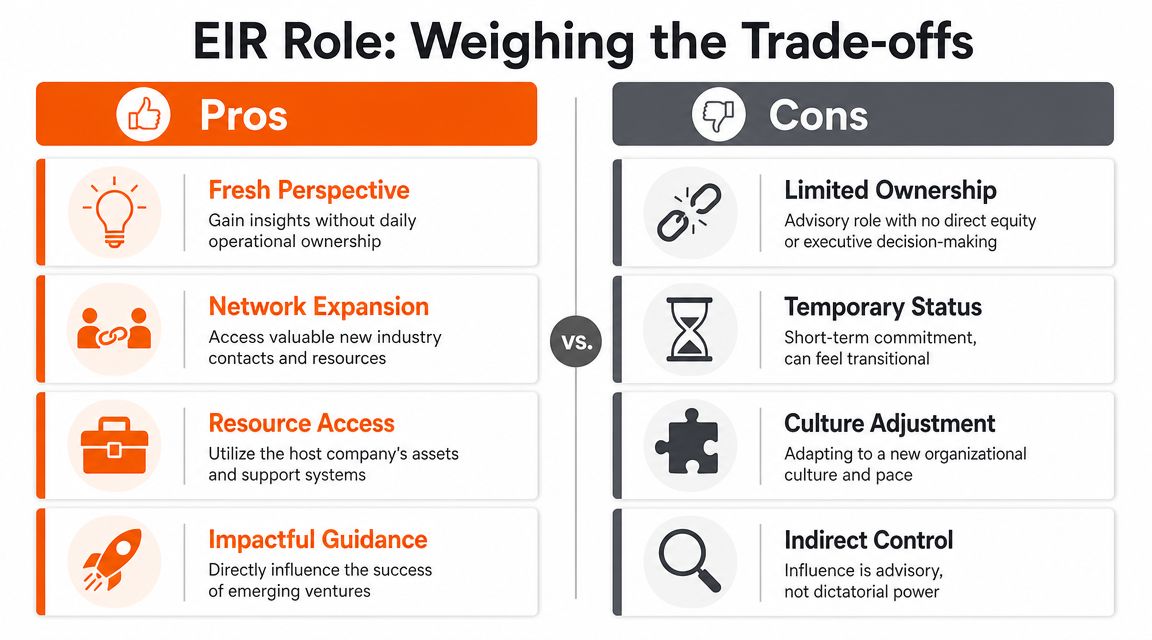
The value is pretty simple. You bring startup pattern recognition into a short engagement, and the host gets access to your execution experience, network, and fundraising judgment. CIO describes the technical value of the role as reducing information gaps, and says effective EIRs often bring capital, technology, and expertise in navigating regulation, while acting like a “super product manager” in a practical explanation of how EIRs help organizations.
Why founders like the role
Here are the upside cases I like most.
- You get breathing room without going cold. That's useful after an exit, a shutdown, or a bruising fundraising cycle.
- You draw upon the host's resources. Brand, access, meetings, data, and introductions get easier.
- You sharpen your next move while someone else covers some of the infrastructure around you.
For a practical founder, this can be a clean bridge between chapters.
Where people get burned
The downsides are also real.
- The goals may be fuzzy. If the host can't define success, they may expect miracles and call it flexibility.
- Your ownership is limited. Influence isn't the same as control.
- You may build around someone else's agenda. That's fine if you choose it. It's miserable if you drift into it.
My bias: never accept an EIR role if the host wants founder energy but won't give founder-level access.
How I decide if the trade is worth it
I use three filters.
The role has to buy you time, not just consume it
A good EIR role creates optionality. A bad one fills your calendar.
The host has to open doors you can't open alone
That might be investor trust, customer access, technical depth, or regulatory know-how. If they don't have real influence, skip it.
The work has to compound into your future
You should leave with stronger judgment, stronger relationships, and a clearer next move. If you leave with only a title, you made the wrong deal.
How to Land an Entrepreneur in Residence Role
Don't apply like a job seeker. That's the first rule.
Most strong entrepreneur in residence roles are found through trust, pattern matching, and specific need. Many aren't posted cleanly. Some are barely defined when they start. You often win by making the role easier to imagine.
Build a reverse pitch
Your pitch should answer one question: why you, here, now?
Don't send a generic founder bio and ask if they're hiring. Send a short note that shows you understand their gap and have a credible way to help close it.
Use this structure:
- Name the problem
- Show why it matters to them
- Explain why your background fits
- Suggest a tight first engagement
Here's the difference.
Weak pitch: “I'm a second-time founder looking for an entrepreneur in residence opportunity.”
Better pitch: “You have strong deal flow in industrial software, but your earliest teams likely need more help with customer discovery and commercialization. I built and sold into that kind of buyer, and I know where founders usually get stuck. I think I can help your portfolio and also pressure-test new venture themes.”
Reframe your founder story the right way
Nobody serious expects a perfect track record.
What they do want is signal. Can you tell the truth? Can you learn? Can you separate bad luck from bad judgment?
Use specifics:
- What you built
- Where you were right
- Where you were wrong
- What pattern you now see faster than other people
Don't oversell the win. Don't hide the scar.
The best founder stories aren't polished. They're clean. I should know what you learned in two minutes.
Hunt where these roles actually appear
You need a better search method than LinkedIn Easy Apply.
Try this:
- Start with funds and programs that already back or support company formation
- Look for commercialization groups inside universities, research centers, and startup programs
- Watch for operator-friendly firms where partners clearly value hands-on builders
- Ask for introductions to people, not jobs because roles often take shape after the conversation
Show them a draft of the future
If you really want the role, do homework.
Write a memo. Map a market. List customer segments. Flag the friction in their current setup. Show them how you'd spend your first month. You are making it easy for them to believe you inside the role.
That is how founders get picked. Not by sounding impressive. By reducing the other side's uncertainty.
The Chicago and Midwest EIR Playbook
Chicago is a better place to land an entrepreneur in residence role than many founders realize.
You just have to play it the Midwest way. Less chest-thumping. More trust. Less hype. More follow-through.

What Midwest buyers of talent want
They want proof that you've done hard things, and proof that you won't act entitled.
That's why this market can reward the right founder. If you're kind, prepared, and useful, people here will make introductions. They won't always post the opportunity. They will often open the side door.
A good local target list includes venture firms, universities, incubators, corporate innovation teams, and startup hubs. If you want a map of the local capital side, start with this guide to venture capital in Chicago.
Use the selective-program standard
I like looking at serious university programs because they tell you what the market respects.
Georgia Tech's Quadrant-i EIR program requires applicants to be proven founders or senior business experts, not first-time entrepreneurs. It calls for five to 10+ hours per week without compensation, with travel expenses reimbursed, and it expects deep market knowledge, startup operations and fundraising experience, and enough financial independence to do the work well. It also lays out milestones like a market assessment in the first 60 days, then value-proposition validation over the next 30 to 60 days, followed by MVP development support, as shown in Georgia Tech's EIR program details.
That should shape how you present yourself in Chicago too.
If you sound like you're “hoping to break into startups,” you're too early for many EIR conversations. If you sound like someone who can reduce uncertainty and move a project through milestones, you're in the game.
Local tactics that work better than cold outreach
Try this stack:
- Get introduced through operators because Midwest trust often travels founder to founder
- Show your work early with a short memo, customer map, or commercialization angle
- Be generous first by helping on one live problem before asking for the role
- Stay consistent because people here watch whether you do what you said
Chicago rewards steady builders. If you're dependable and sharp, that reputation compounds.
Frequently Asked Questions About EIR Roles
You get the meeting. The partner likes your background. The university lead says you could be a strong fit. Then the conversation gets slippery right when it should get specific. Pay, equity, authority, and what “success” means all get treated like details to sort out later.
Do not let that happen.
A good EIR role is clear about what you are responsible for, how your work will be judged, and what you get in return. A fuzzy role burns months and leaves you with a nicer LinkedIn line and very little else.
How do EIRs get paid
In several different ways, and you should ask about compensation in the first real conversation.
Some roles pay salary. Some offer a stipend. Some are project-based. Some are unpaid and try to make up for it with access, credibility, or a first look at venture opportunities. Those can still be useful, but only if the upside is real and the time commitment fits your life.
Midwest founders should be especially careful here. Too many good people accept vague “strategic” roles because they do not want to sound difficult. Ask the direct question. What is the cash compensation, how many hours are expected, and what happens if the scope grows?
Should you expect equity
Expect clarity, not promises.
Equity makes sense if you are helping create a company, shaping the thesis, recruiting the team, or stepping in as the founder. If the host wants your judgment, network, and operating experience but offers no clear path to ownership, treat that as a consulting-style role and price your time accordingly.
If someone says, “We'll figure it out later,” slow the process down. Later usually means never.
What if you do not find a winning idea
The role can still be a smart move.
You can leave with stronger investor relationships, sharper market judgment, better pattern recognition, and a much better sense of what you should build next. That is real value. It only counts if you define it upfront instead of hoping the role will somehow turn into something bigger.
Set your own scorecard early. Then use it.
What should your scorecard include
Use outputs that show movement, not busywork.
- Quality introductions that led to real conversations
- Customer calls that changed the direction of the work
- Decisions made faster because you did the analysis
- New venture paths, funding paths, or partnerships opened
- Clearer conviction about what you should build, join, or pass on
If success cannot be measured in decisions, relationships, or venture progress, the role is too vague.
Can first-time founders land these roles
Usually no.
The stronger EIR roles want someone with scar tissue. They want judgment earned through missed hires, ugly trade-offs, fundraising pressure, and hard customer conversations. You do not need a huge exit. You do need evidence that people can trust you with ambiguity and that you can turn loose ideas into forward motion.
A first-time founder can still get close to the role by becoming obviously useful first. Help a studio evaluate an opportunity. Advise a university team on customer discovery. Build a reputation as the person who follows through. In Chicago and the Midwest, that path works better than trying to sound more experienced than you are.
What is the best question to ask in an EIR interview
Ask this. “What would make you say this was a great EIR engagement six months from now?”
That question forces the room to get concrete. You will learn whether they care about venture creation, commercialization, mentoring, deal flow, or optics. If they cannot answer clearly, the role probably is not structured well enough to help you.
If you're a kind, hard-working founder in Chicago or the Midwest and you want honest feedback, warm intros, and a room full of operators who help, join Chicago Brandstarters. It's a free community built for people who want real conversations, not fake networking.
Leave a Reply