You're probably sitting with two tabs open.
One tab has some story about a flashy e-commerce raise. The other tab is your actual business: product samples, shipping quotes, ad tests, maybe a Shopify draft store, maybe an inbox full of suppliers who still haven't answered your last question. You read about “e commerce investments” and it can feel like the whole conversation belongs to people in Manhattan conference rooms, not to someone in Chicago trying to sell a real product without lighting money on fire.
I don't buy that story.
Most founders don't need hype. You need a clear way to think about money, risk, control, and growth. You need to know when outside capital helps, when it hurts, and when the smarter move is buying a business, borrowing carefully, or staying lean until your numbers tighten up.
That's how I think about e commerce investments. Like an operator. Like somebody who has to make payroll, place inventory, answer customers, and live with the consequences.
Tired of Hearing About E-Commerce Investment Hype
I've had this conversation a lot. A founder tells me they feel behind because some coastal brand raised a huge round and got written up everywhere. Meanwhile they're trying to figure out packaging costs, freight timing, and whether their second product will improve repeat purchase behavior.
That gap creates fake pressure. It makes normal founders feel small for no reason.
It's simpler than that. A lot of the easy-money DTC story already got punched in the mouth. Recent coverage says U.S. e-commerce startup funding is projected at $2.73 billion in 2025, down from $3.06 billion in 2024 and $28.05 billion in 2021 according to Practical Ecommerce's look at where investors see e-commerce heading. Investors have rotated away from broad DTC and toward infrastructure, AI, logistics, and other enablement plays.
That's not bad news for you. It's a filter.
If you're building a Midwest brand, you should stop trying to cosplay as a venture-backed poster child. Build something a real customer wants. Build margins. Build a repeatable channel. Then pick the funding path that fits your current business.
What the hype gets wrong
Here's where people get twisted up:
- They confuse funding with validation. Money doesn't prove the business works. Customers do.
- They copy the wrong model. A venture model is built for speed and outsized outcomes. Plenty of good brands should never touch it.
- They ignore geography as an advantage. In places like Chicago, you can often build with less ego, less burn, and better judgment.
Practical rule: If the business only looks attractive when you assume endless ad spend and generous future funding, the business isn't attractive.
A founder in the Midwest has a shot if they stay honest. You don't need to win a hype cycle. You need to build a company that can survive contact with reality.
What I'd do instead
I'd ask three blunt questions before chasing money:
| Question | Why it matters |
|---|---|
| Do customers come back? | That tells you whether demand is real or rented. |
| Does more spend produce more profit? | Growth without contribution is a treadmill. |
| What are you giving up for the cash? | Equity, control, time, or repayment pressure all have a cost. |
That's the frame for the rest of this. Forget the theater. Think like an owner.
What E-Commerce Investment Really Is
E-commerce investment is just fuel. That's it.
You have a vehicle, which is your business. You have a destination, which is your goal. And you have fuel, which is capital. Most founders get in trouble because they obsess over fuel before they've decided where they're driving.
If you're building a small, profitable niche brand, you don't need rocket fuel. If you're trying to grab market share fast in a crowded category, maybe you do. Different trip, different gas station.
The business is bigger than your store
This isn't some tiny side category anymore. U.S. online retail sales were $27.6 billion in 2000 and exceeded $1.234 trillion in 2025, a roughly 45-fold increase, according to Digital Commerce 360's review of U.S. e-commerce sales. That tells me one thing very clearly. Selling online is not a fad. It is normal commerce now.
So when I talk about e commerce investments, I'm not talking only about buying stock in Amazon or betting on some trendy app. I'm talking about putting money into the machines that make online commerce move: inventory, ads, software, packaging, fulfillment, product development, photography, working capital, and people.
Where capital actually goes
Most founders use investment for one of a few reasons:
- Inventory: You need stock before you can fulfill demand.
- Customer acquisition: You've found a working channel and need more budget.
- Operations: You need systems, contractors, or hires to stop bottlenecks.
- Stability: You need room to manage cash timing, especially when suppliers and payouts don't line up.
If you're still at square one, fix the basics first. A practical starting point is this guide on how to start an ecommerce business. I like it because it helps you map the vehicle before you worry about fuel.
The wrong capital at the wrong time works like pouring race gas into a lawn mower. Expensive, dramatic, and useless.
Match the money to the mission
I think founders should write down their goal in one sentence before talking to anyone about money.
Try one of these:
- “I want to get from idea to first 100 customers.”
- “I want to buy more inventory because demand is already proven.”
- “I want to acquire a small store and improve it.”
- “I want to grow fast enough that equity dilution is worth it.”
Those are four different businesses. They need four different capital plans.
That's what investment really is. Not status. Not press. Just choosing the right fuel for the trip you're taking.
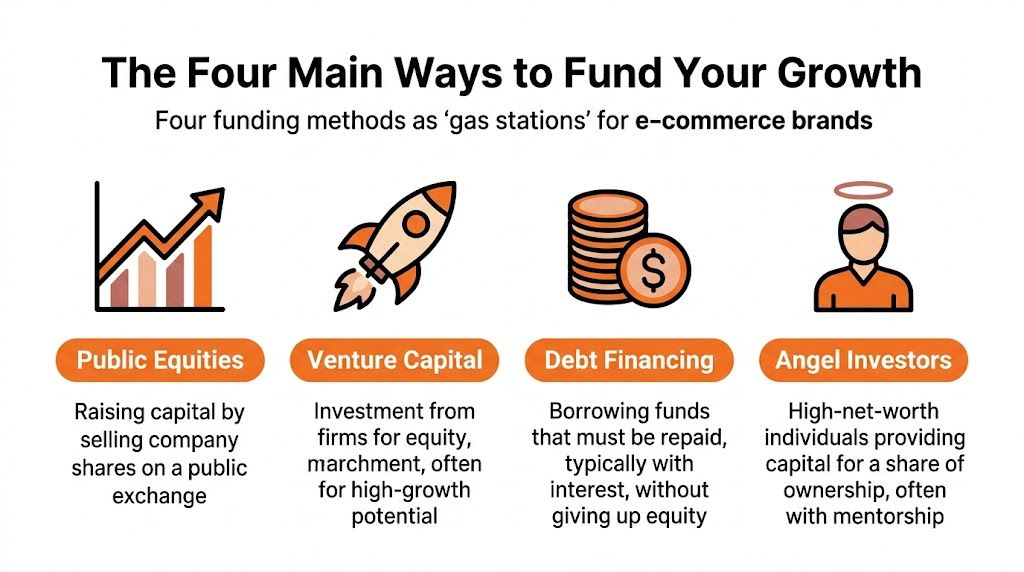
The Four Main Ways to Fund Your Growth
Some founders act like there's one door to money. There isn't. There are several. Each one asks for something different in return.
Public equities
This is the least relevant path if you're building your own brand from scratch. Public equities means buying shares in existing public companies. That's an investment path for outside investors, not a funding source for your early-stage store.
If you're a founder, I'd treat this as education, not operating capital. Study how public markets value commerce businesses. Don't confuse that with how your small brand gets funded.
Venture capital and angel money
This is the path everybody talks about because it's dramatic. Angels and VC firms put in money for ownership. In exchange, they expect growth, speed, and a path to a big outcome.
That can work. But it only fits a narrow slice of businesses.
If your category has huge upside, your retention is strong, and you can deploy capital into growth with discipline, equity money can make sense. If you're selling a solid niche product with moderate upside and a calm pace, equity can become a bad marriage fast.
Here's my blunt advice. Don't raise equity because you're broke. Raise equity because more capital predictably creates more enterprise value.
Debt financing
Debt is underrated because it's less glamorous. I like that about it.
If your store has working demand, decent margins, and predictable cash movement, debt can be cleaner than selling ownership. You keep control, but you take on repayment risk. That means you need to know your numbers cold. If you're exploring that route, this page on ecommerce business loans is a useful starting point.
Debt is usually better for financing things with a clear payback path. Inventory is a common example. Plugging a broken business with debt is how founders dig a deeper hole.
Buying an existing store
This is the move too many people ignore.
You do not have to build from zero. You can buy an existing, profitable e-commerce store and improve it. That can be smarter than trying to invent demand from scratch. You start with customers, products, and a sales history. Then you fix what the current owner neglected: email, conversion flow, bundles, creative, margins, or SKU sprawl.
I like this path for operators who are better at improving systems than inventing brands from a blank page.
A quick side-by-side view
| Funding path | What you get | What you give up | Best fit |
|---|---|---|---|
| Public equities | Exposure to e-commerce companies | Control over the operating business | Outside investors |
| Venture capital | Larger checks and growth support | Equity and pressure to scale | High-upside, fast-growth brands |
| Debt financing | Capital without dilution | Repayment obligations | Predictable stores with working economics |
| Angel investors | Flexible early money and advice | Equity and some influence | Early-stage founders with traction and a strong story |
If you can grow with customer cash, do that first. It's the cheapest money you'll ever get.
How Investors and Buyers Read the Scoreboard
Founders love vanity metrics because vanity metrics are flattering. Traffic looks good. Followers look good. Revenue screenshots look good. Buyers and investors care about a different scoreboard.
They want to know whether your store is a machine or a magic trick.

Start with stage-appropriate metrics
The right scorecard changes as you grow. Guidance for 2026 from Improvado's e-commerce analytics overview says that at launch you should focus on CAC, conversion rate, and AOV. In growth, shift toward CLV by cohort and channel ROAS. At scale, spend more time on gross margin and churn prediction. I agree with that progression because it matches how real businesses mature.
A baby brand needs proof that strangers will buy. A growing brand needs proof that channels produce profitable customers. A larger brand needs proof that it isn't leaking money under the floorboards.
The three numbers I'd want on one page
I can learn a lot from these three:
CAC
Customer acquisition cost tells me what you pay to get one buyer. If your paid channels rise and you don't know CAC by channel, you're driving with the speedometer covered.
CLV
Customer lifetime value tells me what that customer is worth over time. A high CAC can be fine if repeat behavior is strong. A low CAC can still be bad if customers buy once and vanish.
Gross margin
The practical reality is this: You can be good at selling and still have a weak business if fulfillment, returns, packaging, discounts, and product costs eat the upside.
If you want to sharpen your retention view, email matters a lot here. A practical companion read is essential email marketing KPIs to track, because email is often where repeat purchase economics become obvious.
Read the game film, not just the box score
I'd ask you questions like these:
- Which channel brings customers who come back?
- Which SKU has the healthiest margin after returns and shipping?
- Which first order leads to the best second order behavior?
- Where do carts die?
That's how smart buyers think. They don't just ask, “How much did you sell?” They ask, “What kind of business produces those sales?”
For a cleaner handle on profitability, use a simple gross margin framework like this calculation of gross margin percentage. Every founder should be able to do that math quickly, without hunting through ten tabs.
A short walkthrough helps if you want to see how operators break this down in practice.
What mature thinking sounds like
My rule: I'd rather pay more for a customer who buys again than less for a customer who disappears.
That's why judging channels by CLV instead of low CAC alone is smarter. Cheap traffic can be expensive if it produces weak customers. Expensive traffic can be great if it brings people who stick.
If you want outside money or want to sell one day, learn to talk this way. You'll sound less like a marketer and more like an owner.
Finding Opportunity Where Others See Flyover Country
I think the “you need to be on the coasts” narrative is lazy.
It usually comes from people who spend too much time talking to each other and not enough time talking to customers. If you're in Chicago or anywhere in the Midwest, you're often closer to practical buyers, realistic costs, and less crowded ideas. That's useful.
Underestimated founders often move faster
A 2026 survey found that 79% of small business owners in underserved communities say digital tools are highly important, versus 69% elsewhere, and 65% say AI tools are important, versus 54% elsewhere, according to this national survey on tech, crypto, and AI adoption. I like this data because it cuts against the stereotype that overlooked founders are slow adopters.
A lot of under-the-radar builders are pragmatic. They don't buy software because it sounds cool. They buy it because it saves time, cuts labor, or helps them sell.
That mindset wins.
Your location can sharpen your thesis
Midwest founders often have three built-in edges.
- You hear ordinary customer problems more clearly. You're not trapped in a bubble where every product idea sounds like a luxury wellness brand.
- You usually build with more discipline. When money is tighter, you test harder and waste less.
- You can sell nationally without acting nationally. The internet doesn't care where your office is.
That creates good hunting ground for niche brands. Boring categories. Regional loyalty. Products with practical demand. Existing stores that need better operators. Those ideas don't always get cocktail-party attention. I'm fine with that.
What I'd look for in flyover country
I'd hunt in places where coastal investors get bored too fast:
| Opportunity type | Why I like it |
|---|---|
| Niche replacement products | Clear demand and less trend risk |
| Category-specific accessories | Easier messaging and bundling |
| Existing stores with weak operations | Improvement upside is often obvious |
| Brands serving overlooked communities | Trust and relevance matter more than hype |
Being underestimated is useful. It gives you time to build before the copycats show up.
I'd also take local money seriously. Friends of operators, small angel groups, successful business owners, family offices with commerce exposure, and acquisition-minded buyers can all matter. You do not need to force your business into a Sand Hill template if your better route is regional capital plus steady execution.
One more thing. If you're in Chicago, don't apologize for it. Use it. The city teaches you to work, not perform.
Your Checklist Before You Ask for a Dime
If you ask for money before you understand your own business, you'll either get rejected or, worse, get funded for the wrong reasons.
Most founders think they need a prettier pitch deck. Usually they need cleaner numbers.

Get the financial house in order
Financial reporting guidance from Ramp's write-up on e-commerce reporting and metrics stresses gross and net margin reports, cash flow reports, and balance sheets, and it points out that you need to monitor credit-cycle length because e-commerce businesses can run out of cash even while sales grow.
That last point matters more than founders think. You can have a good month on paper and still get punched by timing. Supplier terms, payout delays, inventory deposits, disputes, and refunds all affect your oxygen.
Before I asked anyone for capital, I'd want these done:
- A clean P&L: Monthly, not random screenshots from your dashboard.
- A cash flow view: I want to know when cash lands and when it leaves.
- A balance sheet: If you don't know what you owe and own, fix that.
- Margin by product or product family: Revenue alone is not enough.
Know your acquisition story
I don't need a buzzword salad. I need answers.
Can you explain which channel gets first purchases? Can you explain what happens after that first order? Can you show what changed when you adjusted creative, offer, landing page, or merchandising?
If you're still estimating startup needs, this breakdown of the cost to start an online store is a useful way to pressure-test your assumptions before you ask for funding.
Your due diligence checklist
This is the boring work. Do it anyway.
Corporate basics
Entity docs, ownership split, tax records, bank statements.Commerce data
Store platform access, channel reports, refund history, top SKUs, supplier agreements.Marketing records
Ad account performance, email performance, creative tests, attribution notes.Operational notes
Lead times, fulfillment setup, customer service workflow, return policy, inventory process.Capital plan
How much you need, exactly what it funds, and what outcome you expect.
For a tighter working list, use a founder-friendly startup due diligence checklist. It helps you spot gaps before an investor or lender does.
Ask yourself the uncomfortable questions
If somebody wired you the money tomorrow, could you explain where each dollar goes and how you'll know whether it worked?
If the answer is fuzzy, wait.
One good side effect of this prep is that some founders realize they don't need outside money yet. They need a better reorder plan, a tighter offer, lower waste, or one channel that converts. That's a win. Capital readiness should make you a sharper operator first.
I'll mention one practical option here because it fits the audience. Chicago Brandstarters is a free, vetted community where founders talk through real operator problems in small dinners and group chat. For some people, that kind of peer pressure and tactical feedback is more useful than raising money too early.
What's Your Next Move
Your next move is not “raise money.”
Your next move is to decide what game you're playing.
If you want a durable niche brand, build for cash discipline and repeat purchase. If you want to buy and improve an existing store, learn how to evaluate operations and seller quality. If you have a real shot at fast growth, then earn the right to have equity conversations by knowing your numbers better than anyone in the room.
That's how I'd think about e commerce investments. Not as one event. As a capital strategy.
Pick the right fuel. Use only as much as the trip requires. Keep control when control matters. Give up equity only when the trade is worth it. And don't let somebody else's fundraising story bully you into a bad decision for your business.
You can build something real from Chicago. You can do it from Milwaukee, Indianapolis, Detroit, St. Louis, Des Moines, or a town most investors fly over without noticing. In some ways, that's better. Less noise. Fewer copycats. More room to think.
The founders I trust most usually aren't the loudest. They know their margins. They know their customers. They know what kind of money fits the machine.
Be that founder.
If you want honest help from people building real brands, join Chicago Brandstarters. It's a free, vetted community for kind, bold, hard-working founders in Chicago and the Midwest who want real conversations, small private dinners, and practical support while they build.
Leave a Reply