

Most Soho House advice is backwards. It tells you how to look desirable to the club before asking whether the club is desirable for you.
I think founders should flip that. A soho house application is not a college essay, and it isn't a status game worth winning at any cost. It's a business decision with a social wrapper. If you run your company with discipline, you should apply with the same discipline.
I like private communities when they create honest collisions, better conversations, and a room you frequently use. I dislike them when they turn ambitious people into slightly better-dressed procrastinators. Soho House can do both. Your job is to know which version you're buying into.
Before You Apply Is Soho House Right for a Founder
The popular advice says, "Just apply. The network is worth it." I don't buy that.
A founder should ask a harder question first. Will this membership create real advantage, or just give me a prettier place to avoid my actual work?

Start with the ugly facts
Soho House has demand. It also has problems.
GlassHouse Research said the business model was "broken" in February 2024, while waitlists reached 111,000 in Q2 2024 and membership grew 16% year over year to 204,028 members, according to GlassHouse Research's report on Soho House. That's the paradox. People want in. The economics still raise real questions.
If you're a founder, that should matter to you. You don't need to panic. You do need to think clearly.
Practical rule: Don't treat a membership like an asset. Treat it like an expense that must earn its keep.
There's another issue most guides ignore. There is no clear founder-specific ROI framework in public guidance. You can find endless talk about "community" and "creativity." You can't find much that tells a founder whether the room leads to customers, hires, partnerships, or investor intros in a way you can measure.
My filter for deciding yes or no
I use a simple founder test. If Soho House doesn't pass at least two of these, I'd skip it.
- Work utility: Will you use the space to work, host meetings, or reset between meetings?
- Travel utility: Do you spend enough time in cities with Houses to make broad access matter?
- Relationship utility: Are you at a stage where being around other operators could change your next year?
- Energy fit: Do you leave curated social spaces feeling sharper, or drained and performative?
If your honest answer is "I mostly want to get in because it feels cool," that's a weak reason.
A good community should reduce noise. A bad one adds another tab to your already overloaded browser. If you need help building a more grounded networking approach first, I like these GroupOS networking advice ideas because they focus on real connection instead of chest-puffing.
The founder-brain question
Here's the blunt version. Soho House might be useful. It is not automatically wise.
A room with nice lighting doesn't fix weak positioning, bad cash flow, or your fear of selling. If you're curious about the local angle, you can browse Soho House coverage from Chicago Brandstarters for context on how founders think about it in Chicago.
Before you touch the application, write down this sentence and answer it in one line:
Why is this better for me right now than spending the same money, time, and energy on customers, peers, or a tighter founder circle?
If you can't answer that fast, don't apply yet.
The Unwritten Rules of Eligibility
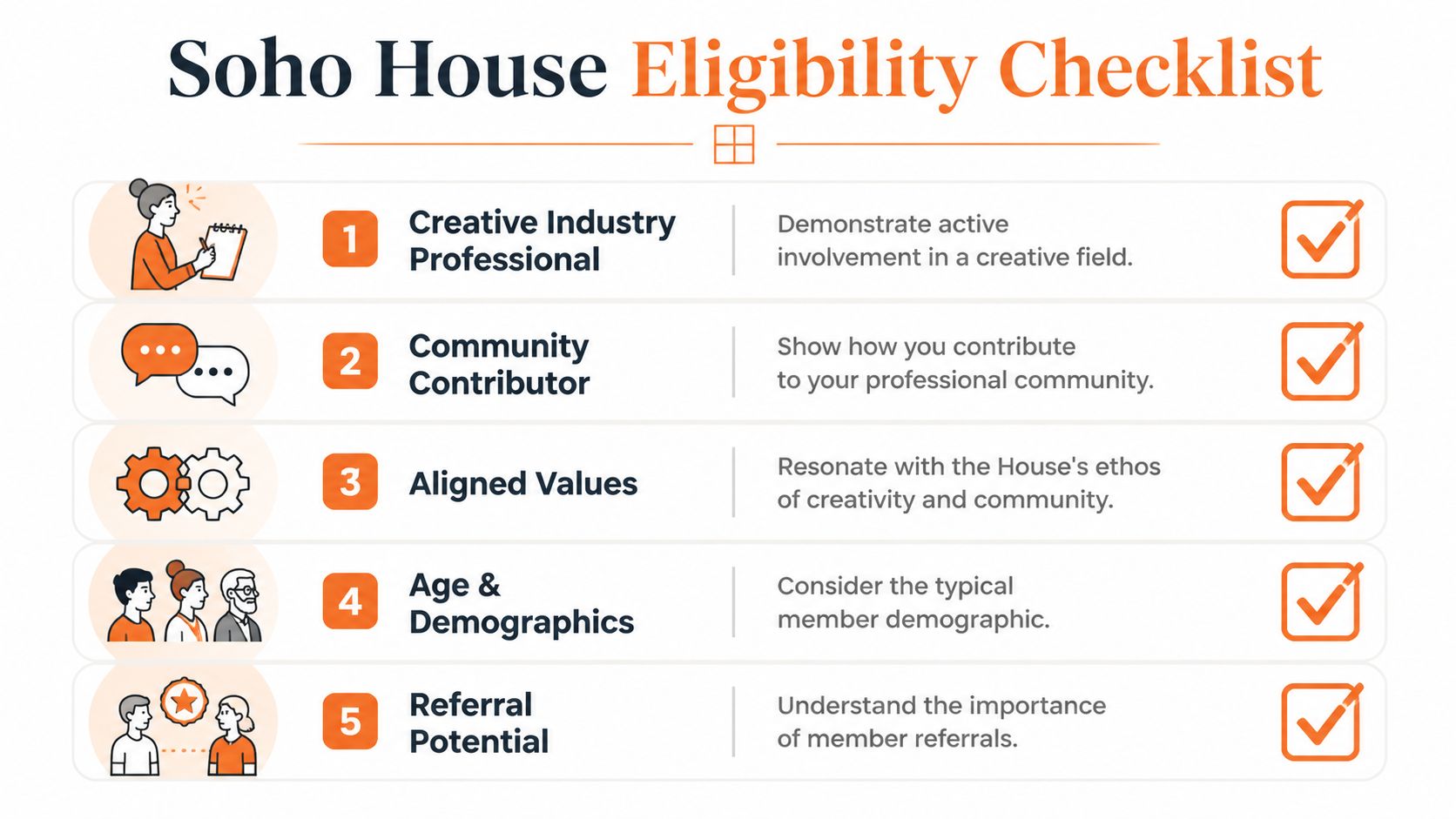
The actual filter is not "Are you creative enough?" It is "Do you sound like someone who contributes to the kind of room they want to build?"
For founders, that usually means showing taste, authorship, and cultural relevance in plain English. You do not need to pretend you are a filmmaker if you run a skincare brand. You need to show that your work has a point of view, affects how people experience a product or brand, and puts you in active conversation with other creative operators.
What "creative" usually means in practice
Founders get rejected when they describe themselves like back-office machinery.
If you run DTC, talk about product direction, brand identity, packaging, community, customer rituals, and the experience people buy into. If you run SaaS, describe the human problem you remove and the audience you serve, not the database you optimized. If you run an agency, define the change you create in taste, narrative, or perception.
A few examples:
| Founder type | Weak framing | Better framing |
|---|---|---|
| E-commerce founder | "I sell supplements online" | "I build a wellness brand with a clear point of view on daily rituals, education, and product design" |
| SaaS founder | "I made software for scheduling" | "I built a tool that removes admin drag for creative teams so they can protect more time for actual work" |
| Agency founder | "I do marketing services" | "I help brands clarify their story, visual identity, and customer relationship" |
Soho House's selection process emphasizes texture over job titles.
The profile they tend to favor
The membership brand clearly skews toward people in creative fields and younger professionals building social and professional identity. You can see that in how they market the club, how they talk about member communities, and how much attention they give early-career applicants. Read that as strategy, not romance. They are building a long-tail customer base.
As a founder, that should change how you apply. If you fit that broad lane, present your work cleanly and confidently. If you are older, more technical, or operate in a less obviously cultural category, your application has to work harder to show community fit and creative relevance.
Your job is to show that you add signal.
What to have ready before you apply
The form itself is simple. The judgment is not.
Before you submit, get five things straight:
- A one-line identity: What you build, for whom, and why it matters.
- Evidence of taste: Design choices, writing, events, brand world, content, product thinking.
- Visible participation: Hosting, teaching, publishing, collaborating, supporting other builders.
- A contribution angle: What kind of conversations, introductions, or energy you bring into a room.
- A real reason to join: Work utility beats status hunger every time.
If your current profile is thin, fix the profile first. That might mean publishing more, hosting small gatherings, sharpening your public bio, or getting clearer on your own narrative. The same discipline applies when you are applying for capital or grants. Orbit AI's guide to funding gets this right. Selection often follows clarity.
What hurts you
Status language kills otherwise decent applications.
So does startup filler. Phrases like "visionary entrepreneur," "disrupting the industry," and "building solutions" make you sound interchangeable. Soho House does not need another polished résumé in a leather jacket. It wants people with a distinct body of work and some social proof that they show up well in communities.
One more uncomfortable truth. If your best case for membership is prestige, you are already off track. A club with shaky financials is not a sacred object. It is a tool. If the tool fits your work, apply appropriately. If it does not, save the money and build a better room yourself.
Crafting Your Application Story
The form itself is easy. The story is where people lose.
Soho House has a selective and opaque process, with no publicly disclosed success rates. Good advice usually points in the same direction: tailor your application to your creative and professional identity, get strong member referrals if you can, and avoid generic submissions. That matters more than trying to sound important.

Stop performing and start translating
Most bad applications have the same smell. They try too hard.
They read like LinkedIn wrote them after three espresso shots. "Visionary founder." "Disrupting the market." "Building at the intersection of innovation and culture." Nobody talks like that at dinner, and nobody should write like that in a membership application.
What works is clarity with texture.
Bad answer
"I am a serial entrepreneur focused on innovation, scaling ventures, and building meaningful impact across industries."
Better answer
"I run a small skincare brand. I started it because I couldn't find products with simple formulas and thoughtful design. Most of my week goes to product development, brand storytelling, and talking with customers. I want to be around people who care about making things well."
The second one sounds like a person. The first one sounds like a conference badge.
What each part of your story should do
Think of your application like a storefront window. You're not dumping your whole inventory on the sidewalk. You're arranging a few items so the right person wants to step inside.
Use this rough map:
- Occupation: Provide the specific title, then make it legible. "Founder of a tea brand" beats "CEO of a consumer packaged goods venture."
- Interests: Select the ones you actively pursue. If you put five trendy interests you can't discuss for more than a minute, you look plastic.
- Why you want to join: Focus on space, people, and contribution.
- How you'd use it: Mention work, conversation, events, travel, or creative exchange in a grounded way.
My advice: Write your answers, then remove every phrase you'd never say out loud to a smart stranger.
A founder example that works
Let's say you're a Chicago founder building a niche furniture brand.
A weak application says:
- "I am an entrepreneur in home goods."
- "I want to network with top people."
- "I believe I would be a great fit."
A stronger application says:
- "I build a furniture brand that mixes Midwest manufacturing with cleaner modern design."
- "I spend most of my time on product development, supplier relationships, and visual storytelling."
- "I'm looking for a space where I can work between meetings, meet other builders in design and hospitality, and take part in conversations that stretch my thinking."
That works because it is specific. It also doesn't beg.
Your photo matters more than people admit
Use a recent photo that looks like you on a good normal day. Not your wedding. Not a bottle-service crop. Not a moody black-and-white headshot where you look like you direct perfume ads.
You want "grounded and socially aware," not "trying to get cast."
For founders, I like this simple test:
| Photo type | Keep or cut | Why |
|---|---|---|
| Clean natural-light portrait | Keep | Feels current and human |
| Conference stage shot | Usually cut | Looks self-promotional |
| Group photo cropped into a solo shot | Cut | Feels lazy |
| Heavy edited fashion shot | Cut | Looks performative |
A useful cross-check is to compare your application tone with how you'd write when money is on the line. This isn't a funding round, but the discipline is similar. I like the way Orbit AI's guide to funding pushes people to answer prompts with concrete, credible language instead of filler. Same principle here.
Here is a quick visual primer before you hit submit.
The final smell test
Read your application once and ask:
- Does this sound like me?
- Does this show what I make, not just what I want?
- Would a member feel relieved to meet me, or exhausted by me?
If the answer to the third question is "exhausted," rewrite it.
Securing Referrals the Chicago Way
Referrals are a judgment call, not a favor. Treat them that way.
If a member puts their name behind you, they are saying you will add something to the room and not drain it. Founders miss this because they approach Soho House like a growth hack. Wrong frame. If you need to force the referral, the club is probably not the right tool for you anyway.

Why the give-first route wins
A weak referral does almost nothing. A strong one can help, but the bigger upside is what happens before the ask. You find out whether this person respects your work, whether they like how you move, and whether Soho House fits the way you build relationships.
That matters more than people admit.
Founders who chase referrals too early usually collect polite replies, thin social proof, and zero real signal. Founders who build trust get an honest read. Sometimes that read is, "You don't need this club." Good. That answer can save you money, time, and ego.
Ask for perspective first. Ask for the referral after they've seen enough to mean it.
What this looks like in Chicago
Chicago rewards consistency over sparkle. People here usually care less about who you know and more about whether you are useful, steady, and normal to be around.
Start with a real reason to talk:
- a shared operator problem
- a sharp question about their business
- a relevant introduction
- a useful resource
- a thoughtful follow-up after meeting in person
If you need better rooms to meet founder-adjacent people without the status theater, use this list of Chicago small business networking events. Go where people are building things.
The right ask
Once you've had a few real interactions, be direct and leave them room to decline.
Try this:
"I'm considering Soho House, but only if it's a real fit for how I work and meet people. You've spent time there, so I'd value your honest take. If you think I'd be a good addition, I'd appreciate a referral. If not, no worries."
That works because it sounds like an adult wrote it. You are asking for judgment, not extraction.
The wrong ask
Skip the fake-curious outreach.
"Hi, I'd love to connect and learn more about your Soho House experience. I'm applying soon and would be grateful for your referral."
Everyone can see what that message is doing. It asks for trust before you've earned any.
A better local playbook
- Show up more than once: Familiarity beats one polished intro.
- Be useful early: Share a contact, article, customer lead, or practical insight.
- Keep your status anxiety quiet: People respond to grounded interest, not ambition theater.
- Ask after there is context: If they cannot describe your work or your vibe, it is too soon.
- Take no well: A clean no preserves the relationship. Pushing never helps.
The Chicago way is simple. Be warm. Be clear. Be someone a member would feel good introducing twice, not just once.
The Waiting Game and What Comes Next
After you submit, stop treating the application like a startup dashboard.
Founders are especially bad at this. We stare at silence, assume it means something, and waste energy trying to decode a process we do not control. Soho House is not evaluating your hustle in real time. They are working through their own queue.
Your job is simple. Stay steady and keep building.
What to do after you apply
A calm applicant reads better than an anxious one.
- Save what you submitted: If they reply later, your story should match what you already wrote.
- Keep living a real founder life: Ship work, host dinners, meet good people, and stay visible in your actual community.
- Follow up once, not five times: One polite check-in after a reasonable wait is enough.
- Stay reachable: Check spam. Answer unknown numbers for a while.
Do not romanticize the wait. Soho House is a private club with a strong brand, not a sacred institution. If you are joining for founder ROI, keep that standard during the waiting period too. Ask yourself whether this membership would improve your network, workflow, or deal flow more than a smaller, trusted group. In many cases, mastermind groups for entrepreneurs will do more for your business than a polished room ever will.
That question matters even more because the company behind the brand has had well-documented financial pressure. You do not need to worship a membership product that is still trying to prove its own long-term business strength.
If they want to talk
Sometimes the process includes a quick call or casual conversation. Treat it like a fit check.
Be ready to answer four things clearly:
| Topic | Strong answer |
|---|---|
| What you do | One plain sentence that a smart stranger can repeat |
| Why you want to join | A specific use case, not vague status language |
| What you add | Conversation, taste, generosity, perspective, or builder energy |
| How you'd show up | Consistent, respectful, engaged, and easy to welcome back |
Keep your tone relaxed and adult. If you sound overeager, people feel it immediately.
Rehearse enough to be clear. Stop before you sound rehearsed.
If you get rejected
Take the ego hit quickly and move on.
A no usually points to fit, timing, framing, or referral quality. Those are different problems, and they need different fixes. None of them say much about your worth.
Here is the right response:
- Review the story you told.
- Strengthen your visible proof of work, community, and character.
- Reapply later only if the reason for joining is still practical and specific.
If the club still fits, apply again with a better case. If it does not, save the money and put it into rooms where people actually help each other. That is the founder move.
A Club Is a Tool Not a Trophy
If you get in, use it like a pro. Meet people slowly. Work there with intention. Go to events that fit your actual interests. Leave when it turns into avoidance dressed up as opportunity.
If you don't get in, you're fine. Plenty of excellent founders build huge companies without ever stepping inside a private club. Membership doesn't create magnetism. Your work does.
The healthiest way to think about Soho House is simple. It is a tool. Tools are only good when they fit the job in front of you.
I like rooms that help founders tell the truth, share mistakes, and sharpen each other. I don't care much for rooms that make people posture. If Soho House becomes a place where you think better, connect better, and build better, great. If it becomes another expensive way to feel adjacent to momentum, cut it loose.
If you want a more grounded model for founder community, spend time with people who value honesty over optics. Small, trusted groups usually beat glamorous rooms for actual progress. That's why founder circles and mastermind groups for entrepreneurs often do more for your business than status-coded spaces ever will.
If you're a kind, ambitious builder in Chicago or the Midwest and you want a founder community that values honesty over performance, join Chicago Brandstarters. It's free, vetted, and built for people who want real conversations, real support, and real momentum.
Leave a Reply