I once spent a week polishing a homepage headline that I thought sounded sharp. It was clever, polished, and completely useless. People read it and still asked, “Wait, what do you do?”
That’s the trap. Founders fall in love with sounding smart when they should focus on being obvious.
Why Most Value Propositions Are Useless
Most value propositions fail because founders write them for themselves, not for buyers.
They write a slogan. Or a mission statement. Or a puffy sentence about innovation, quality, and passion. None of that helps a customer decide whether to buy. A value proposition is much simpler than that. It’s the promise that answers one question: Why should I choose you instead of the other options?

I learned this the expensive way. I used to write copy that sounded polished in a pitch deck and fell apart on a landing page. I’d describe the product. I’d list features. I’d talk about the brand story. Then I’d wonder why no one converted.
The answer was obvious later. I wasn’t giving people a reason to care.
According to InvespCRO’s writeup on useful value propositions, only 2.2% of companies have useful value propositions. Good. That means clarity is still a weapon.
A value proposition is not your tagline
A lot of founders mix up four different things:
| Item | What it is | What it should do |
|---|---|---|
| Tagline | A short brand phrase | Be memorable |
| Mission statement | What you believe or aim to do | Guide the company |
| Positioning statement | How you fit in the market | Help internal direction |
| Value proposition | Why a customer should choose you | Help someone buy |
If you sell coffee, I don’t need a poem about sourcing, ritual, and craft. I need to know whether it’s strong, hot, and ready now.
That’s how buyers think. They aren’t grading your originality. They’re scanning for relevance.
Your customer isn’t asking, “Is this brand articulate?”
Your customer is asking, “Will this solve my problem?”
Features are cheap. Outcomes sell.
Weak value propositions describe the thing. Strong ones describe the result.
Here’s the difference.
- Weak: “We make an AI-powered project management platform for modern teams.”
- Better: “We help small agencies keep client work on track without chasing updates across five tools.”
The first line tells me what you built. The second line tells me what I get.
This is the core task in how to write a value proposition. You translate your product into buyer language. You move from mechanism to payoff.
Use this quick filter:
- If it sounds like an internal product brief, rewrite it.
- If a customer could say “so what?”, rewrite it.
- If your competitor could copy-paste it onto their homepage, rewrite it.
- If it leads with your features instead of their pain, rewrite it.
Why founders keep getting this wrong
I think most founders mess this up for three reasons.
First, they’re too close to the product. They know how hard it was to build, so they overexplain the engine and underexplain the win.
Second, they try to sound premium. That usually creates fog.
Third, they’re scared to narrow the audience. So they write broad mush that applies to everyone and persuades no one.
Practical rule: If your value proposition could fit on any SaaS homepage, it’s dead on arrival.
Clear beats clever. Specific beats broad. Human beats polished.
If you remember nothing else, remember this: your value proposition is a sales sentence, not a branding exercise.
Answer These Three Questions to Find Your Message
You don’t need a whiteboard marathon to find your message. You need honest answers to three questions.
That’s it.
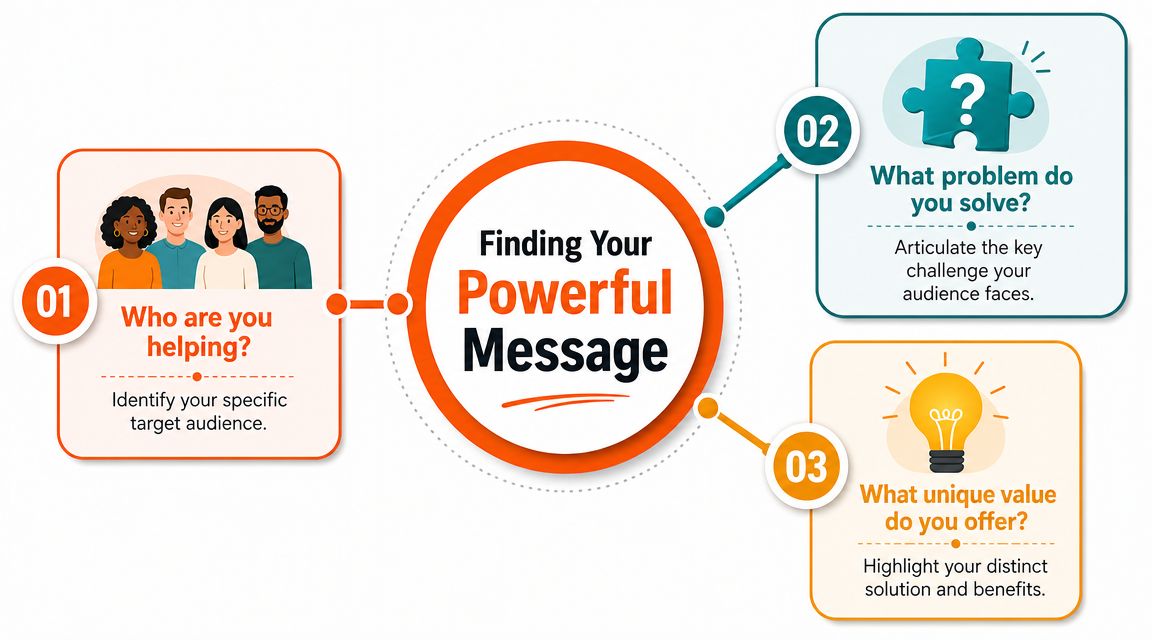
A strong value proposition usually comes from answering these three things with painful clarity:
- Who are you helping?
- What problem is eating at them?
- Why is your solution the one they should trust?
Who are you helping
Most founders answer this too loosely.
They say “small businesses,” “creators,” “busy professionals,” or “ecommerce brands.” That’s too vague to write good copy from. You need a tighter picture.
I want you to define your buyer the way you’d describe a friend over dinner. What are they trying to do? What do they hate? What do they value? What have they already tried?
“The Value Proposition Canvas” helps with this. It maps customer pains and gains to your pain relievers and gain creators. Teams using it report reaching product-market fit two to three times faster because it forces them to stop guessing, according to Amoeboids’ explanation of the Value Proposition Canvas.
A loose customer profile gives you loose messaging. A sharp customer profile gives you sharp language.
Try writing your customer like this:
- Bad: Small business owners
- Better: First-time ecommerce founders doing their own ops, marketing, and customer support
- Even better: Bootstrapped skincare founders who have traction, hate agency fluff, and need clearer messaging before they spend on ads
That last one is useful because you can write to that person.
What problem is eating at them
Founders usually grab the surface problem because it’s easier.
The surface problem sounds like this: “They need more sales.” True, but lazy.
The deeper problem sounds like this: “They can’t explain why someone should buy from them, so traffic bounces, ads get expensive, and word-of-mouth stays weak.”
That’s where the money is. You want the nagging problem behind the obvious one.
Use this simple prompt in customer calls, DMs, reviews, or sales notes:
- What were you frustrated by before trying to solve this?
- What have you already tried?
- What made that disappointing?
- What happens if this problem doesn’t get solved?
Their answers usually contain your best copy.
Why should they trust your solution
At this point, most value propositions turn generic.
If you say “high quality,” “easy to use,” or “cutting-edge,” you’ve said nothing. Your buyer has heard those words a thousand times.
You need your only-we angle. What do you do in a way others don’t? Maybe your process is faster. Maybe your service is narrower and more specialized. Maybe your product removes a painful step competitors still force people through.
Here’s the easiest way to find it. Finish this sentence:
The reason people choose us instead of the usual option is…
Then keep rewriting until it sounds plain and believable.
If you can’t explain your difference in one breath, your customer won’t remember it in one glance.
Use the canvas without overcomplicating it
I like the Value Proposition Canvas, but I don’t like when founders turn it into homework theater. Keep it practical.
Use a two-column note:
| Customer side | Your side |
|---|---|
| Jobs they’re trying to do | What you sell |
| Pains they hate dealing with | How you remove those pains |
| Gains they want | How you create those gains |
For example:
- Customer pain: “I don’t know how to explain my brand without sounding generic.”
- Your pain reliever: “I turn messy founder language into a sharp homepage message.”
- Customer gain: “I want people to get it fast and buy faster.”
- Your gain creator: “I write one clear promise plus proof and supporting bullets.”
That’s the raw material. Don’t write the final line until this part is solid.
Steal These Proven Value Proposition Templates
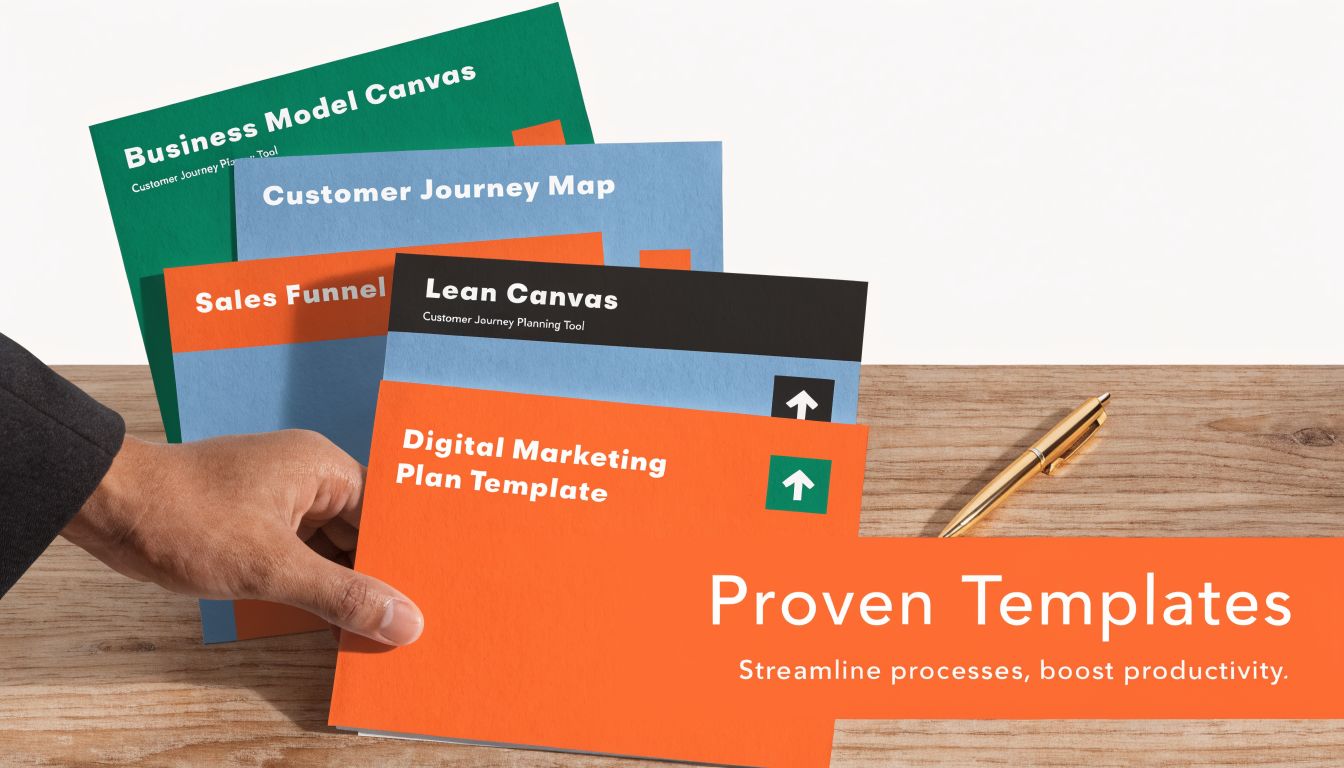
Blank-page syndrome is real. Don’t fight it with willpower. Fight it with templates.
I don’t mean lazy fill-in-the-blank copy. I mean structures that force you to say the hard thing clearly. If you’re learning how to write a value proposition, templates help because they strip away your usual bad habits.
Template one for plain English founders
Steve Blank’s classic formula is still useful:
We help X do Y by doing Z.
It works because it makes you say the audience, the outcome, and the mechanism in one line.
Bad example
We help businesses grow by using advanced digital strategies.
Good example
We help independent food brands get retail-ready packaging by turning rough ideas into manufacturer-friendly designs.
Use this when you’re early, still figuring things out, or you tend to overtalk.
Template two for homepage headlines
This one is simple:
Get [desired outcome] without [painful tradeoff].
This works well when your customer already knows the problem and hates the usual solution.
Bad example
Get better productivity without compromise.
Good example
Get clearer customer insights without paying for an agency research project.
This format is clean, fast, and strong above the fold.
Template three for competitive markets
Use this when alternatives all sound the same:
For [specific customer] who need[s] [core need], [brand] is the [category] that delivers [main benefit]. Unlike [alternative], we [difference].
If you want a starting point, Chicago Brandstarters has a marketing positioning statement template that uses this structure.
Bad example
For growing companies, Acme is the software platform that provides efficiency. Unlike others, we care more.
Good example
For small creative agencies that need to track client work without adding admin overhead, FlowDock is the project system that keeps deadlines, files, and feedback in one place. Unlike bloated enterprise tools, we’re built for lean teams that move fast.
You can use this in strategy docs, pitch decks, or homepage drafts.
Template four for proof-driven buyers
This is the one most founders avoid because it forces honesty.
Corporate Visions found that a “Telling Details” message beats other messaging types, and it works because specifics are more believable than vague claims. Their example uses language like “reduce churn by 25%,” as explained in Corporate Visions’ article on unique value propositions.
If you don’t have hard numbers you can prove, don’t make them up. Use concrete details without fake precision.
Format it like this:
You can [specific result] with [specific mechanism or constraint].
Bad example
We help teams achieve better communication.
Good example
You can keep client feedback, revisions, and approvals in one thread instead of hunting through email and Slack.
That’s still specific, even without a stat.
Here’s a short walkthrough if you want another angle before you write:
Template five for service businesses
Service founders often need one more thing in the sentence: the pain of the old way.
Try this:
We help [customer] stop [frustrating situation] so they can [desired business result].
Bad example
We help coaches grow online.
Good example
We help executive coaches stop relying on referrals alone so they can book steady discovery calls from clear website messaging.
How to choose the right template
Use the one that matches your situation.
- Use Steve Blank’s format when your message is still messy.
- Use the “without” format when buyers hate the current tradeoff.
- Use the competitive template when you need sharper differentiation.
- Use Telling Details when buyers are skeptical and want proof.
- Use the service template when your offer solves a recurring pain point.
Good templates don’t do the thinking for you. They expose whether you’ve done the thinking.
Real-World Examples for Chicago Builders
Most advice gets fuzzy because it stays generic. Let’s make this real.
I’ll give you three fictional examples. Same city. Different business models. Same rule: the message has to help a buyer decide fast.
Example one for a DTC brand
A founder in Chicago sells refillable home cleaning products online.
Her first attempt at a value proposition is this:
“Thoughtfully designed sustainable cleaning products for modern homes.”
That sounds polished and says nothing.
The buyer isn’t shopping for “thoughtfully designed.” They want their home clean, they want to reduce waste, and they don’t want ugly bottles sitting on the counter.
A better version is:
Refillable cleaning products that keep your home clean and your counters uncluttered.
Why this works:
- It names the product type.
- It states the result.
- It slips in an emotional benefit. Your kitchen doesn’t look like a storage closet.
If I were refining it further, I’d test a version that speaks to the tradeoff: clean house, less plastic, no ugly packaging.
Example two for a B2B SaaS tool
Now a founder builds software for small agencies juggling client work.
The weak version is:
“We streamline project workflows for fast-growing teams.”
I’ve seen that sentence a hundred times. Your buyer has too.
A stronger one is:
Project tracking for small agencies that are tired of chasing updates across email, Slack, and spreadsheets.
This works because it names the buyer and the mess. It also sounds like something an actual agency owner would say.
A formal six-step framework helps here. It goes like this: identify customer, find their pain, describe your solution, list the benefits, define your differentiation, and show proof. Companies using that structured process have seen a 15-25% revenue uplift in B2B pilots, according to Salesforce’s article on customer value propositions.
Here’s how I’d break that SaaS example down:
| Step | Agency software example |
|---|---|
| Customer | Small agencies with lean teams |
| Pain | Work gets lost across scattered tools |
| Solution | One place for tasks, files, and feedback |
| Benefit | Less chasing, fewer missed deadlines |
| Difference | Built for agencies, not giant enterprises |
| Proof | Customer language, demo clarity, test results |
That process looks boring. Good. Boring structure produces useful copy.
If you want more side-by-side inspiration, Chicago Brandstarters also has positioning brand examples that show how different businesses frame their message.
Example three for a side-hustle coach
Now let’s take a part-time founder who helps professionals launch specialized coaching offers.
I enable ambitious professionals to step into their highest potential.
That’s word salad.
Try this instead:
I help experienced operators turn their expertise into a coaching offer people understand and buy.
Cleaner. Sharper. More grounded.
Why these examples work
All three good versions do the same few things right.
- They pick a buyer. No “everyone” language.
- They name the pain. Not in abstract terms. In lived terms.
- They talk like humans. No consultant fog.
- They make a buying case. They don’t just describe the business.
If your sentence sounds like a conference panelist said it, cut it in half and try again.
How to Know If Your Value Proposition Works
You are not the judge of your own value proposition. The market is.
I’ve seen founders stare at a sentence for three days, swap one adjective for another, and convince themselves they’ve improved it. Then they put it in front of customers and get blank looks. That’s normal. You need tests that force honesty.

Run the five-second test
This is the fastest filter I know.
Show your homepage hero, or just your value proposition, to someone who doesn’t know your business. Give them five seconds. Then ask:
- What does this company do?
- Who is it for?
- What’s the main benefit?
If they can’t answer those three questions, your message is blurry.
Don’t ask if they “like it.” That question ruins everything. People will be polite. Clarity matters more than compliments.
Ask buyers, not branding friends
Your founder friends can help you punch up wording. They usually can’t tell you whether the message lands with your customer.
Go to people who match the audience. Send a short message. Show them two versions. Ask which one makes them more curious, which one feels clearer, and what words feel vague.
Keep the ask small. Nobody wants to write your copy for you.
Use prompts like these:
- What do you think I sell after reading this?
- What part feels generic?
- What would make this more believable?
- What would you expect to see next after this claim?
The best feedback often comes from the moments where they misunderstand you.
Use simple live tests
Once your value proposition passes the smell test, put it in motion.
Test it in places like:
- A landing page headline: Send real traffic and compare responses.
- Cold outbound or warm outreach: Watch which version gets better replies.
- Sales calls: Notice whether prospects immediately “get it” or need extra explanation.
- Your social bio or profile headline: See if more of the right people start conversations.
If you’re working on conversion issues too, this guide on conversion rate optimization techniques is a useful next step after your core message is in place.
What feedback to ignore
Not all feedback is useful. Ignore comments that only chase style.
Examples:
- “This should sound more premium.”
- “Can you make it pop more?”
- “I’d use a stronger brand voice.”
Maybe later. First make it clear.
Here’s the hierarchy I trust:
| Priority | What to listen for |
|---|---|
| Highest | Confusion about what you do |
| High | Weak reaction to the problem or result |
| Medium | Lack of differentiation |
| Low | Personal wording preferences |
Field note: If buyers repeat your value proposition back to you in their own words, you’re getting close.
A working value proposition makes the next conversation easier. People ask sharper questions. Sales calls start further down the field. Website visitors don’t need a tour guide.
That’s how you know it’s doing its job.
Your Go-Live Checklist Before You Deploy
Once your value proposition is solid, put it everywhere that matters. Don’t let it sit in a doc while your website, socials, and pitches still use old mush.
Most founders do the hard thinking, write one good sentence, and then forget to deploy it consistently. That leaves money on the table.
Put it in the places buyers actually see
Start with your homepage hero. That’s the obvious one.
Then update the rest:
- Your website subhead: Add one sentence that supports the main promise.
- Your email subject lines and intros: Make sure they use the same core message.
- Your social bios: Strip out vague identity language. Say what you help with.
- Your pitch deck: The first few slides should sound like the same company.
- Your sales call intro: Say the value proposition out loud and see if it sounds natural.
- Your ad copy: Keep the promise consistent, then test variations around it.
- Your email signature or founder bio: If people bump into your business there first, make it count.
If your message changes from one touchpoint to another, buyers start doing extra work. Don’t make them do that.
Use this final filter before publishing
Read the sentence out loud. Then run it through this checklist.
| Question | If the answer is no |
|---|---|
| Is it plain English? | Remove jargon |
| Can a stranger understand it fast? | Shorten it |
| Does it name the buyer or problem? | Make it more specific |
| Does it promise an outcome? | Move from feature to result |
| Does it sound believable? | Cut inflated claims |
| Could a competitor say the same thing? | Add your difference |
| Would you say this in person? | Rewrite it like a human |
That last one matters a lot.
A lot of homepage copy dies because nobody would ever say it out loud. If you’d feel weird saying it to someone across a dinner table, don’t publish it.
Keep two versions, not twelve
I like having two versions of a value proposition.
One is the short version. This is for homepage headers, social bios, and intros.
The other is the expanded version. This is for the next line down, your deck, and sales conversations.
That’s enough. You do not need ten variants floating around your company. That creates drift.
A good value proposition should make the rest of your marketing easier
When the sentence is right, a lot of downstream work gets simpler.
Your homepage gets easier to write. Ads get easier to test. Sales calls get easier to open. Content gets easier to plan because you know what promise you keep repeating.
That’s the payoff. Good messaging reduces waste.
Clear value propositions don’t make selling effortless. They stop you from making it harder than it already is.
If you’ve been stuck on how to write a value proposition, stop chasing originality. Start chasing precision. Write the sentence your buyer wishes you had written months ago.
If you’re building in Chicago or the Midwest and want honest feedback on your message from founders who are in the trenches, take a look at Chicago Brandstarters. It’s a free, vetted community where early-stage builders share real tactics, talk through problems candidly, and help each other sharpen ideas before wasting months on the wrong message.
Leave a Reply