Author: Kevin Tao

  • A Founder’s Framework for Making Decisions That Drive Growth

    A Founder’s Framework for Making Decisions That Drive Growth

    A framework for making decisions is just a simple, repeatable process that guides your choices. It's how you move beyond just a gut feeling.

    Think of it like a recipe. You wouldn't toss expensive ingredients in a bowl and hope for a Michelin-star dish. You'd follow proven steps for a great result, every time. A framework does the same for your business strategy, building it on clarity, not chance.

    Why Your Gut Feeling Isn't Enough

    A productive workspace with a laptop, notebooks, and an alarm clock on a desk overlooking a stormy ocean, with text 'BEYOND GUT FEELING'.

    As a founder, I get hit with a firehose of decisions every day. It’s so easy to just go with your intuition. I mean, your gut got you this far, right?

    The problem is, building a business on gut feelings is like sailing through a hurricane without a compass. It feels decisive in the moment, but it's a fast track to getting lost. The hidden costs of bad calls go beyond money—they burn your time, energy, and momentum. Those are your most precious resources.

    This isn't just a startup problem. One study found that huge Fortune 500 companies lose an incredible $250 million in wages every year from broken decision-making. As a startup, you don't have that cash to burn. You need a better way.

    The Power of a Repeatable Process

    I once worked with a founder about to give up. Her main product line was bombing, and her gut screamed at her to shut it all down.

    Instead of panicking, she took a breath. She used a simple decision-making framework to look at customer feedback, market trends, and production costs.

    This structured approach uncovered something totally unexpected. Her customers were obsessed with one tiny feature of her failing product. So, she didn't quit. She pivoted her entire company around that one feature.

    The result? A 300% jump in pre-orders. That simple process didn't just save her business—it showed her a path to massive growth her intuition completely missed.

    This is exactly why having a repeatable process isn't some "nice-to-have" corporate thing. It's the most powerful tool in your arsenal for building a resilient brand. It gives you the clarity to make big, bold moves with real confidence, turning uncertainty into your biggest advantage.

    Start With a Classic: The SWOT Analysis

    A top-down view of a SWOT analysis template, pens, coffee, and a plant on a white desk.

    If you're just getting your feet wet with decision-making frameworks, let's start with a classic. The SWOT analysis is still around for a reason: it’s simple, and it works. I use it to map my Strengths, Weaknesses, Opportunities, and Threats.

    Think of it like getting ready for a Chicago winter. Your strengths are your insulated coat and snow tires—internal advantages you already have. Your weaknesses are that drafty old window you keep forgetting to seal; internal things holding you back.

    Opportunities are those rare, sunny winter days perfect for getting things done. Threats are the surprise blizzards that can shut everything down. These last two are external forces—you can prepare for them, but you can’t control them.

    Breaking Down the Four Boxes

    The real magic of a SWOT analysis is how it forces you to separate your thinking into two buckets: internal factors (Strengths and Weaknesses) and external factors (Opportunities and Threats). This gives you a brutally honest snapshot of where you actually stand.

    • Strengths: What do you do better than anyone else? This could be a killer product feature, a deep network in your neighborhood, or a unique skill your team has.
    • Weaknesses: Where are you falling short? Maybe it's a tiny marketing budget, a shaky supply chain, or no brand recognition. Don't be gentle here.
    • Opportunities: What's happening out there that you can jump on? Think new tech, changing customer habits, or a competitor dropping the ball.
    • Threats: What could seriously hurt your business? This is where you list new competitors, rising costs, or a potential economic downturn.

    This simple act of sorting stops you from confusing what you can control with what you can only react to. It’s the first step to building a real strategy instead of just putting out fires.

    By forcing you to look at your venture from these four distinct angles, the SWOT analysis turns a messy cloud of ideas and fears into an organized map. You can’t chart a course until you know your starting point.

    A good SWOT analysis provides clarity. Let’s make this concrete with an example for a local startup here in Chicago. The table below shows how a new apparel brand might fill this out.

    SWOT Analysis Template for a Chicago Startup

    Category Guiding Question Example (For a Local Apparel Brand)
    Strengths What internal advantages do we have over others? Our designs are created by a well-known local artist, giving us an authentic Chicago connection.
    Weaknesses What internal factors are holding us back? We have limited production capacity and rely on a single local manufacturer.
    Opportunities What external trends or events can we exploit? There's a growing "shop local" movement and several upcoming neighborhood festivals.
    Threats What external factors could jeopardize our business? Fast-fashion giants can produce similar styles for a fraction of the cost.

    See how that works? The framework instantly reveals a path. The brand's strength (local artist) directly taps into an opportunity (the "shop local" movement). It also highlights a critical threat (fast fashion) that their weakness (limited production) makes them vulnerable to. Right away, you can see they need to double down on their local story and perhaps find a backup manufacturer. That's a strategy.

    Upgrade Your Decisions with Data

    A laptop on a wooden desk displays various colorful business performance charts and graphs.

    Alright, you've mapped your landscape with a SWOT analysis. Now it's time to add a critical layer to your framework for making decisions: data.

    This isn't about becoming a spreadsheet guru. It's about listening to the story your customers and the market are telling you through numbers.

    So many founders I know have access to powerful tools like Google Analytics or Shopify reports but get overwhelmed. The sheer volume of numbers feels like staring into a blizzard. But here’s the secret: you don’t need to track everything.

    You just need to identify the three to five Key Performance Indicators (KPIs) that truly matter for your business right now. Think of yourself as a ship captain again. Data is your weather forecast, sea charts, and crew reports all in one. It doesn’t replace your judgment, but it gives you the clarity to make confident moves.

    Identifying Your North Star Metrics

    Your KPIs are your business's vital signs. They tell you if you're healthy, growing, or heading for trouble.

    For an early-stage founder, these metrics often revolve around validating your idea and finding your first customers. You can learn more about how to validate a business idea, which is a critical first step.

    Here are a few examples of KPIs that might matter to you:

    • Customer Acquisition Cost (CAC): How much does it cost you in marketing and sales to get one new customer?
    • Customer Lifetime Value (LTV): How much total revenue can you expect from a single customer?
    • Conversion Rate: What percentage of website or store visitors actually make a purchase?
    • Monthly Recurring Revenue (MRR): If you're a subscription business, this is your lifeblood.

    Choosing the right KPIs is about focus. Picking too many is like trying to listen to five radio stations at once—you just get noise. Start by asking, "What are the one or two numbers that, if they moved, would fundamentally change my business?"

    Don't Just Collect Data; Use It

    It's shocking how many companies collect data they never use. One global survey revealed a staggering gap: while 79% of organizations have defined KPIs, only 36% actually use them consistently to drive decisions.

    The study also found that highly data-driven companies are three times more likely to report significant improvements in their decision-making. That's a powerful insight. It means your advantage isn't just in gathering numbers, but in building the habit of acting on them.

    The goal isn’t to drown in data. It’s to find the essential signals that tell you whether you’re on the right track or need to change course.

    I suggest you set up a simple dashboard—it can even be a basic spreadsheet. Review your key metrics weekly. This consistent rhythm turns abstract numbers into a clear, actionable story about your business, empowering every choice you make.

    Making Tough Calls When the Future is a Total Blur

    So far, we’ve looked at frameworks that help you make sense of what you already know. But what about when the data is murky and the future feels like a shot in the dark? This is the exact moment I see most founders freeze up.

    You don't have to get stuck. When you’re staring into the fog of uncertainty, the goal isn't to magically predict the one "right" future. Your smartest move is to have a framework that gets you ready for multiple futures.

    Think of it like building a choose-your-own-adventure story for your company. You map out a few ways things could go, decide what you’d do in each chapter, and then figure out the signs that tell you which story you’re actually in. This turns gut-wrenching anxiety into focused action.

    A Four-Step Playbook for Navigating the Unknown

    This approach is about building strategic flexibility. Instead of betting the farm on a single outcome, you build a main plan with a few backup plans in your back pocket.

    Here's a simple, four-step process you can use for your next big, uncertain decision:

    1. Diagnose Your Uncertainty: First, get painfully honest about what you don't know. Is it a simple unknown with limited outcomes, or true ambiguity where you can't even list all the possibilities? Big difference.
    2. Brainstorm Scenarios: Based on that uncertainty, dream up two or three believable future scenarios. For example, a best-case (hockey-stick growth), a worst-case (the market tanks), and a weird-case (a surprise competitor pops up).
    3. Develop Your Plans: Now, build your primary plan for the most likely scenario. Then, create smaller "pivot" plans for the others. What moves would you make if the worst-case happens?
    4. Set Your Tripwires: This is the most important step. A tripwire is a specific, measurable event that screams, "It's time to switch plans!" It’s a trigger you decide on before things get chaotic, so you pull emotion out of the equation. For example: "If our customer acquisition cost jumps by 50% for two straight months, we immediately activate Plan B."

    This process gives you a clear playbook, no matter how the story unfolds. You’ve already done the hard thinking when you were calm and rational.

    By preparing for multiple outcomes, you're no longer a victim of the future—you're an active player, ready to adapt. Your decision stops being "what do I do?" and becomes "which pre-built plan do I execute now?"

    Experts have pointed out that leaders often get uncertainty wrong. They look for data that confirms what they believe instead of exploring other possibilities. A classic case study looked at three hospital ICUs with the same average infection rate. But when they dug in, the distribution of those infections was wildly different, revealing huge risks the average number hid. If you want to go deeper, you can explore more about how leaders can better handle uncertainty with a structured approach.

    Using this four-step framework helps you sidestep the trap of just going with your gut or relying on simple averages. You end up building a more resilient business—one that can thrive not just in spite of uncertainty, but because of it.

    Putting Your Framework into Practice

    All this theory is great, but let's get our hands dirty. A framework for making decisions is worthless if you don't use it. I'm going to walk you through how to apply these models to three real-world scenarios you will absolutely face as a founder.

    We'll kick things off with a product decision, then tackle hiring, and finally size up a potential partnership. This is where we make abstract concepts immediately useful for your business.

    When you're staring down uncertainty, this simple decision tree can guide your thinking. It breaks the process down into four clear steps: Diagnose, Brainstorm, Plan, and Act.
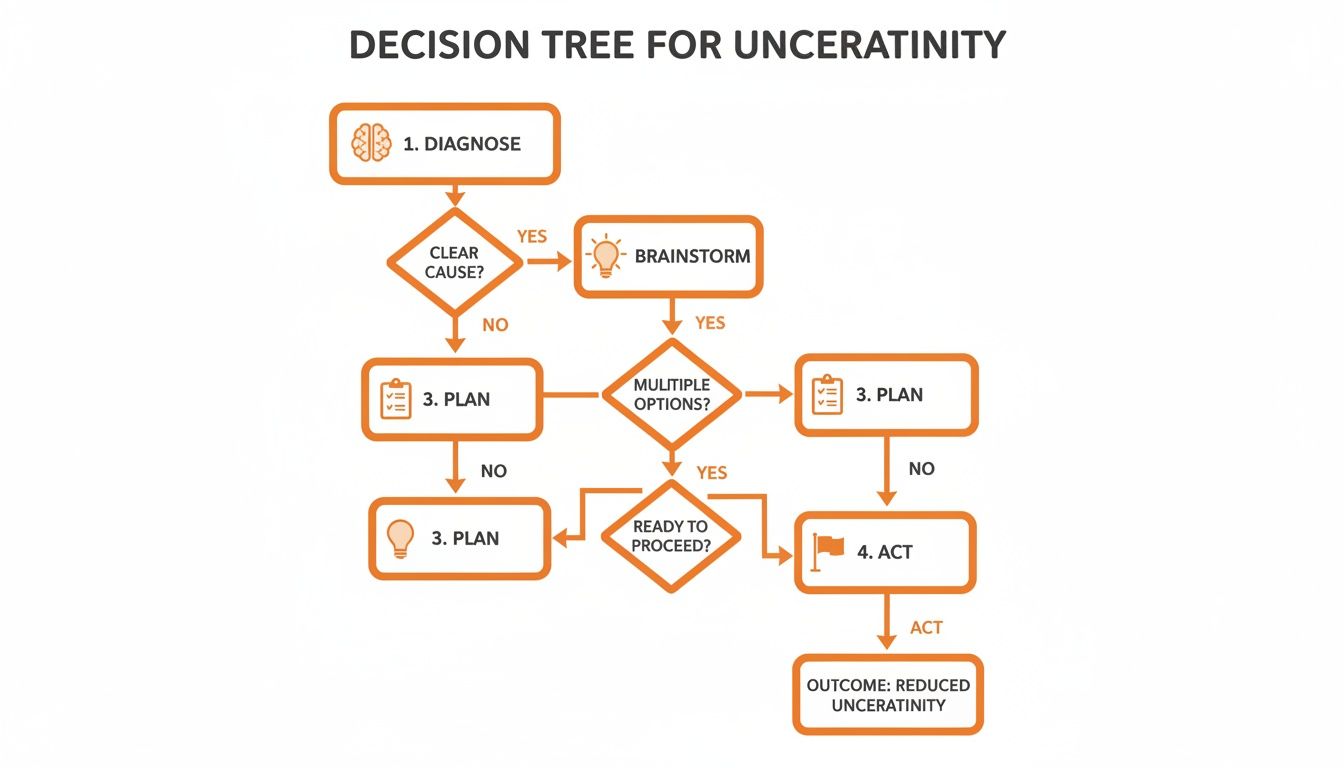
    Flowchart outlining a decision-making process for uncertainty, including diagnose, brainstorm, plan, and act.

    This visual is a crucial reminder: you can't just jump straight to a solution. You have to move deliberately from understanding the problem to taking action.

    Scenario 1: The Product Feature Debate

    Imagine you run a small e-commerce brand that sells custom notebooks. You have two potential features to build next: an online monogramming tool or a subscription box. Your resources are tight, so you can only pick one.

    In a spot like this, a decision matrix is your best friend. It’s a simple grid that helps you score your options against what actually matters to your business.

    Decision Matrix Example: New Product Feature

    Criteria (Scored 1-5) Monogram Tool Subscription Box
    Customer Demand 4 3
    Revenue Potential 2 5
    Technical Difficulty (Low=5) 5 2
    Brand Alignment 4 4
    Total Score 15 14

    Looking at the scores, the monogram tool squeaks out a win. Sure, its direct revenue potential might be lower, but it’s a heck of a lot easier to build and it’s something customers are already asking for. It’s the lower-risk, faster path to adding real value.

    Scenario 2: The First Hire Dilemma

    Your business is growing, and you’ve accepted you can’t do it all yourself anymore. You need help, but what kind of help? Do you hire a full-time employee or bring on a contractor?

    This decision has massive ripple effects on your cash flow, culture, and legal paperwork. Hiring your first employee is a huge step, especially when you're starting out. It's a common hurdle; I know many founders wonder how to get their business off the ground, which is why we put together a guide on how to start a business with no money.

    Let’s use a simple pros-and-cons list to get some clarity.

    • Full-Time Employee:
      • Pros: Deeper commitment and integration into your company culture. They can take on more tasks as needs pop up.
      • Cons: Way more expensive (salary, benefits, taxes), adds management overhead, and it's much harder to undo if it's a bad fit.
    • Contractor:
      • Pros: Lower financial commitment upfront. You get specialized skills for a specific project, and it’s a more flexible arrangement.
      • Cons: They're less integrated, might be juggling other clients, and their knowledge walks out the door when the contract ends.

    The right choice here depends entirely on your most painful need. If you need a specific skill for a short-term project (like a website redesign), a contractor is perfect. If you need someone to grow with the company and wear multiple hats, an employee is the better long-term investment.

    Scenario 3: The Partnership Opportunity

    A popular local coffee shop approaches you about a collaboration. They want to sell your notebooks in their stores and co-host a community event. It sounds exciting, but is it the right move?

    Before you jump in, dust off your SWOT analysis skills. Let's look at this purely through the lens of Opportunities and Threats.

    1. Opportunity: Does this partnership give you access to a new audience you couldn't reach on your own? Does their brand reputation elevate yours?
    2. Threat: Is there a risk of brand misalignment? What if the partnership flops—could it damage your reputation? What are the real resource costs (your time, your money) to make this happen?

    By walking through these questions, you move from an emotional "yes!" to a strategic one. You can see the real benefits clearly while also creating a plan to handle the downsides.

    Your Go-To Decision Making Checklist

    Okay, you’ve seen the theory. Now it’s time to build the habit. A killer decision-making framework is useless if you don't use it until it's second nature.

    Think of this checklist like a pilot's pre-flight routine. You run through it every time, especially when the pressure is on. It’s a simple, repeatable process that stops you from skipping a crucial step when you’re moving fast.

    The Founder's Go-To Checklist

    1. Define the Real Problem: What question are you actually trying to answer? Get specific. Write it down in one clean sentence.

    2. Gather the Right Intel: Take inventory. What data do you have versus what data do you need? Pinpoint your key metrics and call out any huge knowledge gaps.

    3. Evaluate Your Options: You need at least three viable paths. Don't forget, doing nothing is always an option. Score each one against your core business values.

    4. Pressure-Test Your Choice: Time to play devil’s advocate. What are the biggest risks with your top choice? Seriously, what's the most likely way this could blow up in your face?

    The point isn't to get rid of all risk—that's impossible. It's about making sure you're taking the right risks. A simple process like this turns your blind spots into calculated bets on your company's future.

    1. Commit and Communicate: Make the call. Then, make sure every single person on your team understands the "why" behind it. Getting your team on board is everything.

    2. Review and Learn: Put a date on the calendar to circle back and review the outcome. Did it work? What did you learn? This last step turns one good decision into a compounding advantage over time.

    This checklist is meant to be a living tool. If you're looking to get deeper into structuring your overall strategy, our guide on building a startup business plan template is a great resource for formalizing your long-term goals.

    Common Questions and Sticking Points

    Founders I work with often run into the same questions when they start using a more structured way to make decisions. Here are some of the most common ones, with my straight-up advice.

    What If My Data Is Conflicting?

    This happens all the time. Your customer surveys say people want Feature A, but your analytics show they only use Feature B. It can feel like you're getting pulled in different directions.

    Don't let it paralyze you. Conflicting data isn't a stop sign; it's a signal to dig deeper. Is the survey data from your ideal customers, while your sales data is a mix of everyone?

    This is where your gut as a founder comes back in. A framework for making decisions isn't supposed to spit out the answer for you. It's about giving your intuition better, cleaner information to work with. Pick the data source that points most directly at your strategic goals, make the call, and accept it as a calculated risk.

    How Do I Get My Team on Board?

    You can design the most brilliant decision-making process, but it's useless if your team isn't bought in. Dropping a new spreadsheet on them and expecting cheers won't happen.

    You get them on board by bringing them in from the beginning. It's been shown over and over that when you involve your team, you don't just get better ideas—you build a team that actually cares. People always support what they help create.

    Walk them through the framework on a small, low-stakes decision first. Show them how it leads to a clearer outcome. When they see it works and feel their input is valued, they'll become champions for the process, not roadblocks.

    At the end of the day, your team needs to see that this new way of doing things makes their jobs easier and the company stronger. A shared sense of purpose is a powerful thing.

    What If I Make the Wrong Decision?

    Let’s get one thing straight: you will. It’s not a question of if, but when. The best founders I know don’t make fewer mistakes; they just get incredibly good at catching and correcting them fast.

    A bad decision is only a true failure if you learn nothing from it. When you've used a framework, you have a paper trail—a clear record of your assumptions, the data you looked at, and the logic you followed. This makes it so much easier to go back, see exactly where you zigged when you should have zagged, and fix your approach for next time. This is how you turn a mistake into one of your most valuable business assets.


    At Chicago Brandstarters, we believe that building a great company starts with making great decisions, together. If you're a kind, hard-working founder in Chicago looking for a community that shares honest war stories and real support, not just transactional networking, let’s connect. Learn more about joining our free community at https://www.chicagobrandstarters.com.

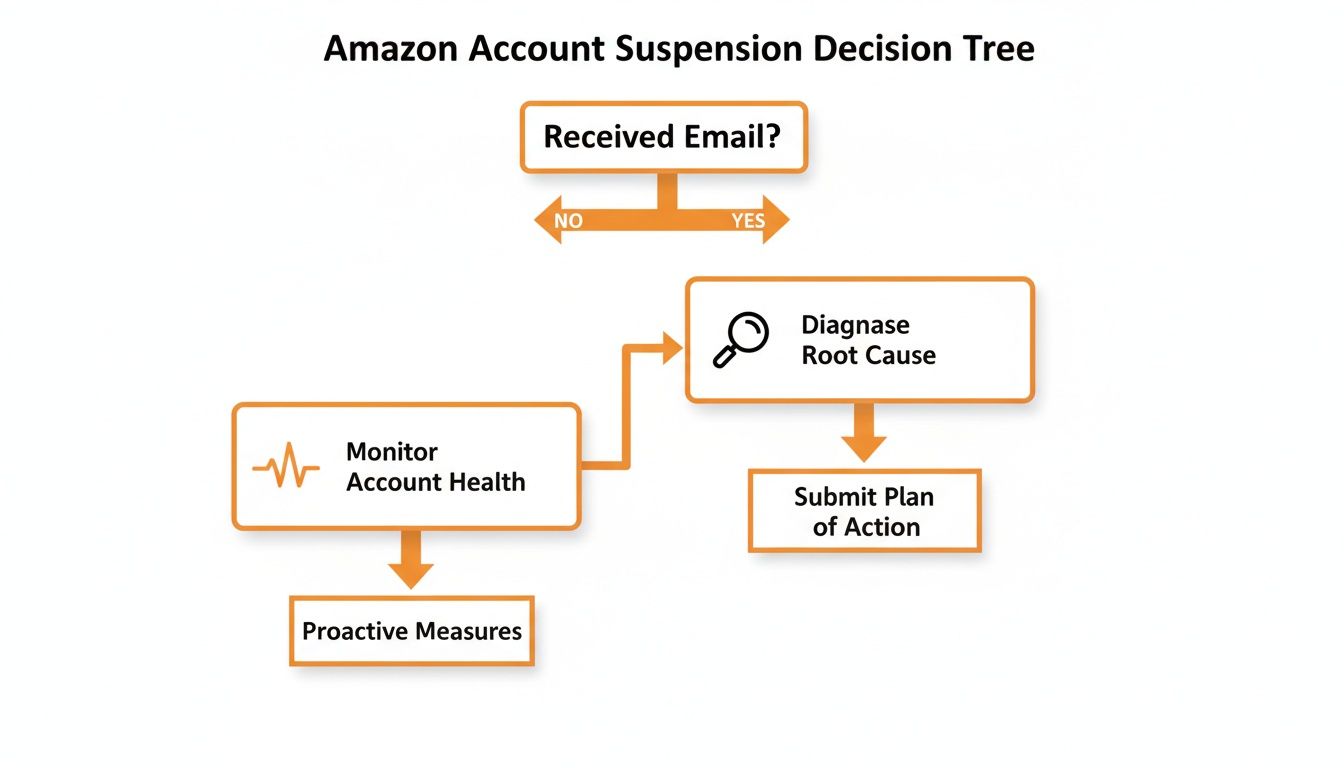
  • 7 Essential Places to Find the Best Business Strategies Books in 2026

    7 Essential Places to Find the Best Business Strategies Books in 2026

    I get it. You're a founder, which means you're building a plane while flying it. You don't have time for a book that doesn't deliver a direct hit of actionable wisdom. But the right business strategies books aren't just reading; they're cheat codes. I see them as a direct line to someone who already solved the exact problem keeping you up at night.

    Think of it like this: every book is a mentor you can hire for about $20. Your real challenge isn't deciding if you should read. It's figuring out what to read and where to find it without wasting time or money. You need proven sources that get you the right insights, fast, so you can apply them today, not next quarter.

    This isn't just another generic list. It's your map to the best places for grabbing the game-changing books that will actually move the needle for your business. I've personally used every one of these sources to build my own strategic library. I want to help you skip the fluff and get straight to the impactful lessons.

    Forget endless scrolling. I built this guide to help you quickly find the best place for your next book, whether you need a physical copy for notes, an audiobook for your commute, or a budget-friendly used edition. Each option includes a direct link so you can get what you need and get back to building. Let's find your next big idea.

    1. Amazon (Books + Kindle)

    When you need a specific book on business strategy, you'll probably look at Amazon first. It’s like the world's largest library and bookstore rolled into one. Its massive catalog makes finding even the most niche business strategies books a simple task. Because it's so dominant, you can compare formats, prices, and delivery options all in one place, saving you precious time.

    The platform's true power is its complete ecosystem. From a single product page, you can order a hardcover for your office, send a paperback to a co-founder, download the Kindle version for your commute, and grab the Audible audiobook for your workout. I find this one-stop-shop convenience hard to beat.

    Why It Stands Out

    Amazon’s main advantage is its sheer scale and integrated services. If you're a Prime member, you get incredibly fast, often free, shipping—a game-changer when you're eager to dive into a new concept. For entrepreneurs on a budget, I recommend the Amazon Marketplace. It's a treasure trove of used copies from third-party sellers, though you'll need to watch seller ratings and shipping times.

    I love the "Look Inside" feature and Kindle sample downloads. They're invaluable for previewing a book before you commit. It’s like flipping through a book in a physical store, but from your desk. You can get a feel for the author's tone and see if it fits your current challenges.

    Maximizing Your Amazon Experience

    Here are a few tips I use to get the most out of Amazon for business books:

    • Create a "Strategy" Wishlist: I keep a running list of books I want to read. This helps me track titles and watch for price drops.
    • Compare All Formats: Don't just look at the hardcover price. The Kindle version is often cheaper and instantly accessible, while a used paperback from the Marketplace could be your most cost-effective option.
    • Read the 1-Star and 3-Star Reviews: While 5-star reviews are great, I find that the critical and moderate reviews often give a more balanced view of a book's drawbacks or specific audience fit.

    Key Insight: I use Amazon's powerful search not just to find books, but to discover them. Search for your core business challenge (e.g., "customer retention for ecommerce") and see what comes up. Then, dive into the "Customers also bought" section to find related gems.

    By being strategic, you can turn Amazon from a simple bookstore into a powerful research tool for your business's growth. The vast selection supports everything from foundational principles to advanced tactics, helping you build a library that directly fuels your success. For more insights on how to apply these readings, you can explore various small business growth strategies and see how others are implementing them.

    Visit Website: https://www.amazon.com/books

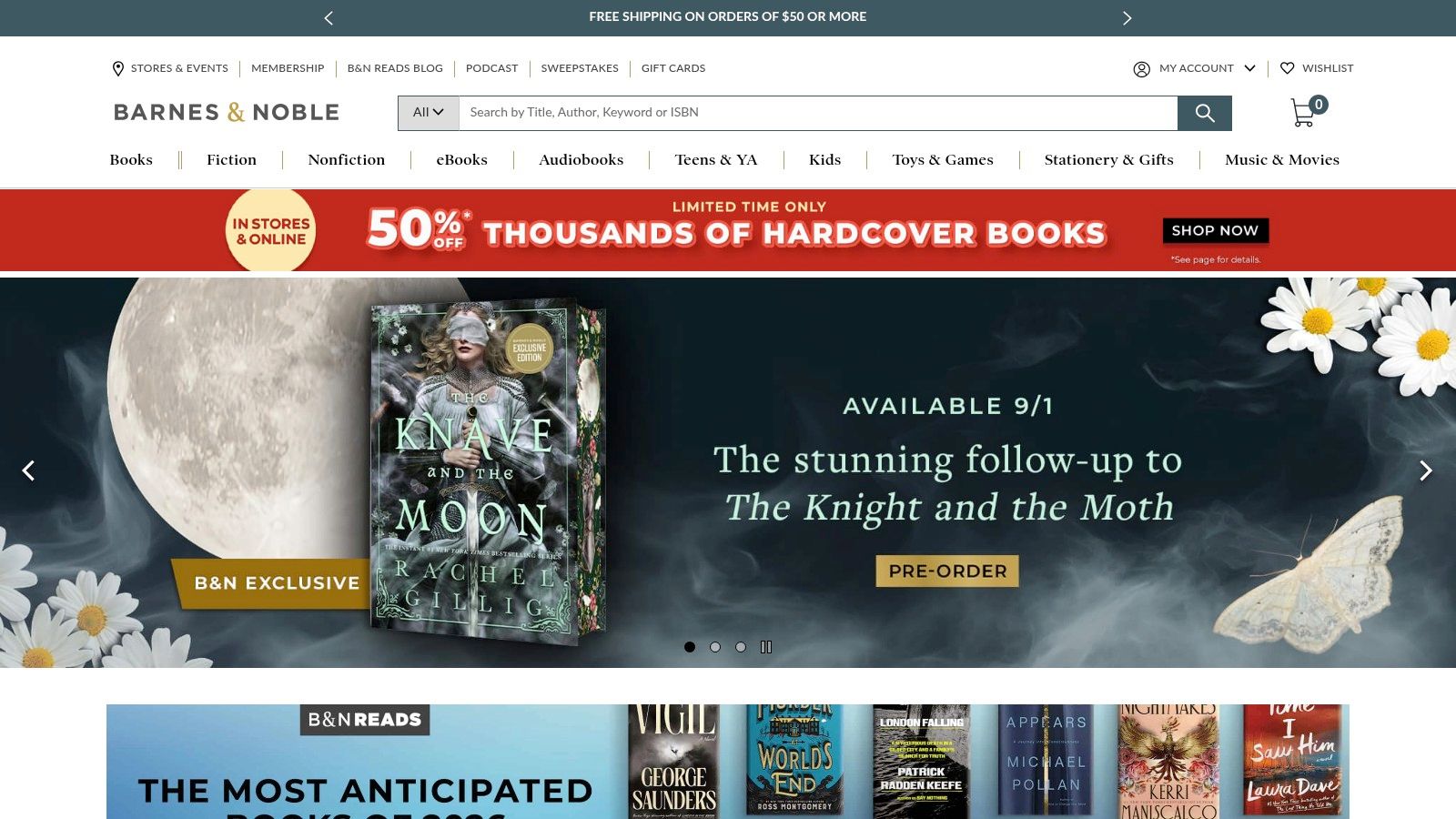
    2. Barnes & Noble (Retail + Nook)

    For those of us who love browsing a physical bookstore, Barnes & Noble offers a great bridge between the digital and physical worlds. It's a trusted bookseller with a deep business section, both online and in its welcoming stores. You can easily find foundational and popular business strategies books on its shelves, giving you a tangible connection to the knowledge you're seeking.

    Barnes & Noble (Retail + Nook)

    The platform’s strength is its hybrid model. You can research a book online, check its in-store availability, and then drive over to pick it up the same day. I find this immediacy invaluable when an idea strikes and I want to start learning right away. It also integrates its NOOK eBook ecosystem, letting you maintain both a physical and digital library through a single, familiar brand.

    Why It Stands Out

    Barnes & Noble excels at creating a curated, community-focused book-buying experience. Unlike the endless digital scroll, walking into a B&N lets you physically handle books, discover titles you weren't looking for, and even attend author events. This environment fosters discovery in a way that algorithms can't always replicate.

    For frequent buyers like me, the loyalty programs offer real value. The paid Premium Membership gives you discounts and free shipping, while the free B&N Rewards program earns you store credit. While its online prices may not always be the absolute lowest, the mix of reliable shipping, easy returns, and in-person service makes it a dependable choice.

    Maximizing Your Barnes & Noble Experience

    Here are a few tips I use for getting the most out of B&N:

    • Use "Pick Me Up" for Speed: If you need a book today, check its availability at your local store online. You can buy it for in-store pickup and have it in your hands within hours.
    • Look for Signed Editions: I've found that Barnes & Noble is a great source for exclusive signed editions from major business authors. These make a great addition to your office library or a gift for a mentor.
    • Combine Rewards and Memberships: If you buy business books regularly, I recommend stacking the free Rewards program with the paid Premium Membership to maximize your savings on every purchase.

    Key Insight: I treat Barnes & Noble as more than just a store; I use it as a validation tool. Seeing which business books are prominently displayed or recommended by staff gives you a pulse on current trends. It's like getting real-world feedback on what concepts are gaining traction—a key part of learning how to validate a business idea before you invest too heavily.

    By blending online convenience with in-person browsing, Barnes & Noble provides a well-rounded and reliable resource. It supports your journey from idea to scaling your business with a carefully selected inventory and a welcoming atmosphere.

    Visit Website: https://www.barnesandnoble.com

    3. Bookshop.org

    If you want your purchase of business strategies books to build more than just your knowledge, Bookshop.org is your platform. It's an online bookstore with a mission: to financially support local, independent bookstores. Think of it this way: instead of your money going to a corporate giant, it directly benefits the small shops that are the heart of local communities. You get to invest in your business and someone else's at the same time.

    Bookshop.org

    The platform combines the ease of online shopping with the impact of buying local. You can choose a specific indie bookstore near you to get the full profit from your order, or you can let your purchase contribute to an earnings pool that's evenly distributed among all independent bookstores on the platform. I love this model because it gives me a vital alternative as a conscious consumer.

    Why It Stands Out

    Bookshop.org’s main advantage is its ethical commerce model. Every purchase you make has a direct, positive impact. Beyond its mission, I find the site is a fantastic place for discovery. It features curated lists from real booksellers, offering a human touch that algorithms often lack. You'll find unique collections of business strategies books put together by people who are passionate about reading.

    While you might not find the deep discounts of mass-market retailers, the prices are competitive. They also offer a non-Amazon digital option with their eBook platform, which still shares profits with indie stores. Just note that these eBooks are not compatible with Kindle devices.

    Maximizing Your Bookshop.org Experience

    Here are a few tips I use on Bookshop.org:

    • Find and Favorite Your Local Store: I use the map feature to find an independent bookstore in my area. By selecting it, that store will receive the full profit from all my future purchases.
    • Explore Curated Lists: Dive into the "Browse" section to find reading lists from bookstore staff across the country. This is how I discover under-the-radar titles and new perspectives.
    • Embrace eBooks for a Cause: If you prefer digital, consider their eBook options. You support indie shops while enjoying the convenience of an e-reader—a win-win for founders on the go.

    Key Insight: I use Bookshop.org not just to buy books I already know, but to discover what passionate booksellers are recommending. Their curated approach can expose you to diverse voices and niche strategies you might miss in a purely algorithm-driven environment.

    Choosing Bookshop.org is a strategic decision in itself. You're building your business library while actively contributing to the small business ecosystem. For anyone starting out, this aligns perfectly with community-focused growth, a key concept when you're thinking about how to start an ecommerce business.

    Visit Website: https://bookshop.org

    4. Porchlight Book Company (formerly 800-CEO-READ)

    When your goal is to get a powerful business book into the hands of your entire team or event attendees, Porchlight Book Company is your partner. While big retailers handle single orders well, Porchlight specializes in bulk orders. They're less like a store and more like a service. They act as a bridge between authors and businesses, making it easy for you to share essential business strategies books at scale.

    Porchlight Book Company (formerly 800-CEO-READ)

    This focus makes them the go-to for leaders who see books as a tool for company-wide learning. Instead of you spending hours coordinating shipping to 50 different addresses, Porchlight's team manages the whole process. It’s like a white-glove service for intellectual capital.

    Why It Stands Out

    Porchlight’s main advantage is its expertise in customized, bulk orders. They aren't just selling books; they are facilitating shared reading experiences. You can work with them to arrange for signed copies, custom inserts like a letter from you as the CEO, or even branded bookmarks. This turns a simple book into a meaningful gift or a core part of your company's culture.

    Their human-centric customer service is a huge differentiator. When you have a complex order, you get to talk to a real person who specializes in these exact scenarios. While you can certainly buy a single copy from them, their real power is unlocked when you’re thinking bigger.

    Maximizing Your Porchlight Experience

    Here are a few ways I suggest you leverage Porchlight for your business:

    • Plan Your Team's Reading: If you're launching a quarterly book club for your leadership team, contact Porchlight to get a bulk quote. They can handle all the fulfillment, even to remote employees.
    • Enhance Your Next Event: Hosting a workshop or conference? Work with Porchlight to provide attendees with a relevant book, perhaps even one signed by your keynote speaker.
    • Use Books for Client Gifting: Instead of another generic gift basket, send your top clients a curated business book with a personalized note from you. Porchlight can add custom inserts to make it special.

    Key Insight: Think of Porchlight Book Company as your outsourced logistics department for knowledge sharing. Before you start a book-related initiative for more than a handful of people, get a quote from them. Their service will likely save you more time and headaches than the small premium you might pay over a DIY approach.

    By partnering with Porchlight, you can scale the impact of a great business book, turning a solo reading activity into a powerful, shared team experience.

    Visit Website: https://www.porchlightbooks.com

    5. Audible

    As a founder, I know your calendar is full. Finding time to sit down and read can feel impossible. This is where Audible shines. It transforms your commutes, workouts, and even chores into learning opportunities. It gives you access to a massive catalog of business strategies books in audiobook format, making it the perfect tool for an entrepreneur on the move. You can absorb groundbreaking ideas while you're driving, on a run, or just giving your eyes a rest.

    Audible

    Audible's platform is designed for listening. Its apps let you download titles for offline use, so you're never without your next lesson. The ability to adjust playback speed means you can consume content faster when you're short on time or slow it down to really digest complex concepts.

    Why It Stands Out

    Audible’s core strength is its focus on the audio experience. While other platforms offer audiobooks as an add-on, Audible has perfected it. The selection of business titles is vast, often narrated by the authors themselves. Hearing them tell their own story adds a layer of authenticity you don't get from text.

    The subscription models offer flexibility. The Audible Plus plan gives you unlimited access to a rotating catalog of thousands of titles, which is great for discovery. The Premium Plus plan adds a monthly credit you can use for any premium title. I find this credit system is often the most cost-effective way to get newly released books.

    Maximizing Your Audible Experience

    Here are a few tips to make Audible an indispensable part of your business education:

    • Use the "Clips" Feature: When you hear a powerful idea, I use the clip feature to save and annotate the snippet. This creates a library of key takeaways I can revisit without scrubbing through the whole book.
    • Listen to Samples: Before using a credit, always listen to the 5-minute sample. A narrator's voice can make or break an audiobook, so I make sure it's a good fit for me.
    • Watch for Member Sales: Audible frequently runs 2-for-1 credit sales. I keep an eye on these to build my library for a fraction of the cost.

    Key Insight: Think of Audible not just as a book source, but as a time-multiplier. It’s like adding extra hours to your day. By integrating learning into activities that don't require your full visual attention, you can dramatically increase your knowledge intake without adding more "work" to your schedule.

    By using its features, you can turn otherwise unproductive time into a strategic advantage. It allows you to consistently absorb new ideas, keeping your mind sharp and your strategies current.

    Visit Website: https://www.audible.com

    6. Google Play Books

    If you live in the Google ecosystem or just want a device-agnostic way to build your digital library, Google Play Books is a great choice. It's a massive digital bookstore that syncs effortlessly across your phone, tablet, or web browser. This means you can start reading business strategies books on your laptop and pick up where you left off on your phone without being tied to a specific hardware brand.

    Google Play Books

    The platform offers millions of eBooks and audiobooks, so you can find everything from timeless classics to modern guides. It's a clean, straightforward alternative if you aren't invested in Amazon's Kindle hardware but still want a robust library.

    Why It Stands Out

    Google Play Books' main advantage is its universal accessibility and a killer feature: you can upload your own files. You can add your own PDFs and EPUB files to your library, consolidating all your reading material in one place. I find this perfect for organizing strategy whitepapers, industry reports, and ebooks from other sources alongside my official purchases.

    The cross-device sync for notes and highlights is seamless. Any insight you highlight on one device is instantly available on all others, making it easy to compile takeaways for your next team meeting. The platform also frequently offers discounts, letting you build your business knowledge without breaking the bank.

    Maximizing Your Google Play Books Experience

    Here are a few tips I have for getting the most out of the platform:

    • Consolidate Your Library: I use the upload feature to add external business reports, case studies, and PDFs to my library. It transforms the app from a store into my personal business knowledge management system.
    • Sample Before You Buy: Just like Kindle, Google Play Books offers free samples. I always read a chapter or two to ensure the author's style is a good fit for my current challenges.
    • Use the Search Within a Book: When you're trying to recall a specific concept from a book you've read, the in-book search function is incredibly powerful and much faster than flipping through a physical copy.

    Key Insight: Think of Google Play Books as your personal, cloud-based business library. Its strength isn't just in what you can buy, but in its ability to organize and sync all the knowledge you collect—from bestsellers to niche industry PDFs.

    By using its open and flexible ecosystem, you can create a comprehensive collection of business strategies books and documents that travels with you everywhere. This makes it easier than ever to turn idle moments into productive learning sessions.

    Visit Website: https://play.google.com/books

    7. ThriftBooks

    If you want to build a world-class business library without a VC-sized budget, ThriftBooks should be your secret weapon. It’s a huge online seller of used books, making it a goldmine for acquiring timeless business strategies books at a fraction of their cost. For you, the bootstrapped founder, this means you can stock up on foundational classics without financial strain.

    The platform is designed for savvy readers like you. You can often find hardcover editions of legendary strategy books for less than the price of a coffee. It's like a stock market for books where you can buy low on proven assets. This accessibility democratizes knowledge, ensuring the best business wisdom isn't locked behind a high price tag.

    Why It Stands Out

    ThriftBooks' main advantage is its unbeatable value, combining low prices with a great rewards program. The ReadingRewards program lets you earn points on every purchase, which quickly turn into free books. If you're an avid reader building a strategy library like me, this is an incredible perk that compounds your savings over time.

    One of its most underrated features is access to out-of-print or older editions of classic business texts. Sometimes, the original version of a book contains insights that were edited out of later reprints. ThriftBooks gives you a direct line to these hard-to-find gems. Their condition grading system also helps you know exactly what you're getting.

    Maximizing Your ThriftBooks Experience

    Here are a few tips I use to turn ThriftBooks into my go-to resource:

    • Build a "Core Strategy" Wishlist: I use the wishlist feature to track evergreen titles like Good to Great or The Lean Startup. The platform notifies me when a copy becomes available.
    • Bundle to Get Free Shipping: With free U.S. shipping on orders over just $15, it's smart to bundle a few books together to maximize value.
    • Check Different Formats and Conditions: A "Good" condition hardcover might be cheaper than a "Like New" paperback. I stay flexible with the condition to get the absolute best price.

    Key Insight: I think of ThriftBooks as an asset acquisition tool for my business. For every core function—marketing, sales, operations—you can acquire the top three foundational books for less than $20 total. This builds your intellectual capital at an incredibly low cost.

    By leveraging its low prices and rewards, you can assemble a powerful library of business strategies books that will pay dividends for years to come. It’s the smartest way to learn from the best without breaking the bank.

    Visit Website: https://www.thriftbooks.com

    Top 7 Platforms for Business Strategy Books — Comparison

    Platform 🔄 Implementation complexity 💡 Resource requirements ⭐📊 Expected outcomes 📍 Ideal use cases ⚡ Key advantages
    Amazon (Books + Kindle) 🔄 Low — straightforward search & checkout 💡 Low — consumer account; Prime optional ⭐⭐⭐⭐ — widest selection; 📊 high availability across formats Quick purchases, format comparison, fast delivery ⚡ Massive catalog, fast shipping, frequent discounts
    Barnes & Noble (Retail + Nook) 🔄 Low — online or in‑store workflows 💡 Medium — Premium membership for best value ⭐⭐⭐ — reliable inventory; 📊 strong in‑store experience In‑store pickup, signed copies, browse/events ⚡ Dependable returns, loyalty perks, physical stores
    Bookshop.org 🔄 Low — simple online checkout; shop selection 💡 Low — standard purchase; supports indies ⭐⭐ — supports local shops; 📊 curated discovery Support independent bookstores; curated lists ⚡ Profits to indie shops; editorial curation
    Porchlight Book Company (formerly 800‑CEO‑READ) 🔄 Medium — custom/bulk order coordination 💡 High — budget for bulk/customization; lead time ⭐⭐⭐⭐ — high impact for groups/events; 📊 strong curated service Bulk orders, team book clubs, event gifting ⚡ White‑glove bulk service, customization, logistics
    Audible 🔄 Low — app/subscription or a‑la‑carte 💡 Medium — subscription or credit purchases ⭐⭐⭐ — excellent audiobook access; 📊 high listening engagement Commuting founders, multitask listening, audio learners ⚡ Large audio catalog, offline playback, speed controls
    Google Play Books 🔄 Low — buy and read across devices 💡 Low — Google account; app access ⭐⭐⭐ — device‑agnostic access; 📊 good notes/highlights Non‑Kindle eBook users; cross‑device reading ⚡ Cross‑device sync, personal file uploads
    ThriftBooks 🔄 Low — marketplace ordering 💡 Low — budget‑focused; may wait for shipping ⭐⭐⭐ — low cost for classics; 📊 variable availability/condition Building a budget library; finding backlist/out‑of‑print ⚡ Very low prices, large used/backlist inventory

    Turn Reading into Action, Together

    We've explored a powerful arsenal of tools for accessing the world's best business strategies books. From the instant delivery of an Audible audiobook to the sustainable joy of finding a gem on ThriftBooks, your path to knowledge has never been clearer. You now have a map to find timeless wisdom from authors who have walked this path before you.

    But let's be honest. A bookshelf full of unread books doesn't build a business. An idea from a book is like a single lego brick; it has potential, but its real power is unlocked only when you connect it with other pieces to build something real. Your goal isn't just to gather information. It's to transform that information into decisive, needle-moving action.

    From Passive Reader to Active Builder

    Your next step is to create a system that bridges the gap between reading and doing. Without a plan, even the most profound insights from books like Blue Ocean Strategy or The Lean Startup can fade away. Your challenge is to build a personal operating system for applying what you learn.

    Here's a simple framework to get you started:

    • Choose Your Platform Wisely: Think about your daily rhythm. Do you have a long commute? Audible might be your best friend. Do you love physical books and want to support local shops? Bookshop.org is your go-to. Aligning the tool with your lifestyle is the first win.
    • Implement an "Insight Catcher": Don't just highlight passages. I create a dedicated space, like a notebook or a digital tool, for every book I read. For each key takeaway, I write down three things: the core concept, why it matters to my business, and one action I can take this week to apply it.
    • Find Your "Strategy Squad": This is the most important piece. Reading alone is a slow path. The real magic happens when you bring these ideas to a trusted group of peers. An insight is a hypothesis; discussing it with other founders turns it into a battle-tested strategy.

    The Power of a Shared Library of Experience

    It’s one thing to read about customer acquisition funnels. It’s entirely different to sit down with six other e-commerce founders and hear how one of them is applying that exact chapter to their Shopify store, what pitfalls they hit, and what specific ad copy is working for them today.

    That's how theory becomes revenue. Our community is a living library of experiences, where lessons from the best business strategies books are debated, tested, and applied to real Chicago and Midwest businesses every day. The knowledge you gain isn't abstract; it's grounded in the shared reality of building something from scratch, right here where we live.

    You've done the hard work of seeking out knowledge. Now, it's time to put it to work with people who will hold you accountable, cheer for your wins, and help you navigate the challenges. Stop guessing and start building with the support of people who genuinely get it. You don't have to build your dream alone.


    Ready to join a community of kind, ambitious founders who turn great books into great businesses? Find your people and start applying these lessons with us at Chicago Brandstarters. We're the "Strategy Squad" you've been looking for. Learn more and connect with us today.

  • Pricing Strategy for New Products: A Practical Guide to Launch Success

    Pricing Strategy for New Products: A Practical Guide to Launch Success

    Figuring out how to price a new product is your roadmap to actually making money. I'm not talking about pulling a number out of thin air. You need to strategically link what you charge to the real value your customers get. It’s how you confidently set a price that feels right for your brand, covers your expenses, and taps into what people will actually pay.

    Trust me, I learned this the hard way. Your price isn't just a number—it’s a powerful statement about what your product is truly worth.

    Moving Beyond Guesswork in Product Pricing

    Let’s be real. Pricing a new product often feels like throwing a dart in a dark room and just hoping you hit the board. You’ve poured everything into creating something incredible, and now you have to slap a price tag on it. This is the exact spot where I see most founders, myself included, get completely paralyzed.

    My goal here is to cut through the noise and give you a clear, no-BS starting point. I'm not giving you some dusty textbook theory. I'm giving you what's built on my own pricing blunders and the hard-won lessons that came after. We're going to break down the common traps so you can start making confident decisions.

    The Cost-Plus Pricing Fallacy

    So many of us first-timers fall back on cost-plus pricing. It seems logical, right? You calculate your costs, tack on a profit margin you like, and—boom—you have a price. But this is a classic trap that will absolutely kill your potential.

    Imagine you're selling a rare painting. A cost-plus model is like adding up the cost of the canvas, the paint, and maybe a few bucks for your time. You might price it at $100. But what if that painting moves someone so deeply it changes how they see the world? Its value isn't in the materials; it's in the emotion. They might happily pay $5,000 for it.

    When you obsess over your costs, you leave a ton of value—and money—on the table. Your price should reflect the problem you solve, not just what it costs you to build.

    The single biggest mistake I see is pricing based on costs or a gut feeling. This almost always leads to underpricing and leaving money on the table. Your price is a signal of your product's value and your confidence in it.

    Shifting to a Value-First Mindset

    The alternative? Build your entire pricing strategy around customer value. This means you have to make a mental shift from asking, "How much does this cost me to make?" to "How much is this worth to my customer?"

    This one change affects everything. It forces you to get inside your customer's head, understand their biggest headaches, and see exactly how your product makes their life better. Your price then becomes a direct reflection of that positive impact.

    To get started, you need to laser-focus on a few core ideas:

    • Nail the Pain Point: What specific, expensive, or frustrating problem does your product solve? Put a number on it if you can. Does it save them hours of work? Does it cut down on costly errors? Does it help them make more money?
    • Know the Alternatives: What are your customers doing right now to deal with this problem? Your price needs to make switching to your solution a complete no-brainer.
    • Shout the Value from the Rooftops: Your marketing, your sales calls, and your product itself all need to scream "value." The price should feel like a fair trade for the awesome benefits they're about to get.

    By the end of this guide, you'll have a simple framework to stop guessing and start making pricing decisions that actually fuel your growth.

    Gathering Your Pre-Pricing Intelligence

    Before you even think about putting a price tag on your new product, you need to put on your detective hat. Your mission is to gather intelligence on three critical fronts: your costs, your customers, and your competition. I don't mean getting buried in spreadsheets; I mean building a rock-solid foundation for every pricing decision you make from here on out.

    Think of it like building a house. You wouldn’t start framing the walls without pouring a concrete foundation first. This intelligence is that foundation, making sure your pricing strategy doesn't collapse under the slightest pressure.

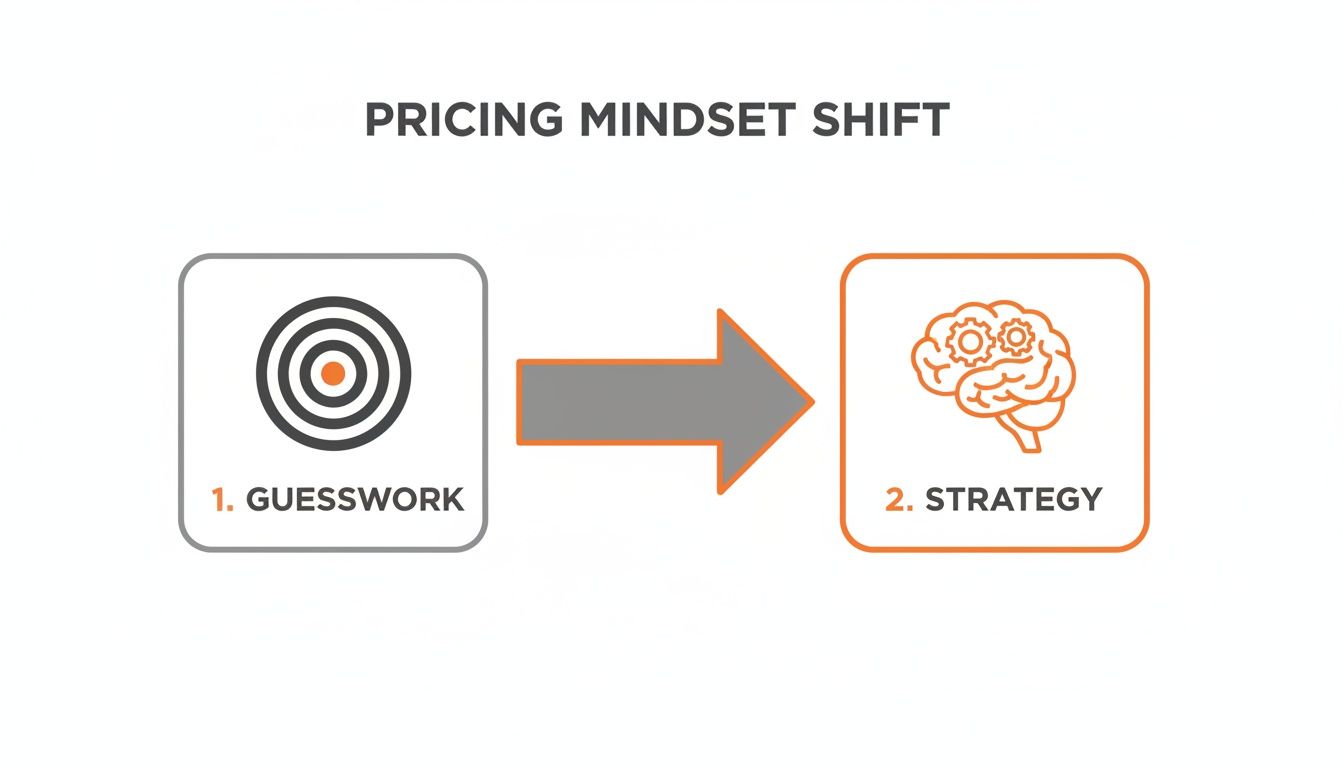
    Doing this homework is what shifts your pricing from a wild guess to a deliberate, informed strategy.

    Diagram illustrating a pricing mindset shift from guesswork (target) to strategy (brain with gears).

    Nail Down Your Unit Economics

    First things first, let's figure out your absolute floor—the bare minimum you have to charge just to keep the lights on. This is where your unit economics come into play. You have to know, for every single unit you sell, exactly what it costs you to make and deliver it.

    This isn’t just your big overhead costs. I'm talking about everything directly tied to one single sale:

    • Cost of Goods Sold (COGS): For a physical product, this is your raw materials, manufacturing labor, and packaging. If you’re selling software, think specific server costs or third-party API calls tied to a single user.
    • Variable Costs: These are things like credit card transaction fees, shipping expenses, or sales commissions. Any cost that goes up directly with each sale.

    Add it all up. That number is your price floor. If you sell for anything less, you are literally paying your customers to take your product off your hands.

    Uncover What Your Customer Is Really Willing to Pay

    Knowing your floor is just the start. The real magic happens when you figure out the ceiling—what your customers will actually pay for the value you provide. This is all about perceived value, and the only way I know to find it is by actually talking to people.

    I get it, it can feel awkward. But you can never ask, "So, what would you pay for this?" That’s a dead end. Instead, you need to have value conversations. Your goal is to deeply understand the pain your product solves.

    Try asking questions like these:

    • "How are you dealing with this problem right now?"
    • "What's the most frustrating part of that process for you?"
    • "If that frustration just vanished tomorrow, what would that be worth to you or your business?"

    Their answers are gold. If your product saves them $500 a month in wasted time, a $99/month price tag suddenly feels like a steal. These conversations should be part of your early development anyway, and you can get a better sense of how to structure them by reading up on how to validate a business idea.

    You’re not selling a product; you’re selling an outcome. Your price should be a small fraction of the value of that outcome.

    Map Out the Competitive Landscape

    Finally, it’s time to size up the competition. I’m not telling you to just copy their pricing—that’s a race to the bottom that nobody wins. What you're actually doing is building a "value map" to see where your product fits in the current market.

    Pick your top three to five direct competitors and analyze them across two key dimensions: price and their primary value proposition.

    • Price: Are they positioned as a budget option, mid-tier, or a premium solution?
    • Value: What's their main hook? Is it speed? Simplicity? A killer feature? Unbeatable customer service?

    Plot this out on a simple chart. You'll quickly see where the market is crowded and, more importantly, where the gaps are. Is there an opening for a high-touch, premium product? Or maybe a simpler, more affordable option for users who are overwhelmed by complex tools?

    This analysis helps you position your product not just to compete, but to win by offering something uniquely valuable. This initial intelligence gathering is the absolute cornerstone of a killer pricing strategy for new products.

    Mastering Price Skimming for Maximum Early Returns

    Alright, let's talk about your opening move. One of the most powerful plays you can run is price skimming. It’s a bold approach, for sure, but it can pay off big time if you’ve got the right product.

    I want you to think of it like this: you're launching the hottest new restaurant in town. For the grand opening, you're not running a two-for-one special. Instead, you're booked out for months with a high-end prix fixe menu. Price skimming is the velvet rope for your product launch—you set a high initial price to capture as much value as possible from the early adopters, the ones who absolutely have to be the first to get what you've built.

    This isn't about being greedy. It’s a smart way for you to recoup your R&D costs fast, which you can then pour back into growth and whatever you’re building next.

    An orange banner with 'PRICE SKIMMING' text, stanchions, and blurred people at an event.

    When Price Skimming Is Your Best Bet

    Price skimming doesn’t work for just any product. I've designed it for a very specific situation where you have a clear, undeniable advantage. If you try to skim with a "me-too" product, you'll just look out of touch.

    You should seriously consider this strategy if your new product:

    • Has a Strong First-Mover Advantage: You've built something genuinely new or so much better than the alternatives that, for a little while, you are the market.
    • Is Protected by a Moat: This could be a patent, a unique piece of tech, or a brand that’s already earned a ton of trust. Basically, anything that stops competitors from copying you overnight.
    • Targets Eager Early Adopters: Your first wave of customers cares more about the benefits and the status of having the latest and greatest than they do about the price tag.

    This whole approach is a signal of confidence. You’re telling the market you’ve created something premium, and the price is a reflection of that value.

    Skimming lets you cash in on your most enthusiastic customers first. You can always lower the price later to bring in a wider audience, but it's nearly impossible for you to jack up your price after you've launched low.

    Real-World Examples of Skimming Mastery

    Tech giants are the undisputed champions of this strategy. I see them use it to cement a premium brand perception from day one and to fund their massive R&D budgets. You see it play out with every new generation of smartphones, gaming consoles, and high-end electronics.

    Price skimming has been a home run, especially for tech innovators. Just look at Apple's iPhone launch back in 2007. They came out of the gate with a steep $499 price tag for the base 4GB model. They skimmed massive margins from early adopters who bought 1.4 million units in the first quarter alone, even with zero real competition.

    This move let Apple recoup its R&D costs—estimated at over $150 million—in just a few months, giving them the cash to fund the next big thing.

    A strategy like this only works when your product has features that truly stand out. If you need some ideas on how to make your product distinct, check out these excellent examples of product differentiation.

    The Risks and How to Manage Them

    Of course, coming in with a high price isn't a guaranteed win. You have to be ready for the downsides and have a game plan to handle them.

    The biggest risk I see is simply misjudging the value and turning off your target market. If your price comes across as outrageous instead of premium, you can kill your launch momentum before it even starts.

    Another thing to watch out for: high prices and fat margins attract competitors like sharks to blood. They'll scramble to build their own versions, and your window of exclusivity might be shorter than you think. This is why you need a plan to lower your price strategically as the market gets crowded.

    Here’s how you can cover your bases:

    1. Validate Your Value: Before you launch, you absolutely must have those tough value conversations with potential customers. You need real proof that they see the value as being much higher than your price.
    2. Have a Pricing Roadmap: Don't just pick a high number and cross your fingers. Map out your price changes for the next 6-12 months. Know exactly when and how you'll lower the price to attract the next wave of buyers.
    3. Communicate the "Why": Your marketing has to scream why your product is worth the premium. I want you to focus on the unique benefits, the superior quality, and the incredible results customers are going to get.

    Price skimming is a powerful tool in your pricing strategy for new products. It’s about being bold, knowing your product's worth, and confidently grabbing the revenue you've earned through innovation before the competition has a chance to catch up.

    Using Penetration Pricing to Capture Market Share

    Alright, let's flip the script. I just talked about launching with a high, exclusive price. Now, we’re going to look at the polar opposite: penetration pricing.

    Forget the velvet rope. I want you to picture hosting a massive, free-for-the-neighborhood block party to introduce your new product.

    The goal is brutally simple: get as many people as you can to try what you've built, and do it fast. You launch with an incredibly low price—sometimes even free—to cut through the noise and build a user base from day one. This is all about grabbing market share now so you can figure out how to best monetize it later.

    I know this can feel terrifying for a founder. You've poured everything into your product, and now you're basically giving it away. But when you get it right, penetration pricing is a powerful engine for building unstoppable momentum and creating a wide moat before competitors even realize you're a threat.

    When to Go Low for a High-Growth Launch

    Let's be clear: this isn't about you being the cheapest option forever. It’s a calculated land grab. Penetration pricing works brilliantly in a few key situations, and you need to be honest about whether your product fits the bill.

    This approach is your best bet when:

    • The Market is Already Crowded: If you're walking into a space with big, established players, a low price is one of the best ways to get customers to even look your way. It dramatically lowers their risk of trying something new.
    • Your Product Thrives on Network Effects: Think about a social app or a collaboration tool. Each new user makes the product more valuable for everyone else. A low entry price seeds that initial community, kickstarting the whole flywheel.
    • You Can Scale Cheaply: This strategy is a volume game. It only works if your cost per user is extremely low (which is true for most SaaS products). You need to be able to support a massive audience before you start asking them to pay up.

    You're making a conscious trade: sacrificing early profits for long-term market dominance.

    Spotify and Zoom Are the Kings of This Play

    You don’t have to look far to see this strategy in the wild. Two of the best examples are companies you probably use every single day: Spotify and Zoom.

    Spotify dove into a world completely dominated by music piracy and Apple's iTunes. People were used to either getting music for free (illegally) or buying songs one by one. Their "freemium" model was a genius penetration play. They offered a gigantic library for free with some ads, getting millions of people completely hooked on the convenience.

    Once you’d spent hours building your perfect playlists, upgrading to the $9.99 premium plan to kill the ads and download songs felt like a tiny price to pay. They won the market first, then sold the value.

    Zoom pulled the exact same move. The world of video conferencing was filled with clunky, expensive, enterprise-level tools. Zoom came in with a free tier that was just good enough for almost everyone. It was simple and it just worked. This drove insane word-of-mouth growth. As people’s needs grew, or as their companies needed more features and control, upgrading to a paid plan was a total no-brainer.

    Penetration pricing is a game of scale. You sacrifice margin on the front end to build an audience so large that it becomes your biggest competitive advantage.

    How to Do It Without Going Broke

    The biggest risk with this strategy? Attracting a ton of freebie-seekers who will never pay, leaving you with sky-high server costs and no revenue to show for it. You absolutely need a plan to avoid that trap.

    When new products go international, penetration pricing can be a blitzkrieg, undercutting local players to grab share and turn an unknown into a household name. Research on SaaS expansion shows companies using this strategy acquired customers 1.8x faster in their first year than their value-based competitors. This is exactly what Spotify did in its 2011 global push. Starting with its famous $9.99 price point but leaning heavily on its massive free tier, it hooked 20 million users in just a few months, paving the way to the 500 million+ it has today. You can dig into more data on pricing strategies for international expansion to see how others are using this play.

    To make this work for you, you have to nail these three things:

    1. Define Your Conversion Path: Know exactly how you're going to nudge free users into paid plans. Will you limit key features? Cap their usage? Offer a clearly superior premium experience? That path needs to be baked into your product from day one.
    2. Obsess Over User Experience: Your product has to be incredible. Since you aren't competing on price long-term, you have to win on the experience. A low price gets them in the door; a great product makes them want to stay.
    3. Have a Clear Pricing Roadmap: Just like with price skimming, you need to know when and how you'll start increasing prices or pushing for those upgrades. Maybe it's after a 90-day introductory period, or once you hit a critical mass of 100,000 active users. Have a plan.

    Used thoughtfully, penetration pricing is an incredibly effective pricing strategy for new products built for one thing: rapid growth and long-term market leadership.

    Testing and Adapting Your Price Post-Launch

    Your launch day isn't the finish line for your pricing strategy. It's the starting gun.

    The most successful founders I know treat their price not as a fixed number, but as a living, breathing part of their business. It needs constant attention and adaptation. The good news? You don't need a massive budget or a team of data scientists to do this right.

    I'll show you how to run simple experiments that give you powerful insights without making you look desperate or confusing your customers. Think of yourself as a scientist in a lab. Your product's price is a key variable, and your job is to constantly tweak it, measure the results, and find the perfect formula for sustainable growth.

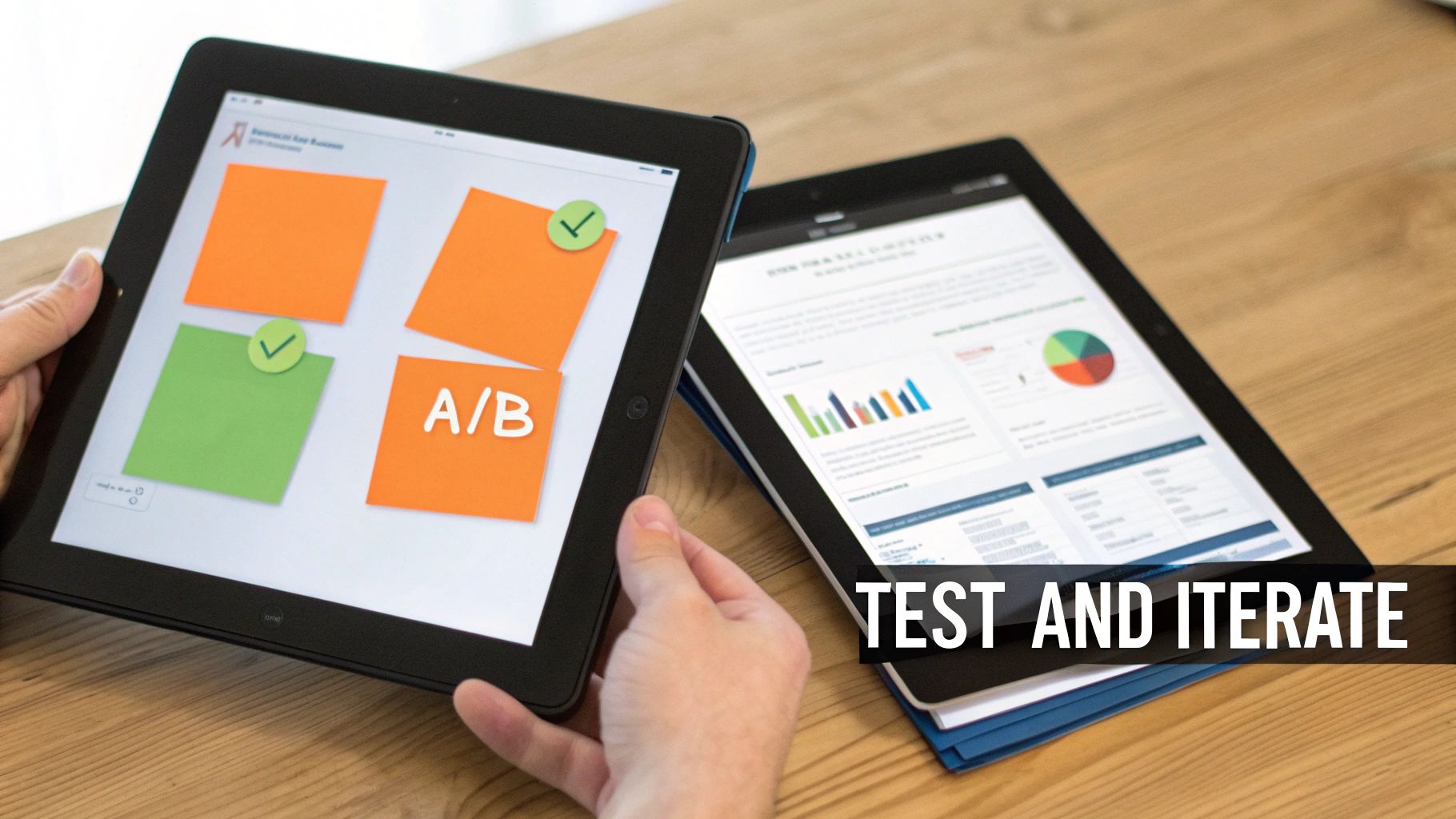
    Hands hold a tablet displaying A/B testing, beside another tablet showing data charts and "TEST AND ITERATE".

    Running Smart Pricing Experiments

    Pricing experiments sound intimidating, but they don't have to be. The secret is to test one thing at a time and have a clear idea of what you’re trying to learn. You want clean data, not a mess of conflicting signals.

    One of the easiest places for you to start is with your checkout or pricing page. This is called an A/B test. You simply show one version of your page (Version A) to half your visitors and a different version (Version B) to the other half.

    Here are a few simple A/B tests you can run right away:

    • Discount Framing: Test offering "$20 off" versus "25% off." Even if the dollar value is nearly identical, I can almost guarantee one will convert better.
    • Price Anchoring: On your pricing page, try highlighting one of your tiers as "Most Popular." This tiny bit of social proof can nudge new customers toward the exact option you want them to pick.
    • Bundling: Create a "starter pack" that bundles your main product with a popular accessory for a single price. This is a fantastic way for you to boost your average order value from day one.

    You can use simple tools like Google Optimize or even built-in features on platforms like Shopify to run these tests. Your goal isn't to hit a home run on your first try; it's to find small wins that add up over time.

    The Metrics That Truly Matter

    When you start testing, it’s easy to get lost in a sea of data. Forget vanity metrics like website traffic or social media likes. For a new product, you need to be absolutely obsessed with the numbers that tell you if your business is actually working.

    Your launch price is just your best guess. You discover the real price through continuous testing and a ruthless focus on the right metrics. Don't be afraid to be wrong—be afraid to stay wrong.

    Let’s break down the big three that you need to be tracking from day one.

    Customer Lifetime Value (LTV)

    This is the total amount of money you expect to make from a single customer over their entire relationship with your business. If a customer pays you $50 a month and sticks around for an average of 18 months, their LTV is $900. This number tells you what each new customer is ultimately worth.

    Customer Acquisition Cost (CAC)

    How much does it cost you in sales and marketing to land one new paying customer? If you spend $1,000 on ads and get 10 new customers, your CAC is $100. This number tells you what you're paying to get that LTV.

    The golden rule of a healthy business is simple: your LTV must be significantly higher than your CAC. A common benchmark is an LTV:CAC ratio of 3:1 or better. If you’re spending $100 to acquire a customer who is only worth $90 to you, you don't have a business—you have a very expensive hobby.

    Churn Rate

    For subscription businesses, churn is the percentage of customers who cancel during a given period. If you start the month with 100 customers and 5 cancel, your monthly churn rate is 5%.

    High churn is a blaring alarm bell. It means you have a problem with either your product or your price. It's a leaky bucket that will sink your business, no matter how many new customers you pour in.

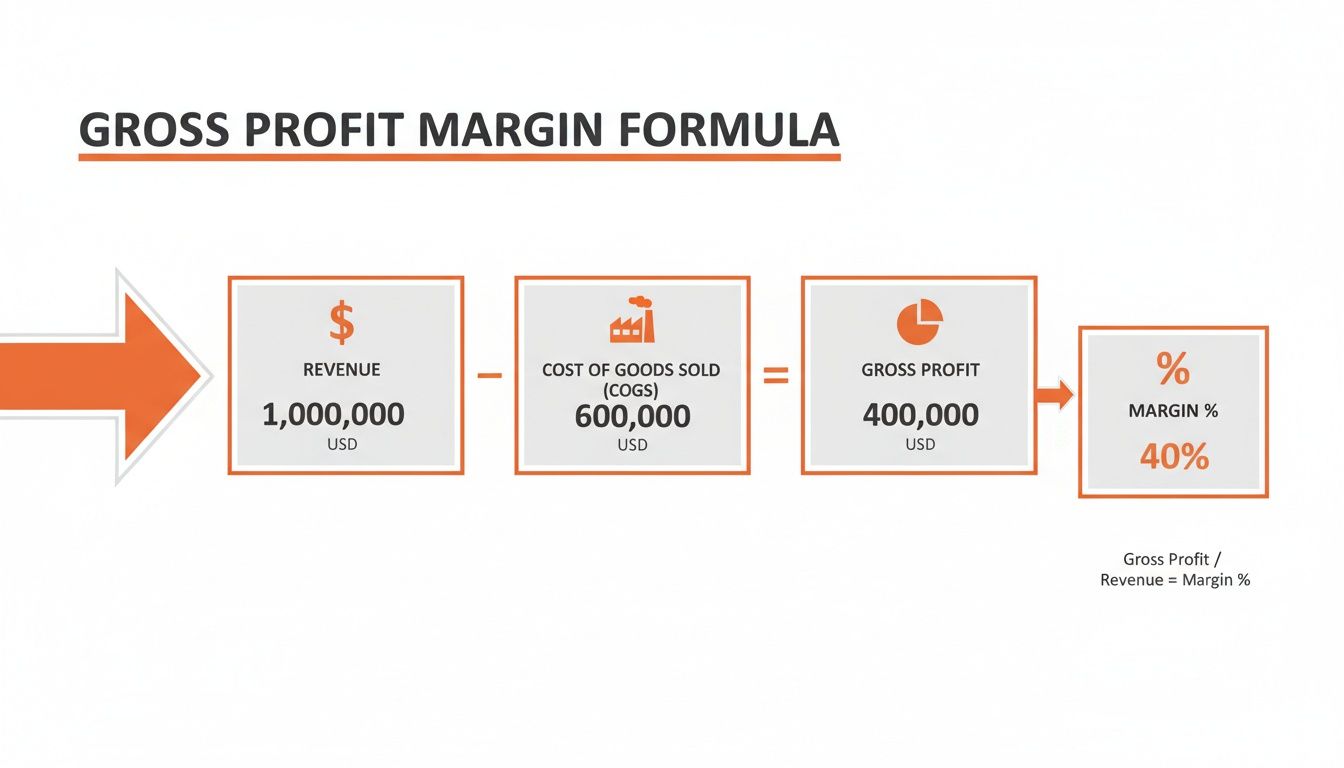
    Tracking these metrics is non-negotiable. They are the health report for your entire pricing strategy for new products. Understanding your numbers also feeds directly into your profitability calculations. You can learn more about the calculation of gross margin percentage to connect these acquisition metrics to your bottom line.

    By treating your launch price as a starting point and relentlessly testing and tracking, you build a resilient business that can adapt, learn, and thrive in any market.

    Some Pricing Questions I Get Asked All The Time

    Let's dig into a few of the questions I hear constantly from founders trying to nail down their pricing. These are the things that keep us tossing and turning at night. Here are my straight-up answers to help you get unstuck and move forward.

    How Do I Price My Thing When There Are No Competitors?

    First off, this is a fantastic problem to have. It means you've built something truly new, and you get to set the terms. Your entire focus needs to be 100% on value-based pricing.

    Don't even think about what it costs you to make. That's irrelevant right now. Instead, you need to get out of the building and talk to your potential customers. But whatever you do, don't ask, "So, what would you pay for this?" That question is a total trap and you'll get garbage answers.

    You need to go deeper and really understand the problem you're solving for them.

    • How much actual time or money is this problem costing their business today?
    • What's the emotional cost? The headache, the stress of dealing with it over and over?
    • What are they paying for the "old way" of solving this problem? Is it a clunky spreadsheet, a part-time intern, a different tool that only does half the job?

    Your price should feel like a tiny fraction of the massive value you deliver. This is also a perfect spot for you to use anchoring. Let's say your new software saves a small business 10 hours of manual work every month. If that work costs them $500 in labor, your $99/month price tag suddenly sounds like a steal. It's a no-brainer.

    What Are the Biggest Pricing Mistakes You See Founders Make?

    I see the same gut-wrenching mistakes again and again. The absolute biggest one is pricing based only on your costs or, even worse, just a random gut feeling. This is a surefire way to underprice your product and leave a mountain of cash on the table.

    Another classic mistake is treating pricing as a "set it and forget it" task. Your price isn't set in stone. It has to evolve as your product gets better, your brand gets stronger, and the market changes around you.

    Your price is a signal. It tells the world how confident you are in your product and the value it delivers. When you launch, you're making a statement about what you believe all your hard work is worth. Don't sell yourself short.

    Finally, please don't launch with a million different pricing tiers. I know it's tempting to try and make an option for every single person, but all you'll do is confuse people and trigger decision paralysis. Start with one or two dead-simple, crystal-clear options. You can always add more tiers later once you have real data on how people are actually using your product.

    Should I Put My Prices on My Website?

    For almost every new product, especially in e-commerce and SaaS, the answer is a massive, unequivocal yes. Please, for the love of all that is holy, just show your price.

    Being transparent with your pricing is one of the fastest ways for you to build trust. When you hide your price behind a "Contact Us for a Demo" button, you're just creating friction. People immediately assume it's crazy expensive and will just bounce over to a competitor who isn't afraid to be upfront.

    The only real exception I see here is for super-complex, enterprise-level products where the price truly depends on a custom setup and deep integrations. For pretty much everyone else, putting your price on your site is the confident, smart, and correct move. It shows you believe in the value you’re selling.


    If you're a founder in the Midwest and you're looking for a community that has honest conversations like this one, you should check out Chicago Brandstarters. It’s a free, vetted group where we share war stories, tactics, and real support to help each other grow. Apply to join us here.

  • The Top 10 Questions to Ask When Buying a Business in 2026

    The Top 10 Questions to Ask When Buying a Business in 2026

    I get it. You're ready to skip the startup grind and acquire something with traction. It's a smart move, but buying a business is like buying a used car: what's under the hood matters far more than the new paint. You're not just purchasing assets; you're inheriting someone else's wins, mistakes, and all their hidden problems. Every business has a story, and you need to uncover the unwritten chapters before you sign.

    Think of me as your personal mechanic, and this guide as my checklist. I'm going to walk you through the ten most critical areas to investigate. I'll give you the specific questions to ask when buying a business that I and other experienced buyers use. We'll skip the generic advice. We will focus on the tough questions that separate a seven-figure rocket ship from a money pit in disguise.

    Answering these will feel like a final exam, but passing it means you're buying a future you can actually build on. This list gives you a solid framework for your due diligence. You will understand the company’s real financial health, how it actually operates, and its true potential for growth. You need to know exactly what you're getting into, so you can build the success you're working so hard for. Let's get started.

    1. Financial Health, Historical Performance & EBITDA Quality

    Before you even think about an offer, you have to become a financial detective. Your first job is to dissect the business's financial statements: the income statement, balance sheet, and statement of cash flows. Think of these documents as the business's report card. They show you its true profitability and how it has managed cash for the last 3-5 years.

    A desk with a calculator, laptop displaying data, financial charts, a notebook, and a pen.

    Your goal isn't to accept the seller's stated profit, often shown as EBITDA (Earnings Before Interest, Taxes, Depreciation, and Amortization). Your mission is to calculate a "normalized" or "adjusted" EBITDA. It's like finding a car's real miles per gallon, not the inflated number the dealer claims. You'll strip out one-time windfalls and personal owner expenses run through the business. This adjusted figure shows you the true, repeatable earning power you will inherit. To dive deeper into profitability, understanding the calculation of gross margin percentage is a crucial first step.

    Key Questions & Actions

    • Request & Verify: Ask me for at least three years of financial statements and the matching tax returns. You need to cross-reference them with bank statements to make sure the reported revenue is real. Any mismatch is a major red flag.
    • Challenge Add-Backs: Sellers will "add back" personal or one-off expenses to pump up the EBITDA. You must scrutinize every single one. Was that "one-time marketing expense" truly a one-off, or is it a recurring cost you will have to pay?
    • Analyze Owner's Compensation: Is the owner paying themselves a tiny salary for a job that would cost you $100,000 to fill? You must adjust the financials to reflect a market-rate salary. This will show you the real profit.
    • Assess Margin Trends: Is revenue growing while profit margins shrink? This could mean rising costs to get customers or pricing pressure. Both threaten your future profits.

    2. Customer Base Quality & Concentration Risk

    A business with big revenue can be a house of cards if it leans on just a few customers. You must investigate the health and diversity of the customer base. This helps you understand the stability of the revenue streams you're buying. Think of it like an investment portfolio: you wouldn't put all your money in one stock. A business shouldn't have all its revenue tied to one or two clients.

    A tablet on a wooden desk displays a bar chart about Concentration Risk, with financial documents.

    Your job is to spot concentration risk. This is the danger that a big chunk of your income could vanish if one major customer leaves. Imagine a service firm where one client makes up 40% of revenue. That is extremely fragile. You also need to check how "sticky" customers are. A business that constantly has to find new customers just to stay level is far riskier than one with a loyal, recurring customer base.

    Key Questions & Actions

    • Analyze the Customer List: You should request a detailed, anonymous customer list showing sales per customer for the last three years. Calculate the revenue percentage from the top 5 and top 10 customers. If any single customer is more than 10-15% of total revenue, I see a red flag.
    • Assess Customer Stickiness: Are customer relationships built on contracts, or just a personal bond with the owner that might not transfer to you? Ask the seller, "Which three customers would hurt the most to lose, and why are they loyal to the business, not just to you?"
    • Evaluate Customer Acquisition Channels: Where do new customers come from? If a brand gets 70% of its sales from Facebook ads, you're inheriting massive platform risk. A simple algorithm change could destroy your sales pipeline.
    • Check Retention & Churn: For any subscription or e-commerce business, you must analyze customer churn and repeat purchase rates. A low repeat purchase rate means you're on a constant, expensive treadmill just to replace lost customers, which eats away at your profits.

    3. Intellectual Property & Brand Assets

    When you buy a business, you're buying more than inventory. You are often buying its brand and the ideas that power it. Your next move is to become an IP investigator. You need to make sure the intangible assets you think you're getting are legally protected and fully transferable. This includes trademarks, patents, copyrights, and even secret recipes.

    A blue binder titled 'BRAND OWNERSHIP' on a desk with an orange box, documents, and a pen.

    Failing to verify IP ownership can be a disaster. Imagine you buy a popular online store only to find out the seller never registered the trademark. You could be forced into an expensive rebrand or even lose the business’s online identity. A strong brand needs a solid legal foundation. You can see different approaches in these positioning brand examples.

    Key Questions & Actions

    • Create an IP Inventory: You need to ask me, the seller, for a complete list of all intellectual property. This should include registered trademarks, patents, domain names, social media handles, and any special software.
    • Verify Ownership: Don't just take my word for it. You should use public databases like the USPTO for trademarks and WHOIS for domains to confirm the business legally owns them. Ask me for proof of a clean chain of title for all key assets.
    • Review All Agreements: You must scrutinize supplier, contractor, and licensing agreements. Do you have clear ownership of the website code a freelancer built? You need written confirmation that all critical IP will be assigned to you at closing.
    • Consult an IP Attorney: I consider this non-negotiable. You should have a qualified attorney review all documents, search for potential problems, and make sure the purchase agreement clearly assigns all IP rights to you, the new owner.

    4. Revenue Model & Customer Acquisition Strategy

    Understanding how a business makes money is as important as knowing how much it makes. You must investigate the engine that drives sales. Is the business built on a sustainable, scalable system? Or is it a house of cards propped up by my personal network or a single, risky marketing channel?

    Your goal is to map the entire customer journey, from first contact to final sale. You need to identify any critical dependencies. For example, a brand that claims strong organic growth might actually spend 80% of its budget on Facebook ads, which means you face a future of shrinking margins. Similarly, if I am the only salesperson, you're making a high-risk purchase. My departure could crater your revenue. You're buying systems and processes, not just my charisma.

    Key Questions & Actions

    • Demand a Channel Breakdown: You should ask for a detailed report showing revenue by source for the last 12-24 months. How much comes from paid ads, organic search, or direct referrals? If an e-commerce store gets 90% of its sales from Amazon, I see that as a significant risk for you.
    • Test for Founder Dependency: Ask me point-blank: "If you walked away tomorrow and I couldn't contact you, would new customers still come in?" My answer will reveal how much success is tied to my personal relationships versus transferable systems.
    • Verify Acquisition Costs: Don't take my word for it. You need to calculate the Customer Acquisition Cost (CAC) and Lifetime Value (LTV). You should request direct, read-only access to my ad accounts (Google, Meta, etc.) to verify the data yourself.
    • Assess Channel Ownership: You must determine if the marketing channels are "owned" or "rented." An owned asset, like a large email list, is incredibly valuable. A rented channel, like Facebook ads, means you are subject to the whims of algorithms and rising costs.

    5. Operational Systems & Key Person Dependency

    You're not just buying assets and customers; you're buying an engine. The critical question here is whether that engine is a well-documented system or a black box that only the current owner knows how to run. A business that relies heavily on the founder's secret knowledge isn't a business—it's a job you're buying, and a very risky one.

    A work desk with an open notebook, laptop displaying business data, headphones, and a small plant.

    Your goal is to uncover "key person dependency." How much would the business crumble if the owner disappeared tomorrow? This dependency can hide everywhere: client relationships known only to the founder, or supplier passwords stored in their head. The true value of a business lies in systems that you can teach and transfer, not in the owner's personal magic.

    Key Questions & Actions

    • Ask the "Bus" Question: You should ask me directly, "If you got hit by a bus tomorrow and couldn't work for three months, what would happen to the business?" My answer will immediately reveal undocumented processes and dependencies.
    • Request Documentation: Ask for all Standard Operating Procedures (SOPs), employee handbooks, and process diagrams. If these don't exist, it's a huge red flag. It means all the operational knowledge lives inside my head.
    • Interview Key Staff: You need to talk to long-term employees and managers. Ask them how they make key decisions. Compare their answers to the official documentation to see if reality matches the manual.
    • Analyze Supplier & Client Relationships: Investigate who manages the relationships with top suppliers and customers. If it’s just me, you risk losing that business the moment you take over. You should request copies of all supplier contracts and client agreements to verify the terms are official, not just handshake deals.

    6. Legal Compliance, Contracts & Liabilities

    When you step into my business, you inherit its entire legal history—the good, the bad, and the ugly. You're not just buying assets; you're buying contracts, obligations, and potential lawsuits. A deep dive into the legal paperwork is a must. It protects you from hidden problems that could cripple the company right after you take over.

    Think of this as a home inspection for legal integrity. You need to check the foundation (licenses and compliance) and look for hidden pests (pending lawsuits or tax issues). A seller might "forget" to mention an ongoing lawsuit or that their key supplier contract can't be transferred to a new owner. You want to uncover these bombshells now, not later.

    Key Questions & Actions

    • Engage a Lawyer Early: Your first move should be to hire an experienced business attorney. They will review all contracts, spotting risks that you would easily miss. This is not a place where you should cut costs.
    • Audit All Agreements: You must request and scrutinize every single contract: employment agreements, supplier contracts, and commercial leases. Pay special attention to clauses about termination, pricing, and change of control. Can a key customer walk away without penalty once you buy the business?
    • Uncover Hidden Liabilities: You need to directly ask me about any past, current, or threatened lawsuits. Then, have your lawyer independently verify this. Check for any liens on assets, which could mean unpaid loans or taxes that you would become responsible for.
    • Verify Regulatory Compliance: Make sure the business has all the necessary local, state, and federal licenses to operate legally. You must confirm that all tax filings are up-to-date to avoid inheriting a dispute with the IRS.

    7. Market Position, Competition & Growth Runway

    Buying a business isn't just about its past performance; it's about its future potential. You need to become an industry analyst. You have to understand where this business fits in its market and whether there's enough room for it to grow. A profitable business in a shrinking market is like a beautiful house on a sinking foundation—it's a risky investment.

    Your mission is to evaluate the company's competitive "moat"—its defensible advantage. Is it a strong brand, exclusive supplier deals, or simply being the lowest-cost provider? A business without a clear reason for customers to choose it over others is vulnerable. A generic dropshipping store has no moat. A brand with a patented product in a growing health category has a fortress.

    Key Questions & Actions

    • Map the Battlefield: You should use tools like industry reports and Google Trends to check the market's health. Is it growing or declining? Identify your direct competitors and indirect competitors who solve the same problem.
    • Define the "Why": Ask me directly, "Why do your best customers choose you over everyone else?" I should give you substantive answers like superior service or unique product features. Vague answers like "we're the best" are a red flag for you.
    • Assess the Runway: What is the Total Addressable Market (TAM)? Is the business a small fish in a huge ocean with plenty of room to swim, or has it already captured most of its small pond? You need to see a clear path for you to scale the business.
    • Look for Headwinds & Tailwinds: Are there regulatory changes or technological shifts that could hurt (headwinds) or help (tailwinds) the business? A company selling high-end baby products, for example, would benefit from a "baby boom" tailwind.

    8. Customer Feedback, Satisfaction & Net Promoter Score

    A business with high revenue but unhappy customers is a ticking time bomb. You are inheriting a relationship with the people who keep the lights on. You absolutely must look beyond the financial statements and gauge the health of the customer base. This means you have to dig into satisfaction metrics and online reviews to understand brand loyalty and predict future churn.

    Your goal here is to get a true pulse on how customers feel. Metrics like Net Promoter Score (NPS), which measures how likely a customer is to recommend the brand, are invaluable. For example, a product with impressive sales but a low NPS score means you'll have to spend heavily on acquiring new customers just to stay afloat. Conversely, a service business with glowing testimonials suggests a loyal base that will stick with you through the transition.

    Key Questions & Actions

    • Analyze Reviews & Testimonials: You should request access to all review platforms (Google, Yelp) and read the negative reviews carefully. Look for recurring themes like poor service or product defects. Ask for customer testimonials and get my permission to speak with a few of them directly.
    • Request Customer Metrics: Ask for the customer list, churn rate data, and any NPS surveys I have conducted. If I haven't run a survey, ask if you can send a simple one to a segment of my email list. High unsubscribe rates are also red flags for you.
    • Investigate Social Proof: You need to examine the business's social media presence. Is there an active community of fans, or is it a ghost town of complaints? A vibrant community is a powerful asset that is very hard for you to replicate.
    • Calculate Customer Lifetime Value (CLV): You must understand how much a customer is worth over their entire relationship with the business. A high CLV suggests customers are happy and loyal, which is a sign of a very healthy operation for you to take over.

    9. Supply Chain, Inventory & Unit Economics

    If you're buying a business that sells physical products, its supply chain is the central nervous system. You need to investigate the entire journey of a product, from raw materials to the customer's doorstep. A seemingly profitable brand can have a fragile foundation, with supplier issues or bloated inventory ready to crumble under your ownership.

    Your goal is to understand the true cost and reliability of getting products made and delivered. A business might look good on paper, but if its primary supplier is unreliable or its warehouse is full of "dead" stock, you're buying a massive, expensive problem. You must confirm that the unit economics—the profit on each item sold—are healthy enough for you to sustain and scale the business.

    Key Questions & Actions

    • Deconstruct Unit Economics: You should request a detailed Cost of Goods Sold (COGS) breakdown for the top-selling products. This must include everything: materials, manufacturing, freight, and duties. What is the true profit on a single unit after all these costs, plus fulfillment and returns, are factored in?
    • Audit the Supply Chain: Ask me for a complete list of suppliers, including contact info, contracts, and lead times. Is the business overly dependent on a single supplier? A business with one key relationship is a high-risk investment for you.
    • Analyze Inventory Health: You must demand an inventory aging report. This shows you how long products have been sitting on the shelf. A lot of old stock is a major red flag, meaning you’ll have to write it off as a loss. You can dive deeper by using an inventory turnover formula to gauge efficiency.
    • Assess Fulfillment Operations: How are orders picked, packed, and shipped? If they use a third-party logistics (3PL) provider, you need to review the contract and costs. You might find significant savings by renegotiating or switching providers, which could immediately boost your margins.

    10. Founder Motivation, Reason for Selling & Post-Sale Transition

    Beyond the spreadsheets, you are buying a business from a human being. Understanding my real reason for selling is one of the most crucial questions you can ask. My story will reveal potential hidden issues, my confidence in the business's future, and how smooth your transition will be.

    Am I truly retiring, or am I fleeing a sinking ship? If I'm just burned out, I might be masking deep operational problems I couldn't solve. My motivation directly impacts the business's health and my willingness to support you after the sale. A smooth handover is critical, and a checked-out founder won't give you the training you need to succeed.

    Key Questions & Actions

    • Probe the "Why": You should start with "Why are you selling?" and follow up with "What would make you decide not to sell?" The second question often gets you the real story. If I say "a better offer," it's about money. If I hesitate, you need to dig deeper.
    • Test Their Confidence: You can propose that a portion of the purchase price be paid through seller financing. If I truly believe in the business's future, I'll often be open to this. It shows you I have skin in the game. My refusal could be a red flag for you.
    • Define the Transition Period: Don't accept my vague promise of "help." You need to negotiate a detailed 30-to-90-day transition plan. This agreement should specify my hours per week, key training responsibilities, and required introductions to clients and suppliers.
    • Get It in Writing: You must ensure the purchase agreement clearly outlines what I will transfer (like intellectual property and client lists) and includes post-sale restrictions, like a non-compete clause, to protect your new investment.

    10-Point Due Diligence Questions for Buying a Business

    Item Implementation Complexity 🔄 Resource Requirements ⚡ Expected Outcomes 📊 Ideal Use Cases 💡 Key Advantages ⭐
    Financial Health, Historical Performance & EBITDA Quality High — detailed accounting review, adjustments, and projections CPA/financial analyst time, bank statements, 3–5 years of statements Normalized EBITDA, realistic valuation inputs, hidden issues revealed Acquisitions, valuation, financing and deal structuring Reveals true profitability; reduces overpaying risk
    Customer Base Quality & Concentration Risk Medium — requires customer-level data and segmentation CRM exports, analytics, customer interviews, churn data Clarity on retention, concentration, LTV:CAC health Revenue sustainability checks; identifying diversification needs Identifies major-customer risk and retention gaps
    Intellectual Property & Brand Assets Medium–High — legal searches and ownership verification IP attorney, WHOIS/domain checks, trademark searches Clear transferability of brand assets and legal exposure Brand acquisitions, licensing, cross-border sales Secures legal rights; prevents post-sale brand disputes
    Revenue Model & Customer Acquisition Strategy Medium — channel analysis and unit-economics modeling Ad-account access, analytics, marketing expertise Understanding of scalable channels and growth levers Scaling DTC/ecommerce and growth planning Highlights scalable channels and actionable growth levers
    Operational Systems & Key Person Dependency Medium — SOP audits and staff interviews Time with team, documentation review, operations consultant Assessment of founder dependency and handover readiness Turnkey buys; reducing operational risk after acquisition Enables scalable ops and smoother transitions
    Legal Compliance, Contracts & Liabilities High — comprehensive contract and legal review Business attorney, insurance review, contract repository Identification of transferability issues and hidden liabilities Contract-heavy businesses; pre-closing risk mitigation Protects buyer from legal and financial surprises
    Market Position, Competition & Growth Runway Medium — market research and competitor mapping Industry reports, SEM/SEO tools, analyst time Realistic growth ceiling and defensibility evaluation Market-entry decisions and strategic positioning Assesses scalability and long-term market fit
    Customer Feedback, Satisfaction & Net Promoter Score Low–Medium — surveys and review analysis Survey tools, review scraping, customer interviews Measure of loyalty, churn risk, and product-market fit Retention improvement, quality validation, post-acquisition planning Signals genuine customer loyalty and problem areas
    Supply Chain, Inventory & Unit Economics High — COGS breakdown and supplier reliability checks Supplier audits, inventory reports, financial modeling True per-unit profitability and working capital needs Product brands, scaling physical goods, margin analysis Reveals margin sustainability and supply vulnerabilities
    Founder Motivation, Reason for Selling & Post-Sale Transition Low–Medium — interviews and verification Time with founder, reference checks, negotiated terms Insight into deal risk, transition quality, and seller incentives Ensuring smooth handover and cultural fit post-acquisition Aligns expectations; often predicts post-sale success

    Your Next Move: From Questions to a Confident Offer

    You’ve reached the end of my interrogation, but it’s just the beginning of your journey. This list of questions to ask when buying a business isn't a simple checklist for you to breeze through. Think of it as an MRI for a business. It's meant to reveal the hidden fractures, strong bones, and true health of the company you’re considering. The answers you uncover will form the bedrock of your valuation, your transition plan, and your strategy for growth.

    This process isn't about finding a flawless business. Let me be clear: they don't exist. Every company has skeletons, quirks, and hidden risks. Your goal isn’t to find perfection; it's to achieve clarity. You are looking for a business whose imperfections you not only understand but are uniquely equipped to fix.

    Turning Answers into Actionable Insights

    By now, you’ve dug into everything from the quality of EBITDA to my real motivation for selling. The amount of information can feel overwhelming, so let’s boil it down to what truly matters for you.

    • Financials are the Past, Not the Future: The P&L statements tell you where the business has been. Your job is to use that data to build a realistic model of where it can go under your leadership.
    • People and Processes are the Engine: A business with a strong brand but a single linchpin employee (often me, the founder) is a huge risk for you. You must identify these dependencies and understand the systems. Is this a well-oiled machine you can step into, or an engine you’ll need to rebuild?
    • Risk is a Price, Not a Stop Sign: Did you find a pending lawsuit or a major client about to leave? These aren't necessarily deal-breakers. They are negotiation points. Every risk has a price, and your job is to quantify it and factor it into your offer. A well-informed offer is one that accounts for the cost of fixing these known issues.

    Ultimately, asking the right questions transforms you from a hopeful buyer into a savvy investor. You move from emotional attachment to objective analysis. This shift is critical. It’s what separates a successful acquisition from a cautionary tale.

    Your Path Forward: From Due Diligence to Deal

    The path from here is about building a bridge from your new knowledge to a confident offer. You're no longer just buying a business; you're buying a specific set of assets, liabilities, and opportunities. You see the company for what it is, not just the polished version I presented.

    This detailed due diligence gives you leverage. It gives you confidence. Most importantly, it gives you a plan. You know what needs fixing on day one and where the low-hanging fruit for growth is. You can now walk into negotiations with a clear-eyed view, ready to make an offer you can stand behind, fully aware of the challenges and excited by the potential. This is how you buy a business without buying a world of unforeseen problems.


    The journey of acquiring and growing a business can feel isolating, but you don't have to go it alone. At Chicago Brandstarters, we are a community of kind, hardworking founders and operators who share these exact war stories and help each other navigate the complexities of building something meaningful. If you're looking for peer support from people who get it, you know where to find us. Chicago Brandstarters

  • Your 2026 Guide to the Top 7 Technology Events in Chicago

    Your 2026 Guide to the Top 7 Technology Events in Chicago

    I get it. Chicago's tech scene is buzzing, but finding the right event can feel like you're hunting for a needle in a haystack. You've probably been to those generic mixers, collected a stack of business cards, and walked away with zero real connections. It’s frustrating. As a founder myself, I know your time is gold; you can't afford to waste an evening on an event that doesn't push your business forward.

    This isn't just another list. I've personally used these platforms to find technology events in Chicago that actually deliver. Whether you're a first-time founder looking for a mentor, a product builder hunting for collaborators, or an investor scouting the next big thing, I wrote this guide for you.

    Think of this as your map to plugging into the city's tech ecosystem the right way. I’ll show you what makes each resource special, who you'll meet, and how to get the most out of your time. You’ll see screenshots and get direct links so you can leave your next event with more than just a handful of LinkedIn requests. Let's find the communities where you can build real relationships and grow your venture.

    1. Eventbrite: Your Go-To for Sheer Variety

    Think of Eventbrite as the Grand Central Station for technology events in Chicago. It’s a massive marketplace where you can find everything from a casual tech mixer in River North to a super-specific coding workshop in Lincoln Park. If you need to find something happening this week, this is your first stop. I use it to get a quick pulse on what’s happening across the city.

    Its strength is pure volume. The platform pulls in events from hundreds of different organizers, big and small, giving you an unfiltered look at the entire landscape. If you're new to the Chicago tech scene, this is a low-risk way to explore different communities without committing to a membership or a pricey conference ticket.

    How to Get the Most Out of Eventbrite

    Eventbrite's open platform is both a blessing and a curse. The variety is unmatched, but you need a strategy to cut through the noise.

    • Master the Filters: Don't just browse. Use the filters like a pro. You can narrow your search by date, price (including a "free" option), and event type. Looking for a weekend workshop on AI? Set your filters for "Saturday/Sunday" and "Workshop," then add "Artificial Intelligence" to the search bar. This turns a firehose of information into a focused list.
    • Follow Key Organizers: When you find an event you like, follow the organizer's profile on Eventbrite. This is the platform's secret weapon. You'll get notified about their future events directly, so you never miss a gathering from a group that fits your goals. I follow organizations like 1871 and specific meetup groups to stay in the loop.
    • Look Beyond Obvious Keywords: Searching for "technology events in chicago" is a great start, but get more specific. Try searching for niche terms relevant to your work, like "SaaS sales," "fintech regulations," or "product-led growth." You'll uncover smaller, more focused events that often lead to higher-quality connections.

    Actionable Tip: I set a calendar reminder for every Monday morning to spend 15 minutes on Eventbrite. Search for events in the next 7-14 days. This small habit keeps me aware of upcoming opportunities and helps me snag spots before popular events sell out.

    Find your next event: Eventbrite Chicago Tech Events

    2. Meetup: The Home for Niche Tech Communities

    If Eventbrite is Grand Central Station, Meetup is your neighborhood 'L' stop for technology events in Chicago. It's where you find your hyper-specific, recurring gatherings—the ones that build real communities. This is where you'll find grassroots groups focused on everything from "Chicago Python Users Group" to "Data Science Chicago."

    Meetup’s power is in its rhythm and focus. These aren't one-off conferences; they are consistent, often monthly, get-togethers that let you build real relationships over time. If you want to go deep on a particular skill or find collaborators, this is where you'll find your people. I've found the quality of connections here can be incredible since you're meeting with the same dedicated folks repeatedly. It's a fantastic place to find a co-founder with a shared technical interest.

    How to Get the Most Out of Meetup

    The community-driven vibe of Meetup means you get authentic experiences, but you need to be proactive to find the best groups.

    • Check a Group's Health: Before you join, check its vital signs. Look at the number of members, the frequency of past events, and the RSVP count for upcoming meetups. A group with thousands of members but only 5 RSVPs for next week's event might be a ghost town. I prioritize groups that have held an event in the last month.
    • Engage Beyond the RSVP: Don't just show up. Use the platform’s features. Join the group's discussion board or message the organizer a question beforehand. This simple step helps you break the ice and shows you’re genuinely interested in the community.
    • Expand Your Radius: The default search is tight. Try expanding your search radius to the entire Chicagoland area. A perfect event for you might be happening in Evanston, and you’d miss it with a narrow search. Adjust the "within X miles" filter to "any distance" from Chicago to see the full picture.

    Actionable Tip: I suggest you join three to five promising tech groups that align with your goals. Turn on notifications for new event announcements from these groups. This creates a curated pipeline of relevant events delivered right to you, saving you from constant searching.

    Find your next event: Meetup Chicago Technology Events

    3. 1871: The Heart of Chicago's Startup Ecosystem

    If Eventbrite is Grand Central Station, 1871 is the exclusive executive lounge for Chicago's tech scene. As the city's flagship innovation hub, it’s the curated epicenter where serious founders, operators, and investors gather. The events here aren't just random mixers; they are high-signal gatherings tied directly to the pulse of the startup ecosystem.

    The quality of the people is what sets 1871 apart. When you attend one of their panels or workshops, you know you're in a room with people actively building and funding the next wave of Chicago tech. While some events are for members, many are open to the public, offering you a fantastic window into this influential community.

    How to Get the Most Out of 1871

    Navigating 1871's calendar requires a strategic approach. The value here is in the quality of connections, so you need to be intentional.

    • Filter by Your Niche: The events calendar lets you browse by topics like AI and fintech. Use this to find your tribe. If you're building a SaaS company, attending a "Future of Work" panel puts you in a room with potential customers and investors already interested in your space.
    • Target Signature Events: Keep an eye out for 1871's big events like their annual awards. These are high-production gatherings that attract top-tier talent from across the Midwest. While some might have a cost, the investment often pays for itself through a single valuable connection.
    • Attend "Public" Events First: If you're not a member, filter for events open to the public. These are your entry point. Use them to understand the culture, meet a few key people, and see if a membership makes sense. Many founders get their start this way, proving you can start building a business with no money by leveraging community resources.

    Actionable Tip: Before you attend an 1871 event, check the speaker list. Research one or two people you'd like to meet on LinkedIn. Prepare a specific question related to their work. This transforms a generic "hello" into a memorable conversation.

    Find your next event: 1871 Events Calendar

    4. mHUB: The Epicenter for HardTech and Manufacturing

    If software events are the city's bloodstream, mHUB is its industrial heart. This is Chicago’s innovation center for physical products and manufacturing. If you’re building something you can hold in your hand—from a smart IoT device to a medical gadget—the mHUB events calendar is your guide. I see it as the essential hub for anyone turning atoms into products.

    Unlike other platforms, mHUB offers a hyper-focused ecosystem. Its events, from the flagship Annual HardTech Summit to casual member BBQs, attract a specific crowd: engineers, industrial designers, and the investors who fund them. For a hardware founder, an mHUB event means you're immediately in a room with people who speak your language.

    How to Get the Most Out of mHUB

    The value of mHUB is its density of specialized talent. To tap into it, you need to be intentional with how you engage.

    • Prioritize the HardTech Summit: The annual summit is mHUB's main event and a must-attend for anyone serious about physical products. Plan for this far in advance. Tickets can sell out, and the schedule is packed. I recommend reviewing the attendee list beforehand to identify a few key people you want to connect with.
    • Attend Community and Demo Events: Don't just wait for the big summit. mHUB hosts smaller, more frequent events like showcases and community gatherings. These are often less formal and provide better opportunities for genuine conversations. They are perfect for getting feedback on a prototype or finding an engineer to solve a specific design challenge.
    • Look for Industry-Specific Programming: Beyond general "hardtech," mHUB often hosts events focused on verticals like medtech or cleantech. Use their event calendar to filter for topics relevant to your industry. These niche gatherings are where you’ll find deep domain expertise.

    Actionable Tip: Before you attend any mHUB event, prepare a one-sentence "ask" and a one-sentence "give." Know exactly what you're looking for (e.g., "I'm seeking a firmware engineer") and what you can offer (e.g., "I can share my experience with D2C logistics"). This focus makes networking incredibly efficient.

    Find your next event: mHUB Chicago Events

    5. TechChicago Week (Go Tech Chicago): The City's Epicenter Festival

    Think of TechChicago Week as the Lollapalooza for the city’s tech scene. It’s a concentrated, week-long festival where the entire ecosystem comes together. The Go Tech Chicago website is your official guide, aggregating over 50 partner events from quantum computing deep dives to high-energy startup showcases. I use this site to plan an entire week of immersive learning and networking.

    Its power comes from its density. Instead of attending scattered technology events in Chicago, you can strategically stack your calendar with multiple high-value sessions in a single week. It’s a perfect chance to get a full overview of the city's key tech sectors—like life sciences, quantum, and clean energy—all in one place.

    How to Get the Most Out of TechChicago Week

    The festival's scale can feel huge, but with a plan, you can turn it into a career-defining week. The website is your primary tool.

    • Plan Your Track: The festival is organized around key themes. Before the week begins, visit the site and identify which track aligns with your industry. Focus your event selection on that theme to have deeper, more relevant conversations.
    • Mix Free and Paid Events: The calendar features a blend of free public events, mixers, and paid conferences. I recommend you create a balanced schedule. Use the free events for broader networking, and invest in one or two paid sessions for more curated access to industry leaders.
    • Map Your Week Geographically: Events are spread across the city. Use the event locations on the website to group your days by neighborhood. Plan your Monday around events in the Loop, and maybe spend Tuesday exploring Fulton Market. This planning saves you from spending half your day in transit.

    Actionable Tip: Once the official schedule is out, I create a personalized Google Calendar for the week. I add my selected events, including locations and registration details. You can share this calendar with a colleague to cover more ground together, then sync up daily to share what you've learned.

    Plan your festival week: TechChicago Week Schedule

    6. Discovery Partners Institute (DPI): Bridging Research and Reality

    Think of the Discovery Partners Institute (DPI) as the translator between cutting-edge academic research and real-world business. It's the University of Illinois' innovation hub in Chicago, and it’s where I go to glimpse the future. I attend their events when I want to understand where technology is headed, not just what’s trending today.

    Its strength is its academic rigor applied to commercial problems. Instead of another startup pitch night, you’ll find deep dives into quantum computing or AI in healthcare. This makes it a goldmine for founders scouting for high-level partnerships or talent grounded in deep technical expertise. The events are often free, making this high-quality programming incredibly accessible.

    How to Get the Most Out of DPI

    DPI's academic focus is its defining feature. You need to approach its events with a specific mindset to get the most value. It’s less about casual networking and more about targeted learning.

    • Focus on the "Why": Before you go, read the event description. Ask yourself, "Why is this research important to my startup?" Formulate one or two insightful questions. This preparation helps you start conversations with researchers and industry leaders on their level.
    • Target Talent Opportunities: DPI is a direct pipeline to talent from the University of Illinois system. If you’re hiring for specialized roles (like data science), their career fairs and tech talks are invaluable. For founders, these events are a prime opportunity to scout for technical advisors.
    • Attend the Series Programs: Look for recurring series like their AI forums. Attending multiple sessions lets you build familiarity with the community and track how a specific technology is evolving. Consistency turns you from a face in the crowd into a recognized community member.

    Actionable Tip: I always connect with at least one speaker on LinkedIn within 24 hours of a DPI event. In my connection request, I mention a specific insight I gained from their talk. This shows you were paying attention and creates a strong foundation for a professional relationship.

    Find your next event: DPI Events Calendar

    7. Polsky Center for Entrepreneurship and Innovation: The Academic Launchpad

    The Polsky Center is the entrepreneurial engine of the University of Chicago, but its impact reaches far beyond campus. Think of it as a bridge connecting academic rigor with real-world venture building. This is where you’ll find some of the most meticulously structured technology events in Chicago, from deep-dive workshops to the demo days of their nationally-ranked accelerator programs. I look to Polsky for events that are less about networking fluff and more about tangible, operator-focused substance.

    Its strength lies in its curriculum-driven approach. Events here are often tied to larger programs like the New Venture Challenge, which means you get access to highly vetted startups and battle-tested insights. While many events are held in Hyde Park, they also host significant gatherings downtown, making their programming accessible to the entire Chicago tech community. For founders seeking serious feedback and investor connections, Polsky offers a respected platform.

    How to Get the Most Out of The Polsky Center

    The Polsky Center's calendar can be a goldmine, but you need to know how to navigate its ecosystem. Here’s how you can tap into their offerings.

    • Bookmark the "Events & Deadlines" Page: This is your source of truth. The Polsky team keeps their public calendar diligently updated. I recommend you check this page bi-weekly to catch opportunities before they fill up, as capacity for non-university affiliates can be limited.
    • Target the Culminating Events: While some workshops are private, the grand finales are often open to the public. Keep an eye out for the "New Venture Challenge Finals." These are high-production demo days where you can see the best startups emerging from the UChicago ecosystem and network with top-tier investors. These events provide a great window into the venture capital landscape in Chicago.
    • Attend "Founder's Stories" and Panels: Polsky frequently hosts fireside chats and panels with successful entrepreneurs and VCs. These events are almost always open to the public and offer direct, unfiltered advice from people who have built and scaled companies. They provide immense value.

    Actionable Tip: I highly recommend you subscribe to the Polsky Center's newsletter. It's the most direct way to get notified about registration for their major public events. This simple step ensures you're among the first to know, which is crucial for events with limited public seating.

    Find your next event: Polsky Center Events & Deadlines

    Comparison of 7 Chicago Tech Event Organizers

    Platform Complexity (🔄) Resource Requirements (⚡) Expected Outcomes (📊) Ideal Use Cases (💡) Key Advantages (⭐)
    Eventbrite Low for attendees, moderate for organizers Low time for browsing; possible ticket/platform fees Fast ticketing, broad selection; variable event quality Quickly find and buy same-week tech events Huge inventory, robust filters, one-click checkout
    Meetup Low for attendees; moderate organizer effort Low cost; time to join groups and engage Recurring community connections and niche networks Grassroots meetups, topic-specific recurring groups Strong niche communities, direct organizer contact
    1871 Moderate (curated programs, some member-priority) Moderate — event quality often tied to partners/membership High-signal networking with founders, investors, corporates Startup founders seeking investor & ecosystem access Curated, high-quality audiences; mix of free and marquee events
    mHUB Moderate (logistics for demos/physical shows) Higher for hardware demos (space, equipment) Access to prototyping talent, manufacturing partners Hardware founders, product demos, manufacturing partnerships Concentrated hardtech ecosystem; clear event logistics
    TechChicago Week (Go Tech Chicago) Low for attendees during festival; high coordination overall Low for discovery; some sessions are paid or invite-only Dense week of cross-sector activity and visibility Attend multiple themed events in a single week Centralized festival calendar; strong institutional partners
    Discovery Partners Institute (DPI) Moderate (academic-style programming) Low cost oftentimes (many free events); domain-specific partners Content-dense sessions; research ↔ industry collaborations Applied research, academic-industry partnership scouting High-quality, research-focused programming; frequent free events
    Polsky Center Moderate (founder-focused, some member priority) Moderate — useful for founders seeking investors/education Practical operator content, demo days, investor exposure Founder education, pitch practice, venture networking Operator-minded programming with investor visibility

    Beyond Events: Finding Your Founder Family

    You've got the roadmap. You know where to look, from big platforms like Eventbrite to focused hubs like 1871 and mHUB. You see how massive festivals like TechChicago Week and academic centers like DPI offer unique paths for growth. But attending events is like collecting ingredients; it’s a crucial first step, but it doesn't automatically create a meal. The real value isn't in how many business cards you collect, but in the quality of the relationships you build.

    After navigating the circuit of technology events in Chicago, I realized my biggest breakthroughs didn't happen in crowded auditoriums. They happened over coffee with a small group of trusted peers. These were the people I could be totally honest with—the ones who saw the messy reality behind the startup grind and didn't flinch. They became my personal board of directors.

    From Attendee to Community Member

    The shift from being a passive attendee to an active community member is where the magic happens. It’s the difference between knowing a lot of people and having a few people who truly know you. Think of your startup journey as climbing a mountain. Attending large events is like looking at a map of the entire range; it gives you the landscape. But your "founder family" is the small climbing team you trust with your life, the ones who check your ropes and share their water when you're running low.

    To make this happen, you need to be intentional. Here’s how I do it:

    • Define Your Need: Are you looking for a co-founder, an investor, or just peers who get the loneliness of being a solo founder? Get specific. Your goal isn't to meet everyone, but to find your people.
    • The "Rule of Three": At your next event, aim for three meaningful conversations instead of twenty shallow ones. Learn their stories. Ask about their biggest challenges. The goal is connection, not collection.
    • Create Your Own Gravity: Don't wait for the perfect event. Once you meet one or two people you click with, suggest a follow-up. A simple "Hey, a few of us are grabbing coffee to talk about our goals, want to join?" can be the seed for your own mastermind group.

    Finding Your Fit in Chicago's Tech Scene

    Ultimately, the platforms in this article are just tools. They are starting points to help you find your footing. The real work begins when you use them to build genuine, supportive relationships. The goal isn't just to build a successful company; it's to build a sustainable life as a founder. And you can't do that alone. You need a crew that champions your wins and, more importantly, helps you navigate the setbacks. The right people don't just accelerate your business; they make the entire journey worthwhile.


    If you're tired of impersonal networking and ready to find a supportive community of fellow brand-builders, I invite you to see what we're building. Chicago Brandstarters is a free, vetted community for founders who believe in kindness and hard work, offering private dinners and real conversations instead of large-scale events. Check us out and apply to join at Chicago Brandstarters.

  • A Founder’s Guide to Venture Capital in Chicago

    A Founder’s Guide to Venture Capital in Chicago

    Let's get straight to it. You've got a killer idea, the grit to see it through, and you're building it right here in the heart of the Midwest. The short answer is a resounding 'yes'—venture capital in Chicago is deep, thriving, and has a flavor all its own. Forget the coastal noise for a minute; I want to show you how this city powers founders who value solid work and real relationships more than a flashy pitch deck.

    So You Want to Raise Venture Capital in Chicago

    I get it. When you hear "venture capital," your mind probably jumps straight to Silicon Valley or New York. But that picture is missing a huge piece of the puzzle. Chicago’s ecosystem isn't about hype; it's about substance.

    Think of it like building a skyscraper here versus on the coasts. Out there, they might throw up flashy glass towers that look amazing on Instagram. Here, we build with solid foundations, steel beams, and a plan to withstand the brutal winters. That’s the exact ethos I've found in our local investment community—a deep focus on sustainable, resilient businesses built to last.

    The Real Numbers Behind the Windy City's VC Scene

    But don't mistake our practical, "show me the numbers" attitude for a lack of capital. The money is absolutely here, and it’s flowing to founders like you with real solutions to real problems. You just have to know where to find it and how to speak the language of Midwest investors, which I've learned is grounded in tangible metrics and a clear path to profitability.

    To give you a sense of the scale we're talking about, let's look at some key stats from the 2023 Chicago venture ecosystem.

    Chicago Venture Capital at a Glance

    Metric Figure What This Means for You
    Total Capital Raised $4.73 billion A huge pool of capital is available for strong companies, from early-stage startups to growth-stage businesses.
    Total Number of Deals 587 Deal activity is broad, not just concentrated in a few massive rounds. There's room for you.
    Number of Unique Investors 788 You have a wide variety of investors to connect with—angels, seed funds, and VCs—not just a few gatekeepers.

    These numbers, pulled from World Business Chicago’s 2023 Year-in-Review, tell a powerful story. This isn't a small, sleepy market; it's a dynamic and active environment where hundreds of founders are getting funded.

    The most encouraging part of all this for me? That 788 distinct investors participated in these deals. It means capital isn't just locked up with a handful of mega-funds. It’s spread across a wide network of angels, seed funds, and VCs who are actively writing checks.

    It's About More Than Just the Money

    Raising capital here feels different. It’s about joining a community. I find investors are often more accessible and genuinely willing to build relationships. They see themselves as your partners, not just another name on a cap table.

    It’s a place where a strong team and a solid, well-thought-out plan can carry you just as far as a slick presentation. If you’re at the very beginning of that journey and still building your core team, you might want to check out my guide on how to find a co-founder.

    This guide will give you the real lay of the land—my honest, no-fluff overview of what venture capital in Chicago is really like. I'll break down the key players, sectors, and strategies to show you that the capital you need is probably closer than you think.

    You've probably heard the saying, "It's all about who you know." In a lot of cities, that’s code for transactional networking and climbing some invisible social ladder.

    But in Chicago, I've found it means something completely different. Our city’s spirit is built on a genuine desire to see other people win. This isn't some fluffy, feel-good idea; it's a core piece of our DNA that directly shapes the venture capital scene.

    The result is a fundraising ecosystem that’s more accessible and, honestly, more human. It's less about flashy presentations and more about real connection. I always think of it as a potluck dinner versus a fancy gala. At a gala, everyone is posturing, trying to look important. But at a potluck, people bring their best dish, share it openly, and make sure everyone gets a plate.

    That’s Chicago. And it's a huge advantage for you.

    An Ecosystem Built on Real Support

    Here, a warm introduction isn't just a transaction. It's a personal vouch of confidence. I'm always shocked at how willing people are to connect you with someone in their network if they genuinely believe in what you're building. This collaborative spirit creates a much softer landing for first-time founders like you who might be put off by the sharp elbows found in other tech hubs.

    Don’t get me wrong, this doesn’t mean investors are just handing out checks without asking tough questions. It's the opposite. Because the community is built on trust, they expect you to be honest and know your business inside and out. But the feedback you get is almost always constructive, aimed at making you and your company stronger.

    The kindness isn't about being "soft." It's about being efficient. A connected, supportive community helps good ideas get to the right people faster, with less friction and wasted effort. It's a strategic advantage that fosters resilience and long-term growth.

    A Tangible Advantage for Diverse Founders

    This community-first mindset has created a landscape that is, by the numbers, more inclusive. The "potluck" approach means more people get a seat at the table, and what you bring is valued. The data backs this up in a big way.

    A study from Chicago:Blend covering companies founded between 2018 and 2023 found some incredible trends. It showed that 36.5% of new venture-backed companies in Chicago had at least one woman founder—the highest rate among all major U.S. cities they looked at.

    When it comes to racial and ethnic diversity, 24.4% of these companies had at least one founder of color, ranking Chicago second in the nation, just a hair behind Miami.

    What this tells you is that Chicago's focus on inclusivity isn't just talk. It’s a real, measurable feature of our market that creates opportunities for founders from all walks of life. If you’re a woman or a person of color, the data shows you have a statistically better shot at getting funded right here than you do in almost any other major city. This environment—where kindness and inclusivity are just how we do things—is a superpower for the entire Chicago VC scene.

    Alright, let's pull back the curtain and talk about who you're actually going to be sitting across the table from. The world of venture capital in Chicago isn't some faceless monolith. It's a living, breathing community of different types of investors, and each one has their own personality, focus, and appetite for risk.

    Knowing who you're talking to is everything. You wouldn't give a highly technical engineering talk to a room full of artists, right? Pitching your hot new consumer product to a deep-tech fund that only touches B2B SaaS is just as pointless. You have to know your audience.

    The Three Main Investor Archetypes in Chicago

    In Chicago, the folks writing the checks generally fall into three main buckets. Figuring out their motivations and what they're looking for is your first step toward getting a meeting that actually goes somewhere.

    • Angel Investors: These are usually successful former founders or other high-net-worth individuals who are investing their own cash. They're the ones writing the earliest, smallest checks and are often betting on you, the founder, just as much as your idea. Think of them as the experienced mentor who also puts some skin in the game.
    • Seed and Early-Stage Funds: These are the professional funds that specialize in writing checks for companies just getting off the ground (pre-seed and seed) or those that have found some initial traction (Series A). Firms like M25, Hyde Park Venture Partners, and Jump Capital are major players here. They become your first institutional partners, helping you turn a raw idea into a real, repeatable business.
    • Growth-Stage Firms: Investors like Bridge Investments step in later, once your business has a proven product, a solid customer base, and is ready to hit the gas. They provide the serious fuel to expand into new markets or just completely dominate your current one. Their focus is less on the idea and almost entirely on execution and growth metrics.

    Here’s a look at how diversity within Chicago's VC leadership can influence the kinds of founders who get funded.

    Diagram illustrating the Chicago VC Diversity Hierarchy, connecting leadership, gender, racial diversity, and investment outcomes.

    This really shows you how having diverse voices at the top of the Chicago VC ecosystem can lead to more equitable investment outcomes for founders from all backgrounds.

    A Look at Some Specific Chicago VC Firms

    While this is far from a complete list, knowing some of the key names gives you a solid starting point for your own research. Each firm has a totally different "flavor."

    • Hyde Park Venture Partners (HPVP): A true powerhouse in the Midwest, HPVP focuses on B2B SaaS and marketplace startups. They are known for being incredibly hands-on with their portfolio companies and having a network that runs deep.
    • M25: An extremely active seed-stage fund, M25 invests exclusively in startups based right here in the Midwest. They're very data-driven and have a reputation for making decisions quickly.
    • Jump Capital: With a broader focus that includes FinTech, B2B SaaS, and IT infrastructure, Jump Capital brings a ton of deep operational expertise to the table. They aren't afraid to roll up their sleeves.
    • Abundant Venture Partners: This firm often co-founds companies alongside entrepreneurs, taking a very direct role in building businesses from the ground up, especially in healthcare and media.

    The key takeaway isn't to memorize firm names, but to understand that each has a specific thesis. Your job is to find the ones whose investment philosophy aligns perfectly with your company's stage, industry, and vision.

    The Community Layer That Connects It All

    Beyond the formal investors, there’s a powerful community layer that makes Chicago’s ecosystem truly unique. This is where groups like ours, Chicago Brandstarters, come in. We aren’t investors, but we create the trusted environment where the real connections are made.

    Think of us as the friendly neighbor who knows everyone on the block. We can give you the real story on which investors are genuinely helpful and which ones you might want to steer clear of. More importantly, we can facilitate the warm introductions that get your email read instead of sent straight to the trash.

    This human side of venture capital in Chicago is where the magic happens. It’s where you get the honest, unfiltered feedback you need to sharpen your pitch long before you ever step into a formal meeting. This isn't just a list of names; it's your field guide to the people who can help you build something great.

    Getting Your House in Order Before You Pitch

    A laptop, notebooks, a pen, and a 'Ready to Pitch' sign on a wooden desk.

    Pitching an investor before you’re ready is like asking someone to marry you on a first date. It’s too much, way too soon, and you’re pretty much guaranteed to hear a "no." Before you even think about opening Canva to build a pitch deck, you need to get your own house in order.

    This is your practical, no-fluff checklist for doing just that. I’ll walk you through the things you absolutely can’t skip: knowing your numbers, getting painfully clear on who your ideal customer is, and building a simple financial model that doesn't require a Wharton MBA.

    But most importantly, we need to talk about traction. This is the secret sauce that turns a cool idea into a business someone will actually fund.

    What Is Traction and Why Does It Matter So Much?

    Traction is your proof of life. It’s the hard evidence that real, breathing humans actually want the thing you’re building. It's the polar opposite of a hypothetical business plan; it's a growing pile of facts.

    Think of it like building a case for a jury. The more evidence you have that your business is a real thing, the easier it is for an investor to believe in you and write that check. Traction isn't just one single metric; it can show up in a bunch of different ways, especially in the early days.

    Here’s how you can show it:

    • Early Revenue: This is the gold standard. Even a tiny bit of revenue proves people will open their wallets for your solution. It validates everything.
    • A Growing Waitlist: If you have hundreds (or thousands) of people lined up, eager to get their hands on your product, that’s a powerful signal of demand.
    • Passionate User Engagement: If your product is free, you can show traction with things like daily active users, how long people stick around on your platform, or a super low churn rate.
    • A Letter of Intent (LOI): In the B2B world, getting a signed LOI from a potential corporate client can be a massive green light for investors.

    The more of this evidence you can gather, the stronger your story becomes. It shifts your pitch from, "I think this will work," to "Here’s the proof that it's already working."

    Know Your Numbers Cold

    You don’t need to be a spreadsheet genius, but you absolutely have to understand the basic numbers that make your business tick. An investor will spot a founder who doesn't know their metrics from a mile away.

    At a bare minimum, you need a solid grasp on these three things:

    1. Customer Acquisition Cost (CAC): How much money does it cost you to get one new paying customer? Be painfully honest with yourself on this one.
    2. Lifetime Value (LTV): Over the entire time a customer uses your product, how much money do you expect to make from them?
    3. Gross Margin: After you pay for the direct costs of making your product or delivering your service, how much profit is left from each sale?

    Having a simple, clear financial model is non-negotiable. It shows you’ve actually thought through how your business is going to make money. If you need a solid place to start, you can use a straightforward startup business plan template that guides you through these key pieces.

    The goal isn’t to predict the future with perfect accuracy. It's to show investors you have a deep, thoughtful understanding of the levers that will make your business grow. Your model is just a story told with numbers.

    The venture capital in Chicago scene really values this kind of prep work. Investors here have a deep respect for founders who have a realistic, clear-eyed view of their business fundamentals. A Next Street analysis found that Chicago closes over $1 billion in angel and venture deals every year, with a strong focus on early-stage investments under $5 million—a perfect zone for founders who have done their homework.

    Define Your Customer with Extreme Clarity

    Finally, you need to know exactly who you are building this for. "Everyone" is not an answer. You should be able to describe your ideal customer in such vivid detail that an investor could almost picture them sitting in the room.

    Who are they? What are their biggest headaches? Where do they hang out online? Why on earth will they choose you over all the other options they have?

    When you have this level of clarity, every other decision—from product features to marketing campaigns—gets way easier and more effective. You're not just building a product anymore; you're building a solution for a specific person with a specific problem. That's a story investors can actually understand and get excited about.

    Crafting Your Story and Making the First Move

    Okay, you’ve got your numbers straight and your business fundamentals are solid. Now it’s time to switch gears from spreadsheets to storytelling. Your pitch isn’t just data—it’s the story of the future you’re building. And that story begins long before you ever step into a meeting.

    Let’s be brutally honest: cold emailing a partner at a top Chicago VC firm is like whispering your idea into a Category 5 hurricane. It’s just not going to work. Your message gets instantly buried under the hundreds of others they get every single week. The best way in—really, the only way in—is through a warm introduction. This is where your community stops being a support system and becomes your single greatest fundraising weapon.

    Building Your One-Page Teaser

    Before you even think about asking for an intro, you need a sharp, simple tool that makes it dead simple for someone to help you. I call this a one-page summary or a "teaser." Its only job is to get an investor excited enough to say, "Yes, I'll take that meeting," without wasting their time.

    Think of it like a movie trailer. It doesn't spoil the whole plot, but it shows off the best action sequences and leaves you desperate to see more. It’s a powerful snapshot of your vision, designed to be digested in under 60 seconds.

    Your teaser absolutely must include:

    • The Problem: State the pain point you’re solving, and make it feel urgent.
    • Your Solution: How your product or service kills that pain in a way no one else can.
    • The Market Size: A realistic, believable look at the opportunity. No fantasy numbers.
    • Your Traction: The hard proof you’re onto something real. Think revenue, users, waitlists.
    • The Team: A quick who's who of the founders, focusing on why you’re the ones to win.

    This little document is your calling card. It proves you’re prepared, professional, and you respect an investor’s most precious resource—their time.

    The Art of the Warm Introduction

    So you've got your teaser. Now, how do you get it into the right hands? You ask for help, but you have to do it the right way. Asking for an intro is a delicate dance, and in a relationship-driven town like Chicago, your approach says a lot about you.

    First, do your homework. Pinpoint the specific firms and partners whose focus genuinely lines up with what you're building. Then, fire up LinkedIn and find a mutual connection—a fellow founder, an old colleague, a mentor. Anyone who can vouch for you.

    When you reach out to that connection, your goal is to make their job effortless.

    Your request for an introduction should be a "forwardable email." This is a tight, well-written message that your contact can simply forward to the investor with a quick "Hey, you should meet these folks" on top. You do the work for them.

    Keep your forwardable email human, clear, and direct. You're not trying to close the deal here; you're just trying to start a conversation. But before you do any of this, you need to be sure your core assumptions are rock-solid. My guide on how to validate a business idea gives you a great framework for pressure-testing everything.

    Leveraging the Chicago Community

    This is where that Midwestern kindness I mentioned earlier becomes your superpower. Communities like ours, Chicago Brandstarters, exist for this exact reason—to help founders like you bridge these gaps. We've built a trusted network where you can get honest feedback and, when you’re ready, find those critical warm intros.

    Instead of spending months trying to network your way into the right rooms, you can tap into a group of peers and mentors who actually want to see you succeed. They’ve walked in your shoes and can point you directly to the investors who will "get" what you're doing.

    This is the real secret of the venture capital in Chicago scene. The path to funding here is paved with genuine relationships, not just transactional LinkedIn requests. Your goal isn't just to get a check; it's to build a partnership based on mutual respect.

    Navigating the Pitch Process and Avoiding Common Pitfalls

    You did it. You landed the meeting. So, what now?

    A lot of founders treat the pitch like a high-stakes final exam. I want you to completely reframe that mindset. It’s not an interrogation. It’s a conversation—a first date, really—to see if you and an investor are a good fit for what could be a 10-year partnership.

    Think of it as a joint mission to find the truth. The investor is just trying to understand three things: your vision, your market, and most importantly, you. They're asking themselves one simple question: "Is this someone I want to be in the trenches with when things get tough?"

    This is where that famous Chicago "no-BS" attitude becomes your secret weapon. Be direct. Be honest. Show them you’re a builder who gets things done, not just someone with a slick deck.

    From Coffee to Deep Dive

    The process usually rolls out in stages, starting with a casual coffee meeting and hopefully leading to a formal partner presentation. Every single step is a filter.

    The initial chat is all about the big picture and your connection to the problem you're solving. Can you tell a compelling story? Do you know your industry inside and out? If you pass that vibe check, you’ll move into the real diligence. This is where they start digging into your numbers, your go-to-market strategy, and your team.

    Your goal here is to be prepared, but also coachable. Showing you can listen to feedback and think on your feet is just as important as knowing your metrics cold.

    The biggest mistake I see founders make is getting defensive. When an investor pokes holes in your plan, they aren't attacking you. They're stress-testing your resilience and critical thinking. Welcome the tough questions—they're a sign of genuine interest.

    Common Founder Pitfalls vs. Winning Approaches

    Navigating the fundraising trail for venture capital in Chicago is less about having a perfect pitch and more about avoiding the common traps that sink promising startups. It’s often the small things, the subtle moves, that make the biggest difference in building the trust you need to get a check.

    Here’s a look at what separates the founders who get funded from those who don't.

    Common Pitfall Why It Fails A Better Approach
    Defensiveness to Feedback This immediately signals you're uncoachable and think you have all the answers. Investors want a partner, not an employee. Say, "That's a great point I hadn't considered. Here's my initial thought, but I want to dig into that more."
    Not Knowing Key Metrics Fumbling with numbers like LTV, CAC, or churn shows you aren't focused on the fundamentals of the business. It's a huge red flag. Know your three most important metrics inside and out. More importantly, be ready to explain the "why" behind them.
    Misrepresenting Traction Exaggerating your numbers will destroy trust instantly when it's discovered during due diligence. And it will be discovered. Be radically transparent. Undersell and over-deliver. Frame your current traction as a strong starting point with a clear path forward.
    "Hiding the Ball" on Risks Pretending there are no risks in your business makes you seem either naive or dishonest. Every startup has risks. Address potential hurdles head-on. Show investors you've already thought about what could go wrong and have a plan to mitigate it.

    Handling the back-and-forth with grace is critical. It’s perfectly fine for you to say, “I don’t have that exact number right now, but here’s how I’ll get it for you by tomorrow.” That response shows honesty and follow-through, which are far more valuable than faking it.

    Remember, they aren’t just betting on your idea. They're betting on your ability to figure things out when the plan inevitably breaks.

    Chicago VC: Your Questions Answered

    When you’re just getting started, the world of venture capital can feel like a maze. Let’s tackle some of the most common questions I hear from founders diving into the venture capital scene in Chicago. Here are some straight-up answers to get you pointed in the right direction.

    Do I Need Revenue to Raise in Chicago?

    Not always. Especially if you're looking at a pre-seed or seed round. While it's true that Chicago investors are a pragmatic bunch, they get that early-stage traction doesn’t always show up as dollars in the bank.

    Instead of revenue, you can show momentum in other ways. Maybe you have a waitlist that’s growing like a weed, or insane user engagement on a free product. Even a letter of intent from a big-name customer can do the trick. The real key is proving you’re solving a problem people actually have.

    Are Chicago VCs More Risk-Averse?

    I wouldn't call them risk-averse. I’d say they’re “metrics-driven.” Think of it like this: a VC on the coast might throw money at ten wild ideas, praying one of them turns into a unicorn. A Chicago investor? They’d rather back a business with a clear, believable path to actually making money.

    And honestly, that’s not a bad thing. It just means they care about sustainable growth and solid fundamentals. If you can show them a practical plan for profitability, you'll find they are very willing to listen.

    They invest in the business, not just the dream. This focus on capital efficiency means your funding often goes further, building a more resilient company from day one. It's a feature, not a bug, of our ecosystem.

    How Important Are Warm Introductions?

    They’re everything. I can’t say this enough. The entire Chicago ecosystem is built on relationships and trust. Investors are drowning in hundreds of cold emails every single week.

    A warm intro from someone they trust—another founder, a lawyer in the startup space, or a community leader—is like a golden ticket. It instantly puts you at the top of the pile. It shows that someone in their network is willing to put their own reputation on the line for you. Make this your top priority.


    If you're looking for that trusted community to help you build relationships and get those critical warm intros, join us at Chicago Brandstarters. We're a free, vetted group of kind and bold founders helping each other win. Apply to join our community.

  • A Founder’s Guide to Freight Forwarders for Amazon FBA

    A Founder’s Guide to Freight Forwarders for Amazon FBA

    When you're first getting a brand off the ground, all your energy goes into the product, the marketing, the pretty website. Shipping feels like a problem for another day. I'm telling you right now, that's a huge mistake.

    For Amazon FBA sellers, a great freight forwarder isn't just another line item on your P&L—they're your single most critical partner. Full stop.

    Why Your Freight Forwarder Is Your Most Important Partner

    I know, logistics isn't sexy. But in the trenches of Amazon FBA, your freight forwarder is what separates a smooth, profitable launch from a cash-burning nightmare. They do so much more than just move your boxes from one side of the world to the other.

    Think of them as your logistics quarterback. You’re laser-focused on making sales. Meanwhile, your forwarder is on the field, running the entire international supply chain playbook for you.

    They're the ones talking to your factory in China at 3 AM their time, wrestling with a mountain of customs paperwork, and making sure your inventory shows up at Amazon's fulfillment center perfectly prepped and ready to sell. Messing this up isn't an option.

    The Real Engine of Ecommerce

    This isn't just about making your life easier; it's about tapping into the global infrastructure that millions of sellers like you rely on to build their businesses. By 2025, Amazon had over 9.7 million registered sellers, and a staggering 82% of them use FBA. That's a massive number of businesses, many right here in the Midwest, all depending on these same international freight systems.

    Industry data shows that 65% of the top-earning Amazon sellers use FBA. It’s not a secret strategy; it's the standard operating procedure for modern ecommerce. You can dig into more of these key Amazon seller statistics on Forceget.com.

    Your forwarder's real job is to protect your cash flow. A delayed shipment doesn't just mean you lose a few sales. It means your capital is stuck in a steel box in the middle of the ocean instead of working for you.

    A good freight forwarder is your advocate in a ridiculously complex system. Here’s what I mean:

    • They handle the bureaucracy so you don't have to. Customs clearance is a minefield of codes, forms, and constantly changing regulations. One tiny typo can get your entire shipment flagged and stuck in port for weeks.
    • They get you space on the boat (and better prices). Forwarders have deep relationships and massive volume discounts with ocean and air carriers that you, as a small brand, could never dream of getting on your own.
    • They master Amazon's crazy rules. Amazon is notoriously strict about how inventory must be labeled, palletized, and delivered. A forwarder who specializes in FBA knows these rules cold, preventing costly rejections and chargebacks.

    Choosing the right freight forwarders for Amazon FBA frees you up to focus on what you do best—growing your brand. You can sleep at night knowing your most valuable asset, your inventory, is in expert hands.

    Freight Forwarder vs DIY Logistics: The Real Score

    For anyone thinking, "How hard can it be? I'll just manage the shipping myself," I've put together a little reality check. Here's a quick look at why going it alone can be a recipe for disaster for a growing FBA brand.

    Task Using a Freight Forwarder Going It Alone (DIY)
    Booking Freight Leverages volume discounts and relationships for better rates and secured space. You're a tiny fish in a huge ocean. Expect high spot rates and getting bumped off vessels.
    Customs Clearance An expert handles all the complex paperwork, duties, and taxes, avoiding costly delays. A single mistake on a form can get your shipment seized for weeks or months.
    Amazon Prep Ensures every carton and pallet meets Amazon's ever-changing, strict FBA requirements. Risk of entire shipment being rejected by Amazon for incorrect labels or palletizing.
    Problem Solving Manages port congestion, customs inspections, and trucking issues on your behalf. You're on your own, making frantic calls at 3 AM to people who don't care about your business.
    Time Investment You send a few emails and get back to selling. Becomes a second full-time job you didn't sign up for and aren't getting paid for.

    At the end of the day, the time, money, and sanity you save by partnering with a pro far outweighs the fees they charge. Trying to DIY international logistics is a classic case of being penny-wise and pound-foolish.

    Your Shipment's Journey From Factory to FBA

    The path from your supplier's factory to an Amazon FBA warehouse can feel like a total black box. You send a pile of money overseas, and weeks later, your inventory just magically appears in Seller Central. I'm going to pull back the curtain and show you exactly what happens in between.

    This isn't just trivia; understanding this process lets you spot problems before they snowball and cost you thousands. It all starts with the most important term you'll learn in this business: Incoterms.

    Incoterms: Who's Responsible for What?

    Think of Incoterms as the rules of engagement for your shipment. They define the exact moment when responsibility for your precious cargo transfers from your supplier to you. You'll hear two terms thrown around constantly: EXW and DDP.

    • EXW (Ex Works): You are on the hook for everything. Imagine you have to arrange a tow truck for your car from the manufacturer's parking lot, handle its export paperwork, ship it across the ocean, deal with import customs, and then drive it to your house. It looks cheap upfront, but you're holding all the risk and doing all the legwork.
    • DDP (Delivered Duty Paid): Your supplier handles the entire journey, customs duties included, all the way to a designated address. It's like buying a car and having it delivered right to your driveway, ready to go. It's more expensive, but it's infinitely simpler if you're just starting out.

    For your first few shipments, I strongly recommend a DDP arrangement, even if it costs a bit more. Let the pros handle the complexity while you're still learning the ropes.

    From Cartons to Pallets: The FBA Prep Checklist

    Once you've nailed down the Incoterms with your supplier, the real physical prep work begins. Amazon has brutally strict rules for how inventory must arrive at their warehouses. Getting this wrong means your shipment gets rejected, and rejection means painful delays and surprise fees.

    This journey starts long before the ship even leaves the port. For a deeper dive into getting this right from the beginning, check out our guide on how to find a manufacturer for your product.

    Your main job here is to make sure every single item and every single box is labeled and packed perfectly.

    1. FNSKU Labeling: Every individual unit needs an Amazon FNSKU barcode sticker. Your supplier can usually apply these for you during production. You absolutely must triple-check that they're using the correct FNSKU for the correct product variation. A mix-up here is a nightmare to fix.
    2. Case Pack Requirements: The larger boxes that hold your individual units (I call them "case packs" or "master cartons") also need specific labels. These tell Amazon what's inside, how many units there are, and the expiration date if you're selling consumables.
    3. The Carton vs. Pallet Decision: You have two ways to send in your goods: as loose cartons (Small Parcel Delivery or SPD) or stacked and wrapped on pallets (Less Than Truckload or LTL). For bigger shipments, LTL is almost always cheaper per unit, but it requires more coordination.

    This diagram breaks down how these pieces fit into the larger puzzle of getting your products from the factory floor to Amazon's door.

    Visual diagram illustrating the freight forwarding process: factory, customs, and Amazon warehouse delivery.

    As you can see, the physical prep at the factory is the critical foundation. A smooth customs clearance and final delivery process depend entirely on getting this first step right.

    Mastering the Final Mile into Amazon

    The final leg of the journey happens not on a truck, but inside your Amazon Seller Central account. This is where you create the "digital handshake" that connects your physical shipment to your online listing.

    You'll create a Shipping Plan, which is where Amazon generates the specific FBA box labels and pallet labels your shipment needs. You must send these PDF files to your supplier or forwarder so they can stick them on the cargo before it leaves. No labels, no entry.

    The most overlooked step is the Advance Ship Notice (ASN). Once your freight forwarder confirms the shipment is on its way, you have to go back into your shipping plan and click the button to mark it as "Shipped." This sends the ASN, which is Amazon's digital heads-up. Forgetting this simple click can cause massive check-in delays at the warehouse.

    A good freight forwarder will walk you through all of this. They'll know exactly what labels they need from you and when. Their expertise here is what keeps your inventory from getting lost in Amazon's massive, chaotic logistics network.

    How to Find and Vet the Right Freight Forwarder

    Man on a video call at a desk, vetting a forwarder on his laptop and phone.

    Choosing a freight forwarder feels like a huge commitment because it is. You're basically handing over a small fortune's worth of inventory and just… trusting them to navigate a global obstacle course. This isn't a decision you make with a quick Google search. You need a real vetting process to separate the pros from the pretenders.

    Think of it like hiring a critical employee, not just buying a service. You need someone who gets the specific, often frustrating, world of Amazon FBA. A generalist forwarder might be great at moving construction equipment, but they'll get shredded by Amazon's picky receiving docks.

    Where to Look for FBA Specialists

    Forget generic logistics directories. Your best leads are going to come from places where other FBA sellers hang out. You want a partner who already speaks the language of FNSKUs, ASNs, and pallet requirements without you having to teach them.

    Here are the places I've found my best partners:

    • Niche Facebook Groups & Online Communities: Find groups dedicated to Amazon FBA sellers. Use the search function before you post. Look for threads where people recommend forwarders they've actually used for recent shipments.
    • Referrals from Other Founders: This is the gold standard. Ask founders in your network—especially those in communities like Chicago Brandstarters—who they trust. A warm introduction from a happy client is the best signal you can possibly get.
    • Supplier Recommendations: Your factory ships products out every single day. Ask your sales contact if they have forwarders they recommend who have experience shipping to the U.S., specifically for Amazon FBA. They’ll know who is reliable and who isn’t.

    Finding a forwarder is like dating. You’re looking for a long-term partner, not just a one-time transaction. The goal is to find someone whose communication style and problem-solving skills match your needs.

    Asking the Right Questions

    Once you have a shortlist of three or four potential forwarders, it’s time to interview them. Your goal here isn't just to get the lowest price. In fact, price should be one of the last things you focus on.

    Recent benchmark data on the popular Shanghai to California FBA lane shows just how experienced sellers think about this. While quotes for a 40-foot container clustered around $3,850–$4,300, the top-ranked forwarder wasn't the absolute cheapest. They won because of their consistency, low FBA prep rejection rates, and smooth customs performance. You can find more details in this in-depth 2026 freight forwarder analysis.

    This confirms what I’ve learned the hard way: reliability is worth paying a premium for. A cheap quote doesn't save you any money when your shipment is stuck at the port for three weeks racking up storage fees.

    Your Vetting Interview Checklist

    Treat your calls with potential forwarders like a job interview. Here are the pointed questions that will tell you what you really need to know:

    • "What percentage of your shipments go to Amazon FBA warehouses?"
      You want to hear a confident, high number like 70-80% or more. If they hesitate or say "we can handle it," that’s a red flag. FBA is a specialty.
    • "Can you walk me through your process for creating an FBA shipping plan and getting the labels from me?"
      Listen for specific terms. Do they mention Seller Central, shipping plans, FBA box labels, and pallet labels? A pro will describe a clear, familiar workflow.
    • "What happens if my shipment gets flagged for a customs exam?"
      This will happen eventually. A good forwarder won’t panic. They should have a standard operating procedure for communicating with you, handling the paperwork, and keeping you updated.
    • "Who will be my single point of contact?"
      You don't want to be bounced around a customer service call center. You need a dedicated agent who knows you and your business. Get their name and their direct contact info.
    • "Can you provide a reference from another Amazon FBA seller you've worked with for over a year?"
      The best forwarders will happily connect you with a long-term client. This is the ultimate proof that they deliver on their promises.

    By focusing on FBA-specific experience and their process for handling problems, you move beyond price shopping and start building a real partnership. This is how you find one of the best freight forwarders for Amazon FBA who will help you scale, not just ship.

    Decoding Freight Costs and Shipping Timelines

    Close-up of hands calculating freight costs on a calculator, with charts and documents on a desk.

    Let's get right to it—the two things that keep every founder I know up at night are money and time. Getting your first freight quote can feel like you’re trying to read a foreign language, a dizzying list of acronyms and fees. I'm going to help you make sense of it all so you can protect your cash and avoid stockouts.

    Think of a freight quote like a car repair bill. There's the big-ticket item (the new transmission), but also a dozen smaller line items for labor, fluids, and shop fees. Ignoring those little fees is exactly how you get a nasty surprise at the checkout counter.

    What You Are Actually Paying For

    Your freight forwarder's quote bundles together a bunch of different services. Your job is to understand what's included so you can spot hidden costs and compare different forwarders fairly.

    Here's what a typical DDP (Delivered Duty Paid) quote should cover:

    • Origin Charges: This is the trucking from your factory to the port and the handling fees on that end.
    • Main Freight: The big one. This is the actual cost of space on the ship (ocean freight) or plane (air freight).
    • Destination Charges: Covers handling fees at the U.S. port, trucking to a local warehouse, and sometimes unloading fees.
    • Customs Clearance & Duties: The fee for the customs broker to file your paperwork, plus the actual import taxes (duties) you owe the government.
    • Final Mile Delivery: The last truck ride from your forwarder's warehouse to the designated Amazon FBA fulfillment center.

    I can't stress this enough: confirm every single one of these is included. Some forwarders will send a cheap-looking "port to port" quote that leaves you on the hook for all the expensive and complicated stuff on the U.S. side. Don't fall for it.

    The Big Trade-Off: Sea Freight vs Air Freight

    Choosing between sea and air really boils down to a simple trade-off between your budget and your deadline. There’s no single right answer; the smart choice changes based on your situation.

    Sea freight is your workhorse. It's dramatically cheaper—sometimes 8-10 times less expensive than air—but it's slow. You're typically looking at 30-50 days from a factory in China to an Amazon warehouse in the Midwest.

    Air freight is your emergency lever. It's incredibly fast, often taking just 7-12 days, but the cost is punishing.

    A great freight forwarder doesn't just book your shipment; they act as a strategic advisor. They help you blend shipping methods—sending a small, initial batch by air to get sales going while the main bulk of your inventory follows by sea. This is a pro move.

    To help you decide, here’s a quick-and-dirty guide I use.

    Air Freight vs Sea Freight: When to Use Each

    This table breaks down the decision-making process based on what's most important for your business right now. Are you racing against a deadline, or are you trying to protect your profit margins?

    Factor Choose Air Freight When… Choose Sea Freight When…
    Urgency You're about to run out of stock and need inventory now to avoid losing sales momentum. You've planned your inventory well in advance and have weeks of buffer stock available.
    Product Value You're shipping small, lightweight, high-margin items where the expensive shipping cost is a small percentage of the retail price. You're shipping larger, heavier, or lower-margin items where air freight would destroy your profitability.
    Launch Timing You're launching a new product and need to get your first units live on Amazon quickly to start generating reviews and sales data. You are placing a routine replenishment order for a product that is already selling consistently.

    Ultimately, the goal is for you to use sea freight for 95% of your shipments and only use air when you absolutely have to.

    Building a Bulletproof Shipping Timeline

    The real secret to winning with international logistics isn't just picking the right shipping method. It's about mastering your timeline to avoid the single most costly mistake in e-commerce: stocking out.

    Running out of inventory doesn't just mean you lose sales. It kills your sales rank on Amazon, which can take weeks for you to claw back.

    To prevent this, you have to work backward from your "stock out" date. Add up your manufacturing lead time, your shipping transit time, and a healthy buffer for unexpected delays (like customs exams or port congestion). This total time is your reorder point. Planning this way is essential for a healthy business, and you can dig deeper into managing this by understanding your inventory turnover formula.

    Always account for things like Chinese New Year, when factories shut down for weeks, or Golden Week in October. A good freight forwarder for Amazon FBA will proactively remind you of these blackout dates, helping you plan your production and shipping schedules so you don't get caught in a massive backlog. This kind of foresight is what saves you money in the long run—not by finding the cheapest quote, but by preventing the catastrophic cost of lost sales.

    Common Shipping Pitfalls and Red Flags to Avoid

    I've made just about every shipping mistake in the book over the years. I’ve also watched fellow founders right here in my Chicago community make some real face-palm errors that cost them dearly.

    My goal here is to help you skip that painful—and expensive—learning curve. Think of this section as your shield, a collection of war stories and hard-won lessons about what can and will go wrong with international freight. Getting this wrong doesn't just delay your shipment; it can torpedo your entire cash flow for months.

    The Most Common FBA Shipping Traps

    It's almost never one big catastrophe that sinks a shipment. It's usually a series of small, preventable mistakes that cascade into a massive problem. If you can sidestep these common traps, you're already ahead of 90% of new sellers.

    The first major pitfall is messing up your product classification. Every single product has a specific HS Code, a universal number customs uses worldwide to identify what you’re importing. Guessing or using the wrong code is a recipe for disaster. It can get your shipment held for inspection, causing weeks of delays and potential fines. Don't guess.

    Another classic mistake is underestimating duties and taxes. Your forwarder will give you an estimate, but if your commercial invoice is filled out wrong or undervalues your goods, you’re in for a nasty surprise. U.S. Customs will correct it and send you a bill for the difference, often long after you thought you were all paid up.

    Finally, so many sellers underestimate the final-mile delivery time. Just because your container has landed in a U.S. port doesn't mean it will be at Amazon the next day. It still needs to be unloaded, trucked to a warehouse, and then scheduled for an FBA delivery appointment—a process that can easily add another one to two weeks.

    Red Flags to Watch for When Vetting a Forwarder

    Just as important as avoiding your own mistakes is learning to spot a bad partner before you ever sign a contract. Some freight forwarders for Amazon FBA are experts who will save your butt, but others are just slick salespeople.

    Here are the warning signs that tell me to run the other way.

    • Guaranteed Delivery Dates: This is the biggest red flag of them all. International freight is packed with variables—port congestion, customs exams, weather. Anyone who promises you a guaranteed delivery date is either lying or inexperienced. A pro gives you a realistic estimate and communicates proactively when things inevitably go sideways.
    • Unbelievably Low Prices: If one quote is dramatically cheaper than all the others, be suspicious. This almost always means they’ve left out critical fees—like destination charges or customs duties—that they’ll spring on you later when you have no choice but to pay.
    • Poor Communication: During the quoting process, are they slow to respond? Are their emails unclear or full of jargon they don't explain? If they’re a bad communicator when trying to win your business, imagine how bad they'll be once they have your money and your inventory.

    A great freight forwarder is a pessimist. They don't sell you a dream; they sell you a realistic plan that anticipates potential problems. They're transparent about what can go wrong because their job is to get ahead of it.

    Recent years have shown just how fragile global supply chains are. Average global shipping delays have increased by 37%, with FBA sellers seeing an average of 23 extra days in transit. It's gotten so bad that 78% of Amazon sellers reported shipping delays directly hurt their profits, and 42% said freight-related stockouts caused them to lose the Buy Box. A 40-day shipment can easily become a 70-day nightmare. You can dig into more of the data on these critical FBA shipping delays.

    Mistakes in this part of the business can have serious consequences beyond your cash flow. If customs finds issues or you fail to pay duties correctly, it can even lead to account problems. I’ve seen founders have to learn about the painful process of handling Amazon account suspensions due to logistics errors.

    Your best defense against these costly pitfalls is a proactive, transparent, and realistic freight partner.

    Your Freight Forwarding Questions Answered

    Let's get into the nitty-gritty. I want to tackle some of the most common questions that pop up when you're just starting out with freight forwarders. These are the things people are often afraid to ask because they think it's a "dumb question," but I guarantee you, everyone is wondering about them. Here are some straight, no-nonsense answers from my own experience to help you move forward with confidence.

    What is the Difference Between a Freight Forwarder and a Customs Broker?

    This is a big one, and it’s actually pretty simple when you break it down.

    Think of it like building a house. Your freight forwarder is the general contractor. They manage the entire project from the ground up—they hire the plumbers, the electricians, and the roofers. In shipping terms, they book the space on the ship, arrange the trucking, and make sure all the different pieces of the puzzle fit together and stay on schedule.

    A customs broker, on the other hand, is a specialist, like the electrician. Their one and only job is to handle the complex legal paperwork required to get your goods cleared through U.S. Customs. They ensure your import is legal and that you pay the right taxes.

    So, while they are different, any good freight forwarder will have an in-house customs broker or a very tight partnership with one. It's part of the package deal. You should never have to find your own separate customs broker; a full-service freight forwarder for Amazon FBA handles this for you.

    Do I Really Need Cargo Insurance?

    Yes. Full stop. You absolutely, 100% need cargo insurance.

    This is probably the single most common and costly mistake I see new sellers make. They try to save a few hundred dollars by skipping it, and it's a catastrophic gamble. Here's why: the carrier's liability—the amount the shipping line is legally required to pay you if your container falls off the ship—is shockingly low. We're talking as little as $500 per container.

    If your container with $50,000 of your inventory ends up at the bottom of the Pacific, the shipping company will send you a check for $500 and a sympathy card. Your business would be toast.

    Cargo insurance is a separate policy, usually purchased through your forwarder, that covers the full commercial value of your goods. It’s incredibly affordable, often costing around 0.5% of your invoice value. Skipping it isn't a calculated risk; it's a foolish one.

    How Far in Advance Should I Book a Shipment?

    You need to start this process way, way earlier than you think. The biggest mistake you can make is waiting until your production is finished to start looking for a shipper. By then, it’s already too late.

    Here's a good rule of thumb for your timeline:

    • Start Vetting Forwarders: Reach out to potential partners at least 4-6 weeks before your production is scheduled to be complete. This gives you plenty of time to interview them, compare quotes, and gather the necessary documents without feeling rushed.
    • Book the Actual Shipment: Once you’ve chosen your forwarder, you should officially book the shipment with them about 2-3 weeks before your "cargo ready" date. This allows them to secure space for you on a vessel at a competitive rate.
    • Peak Season Planning: During busy times like the lead-up to Q4, you might even want to book 4 weeks or more in advance. Space gets tight and prices skyrocket.

    The worst thing you can possibly do is email a forwarder on a Monday and say, "My goods are ready at the factory. I need to ship this now!" You’ll pay a fortune and get terrible service. Plan ahead.

    Should I Use Amazon Global Logistics Instead?

    Amazon Global Logistics (AGL) is Amazon's own freight forwarding service. You can use it, but you need to be very aware of the trade-offs before you jump in.

    The main benefit of AGL is that it's deeply integrated into Seller Central, which can make creating a shipment feel a bit simpler. Everything is in one place, which seems nice on the surface.

    However, the downsides are significant. I've found AGL is often more expensive than independent forwarders, and their customer service can be a real headache. When something goes wrong—and something always goes wrong in logistics—you're often stuck dealing with a generic support ticket system. You can’t just pick up the phone and call your dedicated agent who knows you and your business.

    For most sellers, especially when you're starting out, I strongly recommend using an independent forwarder. You're not just buying a shipping service; you're buying expertise, guidance, and a human partner you can actually talk to when you need help. That personalized support is priceless.


    Finding the right partners is the hardest part of building a brand. If you’re a founder in the Midwest looking for a community of peers who get it, check out Chicago Brandstarters. We’re a free, vetted group of kind, hard-working builders who help each other solve these kinds of problems every day. Learn more and apply to join at chicagobrandstarters.com.

  • Business Insurance for an Online Store: Protecting Your Brand and Profits

    Business Insurance for an Online Store: Protecting Your Brand and Profits

    Running an online store without business insurance is like flying a plane without a parachute. You can focus on the view—sleek products, a killer website, happy customers—but one unexpected tailspin can end the whole flight.

    Business insurance for an online store is that parachute. It protects your personal assets, signals you’re a pro, and gives you the peace of mind to focus on climbing higher.

    Why Smart Founders Get Business Insurance from Day One

    A man in a black jacket and orange shirt works on a laptop at a desk with papers.

    Too many founders see insurance as a boring expense for "later." But seasoned entrepreneurs treat it as a strategic asset from the start. This isn’t about checking a box; it's about building a business that can take a punch.

    Think of your business as a high-performance car you’ve poured your life into. Insurance is the roll cage and safety harness. You hope you never need them, but they’re why you can slam the accelerator, knowing one spin-out won't be a total wreck.

    A Shield for Your Personal and Professional Life

    Without the right coverage, there’s no wall between your business debts and your personal bank account. A lawsuit over a faulty product could drain your savings or force a lien on your house. It happens.

    Business insurance builds a legal and financial firewall. If the company goes sideways, the damage stops there. Your personal finances stay safe.

    This is the bedrock of serious entrepreneurship. It tells partners, suppliers, and customers you're not just a hobbyist—you're a stable, professional operation built to last.

    Unlocking Growth and Building Trust

    Insurance isn’t just defense. It's an offensive tool. Many big growth opportunities—getting into major retailers, landing a huge distributor—are impossible without proof of insurance. Having it ready lets you say "yes" when those chances arrive.

    • Builds Partner Credibility: Wholesalers, fulfillment centers, and giants like Amazon require specific insurance minimums. No exceptions.
    • Enables Aggressive Scaling: A safety net allows you to invest in new product lines or try ambitious ecommerce growth strategies without the constant fear that one mistake could sink you.
    • Strengthens Your Brand: It shows you’ve planned for the worst. That foresight builds trust and reinforces your reputation for reliability.

    Over the last decade, coverage has become non-negotiable for digital brands. Global e-commerce sales soared past an estimated $5.8 trillion in 2023 and are projected to hit $8 trillion by 2027. More growth means more risk, and platforms are tightening their rules. Thankfully, basic policies for new stores still often start under $1,000 a year. With claims rising, marketplaces will be asking for that proof of insurance sooner, not later.

    The Essential Insurance Toolkit for Your Online Store

    A laptop, various branded toolkit items, and an 'Insurance Toolkit' banner on a white table.

    Think of business insurance as a specialized toolkit for your shop. You wouldn't hammer a nail with a wrench. The trick is knowing which tool protects you from which danger. You don't need every tool, but you absolutely need the right ones.

    This is your blueprint. Forget the confusing jargon. Let's break down the essential policies every online store owner needs, piece by piece, using real-world scenarios you can actually picture.

    General Liability: The All-Purpose Screwdriver

    Think of General Liability Insurance as the trusty screwdriver in your kit. It's the foundational tool for a wide range of common business risks. This policy shields you from claims of bodily injury or property damage that happen during your operations but aren't directly caused by your products.

    Imagine: a delivery driver drops off supplies at your Chicago apartment and trips over a box in the hallway. Or you’re at a craft fair, and your booth sign falls, cracking someone’s laptop screen. General liability steps in to handle the legal and medical bills. It’s the basic barrier that keeps a simple accident from becoming a lawsuit that drains you before you've even started.

    Product Liability: Your Most Important Specialty Tool

    If you sell physical products, Product Liability Insurance is the single most critical tool you'll own. This isn't a "nice-to-have." It’s an absolute must. This coverage is designed for claims of injury or damage caused by the things you sell.

    This is where the real e-commerce risk lives. A customer claims your handmade soap caused a nasty allergic reaction. A part in a toy you import breaks off, becoming a choking hazard. These aren't just hypotheticals; they’re the exact scenarios that obliterate small businesses.

    Your general liability policy might not cover product-related claims. You must be certain you have specific product liability coverage. It is the single most important piece of business insurance for an online store.

    Without it, you are personally on the hook for medical bills, legal defense, and massive settlements. This coverage is what lets you sleep at night.

    Cyber Liability: The Digital Locksmith

    Every online store handles sensitive customer data—names, addresses, payment info. Cyber Liability Insurance is your digital locksmith, protecting you when those virtual doors get kicked in. Today, a data breach isn't a matter of if, but when.

    If a hacker steals your customer list, the fallout is immense. You face regulatory fines, the cost of credit monitoring for every customer, and a PR nightmare that sinks your brand. A cyber policy is built to manage these exact costs, helping your business survive and recover. For a small store, a breach can feel fatal. This insurance gives you the resources to manage the crisis professionally instead of closing up shop.

    Other Essential Tools You Might Need

    As your business grows, your toolkit must expand. The three policies above are your starting point, but other specialized tools become necessary as you scale.

    • Business Owner's Policy (BOP): Like a pre-packaged toolkit, a BOP bundles General Liability, Commercial Property (to protect inventory and equipment), and Business Interruption insurance into one policy, often at a lower cost.
    • Professional Liability Insurance: Also known as Errors & Omissions (E&O), this is vital if you sell services or provide advice. If you offer marketing consulting and a client sues you for bad advice that cost them money, this policy has your back.
    • Workers' Compensation: The second you hire your first employee in Illinois—even part-time—the state requires Workers' Comp. It covers medical costs and lost wages for employees hurt on the job, protecting them and you from lawsuits.

    Getting a handle on these tools is fundamental for any founder. For those just starting, our complete guide on how to start an ecommerce business offers a broader look at all the foundational steps.

    Your Online Store's Insurance Toolkit at a Glance

    Here’s a quick summary of what these core policies do and a ballpark of what a new Chicago brand might pay.

    Insurance Type What It Protects You From Typical Annual Cost for a Small Store
    General Liability Third-party injuries and property damage from your operations (not products). $350 – $700
    Product Liability Injuries or damages caused directly by the products you sell. $500 – $2,500+ (highly variable)
    Cyber Liability Financial losses from data breaches and cyberattacks. $650 – $1,800
    Business Owner's Policy (BOP) A cost-effective bundle of General Liability and Property insurance. $500 – $1,500

    These are just estimates. The final cost depends on your sales volume and what you sell. Insuring baby clothes is cheaper than insuring electronic skateboards. The key is to match the tool to the risk, building a protective foundation that lets your brand grow safely.

    Meeting Marketplace Rules on Amazon, Etsy, and Shopify

    Selling on a major platform is like renting a storefront in a high-end mall. You get incredible foot traffic, but you play by the mall's rules. Many founders are surprised to learn platforms like Amazon don't just recommend insurance—they require it once your sales hit a certain level.

    These rules protect the entire ecosystem: customers, the platform, and you. When one seller has a major issue, it can shake everyone's trust. By ensuring sellers are insured, marketplaces know you're a serious business that can handle problems without creating a domino effect.

    Decoding the Platform Requirements

    The fine print varies, but the core demand is similar. They want to see your safety net, and their main focus is liability coverage.

    • Amazon: Amazon is the strictest. The moment you cross $10,000 in gross monthly sales, you need Commercial General Liability insurance. Your policy must have at least $1 million in coverage per occurrence and in total, and you must name "Amazon.com, Inc., and its affiliates and assignees" as additional insureds.
    • Shopify: Shopify itself doesn't force insurance on you. But—and this is a big "but"—the third-party apps, payment gateways, or fulfillment partners you use often do. It’s their rules you have to watch.
    • Etsy: Right now, Etsy doesn't have a hard insurance requirement. As the platform grows, I wouldn't be surprised if that changes. More importantly, flying blind on any platform is just asking for trouble.

    What Is a Certificate of Insurance (COI)?

    When Amazon asks for "proof of insurance," they mean a Certificate of Insurance, or COI.

    Don't let the name intimidate you. A COI is just your insurance ID card. It's a simple, one-page summary from your insurer that outlines your coverage.

    A COI quickly proves you have the right policy and meet the required limits. It lists who is insured, policy dates, coverage amounts, and any "additional insured" parties, like Amazon.

    Getting one is easy. Once your policy is active, just ask your insurance broker. They can usually produce one in minutes at no cost.

    Meeting platform minimums is your ticket to the big leagues. But that's all it is—a ticket. The $1 million liability limit Amazon requires is a solid foundation, not a custom fortress for your specific business.

    If you sell something high-risk, like baby products, that baseline coverage is like bringing a squirt gun to a wildfire if a serious lawsuit hits. The real goal isn't just to check a box. It's to build a business that can take a punch and keep going. Use their rules as your starting point, then talk to a pro to build a plan that actually protects your brand's future.

    Locking Your Digital Doors: Protecting Your Store from Hackers and Data Leaks

    Your online store has digital doors and windows that need locking, just like a physical shop. For e-commerce founders, cyber risk is the modern threat that can shut you down overnight. The danger goes beyond a simple website outage.

    The real risks are quiet and devastating. One convincing phishing scam can give a criminal the keys to your entire operation. A bit of malware can steal your customers' credit card data, leaving you to clean up the mess. This isn't a distant possibility; it’s a daily reality.

    Cyber Liability Insurance: Your Financial Firewall

    Think of Cyber Liability Insurance as a financial firewall. When a digital threat punches through, this policy kicks in to control the damage and cover the astronomical costs. It's built for the unique chaos that follows a data breach.

    A common mistake is thinking a secure gateway like Stripe or PayPal makes you safe. While those services are essential, they don't protect the customer data stored on your systems—email lists, shipping addresses, account histories. That data is your responsibility.

    After a breach, your biggest problems aren't technical; they're financial and legal. Cyber liability insurance handles the expensive aftermath, covering costs that could easily bankrupt a growing online store.

    This coverage is your response plan in a box, ready the moment a crisis hits.

    So, What Does Cyber Insurance Actually Cover?

    What happens when you use it? Cyber insurance is a bundle of protections designed to manage a complex disaster. It helps you pay for critical, often legally required, recovery efforts.

    Here's what a policy usually helps with:

    • Customer Notification Costs: Paying to legally notify every customer whose data might have been exposed.
    • Credit Monitoring Services: Covering services to help your customers protect their credit and identity.
    • Legal Fees and Fines: Handling legal defense bills and regulatory penalties.
    • Public Relations: Hiring experts to manage the fallout and repair your brand's reputation.
    • Data Recovery: Paying forensic IT pros to figure out what happened and restore your systems.

    Without this specialized business insurance for an online store, you'd pay for all of this out of pocket. For most founders, that's an impossible climb.

    Making Powerful Cyber Coverage Affordable

    The good news? Basic digital hygiene makes strong cyber coverage more affordable than you'd think. Insurers reward proactive founders. Simple security controls show them you're a lower risk, which leads to better premiums.

    Ignoring cyber risk is one of the most statistically expensive bets you can make. IBM’s Cost of a Data Breach Report found the average breach cost over $4.4 million per incident in 2023. Insurers get this. They've made cyber policies more accessible, especially if you're serious about security. You can often get meaningful limits—like $250,000 to $1 million—for hundreds, not thousands, of dollars a year by using simple tools like multi-factor authentication (MFA) and running regular data backups. You can learn more by checking out these small business insurance trends on rcins.com.

    Protecting your digital storefront isn't optional. A cyber liability policy is the essential lock on your virtual front door, ensuring one hacker can't steal your customers' trust and your company's future.

    How to Buy Your First Insurance Policy Without the Headache

    Buying business insurance can feel like trying to build IKEA furniture in the dark—confusing and intimidating. But it doesn't have to be. Once broken down, it’s an empowering move for your business. Here’s a simple roadmap to get it done right.

    First, get your house in order. Before you can get an accurate quote, you need a clear snapshot of your business. Like preparing documents for a loan, being organized smooths the process.

    Gather Your Business Vitals

    Think of this as your business's medical chart. Insurers need these core details to understand what they're being asked to protect.

    • Business Structure: Are you an LLC, S-Corp, or a sole proprietorship?
    • Annual Revenue: Use historical numbers if you have them. If you’re new, provide a realistic 12-month projection.
    • Product Details: Be specific. "Handmade jewelry" is okay, but "Handmade sterling silver jewelry with semi-precious stones imported from Brazil" is far better.
    • Inventory Value: If your stock was wiped out tomorrow, what would it cost to replace everything? That's the number they need.
    • Operational Details: Where do you store inventory—a spare room, a garage, a 3PL? How do you ship products?

    Find the Right Insurance Partner

    Next, decide who will help you find the policy. You have two main choices: an agent or a broker. Knowing the difference is a game-changer.

    An insurance agent works for one specific insurance company (like State Farm). A broker, on the other hand, works for you. They are independent and can shop with dozens of carriers to find the best policy and price.

    For most e-commerce businesses, a broker is the way to go. They offer a broader market view and can stitch together a package that actually fits an online brand, rather than cramming you into a generic policy.

    Compare Your Quotes Like a Pro

    Once you get quotes, resist the urge to just pick the cheapest one. Price is only part of the story. Dig deeper into three key areas.

    1. Coverage Limits: The maximum an insurer will pay for a single claim and in total for a year. The standard $1 million per claim / $2 million total is a solid start for most online stores.
    2. Deductible: What you pay out-of-pocket before your insurance kicks in. A higher deductible usually means a lower premium, but don't set it so high you couldn't afford to pay it.
    3. Exclusions: The fine print—what the policy doesn't cover. You must read this. It’s where you avoid nasty surprises later when you think you’re covered for something but aren't.

    A cool secret right now is the softening insurance market. Carriers are competing again, which is great news for well-run online stores. For a Chicago Brandstarters founder, this is a real opportunity. If you can show a tight risk profile—clear labeling, documented safety testing, basic cybersecurity—you're the customer they're fighting over. Good risk management is finally being rewarded with better terms. You can get more insight into top insurance coverage predictions on foagency.com.

    This diagram shows why cyber coverage is so critical. It maps out what happens financially after a breach.

    Cyber attack process flow diagram illustrating breach consequences, associated costs, and available coverage options.

    The initial hack is just the beginning. The real pain is the waterfall of costs that follows—and that's exactly what a solid policy is built to absorb for you.

    A Chicago Founder's Guide to Local Insurance

    Where you build your brand matters. The internet gives you a global customer base, but your daily operations are grounded right here in the Midwest. That means unique risks—and opportunities—that generic online guides miss.

    Think of it like this: a California surfer and a Colorado skier both need protection, but they don't wear the same gear. Your insurance policy needs to be tailored for Chicago conditions, not a cookie-cutter template. This is especially true for us in the Chicago Brandstarters community.

    Home Office vs. Warehouse Realities

    Running your shop from a spare bedroom in Lincoln Park is a different world than operating from a small warehouse in the West Loop. Your insurance has to reflect that reality.

    Heads up: a standard homeowners or renters policy will almost always exclude business activities. This leaves a massive, dangerous gap. If a pipe bursts in your apartment and ruins your inventory, your personal policy won't cover a dime. It also won't help if a FedEx driver slips on your icy porch while picking up packages. You need a real business policy, even if you're just starting small. Many of us bootstrap our brands, and if you're figuring out how to start a business with no money, protecting what little you have is mission-critical.

    Midwest Weather and Your Inventory

    You know how it is here. The weather is wildly unpredictable—polar vortex freezes, summer thunderstorms that flood basements. This is a direct threat to your physical inventory. Water damage and extreme temperature swings can destroy your stock in an instant, making certain coverages more important here than in, say, San Diego.

    When getting a quote for property insurance, specifically ask about coverage for "goods in transit" and damage from things like flooding or burst pipes. This ensures your products are protected whether they're in your basement, a local fulfillment center, or a truck stuck in a blizzard on I-90.

    Illinois Rules for Your First Hire

    This one is a big deal. The moment you hire your first employee in Illinois—even a part-time helper to pack boxes—state law requires you to have Workers' Compensation insurance. This is not optional.

    This policy covers medical bills and lost wages if your employee gets hurt on the job. Forgetting it can lead to painful fines. It’s simple: workers' comp protects your employee and shields your business from lawsuits that could bankrupt you. Get this sorted before making that first hire. It's a non-negotiable step for any growing Chicago brand.

    A Few Final Questions About Online Store Insurance

    Alright, we've covered a lot. But a few "what if" questions are probably still bouncing around in your head. Let's tackle them head-on. Think of this as the final check to ensure you're confident and ready to protect your brand.

    "But I Just Have a Small Etsy Side Hustle. Do I Really Need This?"

    Yes, you do. The hard truth: a lawsuit doesn’t check your P&L statement to see if you’re a “real” business or a side hustle. If your handmade candle starts a fire or your jewelry causes a nasty reaction, the claim can be life-altering.

    Your personal homeowners policy won't touch a business claim. It’s like using your car key to open your house—completely different locks. A basic general liability policy is usually cheap and acts as a crucial firewall, keeping business problems from burning down your personal life. Besides, as you grow, platforms like Etsy will start requiring it anyway.

    "What's the Real Difference Between General and Product Liability?"

    Let's break it down simply.

    Imagine your business is a person. General Liability is like slip-and-fall insurance for that person. It covers accidents they cause by existing—like a delivery driver tripping over a box on your porch. It’s about your operations.

    Product Liability is about the stuff that person makes and sells. If something you sold malfunctions, breaks, or hurts someone, this is the policy that steps in. For any brand selling a physical item, this is the big one. Most policies bundle them, but you must be sure your coverage explicitly includes your products.

    For an online seller, product liability is the main event, and general liability is the opening act. You need both on the ticket, but one is clearly the headliner.

    "I Just Dropship Products. Do I Still Need Insurance?"

    Definitely. A classic mistake. When a customer buys from your store, their relationship is with your brand. They don't know or care about some anonymous manufacturer. So when that dropshipped product causes harm, you’re the one they sue.

    Relying on your supplier's insurance is like hoping your neighbor's fire extinguisher can save your house. It’s a bad gamble. Your own business insurance for an online store is what protects you. It ensures you aren't left holding the bag if your supplier's policy is weak, has gaps, or doesn't cover you at all.

    "Okay, So How Much Coverage Do I Actually Need to Start?"

    For a new online store, the gold standard is $1 million per claim and $2 million total for the year. This isn't a random number; it's the minimum required by giants like Amazon and a solid, responsible starting point.

    Think of that $1M/$2M limit as the concrete foundation for your financial safety net. As your business grows, or if you sell higher-risk products—like baby items, supplements, or electronics—you'll need to build that foundation higher. A good broker will help you figure out when it's time to add another level.


    Ready to connect with other founders who get it? At Chicago Brandstarters, we bring together kind, hardworking builders from across the Midwest to share real stories and support each other's growth. Join a community that values authenticity over hype. Apply to join our free community at chicagobrandstarters.com.

  • A Founder’s Guide to the Calculation of Gross Margin Percentage

    A Founder’s Guide to the Calculation of Gross Margin Percentage

    Let's get straight to it. As a founder, the first number you must master is your gross margin percentage. This isn't just accounting jargon; it's the raw pulse of your business.

    The formula is dead simple: (Revenue – Cost of Goods Sold) / Revenue.

    This calculation reveals your core profitability before you pay for rent, marketing, or your own salary. It’s the truth-teller.

    The First Number That Actually Matters

    Before you build complex financial models, understand this: your gross margin percentage is the realest metric you have. It shows if you're actually making money on your products, long before other costs muddy the waters.

    Imagine you're running a classic Chicago-style hot dog stand. Your business is a simple machine.

    You sell each hot dog for $5. That’s your Revenue.
    The ingredients for one hot dog—the sausage, bun, mustard, relish—cost you $2. That’s your Cost of Goods Sold (COGS).

    Simple, right? The money left is what you use to cover everything else.

    Your gross margin is the cash left on the table from each sale. It pays for the cart rental, your time, marketing flyers, and—hopefully—profit. It’s the bedrock number that determines if your business can survive, let alone grow.

    To make this crystal clear, here’s a breakdown of the terms every founder should know.

    Gross Margin Key Terms for Founders

    Term What It Really Means Example (Hot Dog Stand)
    Revenue The total cash you bring in from sales. The top-line number before any costs are taken out. The $5 a customer pays for one fully-loaded Chicago dog.
    Cost of Goods Sold (COGS) The direct costs to produce or acquire what you sold. If you sold nothing, this cost would be zero. The $2 for the sausage, bun, and all the classic toppings.
    Gross Profit The money left after subtracting COGS from Revenue. It’s a dollar amount, not a percentage. $5 (Revenue) – $2 (COGS) = $3 Gross Profit per hot dog.
    Gross Margin % Gross Profit as a percentage of Revenue. This is the magic number for comparing profitability. ($3 Gross Profit / $5 Revenue) x 100 = 60% Gross Margin

    See? Not so scary. That 60% tells a powerful story. For every dollar in sales, you have 60 cents left to run the rest of your business.

    Why This Isn't Just for Accountants

    Grasping this isn't busywork; it's a strategic weapon. It helps you answer tough early-stage questions instantly:

    • Is my pricing strategy working? A razor-thin margin suggests you might be undercharging.
    • Are my suppliers bleeding me dry? A low margin can be a red flag that your input costs are too high.
    • Can this business realistically scale? A healthy margin fuels growth. Without it, selling more just means losing money faster.

    A street vendor checks his inventory next to a stand with a 'Gross Margin Check' sign.

    Mastering this calculation is a non-negotiable part of building a solid financial foundation. It's a core concept in any decent startup business plan template. It gives you the power to make smarter calls, whether you're selling software or sausages.

    Breaking Down the Gross Margin Formula

    Alright, let's get our hands dirty. The gross margin calculation isn't complex algebra. It’s simple, but the trick—where founders often get tripped up—is knowing exactly what numbers to plug in.

    Here’s the formula we’re using:

    Gross Margin % = (Revenue – COGS) / Revenue x 100

    Think of it as a recipe. You need the right ingredients. Your two key ingredients are Revenue and Cost of Goods Sold (COGS).

    Revenue is easy. It's the total cash from sales over a period, like a month. It’s what customers paid you before you paid anyone else.

    Cost of Goods Sold (COGS) is where it gets fuzzy. This number should only include direct costs tied to making the product or delivering the service you sold.

    For a physical product, this is tangible:

    • Direct Materials: Raw materials like green coffee beans for a roaster or cotton for a t-shirt.
    • Direct Labor: Wages for the person roasting those beans or sewing that shirt.
    • Direct Production Costs: Things like the coffee bag, the label, or the shipping box.

    Crucially, COGS doesn't include things like your marketing spend, office rent, or bookkeeper's fee. Those are operating expenses, paid from your gross profit. Get this wrong, and your numbers are worthless.

    A Real-World Example: A Coffee Roaster

    Imagine you run a small-batch coffee roaster. In one month, you sell $10,000 worth of coffee. That's your Revenue.

    To make that coffee, you spent money on:

    • Green Coffee Beans: $2,500
    • Roaster's Labor: $1,000
    • Bags and Labels: $500

    Your total COGS is $4,000. Now, let's plug these into our formula.

    First, find the gross profit in dollars:
    $10,000 (Revenue) – $4,000 (COGS) = $6,000 (Gross Profit)

    Now, calculate the percentage:
    ($6,000 / $10,000) x 100 = 60% Gross Margin

    This means for every dollar of coffee sold, you have 60 cents left to pay for everything else—rent, marketing, your salary—and hopefully have profit left over.

    How This Looks for a Software Business

    The logic is identical for a service or software business, but the COGS items differ.

    Say a small SaaS company brings in $20,000 in monthly subscriptions.

    Their direct costs to run the software and support customers are:

    • Server Hosting & Infrastructure (like AWS): $1,500
    • Salaries for the Customer Support Team: $2,000
    • Fees for Third-Party APIs they rely on: $500

    Their total COGS is $4,000. Let’s run the numbers.

    Gross Profit: $20,000 – $4,000 = $16,000
    Gross Margin %: ($16,000 / $20,000) x 100 = 80% Gross Margin

    Whether you sell coffee beans or code, the formula tells the same story: how profitable your core business is before overhead kicks in. It's one of the most honest numbers in your business.

    What a Good Gross Margin Percentage Looks Like

    So you’ve crunched the numbers. Now what? The big question isn't just about the math; it's about context. Is your number any good?

    The honest answer: it depends entirely on your industry. A “good” margin isn’t a universal target. Think of it like a race—a sprinter’s pace differs wildly from a marathoner’s, but both can be elite. The same logic applies here.

    This infographic breaks down the simple flow from revenue to your final margin percentage.

    Infographic illustrating the gross profit margin formula, showing revenue, COGS, gross profit, and margin percentage.

    It’s a great visual reminder that your margin is what’s left after paying for the direct costs of what you sell.

    Benchmarks Set the Stage

    Comparing your business to the right industry benchmark is critical. Without it, you’re flying blind. You won't know if your pricing is on point, if your material costs are killing you, or if your business model is built to last.

    The range across industries is staggering. Financial institutions can pull in near 100% gross margins, dwarfing the all-industry average of around 36.56%. Then you have sectors like Auto & Truck manufacturing, scraping by at 12.45%.

    For a Chicago founder, these numbers are a roadmap. A software brand’s average of 71.52% is a great target, while a founder selling a physical product would look at completely different benchmarks. It’s worth digging into profit margins by industry to see where you might fit.

    Knowing your industry's average isn't about feeling good or bad. It's a strategic tool. A low margin tells you to dig into your costs or pricing. A high one confirms your business model has strong legs.

    What to Aim for as a Founder

    So, where do you start? Don't stress about matching industry giants overnight. Your first goal is building a healthy foundation.

    Here are some realistic targets:

    • Software & SaaS: A strong target is 70% to 85%. Anything above 75% signals an efficient, scalable model that investors love.
    • Physical Products & E-commerce: This varies. A healthy margin could land anywhere from 40% to 60%. The key is having enough gross profit to cover marketing, shipping, and operations.
    • Service-Based Businesses: Margins here are about labor costs. A good target is often above 50%, showing you're paid well for your expertise.

    Remember, your gross margin percentage is a living number. Track it constantly, understand what makes it move, and use it to steer your decisions.

    Common Pitfalls When You Calculate Gross Margin

    Getting your gross margin percentage wrong, even slightly, can send you off course. It’s like a GPS with a tiny error—it feels okay at first, but soon you're miles from your destination. Nailing this calculation is about building financial discipline from day one.

    Many founders learn these lessons the hard way. You don't have to. The most common mistakes are simple oversights with a massive ripple effect.

    Misclassifying Your Expenses

    The biggest trap is mixing up Cost of Goods Sold (COGS) with general operating expenses. When you're juggling a dozen tasks, it’s an easy mistake.

    Remember: COGS are the direct costs of your product. If you sold nothing, these costs would be zero. Things like marketing, rent, and software subscriptions are operating expenses—they happen whether you sell anything or not.

    Putting Facebook ad spend into COGS will artificially crush your gross margin, making your product look unprofitable. On the flip side, leaving direct costs out will inflate your margin, giving you a false sense of security that leads to bad decisions.

    Overlooking the Small Direct Costs

    It’s always the little things. Founders often forget small but direct costs in their COGS, which quietly eats away at accuracy.

    Here are a few culprits that fly under the radar:

    • Payment Processing Fees: That 2.9% + $0.30 from Stripe or Shopify on every transaction? That’s a direct cost of the sale. It belongs in COGS.
    • Shipping Supplies: The box, the tape, the packing peanuts—all are direct costs tied to getting your product to the customer.
    • Inbound Freight: The cost to get raw materials shipped from your supplier to your workshop is a direct cost of acquiring inventory. Messing this up can also throw off other key metrics; for more, check our guide on the inventory turnover formula.

    These details add up fast. Including them ensures your gross margin percentage is a true, honest reflection of your business's core profitability. This isn't just accounting—it's having a real conversation with your numbers.

    Alright, you’ve figured out your gross margin. That's the starting line, not the finish. Building a lasting business is about improving that number.

    This isn't about a massive overhaul. The real wins come from small, consistent tweaks that stack up. You have two levers to pull: increase revenue or trim your Cost of Goods Sold (COGS). That’s it.

    A man meticulously reviews a clipboard beside coffee bean bags, with a 'Boost Gross Margin' sign.

    Think of it like tuning an engine. A tiny adjustment to the fuel mix (your COGS) or a little more pressure on the gas pedal (your pricing) makes the whole machine run smoother and faster.

    The First Lever: Dialing Up Your Revenue

    One of the most direct ways to boost your margin is to make more gross profit from each sale. This doesn't just mean jacking up prices. Be smarter.

    • Tweak Pricing Strategically: Instead of a blanket price hike, look at your "star" products—the popular ones with decent margins. Test a small price increase there. A 5% bump on bestsellers can have a huge impact. Our guide on how to price a new product gives you a solid framework.
    • Bundle Your Products: Got a high-margin hero product? Pair it with a slower-moving item and sell them as a package. This increases average order value and clears out inventory, turning a potential loss into a profit.
    • Create Tiers: Roll out "good, better, best" versions of your product. This psychological trick frames the customer's idea of value and nudges them toward the middle or top tier, which should have the best margins.

    The Second Lever: Trimming Your Cost of Goods Sold

    Now for the other side of the coin: your COGS. Every dollar you save here goes straight to your bottom line. It’s pure profit without an extra sale.

    For perspective, S&P 500 data shows an average gross profit margin around 43%. But it varies wildly. Tech companies are at 57.1%, while consumer staples are closer to 39.6%. Knowing your industry's position reveals how much room there might be to improve.

    The most profitable founders I know are obsessed with their COGS. They treat cost management like a sport, constantly looking for small wins that add up to a championship-level margin.

    Here are a few tactics I’ve seen work:

    • Get Tough with Suppliers: Don't be shy about negotiating. Ask for better terms. Can you get a discount for paying early? What about buying in larger quantities? A tiny 2-3% reduction in material costs can seriously pump up your margin.
    • Optimize Your Production: A local Chicago brand I work with boosted its margin by 7% just by switching from an overseas supplier to one nearby. That move crushed their inbound freight costs—a sneaky COGS component many founders forget.
    • Cut Down on Waste: Be ruthless. Track every bit of waste, whether it's spoiled inventory or production scraps. Every bit of that is literally throwing gross profit in the garbage. Find the leak and plug it.

    A Few Common Questions on Gross Margin

    Once you've run the numbers, a few practical questions almost always come up. Let's run through a quick-fire round to clear up any confusion so you can use this metric with confidence.

    These are the most common sticking points for founders.

    Is Gross Margin the Same as Profit?

    No, and this is the most important distinction.

    Gross margin is profit before paying for overhead like marketing, rent, or salaries. It’s the cash left purely from selling your product. Net profit is the final number after every single expense has been paid.

    Think of it this way: Gross margin tells you if your core product is profitable. Net profit tells you if your entire business is profitable. You can have a fantastic gross margin but still lose money every month if your operating costs are out of control.

    A healthy gross margin is your business's first line of defense. It's the fuel that pays for everything else. Without it, you can't build a sustainable company, no matter how much you sell.

    Why Do SaaS Companies Have Such High Gross Margins?

    You'll often see Software-as-a-Service (SaaS) companies with eye-popping gross margins, sometimes 70% to 85%. It’s not magic. Their Cost of Goods Sold (COGS) is a different beast.

    Instead of buying raw materials, their direct costs are things like server hosting, API fees, and customer support salaries.

    Once the software is built, the cost to add one more customer is tiny. This is what investors mean by "scalability," and it's why those business models are so attractive.

    Can My Gross Margin Be Negative?

    Absolutely, and if it is, you have a five-alarm fire.

    A negative gross margin means you lose money on every sale. You're paying people to take your product, even before you've spent a dime on marketing or rent.

    This is an unsustainable situation. It's a flashing red light telling you to immediately fix two things:

    • Your Pricing: You are almost certainly charging too little.
    • Your COGS: Your direct costs are too high for what people are willing to pay.

    Are you a founder in the Midwest looking for real support, not just another networking event? At Chicago Brandstarters, we connect kind, hard-working builders in a vetted community focused on honest conversations and genuine friendships. Learn more about joining our free dinner events and private chats at https://www.chicagobrandstarters.com.