
Author: Kevin Tao

  • 10 Brand Positioning Examples You Can Steal for 2026

    10 Brand Positioning Examples You Can Steal for 2026

    In a crowded market, a great product isn't enough. You could have a killer solution, but if it gets lost in the noise, you lose. This is where brand positioning comes in. Think of it as your brand's unique fingerprint in your ideal customer's mind. It’s the specific, deliberate space you claim that separates you from everyone else. It's the answer to the question: "Why should I choose you?"

    Getting this right is the difference between being a memorable, go-to choice and just another option on the shelf. Strong positioning is your North Star. It guides every decision you make, from product development and marketing copy to your customer service and pricing. It ensures you’re not just shouting into the void but speaking directly to the people who need you most, in a language they understand.

    This isn't some theoretical lecture. I’m going to break down real-world brand positioning examples from companies you know, like Apple, Patagonia, and Stripe. We'll go beyond the surface and dissect the strategic thinking behind their success. For each one, you’ll get:

    • A clear breakdown of their positioning strategy.
    • An analysis of why it works so well.
    • Actionable takeaways you can adapt for your own venture.

    My goal is to give you a practical playbook, not just inspiration. You’ll learn how to stop guessing and start building a brand that stands for something clear, powerful, and unforgettable. Let's get started.

    1. Apple: Premium Design & Innovation Leadership

    When you think of premium technology, what’s the first name that pops into your head? For most of us, it's Apple. They've masterfully positioned themselves as the leader in beautifully designed, innovative technology that just works. Instead of getting bogged down in a specs war over gigabytes and megapixels, Apple’s positioning focuses on the user experience, the emotional connection, and the seamless integration of their ecosystem.

    A tablet on a white pedestal in a professional studio setting with "PREMIUM DESIGN" branding.

    This is one of the most powerful brand positioning examples because it elevates the product beyond its function. An iPhone isn't just a phone; it's a key to a world of creativity and connection. A MacBook isn't just a laptop; it's a tool for creators. By focusing on the why behind their design and the feeling of using their products, Apple has built a fiercely loyal customer base willing to pay a premium.

    Strategic Breakdown

    • Positioning Statement: For creative people who want the best tools, Apple is the premium technology brand that delivers a superior user experience through elegant design and an integrated ecosystem.
    • Target Audience: Consumers who value design, simplicity, and ease-of-use over raw specs. They are often willing to pay more for quality and a seamless experience.
    • Why It Works: Apple sidesteps direct feature-to-feature comparisons. Their positioning creates a distinct category where they are the leader, focusing on intangible benefits like creativity, status, and simplicity. This strategy is a masterclass in using product differentiation to build an unshakeable brand.

    Actionable Takeaways for Your Brand

    You don't need Apple's budget to apply their principles. Focus on what makes your product uniquely valuable to your specific customer.

    • Obsess Over the Details: Invest in your product quality and design. Whether it’s your packaging, your app's UI, or your customer service, every touchpoint should reflect a commitment to excellence.
    • Build an Ecosystem: How can your products or services work together to create more value than they do alone? Creating an interconnected experience increases customer loyalty and makes it harder for them to switch.
    • Tell Your Design Story: Don't just show me your product; explain the "why" behind your design choices. Help me understand how your thoughtful craftsmanship improves my life.

    2. TOMS Shoes: Purpose-Driven Social Impact

    How do you turn a simple shoe into a statement of global good? TOMS built its entire brand on the answer. They pioneered the "One for One" model, positioning themselves not just as a shoe company, but as a vehicle for social change. Instead of competing on price or trendiness alone, TOMS’s strategy is built on a powerful, simple promise: you buy a pair, we give a pair.

    This is one of the most compelling brand positioning examples because it transforms a purchase into a contribution. A pair of TOMS isn't just footwear; it's a vote for a kinder world. This purpose-driven identity allowed them to expand their model to eyewear for vision care and even coffee to provide clean water. By embedding their social mission directly into their business, TOMS created a brand I feel proud to support.

    Strategic Breakdown

    • Positioning Statement: For socially conscious consumers who want their purchases to make a difference, TOMS is the lifestyle brand that integrates a powerful social mission into its products, making it easy to do good.
    • Target Audience: Consumers motivated by altruism and a desire to support ethical companies. They want to feel good about their purchases and believe businesses have a responsibility to create positive change.
    • Why It Works: TOMS's positioning creates a unique value that goes beyond the physical product. It gives you a tangible, emotional reason to choose them over competitors. The "One for One" concept is simple, memorable, and turns every customer into an advocate for the brand’s mission.

    Actionable Takeaways for Your Brand

    You don’t need a global supply chain to build a purpose-driven brand. Start with what you can authentically impact.

    • Integrate Purpose into Your Core: Don't treat social good like a marketing campaign. Build it into the very fabric of your business so that every sale directly fuels your mission.
    • Be Transparent with Your Impact: Show me exactly what my support is accomplishing. This builds trust and reinforces my decision to choose you.
    • Empower Your Team as Ambassadors: Your employees are your best storytellers. Train them to communicate your brand’s purpose authentically, turning every interaction into a chance to share your mission.

    3. Dollar Shave Club: Challenger Brand Disruption & Authenticity

    How do you take on a market dominated by giants like Gillette? You don’t play their game. Dollar Shave Club (DSC) burst onto the scene by positioning itself as the smart, irreverent, and authentic alternative. Instead of focusing on space-age tech and five-blade systems, DSC’s strategy focused on a simple value proposition, cutting through the corporate jargon with humor.

    This is one of the most brilliant brand positioning examples because it weaponized personality. Their legendary launch video didn't just sell razors; it sold an identity. Joining Dollar Shave Club meant you were in on the joke, too smart to overpay for shave tech you didn't need. They built a club for people who value transparency and a good laugh over a corporate image.

    Strategic Breakdown

    • Positioning Statement: For the modern man who is tired of overpaying for brand-name razors, Dollar Shave Club is the subscription service that delivers high-quality blades for a few bucks a month, with a dose of authentic humor.
    • Target Audience: Price-conscious, digitally-native men who are skeptical of traditional corporate marketing and appreciate brands with a transparent, funny, and relatable personality.
    • Why It Works: DSC created a new conversation. Instead of trying to out-feature the competition, they attacked the industry's pricing and stuffiness. Their founder-led, authentic communication established an immediate bond of trust and made customers feel like insiders, a key aspect of powerful integrated marketing communication examples.

    Actionable Takeaways for Your Brand

    You don't need a viral video to disrupt your market. You just need to be more authentic than your competitors.

    • Let Your Founder Shine: If you’re a founder, you are the most authentic voice your brand has. Let your personality show in your communications, whether it's on social media, in emails, or even on your packaging.
    • Position Against an "Enemy": Define what you stand against. Is it high prices, corporate stuffiness, poor customer service, or complexity? Building your brand against a clear problem makes your value instantly understandable.
    • Use Humor to Connect: Don't be afraid to be funny and irreverent if it fits your brand. Humor breaks down barriers, makes your marketing more memorable, and creates content people actually want to share.

    4. Patagonia: Environmental Stewardship & Long-Term Values

    In a world of fast fashion and disposable goods, how do you build a brand that encourages people to buy less? Patagonia did just that. They positioned themselves as the outdoor brand for environmentally conscious adventurers who see their purchases as long-term investments. They don't just sell jackets; they sell a philosophy of durability, repair, and a fierce commitment to protecting the planet.

    Hiking gear and a 'PROTECT THE PLANET' banner on a rocky mountain viewpoint.

    This values-driven approach is one of the most authentic brand positioning examples you'll find. Instead of treating sustainability as a marketing angle, Patagonia wove it into the fabric of its business, from its "1% for the Planet" initiative to its famous "Don't Buy This Jacket" ad. Their activism and radical transparency have cultivated a loyal community that shares their values, proving that a business can thrive by putting purpose before profit.

    Strategic Breakdown

    • Positioning Statement: For conscious consumers and outdoor enthusiasts who believe in protecting our planet, Patagonia is the apparel brand that delivers exceptional, long-lasting products by putting environmental stewardship at the core of its business.
    • Target Audience: Environmentally and socially conscious people who love the outdoors. They prioritize product durability, ethical manufacturing, and corporate responsibility over low prices or fleeting trends.
    • Why It Works: Patagonia's positioning is powerful because it's authentic and consistent. They aren't just talking the talk; their actions, like suing the government to protect public lands or giving the company away to fight climate change, prove their commitment. This builds immense trust and turns customers into advocates.

    Actionable Takeaways for Your Brand

    You don't need to give your company away to build a purpose-driven brand. You can start by integrating your values into your operations.

    • Make Values Your Foundation: Don't tack your values on as a marketing afterthought. Build your business model, your product development, and your hiring practices around what you stand for.
    • Show, Don't Just Tell: Demonstrate your commitment through tangible actions. Whether you donate a percentage of sales, volunteer as a team, or source materials ethically, your actions will always speak louder than your words.
    • Embrace Radical Transparency: Be honest about your successes and failures. If you're struggling with an aspect of your supply chain, share that journey with your customers. This vulnerability builds trust and humanizes your brand.

    5. Warby Parker: Accessibility & Demystification

    For decades, buying prescription glasses was expensive and confusing. Warby Parker shattered that model by positioning themselves as the transparent, stylish, and accessible alternative. They demystified the eyewear industry by cutting out the middlemen, selling directly to consumers online, and making the whole process feel effortless and even fun.

    This is one of the most effective brand positioning examples because it identified and solved a universal customer pain point: overpaying for a necessity. By offering stylish, quality frames at a fraction of the traditional price and introducing their game-changing "Home Try-On" program, Warby Parker didn't just sell glasses; they sold confidence and convenience. They proved you don't have to choose between affordability and style.

    Strategic Breakdown

    • Positioning Statement: For design-conscious, value-seeking consumers frustrated with the traditional eyewear industry, Warby Parker is the direct-to-consumer brand that makes buying glasses affordable, easy, and socially conscious.
    • Target Audience: Millennial and Gen Z consumers who are digitally native, value transparency, appreciate good design, and are motivated by both price and social impact (via their "Buy a Pair, Give a Pair" program).
    • Why It Works: Warby Parker’s positioning directly attacks the industry's opacity and inflated costs. They built trust through transparent pricing and reduced the biggest barrier to buying online—fit—with their Home Try-On kit. This created a new category where they became the default choice for smart, modern eyewear shoppers.

    Actionable Takeaways for Your Brand

    You can apply Warby Parker’s disruptive model to almost any industry plagued by middlemen and high markups.

    • Eliminate Friction: Identify the biggest hassle in your customer's buying journey and innovate a solution. Warby Parker's Home Try-On program is a masterclass in removing purchase anxiety.
    • Embrace Transparency: Be radically honest about your costs and pricing. This builds immense trust and can be a powerful differentiator in a crowded market. Developing a clear pricing strategy for new products is a critical first step.
    • Compete on Value, Not Just Price: Don't just be the cheapest option; be the smartest option. Combine fair pricing with excellent design, a compelling brand story, and a superior customer experience to create unbeatable value.

    6. Basecamp: Tools for Deep Work & Sustainable Growth

    In a world of project management tools that promise everything, Basecamp stands out by promising to do less. They built an incredible brand by positioning themselves as the calm, sane alternative for teams overwhelmed by complexity. Instead of chasing enterprise features and endless integrations, Basecamp’s strategy is rooted in a philosophy of simplicity, deep work, and sustainable growth.

    This is one of the boldest brand positioning examples because it’s an active rebellion against industry norms. While competitors add more buttons and notifications, Basecamp removes them. This philosophy isn't just about software; it’s a way of working. They don’t sell you a tool; they sell you a better, more focused way to run your business.

    Strategic Breakdown

    • Positioning Statement: For small teams and entrepreneurs who are tired of chaos and complexity, Basecamp is the project management tool that provides just what you need and nothing you don't, so you can focus on the work that matters.
    • Target Audience: Small businesses, agencies, and teams that prioritize clear communication and deep work over exhaustive features. They are philosophically aligned with sustainability and reject the "growth-at-all-costs" mindset.
    • Why It Works: Basecamp’s positioning is a powerful act of exclusion. By proudly stating what they are not (a complex, all-in-one enterprise tool), they attract a fiercely loyal tribe of customers who feel seen and understood. Their transparency and opinionated stance build immense trust and differentiate them in a crowded market.

    Actionable Takeaways for Your Brand

    You can adopt Basecamp’s focused approach by building your brand around a core philosophy.

    • Define Your Enemy: Clearly identify what you stand against. Is it complexity, inefficiency, or an outdated industry practice? Positioning yourself as the antidote makes your value crystal clear.
    • Build in Public: Share your business philosophy openly. Founders Jason Fried and David Hansson do this through books like Rework and blog posts. This transparency builds credibility and attracts customers who share your values.
    • Embrace 'Good Enough': Focus on solving one core problem exceptionally well rather than trying to solve every problem for everyone. Sacrifice a larger market for deeper loyalty with a specific niche.

    7. Allbirds: Sustainability as Core Positioning

    What if your shoes could be comfortable, stylish, and good for the planet? Allbirds built its entire brand on this question. They masterfully positioned themselves as the go-to sustainable footwear brand for environmentally conscious consumers who refuse to compromise. Instead of treating eco-friendly materials as a footnote, Allbirds makes sustainability the core benefit and the primary reason to believe in their product.

    A black canvas sneaker with white sole rests on weathered wood, under an orange banner reading 'SUSTAINABLE COMFORT'.

    This is one of the most effective brand positioning examples because it turns a value proposition into a movement. An Allbirds shoe isn't just footwear; it’s a statement of your personal values. By using innovative materials like wool, sugarcane, and tree fiber, and transparently labeling the carbon footprint of each product, Allbirds invites you to be part of the solution. They've proven that you can build a wildly successful brand by leading with your principles.

    Strategic Breakdown

    • Positioning Statement: For the eco-conscious consumer who values comfort and style, Allbirds is the sustainable footwear brand that delivers innovative, high-quality products without compromising the planet.
    • Target Audience: Millennials and Gen Z consumers who are environmentally aware, seek transparency from brands, and are willing to invest in products that align with their personal values. They prioritize comfort and minimalist design.
    • Why It Works: Allbirds doesn't just claim to be sustainable; they prove it with every decision. From material sourcing to carbon footprint labeling, their commitment is tangible. This builds immense trust and differentiates them in a crowded market where "sustainability" is often just a buzzword.

    Actionable Takeaways for Your Brand

    You can make your mission your primary selling point, just like Allbirds. It’s about embedding your "why" into your product.

    • Make Your Mission Your Product: Don't just tack on a social cause as an afterthought. Weave your core values directly into the design, materials, and production of what you sell.
    • Embrace Radical Transparency: Measure and publicly report your key metrics. Whether it's your environmental impact or supply chain ethics, be honest about your progress and your limitations. This builds trust.
    • Educate, Don't Just Sell: Help your customers understand why your approach is different and why it matters. Explain the benefits of your sustainable choices and what their purchase supports.

    8. Mailchimp: Empowering Small Business & Self-Service

    Before Mailchimp, powerful marketing automation felt like a fortress, accessible only to large enterprises with huge budgets. Mailchimp changed the game by positioning itself as the friendly, accessible marketing partner for the underdog: the small business, the freelancer, and the solo entrepreneur. They built their brand not on complex enterprise features, but on empowerment and simplicity.

    This is one of the most effective brand positioning examples because it championed an underserved market. Instead of chasing corporate clients, Mailchimp focused on making sophisticated tools intuitive and self-service. Their friendly mascot, Freddie, and their approachable brand voice made marketing feel less intimidating, turning a complex B2B service into a tool you actually enjoy using.

    Strategic Breakdown

    • Positioning Statement: For small businesses and entrepreneurs who need to grow without a big marketing team, Mailchimp is the all-in-one marketing platform that makes it easy to build your audience and send beautiful, effective campaigns all by yourself.
    • Target Audience: Solopreneurs, small business owners, and creators who need powerful marketing tools but lack the technical expertise or budget for enterprise-level solutions. They value ease-of-use and self-service.
    • Why It Works: Mailchimp carved out a massive niche by deliberately not serving the enterprise market. This focus allowed them to build a product and a brand that perfectly matched the needs of small businesses. Their freemium model was a genius move, letting you grow with the platform and fostering incredible word-of-mouth marketing.

    Actionable Takeaways for Your Brand

    You can win big by focusing on a specific, underserved audience, even if it seems smaller at first.

    • Build for the Underdog: Identify a customer segment that bigger competitors ignore. Design your product, pricing, and messaging specifically for their unique needs.
    • Educate to Empower: Don't just sell me a tool; teach me how to succeed with it. Create extensive guides, tutorials, and case studies that help me achieve my goals, positioning you as a trusted partner.
    • Celebrate Your Community: Feature your customers in your marketing. Campaigns like "Dear Mailchimp" showcase real success stories, which builds social proof and makes your brand more relatable and authentic.

    9. Ben & Jerry's: Activism as Brand Core

    When you buy a pint of ice cream, are you just buying a dessert or making a statement? With Ben & Jerry's, it's often both. They have brilliantly positioned their brand not just around delicious, chunky ice cream but around a deep commitment to social and environmental justice. This isn't a marketing afterthought; it's baked into their DNA.

    This approach is one of the boldest brand positioning examples because it makes activism a core product feature. From flavors like "Pecan Resist" to their vocal support for climate action and racial justice, Ben & Jerry's connects with consumers on a values level. You're not just choosing a snack; you're supporting a company that uses its platform to fight for a better world, creating a powerful emotional bond that transcends the product itself.

    Strategic Breakdown

    • Positioning Statement: For conscious consumers who want to enjoy indulgent ice cream, Ben & Jerry's is the dessert brand that actively fights for social and environmental justice, making every purchase a statement of values.
    • Target Audience: Consumers who are progressive, socially aware, and prioritize buying from companies that align with their personal values. They are willing to pay a premium for products from ethical and mission-driven brands.
    • Why It Works: Ben & Jerry's positioning creates a tribe of fiercely loyal customers. They aren't afraid to be polarizing because they know their core audience will love them even more for the stands they take. This values-based differentiation makes them nearly immune to competition based purely on price or flavor.

    Actionable Takeaways for Your Brand

    You don't need a global footprint to build a mission-driven brand. In fact, starting with your local community can be even more powerful.

    • Embed Your Mission: Don't just slap a mission statement on your website. Integrate your values into your business operations, from how you source materials to how you treat your employees.
    • Be Authentic and Unapologetic: Choose causes you genuinely believe in, not just ones that are trending. Be prepared that taking a stand might alienate some people, but it will solidify your relationship with those who share your vision.
    • Show, Don't Just Tell: Back up your activism with real action. This could be through Fair Trade certifications, donating a percentage of profits, or using your platform to advocate for specific policy changes.

    10. Stripe: Power & Simplicity for Developers

    In the complex world of online payments, Stripe carved out its kingdom by focusing not on the merchant, but on the developer building the checkout experience. They masterfully positioned themselves as the ultimate toolkit for developers, emphasizing elegant, well-documented APIs and a user-first design philosophy. While competitors focused on merchants, Stripe spoke directly to the builders.

    This is one of the most effective B2B brand positioning examples because it turned a potential commodity into a premium, beloved platform. A payment processor isn't just a utility; Stripe made it a powerful, elegant, and even enjoyable part of the development process. By catering to the people who actually implement the technology, they built a moat of deep loyalty and high switching costs, winning over the startups that would become the next generation of tech giants.

    Strategic Breakdown

    • Positioning Statement: For developers and businesses who want to build sophisticated financial products, Stripe is the payments infrastructure that provides powerful, flexible, and easy-to-use APIs, removing the complexity of global commerce.
    • Target Audience: Developers, technical founders, and product teams who prioritize speed of implementation, powerful features, and excellent documentation over the lowest possible processing fee.
    • Why It Works: Stripe’s strategy brilliantly sidestepped the race-to-the-bottom on pricing. They understood that for a developer, time is the most valuable resource. Saving a week of development pain is worth far more than a fraction of a percentage on transaction fees. This developer-first approach created influential evangelists within organizations who championed Stripe from the ground up.

    Actionable Takeaways for Your Brand

    You don't need to be a fintech giant to adopt a developer-centric mindset. If your product has a technical user, these lessons are for you.

    • Obsess Over Documentation: Your documentation is a core part of your product. Invest in making it clear, comprehensive, and easy to navigate. Treat it as a key marketing tool.
    • Build an Ecosystem, Not Just a Tool: How can you integrate with other tools your audience already loves? Stripe's extensive library of integrations makes it the easy, default choice for developers building a modern tech stack.
    • Invest in Community: Create spaces for your users to learn and connect. Stripe hosts developer conferences, maintains active forums, and produces high-quality educational content that empowers their community and reinforces their brand.

    Top 10 Brand Positioning Comparison

    Brand / Positioning Implementation Complexity 🔄 Resource Requirements ⚡ Expected Outcomes 📊 Ideal Use Cases 💡 Key Advantages ⭐
    Apple — Premium Design & Innovation Leadership High 🔄 — vertical HW/SW integration and sustained R&D Very high ⚡ — design, manufacturing, ecosystem investment Premium margins, strong brand loyalty 📊⭐ Premium product lines; builders prioritizing craftsmanship Differentiation by design; ecosystem lock‑in ⭐
    TOMS — Purpose‑Driven Social Impact Medium 🔄 — embed giving model into operations Medium ⚡ — partnerships, impact measurement, supply chain Emotional loyalty and earned PR; values alignment 📊 Brands integrating social mission into core product Authentic social impact; meaningful differentiation ⭐
    Dollar Shave Club — Challenger Disruption & Authenticity Low–Medium 🔄 — focused DTC model + bold comms Low–Medium ⚡ — viral content, fulfillment Rapid awareness and organic growth; lower CAC 📊⚡ Challenger brands breaking category norms with personality Authentic voice and shareable content; fast traction ⭐
    Patagonia — Environmental Stewardship & Long‑Term Values High 🔄 — values-driven tradeoffs across business High ⚡ — sustainable sourcing, activism funding Deep loyalty, earned media, defensible premium positioning 📊 Mission-first brands willing to sacrifice short‑term growth Credibility through action; long‑term defensibility ⭐
    Warby Parker — Accessibility & Demystification Medium 🔄 — DTC + optical logistics, CX innovations Medium–High ⚡ — tech platform, inventory, fulfillment Scalable growth and trust; reduced purchase friction 📊 Making aspirational categories accessible and transparent Low friction buying (Home Try‑On); transparent pricing ⭐
    Basecamp — Tools for Deep Work & Sustainable Growth Low 🔄 — intentionally small feature set and discipline Low–Medium ⚡ — focused engineering and comms Loyal niche customers; sustainable, predictable revenue 📊 Simple productivity tools for small teams/solopreneurs Clarity of product; high retention and credibility ⭐
    Allbirds — Sustainability as Core Positioning Medium–High 🔄 — product redesign around renewable materials High ⚡ — sustainable raw materials and supply chain Premium positioning among eco‑consumers; PR lift 📊 Apparel/footwear where sustainability is primary benefit Product‑led sustainability; transparent impact reporting ⭐
    Mailchimp — Empowering Small Business & Self‑Service Low–Medium 🔄 — freemium + self‑service growth model Medium ⚡ — product UX, content, community support Viral adoption from freemium; strong LTV as customers scale 📊 Tools that democratize professional capabilities for SMBs Freemium virality; education and community focus ⭐
    Ben & Jerry's — Activism as Brand Core High 🔄 — activism embedded in sourcing and comms High ⚡ — advocacy, grants, ethical sourcing Strong emotional loyalty; polarizing but high engagement 📊 Brands that fuse product with active social advocacy Activism‑driven loyalty and media resonance ⭐
    Stripe — Power & Simplicity for Developers High 🔄 — robust APIs, reliability, global infra Very high ⚡ — engineering, compliance, docs High-value customers, network effects, low churn 📊 Developer‑first infrastructure and B2B platforms Exceptional developer experience; defensible switching costs ⭐

    Your Turn: How to Build Your Own Unforgettable Brand Position

    We've just journeyed through ten powerful brand positioning examples, from Apple's innovation fortress to Patagonia's unwavering environmental stand. We’ve seen how disruptors like Dollar Shave Club used humor to redefine a stale market and how purpose-driven brands like TOMS built empires on giving back. Each story, each strategy, offers a unique blueprint for carving out a meaningful space in a crowded world.

    But looking at finished masterpieces can feel intimidating. It’s like staring at a skyscraper and wondering how you're supposed to lay the first brick for your own shop. The key is to remember that every one of these iconic brands started with a simple, core decision. They didn't begin with a global presence; they began with a point of view.

    Distilling the Lessons: From Examples to Action

    What’s the common thread weaving through these success stories? It’s not about having the biggest marketing budget or the most revolutionary product. It's about uncompromising clarity.

    Each brand we examined knew exactly:

    • WHO they were for (and, just as importantly, who they were not for).
    • WHAT unique value they delivered that no one else could.
    • WHY it mattered on an emotional or philosophical level.

    Think about it. Stripe didn't just build payment processing; they built a tool that gave developers their time back. Basecamp didn't just create project management software; they championed a calmer, more sustainable way to work. Their positioning wasn't a tagline added at the end. It was the central organizing principle for every decision they made.

    Your First Steps to Defining Your Position

    So, how do you translate these big-picture brand positioning examples into your own strategy? Don't try to build the whole skyscraper at once. Just focus on laying a solid foundation. Start by asking yourself three brutally honest questions:

    1. The "Only" Question: What can you realistically claim to be the "only" brand that does X for Y audience? Are you the only coffee shop in your neighborhood that sources beans directly from a single family farm in Colombia? Are you the only project management tool designed for solo creatives who hate admin tasks? Find your "only."

    2. The "Enemy" Question: Who or what are you fighting against? Your enemy doesn't have to be a direct competitor. For Patagonia, the enemy is throwaway consumer culture. For Dollar Shave Club, it was the inflated razor establishment. Defining your enemy gives your brand a clear purpose and a compelling narrative.

    3. The "Evidence" Question: How will you prove your position in everything you do? If your position is "unmatched simplicity," your website checkout better be a single click. If it's "radical transparency," you should publish your manufacturing costs. Your operations must be a living testament to your positioning statement.

    Building a brand is an act of courage. It's about planting a flag and declaring, "This is what we believe, this is who we serve, and this is the change we want to see." The examples in this article prove that a well-defined position is more than a marketing exercise; it's your most powerful competitive advantage. It’s the compass that guides you, the filter for every hard decision, and the magnet that pulls your perfect customers toward you. Now, it's your turn to plant your flag.


    Feeling inspired by these brand positioning examples but need a community to help you build your own? Chicago Brandstarters is a peer support group for kind, ambitious founders just like you, dedicated to helping you translate big ideas into a powerful brand. Join us to find the clarity and support you need to build something unforgettable. Chicago Brandstarters


  • Vulnerability in leadership: Build Trust and Drive Team Growth

    Vulnerability in leadership: Build Trust and Drive Team Growth

    Let's be honest, vulnerability in leadership isn't about being weak. It's a strategic choice—the choice to be open, honest, and fundamentally human with your team. It means you trade the heavy armor of perfection for the real power of genuine connection.

    This shift is your greatest strength, not a liability.

    Your Greatest Leadership Strength Is Vulnerability

    I used to believe the old playbook. You know the one: you, the leader, must be bulletproof, always have the right answer, and project unshakeable confidence 24/7. It didn't take me long to learn that this approach is a direct path to burnout for you and a culture of fear for your team.

    The whole "invincible boss" model is fundamentally broken. It creates a massive bottleneck where you become the only source of solutions, and your team is too afraid to admit when they don't know something. This kind of performative perfection absolutely kills innovation and engagement.

    A male presenter in a suit leads a business meeting with three colleagues, discussing strategic vulnerability.

    Trading Perfection for Power

    Think of it like being a master chef. A performative chef pretends to know every single recipe by heart. This creates an intimidating kitchen where nobody dares to experiment. A truly great chef, on the other hand, admits when they’ve never tried a technique before and asks their team for ideas. That’s vulnerability in leadership—you trade your ego for collaborative power.

    When you show your humanity, you give your team permission to show theirs. This one shift accomplishes several critical things for your business:

    • It Builds Psychological Safety: Your team members will feel safe enough to take risks, ask questions, and admit mistakes without fearing punishment.
    • It Encourages Innovation: When people aren't afraid to fail, they're far more willing to propose the bold, new ideas that actually move your business forward.
    • It Deepens Trust: Authenticity is the bedrock of trust. People don’t follow perfection; they follow people they can relate to and believe in.

    This isn't just a warm and fuzzy feeling; it’s backed by real-world data. There’s often a huge gap between how vulnerable we leaders think we are and how our teams actually perceive us. One study found that while 24% of senior leaders feel they are vulnerable at work, only 13% of their direct reports agree.

    The impact is staggering: your employees are 5.3 times more likely to trust you when you show vulnerability and 7.5 times more likely when you own your failures. You can dive deeper into these leadership findings at DDI.com.

    "People don’t follow perfection—they follow humanity."

    Reframing the Fear of Weakness

    I get it. The biggest hurdle is the fear of looking weak or incompetent. You're probably thinking, "If I admit I don't know something, won't my team lose confidence in me?"

    The opposite is true. Admitting you don't have all the answers isn't a sign of weakness; it's an invitation. You're inviting your team to step up, innovate, and solve problems with you. You transform your role from the all-knowing hero to the skilled facilitator of your team's collective genius.

    By embracing strategic vulnerability, you unlock your team's full potential and build a resilient, creative, and deeply engaged organization. It’s the single most powerful shift you can make.

    What Vulnerable Leadership Actually Looks Like

    Let's clear the air right now. Vulnerability in leadership isn’t about tearful confessions in your weekly sync or oversharing your personal life. That’s a damaging misconception. True vulnerability is about controlled, strategic honesty.

    Imagine you're a sound engineer at a mixing board. You're not just cranking every fader to eleven, creating a wall of emotional noise. You're also not silencing every channel, leaving a cold, empty void. You're carefully adjusting each level to find the perfect balance for a clear, powerful mix. That’s vulnerability in action.

    A man in a cap adjusts a sound mixer while two people observe, with a "Controlled Honesty" banner.

    It’s about showing up as a real person without sacrificing your role as the stable, guiding force for your team. This isn’t performative weakness; it’s an intentional act of strength.

    The Fear That Holds You Back

    So why don't more of us do this? It's not because we don't want to be open. It's because of a deep-seated fear of looking incompetent.

    A McKinsey study of over 500 global executives uncovered a strange paradox: the biggest vulnerability leaders face isn't a skills gap, but an ingrained fear of appearing vulnerable. One new CEO, for example, compulsively corrected a board director in meetings, driven by a childhood need to always be right. It just created awkwardness and hurt the business. That behavior comes from fear, not strength. You can dig into the full McKinsey vulnerability findings yourself.

    To help you move past this fear, I want to show you exactly what this looks like day-to-day with some practical, real-world examples. These aren’t just theories; they're scripts you can use tomorrow to start building trust.

    Real Scenarios: Performative vs. Vulnerable Leadership

    Vulnerability lives in small, everyday moments. It's about how you respond when you’re put on the spot, when you screw up, or when you just need your team’s help.

    The table below breaks down the difference between the old way of doing things—performative leadership—and a stronger, vulnerable approach. It's a simple shift, but it makes all the difference.

    Performative Leadership vs Vulnerable Leadership

    Situation Performative (Weak) Response Vulnerable (Strong) Response
    You don't know the answer "I'll look into that and get back to you." (A classic deflection that creates distance.) "That's a great question. I honestly don't have the answer right now, but I have some initial thoughts. Sarah, you have more experience in this area—what's your take?"
    You need help with a project "We need to figure out how to increase Q3 sales. Get me your ideas by Friday." (This is a directive, not a collaboration.) "I’ve been struggling with our Q3 sales strategy and feel a bit stuck. I could really use your collective brainpower. Can we block an hour to brainstorm together? I need your perspective."
    You make a mistake "Mistakes were made with the product launch, but we're moving forward." (Passive voice, zero ownership.) "I made a bad call on the product launch timeline, and I take full responsibility for the issues it caused. I apologize to the team. Here's what I learned, and here's my plan to fix it."

    See the difference? The vulnerable responses don't just solve the immediate problem; they pull people in, creating a sense of shared ownership and psychological safety. It makes you more relatable and invites your team into the problem-solving process.

    Vulnerability isn’t about broadcasting your insecurities. It’s about being secure enough to be honest.

    This is especially critical when you're building a new venture from the ground up. If you're at that starting stage, finding partners who share these values is everything. You might find my guide on how to find a co-founder helpful.

    When you choose these vulnerable responses, you aren't just getting answers or help. You're building a culture where it's safe to be human, to learn, and to grow together. That’s the real power of vulnerability in leadership.

    The Tangible ROI of Leading with Vulnerability

    As a founder, you live and die by results. So let’s get past the fluffy stuff and talk about the real, measurable return on investment of vulnerability in leadership. This isn’t just about creating a nice culture; it’s about building a more resilient, innovative, and ultimately, more profitable business.

    I’ll connect the dots for you between being open and hitting your most important business outcomes. It all boils down to one core concept: psychological safety.

    Three business professionals analyzing a bar chart on a tablet and documents, discussing 'Vulnerability ROI'.

    Think of psychological safety as the soil your company’s best ideas grow in. When you, the leader, admit a mistake or have the guts to say "I don't know," you’re fertilizing that soil. You’re making it safe for your team to plant their own creative seeds without the fear of getting their hands slapped for a failed experiment.

    And that safety translates directly to your bottom line.

    How Vulnerability Creates Financial Value

    When you consistently model vulnerability, you're not just being a good person—you're making a calculated business move. The culture of psychological safety that stems directly from your vulnerability has a powerful compounding effect on your key metrics.

    This is where the rubber meets the road. Let’s look at the tangible benefits that actually show up on your P&L statement and in your team's performance.

    • Higher Team Engagement: When people feel safe, they bring their full selves to work. Engagement isn’t just a buzzword; research shows that highly engaged teams can be 23% more profitable than their disengaged peers. Vulnerability is the key that unlocks that potential for you.
    • Faster, More Creative Problem-Solving: A team that feels safe isn’t afraid to flag problems early or pitch a weird, unconventional solution. Imagine a developer feeling secure enough to say, "I think this project timeline is unrealistic, and here’s a potential flaw I see." That single moment of honesty could save you hundreds of thousands of dollars and months of wasted work.
    • Lower Employee Turnover: Hiring is painfully expensive. Replacing an employee can cost you anywhere from half to double their annual salary. Vulnerable leaders build trust and loyalty, and that’s what makes people stick around. People don't leave companies where they feel seen, trusted, and valued.

    Your vulnerability is an investment. It pays dividends in trust, innovation, and a team that will run through walls for a mission they believe in.

    This isn't just my opinion. Study after study links this leadership behavior to concrete business outcomes. A culture where people feel safe to speak up is one of the biggest predictors of high-performing teams.

    The Million-Dollar Mistake You Can Avoid

    Think about this scenario. Your marketing team is about to launch a massive campaign you’ve sunk $50,000 into. A junior analyst spots a flaw in the data that suggests the whole thing will probably fail, but she's afraid to speak up. Why? Because the last person who challenged a major decision got subtly shut down in a team meeting.

    So, she stays quiet. The campaign launches and tanks, wasting your initial investment and costing even more in lost opportunity.

    Now, imagine that same situation, but in a culture you've built on vulnerability. The same junior analyst feels completely safe raising her hand and saying, "I might be wrong, but I'm seeing a red flag in our target audience data. Can we pause for an hour to double-check this?"

    In this case, your vulnerability as a leader just directly saved your company $50,000. That's the real ROI.

    It’s about creating an environment where the truth can surface before it becomes an expensive disaster. It transforms your team from passive order-takers into an active defense system for your business. This is the tangible, dollars-and-cents impact of genuine vulnerability in leadership.

    A Practical Framework for Safe Vulnerability

    Trying to be a vulnerable leader without a plan is like jumping out of a plane without a parachute. You know where you need to go, but without a clear process, things are going to get messy, fast. Think of this section as your parachute—a practical way for you to practice vulnerability that builds trust instead of panic.

    The goal isn't for you to be an open book for everyone, all the time. That's not leadership; it's just emotional dumping. You need a structured approach to share challenges in a way that actually empowers your team and pulls them into the solution. It’s all about being intentional.

    Start with the Right Context

    First things first: you have to choose the right people and the right setting. This is the most important part of the whole process. You wouldn't share your biggest business fears at a crowded networking event, would you? Of course not. You share them with your trusted inner circle.

    I like to think of it as concentric circles of trust.

    • Your Innermost Circle: This could be your co-founder, a mentor, or a peer group like the ones we build at Chicago Brandstarters. This is your safe zone for the raw, unfiltered truth.
    • Your Leadership Team: With your key reports, you can be more open about strategic hurdles and uncertainties. The idea here is to get their perspective and create collective ownership of the problem.
    • The Full Company: When you talk to the whole team, your vulnerability needs to be more focused and framed. You share challenges that are relevant to everyone, and always, always pair them with a call to action or a clear path forward.

    Picking the right context stops your vulnerability from being seen as instability. It makes sure your message lands with the people who can actually help you do something about it.

    Frame the Challenge for Collaboration

    Once you know who you're talking to, you have to figure out what to share and how to share it. Not every problem is productive to share. Just complaining about a tough client only spreads negativity. But admitting you're struggling to crack a new market and asking for ideas? That's strong leadership.

    The key is to frame your vulnerability as an invitation to collaborate, not a declaration of defeat.

    Vulnerability without a purpose can feel like a burden to your team. Vulnerability with an invitation becomes a rallying cry for collective problem-solving.

    This is where my "Ask, Don't Announce" technique comes in. It’s a simple but powerful shift in how you talk about a problem. Instead of announcing "We have a problem," which just makes people anxious, you ask, "How can we solve this problem together?" This simple change transforms you from a stressed-out boss into a leader who trusts their team.

    Use the Ask, Don't Announce Technique

    This technique is all about turning your moments of uncertainty into opportunities for your team to step up. It has three simple steps you can use in your very next meeting.

    1. State the Challenge Clearly: Be direct and honest. Don't sugarcoat it, but don't be overly dramatic either. Just state the facts. For example: "Our customer acquisition cost has jumped 20% this quarter, and our current strategy isn't hitting the mark anymore."
    2. Admit Your Own Uncertainty: This is the core vulnerable moment. It shows you're human and that you don't have all the answers. For example: "Honestly, I've been wrestling with this and I'm not sure what the right next move is. I have a few ideas, but I feel like I'm too close to the problem."
    3. Make a Specific Ask: This is the most critical part. You have to invite your team into the solution with a clear, actionable request. For example: "I need your fresh perspectives. Can we brainstorm some new acquisition channels this afternoon? I want to hear your wildest ideas."

    This method helps you build your vulnerability muscle safely over time. It shows you trust your team's expertise and turns a potential crisis into a moment of shared ownership and innovation. It's a key tool in your leadership toolkit, and having a solid framework for making decisions will make these conversations even more productive.

    Common Vulnerability Pitfalls to Avoid

    Trying to practice vulnerability as a leader can feel like you're walking a tightrope. When you nail the balance, it's an incredible display of strength that builds deep trust. But if you lean just a little too far in the wrong direction, you can fall right into a few common traps.

    Knowing where these landmines are buried is half the battle. This isn't to scare you off from being open—it's to make sure that when you are, your efforts actually bring your team closer instead of pushing them away.

    The Trap of Vulnerability Theater

    The biggest mistake I see leaders make, time and time again, is falling into vulnerability theater. This is when you perform vulnerability to get something—to seem more relatable, to motivate people through guilt, or to manipulate an outcome. It’s calculated, it’s fake, and your team will sniff it out from a mile away.

    Think of it like this: real vulnerability is you sharing the messy, hand-drawn map of a tough journey you're on and asking your team to help figure out the path. Vulnerability theater is just showing them a glossy photo of the map while pretending to look lost. One invites real connection; the other just creates cynics.

    Your team has a finely tuned radar for authenticity. If your vulnerability feels like a tactic, you’ll lose the very trust you’re trying to build.

    Authenticity isn't a switch you can flip. It comes from your genuine desire to connect and lead with honesty, especially when it’s hard.

    Emotional Dumping vs. Strategic Sharing

    Another huge pitfall is emotional dumping. This happens when you unload all your raw, unfiltered anxiety onto your team without thinking about whether they can handle it. You end up making your stress their problem instead of empowering them to help solve a business challenge.

    Imagine you are a ship's captain in the middle of a nasty storm.

    • The emotional dumper: You run out on deck yelling, "The waves are terrifying, the ship is groaning, and I'm scared we're all going to sink!" This just creates panic.
    • The vulnerable leader: You gather the crew and say, "We're in a serious storm, and frankly, it's testing our limits. I need all hands on deck, laser-focused on your roles, so we can navigate this thing together."

    The second captain is honest about the danger but frames it as a shared mission. It inspires action, not fear. Your job is to share the weight of the problem, not the weight of your personal anxiety.

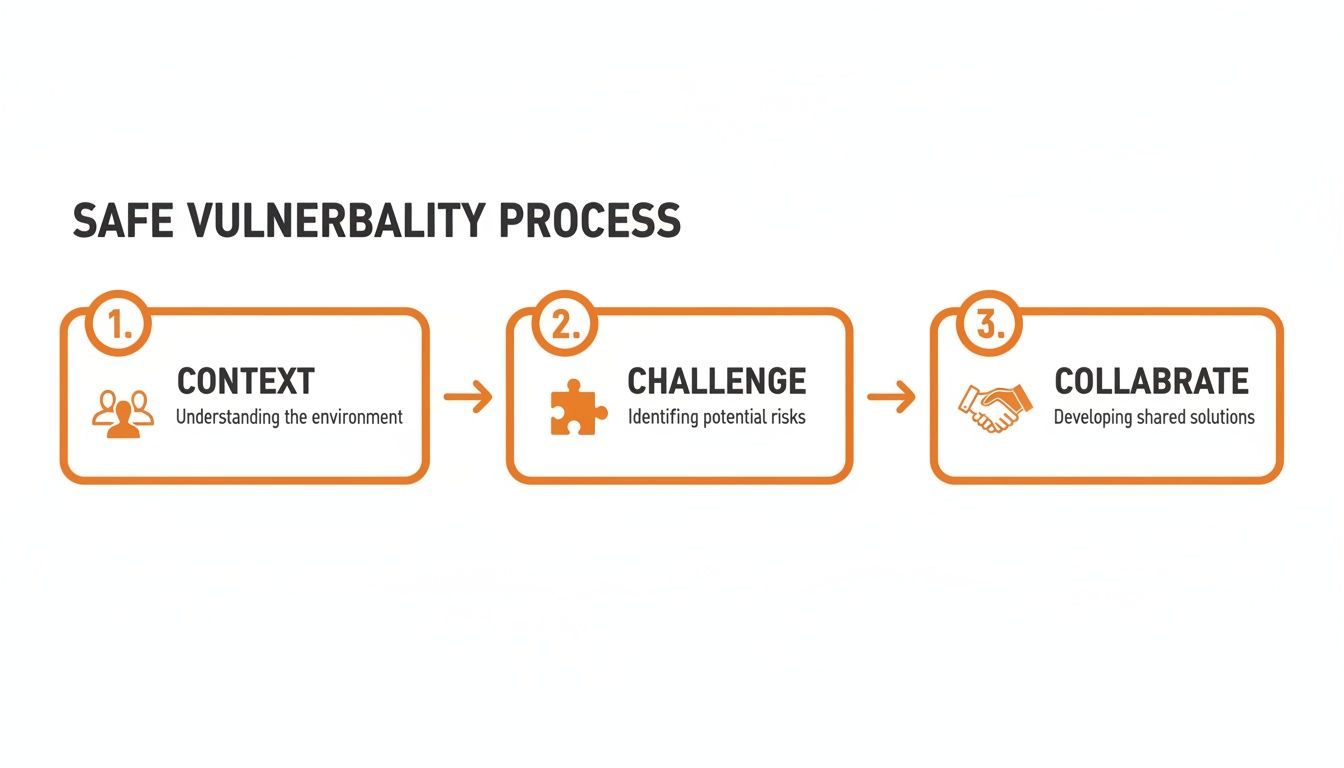
    To make sure your vulnerability is productive, it helps to have a simple framework. This three-step process keeps your sharing safe, focused, and effective.

    A three-step safe vulnerability process diagram with Context, Challenge, and Collaborate stages.

    This flow—giving context, defining the challenge, and asking for collaboration—keeps you on the right side of the line.

    Setting Boundaries to Avoid TMI

    The final pitfall is a total lack of boundaries, which quickly leads to "Too Much Information" (TMI). Being a vulnerable leader doesn't mean you share every dark thought or personal struggle. You're still the leader, and your team needs you to be a source of stability.

    Here’s how I think about setting healthy boundaries:

    • Keep it professional. It's okay for you to say, "I'm feeling the pressure of this tight deadline." It's not okay to detail a personal financial issue that’s stressing you out.
    • Share your thought process, not just your fear. Instead of "I'm terrified this whole project will fail," you could try "I'm weighing two different paths forward here. Can I walk you through my thinking and get your input?"
    • Check your motive. I ask myself: "Am I sharing this to solve a problem and build trust, or am I looking for therapy from my team?" If it's the latter, that's a conversation for a co-founder, a mentor, or a peer group—not your direct reports.

    To help you stay on track, here’s a quick guide to recognizing these traps and getting back to a healthier approach.

    Vulnerability Pitfalls and Solutions

    The Pitfall Why It Fails The Solution
    Vulnerability Theater It feels manipulative and inauthentic because it is. Your team sees it as a performance, destroying trust. Share to connect, not to gain. Check your motive. Are you being open to build a stronger team, or are you trying to get a specific reaction? Be honest with yourself.
    Emotional Dumping You make your personal anxiety the team's burden. It creates fear and instability instead of inspiring action. Frame it as a shared challenge. Focus on the professional problem, not your personal feelings about it. Share the problem, not the panic.
    TMI / No Boundaries Oversharing personal details erodes your authority and makes people uncomfortable. It blurs the line between leader and friend. Keep it relevant and professional. Ask yourself, "Does my team need to know this to do their job better?" If not, it's probably best you keep it to your inner circle.

    Steering clear of these common mistakes is what separates effective, respected leaders from those who just create confusion. When you get it right, vulnerability stops being a risk and becomes one of your greatest strengths.

    How to Nurture a Culture of Vulnerability

    Showing vulnerability yourself is a huge first step. But the real magic happens when it stops being just your thing and starts becoming part of your company's DNA. This is how you go from being a vulnerable leader to building a vulnerable culture—an environment where everyone feels safe enough to be real. The goal is to make honesty a reflex, not a calculated risk.

    It all comes down to weaving vulnerability into your team's daily routines and rituals. Think of it like going to the gym. You don’t get strong by doing one massive workout and then taking a month off. You build muscle with consistent, daily effort. The same exact principle applies here. Small, repeated acts of vulnerability are what build a culture of real trust over time.

    Weave Vulnerability into Your Daily Operations

    You can start making this shift today with a few simple, concrete tactics. These aren't huge, earth-shattering changes. They're small tweaks to how you and your team interact, designed to make honesty the path of least resistance.

    A simple place I like to start is meetings. Instead of jumping straight into the agenda, kick things off with a simple check-in. One of my favorites is the "yellow light" check-in. Just ask everyone, "What's one thing that’s giving you some caution or slowing you down this week?" It immediately gives people permission to share a struggle, not just a success story.

    Here are a few other ways for you to embed this behavior:

    • Celebrate Intelligent Failures: When a smart experiment doesn't pan out, don't just bury it. Hold a project "post-mortem" and publicly praise the team for taking a good risk. You can frame the failure as a tuition payment for a lesson you couldn't have learned any other way.
    • Model It Consistently: Your team is always watching you. When you mess up, own it. Do it publicly, without excuses. When you don’t have the answer, just say so and ask for help. Your actions will always, always speak louder than your words.
    • Reward Honest Feedback: When someone gives you tough feedback or points out a flaw in a plan, thank them for it. Make it obvious that you reward candor, not punish it. This reinforces the idea that telling the truth is an act of loyalty, not a career risk.

    Create Rituals of Trust

    Beyond the daily tactics, you need to create actual rituals that reinforce these values. These are structured times and places for the kind of open conversations that build deep, lasting trust. For founders, these spaces are life-or-death, because the journey is incredibly lonely.

    Vulnerability isn't a one-time announcement. It's a thousand small moments where you choose honesty over image.

    This is exactly why peer groups are so powerful. They create a dedicated space where you can be brutally honest without worrying about judgment. Having a support system of other entrepreneurs who just get it is critical. You can see how these work in my guide on mastermind groups for entrepreneurs.

    By consistently modeling these behaviors and creating rituals that support them, you turn vulnerability from a personal trait into a core organizational strength. This is how you build a resilient, innovative team that truly trusts you and, more importantly, each other.

    Your Questions About Vulnerability Answered

    I get a lot of questions from founders trying to put this into practice. It’s one thing to read about vulnerable leadership on a blog; it’s another thing entirely to live it day-to-day.

    Here are my straight-up, no-fluff answers to the questions that come up most often.

    Is There a 'Right' Time to Be Vulnerable?

    Yes and no. Vulnerability isn’t something you can just pencil into your calendar. It’s really about how you show up in the moment—when a launch doesn't go as planned, when you genuinely don't have the answer, or when you have to raise your hand and ask for help.

    That said, context is everything. Sharing a nagging worry about a strategic pivot with your leadership team so you can all brainstorm is a perfect use of vulnerability. But unloading that exact same fear on a brand-new hire? That’s more likely to create anxiety than collaboration.

    It’s about matching the right problem to the right audience.

    How Do I Know if I'm Being Vulnerable vs. Just Complaining?

    This is a huge one, and the line can feel blurry. It's a critical distinction for you to make. Complaining is a dead end; it just circles the problem and your own frustration. Vulnerability, on the other hand, is about finding a path forward.

    Here’s a simple gut check I use: ask yourself, "Am I sharing this to invite people in, or just to vent?" If your statement naturally leads to a question like, "What do you all think?" or "How can we tackle this?", you're on the right track.

    If it’s just a declaration of how bad things are, you’re probably just complaining.

    Vulnerability is about moving forward together, even when the path is uncertain. Complaining is about staying stuck.

    What if My Team Reacts Badly or Sees Me as Weak?

    This is the big one. It's the fear that stops most leaders, and it’s a totally valid concern. If you’ve spent years building a culture of "performative perfection," you can't expect things to change overnight.

    The key is for you to start small. Don't jump straight to baring your soul. Begin with low-stakes admissions, like saying, "Honestly, I'm not sure what the best approach is here. I'd love to hear what you all think."

    When you do this, you aren't just showing weakness; you're showing you trust their intelligence. Over time, your team will learn that your honesty isn't a liability—it's an invitation for them to step up and own their expertise. They won't see you as weak; they'll see you as a leader who respects them enough to be real.

    Your consistency is what builds that trust.


    Navigating the founder's journey is tough, but you don't have to do it alone. At Chicago Brandstarters, we connect kind, hard-working builders in a free community built on real support, not performative networking. If you're ready to share war stories and grow with peers who get it, join us.

  • Cash Flow Management for Small Business: A Founder’s Guide

    Cash Flow Management for Small Business: A Founder’s Guide

    Here's a hard truth I learned early on: profit on paper means nothing if you can't pay your bills. That's the core of cash flow management. It isn’t some accounting puzzle; it’s about making sure you always have enough actual cash on hand to cover payroll, rent, inventory, and all those other costs that pop up.

    For you, the small business owner, cash flow is oxygen. Without it, your business suffocates.

    Why Cash Flow Feels Like Oxygen

    When I built my first app, I was obsessed with my profit and loss statement. The numbers looked great! But my bank account told a completely different, and much scarier, story. I was making "profit" but had no money to pay my developers.

    That’s when it clicked. Profit is like owning a beautiful, high-performance race car. Cash flow is the fuel. Without gas in the tank, that shiny car is just a very expensive lawn ornament. It’s not going anywhere.

    It’s a shockingly common mistake. You get so focused on revenue and profit margins that you forget about liquidity—the cash available right now. A recent study from OnDeck found that a staggering 82% of small business failures trace back to poor cash flow management. It’s the silent killer.

    And things are only getting tougher. With inflation squeezing margins, 30% of owners now say it’s their top challenge. In the US, 51% of companies are battling uneven cash flow, making it their third-biggest operational headache.

    Profit vs Cash Flow: The Core Differences

    It’s easy to confuse these two, but they tell very different stories about your business's health. Think of this table as your cheat sheet for understanding the distinction.

    Concept Profit Cash Flow
    Measurement Earnings minus expenses (on paper) Actual cash moving in and out of your bank accounts
    Timing A snapshot, usually quarterly or annually A real-time pulse of your business, tracked daily or weekly
    Impact Shows your business's potential long-term value Determines your immediate survival and operational breathing room

    Getting this right helps you spot the blind spots in your financial story before they become full-blown crises. Profitability is the goal, but positive cash flow is what gets you there.

    Why You Need to Monitor Your Cash Flow Religiously

    Constantly keeping an eye on your cash isn’t about being a pessimist; it’s about being a realist.

    Here’s what it does for you:

    • Eliminates nasty surprises. You’ll know exactly when you can afford that new hire or that big marketing push.
    • Informs your strategy. It tells you when to invest aggressively in growth and, just as importantly, when to pull back and conserve cash.
    • Plugs leaks before you sink. You can spot where money is quietly draining out of your business before it becomes a major problem.

    You don't need complicated software to get started. A simple log of what's coming in and what's going out is enough. I want you to start checking your cash balance daily, or at least a few times a week. This simple habit alone can be a game-changer. If you’re just starting out, my guide on starting a business with no capital shows how this kind of basic tracking builds incredible momentum from day one.

    Cash flow isn’t some optional metric for your accountant to worry about. It’s the absolute life support system for your business.

    I’m not here to bore you with theory. My goal is to give you a practical, no-fluff playbook for keeping the lights on, meeting payroll, and sleeping soundly at night. In the next sections, I'll walk you through exactly how to diagnose your cash situation, build a simple forecast, and pull the right levers to keep your business healthy and growing.

    How to Build Your First Cash Flow Forecast

    Forecasting your cash flow isn't some dark art only for CFOs. Honestly, it's more like a weather report for your money. It tells you when to expect sunshine and when you might need to grab an umbrella, giving you precious time to prepare. You don't need fancy software—a simple spreadsheet is your best friend here.

    I’m going to walk you through building a 13-week cash flow forecast. Why 13 weeks? Because it gives you a full quarter’s view, which I've found is the perfect sweet spot between long-term vision and short-term, actionable steps. This is the exact tool I use with founders to get them out of their gut and into making decisions with real confidence.

    Mapping Your Cash Inflows

    First up, let's get a handle on all the cash you actually expect to come into the business. This is way more than just looking at your total sales numbers. You have to get granular about when that money will physically hit your bank account.

    Your cash inflows will probably include a few things:

    • Sales Revenue: Project your sales on a weekly basis. And be real about it. Dig into your past data, consider seasonal trends, and factor in any promos you're running. If you're an e-commerce brand, what are your average weekly sales, really?
    • Invoice Payments: When are clients actually paying you? If your terms are Net 30, don't fool yourself into forecasting that cash for the day you send the invoice. I always tell founders to add a week or two to the official due date to account for the inevitable late payers. It’s just reality.
    • Other Income: Got a loan coming through? Expecting a tax refund or an investor check? Slot that into the specific week you know it's landing.

    This exercise is what turns an abstract idea like "profit" into tangible, spendable cash.

    A forecast is just your best-educated guess. It will never be perfect, but an imperfect plan is infinitely better than flying blind. It gives you a baseline to measure against reality.

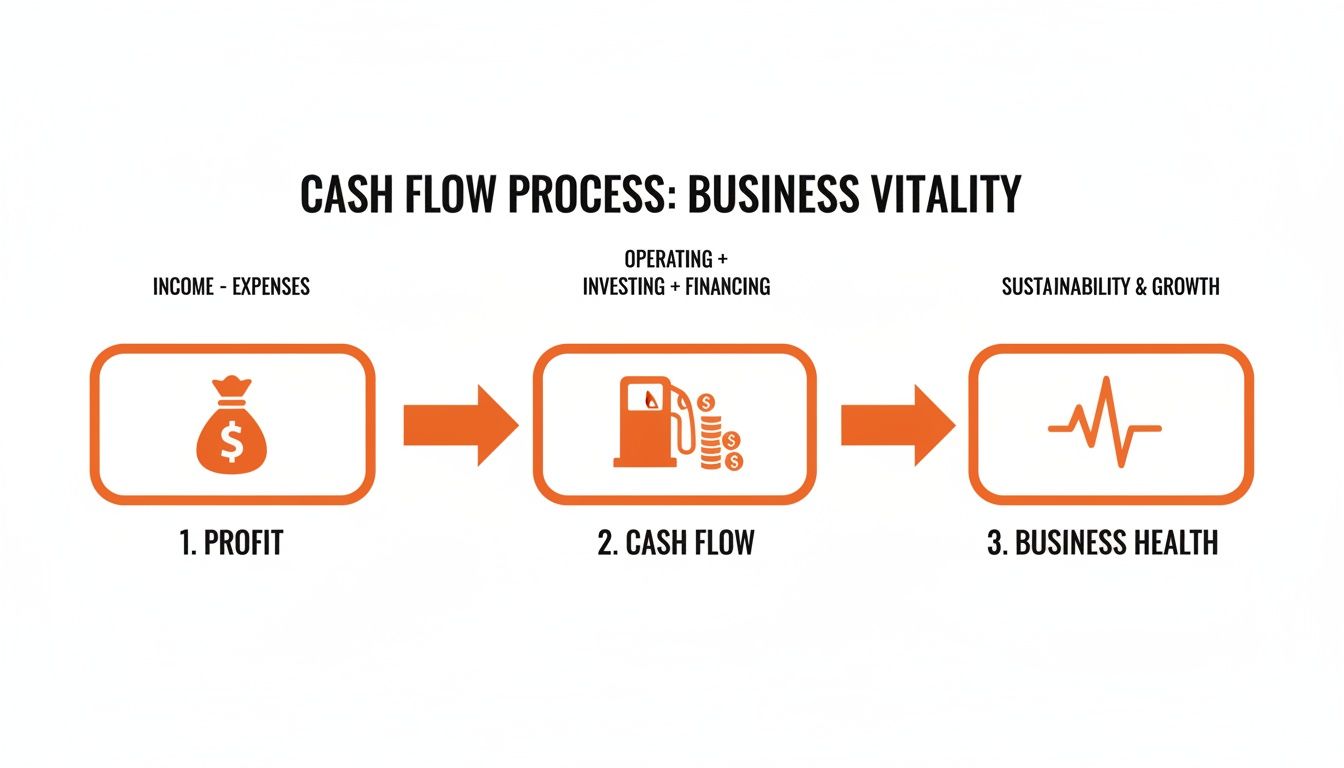
    The whole point is to map the journey from a sale (which is profit on paper) to actual funds in your bank (which is cash flow). That's what really determines if your business is healthy enough to survive and grow.

    Diagram illustrating the cash flow process for business vitality, from profit to health and growth.

    This diagram nails it: profit is just the starting line. It's the cash flow that actually fuels the health and vitality of your business.

    Projecting Your Cash Outflows

    Now for the other side of the coin—the money going out the door. This part is usually a bit easier to pin down since so many of your costs are fixed or recurring. But you have to be brutally honest with yourself here. Underestimating your expenses is a fast track to serious trouble.

    List out every single thing you have to pay for, week by week:

    • Fixed Costs: These are your regulars, the predictable bills like rent, payroll, software subscriptions, and any loan payments.
    • Variable Costs: These move up and down with your sales. For an e-commerce brand, think cost of goods sold (COGS), shipping fees, and what you're spending on ads.
    • One-Time Expenses: Are you buying a new laptop, placing a huge inventory order, or paying that big annual insurance premium? Pinpoint the exact week that cash is scheduled to leave your account.

    Putting It All Together

    Okay, once you have your inflows and outflows listed out, this is where the magic happens. For each of the next 13 weeks, you’ll calculate your net cash flow (Total Inflows – Total Outflows) and, most importantly, your ending cash balance.

    The math is simple:

    Ending Cash = Starting Cash + Net Cash Flow for the Week

    Your ending cash for Week 1 becomes the starting cash for Week 2, and so on. This rolling calculation creates a powerful snapshot of your financial future. You'll immediately spot the weeks where your bank balance might dip dangerously low, giving you a chance to do something about it before it's a five-alarm fire.

    Think about it. Imagine you’re planning a big product launch. You can use this forecast to see if you can actually afford a $50,000 inventory purchase in Week 4 and still make payroll in Week 6, all based on your sales projections. That's the kind of clarity that turns chaos into control.

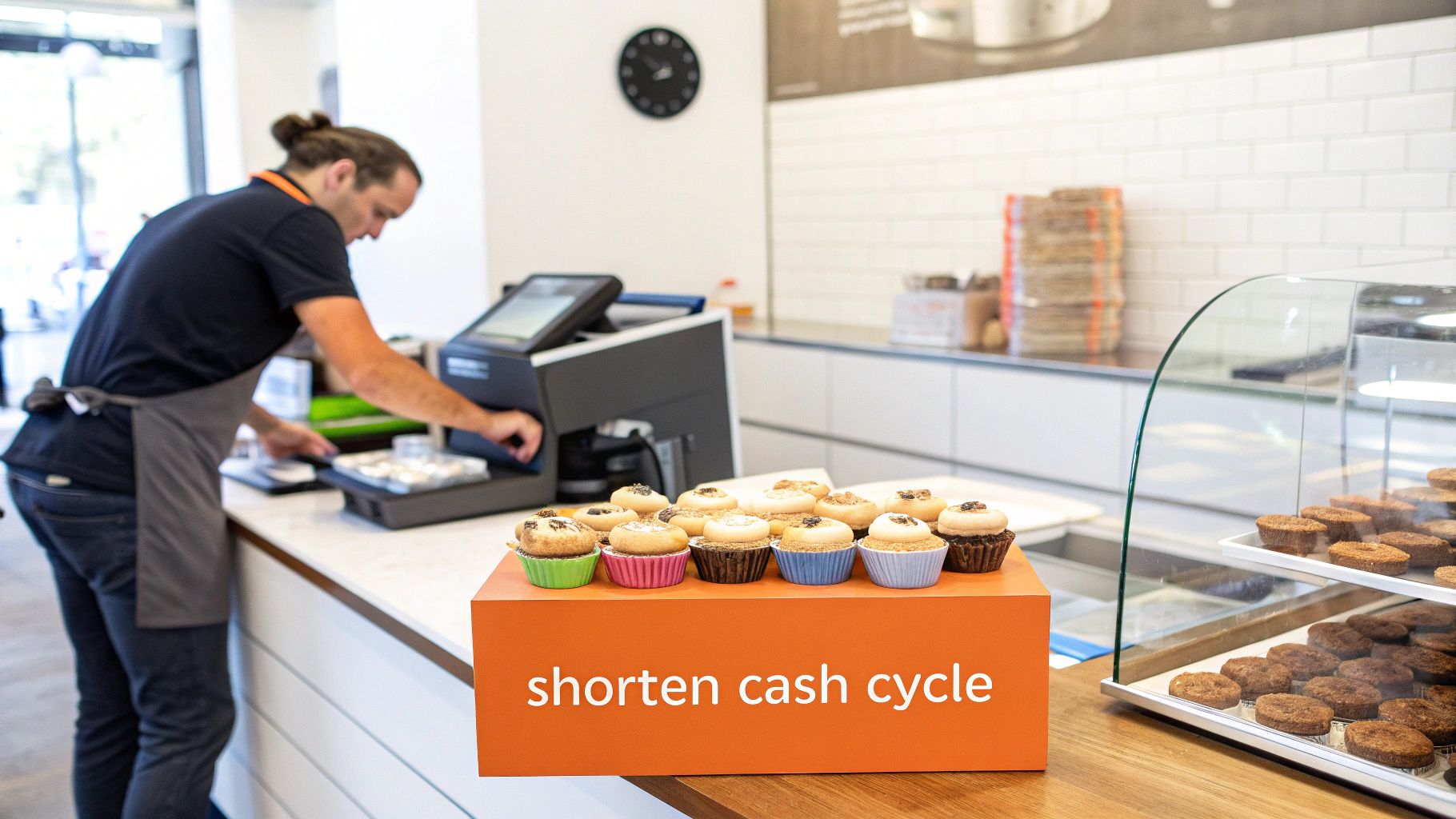
    Shorten Your Cash Conversion Cycle

    A cafe employee works at a POS system while various baked goods are displayed on the counter, with a sign reading 'shorten cash cycle'.

    Alright, let's get tactical. Once you've built your forecast, the real work begins. Your next move is to actively shrink the time it takes to turn your investments back into real, spendable cash.

    This is your Cash Conversion Cycle (CCC), and it’s one of the most powerful levers you can pull in your entire business.

    Think of it this way: if you're a baker, your CCC is the time between paying for flour and a customer's payment for a cupcake actually hitting your bank account. A long cycle means your cash is trapped—in ingredients, in finished goods, or in unpaid invoices. A short cycle means you get paid faster, freeing up your capital to reinvest and grow.

    The formula might look a little intimidating, but the idea is simple. You just have to manage three core parts:

    • Days Inventory Outstanding (DIO): How long your products sit on the shelf before you sell them.
    • Days Sales Outstanding (DSO): How long it takes your customers to pay you after a sale.
    • Days Payable Outstanding (DPO): How long you take to pay your own suppliers.

    Your goal is to crush your DIO and DSO, making them as short as possible, while stretching out your DPO as long as you can (without, you know, ruining your supplier relationships). Let me break down how to attack each one.

    Reduce Your Days Sales Outstanding (DSO)

    This is all about getting paid faster. Every day an invoice sits unpaid is another day someone else is using your money to run their business. A high DSO is an absolute cash flow killer.

    I once worked with a branding agency whose DSO was a terrifying 90 days. They were profitable on paper but constantly on the brink of collapse. I helped them cut that number in half in just a few months with some simple, non-confrontational tactics.

    Here’s what you can do right now:

    • Invoice immediately and clearly. Don't wait until the end of the month. Send the invoice the moment the work is done with crystal-clear payment instructions and due dates.
    • Offer more ways to pay. Make it ridiculously easy for people to give you money. For Chicago's bold yet kind builders, practical wins include offering payment variety to speed up inflows. Data shows 70% of businesses accept credit cards, and 62% use PayPal. You build a resilient business by making these small operational tweaks. You can find more small business cash flow insights in a report from Xero.
    • Automate your follow-ups. Set up friendly, automated email reminders for invoices that are approaching their due date or are just past due. This removes the emotion and awkwardness from collections.
    • Consider early payment discounts. Offering a small carrot, like 2% off if paid in 10 days instead of 30, can be a powerful nudge.

    Optimize Your Days Inventory Outstanding (DIO)

    If you sell a physical product, this is huge. Inventory is just cash sitting on a shelf, not working for you. Your mission is to move it as efficiently as possible.

    I know a local t-shirt brand that struggled because they ordered massive batches of every design to get a lower per-unit cost. The problem? Some designs flopped, and that cash was trapped in boxes of unsold shirts for over a year.

    Your inventory isn’t an asset until it sells. Before that, it’s a liability that’s actively draining your cash resources.

    To shrink your DIO, you need smarter inventory management.

    • Get better at forecasting. Use your past sales data to make better predictions about what will sell and when. Don't just guess.
    • Try a Just-In-Time (JIT) approach. Where it makes sense, order inventory closer to when you actually need it. This reduces the time it sits in your warehouse burning a hole in your pocket.
    • Liquidate slow-moving stock. Run a sale or a promotion on items that have been gathering dust. It's better to get some cash back now than no cash back ever.

    Improving how you manage products on the shelf is a core part of effective cash flow management. If you want to dive deeper, my guide on the inventory turnover formula is a great place to start.

    Extend Your Days Payable Outstanding (DPO)

    Finally, let's talk about the money you owe. This is the one part of the cycle you actually want to make longer. By strategically timing your payments to suppliers, you keep cash in your own bank account for a longer period.

    This isn't about being a deadbeat or hurting your relationships. It's about using the payment terms you've already negotiated to your advantage. If a supplier gives you Net 30 terms, don't pay the bill on day one. Pay it on day 28 or 29. That extra month of holding onto your cash can make a huge difference.

    • Negotiate better terms. Once you've proven you're a reliable customer, don't be afraid to ask your key suppliers for longer payment windows, like Net 45 or even Net 60. The worst they can say is no.
    • Schedule your payments. Use your accounting software or even just a calendar to schedule payments to go out right before they are due, not weeks ahead.
    • Use credit cards strategically. Paying a supplier with a credit card can instantly give you an extra 30 days before the cash actually leaves your bank account. Just be sure you pay the balance in full to avoid nasty interest charges.

    Proven Tactics to Get Cash in the Door Faster

    Getting paid is always priority number one. But just sending an invoice and hoping for the best isn't a strategy—it's a recipe for sleepless nights. The real goal is for you to pull specific, actionable levers that get money into your bank account faster.

    Think of your accounts receivable like a garden hose with a bunch of kinks in it. The water (your cash) is trying to get through, but it’s stuck. Your job is to find those kinks and straighten them out so the cash can flow freely.

    Reimagine Your Invoicing and Collections

    The single biggest kink for most businesses is a passive collections process. You do amazing work, send an invoice, and then… you wait. This is a massive mistake. You need to actively guide your cash home.

    I worked with a founder who was constantly stressed, waiting on payments that were 60 or even 90 days past due. I helped him implement a few tiny changes that cut his average collection time by 40%. The secret? We made his invoices friendlier and his follow-up system consistent.

    Here’s what you can steal from that playbook:

    • Offer a Carrot: Incentivize early payments. A simple phrase like, "Pay within 10 days for a 2% discount" can work wonders. It reframes paying you early as a smart financial move for your client, not just a favor to you.
    • Automate Friendly Nudges: Set up simple, automated emails. One that goes out a week before the due date as a gentle reminder, and another the day it's due. This takes the personal awkwardness out of it and ensures no invoice falls through the cracks.
    • Change Your Language: I had my client ditch the sterile "Payment Due" subject line and try "Ready for Your Thoughts & Payment." It felt more collaborative and less like a demand, which, believe it or not, got a much faster response.

    Don't think of collections as nagging. Think of it as excellent customer service. You're making it easy for them to do business with you and keeping their account in good standing.

    Build Predictable Revenue Streams

    Another powerful way to fix your cash flow is to stop living project-to-project. You have to build systems that generate predictable, recurring revenue. This is all about smoothing out those terrifying peaks and valleys.

    For service businesses like mine, this means getting clients on retainers. Instead of a one-off project, you agree to a set scope of work for a fixed monthly fee. Suddenly, you have a reliable income baseline you can actually count on.

    For you ecommerce founders, the principle is the same, even if the execution is a little different. The question is: how do you turn one-time buyers into repeat customers?

    • Subscription Models: Can you offer your product as a monthly subscription? Think coffee, skincare, or even curated snack boxes.
    • Fix Your Checkout Flow: A shocking number of sales are abandoned right at the finish line. You need to simplify your checkout, offer multiple payment options (like PayPal or Apple Pay), and be totally transparent about shipping costs upfront. Every bit of friction you remove makes it easier for cash to find its way to you.

    Get Paid Before You Start the Work

    This might sound like a no-brainer, but I see so many founders skip this step. For any significant project, you absolutely must require a deposit before you lift a finger. This is non-negotiable.

    Requiring 30-50% upfront does two critical things. First, it immediately injects cash into your business, giving you capital to cover initial costs without draining your reserves. Second, it secures commitment. A client who has paid you a deposit is far more invested in seeing the project succeed.

    Finally, I want you to take a hard look at your pricing. Sometimes the fastest path to better cash flow isn't just collecting faster—it's collecting more. Are you charging what you're truly worth? Bumping your prices by just 10% can have a massive impact on your cash reserves, often with little to no pushback from clients who already see your value.

    Smart Strategies to Control Cash Outflow

    Hands writing in a financial planner with a calculator on an orange background, symbolizing control spending.

    Dialing in your spending is just as important as cranking up your sales. Every single dollar you don't spend is another dollar you can plow back into growth, marketing, or even your own pocket.

    Being disciplined with your cash doesn't mean you have to starve your business. It just means you need to be intentional about where every dollar goes.

    Think of it like packing for a long hike. You can't bring everything. You have to be ruthless about what's essential versus what's just dead weight. Let’s sort through your business’s backpack and make sure you’re only carrying what you need to get to the top.

    Conduct a Ruthless Expense Review

    First, you have to get an honest look at where your money is really going. Most founders I know have a decent grip on big-ticket items like rent and payroll. But it’s the small, recurring charges—the "death by a thousand cuts"—that quietly drain your bank account.

    I recommend you try a simple monthly ritual. Print out your bank and credit card statements and grab three different colored highlighters.

    • Green: Highlight everything that is absolutely essential to keep the lights on. This is your rent, core software, and payroll. No debates here.
    • Yellow: Highlight the "nice-to-haves." These are things that are helpful but not strictly necessary for survival. Think of that extra analytics tool or the premium coffee subscription for the office.
    • Red: Highlight anything that makes you ask, "What is this even for?" or "Are we still using this?" You’ll be shocked at what you find. I guarantee it.

    This simple, hands-on exercise forces you to confront every single outflow. It turns your expenses from an abstract number in QuickBooks into a concrete list of decisions you’ve made. That’s powerful.

    Adopt a Lean Operating Model

    Especially in the early days, your default answer to any new expense should be "no." A lean mindset is your best defense against burning cash on things you don't need yet. You can always add costs later when your revenue actually justifies it.

    Here are a few practical ways I’ve seen founders stay lean without slowing down:

    • Freelancers Over Full-Timers: Need a great designer, writer, or bookkeeper? A skilled freelancer can deliver amazing results without the crushing overhead of a full-time salary, benefits, and payroll taxes. It’s no surprise that 38% of small businesses fail because they run out of cash; high fixed payroll costs are often the killer.
    • Negotiate Everything: Never, ever accept the sticker price, especially from vendors. Whether it's your software provider or your packaging supplier, you should always ask, "Is there any flexibility on that price?" or "What do your payment terms look like?" The worst they can say is no.
    • Leverage Technology Wisely: Automation is your best friend. Use tools to handle social media posting, email marketing, and even basic customer service chats. Every hour you save is an hour you can spend on things that actually bring in cash.

    Your job as a founder isn't to eliminate all costs—it's to get the absolute maximum return on every single dollar you spend. Be a disciplined investor, not just a spender.

    Use Your Payables Strategically

    One of the most overlooked tools in your cash flow management toolbox is your accounts payable. This isn't about stiffing your vendors; it's about using the payment terms they give you to your advantage.

    If a supplier gives you Net 30 terms, don't pay the invoice on day one. Pay it on day 29. That extra 28 days of holding onto your cash can be the difference between making payroll and having a full-blown panic attack. Think of it as a free, short-term loan from your supplier.

    Business credit cards can also be a powerful tool, but you have to use them with extreme discipline. A card can extend your payment cycle by another 30 days, potentially giving you a 60-day buffer before cash actually leaves your account. But this is a tool for managing timing, not a lifeline to fund a failing business. You must pay that balance in full every single month, without exception.

    This approach keeps your cash working for you longer. As your cash flow improves, you can start to think more about how to pay yourself from your business more consistently.

    Alright, let's get down to business. All the theory in the world is useless if you don't actually do something with it. This is where you stop talking and start building. I’m giving you a straightforward 30-60-90 day plan to get a handle on your cash flow once and for all.

    Think of this as your personal playbook. It's designed to take you from chaos to control, step by step.

    The First 30 Days: Diagnosis Mode

    Your first month is all about getting brutally honest with yourself and gaining clarity. You can't fix what you can't see, so your only goal here is to understand your financial pulse. No judgment.

    • Pick your weapon. Before you do anything else, commit to a tracking system. Seriously, a simple spreadsheet is more than enough to get you started. Just list every dollar that comes in and every dollar that goes out.
    • Calculate your runway. Look at your current bank balance and your average monthly burn. If your revenue dropped to zero tomorrow, how long could you keep the lights on? This number might be scary, but you need to know it.
    • Track your CCC. Go ahead and calculate your Cash Conversion Cycle for the first time. The number might be ugly. That’s okay. You now have a baseline—a starting line for the race ahead.

    Days 31-60: Time to Optimize

    Now that you have your baseline, it's time to make a few smart moves. You’re not trying to boil the ocean here. Your goal is to find a couple of small, high-impact wins to build some momentum.

    Don't overcomplicate it. Just choose one tactic to improve your cash inflows and one to tighten up your cash outflows.

    • Build your forecast. This is the moment to create that 13-week cash flow forecast we talked about. Think of it as your financial weather report for the next quarter.
    • Pull one "inflow" lever. As an example, start offering a 2% discount for customers who pay their invoices within 10 days. It's a simple, classic move for a reason.
    • Pull one "outflow" lever. Pick one of your suppliers and just ask to extend your payment terms from Net 30 to Net 45. The worst they can say is no.

    The goal here isn't perfection; it's progress. Small, consistent actions create massive change over time. Just focus on making one smart decision for your inflows and one for your outflows. That's it.

    Days 61-90: Make It a System

    By now, you should have much better visibility into your cash and a couple of small wins under your belt. This final month is all about turning these new actions into habits that stick. This is how you build a resilient business that can actually weather a storm.

    • Schedule your weekly cash check-in. Block out 30 minutes on your calendar every single Friday. Use this time to update your forecast and review your cash position. You must treat this meeting with yourself as non-negotiable.
    • Set real financial goals. Based on what your forecast is telling you, set a clear, tangible goal. Maybe it's increasing your cash runway from two months to three. Or maybe it's slashing your DSO by 15 days.
    • Define your red flags. Decide now what a "cash emergency" looks like for your business. A common one is having less than 30 days of operating expenses in the bank. Figure out ahead of time what you'll do if you hit that number—will you draw on your line of credit? Cut specific costs immediately? You need to make the decision before the pressure is on.

    Founder FAQs on Cash Flow Management

    I get a ton of questions from founders trying to finally get a handle on their finances. It’s a common pain point, and it usually boils down to a few key worries. Here are the most common ones I hear, along with my straight-up, no-fluff answers.

    What Is the Best Software When I’m Just Starting?

    Honestly, don't overcomplicate this. A well-organized Google Sheet or a simple Excel spreadsheet is all you need at first.

    I've seen founders waste weeks and thousands of dollars on complex software they didn't need yet. Your real goal in the beginning is to build the habit of tracking, not to become an expert in a new tool.

    Once your revenue gets more consistent and you have more moving parts, then you can graduate to something like QuickBooks or Xero. For an early-stage founder like you, simple is powerful.

    How Much Cash Should My Business Keep on Hand?

    A solid rule of thumb is for you to have enough cash in the bank to cover at least three to six months of your essential operating expenses. Think of this as your business's emergency fund.

    This is the cash you’d need for rent, payroll, and critical software subscriptions if your sales suddenly dropped to zero. This buffer gives you the breathing room to handle a slow month or an unexpected cost without panicking. If your revenue is still unpredictable, as it is for most startups, aiming for that six-month cushion is always the safer, smarter bet.

    Your cash reserve isn't idle money; it's a strategic asset. It buys you time to make smart decisions instead of desperate ones.

    My Cash Flow Is Always Negative. What’s the First Thing to Fix?

    If you're constantly in the red, it points to a fundamental problem with your business model. The very first place you need to look is your gross margin. That's just your revenue minus the direct costs of what you sold. Are you charging enough to actually make money on each sale?

    If your margins aren't healthy, you really only have two choices: raise your prices or find a way to lower your costs, period.

    But what if your margins look good on paper and your bank account is still empty? Then your issue is likely your payment cycles. Are clients taking way too long to pay you? Fixing your collections process is often the quickest win for your cash flow.


    At Chicago Brandstarters, I believe that kind, hardworking founders deserve to win. If you're building a brand in Chicago and want to surround yourself with a vetted community of peers who share honest war stories and real tactics, I’m here for you. Learn more and apply to join our free community at https://www.chicagobrandstarters.com.

  • 12 Fresh Ideas for Product Innovation That Actually Work in 2026

    12 Fresh Ideas for Product Innovation That Actually Work in 2026

    Let's be real. Coming up with groundbreaking ideas for product innovation can feel like trying to catch smoke. I see whispers of something great, but the concept disappears the moment I try to grab it. It's often a lonely, frustrating process. I've been there myself, staring at a blank whiteboard, feeling like every good idea has already been taken.

    But true innovation isn't about waiting for a magical lightning strike. It's a muscle you build, a skill you practice. Think of it like learning to play the guitar; at first, it’s just noise and sore fingers, but once you learn the right scales and chords, you start making music. The right frameworks are your chords.

    This list is my playbook for you. I'm not here to give you vague advice like "think outside the box." Instead, I'm handing you 12 specific, actionable ideas for product innovation that you can apply directly to your venture. These are the concrete concepts that help you find real customer pain points, experiment with new business models, and validate your next big move without betting the farm.

    Each item includes a tangible example, a quick validation tactic you can use this week, and a clear next step to get you moving. We'll explore everything from building community-driven validation platforms to launching a regional supply chain bootcamp. My goal is to get you unstuck and back to doing what you do best: building something amazing. Let’s get started.

    1. Community-Driven Product Validation Platform

    Before you sink thousands of dollars and countless hours into development, imagine getting targeted, honest feedback from people who genuinely want you to succeed. That's the core of a community-driven product validation platform. This is one of the most powerful ideas for product innovation because it uses collective intelligence to de-risk your venture from day one. Instead of guessing what users want, you build a curated group of peers, potential customers, and industry experts to pressure-test your concepts in a structured, private environment.

    Diverse colleagues collaborate on a laptop in a modern office with 'VALIDATE IDEAS' sign.

    This approach creates a powerful feedback loop. You submit your idea, and the community provides insights based on clear guidelines, preventing the vague "that's cool" feedback that doesn't help you build. Platforms like Indie Hackers and early-stage Product Hunt communities pioneered this model, proving that collaborative validation leads to stronger products.

    How to Implement This Idea

    To build your own validation engine, you don't need complex software. You can start with a private Slack or Discord channel.

    • Establish Clear Rules: Create confidentiality agreements and a code of conduct. You want honest, kind feedback, not brutal takedowns.
    • Structure the Feedback: Develop a simple rubric or a set of questions for reviewers. Ask them to rate the problem's severity, the solution's clarity, and their willingness to pay.
    • Create a Cadence: Institute "Feedback Fridays" or monthly "Validation Cycles" to keep the momentum going and ensure everyone gets a turn.

    This method is perfect for you if you're an early-stage founder seeking to confirm market demand before committing significant resources. To dive deeper into the nuts and bolts of this process, you can explore detailed guides on how to validate a business idea.

    2. Founder Accountability Partnership Matching

    Imagine having a dedicated co-pilot on your entrepreneurial journey, someone who isn't on your payroll but is equally invested in your success. That’s the power of a founder accountability partnership. This isn't just another networking group; it's a structured system that matches you with a peer based on complementary skills, business stage, and core values. This is one of the most effective ideas for product innovation because it creates a focused, one-on-one environment for radical honesty and shared growth. Instead of navigating challenges alone, you commit to weekly check-ins, report progress on key milestones, and receive candid feedback from someone who truly gets it.

    This model is a force multiplier for motivation and execution. When you know you have to report your progress to a trusted peer, you are far more likely to follow through on difficult tasks. This concept has been proven effective in high-stakes environments like Vistage CEO groups and accelerator cohorts, where peer accountability is a cornerstone of success. You’re not just sharing wins; you’re dissecting failures and brainstorming solutions in a safe, confidential space.

    How to Implement This Idea

    You don't need a complex platform to start. You can build a powerful accountability system with intentionality and simple tools.

    • Create a Matching Survey: Before pairing people, use a detailed survey to understand their work styles, top three goals for the quarter, communication preferences, and biggest challenges.
    • Provide a Structure: Give partners a template for their weekly check-ins. This should include sections for last week's wins, current roadblocks, and commitments for the upcoming week.
    • Establish an "Easy Out": Not every match is perfect. Create a graceful, no-questions-asked process for partners to reset and find a new match after a trial period, preventing awkwardness and ensuring everyone gets value.

    This approach is perfect for you if you're a solo founder or leading a small team and need an external source of motivation and unbiased feedback to stay on track.

    3. Midwest Founder Playbook Library

    Imagine having access to a private video library where successful founders pull back the curtain on exactly how they solved their toughest problems. That’s the concept behind a Midwest Founder Playbook Library. This is one of the most practical ideas for product innovation because it focuses on community-sourced wisdom over generic advice. Instead of you sifting through abstract theories, this repository offers searchable, real-world case studies from peers who have already navigated the challenges you're facing, from securing manufacturing to launching a marketing campaign.

    Laptop on a wooden desk displaying an image gallery, alongside a stack of books and a vibrant green plant.

    This idea democratizes the kind of insider knowledge typically reserved for elite accelerator programs. Think of Y Combinator's Startup School video archives or First Round Review's deep-dive articles, but tailored specifically to the regional challenges and opportunities you face. It’s an invaluable resource built by and for the community it serves.

    How to Implement This Idea

    You don't need a high-end production studio to start building your library. Focus on capturing authentic stories with clear audio and video.

    • Pilot the Process: Start with 3-5 founders willing to share a specific "war story." Guide them to detail the problem, their solution, and what they would do differently.
    • Structure the Content: Organize the videos into categories that match the founder journey, like "Pre-Launch," "First Revenue," and "Scaling." This makes the library easy to navigate.
    • Keep Production Lean: Your focus should be on high-quality content, not Hollywood-level cinematography. Good lighting and a clear microphone are your most important tools.

    This approach is perfect for you if you're a community builder or a founder who believes in the power of shared knowledge. It helps everyone in your ecosystem avoid reinventing the wheel and accelerate their growth based on proven, localized tactics from founders who have actually done it.

    4. Vetted Supplier and Service Provider Network

    Finding a reliable manufacturer, designer, or fulfillment partner can feel like searching for a needle in a haystack. A vetted supplier and service provider network eliminates the guesswork by creating a curated marketplace built on trust and shared experience. This is one of the most practical ideas for product innovation because it directly addresses a massive operational bottleneck for founders, allowing you to focus on building your product instead of endlessly vetting vendors. You get access to a pre-approved list of partners who have already delivered for people just like you.

    A person's hand reaches for an orange box, with a tablet displaying a business interface and 'TRUSTED SUPPLIERS' text.

    This model shifts the power back to you. Instead of relying on a vendor's sales pitch, you can see real testimonials and performance data from your peers. Major platforms like Shopify's partner network and Alibaba's verified supplier program demonstrate how effective this is at a large scale, but it's even more powerful within a tight-knit community. It builds a protective moat around members, ensuring quality and accountability.

    How to Implement This Idea

    You don't need a custom-built platform to get started. A simple, well-organized database or even a shared spreadsheet can be incredibly effective.

    • Establish Vetting Criteria: Require at least two positive experiences from existing community members before you list a new provider. Create clear standards for quality and communication.
    • Create Simple Feedback Loops: Develop a straightforward form for members to fill out after using a recommended supplier. This keeps your data fresh and relevant.
    • Start Small and Focused: Begin with just 2-3 critical categories like local manufacturing, fulfillment, and packaging design. You can expand as the network grows and proves its value.

    This approach is ideal if you are building a physical product and need to establish a reliable supply chain without the risk and cost of trial and error. To learn more about building these trusted relationships, consider exploring resources on effective supplier management strategies.

    5. Founder Financial Dashboard and Planning Tool

    Most founders aren't accountants, but financial literacy is non-negotiable for survival. Imagine a dashboard that cuts through the noise of complex spreadsheets and gives you just the vitals: cash runway, unit economics, and key growth metrics. This is one of the most practical ideas for product innovation because it directly addresses a major pain point for nearly every early-stage entrepreneur. Instead of wrestling with confusing software, you get a simplified, visual tool tailored to your specific business model, whether it's SaaS, ecommerce, or a physical product.

    This approach democratizes financial planning. It’s like giving a pilot a clean, simple cockpit display showing only altitude, speed, and fuel, rather than overwhelming them with every single engine metric. Companies like Wave and Stripe have built successful products by simplifying complex financial tasks, proving there is a huge market for user-friendly financial tools that empower founders to make smarter decisions, faster.

    How to Implement This Idea

    You don't need to build a full-fledged accounting suite. Start with a focused tool that solves the most immediate problems for founders.

    • Create Industry-Specific Templates: Design pre-configured dashboards for common business models. An ecommerce founder needs to see COGS and customer acquisition cost, while a SaaS founder focuses on MRR and churn.
    • Focus on Key Metrics: Prioritize clarity over complexity. Your dashboard should instantly answer three questions: How much cash do we have left? Are we profitable on each sale? And are we growing?
    • Build in Scenarios: Include simple calculators for common decisions, like modeling the impact of a price increase or a new hire on your cash runway.

    This tool is perfect if you want to help founders move from financial anxiety to confident, data-driven leadership. For a deeper understanding of a core metric, you can learn more about the calculation of gross margin percentage and see how it impacts profitability.

    6. Skill-Share Workshop Series

    Imagine tapping into the specialized knowledge of your most advanced community members to level up everyone's skills. That's the power of a skill-share workshop series. This is one of the most impactful ideas for product innovation because it transforms your user base from passive consumers into active contributors, creating an ecosystem of mutual growth. Instead of you creating all the content, you empower experts within your community to teach practical skills like design thinking, copywriting, or fundraising.

    This model builds deep, authentic connections and establishes your community as a hub for real-world expertise. It's not about self-promotion; it’s about a genuine desire to share what works. Accelerators like Techstars and educational platforms like General Assembly have proven that when experienced founders teach, the lessons are practical, relevant, and immediately applicable. This creates a powerful cycle of learning and contribution that strengthens your entire network.

    How to Implement This Idea

    You don't need a formal campus to start. You can launch a powerful workshop series with simple planning and a focus on quality over quantity.

    • Survey Your Members: Before scheduling anything, ask your community what they want to learn. Use a simple poll to identify the most in-demand topics, ensuring every session is relevant.
    • Recruit and Support Instructors: Identify members with proven expertise and a passion for teaching. Offer them a stipend, public recognition, or a "teaching mentor" to help them structure their content for maximum impact.
    • Start with a Quarterly Cadence: Plan for four high-quality workshops per year. This makes planning manageable and builds anticipation for each event. Record and professionally edit the sessions to create a valuable archive for all members.

    This approach is perfect for you if you lead a community-focused business and want to deliver immense value beyond your core product. It's a low-cost, high-impact way to foster loyalty and turn your members into evangelists.

    7. Pre-Seed/Seed Investor Introduction Program

    Getting your idea in front of the right investor can feel like searching for a needle in a haystack. An investor introduction program changes that by creating a curated, warm pathway to capital. This is one of the most impactful ideas for product innovation because it focuses on building genuine relationships rather than making cold pitches. Instead of scrambling for transactional pitch events, you join a structured program that connects founders who meet specific readiness criteria with angels, micro-VCs, and early-stage investors.

    This model prioritizes authentic connection over sheer volume. Think less "Shark Tank" and more of a series of well-matched conversations over coffee or dinner. Programs like Y Combinator's Demo Day and Techstars' investor access have proven that curated introductions lead to better founder-investor fits. In Chicago, organizations like the Polsky Center and 1871 also champion this relationship-first approach, recognizing that great companies are built on trust.

    How to Implement This Idea

    You don't need a massive network to start; you just need to be strategic. You can build a small, high-quality introduction engine to connect with capital partners.

    • Establish Readiness Criteria: Be clear about what makes a founder "ready." This could be hitting a minimum monthly revenue, achieving specific customer acquisition cost benchmarks, or having a validated prototype.
    • Start Small and Build Trust: Begin with 5-10 trusted investor relationships. Focus on delivering high-quality, well-vetted founders, and your network will grow organically.
    • Host Intimate Events: Organize relationship-building dinners or investor education sessions. These create a relaxed atmosphere where investors can offer value and meet founders authentically.
    • Offer Pre-Meeting Coaching: Provide founders with pitch coaching and feedback from experienced entrepreneurs before they meet investors. This ensures they put their best foot forward.

    This approach is ideal for you if you've achieved initial traction and are ready to seek pre-seed or seed funding but want to avoid the transactional nature of traditional fundraising.

    8. Brand Positioning and Storytelling Workshop Series

    Your product can be revolutionary, but if its story doesn't connect, it will get lost in the noise. A brand positioning and storytelling workshop series offers one of the most crucial ideas for product innovation by focusing not on the product itself, but on its narrative. This is about transforming your features and benefits into a compelling story that resonates deeply with your ideal customer, making them feel understood and connected to your mission. Instead of just selling a product, you're building a brand that people want to be a part of.

    This approach creates a powerful framework for all your marketing and sales efforts. You learn to articulate your unique value proposition with clarity and confidence. Models like the StoryBrand framework by Donald Miller or the value proposition canvas by Strategyzer have proven that a clear, customer-centric narrative dramatically increases engagement and conversion, making your brand memorable in a crowded market.

    How to Implement This Idea

    You can create this focused environment to sharpen your brand's message without hiring an expensive agency. The goal is collaborative, structured storytelling.

    • Partner with a Pro: Collaborate with a brand strategist or a seasoned copywriter to facilitate the workshops, providing expert guidance and structure.
    • Use Real-World Case Studies: Showcase tangible results by using real founder examples from your community. This makes the concepts less abstract and more achievable.
    • Develop Reusable Templates: Create simple, actionable templates for value propositions, brand messaging, and elevator pitches that founders can use independently after the sessions.
    • Focus on Authenticity: Emphasize weaving your authentic founder story and values into the brand narrative. This is what builds genuine trust and loyalty.

    This method is perfect for you if your product is ready but you struggle to communicate its value effectively. To see how powerful this can be, you can find inspiration from these detailed examples of effective brand positioning.

    9. Founder Mental Health and Resilience Program

    The relentless pressure of building a company often comes at a steep, unspoken cost: your mental health. A confidential, peer-led support program directly addresses this, treating founder resilience not as a luxury but as a critical business asset. This is one of the most vital ideas for product innovation because it focuses on the single most important component of any startup, you, the founder. Instead of a "grind at all costs" mentality, you create a safe, structured space for sharing struggles, managing stress, and preventing burnout.

    This approach builds a powerful support system. You’re not just getting advice; you’re connecting with others who understand the unique isolation and stress of the founder journey. Organizations like the Founder Institute and retreats like Lighthouse have pioneered this model, proving that prioritizing founder wellness leads to more sustainable and successful ventures. It acknowledges that a healthy founder is the foundation of a healthy company.

    How to Implement This Idea

    You can build the foundation of this program without a massive investment. The key is creating trust and psychological safety.

    • Establish Confidential Circles: Start with monthly, confidential peer support circles led by a trained facilitator. Enforce a strict "what's said here, stays here" rule.
    • Curate Professional Resources: Partner with a few therapists who specialize in the stressors faced by entrepreneurs. Offer subsidized access or a curated referral list.
    • Normalize the Conversation: Host events featuring founders who openly share their mental health journeys. This simple act reduces stigma and encourages others to seek help.

    This model is perfect for you if you recognize that your well-being is directly tied to your company's success. It’s for founders who want to build a resilient company by first building a resilient self.

    10. Regional Supply Chain and Manufacturing Bootcamp

    Navigating the world of physical products can feel like trying to solve a puzzle in the dark. A regional supply chain and manufacturing bootcamp is one of the most practical ideas for product innovation because it illuminates the path from prototype to production. This isn't a theoretical business class; it's an immersive, hands-on program led by founders who have successfully scaled their own manufacturing and supply chains, often with a focus on nearshoring and domestic sourcing.

    Instead of learning from abstract case studies, you get direct access to the people, processes, and even the factories that make it all happen. This model, championed by organizations like Made in Chicago and platforms such as Sourcify, demystifies the complex trade-offs between cost, speed, quality, and ethics, giving you the confidence to build a resilient production system.

    How to Implement This Idea

    You can create a powerful learning experience by connecting founders with real-world manufacturing expertise.

    • Partner with Experienced Founders: Recruit 2-3 product entrepreneurs who have navigated scaling. Their war stories and practical advice are more valuable than any textbook.
    • Organize Experiential Learning: Make factory tours the centerpiece of the program. Seeing the process firsthand provides an unparalleled understanding of production realities.
    • Provide Practical Tools: Create templates for vendor comparison, negotiation, and quality control checklists. Give attendees actionable tools they can use immediately.
    • Build a Pre-Vetted Network: Connect each founder with at least one trusted referral manufacturer, reducing the friction and risk of finding reliable partners.

    This bootcamp approach is ideal for you if you're an early-stage founder with a physical product and need to build a robust, ethical, and efficient supply chain from the ground up.

    11. Founder Exit and Transition Planning Service

    You pour your life into building a company, but what's the endgame? A confidential advisory service focused on founder exits is a powerful product idea because it addresses the often-neglected final chapter of the entrepreneurial journey. This isn't just about selling; it's about helping founders plan for acquisitions, CEO transitions, or even just stepping back from daily operations while ensuring their personal well-being is prioritized alongside financial outcomes.

    This service is one of the most human-centric ideas for product innovation, moving beyond balance sheets to tackle the emotional and identity shifts that come with letting go. You’re not just an M&A advisor; you're a strategic partner for the founder's next chapter. Resources like John Warrillow's "Built to Sell" and services from specialized exit advisors prove there's a deep need for guidance that respects the founder's journey from start to finish.

    How to Implement This Idea

    You can build this service by focusing on education first, then personalized advisory. Think of it as creating a roadmap for a founder's biggest professional transition.

    • Start with Education: Host workshops or webinars on different exit scenarios (acquisition, management buyout, passing it on). This builds trust before any one-on-one engagement.
    • Build a Partner Network: You can't be an expert in everything. Partner with vetted M&A lawyers and financial advisors to provide comprehensive support.
    • Focus on the Human Element: Create resources that address the emotional side of exiting. Use anonymized case studies to show different successful transition paths and what life looks like after the company.

    This approach is perfect for you if you have experience in finance, operations, or coaching and want to provide a holistic service that supports founders through one of their most critical and personal business decisions.

    12. Midwest Founder Podcast and Media Platform

    Instead of shouting into the void with ads, imagine building a dedicated audience that trusts your brand before they ever see your product. This is the power of creating a niche media platform, like a podcast or blog focused on a specific community. For founders, this is one of the most effective ideas for product innovation because it flips the traditional marketing model. You provide immense value first, build genuine connections, and establish yourself as a central hub for your target audience.

    This strategy involves creating content that features authentic stories, practical tactics, and the real challenges faced by a specific group, such as founders in the Midwest. By amplifying the voices of your community, you not only attract more like-minded individuals but also build a powerful asset that generates organic leads and deepens customer loyalty. Successful examples like the Shopify Masters Podcast and Indie Hackers prove that becoming the go-to resource for a niche audience is a sustainable way to grow.

    How to Implement This Idea

    Launching a media platform doesn't require a Hollywood budget. You can start small and scale as your audience grows.

    • Define Your Niche: Focus on a specific pain point or community. Instead of "business stories," narrow it down to "first-year challenges for Chicago e-commerce founders."
    • Start with a Sustainable Cadence: Commit to two episodes or articles per month. Consistency is more important than frequency, and this pace prevents burnout.
    • Invest in Quality Basics: Get a decent microphone and use simple editing software. Clear audio is non-negotiable for podcasts.
    • Promote Strategically: Share your content on channels where your audience already gathers, like LinkedIn groups, local Slack communities, or industry forums.

    This approach is perfect for you if you're a community-builder looking to establish long-term authority and create a durable marketing engine. You can learn more about building a brand that resonates by exploring resources on how to build a memorable brand.

    12 Product Innovation Ideas Comparison

    Program / Service Implementation Complexity 🔄 Resource Requirements ⚡ Expected Outcomes ⭐📊 Ideal Use Cases 💡 Key Advantages 📊
    Community-Driven Product Validation Platform Medium — platform + moderation and curation Moderate — product dev, community managers, active reviewers Rapid idea validation; reduced wasted dev spend; early advocates Early-stage founders testing concepts pre-build Structured peer feedback; iteration tracking; leverages existing community
    Founder Accountability Partnership Matching Low–Medium — matching algorithm and oversight Low–Moderate — surveys, dashboards, coordinator time Increased follow-through; reduced isolation; more consistent progress Founders needing peer accountability and weekly check-ins Deeper relationships than events; surfaces mentorship and skill-sharing
    Midwest Founder Playbook Library Medium — content capture, curation, quality control Moderate — video production, hosting, contributor time Preserved institutional knowledge; fewer repeated mistakes Founders seeking tactical, documented solutions by stage/problem Reusable searchable content; credibility building; practical templates
    Vetted Supplier and Service Provider Network Medium–High — vetting, relationship management, policies High — supplier outreach, legal, ongoing QA Faster supplier selection; lower vendor risk; potential discounts Product founders needing reliable manufacturers and partners Trusted referrals with member reviews; negotiation guidance; volume benefits
    Founder Financial Dashboard and Planning Tool Medium — tool build, integrations, benchmarking Moderate — product dev, CPA partnerships, templates Clearer runway and unit economics; better financial decisions Non-finance founders tracking cash, pricing, and growth scenarios Simplifies finance; regional benchmarks; accounting integrations
    Skill-Share Workshop Series Low–Medium — programming and instructor coordination Low–Moderate — volunteer instructors, event ops, recordings Faster skill development; practical takeaways; leader cultivation Founders wanting hands-on skills (design, copy, ops, hiring) Peer-led practical learning; repeatable frameworks; community visibility
    Pre-Seed/Seed Investor Introduction Program High — investor sourcing, curation, readiness gating High — investor relationships, coaching, event coordination Improved access to capital for vetted founders; stronger investor ties Fundraising-ready founders seeking Midwest angel/micro-VCs Curated relationship-building; reduced cold-pitch friction; investor education
    Brand Positioning and Storytelling Workshop Series Low–Medium — curriculum and facilitated sessions Moderate — skilled facilitators, templates, copy clinics Clearer brand narratives; improved conversion and messaging clarity Founders refining positioning before scaling marketing spend Differentiation-focused; practical copy and voice work; peer feedback
    Founder Mental Health and Resilience Program Medium — confidentiality protocols and trained facilitators Moderate — therapist partnerships, facilitator training, funding Improved resilience; reduced burnout; better decision-making Founders experiencing stress, isolation, or burnout risk Confidential peer support; subsidized therapy access; destigmatization
    Regional Supply Chain and Manufacturing Bootcamp High — technical curriculum, factory access, expert instructors High — instructor pay, facility tours, one-on-one consulting Fewer manufacturing errors; stronger vendor relationships; scaling readiness Physical product founders scaling production and QA Hands-on factory tours; Midwest nearshoring expertise; vendor templates
    Founder Exit and Transition Planning Service High — advisory network, confidentiality, personalized planning High — M&A/legal/accounting advisors, curated case studies Better-prepared exits; potentially higher deal value; smoother transitions Founders planning acquisition, sale, succession, or step-back Holistic exit strategy; advisor connections; emotional and financial planning
    Midwest Founder Podcast and Media Platform Medium — content production cadence and editing Moderate — recording, editing, promotion, guest coordination Increased brand awareness; member visibility; community growth Storytelling, recruiting members, and showcasing tactical wins Scalable content asset; thought leadership; amplifies member voices

    Your Next Move Is the Only One That Matters

    I've just walked you through a dozen distinct blueprints for innovation. You’ve seen how to build a community-driven validation platform, a founder accountability system, and even a program dedicated to mental resilience. The list is extensive, covering everything from nailing your brand story to navigating the complexities of regional manufacturing. It’s easy to look at a list like this and feel overwhelmed, like a chef staring at an entire pantry when you only need to make one dish.

    But here’s the secret: you don't need to master all these ideas for product innovation at once. True progress isn't about doing everything; it's about doing the right thing next. Think of it like learning a new instrument. You don’t try to play a complex symphony on day one. You start with a single chord. You practice it, fumble through it, and practice it again until the sound is clean and your fingers know where to go without thinking. Only then do you add the next chord.

    Distilling Action from Information

    Your task now is to identify your single most pressing challenge. Read back through the ideas I've explored and ask yourself one simple question: "Which of these solves the problem that's keeping me up at night?"

    • Feeling isolated and losing motivation? The Founder Accountability Partnership Matching idea is your first chord. Find that partner.
    • Struggling with unclear financials? The Founder Financial Dashboard and Planning Tool is your starting point. Build that simple spreadsheet.
    • Burning through cash on features nobody wants? The Community-Driven Product Validation Platform is your immediate priority. Set up that survey or private group.

    The goal isn't perfection; it’s momentum. Each small, focused action builds on the last, creating a powerful compounding effect that turns a simple idea into a thriving business. You are a builder, and your greatest asset is your ability to take one brick and lay it perfectly, then another, and then another.

    The Midwest Advantage: Building Together

    For those of you building in Chicago or the broader Midwest, remember that you are part of a unique and powerful ecosystem. The grit, honesty, and collaborative spirit here are your unfair advantages. You don't have to build in a vacuum, fending off the sharks and fighting for scraps. You can build among peers who genuinely want to see you succeed.

    "Innovation is rarely a solo act. The most transformative ideas for product innovation emerge when passionate builders share their struggles, insights, and victories."

    I've covered a wide spectrum of strategies, from tactical business model pivots to deeply personal programs for founder well-being. The underlying message is that holistic innovation matters. A brilliant product can still fail if you burn out or your supply chain collapses. By focusing on the entire system of your business, you're not just creating a product; you're building a resilient, sustainable engine for growth.

    Your journey is unique, but the path is well-worn by others who have faced the same dragons. The ultimate takeaway is this: pick one idea from this list. Just one. Commit to it. Make it your mission for the next week or the next month. Test it, learn from it, and let that small win propel you forward. That next move is the only one that matters, because it's the one that gets you closer to building something truly remarkable.


    If you’re a kind, ambitious founder in Chicago looking for a community that values collaboration over competition, we built Chicago Brandstarters for you. We connect builders in small, private mastermind groups to share real-world tactics and find the support needed to turn great ideas for product innovation into reality. Learn more and see if our community is the right fit for your journey at Chicago Brandstarters.
  • What Is Business Scaling: Proven Steps to Grow Without Chaos

    What Is Business Scaling: Proven Steps to Grow Without Chaos

    You've probably heard people toss around "growth" and "scaling" like they're the same thing. They're not. They're worlds apart.

    Business scaling isn’t just about getting bigger. It’s about getting smarter. I mean blowing up your revenue while your costs barely budge. This is the crucial shift from scrambling to add more people and more resources for every new sale, to building a machine that handles massive demand with little extra effort.

    What Is Business Scaling Anyway

    Let's cut through the jargon. You hear the terms in meetings, on podcasts, everywhere. But what does "scaling" actually mean for you as a founder on the ground? It's a total mindset shift—the one that separates the businesses that just get by from the ones that completely own their market.

    Imagine you’ve got a killer Chicago-style hot dog stand. You're slammed, and you want to make more money.

    • Growing is hiring another person to sell one more hot dog. Your revenue goes up, but so do your costs. It's a straight, predictable line.
    • Scaling is you figuring out how to bottle your secret relish and get it into grocery stores nationwide. Suddenly, you're selling thousands of units without having to hire thousands of people.

    That’s the core of it. Scaling is designing your business to handle a flood of new revenue while your costs only inch up. It’s about building repeatable systems and a solid foundation that can take the pressure of explosive demand without cracking.

    A hot dog stand with a 'SCALE Vs GROW' sign, condiments, and a prepared hot dog in a store.

    From Hustle To System

    In the beginning, your hustle is everything. You’re the one making the sales calls, packing the orders, answering the emails. That kind of growth is tied directly to your effort. But you can't clone yourself. There are only 24 hours in a day.

    This is where the difference becomes so important. Scaling is the deliberate act of building a business that runs like a well-oiled machine, without you having to be hands-on with every single task. You have to shift from being the chief doer to the chief architect.

    “The amateur works until he can get it right. The professional works until he can’t get it wrong.” – Unknown

    This mindset is everything, because true scaling is incredibly rare. Plenty of businesses grow, but very few actually pull off scaling. An in-depth OECD study found that "scalers" make up just 8-14% of small and medium-sized businesses by employment growth and 12-24% by turnover. These are the companies punching way above their weight, driving job creation and real economic competition.

    Understanding this difference is that first 'aha!' moment. It shifts your whole perspective from just getting bigger to getting fundamentally better.

    Scaling vs Growing Your Business

    To really hammer this home, let's break down the fundamental differences between growing and scaling. Seeing it side-by-side helps clarify where your business is right now and where you want it to go.

    Aspect Business Growth (Linear) Business Scaling (Exponential)
    Revenue & Costs Revenue and costs increase at a similar rate. You add a customer, you add a cost. Revenue increases much faster than costs. You add 100 customers, maybe add one small cost.
    Strategy Adding resources (people, equipment) to meet demand. Investing in systems, tech, and processes to handle demand efficiently.
    Example A freelance designer takes on more clients by working longer hours. A designer creates a digital course and sells it to thousands without extra work per sale.
    Focus Short-term gains and immediate sales. Long-term sustainability and building a repeatable model.
    Predictability Easy to forecast. More input = more output. Can be unpredictable but has massive upside potential.

    Growth is tactical; it's about doing more of what works. Scaling is strategic; it's about building a foundation that can support something ten times bigger than you are today.

    Are You Genuinely Ready to Scale?

    Trying to scale before you're ready is like shoving a race car engine into a rusty pickup truck. Yeah, it sounds powerful, but the second you slam on the gas, the whole frame will shatter into a million pieces.

    So how do you know if your business is solid enough to handle that kind of torque?

    This is your pre-flight checklist. So many founders I talk to are itching to dump money into marketing or hire a sales team, but they haven't honestly stress-tested their core business. Pushing for growth on a shaky foundation isn't just a bad idea; it’s a fast track to burning out and burning through all your cash.

    Before you even think about hitting the accelerator, you need to check the vital signs. This isn't about wishful thinking. It’s about taking a hard, honest look at where your company stands right now.

    Your Unshakeable Foundation

    First question, and be honest: Do you have a product people consistently love? I'm not talking about your mom or your best friends. I mean real, paying customers who would be genuinely bummed out if you disappeared tomorrow. This is the holy grail: product-market fit.

    It’s the difference between pushing a boulder uphill and just guiding one that’s already rolling. If you’re constantly fighting to convince people your thing is valuable, you are not ready. But if your customers are coming back on their own, telling their friends, and sending you "I love this!" emails out of the blue, you’ve got the traction you need to scale.

    A business without a repeatable sales process is just a person with a hobby. If every sale depends entirely on your personal magic, your charm, or your relentless hustle, you can't scale it. The goal is to build a system someone else can run.

    Think about it this way: could you hand a playbook to a brand-new salesperson and have them get even 70% of your results? If you said no, then your first job is to get that process out of your head and onto paper. Map out everything, from how you find leads to the exact script you use on a discovery call. Building a reliable framework for making decisions is what turns your personal sales magic into a structured, scalable machine.

    Can Your Operations Handle the Pressure?

    Imagine your sales suddenly double overnight. Would your operations hum along, or would they grind to a screeching, catastrophic halt?

    Be brutally honest with yourself here.

    • Fulfillment: Can you actually get twice as many orders out the door without a total meltdown? Are your suppliers solid enough to handle a surprise surge in demand?
    • Customer Support: What happens when you have double the customer questions and complaints? If your "support system" is just your personal inbox, you're going to break.
    • Financials: Do you have positive cash flow? Scaling costs money before you see the revenue. You need cash for more inventory, bigger marketing spends, and new hires. You need a cushion to absorb those costs.

    A founder I know in Chicago learned this the hard way. He landed a massive retail order for his craft food product—a dream come true, right? But his co-packer couldn't handle the volume. It led to huge delays, a canceled contract, and a devastating financial hit. He tried to scale before his operational engine was ready for the load.

    Your goal is to have systems that are solid but flexible. You don't need a perfect, enterprise-level setup from day one. But you do need a plan for how each part of your business will handle 2x, 5x, and even 10x the current volume. Scaling is all about preparing for success so that when it finally hits, you're not crushed by it.

    Building Your Operational Scaling Engine

    Scaling a business isn't about you, the founder, working harder. It’s about building an engine that runs smoothly, even when you step away for a week. If your business is still just you doing everything, you don't have a business—you have a high-stress job.

    The engine you need has three core components: your people, your processes, and your technology.

    Think of it like building a race car. Your processes are the chassis and the drivetrain—the core structure ensuring everything moves together reliably. Your people are the skilled drivers and mechanics who operate and maintain the vehicle. Finally, your technology is the turbocharger, giving you a massive boost of power and efficiency without needing a bigger engine block.

    When these three parts work in harmony, you create an operational machine that can handle a flood of new business without breaking a sweat. You stop being the engine and become the architect.

    But before you can even think about building this engine, you need the fundamentals locked down.

    A 'Scale Readiness Hierarchy' diagram showing Foundation, Sales, and Cashflow levels with icons.

    This diagram says it all. Without a solid foundation, repeatable sales, and healthy cash flow, any attempt you make to scale your operations is like building a skyscraper on sand.

    Codify Your Processes

    The first gear in your scaling engine is documenting your processes. If a key task lives only in your brain, it’s a bottleneck just waiting to happen. The solution? I want you to create simple Standard Operating Procedures (SOPs).

    This doesn't mean writing a 300-page corporate manual nobody will ever read. I'm talking about a simple, one-page checklist or a quick screen recording for any task that happens more than twice.

    • How to handle a customer refund: Write down the exact steps.
    • How to onboard a new client: Create a checklist.
    • How to post on social media: Document the workflow.

    The goal is for someone else to perform a task 80% as well as you on their first try. This simple act frees you from the tyranny of the day-to-day grind and ensures consistency, no matter who is doing the work.

    Hire and Delegate Effectively

    Once you have processes, you can bring in people to run them. Your first hires are absolutely critical. You're not just hiring for a task; you're hiring to buy back your most precious resource: time.

    Look for people who are proactive and can take ownership. Your first key hire—maybe a virtual assistant or a customer service specialist—should be someone you can trust to run the playbook you’ve created. This isn't just about offloading work; it's about entrusting parts of your business to others so it can grow beyond you.

    Delegation is the single most important skill a founder must learn to scale. If you can’t let go, you can’t grow. It’s a terrifying but necessary leap of faith you have to take.

    Learning to delegate is tough. You have to be okay with that 80% result at first. But by empowering your team, you create capacity. You move from being the player on the field to the coach on the sidelines, seeing the whole game and making strategic calls.

    Leverage Simple Technology

    Finally, let’s talk about the turbocharger: technology. You don't need a complex, expensive enterprise system. Simple, off-the-shelf tools can automate the repetitive work that drains your soul.

    Technology is your force multiplier. Studies show that AI adoption is surging, with 40% of service firms now using it for things like marketing and data management. You can do the same on a smaller scale, right now.

    Here’s where I recommend you start:

    1. Project Management: Use tools like Trello or Asana to manage workflows and see who is doing what, without constant check-ins.
    2. Customer Relationship Management (CRM): A simple CRM like HubSpot's free version can automate your follow-up emails and keep track of every customer interaction.
    3. Automation Tools: Use Zapier to connect different apps so they talk to each other. For example, you can automatically add a new customer from your payment processor to your email list.

    These tools handle the grunt work, freeing up you and your team to focus on the high-value activities that actually move the needle. By combining smart processes, capable people, and the right tech, you build an operational engine that doesn’t just grow—it scales.

    Proven Strategies to Fuel Your Scale

    Alright, you've built the operational engine for your business. Now it's time to add the high-octane fuel. This is the fun part, where you shift from just building the machine to actively flooring it for exponential growth.

    Real scaling isn't about working harder; it's about pulling specific, powerful levers that multiply your results without multiplying your effort. I’ll walk you through three of the most effective ways to do this. Think of them as different ways to hit the accelerator.

    Expand Your Offerings

    Who is the easiest person to sell to? Someone who already knows and trusts you. Hands down, one of the most direct paths to scaling your revenue is by getting each customer to spend more with you over their lifetime. This metric is called Customer Lifetime Value (LTV), and it's a game-changer.

    You can boost your LTV by strategically expanding what you offer. This isn't about throwing random new products at the wall; it’s about creating logical next steps for your loyal fans.

    • Create a premium version: Got a product or service people love? Offer a "pro" tier with advanced features. This lets your biggest fans pay you more for more value.
    • Add a complementary service: If you sell a physical product, could you offer an installation service? A maintenance plan? A subscription for refills?
    • Develop a new service tier: For your service business, this could mean going from one-on-one consulting to a group coaching program or a digital course. It allows you to serve many clients at once with the same amount of effort.

    This whole approach lets you grow revenue in a big way without the massive cost of acquiring brand-new customers for every single sale.

    Diversify Your Channels

    If you’re only selling through your own website, you're leaving a ton of money on the table. It's like building an amazing destination but only having one road leading to it. Diversifying your sales channels is all about opening up new highways for customers to find you.

    Business scaling is often about finding new ways to reach customers you couldn't access before. It’s about leveraging other people's audiences and platforms to amplify your own reach.

    I want you to consider these powerful channel strategies:

    1. Strategic Partnerships: Team up with a non-competing business that serves the same audience. A local Chicago coffee shop partnering with a nearby bakery is a classic example. You both get instant access to a warm, relevant audience.
    2. Wholesale or Retail: Getting your product into other stores—whether online or brick-and-mortar—can expose your brand to a massive new customer base overnight. The margins are different, but the volume can be huge.
    3. Affiliate Programs: Create a program where influencers or other businesses earn a commission for sending customers your way. You only pay for performance, making it a super low-risk way to scale your marketing.

    Exploring different small business growth strategies like these is critical. Don't put all your eggs in one basket. A multi-channel approach makes your business more resilient and much more scalable.

    Optimize Your Acquisition Funnel

    Finally, you have to make sure you're getting the absolute most out of every single person who shows interest in your brand. Pouring more money into ads without fixing a leaky sales funnel is like trying to fill a bucket with holes in it. It's just wasteful.

    The key is to convert more of the leads you already have, with less friction and lower cost.

    I want you to start by mapping out every single step a person takes, from first hearing about you to making a purchase. Where are they dropping off? Is your checkout process confusing? Is your landing page unclear? Even tiny tweaks here can lead to huge gains. A business that improves its conversion rate from 1% to 2% hasn't just seen a 1% improvement—you've literally doubled your sales without spending a dime more on ads.

    Test everything. Experiment with different headlines, offers, and calls to action. Use A/B testing tools to get real data on what works best. By relentlessly optimizing this process, you create a hyper-efficient customer acquisition machine that turns every marketing dollar into two, three, or even ten dollars in revenue. That's what scaling looks like in action.


    Your First Scaling Moves

    Feeling overwhelmed? Don't be. Here's a quick-reference guide to actionable scaling strategies you can start exploring today. Pick one area and dig in.

    Strategy Area Example Tactic Key Metric to Track
    Offer Expansion Bundle two existing products for a small discount. Average Order Value (AOV)
    Channel Diversification Find one local, non-competing business for a partnership. Referral Traffic/Sales
    Funnel Optimization Simplify your checkout process to have fewer steps. Conversion Rate

    Focusing on just one of these tactics can create real momentum. The goal is to start making small, smart moves that build on each other over time.

    The Critical Metrics That Actually Matter

    When you start to scale, it's dangerously easy to get lost in numbers that feel good but mean absolutely nothing. I'm talking about vanity metrics—things like your website traffic, social media likes, or new email subscribers. They give you a nice little ego boost, but they don't pay the bills or tell you if your business is actually healthy.

    When you're pouring fuel on the fire, you need to be watching the right gauges. Focusing on the wrong ones is like a pilot watching the cabin temperature instead of the altitude. To really get what scaling means in practice, you have to cut through the noise and lock in on the handful of Key Performance Indicators (KPIs) that signal the real health of your efforts.

    This isn't about becoming a data nerd. It's about learning to read your business's vital signs so you can make smart moves based on reality, not wishful thinking.

    The Two Most Important Numbers in Your Business

    If you only track two things, make it these. They tell a powerful story about whether your business model can actually last.

    First is your Customer Acquisition Cost (CAC). Simply put, how much are you spending in marketing and sales to get one new paying customer? If you drop $500 on ads and get 10 new customers, your CAC is $50. It’s your cost of entry.

    Second is the Lifetime Value (LTV) of a customer. This is the total profit you expect to bank from an average customer over the entire time they do business with you. It measures way more than their first purchase; it’s about their loyalty and repeat business.

    A business that doesn't know its CAC and LTV is flying blind. You're just spending money and hoping for the best, which is a recipe for disaster when you try to scale.

    The Magic Ratio That Unlocks Scaling

    Now, here’s where it gets powerful. The real insight comes when you smash these two numbers together. The LTV-to-CAC ratio is the ultimate health check for your scaling engine.

    Think of it as a simple investment. For every dollar you spend to get a customer (your CAC), how many dollars do you get back over their lifetime (your LTV)?

    A healthy, scalable business should be aiming for an LTV-to-CAC ratio of at least 3:1. For every $1 you spend on marketing, you should be getting $3 back in profit.

    • A 1:1 ratio? You’re losing money. Once you factor in all your other costs, every new customer is a net loss. Hit the brakes on spending and fix your model.
    • Less than 3:1? You’re profitable, but maybe not enough to scale aggressively. You might need to beef up your margins. This is where understanding the calculation of gross margin percentage becomes critical.
    • 3:1 or higher? This is your green light. It signals you've built a profitable, repeatable machine. Every dollar you feed into your marketing engine prints more money on the other side. Now you can confidently hit the accelerator.

    This one ratio tells the story of your business's efficiency. It strips out the emotion and ego from your decisions and replaces them with cold, hard math. When you know your LTV is triple your CAC, scaling stops being a gamble. It becomes a calculated, strategic investment in your future.

    Common Scaling Pitfalls and How to Dodge Them

    A woman wearing glasses and a jacket marks a map on a table at an outdoor event.

    The road to a scalable business is littered with predictable traps. They catch even the smartest founders off guard because scaling is exciting, and it’s way too easy to get swept up in the momentum. My goal here is to help you sidestep these traps completely.

    Think of this as your map of the minefield. I’ve seen these mistakes happen firsthand—to myself and to others—and they are almost always avoidable. Learning from other people's expensive missteps is the cheapest and most valuable education you can possibly get.

    The Siren Song of Premature Hiring

    When you finally get some real traction, the first impulse is almost always to hire. "We need a Head of Marketing!" "Let's get a full-time sales team!" This feels like progress, but it's often just a vanity metric in disguise.

    Hiring too fast, before you have crystal-clear roles and repeatable processes, just bloats your payroll and complicates everything. Suddenly, you have a massive fixed cost draining your bank account every single month, forcing you to chase revenue just to stay afloat. It puts you in a defensive, reactive position instead of an offensive, strategic one.

    How I want you to dodge it:
    Before you even think about a full-time employee, try to solve the problem with a process or a tool first. If that doesn't work, bring on a part-time contractor or a freelancer. This lets you test the role and refine what you actually need without the heavy commitment of a salary and benefits. Hire for a role only when the pain of not having that person is unbearable and you have a documented system for them to plug into on day one.

    The goal isn't to build a big team; it's to build a profitable business. A lean team executing on slick processes is far more powerful than a bloated team stumbling over each other.

    The Silent Killer of Company Culture

    In the early days, your culture is just… you. It’s the way you answer the phone, the extra care you put into an order, the inside jokes you share. As you start adding people, that culture can get diluted so fast you won't even notice until it’s already gone.

    Suddenly, you have team members who don't share your work ethic or your values. The "we're all in this together" vibe disappears, replaced by a more transactional, "it's just a job" attitude. This erosion is subtle but deadly, as it kills the very spirit that made your business special in the first place.

    How I want you to dodge it:
    Write down your core values. And I don’t mean corporate jargon, but real, gut-level statements about how you operate. For us at Chicago Brandstarters, it's about being kind and being bold. Then, hire and fire based on those values, relentlessly. During your interviews, ask questions that reveal a candidate's character, not just their skills. A talented person who doesn't fit your culture is a net negative. Protect your culture like it's your most valuable asset—because it is.

    Outrunning Your Cash Flow

    This is the cardinal sin of scaling, and it's the one that puts more businesses in the grave than anything else. You can be profitable on paper but still run completely out of money. How?

    Scaling requires upfront investment. You have to buy more inventory, spend more on marketing, and pay new salaries before the revenue from those investments comes in. This gap between spending money and making money is the cash flow gap. If that gap gets too wide, you run out of cash. Game over.

    How I want you to dodge it:
    Become absolutely obsessed with your cash flow statement. You must know, at all times, how much cash you have in the bank and what your monthly burn rate is. Create a simple 13-week cash flow forecast and update it every single week. This forces you to see a cash crunch coming months in advance, giving you time to secure a line of credit, slow down spending, or raise funds from a position of strength—not desperation. Don't let your own success kill you.

    Answering Your Top Scaling Questions

    You've made it this far, and your head is probably buzzing with ideas. That's a good thing. But when theory hits the pavement, real-world questions always pop up. Here are some quick, no-fluff answers to the questions I get all the time from founders like you who are ready to stop just growing and start truly scaling.

    What Is the Very First Step I Should Take to Scale?

    The absolute first step you should take is to document everything you do. I mean everything. Before you can hand off a task or build a system around it, you need a playbook. Start by creating simple Standard Operating Procedures (SOPs) for the things you do over and over again.

    This isn't about writing some huge, corporate manual that will collect dust on a shelf. Think simpler. A one-page checklist. A five-minute screen recording. The goal is to create instructions so clear that someone else can do the task 80% as well as you can on their first try. This is how you start buying back your time to work on the business, not just in it.

    How Much Money Do I Need to Start Scaling?

    There’s no magic number. It's less about a specific dollar amount and more about your financial stability. You need predictable revenue and healthy profit margins before you even think about it. Scaling costs money—for marketing, new hires, tech—and you have to pay for all of it before you see the return.

    A good rule of thumb I tell people is to have at least 3-6 months of operating expenses saved up as a cash cushion. Never, ever try to scale your business on financial fumes. It's a classic trap that sinks even fast-growing companies when they run out of cash.

    Scaling is an investment in your future, but you can't make that investment with money you don't have. Financial discipline isn't just important; it's the bedrock of sustainable scaling.

    Can a Service-Based Business Scale as Effectively?

    Absolutely, but you have to change your mindset. A traditional service business where you trade hours for dollars is almost impossible to scale. You can't clone yourself, after all.

    The secret is to "productize" your service. You have to decouple your revenue from your direct time and effort. Here are a few ways I've seen founders do this right now:

    • Tiered Packages: Stop creating custom quotes. Build defined service packages at different price points so your clients can self-select.
    • Group Programs: Instead of 1-on-1 consulting, launch a group coaching program or workshop where you can serve many clients at once.
    • Digital Products: Create a digital course, an ebook, or a subscription resource library that packages your expertise.

    The goal is the same whether you sell products or services: build a system that delivers massive value without you having to be personally involved in every single transaction. It’s about creating leverage so your business can serve hundreds, or even thousands, without you burning out.


    Building a business is tough, and the path from idea to scale can feel incredibly lonely. You don't have to walk it by yourself. At Chicago Brandstarters, we've built a free, vetted community for kind and bold founders right here in the Midwest who are tired of superficial networking. We connect over small dinners and an active group chat, sharing real war stories and practical advice to help each other win. If you're ready to build alongside people who genuinely want to see you succeed, learn more about joining us.

  • The 12 Best Business Model Canvas Template Downloads for 2026

    The 12 Best Business Model Canvas Template Downloads for 2026

    I get it. You have a game-changing idea, but it’s a jumble of thoughts in your head. Maybe you've scribbled it on napkins or lost it in a dozen different notes. How do you turn that chaos into a clear, actionable plan? Think of a Business Model Canvas template as your idea's one-page blueprint. It's not a dusty 50-page business plan; it's a living, breathing map that shows you how all the moving parts connect to create a real, working business.

    I’ve been there, staring at a blank page, wondering where to even begin. This isn't about abstract theory. I want to help you find the right tool to get your thoughts organized so you can start doing. I'm cutting through the noise to get you straight to the point.

    I've rounded up the best, most practical Business Model Canvas template options out there—from the original at Strategyzer to versatile digital whiteboards like Miro and design tools like Canva. Each entry gives you screenshots, direct links, and a clear breakdown of who it's for, whether you're building an e-commerce store, a SaaS product, or a local service. My goal is simple: help you find the perfect fit and get moving on your big idea today. Let's build your map.

    1. Strategyzer

    When you want to learn something right, you go to the source. Strategyzer is the home of the original Business Model Canvas, created by Alex Osterwalder and Yves Pigneur. This is the place for the official, canonical template. Using it ensures you're applying the framework exactly as its inventors intended. I see it as the most authoritative starting point for anyone serious about business model innovation.

    Strategyzer

    Beyond just the template, their website is a library of knowledge. You'll find detailed explanations for each block of the canvas, plus foundational videos and articles. While the basic business model canvas template is free to download, their master courses and software tools cost extra. The free resources give you a solid foundation, which is often all you need to start mapping out your venture. If you're looking for a deeper dive into structuring your new venture, you can explore how this tool fits into a comprehensive startup business plan template.

    Key Features and Takeaways

    • Best For: Entrepreneurs who want to learn the Business Model Canvas methodology from its creators.
    • Pros: You get the most authentic and up-to-date version of the canvas for free. The accompanying resources are top-notch for understanding the core concepts.
    • Cons: You have to pay for the platform’s advanced collaboration tools and in-depth training.
    • Link: Strategyzer Official Canvas

    2. Canva

    If you need a visually polished business model canvas template without the headache of professional design software, Canva is your go-to. I think of it as a design studio packed into an easy-to-use web app. It's built for people like you and me who aren't designers, making it incredibly simple to create a clean, shareable canvas that you can even customize with your brand. It's perfect when you need to present your business model in a pitch deck or print it for a workshop.

    Canva

    Canva's strength lies in its drag-and-drop editor and a huge library of ready-made layouts, including both Business Model and Lean Canvas variations. You can also use its Online Whiteboards feature for real-time team collaboration, letting you and your co-founders fill out the canvas together. While the core functionality is free, you'll need a Pro subscription to unlock premium templates and brand kits. For a quick, printable one-pager, the free version gives you everything you need.

    Key Features and Takeaways

    • Best For: Founders and teams who want to create a visually appealing, branded, and easily shareable canvas for presentations or print.
    • Pros: Extremely intuitive, even if you have no design experience. You get great flexibility for customizing colors, fonts, and logos, and you can easily export to PDF or PNG.
    • Cons: It’s less suited for dynamic, sticky-note brainstorming compared to dedicated whiteboarding tools. You have to pay for some premium design elements.
    • Link: Canva Lean Canvas Templates

    3. Miro

    If you're working with a team, especially a remote one, Miro is your digital whiteboard paradise. It transforms filling out a business model canvas template from a solo task into a dynamic, real-time collaboration. Imagine your whole team using digital sticky notes, drawing connections, and leaving comments at the same time on one massive, shared canvas. Miro offers a variety of templates, including the classic Strategyzer version, right within its huge community library, the Miroverse.

    Miro

    The platform is designed for facilitation. I love that it gives you tools like timers to keep workshops on track and voting to make quick group decisions. While the free plan is generous enough to get you started, you'll need a paid subscription to unlock all the advanced features. This tool is especially powerful in the early stages, as it helps your team visually brainstorm and validate a business idea together before you commit significant resources. The interface is intuitive, but I'll admit mastering the facilitation tools might take a session or two.

    Key Features and Takeaways

    • Best For: Remote teams, workshop facilitators, and anyone needing a collaborative brainstorming environment.
    • Pros: Top-tier real-time collaboration with features like live cursors and comments. You get access to a massive library of community-created templates beyond just the BMC.
    • Cons: The most powerful facilitation features are behind a paywall, and I found there can be a slight learning curve for new users.
    • Link: Miro Business Model Canvas Template

    4. Mural

    If your goal is collaborative creation, Mural turns the Business Model Canvas from a static document into a dynamic workshop. It's an online whiteboard built for facilitated sessions where you and your team can brainstorm in real time. The platform provides a pre-built business model canvas template with prompts and a structured flow. I find this ideal for guided sprints or team meetings where you need everyone to contribute simultaneously.

    Mural

    Mural excels at turning abstract ideas into a tangible, shared experience. You can use its facilitation tools like timers and voting to keep workshops focused and on track. While you'll need to create a free account to get started, the platform's user-friendly interface and clear instructions make it incredibly accessible for beginners. You can easily export your finished canvas as an image or PDF, which means you can drop it into presentations and business documents. I think it’s a powerful tool for both creation and communication.

    Key Features and Takeaways

    • Best For: Teams, facilitators, and educators who need a collaborative digital space for workshops and sprints.
    • Pros: Excellent facilitation tools for guided sessions. The templates are clear and beginner-friendly, which helps promote active participation.
    • Cons: You need an account to access it. Advanced security features and unlimited canvases are reserved for paid plans, and you can't work offline.
    • Link: Mural Business Model Canvas Template

    5. Figma / FigJam

    For product and design-led teams, it just makes sense to bring your business model planning into the same ecosystem as your UX flows and UI designs. FigJam, Figma's collaborative whiteboard tool, offers an interactive business model canvas template that lives right next to your wireframes and prototypes. This proximity lets you seamlessly connect strategic business decisions with the actual user experience you're building. I love how it ensures your model and product are always in sync.

    Figma / FigJam

    This integration is the platform's superpower. You can visually link canvas blocks directly to user journey maps, flow diagrams, and screen designs, creating a single source of truth for your entire team. Using FigJam's widgets, stamps, and sticky notes makes brainstorming dynamic and engaging. While it may not offer as many pre-built business strategy templates as dedicated tools like Miro, its strength is its deep connection to the design process. I see it as an invaluable tool for SaaS, app, and product-focused founders.

    Key Features and Takeaways

    • Best For: Product managers, UX designers, and founders who want to align their business model directly with product development work.
    • Pros: Excellent integration with Figma design files, creating a unified workspace. Its free starter plan is generous for small teams.
    • Cons: You'll have the best experience if you're already familiar with the Figma ecosystem. The template library is less extensive than competitors focused solely on whiteboarding.
    • Link: Figma Community BMC Template

    6. Lucid (Lucidchart / Lucidspark)

    For teams already embedded in a more structured, diagram-heavy workflow, Lucid offers a powerful and familiar environment. Both of their platforms, Lucidchart for diagrams and Lucidspark for whiteboarding, house a business model canvas template. This makes it an ideal choice if your team already uses Lucid for other process flows or org charts, as it keeps all your strategic planning tools under one roof. I think it excels at integrating your canvas into a broader documentation ecosystem.

    Lucid (Lucidchart / Lucidspark)

    What sets Lucid apart are its enterprise-grade features. You get robust real-time collaboration with commenting, plus slick integrations with tools like Slack, Jira, and Google Workspace. This means you can seamlessly pull your canvas into the project management and communication tools you already use every day. While a free tier exists, you have to pay for many of the advanced collaboration and integration features. This positions it as a professional-grade solution rather than a simple, free-for-all whiteboard. To me, the interface leans more towards a structured diagramming tool than a free-form brainstorming space.

    Key Features and Takeaways

    • Best For: Established teams and businesses that use Lucid for other diagramming and want an integrated solution.
    • Pros: Excellent collaboration features and deep integrations with other business software. You get strong sharing and export options for presentations and documentation.
    • Cons: You'll have to pay for the most powerful features. The user interface can feel more rigid and less like a creative whiteboard tool.
    • Link: Lucid Business Model Canvas Templates

    7. Smartsheet

    If you’re looking for sheer versatility, Smartsheet offers a comprehensive collection of downloadable files that fit right into your existing workflow. Instead of locking you into a new platform, they give you a curated pack of business model canvas templates in nearly every format you could want: Google Docs, Sheets, Slides, Microsoft Word, Excel, PowerPoint, and PDF. This makes it incredibly easy for you to grab a template and start working without any learning curve.

    Smartsheet

    What makes Smartsheet stand out is its library of specialized variations. You’ll find canvases tailored for tech startups, e-commerce ventures, and even social enterprises, each with prompts relevant to that specific field. While the files are free, be aware that you'll see calls-to-action to try Smartsheet's own software. However, you can easily bypass these and use the static templates on their own. I find them perfect for printing out for a team workshop or for quick offline brainstorming.

    Key Features and Takeaways

    • Best For: Individuals or teams who want a simple, downloadable template in a familiar format like Word, Excel, or Google Docs.
    • Pros: Truly cross-tool templates that don't require you to sign up for a new service. Great for printing or working offline.
    • Cons: These are static files. They lack the built-in live collaboration features of web-based tools unless you're already a Smartsheet user.
    • Link: Smartsheet Business Model Canvas Templates

    8. SlideModel

    If you need to present your business model in a polished, professional format, SlideModel is your go-to resource. It's less of a workshop tool and more of a presentation asset. It gives you beautifully designed business model canvas template downloads for PowerPoint and Google Slides. I find this perfect for when you need to drop a clear, concise one-pager into an investor deck or an internal strategy meeting without wrestling with design software.

    SlideModel

    The platform provides several visual styles, including sleek 3D variants, that are fully editable right within your presentation software. You can change colors, text, and icons to match your company's branding effortlessly. While SlideModel offers a free business model canvas template, accessing their extensive library of premium slide designs requires a subscription. I think of it as the final step: after you've used a whiteboard tool to brainstorm, you use SlideModel to create the final, presentation-ready version that makes your model look as good as it sounds.

    Key Features and Takeaways

    • Best For: Founders and managers who need a high-quality, presentation-ready canvas for decks and reports.
    • Pros: Professionally designed templates that look great out of the box. You can easily edit them in PowerPoint and Google Slides.
    • Cons: Not a collaborative, real-time tool for brainstorming. You need a paid subscription for the best templates and full library access.
    • Link: SlideModel Business Model Canvas Templates

    9. Shopify

    For aspiring e-commerce entrepreneurs, Shopify offers a streamlined and highly relevant starting point. Their business model canvas template is designed with you, the online store owner, in mind. It gives you a no-fuss, direct download without any required sign-ups. I like how it gets you straight to the action of mapping out your e-commerce venture, stripping away complexity to focus on what matters for a digital-first business.

    Shopify

    What makes Shopify's offering unique is how it connects to the entire e-commerce journey. The accompanying guidance naturally ties into the practical steps of setting up an online store, from defining your customer segments to setting your revenue streams. This approach makes the canvas less of a theoretical exercise and more of a practical first step in your launch plan. As you consider your revenue, it's crucial that you understand how to price a new product to ensure you're profitable from day one.

    Key Features and Takeaways

    • Best For: New e-commerce founders who want a simple, actionable tool that connects directly to their business launch plan.
    • Pros: It’s a fast, no-friction resource perfectly suited for online retail use cases. The template is clean and easy to use.
    • Cons: The guidance is basic compared to more methodology-focused platforms, and you get minimal template variations.
    • Link: Shopify Business Model Canvas Template

    10. Asana

    For teams who live and breathe project management, bringing your strategy into your workflow is key. Asana offers a unique business model canvas template that isn't just a static document; it’s a living project. I find this approach perfect for converting your strategic hypotheses into actionable tasks, complete with owners, deadlines, and dependencies, right where you manage your day-to-day work.

    Asana

    This template bridges the often-wide gap between high-level planning and on-the-ground execution. Each block of the canvas becomes a section in an Asana project, and you can turn each idea within a block into a task. You can attach research files, hold conversations in the comments, and track progress, transforming your canvas from a brainstorming artifact into a dynamic roadmap. It’s a practical way for you to ensure your strategic planning doesn’t just end up on a whiteboard.

    Key Features and Takeaways

    • Best For: Teams already using Asana who want to integrate their strategic planning directly into their project management workflows.
    • Pros: Seamlessly converts strategy into trackable tasks with owners and due dates. The template is free for you to use with any Asana account.
    • Cons: It lacks the visual, free-form nature of a traditional canvas, which can stifle initial brainstorming. It’s less useful if your team isn't committed to the Asana ecosystem.
    • Link: Asana Business Model Canvas Template

    11. Notion

    If you already live inside Notion, it just makes sense to keep your business model planning there. Notion offers a highly flexible, database-driven approach to the Business Model Canvas. It allows you to integrate it directly into your existing startup wiki or project hub. Instead of a static PDF, your canvas becomes a living document, right alongside your market research, user personas, and financial projections.

    Notion

    The real power here is context. You can link any canvas block directly to a database of customer interviews, a competitive analysis page, or a list of your core assumptions. I've found that community-shared templates are easy to find and duplicate into your workspace for free. This transforms your business model canvas template from a simple poster into an interconnected dashboard for your entire venture. It's ideal for founders like me who value organization and want all their critical information in one unified space.

    Key Features and Takeaways

    • Best For: Founders and teams who already use Notion as their central workspace or "second brain."
    • Pros: Integrates seamlessly with your other research, notes, and project plans. Free to duplicate and highly customizable within the Notion ecosystem.
    • Cons: The visual layout feels less like a traditional canvas and more like a structured document. It lacks the real-time, free-form collaboration of dedicated digital whiteboards.
    • Link: Notion Community Canvas Template

    12. Etsy

    For those who want a business model canvas template with more personality and visual flair, Etsy is an unexpected but valuable resource. Instead of standard corporate designs, you'll find a marketplace full of creative, low-cost templates crafted by independent designers. Many of these are instantly downloadable and editable in popular tools like Canva, making it simple for you to customize colors, fonts, and layouts to match your brand's aesthetic. I think this is perfect if you plan to print out a large poster for a team workshop or include a stylized canvas in a presentation deck.

    The platform offers a huge array of designs, from minimalist to colorful, often bundled with other useful frameworks like the Lean Canvas or Value Proposition Canvas. Because you're buying from individual sellers, the quality and format can vary, so I'd advise you to check reviews and preview images before purchasing. While these templates aren't integrated into collaborative software, they offer an affordable and visually appealing alternative for mapping out your business model.

    Key Features and Takeaways

    • Best For: Entrepreneurs and teams who need a printable, aesthetically pleasing canvas for workshops, presentations, or office walls.
    • Pros: Highly affordable, with most templates priced under $15. You get a wide variety of unique designs and bundles, many of which are easily editable in Canva.
    • Cons: Quality and file types vary by seller, so you need to vet each listing. These are static files, not integrated with any collaborative or project management software.
    • Link: Etsy Business Model Canvas Marketplace

    Business Model Canvas: 12-Tool Comparison

    Tool Core features Collaboration & UX Unique edge Price / Value Best for
    Strategyzer Official BMC template + courses ✨ ★★★★★ Template download; guidance-focused; limited built-in collab Originators' fidelity & methodology 🏆 💰 Free template; paid courses 👥 Founders seeking canonical framework
    Canva Drag‑and‑drop editor; whiteboards; export to PDF/PNG ✨ ★★★★☆ Very easy; co-edit whiteboards; printable outputs Brand‑customizable, design-first canvases ✨ 💰 Freemium (Pro for brand features) 👥 Non‑designers & marketing founders
    Miro Multiple BMC templates; sticky‑note tools ★★★★★ Live multi‑user editing, comments, timers, voting Best-in-class remote workshop facilitation 🏆✨ 💰 Freemium; paid for advanced team features 👥 Remote teams & facilitators
    Mural Pre‑framed canvases + workshop flows ★★★★ Guided session tools (timer, voting, private mode) Structured facilitation for sprints ✨ 💰 Free trial; paid plans for teams 👥 Workshop leaders & consultants
    Figma / FigJam FigJam BMC boards; widgets & stamps ★★★★ Real‑time FigJam collaboration; smooth hand‑off to Figma Tight UX/product design integration ✨ 💰 Free starter; paid for org features 👥 Product & UX teams
    Lucid (Chart/Spark) BMC templates across Lucid tools ★★★★ Real‑time collab, comments, enterprise integrations Enterprise admin controls & integrations 🏆 💰 Paid tiers; limited free plan 👥 Enterprise/product ops teams
    Smartsheet Multi‑format BMC downloads; specialized versions ★★★☆ Static files by default; or use Smartsheet for collab Truly cross‑tool (Docs/Sheets/PPT/Excel) ✨ 💰 Free templates; Smartsheet paid 👥 Offline/print & cross‑tool users
    SlideModel Polished PPT/Slides BMC designs ★★★☆ Not a live whiteboard; slide‑first sharing Executive‑ready visuals for decks 🏆 💰 Free sample; subscription for full library 👥 Presenters & investor decks
    Shopify E‑commerce focused BMC + how‑to ★★★☆ Simple downloads; basic guidance Pairs directly with store launch steps ✨ 💰 Free resource 👥 New e‑commerce founders
    Asana BMC as Asana project (tasks, owners) ★★★★ Task tracking, owners, attachments; workflow bridge Converts canvas into execution & accountability ✨ 💰 Free to start; premium tiers 👥 Teams linking strategy → execution
    Notion Duplicateable BMC page with databases ★★★★ Doc‑style collaboration; inline notes & links Keeps canvas, research, and docs together ✨ 💰 Free/paid plans 👥 Founders using Notion as workspace
    Etsy Low‑cost downloadable BMC files (Canva‑editable) ★★★ Variety of printable/stylized templates Affordable, classroom‑ready designs 💰✨ 💰 Low per‑item cost (often <$15) 👥 Workshop leaders & DIY designers

    Your Canvas Is a Compass, Not a Map

    You've explored the tools, seen the examples, and maybe even started sketching out your own venture. I've walked you through everything from collaborative powerhouses like Miro to design-centric platforms like Figma, and even specialized templates from Shopify and Etsy. You now have a comprehensive toolkit of business model canvas template resources at your fingertips.

    But let’s be real. If you’ve filled out every box on your canvas, your work isn’t done. It has just begun. The biggest mistake I see founders make is treating their Business Model Canvas like a stone tablet—a perfect, unchanging plan. It's not.

    Think of your canvas as a compass, not a map. A map shows you a fixed path from point A to point B. A compass just points you North. It gives you a direction, but you still have to navigate the actual terrain in front of you—the unexpected valleys, the uncrossable rivers, and the surprise mountains. Your canvas gives you your initial direction, but I believe customer feedback is the terrain.

    The Real Job: Invalidate Your Assumptions

    Your goal now is to break your own model. Each sticky note in your "Customer Segments," "Value Propositions," and "Revenue Streams" boxes is just a hypothesis. It’s a guess. Your real job is to get out there and systematically test these guesses with real people.

    • For SaaS Founders: Does your "Key Activities" block accurately reflect the brutal reality of coding, debugging, and customer support? Are users actually willing to pay for the features you listed under "Value Propositions"?
    • For E-commerce Brands: Did your "Channels" assumption hold up? Maybe you thought Instagram would be your golden ticket, but your first 10 customers actually came from a local market. That changes everything.
    • For Local Service Businesses: Is your "Cost Structure" realistic? Did you account for the rising price of gas, insurance, and the time it takes you to travel between clients?

    Each conversation, each sale, and each piece of feedback gives you an opportunity to update your canvas. The version you have today should look drastically different in three months. If it doesn’t, you're probably not listening hard enough to the market. This is the iterative loop of building: you draft, you test, you learn, you repeat.

    Choosing the right business model canvas template and tool is the easy part. The hard part is embracing the uncertainty and being willing to be wrong. The most successful founders I know are the ones who fall in love with the problem they are solving, not the first solution they put on a sticky note. So, take your beautifully crafted canvas, thank it for getting you this far, and then go prove one of its assumptions wrong. That’s where the real magic happens for you.


    The journey from a canvas to a real, thriving business can be lonely, especially when you’re challenging your own ideas daily. You don’t have to do it alone. If you're a kind, hardworking builder in or around Chicago, check out Chicago Brandstarters; we're a community dedicated to helping each other navigate these exact challenges with honesty and support.

    Join our community of founders at Chicago Brandstarters
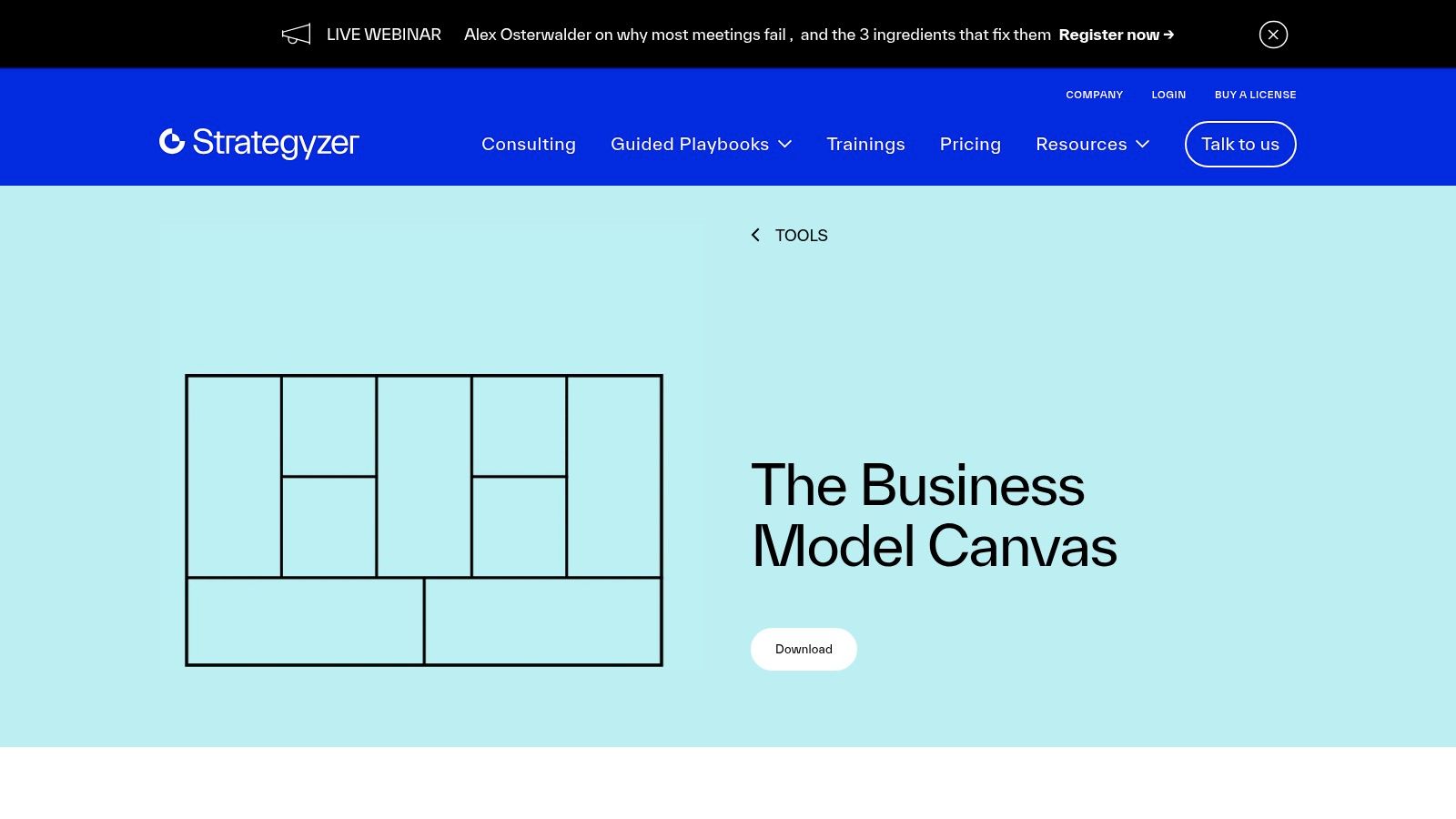
  • How to Quit Your Job and Start Your Dream Business

    How to Quit Your Job and Start Your Dream Business

    I believe knowing when to quit your job boils down to one simple truth: you pull the trigger when the pain of staying is greater than the fear of leaving. It's about listening to your gut feeling and then making a strategic plan, not an impulsive leap. You’re not just running from something; you're building toward something better.

    Is It The Right Time to Quit Your Job?

    A pensive businessman in a suit looks out a window at a city skyline, contemplating his career with the text 'IS IT TIME?'

    If you're reading this, that little voice in your head is probably getting louder. The Sunday Scaries hit harder than ever, meetings feel like a criminal waste of your talent, and you catch yourself daydreaming about what you could be building instead. I’ve been there. This isn’t just a bad week—it’s a signal.

    And you're not alone. Employee turnover is through the roof, and disengagement is a silent epidemic. A recent Gallup report found that U.S. employee engagement is at an 11-year low. A jaw-dropping 50% of job-seekers said their manager was the main reason they left.

    For you, an aspiring founder, this is the key takeaway: an estimated 40% of employees are actively considering quitting right now. This isn't just you; it's a massive trend.

    The Real Reasons You're Ready to Leave

    It’s almost never about one big, dramatic blow-up. It's usually a slow burn—a thousand tiny cuts that finally become too much. Think of it like a leaky faucet. One drop is nothing, but leave it long enough, and it floods the whole house.

    Your reasons probably fall into a few common buckets:

    • A Lack of Autonomy: You feel micromanaged, with no real ownership. Every day is just about following a script someone else wrote for you.
    • Misaligned Values: The company’s mission, its culture, or its ethics just don't feel right anymore. You feel like you're compromising a piece of yourself every time you log on.
    • Stagnant Growth: You've hit a ceiling. There's nothing new to learn, no clear path forward, and your own development has completely flatlined.

    Your job should be a platform for your growth, not a cage. When you spend more time navigating internal politics than doing real, meaningful work, it’s a flashing red sign that your energy is being wasted.

    From Frustration to Foundation

    Many of the most successful founders I know in Chicago started right where you are. They didn’t just quit because they hated their jobs; they channeled that frustration into fuel.

    The anger over clunky, inefficient processes became the fire to build a better system. The annoyance with a terrible boss inspired them to become the kind of leader they always wished they’d had.

    This decision isn't just about escaping a bad scene. It's about realizing your dissatisfaction is actually powerful data. It's pointing you directly toward a problem you are uniquely qualified to solve. Your desire to leave isn't a failure—it’s the first step toward building something that truly matters to you.

    Before you make the final call, it’s smart to walk through a solid framework for making decisions to make sure your choice is both logical and emotionally sound.

    So, you're thinking about quitting your job to go all-in on your business idea. Let's talk about that.

    Quitting without a plan is like jumping out of a plane and hoping you’ll sprout wings on the way down. It's a bad idea. Before you even think about writing that resignation letter, we need to do a brutally honest self-audit.

    This isn't just about money. It's about stress-testing your idea and getting your head right for the insane pressure that’s coming. We're going to skip the generic advice and build your parachute, piece by piece. This is your no-nonsense checklist to make sure you're taking a calculated risk, not a blind gamble.

    Your Pre-Launch Financial and Mental Checklist

    Calculating Your True Financial Runway

    That old advice to "save six months of expenses" is dangerously outdated for a founder. It just doesn't work.

    Your 9-to-5 job is a predictable paycheck, like a steady IV drip of cash. Entrepreneurship is completely different. It’s more like hunting for your own food—some days you’ll feast, and many others you’ll go hungry.

    Your founder's runway isn't just about covering rent and groceries. It has to cover the hidden costs that ambush you the second that W-2 income disappears. You're not just trying to survive; you're trying to build a business from ground zero.

    Let’s get specific. You need to budget for:

    • COBRA or ACA Premiums: Your employer is probably subsidizing 70% or more of your health insurance. That cost is now 100% on you, and trust me, it can be a shocking monthly bill.
    • Self-Employment Taxes: Say goodbye to your employer covering half of your FICA taxes. You're now on the hook for the full 15.3% on your earnings, and that's before federal and state income taxes.
    • Business Startup Costs: Even a super-lean business has expenses. Think software subscriptions, legal fees to set up your LLC, a new laptop, or those first few marketing experiments. They add up fast.
    • The 'Oh Sh*t' Fund: This is for when life happens. A surprise car repair or an unexpected medical bill can completely derail you if your margins are razor-thin.

    Think of your savings as the fuel in a rocket ship. You need enough to not only get into orbit but also to handle course corrections and unexpected turbulence without crashing back to Earth. Aim for 9-12 months of your total runway, not just personal expenses.

    To get a clearer picture, let's map it out. Use this simple calculator to figure out exactly how much cash you need in the bank before you make the leap.

    Your Financial Runway Calculator

    Use this table to calculate the minimum savings you need before quitting your job, factoring in both personal and early business expenses.

    Expense Category Monthly Cost Recommended 9-Month Total Notes and Considerations
    Rent / Mortgage
    Utilities (Gas, Electric, Water, Internet)
    Groceries / Food
    Health Insurance (COBRA or ACA Marketplace plan)
    Car Payment / Transit
    Phone Bill
    Student Loans / Debt
    Personal Spending (Entertainment, etc.)
    Personal Subtotal $0 $0
    Business Software (SaaS) (Email, CRM, Accounting, etc.)
    Legal / Accounting Fees (LLC formation, CPA advice)
    Marketing / Ad Spend (Initial test budget)
    Inventory / Supplies
    'Oh Sh*t' Fund (Aim for 15-20% of total expenses)
    Business Subtotal $0 $0
    GRAND TOTAL $0 $0 This is your target savings number!

    Seeing the final number in black and white can be a real wake-up call. It's not meant to scare you—it's meant to prepare you. Now you have a real, tangible goal to work toward.

    Pressure-Testing Your Business Idea

    Having a cool idea is not the same as having a business. I'll say it again: a cool idea is not a business.

    Before you quit, you have to prove that people other than your mom will actually pay you for what you're building. The great news is your day job provides the perfect, low-risk laboratory to do just that.

    First, ask yourself: are you solving a real, painful problem? A "vitamin" is a nice-to-have. A "painkiller" is something people desperately need and will happily pay for. You need to be a painkiller.

    Here’s how you can test your concept while you still have that steady income:

    • Build a 'Minimum Viable Audience': Start a newsletter, a blog, or a social media account focused on the problem you solve. Can you attract 100 true fans who are genuinely into your topic?
    • Conduct Customer Interviews: This is non-negotiable. Talk to at least 20-30 people in your target market. Don't pitch them. Just listen. Ask about their problems and use their exact language to describe their pain points.
    • Presell Your Idea: This is the ultimate test. Can you get someone to pay you before the product even exists? A simple landing page with a "Pre-Order Now" button can tell you everything you need to know about market demand. For more on this, check out our guide on how to start a business with no money.

    The Mental and Emotional Readiness Audit

    The financial leap is scary, but the mental grind is what truly breaks most founders.

    Entrepreneurship is lonely. The predictable structure of a 9-to-5—colleagues, regular feedback, a clear career path—is gone overnight. Suddenly, you're the CEO, the intern, the salesperson, and the janitor, all at once. The highs are higher, but the lows are crushingly lower. Are you really prepared for that emotional rollercoaster?

    Ask yourself these hard questions:

    • Can you handle solitude? You'll spend countless hours working alone. Do you have a solid support system—a partner, friends, or a community like Chicago Brandstarters—who actually gets what you're going through?
    • How do you react to failure? You will face rejection and setbacks every single day. Can you treat failure as data and a lesson, or will it just crush your motivation?
    • Are you self-disciplined? There's no boss looking over your shoulder. Can you stay focused and execute consistently, even on the days you have zero motivation?

    This checklist isn't meant to talk you out of it. It's designed to make sure you walk in with your eyes wide open. Quitting your job is a massive step, but with the right financial cushion, a validated idea, and a resilient mindset, you’re not just quitting—you’re launching.

    Crafting Your Strategic Exit Plan

    Once you've pressure-tested your finances and got a solid gut-check on your idea, the next big piece of the puzzle is timing your exit. This isn't just about blurting out "I quit." It's a strategic move, like a well-played chess game, designed to protect your hard-earned reputation and give you the maximum runway for what’s next.

    You need to become a student of your company's internal rhythm. Think of it like a surfer reading the ocean. You don’t just paddle out into chaos; you wait for the right wave to carry you smoothly to shore. That means watching for the signs inside your own workplace.

    Is your department about to wrap up a massive, year-long project? That's a natural exit point. Are whispers about restructuring or layoffs getting louder? It might be smarter to make your move before the company makes it for you. Your goal is to leave on a high note, not in the middle of a dumpster fire.

    This visual breaks down the core checkpoints—finances, idea validation, and your own mental state—that signal you're truly ready to pull the trigger.

    A flowchart outlining the 'Quit Checklist Process' with three key steps: Finances, Idea, and Mental State, each with a relevant icon.

    This flow shows how your financial runway, a validated idea, and mental preparedness aren't just separate boxes to check—they build on each other, forming the foundation of your decision to leave.

    Align Your Exit With Your Wallet

    Timing isn't just about office politics; it's about your bank account. Quitting a week before your annual bonus hits or your stock options vest is a rookie mistake. It's like leaving the game in the final inning right before your team scores.

    Get your hands on your company's bonus policy and your stock grant agreement. Find the exact dates for these key events:

    • Bonus Payouts: Know when the money actually lands in your bank. Don't resign the day you're told the amount; wait until that direct deposit clears.
    • Stock Vesting: Vesting usually happens on a specific date or your work anniversary. Bouncing even one day early could cost you thousands.
    • 401(k) Matching: Some companies have a vesting schedule for their matching funds. Make sure you've been there long enough to keep all the free money they gave you.

    See your last few months at the job as your first angel investment in your new venture—funded entirely by your old employer. Stay focused, collect what you've earned, and then make your graceful exit.

    Don't be surprised by how common it is for people to quit. Across the U.S., quits have stabilized around 3.0 million per month, a big slice of the 5.1 million total monthly separations. In sectors like retail, turnover can be as high as 59.8%, and for most companies, only 38% can accurately predict who is going to leave next. Your departure might be less of a shock than you think. You can dig into these U.S. labor turnover statistics on BLS.gov.

    Translate the Legal Jargon in Your Contract

    Before you even think about giving notice, you need to go on a treasure hunt for your original employment agreement. Tucked away in that dense legal document are potential landmines that could sabotage your new business before it even gets off the ground.

    You’re looking for a few key clauses. The big one is the non-compete agreement. This can restrict you from working in the same industry or even the same city for a set period. While they're often tough to enforce, you absolutely need to know if you signed one and what it says.

    Also, keep an eye out for clauses on "inventions" or "intellectual property." Some contracts state that anything you create while employed—even on your own time—belongs to the company. This is exactly why it's so critical to build your side project on your own equipment and strictly outside of work hours.

    If any of this legal language feels like gibberish, this is not the time for guesswork. Spend a few hundred bucks to have an employment lawyer look over your contract. It's a small price to pay to avoid walking into a legal battle later. This clarity is also essential as you formalize your new venture's strategy; you can find more guidance in our startup business plan template.

    Leaving with your professional reputation—and your future business—intact is the whole point. By carefully timing your departure and understanding your legal obligations, you set the stage for a clean, powerful launch.

    How to Have The Resignation Talk

    This is it. The conversation you’ve probably been rehearsing in the shower for weeks. I know it can feel like a huge, dramatic scene is about to unfold, but I promise you, it doesn’t have to.

    Think of your resignation as the final project you’ll deliver for this company. Your goal isn’t to burn bridges or launch into a monologue about everything that’s wrong. It’s to execute a clean, professional, and graceful exit that leaves everyone feeling respected.

    Let's walk through exactly how to handle this conversation with confidence, no matter who's on the other side of the desk.

    Preparing for the Conversation

    Walking into this meeting prepared is the difference between a calm discussion and an awkward, rambling mess. You need to have your key points locked in before you even schedule the meeting.

    Your message should be simple, direct, and completely unshakable. Don't leave any room for ambiguity. This isn't a negotiation; it's an announcement.

    Here’s your pre-meeting checklist:

    • Decide Your Last Day: Have a specific date in mind. Two weeks is the standard notice, but it's smart to double-check your contract for any specific requirements.
    • Write Your Resignation Letter: Bring a printed and signed copy with you. Keep it brief and professional. All it needs to say is that you're resigning and what your final day of employment will be.
    • Anticipate Questions: Your manager is almost guaranteed to ask why you're leaving and where you're going. You don't owe them a detailed explanation. Prepare a concise, positive, and generic answer you can deliver without flinching.

    Your resignation talk is a notification, not a conversation. Your job is to deliver the news clearly and professionally, not to justify your decision or get drawn into an emotional debate.

    Scripts for Different Scenarios

    The dynamic of this conversation is going to feel different depending on your relationship with your manager. You can’t use the same script for a boss you genuinely admire as you would for one you can’t stand.

    Let’s role-play a few common situations so you have the right words ready to go.

    Scenario 1: The Manager You Admire and Respect

    This is often the hardest conversation to have. You feel a sense of loyalty and don't want to let them down. The key here is to express genuine gratitude while remaining firm in your decision.

    • You: "Hi [Manager's Name], do you have a few minutes to talk privately? I wanted to let you know that I've decided to move on from my role here. My last day will be [Date]."
    • Them: "Wow, I'm really surprised to hear that. Is there something we can do?"
    • You: "I've really appreciated the opportunity to work with you and learn from you. This was a difficult decision, but I’ve accepted another opportunity that aligns with my long-term career goals. I’m committed to ensuring a smooth transition over the next two weeks."

    Scenario 2: The Manager You Don't Get Along With

    It's so tempting to use this moment to air all your grievances. Don't do it. It will only make you look unprofessional and burn a bridge you might not realize you need later. Keep it brief, factual, and completely devoid of emotion.

    • You: "Hi [Manager's Name]. I’m here to let you know that I am resigning from my position. My last day will be [Date]. Here is my formal letter of resignation."
    • Them: "Okay. Why are you leaving?"
    • You: "I've found a new opportunity that is a better fit for my career path. I am happy to help create a transition plan to wrap up my projects before I leave."

    Handling the Inevitable Counteroffer

    Once you resign, there's a good chance your company will suddenly find the budget for that raise you've been asking for. This is the counteroffer, and it's a trap.

    Accepting a counteroffer is almost always a mistake. Think about it: why did they only value you this much when you had one foot out the door?

    The money might be a temporary fix, but the underlying reasons you wanted to leave—the bad culture, the lack of growth, the toxic management—will still be there. Studies have shown that a majority of employees who accept a counteroffer end up leaving within a year anyway. Politely, but firmly, decline.

    Here’s how to say no without burning the bridge:

    • "I genuinely appreciate the offer. It means a lot. However, my decision isn't about the money. I’m really excited about this new direction and have already committed to it."

    Your resignation is your final act as an employee. By staying professional, direct, and gracious, you close this chapter on your own terms and set yourself up for a clean start on your next big adventure.

    Managing Your Final Two Weeks and Beyond

    Two people's hands exchanging an orange folder over a desk, symbolizing a smooth document handover.

    How you navigate your last two weeks says everything. You can either quietly fade out or you can finish strong, leaving behind a reputation for professionalism that will follow you for years.

    This is your last chance to make a good impression.

    The mission here is simple: execute a smooth, responsible handover. Tie up every loose end you can and set your team up to succeed without you. After that, it's time to pivot to the administrative maze that is your new life.

    Create an Invaluable Transition Document

    Your single most important task during your notice period is building a rock-solid transition document. Seriously, think of it as the ultimate user manual for your job. The goal is to make it so unbelievably thorough that your replacement could step in and get moving with almost zero hand-holding.

    This document isn’t just a nice thing to do; it’s a strategic move. It makes you look incredibly organized and responsible. More importantly, it dramatically reduces the frantic emails and calls you'll get weeks after you’ve already checked out.

    Your handover guide has to include:

    • Project Status: A clean summary of all your current projects. What's the status, who are the key contacts, what are the next steps, and what are the potential roadblocks?
    • Key Responsibilities: Break down your daily, weekly, and monthly tasks. Don't assume anything is obvious. If you do it, write it down.
    • Essential Contacts: A list of vendors, clients, and internal stakeholders, with a quick note on your relationship dynamic with them.
    • File Locations: Direct links to important documents, reports, and templates on the company server. Don't make them hunt for things.

    Your transition document is your legacy. It’s the final proof of your competence and the ultimate act of goodwill that ensures you leave on the best possible terms.

    The Art of the Exit Interview

    Sooner or later, you'll get that calendar invite from HR for an exit interview. It's incredibly tempting to use this as a final opportunity to unload every frustration you've ever had.

    Don't do it. You have to resist that urge.

    The exit interview is not a therapy session. Anything you say gets noted in your employee file, forever. The smart play is to be polite, constructive, and strategically vague.

    Keep your feedback high-level. Instead of saying, "My manager was a micromanager who made my life miserable," try something more diplomatic like, "I'm looking for a role with more autonomy over my projects." Focus on the pull of the new opportunity, not the push from the old job.

    Remember, in some industries, leaving is just part of the game. In hospitality, total turnover is a massive 75.2%, while retail sees 59.8%. In these fields, your professional exit is just business as usual. This is a sharp contrast to the 84% of employees in the 'Eggshell Economy' who feel trapped and are afraid to make a move. For the company, remember that 66% of HR executives say retention is their biggest challenge, which is why they take these interviews seriously. You can learn about the latest employee retention statistics to get the full picture.

    Your Post-Resignation Logistics Checklist

    Once your last day is officially in the rearview mirror, the real work begins. You're no longer just an employee; you're the CEO of your own life and your new business. That means you're on the hook for all the administrative stuff your old employer used to handle.

    Here’s your immediate to-do list for Day One of your new life:

    • Tackle Health Insurance Immediately: You’ll get paperwork for COBRA, which lets you keep your old health plan… but you'll be paying the full, often shocking, premium. Get on the ACA Marketplace immediately. Losing your job is a qualifying life event, so you can enroll outside the standard window.
    • Roll Over Your 401(k): You've got a few options here. You can leave it with your old company (if the balance is high enough), roll it into an IRA, or potentially move it into a new Solo 401(k) for your business. Whatever you do, don't just cash it out. You'll get crushed by taxes and penalties.
    • Understand Your New Tax Situation: Welcome to the world of self-employment tax. You're now responsible for paying the full 15.3% yourself. You'll likely need to start making estimated tax payments to the IRS every quarter. Skip this, and you'll face a monster bill plus penalties at the end of the year. This is the perfect time to find a CPA who specializes in small businesses.

    Your Toughest Questions Answered

    Alright, let's get into the tricky questions, the ones that probably keep you up at night. Quitting your job to go all-in on an idea is a massive leap, and it's totally normal to have these doubts circling. Here are my straight-up answers to the questions I hear most often from founders planning their escape.

    How Much Money Should I Really Save Before I Quit My Job?

    Forget the old "6 months of expenses" rule. That's for someone looking for another 9-to-5. For a founder, that’s barely scratching the surface. You need to think in terms of a founder's runway. This isn't just about survival; it's about giving your business a real chance to breathe and grow.

    First, get brutally honest about your personal survival budget—the absolute bare-bones minimum you need for rent, groceries, and essential bills. Next, map out a realistic guess for your initial business costs for the first nine months. Add those two numbers together.

    The real goal here is to have 9-12 months of that total runway socked away. This cushion is your single biggest advantage. It lets you build, test, and even mess up without making desperate choices because your bank account is screaming at you.

    What If My Boss Makes a Huge Counteroffer to Keep Me?

    I get it. It feels amazing to be wanted, and that huge number can be incredibly tempting. But trust me on this: accepting a counteroffer is almost always a mistake. It’s like slapping a new coat of paint on a house with a busted foundation.

    You have to ask yourself one simple, critical question: Why did they only decide you were worth that much when you were already one foot out the door?

    The real reasons you wanted to leave—the toxic culture, the dead-end projects, the micromanaging boss—those things aren't going anywhere. They'll still be there in a month. The stats don't lie: the vast majority of people who take a counteroffer are gone within a year anyway. Just politely decline. Explain that your decision is about chasing a new opportunity you're truly passionate about, not just about the money.

    Can I Work on My Business While I Am Still Employed?

    Yes, absolutely. In fact, you should. This is your golden opportunity to de-risk the entire venture before you take the final plunge.

    Think of it as running a secret lab on the side. The rules of this lab are non-negotiable:

    • Never use company time. Not for a minute.
    • Never use your work laptop or any company software.
    • Never use company resources. Period.

    This has to be done on your own time, with your own gear. The most important thing you can do right now is dig up your employment agreement and read it carefully. Look for any nasty clauses about “inventions” or non-compete agreements. These can be serious traps. Your goal is to build a prototype and validate your idea quietly, so when you do quit, you’re hitting the ground sprinting, not starting from a standstill.

    How Do I Handle Health Insurance After I Quit?

    This is the big, scary one for a lot of people in the U.S., but you've got options. It’s not as bad as you think.

    Your most immediate path is COBRA. This lets you keep your old health plan, which sounds great until you see the bill. You have to pay 100% of the premium yourself, and it's often shockingly expensive.

    For most new founders, a much better route is the ACA Marketplace (you know it as Healthcare.gov). The beautiful thing is that losing your job is a “qualifying life event.” This means you can enroll for a new plan right away, even outside the normal open enrollment period. And because your income as a founder will likely be much lower, you might qualify for subsidies that make your monthly premium surprisingly affordable. Do your research on this before your last day so you have a plan ready to execute.


    At Chicago Brandstarters, we believe Chicago's spirit of kindness and hard work makes for the best founders. If you’re ready to build something meaningful and want a community that has your back, we're here for you. Join our free, vetted community to connect with peers who get it. Learn more and apply to join at chicagobrandstarters.com.

  • 7 Places to Find the Best Seller Business Books in 2026

    7 Places to Find the Best Seller Business Books in 2026

    You're building a brand from scratch. Time is your most precious asset. I know you can't afford to waste it on generic "must-read" lists that lead nowhere. You need real wisdom for today's problems, not abstract theories. I've been in your shoes, drowning in a sea of best seller business books, trying to figure out which ones actually hold the keys.

    Think of this guide as your shortcut. Instead of just giving you a list of books, I'm showing you exactly where to find them and which place fits where you are right now. I'll walk you through the 7 best spots that successful founders—especially those I know in our Chicago and Midwest communities—use to find their next game-changing read.

    This isn't fluff. It's a map. It's built to help you find insights you can use immediately, whether you're sketching an idea on a napkin, scaling an online store, or growing a side hustle. Every recommendation has a direct link and a simple reason why it's worth your time. Let's cut through the noise and get straight to the tools that will help you build something that lasts.

    1. Amazon

    As the biggest bookseller out there, Amazon is the obvious first stop. You can find almost any business book ever written. Whether you have a title in mind or you're just browsing the best seller business books, its huge catalog and sharp search tools make it easy. From classics to brand-new releases, you can get it in any format you want.

    A screenshot of the Amazon homepage, a prominent source for best seller business books.

    The platform nails it when it comes to choice. You can grab a hardcover for your desk, download a Kindle eBook for your commute, or listen to an audiobook on Audible while you're at the gym. It’s like a Swiss Army knife for readers. Throw in fast Prime delivery, and you’ve got unbeatable convenience.

    Key Features for Founders

    Amazon's whole system is designed to help you decide fast. The "Look Inside" feature is like flipping through a book in a store; you can read the first few pages and get a feel for the author’s voice before you buy. Then you have the customer reviews, which are a goldmine of real-world feedback on what works and what doesn't.

    Here's a pro-tip I use: keep an eye on the live Kindle Store Bestseller Ranks in the "Business & Investing" category. It’s like having a direct line to what other founders are reading right now. This helps you stay on top of the ideas shaping your industry.

    Pros and Cons

    Pros Cons
    Widest selection of formats and titles Crowded marketplace with varying seller quality
    Fast and reliable delivery with Prime Pricing and stock can fluctuate unexpectedly
    Robust customer reviews and previews Can be overwhelming without a specific title in mind

    Why It Makes the List

    Amazon’s massive scale, format options, and pricing make it a must-have for any founder building a business library. Its discovery tools and customer reviews mean you can find the exact knowledge you need, right when you need it. Since many of us also sell on Amazon, it's vital to know the rules. I've covered how to deal with problems in my guide on handling Amazon account suspensions.

    Website: https://www.amazon.com

    2. Barnes & Noble

    As a bookstore veteran, Barnes & Noble gives you a more curated, classic way to find best seller business books. It's the perfect middle ground between the chaos of a huge online marketplace and the focused feel of a real bookstore. You can easily browse its well-organized business section, which highlights new releases, staff picks, and top sellers.

    This platform gives you the best of both worlds. You can order a hardcover online and have it shipped to your door, or you can use in-store pickup to grab it today. If you're a digital reader, the NOOK eBook format lets you dive into a new strategy guide instantly.

    Key Features for Founders

    The "Business" category hub is where Barnes & Noble really shines. Unlike sprawling sites, it's neatly organized into practical subgenres like "Management," "Finance," and "Small Business & Entrepreneurship." This helps you find what you need much faster. It's like having a librarian who's already sorted the shelves for you.

    Here's a tip I recommend: check out the "Staff Picks" in the business section. This is where I often find hidden gems that haven't hit the mainstream bestseller lists yet. Think of it as getting a personal recommendation from someone who reads for a living, which can introduce you to ideas you wouldn't find otherwise.

    Pros and Cons

    Pros Cons
    Clean category navigation for focused browsing eBook ecosystem is smaller than Amazon/Google
    In-store pickup option combines online and physical shopping Some pages require JavaScript, which may lag on older browsers
    Clear shipping perks for members and non-members Selection, while large, is not as exhaustive as Amazon's

    Why It Makes the List

    Barnes & Noble earns its spot by offering a more intentional shopping experience. If you get overwhelmed by endless choices, its curated approach is a breath of fresh air. The mix of a solid online store and reliable physical locations gives you the flexibility to get the business insights you need, how you need them.

    Website: https://www.barnesandnoble.com/b/books/business/_/N-29Z8q8Zt82

    3. Bookshop.org

    If you like shopping online but want your money to support local businesses, Bookshop.org is for you. This platform is an online marketplace built to help independent bookstores thrive. When you buy a book, a big slice of the profit goes into a pool that's split among participating indie shops. It’s a way to find the best seller business books that feels good.

    Bookshop.org

    The site is clean and simple, making it easy to discover both print and digital books. While it's not as massive as Amazon, you'll find almost every major business title. You can even choose a specific local bookstore to support with your purchase. You’re not just buying a book; you’re investing in other small business owners like you.

    Key Features for Founders

    Bookshop.org is all about curation. It feels more like a boutique than a big-box store. You can browse lists created by specific bookstores, authors, and publications, which often unearth amazing books you'd otherwise miss. These collections in the "Business & Economics" category can lead you to niche topics that are incredibly relevant.

    Since they've added eBooks, you can learn on the go with their app. Here's a tip: look for affiliate pages from your favorite business podcasts or thinkers. Many create curated lists on Bookshop.org, so you can see what they recommend while supporting them and local stores at the same time.

    Pros and Cons

    Pros Cons
    Purchases directly support independent bookstores Print shipping is currently limited to the US
    Clean, curated browsing experience Bookshop eBooks do not support Kindle devices
    Simple 30-day return policy for print books In-app eBook purchasing can be limited by app store rules

    Why It Makes the List

    Bookshop.org makes the list because it’s a powerful, mission-driven choice for founders who care about community. You can build your business library while directly investing in the small business ecosystem. If you believe how you spend your money matters, this platform aligns your purchases with your values, without giving up convenience.

    Website: https://bookshop.org

    4. Porchlight Book Company

    When you need more than just one book, you need a specialist. That's Porchlight Book Company (you might remember them as 800-CEO-READ). This isn't your typical bookstore. It's a service for bulk orders and corporate gifts. If you're planning a team-wide read for your startup or sending a thank-you to investors, this is your place to find best seller business books with a professional touch.

    Their entire business is built to serve teams, not just individuals. This means they offer customization you won't find anywhere else. Think of Porchlight less like a store and more like a partner who helps you spread knowledge across your entire company.

    Key Features for Founders

    Porchlight makes big orders simple. Their bulk fulfillment service gives you custom quotes, handles all the logistics, and makes sure every book gets where it needs to go. You can even add custom stickers or signed bookplates to turn a book into a memorable gift.

    A great way to find your next team read is to check out their editorial picks and the annual Porchlight Business Book Awards. These lists cut through the noise and highlight innovative books you might have missed. Their customer service is run by actual people, which is a huge help when you need to track down a specific edition.

    Pros and Cons

    Pros Cons
    Streamlined process for bulk and corporate orders Limited selection of eBooks and audiobooks
    Unique customization options (e.g., signed bookplates) Shipping costs and timelines vary by project
    Expert editorial curation helps with discovery Some bulk discounts may be non-returnable

    Why It Makes the List

    Porchlight makes the list because it's laser-focused on what organizations need. When you have to get the same knowledge into the hands of your whole team, their service is unbeatable. They’re the bridge between an author’s ideas and your entire company, making it easy to share the best business insights at scale.

    Website: https://www.porchlightbooks.com

    5. Harvard Business Review (HBR) Store

    If you're after serious, research-backed business knowledge, the Harvard Business Review (HBR) Store is your destination. This isn't a massive marketplace. It's a direct line to some of the most respected thinking in the business world. Here, you'll find HBR Press books, individual articles, and deep-dive case studies to sharpen your strategic mind.

    A screenshot of the Harvard Business Review (HBR) Store, a source for best seller business books.

    The platform is great at packaging wisdom. Collections like HBR's 10 Must Reads bundle the most powerful articles on topics from leadership to strategy. It's like getting a masterclass in a box. Buying straight from the publisher ensures you're getting the real deal, perfect for building a professional library for you or your team.

    Key Features for Founders

    The HBR Store’s power is in its focused catalog. Instead of just browsing titles, you can filter by critical topics like innovation or marketing to find targeted solutions. Being able to buy single articles or case studies is a game-changer. It lets you get powerful ideas for a specific problem without having to read an entire book.

    Here's a tip I give to founders: use their curated collections to get your leadership team on the same page. Buying a set of books on management, for example, means everyone is working from the same playbook. Aligning your team on core ideas is a key part of the small business growth strategies I recommend.

    Pros and Cons

    Pros Cons
    Direct publisher access guarantees authenticity Shipping isn't typically free and has set tiers
    Curated collections simplify learning on key topics Digital items are usually non-returnable
    Offers individual articles and case studies Selection is limited to HBR-published materials

    Why It Makes the List

    The HBR Store earns its spot by providing access to authoritative, research-backed business insights you can't get just anywhere. It’s the perfect place for founders who want to build their business on proven principles, not just trends. For creating a team reading list or diving deep into a strategic challenge, HBR delivers depth and credibility.

    Website: https://store.hbr.org

    6. Audible

    For busy founders, I know sitting down to read can feel like a luxury you don't have. Audible fixes that. It turns your commute, workout, or chores into learning time. As the top audiobook platform, it has a massive library of best seller business books, often narrated by the authors themselves and available on launch day.

    A person listening to audiobooks, a great way to consume best seller business books.

    The platform runs on a membership. The premium plan gives you monthly credits to buy any title you want, which you then own forever. This is great for those core books you'll listen to again and again. A cheaper plan gives you unlimited listening to a huge, rotating catalog of audiobooks and podcasts. It’s like a Netflix for your ears.

    Key Features for Founders

    Audible's biggest win is accessibility. The power to absorb dense business ideas while you do other things is a game-changer for me. When the author narrates, you often get an extra layer of meaning and emphasis that helps the lessons stick.

    A tip I use all the time is the clipping feature. You can save key moments or advice and revisit them later without having to search through hours of audio. Also, keep an eye out for member-only sales. You can often grab top-tier business books for a steep discount, making your learning budget go further.

    Pros and Cons

    Pros Cons
    Huge catalog with day-one availability for new releases Top bestsellers often require a paid credit
    Audio format is ideal for multitasking and busy schedules The Plus Catalog selection can be hit-or-miss
    Keep your purchased audiobooks forever with a credit Navigating different membership tiers can be confusing

    Why It Makes the List

    Audible makes professional growth possible, no matter how jammed your schedule is. It turns downtime into growth time, letting you absorb the latest strategies without needing to block off hours to read. For founders building a knowledge base, I've curated a list of essential business strategy books on our blog, and they're all on Audible.

    Website: https://www.audible.com

    7. Google Play Books

    If you're plugged into the Android and Google world like I am, Google Play Books is a seamless alternative to Kindle. It offers a huge catalog of digital books, making it a great spot to find the best seller business books without ever leaving Google's familiar space. You can access your library from anywhere—your web browser, Android phone, or even an iPhone.

    A screenshot of the Google Play Books interface showcasing best seller business books.

    The platform focuses on ebooks and audiobooks with a clean, easy-to-use experience. What I love most is how it syncs across my devices. I can read a chapter on my laptop, then pick up right where I left off on my phone during my commute. It just works.

    Key Features for Founders

    Google Play Books is all about convenience. A key feature for me is the ability to download some books as DRM-managed EPUB or PDF files for offline reading on different e-readers. This is a big plus if you don't use a Kindle. The platform also runs frequent sales, so you can often grab popular business titles for less.

    A huge benefit for founders is the clear, 7-day refund policy on most ebooks. If you buy a book and it's not what you hoped for, you can get your money back easily. This removes the risk of spending money on a book that doesn't help your business, making it easier for you to explore new ideas.

    Pros and Cons

    Pros Cons
    Excellent for readers outside the Kindle ecosystem Kindle-exclusive titles will not be available
    Strong cross-device compatibility with cloud sync Some publishers enforce strict DRM on downloads
    Clear and user-friendly 7-day refund policy Audiobooks and certain titles have stricter refund rules

    Why It Makes the List

    Google Play Books makes the list because it's a strong, user-friendly digital option, especially for those of us using Android and Google. Its simple interface, frequent deals, and straightforward refund policy make building your digital business library both cheap and risk-free. It’s a solid choice for getting the knowledge you need on any device.

    Website: https://play.google.com/books

    Best-Seller Business Books: 7-Store Comparison

    Retailer Implementation complexity 🔄 Resources & Formats ⚡ Expected outcomes 📊 Ideal use cases ⭐ Key advantages / tips 💡
    Amazon 🔄 Low — streamlined checkout, multiple sellers and account features ⚡ Broad: hardcover, paperback, Kindle, Audible; Prime fast delivery 📊 High discoverability and dynamic pricing; quality varies by seller ⭐ Finding bestsellers quickly, price/promotions, fast delivery 💡 Use Kindle previews, bestseller rankings and watch seller listings
    Barnes & Noble 🔄 Medium — online + in-store flows; some JS-dependent pages ⚡ Print + NOOK eBooks; in-store pickup and member shipping perks 📊 Curated business navigation with predictable shipping terms ⭐ Buyers who want brick-and-mortar support and curated lists 💡 Leverage member shipping thresholds and staff picks for discovery
    Bookshop.org 🔄 Low — simple checkout focused on independent stores ⚡ Print shipping (US); eBooks via iOS/Android/web (no Kindle) 📊 Supports indie bookstores; curated lists but limited device reach ⭐ Ethical buying to support independent bookstores 💡 Choose to fund local stores; confirm eBook device compatibility
    Porchlight Book Company 🔄 High — custom quotes, bulk workflows, human-managed logistics ⚡ Print-focused with customization (signed plates, bundles, inserts) 📊 Tailored corporate orders and event-ready fulfillment ⭐ Bulk corporate orders, custom gifting, team reads 💡 Best for customization and bulk discounts; expect variable shipping terms
    Harvard Business Review Store 🔄 Medium — publisher-direct purchase with curated collections ⚡ Books, articles, case studies in print and digital; team sets 📊 Reliable access to HBR titles and professional collections ⭐ Building professional reading sets or purchasing case studies 💡 Buy direct for HBR content; check shipping fees and final-sale digital rules
    Audible 🔄 Low — subscription/credit model via app and web ⚡ Audiobooks with day-one releases; Premium Plus credits and Plus Catalog 📊 Excellent audio access and retention for busy listeners ⭐ Commuting, multitasking, consuming business books by audio 💡 Use credits for major releases and watch member-only sales/trials
    Google Play Books 🔄 Low–Medium — cross-platform purchase and sync ⚡ eBooks and audiobooks on web, Android, iOS; cloud sync; some DRM 📊 Good cross-device compatibility outside Kindle ecosystem ⭐ Readers who want non-Kindle ecosystem and cross-device access 💡 Use cloud sync and 7-day refunds; check DRM and lending limits

    Your Next Move: Turn Reading into Doing

    You've just walked through my guide to the best places for finding best seller business books. You now have a map to the world's most powerful business knowledge, from Amazon's giant marketplace to Bookshop.org's community-focused shelves. We've seen how each tool—from HBR's academic rigor to Audible's convenience—serves you at different stages of your journey.

    Here's the real lesson: knowledge isn't a trophy for your shelf. It’s a tool. And like any tool, it’s only valuable when you use it. Reading "The Lean Startup" is one thing; actually building and testing a Minimum Viable Product is another. The gap between knowing and doing is where most of us get stuck.

    From Passive Learner to Active Builder

    So how do you cross that gap? The answer isn't to read more. It's to act on what you read. You have to test the theories and, most importantly, connect with other people on the same path. I’ve found the best insights don't come from the page, but from the conversation you have about it with another founder.

    Think of it like learning to cook. You can read every cookbook ever written, but you won't be a chef until you get in the kitchen and risk burning a few things. Each book is a recipe. Your business is the kitchen. It’s time to start cooking.

    Choosing Your First Action Step

    To beat analysis paralysis, don't try to do everything at once. Pick one key idea from one book and commit to applying it this week.

    Here’s a simple way to choose:

    • If you're at the idea stage: Use Amazon's reviews to find a book on validation, like The Mom Test. Your action step: conduct five customer interviews using the book's techniques.
    • If you're building a product: Head to the HBR Store for an article on product-market fit. Your action step: create a one-page strategy doc based on a framework you find.
    • If you're scaling: Grab a book on Audible about systems, like Traction. Your action step: implement one meeting rhythm or accountability tool with your team.

    The goal is momentum. One small action builds confidence and gives you real-world data, which is worth more than a dozen unread books. You're not just reading about the best seller business books; you're turning their wisdom into your success.


    A book is just paper until you put its ideas to work with people who can help you. At Chicago Brandstarters, I connect kind, hard-working founders to talk about what's actually working, turning book smarts into street smarts. If you're ready to move from reading to doing with a community you can trust, apply to join our next founder dinner at Chicago Brandstarters.

  • A Founder’s Guide to Dealing With Difficult Customers

    A Founder’s Guide to Dealing With Difficult Customers

    Look, nobody enjoys getting that gut-wrenching, angry email from a customer. It’s a punch to the gut. When you’re a founder, that stuff feels incredibly personal, like a direct attack on you and your baby.

    I’ve been there. My first reaction was always to get defensive, to rattle off all the reasons why they were wrong and I was right. But let me tell you, that approach is a dead end.

    The Mindset Shift For Handling Tough Customers

    The single biggest change I ever made was realizing that most unhappy customers aren't actually attacking me. They're just frustrated. They're upset because what they got didn't line up with what they expected.

    Their anger isn't a personal vendetta; it's a signal. A loud, flashing one.

    Think of it this way: customer anger is the check-engine light for your business. You don't get mad at the light, right? You pop the hood to figure out what's actually broken. Is it a shipping screw-up? A confusing product description on your site? A bug in your software? The emotional outburst is just the symptom, not the disease.

    Once you train yourself to see past the heat of the moment, you can start diagnosing the real problem. This isn’t just about putting out fires. It's about collecting priceless data that will make your entire business stronger.

    The goal is not to prove you're right. The goal is to make the customer feel heard and understood, which is the only way you can guide the conversation toward a solution.

    This shift in perspective is more critical now than ever. Let's be honest, people are getting more tense. Over the last decade, things have really escalated. Back in 2015, about 35% of customers admitted to raising their voice during a service issue. By 2023, that number jumped to 43%.

    And with 63% of customers feeling genuine anger when they feel wronged, your ability to stay cool and objective is your biggest superpower. You can learn more about these customer service trends and see how they’re changing the game.

    So, what does this look like day-to-day?

    • Separate the Person from the Problem: Drill this into your head: their anger is aimed at a situation, not at you personally.
    • Embrace the Data: Every single complaint is a goldmine of information about a friction point in your customer's journey.
    • Focus on the Fix, Not the Fight: Your energy is finite. Spend it on finding a resolution, not on winning an argument.

    Adopting this viewpoint changes everything. It turns a draining, soul-crushing experience into a productive one. Instead of losing a customer for good, you get a rare chance to show them what your brand truly stands for—and maybe even build some unexpected loyalty along the way.

    Your De-Escalation Playbook for Heated Moments

    When a customer is upset, your first move determines everything. It’s so easy to get that knot in your stomach and just react, but trust me, having a clear plan is always better. My playbook for these tough moments starts with one simple, non-negotiable rule: listen first, act second.

    Think of yourself as a firefighter arriving at a blaze. You don't just start spraying water everywhere, right? You have to assess the situation, find the source of the heat, and then apply a targeted solution. Rushing in with solutions before you truly get what’s going on is like aiming the hose at the smoke instead of the fire.

    This is where active listening becomes your most powerful tool. And I don’t just mean staying quiet while they talk; it’s about making them feel genuinely heard.

    The Power of the Empathy Opener

    The first words out of your mouth (or in your email) can immediately lower the temperature. I call this the 'empathy opener.' It’s a simple, non-robotic phrase that acknowledges their emotional state without you having to admit fault right away.

    Here are a few you can use in a pinch:

    • "I can absolutely understand why you're feeling frustrated about this."
    • "That sounds like a really difficult situation, and I'm sorry you're dealing with it."
    • "Thank you for bringing this to my attention. It’s clear this has been a major headache for you."

    Notice you aren't saying, "You're right, we messed up." You're validating their feeling, not necessarily their version of the facts. This small step is huge. It shifts the dynamic from a confrontation (you vs. them) to a collaboration (you and them vs. the problem).

    When a customer feels understood, their defensiveness drops. Only then can you start guiding the conversation toward a productive resolution. This is the core of effective de-escalation.

    You have the power to guide a customer's mindset during a tough interaction, shifting them from pure frustration to seeing you as a helpful partner.

    Infographic illustrating a customer mindset shift from frustration to opportunity through reframing.

    The key takeaway here is that you can reframe the entire interaction from a moment of pure frustration into an opportunity to show your brand's commitment. It’s a chance to turn a bad experience into a memorable, positive one.

    From Listening to Problem-Solving

    Once you’ve validated their feelings, it’s time to pivot to finding a solution. This transition is crucial—you need to take control of the conversation calmly and clearly.

    Your next move is to summarize their complaint back to them. I use this all the time. It shows you were actually paying attention and makes sure you're both on the same page before taking another step.

    For example:
    "Okay, just to make sure I've got this right, the package arrived three days late, and when you opened it, the item was the wrong color. Is that correct?"

    This simple confirmation does two things. First, it gives them a chance to correct any misunderstandings. Second, it proves you're taking them seriously, which builds the trust you absolutely need to solve the problem. Only after you get their "yes, that's right" should you start exploring next steps. This keeps you from solving the wrong problem and keeps the interaction moving forward.

    Scripts And Templates That Sound Human

    Knowing how to de-escalate is half the battle. Knowing the exact words to use is the other.

    Forget the robotic, corporate-speak that makes customers feel like they're talking to a wall. I'm going to give you the same plug-and-play phrases I've personally used to turn tense situations around.

    This isn't about becoming a script-reading robot, though. Think of these phrases like a musician learning scales. You practice them so that when it’s time to improvise, the right notes just flow.

    Laptop on a wooden desk displaying 'Human Scripts' content, alongside a notebook and plant.

    A Human-Centered Email Template

    Here’s a simple, effective structure you can adapt for almost any email response. I've found it follows a clear psychological path that works: acknowledge, align, then act.

    • The Sincere Opener (Acknowledge): First, you have to validate their frustration. Don't fake it. "I'm so sorry to hear about the issue with your order. I can definitely see how frustrating that would be."
    • The Quick Summary (Align): Next, briefly restate their problem to show you're on the same page. "Just to confirm I understand correctly, the package arrived damaged, and you're unable to use the product. Is that right?"
    • The Action Step (Act): Now, tell them exactly what you’re going to do. Be clear and direct. "I've already processed a replacement for you, which will ship out today. You'll get a new tracking number shortly."
    • The Simple Close: End on a human, helpful note. No corporate jargon. "Thanks for your patience as we get this sorted out for you."

    This structure works because it puts their experience first. You’re not just solving a problem; you’re showing you actually care about their frustration.

    Phrases For Specific Scenarios

    Let's be real, you don't have time to workshop the perfect response when an angry email lands in your inbox. Having a few key phrases ready to go can make all the difference.

    Here are some of my go-to lines for common headaches:

    • For a Shipping Delay: "I know how disappointing it is when a delivery doesn't arrive as expected. I've looked into this, and here's the latest update from the carrier…"
    • For a Product Defect: "That's definitely not the quality we aim for, and I'm really sorry about that. Could you please send a quick photo so I can get this fixed for you right away?"
    • For Stating a Policy Firmly but Kindly: "I understand where you're coming from. While our policy doesn't allow for refunds on used items, here is what I can do for you as a gesture of goodwill…"

    Using the right words is critical because the stakes are incredibly high. The threshold for a customer leaving is shockingly low. One study found that after just a single poor experience, 32% of customers will abandon a brand they previously loved.

    That number skyrockets after a second bad interaction. A staggering 86% of customers are willing to walk away for good. Your words are your best defense against that churn. You can dig into more of these customer retention statistics to get the full picture.

    These scripts aren't magic wands, but they are a solid foundation. They give you a calm, structured response when your own stress levels are through the roof, ensuring you sound helpful and human every single time.

    Setting Boundaries And When To Say Goodbye


    As a founder, your gut tells you to do anything to make a customer happy. But you can’t build a lasting business by bending until you break. The real key to sustainability is setting clear, fair boundaries that protect your sanity, your team, and your bottom line.

    Think of your company policies—especially for returns and refunds—as guardrails. They're not there to be mean; they keep everything on a safe, predictable path when things get shaky. Without them, every difficult situation becomes a new fire you have to put out based on emotion, and that's a one-way ticket to burnout.

    Your Policies Are Your Best Friend

    A good, solid policy isn't about being rigid. It's about being consistent and fair to everyone, including yourself. When you're in the trenches with a frustrated customer, the last thing you want is to make a decision on the fly. You need a reliable framework to fall back on.

    Make sure your policies are:

    • Easy to find: Don't hide your return policy in your site's footer. Make it obvious. Put it where people can see it before they even think about buying.
    • Written in plain English: Ditch the legal jargon. A customer should be able to read your policy and understand exactly what's up.
    • Fair but firm: Be generous where it makes sense, but clearly define your limits. A 30-day return window for unused products is a pretty standard, solid starting point.

    This kind of proactive communication cuts down on tons of confusion and headaches later. It also gives you a calm, objective document to point to when a customer's request is just not something you can do. Getting these decisions straight from the get-go is critical. If you need help building this muscle, check out our framework for making decisions.

    Knowing When to Fire a Customer

    Look, sometimes no amount of de-escalation or policy-quoting is going to fix the situation. There are customers who will drain every ounce of energy from your team, cost you more in time than their business is worth, and just generally make everyone miserable. Learning to spot these situations and act on them is a survival skill.

    And it’s not always the loudest ones. In fact, a whopping 56% of consumers who have a bad experience never even complain—they just ghost you. While that silent churn hurts, it's the overtly abusive or endlessly demanding customer that requires a firm, final response. You can find more data like this in these customer service statistics.

    It is 100% okay to say goodbye to a customer who is abusive, makes completely unreasonable demands, or repeatedly ignores your policies. Your mental health and your team's well-being are worth more than any single sale. Period.

    So how do you pull the plug professionally? When a customer has truly crossed the line, you don't need a dramatic breakup. A simple, direct script is all you need to end the relationship cleanly.

    Here’s a template you can adapt:

    "Hi [Customer Name],

    We've done our best to find a solution that works for you, but it seems we aren't able to meet your expectations. At this point, it's clear our company isn't the right fit.

    We are issuing a final refund and will be closing your account. We wish you the best in finding a company that's a better match for your needs."

    This response is final, professional, and keeps emotion out of it. It closes the loop and lets you and your team get back to focusing your energy on the fantastic customers you can help.

    Protecting Your Most Important Asset: Your Team

    You can't pour from an empty cup. It’s an old saying, but it's the absolute truth when you and your team are on the front lines, dealing with tough customers day in and day out.

    If you're a solo founder, you’re the one taking every single emotional punch. And if you have a team, their well-being is squarely on your shoulders.

    Every tense interaction chips away at your collective energy. Think of it like an emotional battery draining a little with every angry email or frustrated phone call. You wouldn't let your phone hit 0% and still expect it to perform, so why would you do that to yourself or your people?

    Diverse professionals smiling and engaged in a casual team discussion in an office lounge.

    Let's be clear: this isn't some fluffy, feel-good topic. This is about building a brand that's resilient enough to handle any storm that comes its way. A burned-out, exhausted team simply can't deliver the kind of thoughtful, high-quality service needed to turn a bad situation around. In fact, research shows that 74% of agents feel more empowered to handle stress when they have the right tools and support.

    Building Resilience and a Safety Net

    First things first: you have to build a culture where it's not just okay, but actively encouraged, for your team to admit they're struggling. You need a system where someone can raise their hand and say, "I need to tap out on this one," without an ounce of judgment. This is your psychological safety net.

    Your team's mental health isn't a secondary priority; it is the engine of your customer experience. When they feel supported, they can support your customers. When they feel drained, that negativity inevitably leaks into every interaction.

    After a particularly draining call or a nasty email chain, you need a cooldown ritual. This doesn't need to be fancy. It can be as simple as stepping away from the desk for five minutes, grabbing a coffee, or just chatting about something totally unrelated with a colleague. That small act creates a buffer, stopping the stress from one bad interaction from bleeding into the next.

    For solo founders, this is even more critical. You don't have a coworker in the next room to vent to. This is where peer support becomes a lifeline. Finding a trusted circle of other founders is a complete game-changer. You might find real value in exploring options like mastermind groups for entrepreneurs to build that essential network. It's lonely out there otherwise.

    Celebrate the Wins and Debrief the Losses

    It's so easy to get bogged down in what went wrong. Don't fall into that trap. You have to celebrate the "saves"—those moments when a team member masterfully turns a furious customer into a fan. These wins are proof that your approach is working and are a massive morale booster.

    Here's a simple way to structure this:

    • The Post-Mortem Debrief: For the really tough cases that didn't go well, hold a blameless debrief. The goal isn't to point fingers. It's to ask, "What can we learn from this? What could we try differently next time?"
    • The "Save of the Week": Make a point to highlight a great customer interaction in your team meetings or Slack channel. Share the story, shout out the person who handled it, and celebrate them. This reinforces the right behaviors and reminds everyone that their hard work really does pay off.

    By learning from the losses and celebrating the wins, you create a balanced, supportive environment. This proactive approach isn't just about being nice—it's the ultimate strategy for consistently and successfully navigating the challenges of difficult customers.

    Answering Your Toughest Customer Questions

    Alright, let's get into the weeds. I want to tackle some of those sticky situations that pop up and make you feel totally stuck as a founder. When you’re not sure what the right move is, this is your playbook for making the tough calls.

    What If a Customer Is Publicly Trashing My Brand?

    First thing: take a deep breath. Your gut reaction might be to delete the comment or fire back with a defensive reply. Don't do either. I promise you, you cannot win a public argument.

    Instead, post a single, calm, professional response. Your only goal is to acknowledge them and pull the conversation into a private channel, fast.

    "We're so sorry to hear about your experience and want to make this right. Please DM us your order number so we can investigate this for you immediately."

    This simple script does two things. It shows everyone else watching that you're on top of it, and it moves the messy back-and-forth out of the public square. Once you're in the DMs, you can actually solve the problem.

    How Do I Handle a Customer Who Is Clearly Wrong but Won't Back Down?

    Ah, the classic founder headache. We've all been there. The secret is to validate their feeling, not their version of the facts. You don't have to agree that your product spontaneously combusted, but you can absolutely agree that being frustrated is a valid feeling.

    Try using phrases that separate their emotion from the objective reality:

    • "I can definitely understand why that would be so frustrating."
    • "It sounds like this has been a really difficult experience for you."

    Once they feel heard, you can gently pivot back to your policy or the facts. "While our policy doesn't cover this specific issue, here is what I can do for you…"

    Often, a small, unexpected gesture of goodwill—like a discount on a future order—is all it takes. You're not trying to win the argument; you're just trying to make them feel heard and move on.

    Is It Okay to Just Issue a Refund to Make Someone Go Away?

    Yes. But you have to be smart about it.

    Your time and mental energy are your most valuable resources. If a customer is hammering your inbox over a $20 refund and it’s going to cost you an hour and a spike in your blood pressure, it's just not a battle worth fighting. Cut your losses and move on.

    Think of the "goodwill refund" as a tool for efficiency, not a knee-jerk reaction to every complaint. The key is to track these. If you notice the same person is constantly finding "issues" to get free stuff, that's when you draw the line and stand firm.

    How Can I Set Up Good Policies From Day One?

    Keep it simple. Keep it clear. Keep it fair. A policy filled with legalese is just a recipe for confusion and angry emails.

    Start with the basics. A 30-day return window for unused products is a solid, standard starting point. Be crystal clear about who pays for return shipping (usually the customer, unless you made a mistake). For refunds, give a clear timeline, like, "Refunds will be processed within 5-7 business days of receiving your return."

    Building a solid sales process from the start is one of the smartest things a new brand can do. You can learn more by checking out our guide on the B2B sales process to get started.

    The most important thing? Be consistent. A clear policy that you apply fairly to everyone is your absolute best defense against unreasonable demands.


    At Chicago Brandstarters, we know that building a brand is full of these tough moments. Our community is a place where kind, hardworking founders share real stories and get practical advice so you never have to feel stuck or alone. Apply to join our free community and start building with us.

  • 10 E-commerce Growth Strategies I Used to Scale Past Seven Figures in 2026

    10 E-commerce Growth Strategies I Used to Scale Past Seven Figures in 2026

    I get it. You're swimming in flashy 'get rich quick' e-commerce advice that feels empty. It's all unsustainable ad spends and fleeting overnight wins. That's not how you build a real, lasting business, especially not here in the Midwest. We build things that matter.

    This isn't just another list. I've poured years of my own experience into 10 real e-commerce growth strategies that I’ve personally used and watched work for founders right here in our Chicago community. Think of me as a guide, not a guru. This is your playbook for building a business that doesn't just make you money, but makes you proud.

    We're skipping the fluff. I'll use simple analogies to make complex ideas click, share stories from the trenches, and give you steps you can take today. My goal is to hand you a clear, prioritized map that feels authentic to you, whether you’re launching a side-hustle or scaling toward your first million. We'll cover everything from building a loyal tribe to mastering your numbers to forging powerful alliances. These aren't just theories; they're the pillars of sustainable growth.

    Building a business is like building a house. You can't just throw up the walls and hope it stands; you need a solid foundation. These ten strategies are your blueprint and your toolbox. I'll help you build a strong, resilient brand that can weather any storm. Let’s start laying the first bricks.

    1. Community-Driven Growth & Word-of-Mouth Marketing

    Forget chasing expensive clicks for a minute. What if your growth engine ran on genuine connection? That’s the heart of community-driven growth, one of the most powerful and sustainable e-commerce growth strategies you can use. Instead of just buying customers, you’re building a tribe of advocates who can't wait to spread the word about your brand. This isn't about manufacturing hype; it's about fostering real relationships that create organic momentum.

    This works because you trust your friends more than you trust an ad. When you build a community, you create a home for your customers to share, give feedback, and feel like they belong to something bigger. Think of it like a flywheel: the more you invest in genuine connection, the faster it spins, generating word-of-mouth that paid ads can't touch. I've found this strategy works best when you lead with transparency and a bit of vulnerability.

    Diverse group of three adults having a meeting or consultation, reviewing documents in a bright living room.

    Why It Works & When to Use It

    I recommend this strategy for early-stage brands building from scratch or for established brands that want deeper customer loyalty. It sings when your product has a strong story, a clear mission, or solves a real problem for a niche audience. Look at brands like Glossier and Patagonia. They didn't just sell stuff; they built movements around shared values. By putting community first, they turned their customers into evangelists who drove their growth.

    Actionable Steps to Build Your Community

    Ready to start? Here are some practical steps you can take today:

    • Create a "Third Place": Build a dedicated space for your community to gather. This could be a private Slack or Discord server, a Facebook Group, or a forum on your site. This gives your biggest fans a direct line to you and each other.
    • Share Your Founder Story: Don't hide behind a corporate mask. I want you to share your journey—the struggles, the wins, the "why." People connect with people, not logos. This is a core belief for me at Chicago Brandstarters, where real stories build real trust.
    • Implement a Value-Aligned Referral Program: Instead of just throwing cash, create referral perks that reflect your brand. Think exclusive products, early access, or donations to a cause you all believe in. Warby Parker's "Buy a Pair, Give a Pair" model baked social good right into their growth loop.
    • Host Exclusive Events: Connection happens in real time. You can organize virtual workshops, AMAs (Ask Me Anything) with you as the founder, or in-person meetups. These events make your community members feel like true insiders.

    2. Direct-to-Consumer (DTC) Sales Model

    Imagine cutting out the middlemen and talking directly to your customers. That’s the power of the Direct-to-Consumer (DTC) model, a key piece of modern e-commerce growth strategies. Instead of fighting for shelf space or giving up your margins to retailers, you control the whole journey, from the first click to the unboxing. You own the data, the relationship, and the brand experience.

    This model lets you build a sustainable business on your terms. It’s like owning your own storefront instead of renting a small booth in a giant, noisy market. Every piece of customer feedback comes straight to you, letting you improve your products at a speed traditional retail just can't match. If you value your autonomy and want to build a real connection with your audience, the DTC path is for you.

    Hands unboxing a 'Direct-To-Consumer' package with white wrapped items and an orange booklet inside.

    Why It Works & When to Use It

    The DTC strategy is perfect for new product-based brands that want to build a strong identity and own customer relationships from day one. I've seen it work wonders when you have a unique product or a powerful story that might get lost in a big-box store. Brands like Native deodorant and Allbirds used the DTC model to shake up massive industries by listening directly to their customers, which let them rapidly perfect their products and messaging.

    Actionable Steps to Launch Your DTC Brand

    Ready to build your direct sales engine? Here are the essential steps to get started:

    • Build Your Digital Storefront: You need to invest in a solid e-commerce platform like Shopify from the very beginning. It’s the foundation of your whole operation, so don't cut corners. Your website is your flagship store.
    • Create a Memorable Unboxing Experience: The first physical thing your customer touches is the box. You can use custom packaging, a handwritten note, or a small gift to make it unforgettable.
    • Own Your Customer List: Start building an email and SMS list from day one, even before you launch. This is your most valuable asset—a direct line to your audience that you completely control.
    • Plan Your Logistics Early: Don't wait for your first sale to figure out shipping. You should research and partner with a reliable third-party logistics (3PL) provider to handle fulfillment. This frees you up to focus on growth, not packing boxes.

    3. Strategic Partnerships & Wholesale Expansion

    Relying only on your direct channel can feel like trying to fill a stadium one person at a time. Strategic partnerships and wholesale are like opening new gates. You tap into established audiences and grow faster than you ever could on your own. This strategy involves you partnering with complementary brands or getting your products into retail stores, instantly borrowing credibility and accessing a built-in customer base.

    This isn't just about moving product; it's about building your brand. When another respected brand or retailer co-signs your product, it tells consumers you're trustworthy. Think of it as a strategic alliance: you get their audience and distribution, and they get to offer their customers your cool product. I find it’s one of the most effective e-commerce growth strategies for scaling without just pouring more money into ads.

    Why It Works & When to Use It

    This approach is perfect when you've built a solid DTC foundation and you're ready to scale your reach. It’s especially good for brands with a physical product that has broad appeal. Think of Harry's razors landing in Target or Liquid Death expanding into 7-Eleven. They didn't just boost sales; they became household names. This strategy works best once you have your manufacturing and supply chain dialed in to handle bigger orders.

    Actionable Steps to Expand Your Reach

    Ready to move beyond your website? Here’s how you can get started with partnerships:

    • Start Small and Strategic: Don't try to partner with everyone at once. You should identify one or two key partners whose audience and values perfectly align with yours. For kind founders, this values-first approach is everything.
    • Negotiate Crystal-Clear Terms: Before you sign anything, define everything: wholesale pricing, payment terms, sales territory, and any exclusivity clauses. A clear contract saves you headaches later and protects your brand.
    • Equip Your Partners for Success: Your partners are your sales team. You need to give them high-quality marketing assets, product training, and dedicated support so they can represent your brand effectively.
    • Maintain Your DTC Channel: Don't abandon your direct channel. Wholesale and DTC should help each other. You can use your DTC site to test new products, own customer data, and keep your highest profit margins. We can help you navigate this; Chicago Brandstarters often introduces founders to vetted partners and helps you find allies who align with your mission.
    4. Content Marketing & Educational Authority Building

    Stop selling and start teaching. This is the heart of using content to build authority, a key part of modern e-commerce growth strategies. Instead of just shouting about your product, you become the go-to resource in your niche, generously sharing knowledge that solves your customer's problems. This builds incredible trust and attracts an audience that sees you as an expert guide, not just a vendor.

    This long-term play flips the old marketing funnel on its head. You're not interrupting people; you're attracting them organically by giving real value first. As you consistently create helpful blogs, videos, or podcasts, you build a library of assets that works for you 24/7, drawing in traffic and building your brand's credibility. It’s like planting an orchard instead of just buying fruit; the early work is heavy, but the harvest is sustainable and grows over time.

    A man works on a laptop at a desk with a microphone, camera, and books, under a 'CONTENT AUTHORITY' text overlay.

    Why It Works & When to Use It

    I've seen this strategy work wonders for brands in complex or passion-driven niches where customers research heavily before buying—think fitness, finance, or specialized hobbies. It’s perfect if you're a founder with deep expertise to share. Just look at Andrew Huberman. He built a massive, trusted brand with his podcast, which then easily supports product sales. It's about earning attention, not buying it.

    Actionable Steps to Build Your Authority

    Ready to become the trusted voice in your space? Here’s how you can start:

    • Pick One Platform to Master: Don't try to be everywhere at once. You should choose one main channel—like a blog for SEO or a YouTube channel for visual guides—and get great at it before you expand.
    • Solve Problems, Not Just Sell Products: Create content that answers the questions your ideal customers are typing into Google. You need to address their pain points, fears, and goals before you ever mention what you sell.
    • Repurpose Your Core Content: Turn one great blog post into a series of tweets, an email newsletter, a short video, and a podcast segment. This maximizes your effort and lets you reach different audiences on multiple platforms.
    • Focus on SEO from Day One: Research the keywords your audience uses and build your content around them. This is how you capture sustainable, high-intent organic traffic that converts better than paid ads.
    • Share Your Founder Journey: Weave your personal story and the "why" behind your brand into your content. As I always stress at Chicago Brandstarters, this authentic, Midwestern approach to vulnerability builds a connection that slick marketing can’t buy.

    5. Email Marketing & Customer Retention Optimization

    If paid ads are like renting an audience, your email list is a home you own. Email is still one of the highest ROI marketing channels because you control the platform and have a direct line to your most engaged fans. This is where you turn one-time buyers into loyal, repeat customers. This creates a predictable revenue stream that frees you from the whims of ad platforms. Keeping a customer is 5 to 25 times cheaper than finding a new one. Retention is the secret weapon of profitable e-commerce.

    This strategy is about more than just sending discounts. You're building a relationship in their inbox. You nurture customers from their first welcome email to their tenth purchase by giving value, sharing your story, and making them feel seen. Think of it as your main communication channel—a place to share wins, be open about challenges, and build a lasting connection that turns customers into lifelong fans. This direct, authentic communication is a core principle for me and my work at Chicago Brandstarters.

    Why It Works & When to Use It

    This strategy is non-negotiable from day one. Whether you have zero sales or thousands, you should be building your email list. It’s especially powerful for brands trying to increase customer lifetime value (LTV) and build a stable, profitable business. Brands like Casper and Dollar Shave Club masterfully use email not just to sell, but to educate, entertain, and remind customers of their value, making sure they stick around. For a Chicago-based founder like you, this is your chance to inject local authenticity directly into your customers' lives.

    Actionable Steps to Optimize Your Email & Retention

    Ready to turn your inbox into a revenue machine? Here are some steps you can take:

    • Build Your Welcome Series: Don't just send a coupon. You should create an automated 3-5 part welcome sequence that introduces your founder story, explains your brand values, and showcases your best-sellers. This is your best chance to make a lasting impression.
    • Segment Your Audience: Treat your customers like individuals. You can segment your list based on their behavior—like first-time buyers, high-value customers, and people who viewed a product but didn't buy. Send targeted, relevant content to each group.
    • Share Vulnerable Founder Updates: People connect with people. I want you to use your email list to share honest updates about your journey, the highs and the lows. This builds immense trust and makes subscribers feel like real insiders.
    • Systematize Your Campaigns: Create a simple content calendar. Plan for weekly campaigns that mix promotion, storytelling, and user-generated content. Consistency is how you stay top-of-mind without burning out your list. You should aim for 30-40% of your customers to make a repeat purchase within their first six months.

    6. Paid Advertising & Performance Marketing Mastery

    When you have a product that's ready to scale, pouring gasoline on the fire is one of the most effective e-commerce growth strategies. That gasoline is paid advertising. This isn’t about blindly boosting posts; it’s the disciplined science of performance marketing. It means you understand your numbers inside and out, from Customer Acquisition Cost (CAC) to Return on Ad Spend (ROAS), and you use data to fuel rapid, predictable growth. I see most founders either avoid paid ads or spend money inefficiently, burning cash with little to show for it.

    Mastering paid media gives you a powerful lever to control your growth. Instead of waiting for organic traffic, you can put your product directly in front of your ideal customer the moment they’re looking for a solution. Think of it as a direct injection of qualified traffic into your sales funnel. The key is to treat every dollar you spend as an investment that must generate a measurable return. This lets you scale your winners and cut your losers with brutal efficiency.

    Why It Works & When to Use It

    This strategy is perfect when you have proven product-market fit and a clear grasp of your unit economics (especially your Lifetime Value or LTV). If you know a customer is worth $150 to you over time, you can confidently spend a certain amount to get them. It's a game of arbitrage. Brands like Dollar Shave Club used this perfectly, leveraging viral YouTube ads to scale aggressively once they knew their numbers worked. Native deodorant also scaled massively by mastering performance marketing on Instagram, turning eyeballs into loyal subscribers.

    Actionable Steps for Paid Ad Mastery

    Ready to turn your ad spend into a growth machine? Here’s how you can get started:

    • Master ONE Channel First: Don't spread yourself thin across Google, TikTok, and Instagram. You need to pick the platform where your ideal customer lives and focus all your energy on mastering it. Only expand once you have a profitable, repeatable system.
    • Test Creative Aggressively: Your ad creative is the biggest variable. Never launch with just one ad. You should create and test at least 10 different variations of images, videos, and headlines to find what really clicks before you scale the budget.
    • Know Your LTV:CAC Ratio: This is your north star. As a rule, you should never spend more than 30% of your projected LTV to acquire a customer. Always aim for at least a 3:1 LTV to CAC ratio to ensure you’re building a profitable business.
    • Scale with Lookalike Audiences: Once you have a solid base of 500-1,000 customers, use that data to create lookalike audiences on platforms like Facebook and Instagram. This tells the algorithm to find more people who look and act just like your best customers, which dramatically improves your targeting.

    7. Influencer Partnerships & Brand Ambassador Programs

    Move beyond interruptive ads and tap into the power of trusted voices. Influencer partnerships let you borrow credibility and reach highly engaged, niche audiences through creators they already follow. This isn't about celebrity endorsements; it's about forming real collaborations with people whose values and audience align perfectly with your brand. The right partnership feels less like an ad and more like a trusted friend's recommendation.

    This strategy is one of the most effective e-commerce growth strategies because it uses social proof at scale. When a creator you trust loves a product, you’re more likely to check it out. I've found that micro-influencers (those with 10K-100K followers) are often the sweet spot, delivering higher engagement and better ROI than mega-influencers. Think of it as planting seeds in dozens of fertile gardens instead of just one giant field.

    Why It Works & When to Use It

    This strategy is powerful for brands with visually appealing products or those in specific lifestyle niches like fitness, beauty, or sustainable living. It's ideal for launching new products to create initial buzz or for scaling awareness once you've found product-market fit. Gymshark built its empire on the backs of fitness athletes, turning them into long-term ambassadors who embodied the brand's spirit, driving explosive growth from day one.

    Actionable Steps to Build Your Program

    Ready to connect with creators? Here’s how you can start building authentic partnerships:

    • Start with Micro-Influencers: You should identify 5-10 micro-influencers whose engagement rate is more impressive than their follower count. Look for real interaction in their comments. Your budget can go much further here.
    • Focus on 'Values Fit' Over Vanity Metrics: The best partnerships happen when a creator genuinely loves your product and shares your mission. This is especially vital for kind founders like you who lead with purpose.
    • Prioritize Long-Term Relationships: You should propose multi-post collaborations or a 3-6 month partnership instead of a single post. This builds deeper audience trust and turns influencers into true brand ambassadors.
    • Grant Creative Freedom: You're hiring them for their unique voice and connection to their audience. Give them clear guidelines and goals, but let them create content in their own style. It will feel far more authentic.
    • Track Everything: You must provide each influencer with a unique discount code and UTM-tracked links. This is the only way you can accurately measure the ROI of each partnership and optimize your strategy.

    8. Product Expansion & Complementary Offerings Strategy

    Once you've found product-market fit with your hero product, what's next? The answer often isn't about finding more new customers, but serving your existing customers more deeply. This is the essence of product expansion, a powerful e-commerce growth strategy focused on increasing customer lifetime value (LTV). Instead of relying on a single product, you strategically launch complementary products or bundles that solve related problems for the people who already trust you.

    Think of your first product as the foundation of a house. A strong foundation is critical, but you build real value by adding the rest of the structure. Product expansion is how you add more rooms, creating more reasons for customers to stay and invest in your brand. It turns a one-time purchase into a long-term relationship, which dramatically reduces your reliance on costly customer acquisition.

    Why It Works & When to Use It

    This strategy is perfect for brands that have a loyal, established customer base and a deep understanding of their needs. If you’re constantly selling out of your core product and getting feedback like, "I wish you also sold X," it’s time for you to consider expansion. Brands like Casper didn't stop at the mattress; they expanded into pillows, sheets, and bed frames because they knew their customers wanted a complete sleep solution. This approach builds a defensible moat around your business.

    Actionable Steps for Product Expansion

    Ready to build out your product line? Here are some practical steps for you to get started:

    • Survey Your Superfans: Your best customers are a goldmine of ideas. You should send out surveys or hop on calls to ask them directly: "What other problems can I help you solve?" Their pain points are your product roadmap.
    • Start with Bundles: Before you commit to new manufacturing, test the waters by creating product bundles. This is a lower-risk way for you to see what combinations work and can immediately increase your average order value.
    • Launch an Adjacent Product: Use your customer research to expand into a logical next category. Dollar Shave Club mastered this, moving from razors to a full suite of men's grooming products, capturing more of their customers' monthly spend. Getting the numbers right is crucial, and understanding how to price a new product is your first step.
    • Test with Your Inner Circle: Before a big launch, you should offer the new product exclusively to your most loyal customers or community members. At Chicago Brandstarters, I see founders get priceless feedback this way, which lets them perfect the product before a wider release.

    9. Referral Programs & Incentivized Growth

    If community is your growth engine, a referral program is the high-octane fuel that makes it run faster. This strategy turns your happiest customers into your best sales team by giving them a great reason to share your brand. It moves beyond passive word-of-mouth into a structured, trackable, and scalable system for finding new customers who already trust you because their friends do. I think it’s one of the most direct and efficient e-commerce growth strategies you can use.

    This approach turns advocacy from a hope into a deliberate acquisition channel. You're not just hoping people talk; you're giving them the tools and motivation to do it. Think of it as a flywheel: a happy customer refers a friend, that friend becomes a happy customer, and they, in turn, refer another. This creates a self-sustaining cycle of low-cost, high-trust customer acquisition. It's how startups like Dropbox and Airbnb achieved their explosive early growth.

    Two happy women smiling while looking at an orange smartphone, featuring a "Refer & Earn" banner.

    Why It Works & When to Use It

    A referral program is perfect once you have a product that customers genuinely love and a small base of loyal fans. It’s most effective when you’ve achieved product-market fit and are ready to scale beyond paid channels. Brands like Warby Parker built their empires on this model, offering a simple $20 for you, $20 for your friend incentive that was easy to understand and share. This strategy works because it uses social proof at the point of acquisition, which dramatically lowers your customer acquisition costs (CAC).

    Actionable Steps to Build Your Referral Program

    Ready to turn your customers into advocates? Here’s how you can launch a program that gets results:

    • Make It Frictionless: The easier you make it to share, the more people will do it. You need to provide a single, unique link that customers can copy and share anywhere. The process from click to conversion should be seamless for the new customer.
    • Reward Both Sides: Create a win-win. Rewarding both the referrer and the new customer, like Uber did, motivates both people to complete the action. This reciprocity is key to a successful program.
    • Offer Compelling Incentives: You should test different rewards to see what motivates your audience. While cash or store credit works, don't overlook non-monetary rewards like exclusive access, free products, or unique experiences that align with your brand.
    • Promote It Everywhere: Your referral program shouldn't be a secret. You need to promote it in post-purchase emails, on your website's main navigation, within customer accounts, and across your social channels. Make it a visible part of the customer journey.

    10. Operational Excellence & Unit Economics Mastery

    Chasing revenue without understanding your numbers is like trying to fill a bucket with a hole in it. Operational excellence and a mastery of your unit economics are the foundation of all sustainable e-commerce growth strategies. This is about moving beyond vanity metrics and getting brutally honest about whether each sale actually makes you money. It’s the difference between a business that looks impressive and one that is genuinely profitable and built to last.

    This approach forces you to become a student of your own business finances. By obsessively tracking metrics like Customer Acquisition Cost (CAC), Lifetime Value (LTV), and gross margin, you can make surgical decisions instead of just guessing. Think of it as your financial dashboard: without it, you're flying blind, pouring cash into channels that don't work and celebrating sales that are actually losing you money. Mastering this is what separates fleeting brands from enduring ones.

    Why It Works & When to Use It

    This strategy is non-negotiable from day one and becomes even more critical as you scale. Early-stage founders like you need it to find a profitable growth model, while established brands use it to optimize for long-term health. It’s especially crucial before you raise capital or make big investments in marketing or inventory. Brands like Dollar Shave Club didn't just sell razors; they mastered their CAC payback period, ensuring they could scale without burning through cash. This is your bedrock for building a resilient business.

    Actionable Steps to Master Your Metrics

    Ready to get a handle on your numbers? Here are the essential steps you can take:

    • Build Your Financial Dashboard: You don't need a CFO on day one. Create a simple spreadsheet (or use tools like Tableau) to track your five core metrics daily: CAC, LTV, Gross Margin %, Average Order Value (AOV), and Repeat Purchase Rate.
    • Target a 3:1 LTV to CAC Ratio: This is the golden rule of DTC. For every dollar you spend to get a customer, you should aim to get at least three dollars back over their lifetime. If your ratio is lower, you have a problem.
    • Analyze by Channel: Don't just look at a blended CAC. You must break down your acquisition costs for each marketing channel (Facebook, Google, TikTok, etc.). This will show you your true winners and losers, letting you reallocate your budget for maximum impact.
    • Hold Monthly Metric Reviews: Schedule a non-negotiable meeting each month with a co-founder or advisor to review your numbers. I do this with founders in Chicago Brandstarters to hold them accountable and find opportunities for improvement.
    • Optimize Your Inventory: Your financials are directly tied to how efficiently you manage stock. Understanding metrics like your inventory turnover ratio is crucial for you to manage cash flow and improve margins.

    Top 10 E-commerce Growth Strategies Compared

    Strategy Implementation Complexity 🔄 Resource Requirements ⚡ Expected Outcomes 📊 (Quality ⭐) Ideal Use Cases 💡 Key Advantages ⭐
    Community-Driven Growth & Word-of-Mouth Marketing Medium — ongoing moderation & culture building 🔄 Low–Medium — time, community manager, events ⚡ Long-term organic growth; high loyalty and referrals 📊 ⭐⭐⭐⭐ Values-driven brands, early-stage founders with limited ad spend 💡 Low CAC; high LTV; authentic advocacy
    Direct-to-Consumer (DTC) Sales Model High — e‑commerce, fulfillment, compliance 🔄 High — platform, inventory, logistics, marketing budget ⚡ Higher margins & customer ownership; control of brand experience 📊 ⭐⭐⭐⭐ Product brands seeking control and margins (founder-led) 💡 Full margin capture; customer data; fast product iteration
    Strategic Partnerships & Wholesale Expansion Medium–High — partner vetting, contracts, integration 🔄 Medium — sales resources, co-marketing, distribution adjustments ⚡ Rapid reach and revenue scale via existing channels 📊 ⭐⭐⭐ Brands ready to broaden distribution and credibility 💡 Exponential reach; revenue diversification; shared costs
    Content Marketing & Educational Authority Building Medium — strategy + consistent production 🔄 Low–Medium — time, skills (writing/video), modest tools ⚡ Long-term organic traffic, brand authority; compounding returns 📊 ⭐⭐⭐⭐ Founders building personal brands, SEO-driven acquisition 💡 Low long-term cost per viewer; repurposable assets; SEO gains
    Email Marketing & Customer Retention Optimization Low–Medium — segmentation & automation setup 🔄 Low — ESP, copywriting, data; modest ongoing effort ⚡ High ROI and predictable recurring revenue; strong retention 📊 ⭐⭐⭐⭐⭐ Any DTC or subscription business focused on repeat purchases 💡 Highest ROI; owned channel; highly measurable
    Paid Advertising & Performance Marketing Mastery High — creative testing, attribution, continuous ops 🔄 High — ad spend, creative production, expert management ⚡ Immediate traffic and scale when optimized; measurable ROAS 📊 ⭐⭐⭐ Fast-growth goals or product-market fit testing at scale 💡 Rapid scaling; precise targeting; fast feedback loops
    Influencer Partnerships & Brand Ambassador Programs Medium — sourcing, contracting, relationship mgmt 🔄 Medium — fees, product seeding, program management ⚡ Increased reach and authentic UGC; variable ROI 📊 ⭐⭐⭐ Consumer brands seeking cultural relevance and UGC 💡 Credibility transfer; long-term content assets; engaged audiences
    Product Expansion & Complementary Offerings Strategy High — product development, inventory & ops complexity 🔄 High — R&D, inventory capital, market testing ⚡ Higher AOV & LTV; stickier customer relationships 📊 ⭐⭐⭐⭐ Established brands with repeat buyers ready to cross-sell 💡 Increases LTV; diversifies revenue; improves unit economics
    Referral Programs & Incentivized Growth Low–Medium — program design and fraud prevention 🔄 Low–Medium — incentives, tracking tools, modest ops ⚡ Lower CAC and viral growth potential; measurable performance 📊 ⭐⭐⭐⭐ Brands with satisfied customers or active communities 💡 Low CAC; measurable & scalable; leverages existing advocates
    Operational Excellence & Unit Economics Mastery High — rigorous tracking, modeling, process changes 🔄 Medium — analytics tools, finance expertise, dashboards ⚡ Sustainable profitability and investor readiness; uncovers levers 📊 ⭐⭐⭐⭐ Scaling companies focused on efficient, durable growth 💡 Prevents unprofitable scaling; enables data-driven allocation

    Your Next Move: Stop Doing It Alone

    There you have it. Ten powerful, field-tested e-commerce growth strategies designed to take your brand from a spark to a sustainable business. I've walked you through the entire landscape, from building a loyal tribe through community and content to scaling your reach with strategic partnerships and paid ads. We dissected how to master your unit economics, optimize your email for retention, and expand your product line without losing focus.

    Think of each strategy as a different tool in your workshop. A referral program is your lever for exponential growth. Mastering your operations is the solid foundation that keeps everything from collapsing. Content marketing is your magnet, drawing in the right people who believe what you believe. You don't need to use every tool at once, but knowing which one to grab for the right job is what makes you a true craftsperson.

    From Information to Transformation

    The gap between knowing these strategies and actually using them can feel like a chasm. It’s one thing to read about optimizing your DTC sales model; it’s another to stare at a spreadsheet at 1 a.m., trying to figure out why your conversion rate just dropped 15%. This is where theory meets reality, and it's often a lonely place.

    This is where I see most founders get stuck. Paralysis by analysis is a real threat. You second-guess your decisions, wonder if you're focusing on the right thing, and feel the immense pressure of carrying it all yourself. I've been there. The biggest unlock for my own journey wasn't a new marketing tactic. It was finding a trusted circle of peers who were also in the trenches, navigating the same uncertain path.

    Key Takeaway: The most potent growth strategy isn't a tactic; it's a support system. Having people who understand your struggles, celebrate your wins, and give you honest feedback is the ultimate unfair advantage.

    Your Action Plan for Momentum

    So, what's next? Don't just close this tab and let these ideas fade. I want you to take immediate action. Here’s a simple framework to get you started:

    1. Pick ONE Strategy to Master: Don't try to boil the ocean. You should review the ten strategies we covered and choose the one that feels most aligned with your current bottleneck. Is customer acquisition your biggest challenge? Focus on paid ads or influencer partnerships. Struggling with repeat purchases? Double down on email marketing.
    2. Define a 30-Day "Quick Win": What is the smallest, most impactful action you can take in that area over the next month? If you picked community, your goal might be to host one small virtual event. If it's content, your goal could be to publish two high-value blog posts. Make it specific and achievable.
    3. Find Your People: This is the most crucial step. You need to find other founders to share this journey with. Share your 30-day goal with them. Ask for their feedback. Offer to help them with their goals. This support system is how you build resilience and momentum. It turns the isolating grind into a collective mission.

    The journey of building an e-commerce brand is a marathon, not a sprint. The strategies I've shared are your roadmap, but your fellow founders are the support crew who will hand you water, cheer you on, and help you get back up when you stumble. True, sustainable growth is a team sport. Stop trying to do it alone.


    I started Chicago Brandstarters for this exact reason. We are a free, curated community of kind and ambitious founders who meet for small dinners, share what’s really going on behind the scenes, and help each other win. If you're building a brand in the Midwest and are tired of going it alone, join us at Chicago Brandstarters.