The usual advice tells you to start with white label, then graduate to private label. That's too simple. Customization only makes sense when customers value the change enough to cover its cost. Otherwise, you're buying development work, inventory, and extra ways for a launch to go wrong.
The practical choice in private label vs white label comes down to what you need to learn, what you need to control, and how much cash you can afford to lose. I'd rather test a standard product with clear terms than fund a custom product whose ownership and testing nobody can explain.
Private Label vs White Label at a Glance
With white label, you put your name on a product that already exists in a supplier's catalog. With private label, you ask a manufacturer to produce a product to your specifications, often for your brand alone.
Investopedia's white-label explanation describes the distinction through shared products, branding, and customization. For your sourcing decision, focus on two separate levers: what you can change and what competitors can buy. You might control the packaging without controlling the formula, or negotiate exclusivity without commissioning a new design.
Private label vs white label side by side
The timing benchmarks below come from Ruit's manufacturing comparison, which places white-label first runs at about 1–4 weeks and private-label runs at about 8–16 weeks after final specifications; category, testing, tooling, and freight can change those ranges.
| Factor | White Label | Private Label |
|---|---|---|
| What you sell | Standard product from a supplier's catalog | Product built to your specifications |
| Customization | Labels, packaging, tags, and sometimes color | Formula, materials, design, and packaging |
| Exclusivity | The supplier sells the same base product to other brands | You can negotiate exclusivity in the contract |
| Lead time | About 1–4 weeks for a first run | About 8–16 weeks after specs are final |
| Best stage | Testing demand and pricing | Scaling a product customers already want |
| Main risk | Competitors can buy the same product | You fund an untested formula or make unsupported claims |
Identify the arrangement behind the name
Suppliers use these terms loosely. A factory might call a stock shampoo with your label private label, while another reserves that term for a formula its lab adapts for you.
Don't argue about vocabulary. Ask for the product specification and a written explanation of your rights. A sales representative's promise of a custom product tells you little if the agreement gives the factory permission to sell that exact item elsewhere.
Ask this question first: Will you sell this same product to another brand? Then ask what the supplier means by same: the formula, components, appearance, or complete packaged item.
Quick decision: White label is the cheap demand test; private label is the scale-up when customers ask for a specific change and the economics support it.
How Much Control You Get Over the Product
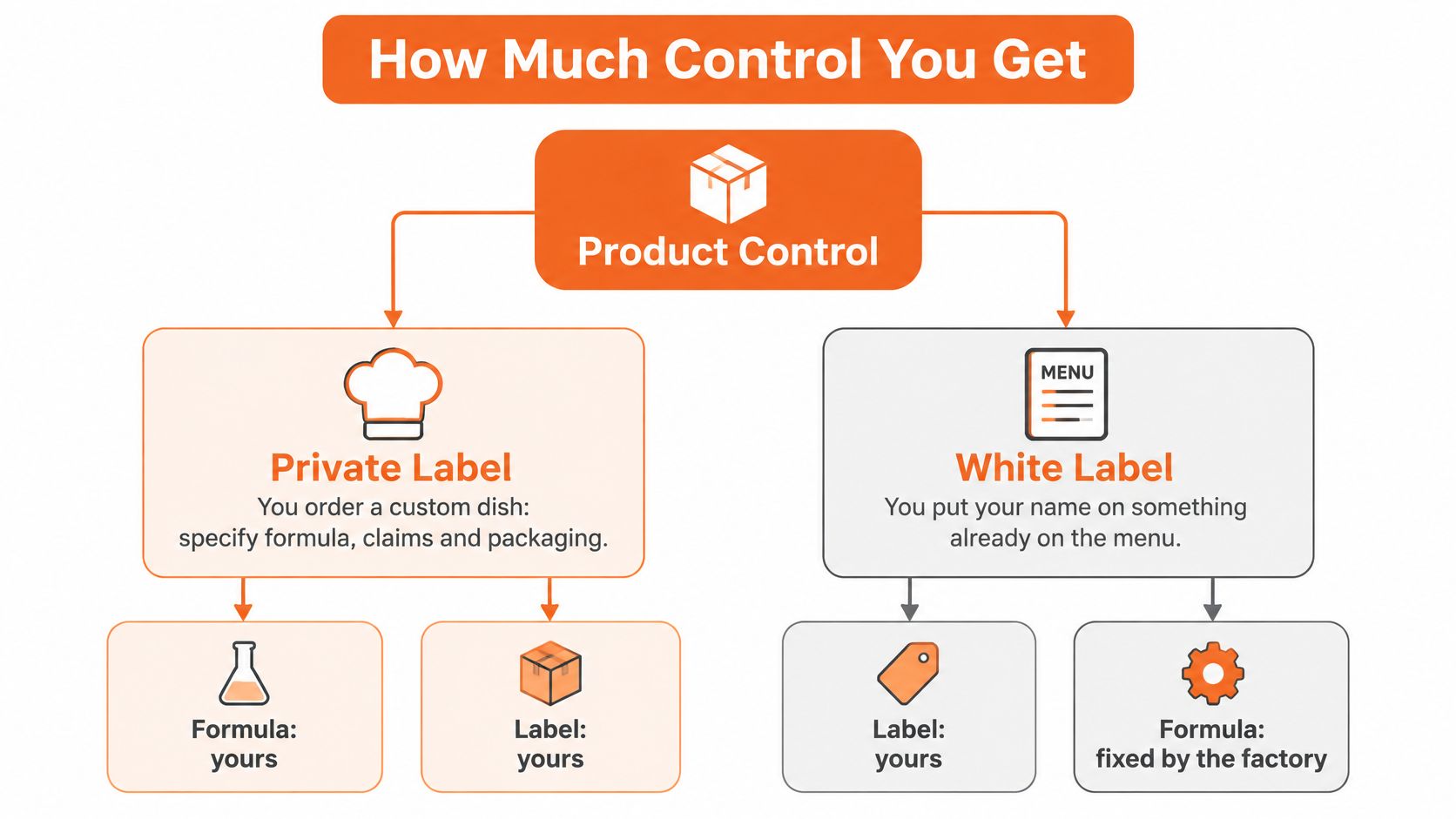
Think of private label as ordering a custom dish from a restaurant. White label means putting your name on something already on the menu. Thomasnet's manufacturing comparison uses this distinction to explain how you can change the product itself rather than its branding alone.
You don't need every kind of control. You need control over the attribute that gives your customer a reason to choose you.
Choose your level of change
- Label and packaging only. You change the presentation while keeping the underlying product.
- Color, tags, and pack size. You adjust appearance or quantity, but you still need to check component availability and packing requirements.
- Ingredients or formulation. You change what the product contains, so you need samples and evidence that the revised formula performs as intended.
- Materials and components. You change physical construction, which can affect durability, fit, compatibility, and purchasing minimums.
- Molds, tooling, and certified manufacturing steps. You commit to production assets or processes that can make switching factories harder.
As you move down that list, expect more development work, supplier coordination, and testing. Don't assume a small-looking change creates a small manufacturing task.
Say you're launching candles. Choosing a different stock jar changes the presentation, although you still need to check how the finished candle burns in it. Changing the wax blend reaches further: you must evaluate how the wax, fragrance, wick, and container work together.
Separate control from ownership
In white label, you generally supply your name, logo, and label for a catalog product. With private label, you can negotiate changes to design and packaging, but payment for development doesn't automatically establish ownership.
Treat the diagram's ownership shorthand as something to negotiate, not a promise. Your agreement must identify who owns the formula, artwork, production files, and tooling, and what you can take to another manufacturer.
Start with the smallest change that creates a customer-relevant difference. Extra customization without a buying reason is extra work.
What Each Model Costs to Start
Minimum orders and starting spend by model
These figures describe a 2026 beauty-manufacturing benchmark, not a universal startup budget. QuickOEM's beauty-category benchmark puts white-label minimums at 300–2,000 units per SKU, initial spending at about $3,000–$8,000, and full custom manufacturing at 5,000–20,000 or more units, with the custom development and product-line costs below.
| Model | Minimum Order | Starting Spend | Formula Development |
|---|---|---|---|
| White label | 300–2,000 units per SKU | About $3,000–$8,000 | None, uses the catalog formula |
| Private label | 5,000–20,000 or more units | About $38,000–$88,000 for a complete product line | At least $15,000–$30,000 |
Category and supplier matter. Full custom manufacturing sits at the expensive end of private label. A packaging-only project won't necessarily require the same development commitment, and a complete product-line budget doesn't describe the cost of a single stock item.
General comparison benchmarks can put white-label minimums below the beauty ranges. That's why you should price your actual product rather than build a budget around the cheapest minimum you find online.
Suppose you have $10,000 available, purely as a planning example. A white-label first run could leave room for a focused product test, although you'd still need to budget for the launch. Full formula development could exceed that entire allowance before you buy finished inventory.
Build the cost stack before choosing
Your supplier's unit price leaves out expenses that can change the decision:
- Before production: Sampling, formula work, packaging design, testing, and setup.
- At shipment: Freight, insurance, duties, and receiving costs.
- After arrival: Storage, damaged units, fulfillment, returns, and unsold stock.
Use a spreadsheet to separate one-time development expenses from recurring costs. Our guide to calculating production costs can help you structure that calculation without confusing the factory price with your full cost.
Start with minimum order × unit cost. Add setup, sampling, testing, packaging, freight, and duties, then reserve enough cash to sell the goods.
Also ask when each payment falls due. A reasonable total can still strain your business if you must pay development fees, packaging deposits, and production balances before you collect customer revenue.
Budget check: If you can't absorb the full loss of the opening order, reduce the commitment before you negotiate a lower unit price.
Timeline From Idea to First Sale
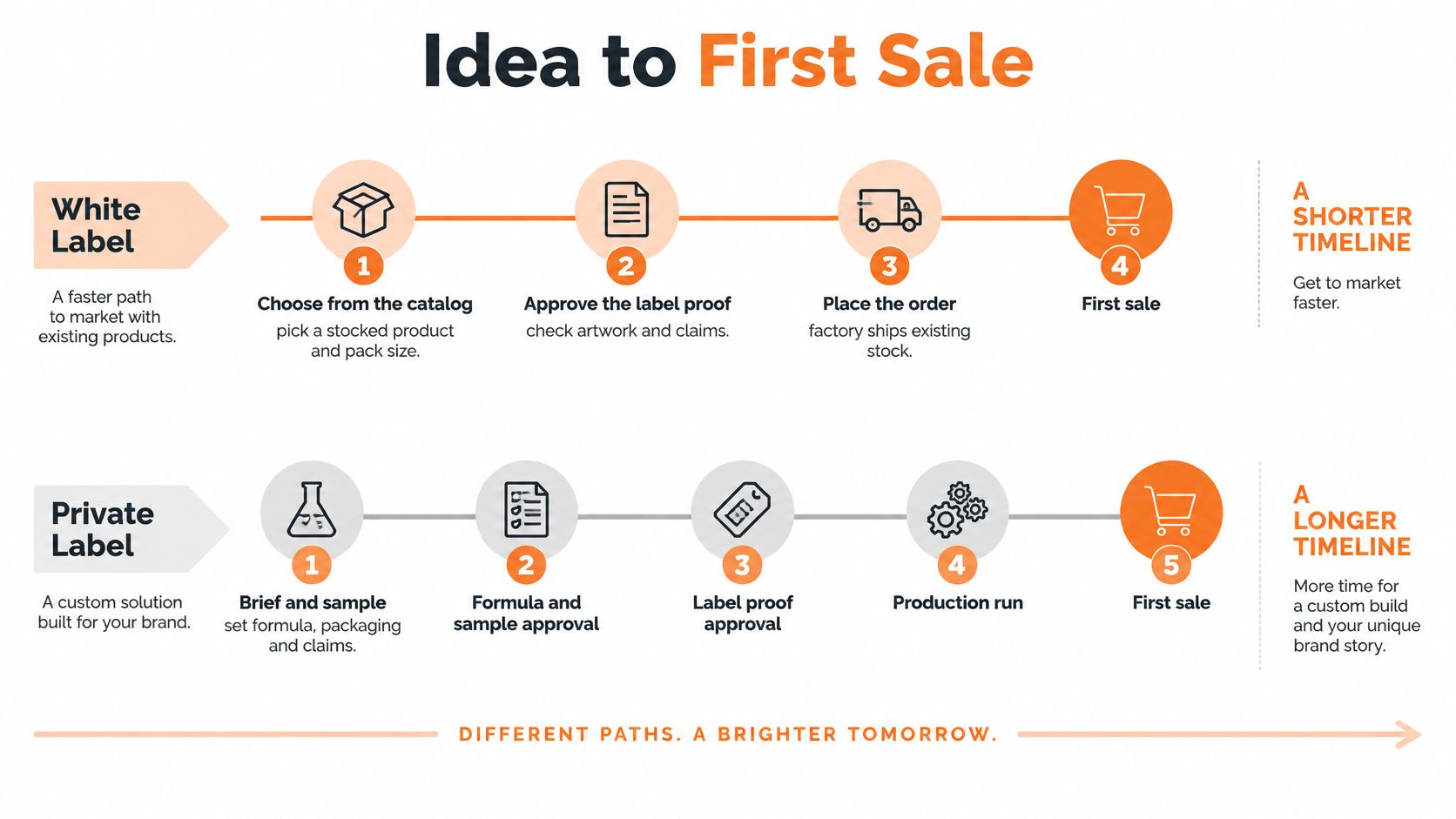
White label usually follows a short path: choose a catalog product, approve the label proof, and place the order. You still need to confirm stock availability, artwork requirements, and shipping arrangements before promising a launch date.
Salesforce's white-label guide explains the speed difference through research and development: you skip much of that work with an existing product, while customization requires development and testing.
Use this process comparison to separate a factory's production schedule from your complete launch calendar.
Map the private-label dependencies
- Define the specification. Resolve ingredients, dimensions, performance requirements, and tolerances before the factory estimates the work.
- Develop or adapt the product. Allow for ingredient sourcing, component availability, and technical questions.
- Make and revise samples. Include time for shipment, evaluation, feedback, and another sample if the first misses the brief.
- Complete testing. Confirm which tests you need and whether a failed result requires another development round.
- Develop the packaging. Check fit, artwork, label content, and component supply before approving production.
- Schedule manufacturing. Get a confirmed production slot rather than assuming the factory starts immediately after approval.
- Arrange freight and receive stock. Include transport, customs when relevant, receiving checks, and fulfillment preparation.
Some tasks can overlap. Don't overlap tasks that depend on an unresolved decision, though. Printing packaging before finalizing the formula or claims can leave you paying to replace it.
Work backward from the selling date
Suppose a factory quotes six weeks of production in a hypothetical project. That quote doesn't include your sampling discussions, testing, packaging approvals, or freight unless the supplier explicitly includes them.
Build the calendar backward from when you need sellable stock. Place the slowest dependency first, assign an owner to each approval, and ask what happens when a sample fails. You'll get a more useful schedule than a single optimistic delivery date.
Finding and Vetting a Supplier
Will you sell the same item to other brands? Start there, then request the catalog sample and specification sheet. You need to know what you're buying before you compare prices.
For a practical starting point, use our guide to finding a manufacturer for your product. If you're sourcing jewelry for an online store, HonHo Wholesale Jewelry's supplier vetting guide for Shopify sellers gives you a category-specific companion.
Request a written supplier packet
- Commercial details: Ask for the minimum per SKU, quantity-break pricing, sampling charges, setup fees, and payment schedule.
- Product evidence: Request test reports for the exact item, relevant certificates, and the factory's quality-control procedure.
- Reference contact: Ask for a past customer you can contact about communication, consistency, and problem resolution.
- Delivery terms: Record the lead time, who pays freight and duties, and the remedy for a late or defective order.
Compare like with like
Send the same specification sheet to your shortlisted suppliers. Otherwise, you might compare a quote that includes packaging and testing with one that excludes both.
Don't choose the lowest unit price until you've checked the fees around it. A supplier who answers clearly in writing gives you something you can evaluate; one who dodges basic questions asks you to fund uncertainty.
Differentiation and Pricing Power
You might assume private label gives you exclusivity. The name alone gives you no reason to make that assumption. You need a defined specification and an agreement that reserves it.
WisePIM's comparison connects private-label differentiation with contractual control over specifications, intellectual property, tooling, and exclusivity. You can negotiate a product that competitors can't source from the same factory, but you still need customers to care about the difference.
Define what you're reserving
A useful exclusivity clause identifies the protected product instead of relying on a broad product name. Attach the formula identifier, approved drawing, component list, or other specification that describes your actual item.
Then define the boundaries:
- Sales channels: Specify whether the restriction covers marketplaces, direct sales, wholesale, or all agreed channels.
- Territory: Name the geographic area where the restriction applies.
- Duration: State when protection starts, when it ends, and how renewal works.
- Permitted alternatives: Clarify whether the supplier can sell a near-identical version with a minor change.
Ask a qualified lawyer to turn the commercial agreement into enforceable terms for your situation. A broad promise can disappoint you when the actual restriction covers less than you expected.
Test the customer's reason to pay
Say you sell shampoo. If shoppers can compare your standard formula with an identical bottle under another name, you'll need a reason beyond the contents to hold your price.
A custom formula with a documented benefit can create that reason. A different fragrance that your audience doesn't care about may increase your costs.
Use concrete examples of product differentiation to distinguish a meaningful improvement from a cosmetic change. You can also compete through service, education, convenience, or a focused audience, so don't assume every white-label product requires a formula overhaul.
Ask: If a competitor bought my exact product tomorrow, why would someone still choose mine?
Then calculate margin using your full landed cost, development expense, fulfillment, returns, and selling costs. A higher retail price won't rescue a product if customization consumes the extra contribution. Negotiate protection for the change customers value, rather than paying to make every part different.
Risks and Contracts to Check Before You Sign
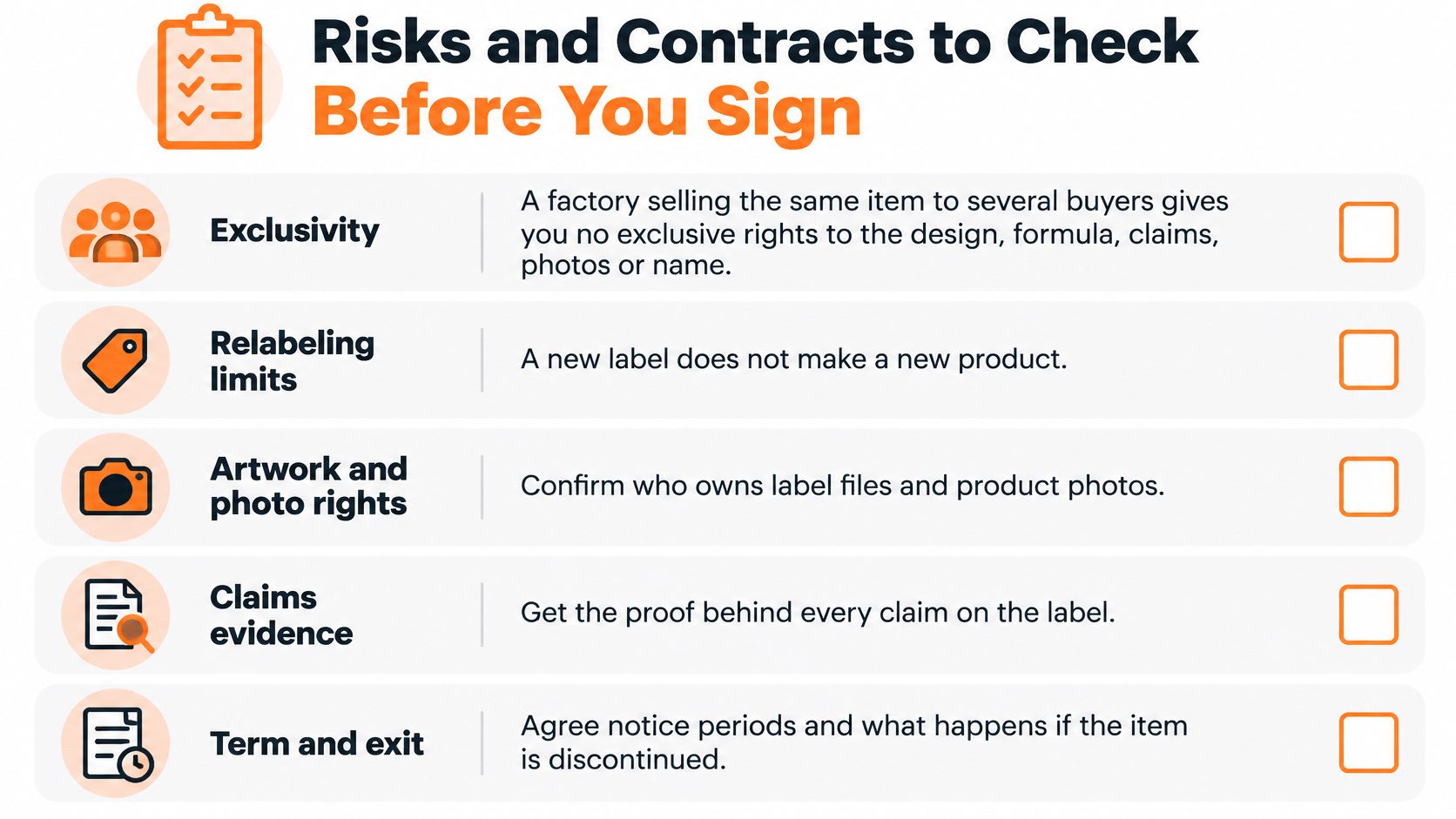
More customization can create more risk. If you commission an untested formula or print a performance claim you can't support, you create obligations that a standard catalog product may never have required.
A factory's willingness to sell you an item doesn't establish your exclusive rights to its design, formula, claims, photographs, or name. Relabeling also doesn't automatically transfer your product-safety, labeling, traceability, or recall responsibilities to the factory.
Use this checklist to organize the documents you need before paying a deposit.
Put responsibility in writing
- Confirm ownership. Identify who owns the design, formula, packaging files, photography, tooling, and brand name, along with your rights to use each asset.
- Check competitor access. Ask whether the factory sells the identical item or an equivalent version to other buyers, then document any restriction.
- Verify testing. Request reports and category-relevant certifications that match your actual product, materials, and intended use.
- Substantiate claims. Match every health, safety, environmental, or performance statement to evidence before printing labels or publishing listings.
- Allocate financial responsibility. Define indemnities, insurance requirements, recall coordination, customer notification, and who pays the associated costs.
- Set quality and audit rights. Attach approved specifications, describe inspection rights, and require your approval before the factory changes materials or processes.
- Plan the exit. Agree on termination, notice periods, remaining inventory, tooling release, and the documents you can take to another supplier.
Check how the documents work together
A supply agreement, purchase order, specification sheet, and email approval can contain conflicting terms. Don't assume your preferred clause controls because you sent it last.
Supply Automate's explanation of purchase order terms and conditions can help you identify purchasing terms to discuss with counsel. Ask your lawyer to specify which document takes priority and how both parties approve changes.
For a white-label order, inspect the supplier's evidence rather than assuming an existing product is safe for every market or claim. For a private-label order, identify what your changes require you to test again.
Keep signed approvals, reports, batch identifiers, and supplier correspondence in an organized product folder. If you need to investigate a defect, you'll want to connect the affected goods to their specification and production records.
The contract allocates commercial risk; applicable law can still impose duties you can't sign away. Judge the arrangement by those responsibilities, not by its label.
Pick Your Model and Confirm the Supplier Terms
Which model fits your situation
| Your Situation | Better Fit | Why |
|---|---|---|
| Testing demand on limited cash | White label | Low minimum orders and a quick first run let you learn before you commit |
| Customers ask for one specific change | Private label | The change becomes your differentiator once evidence supports it |
| Standard item sold mainly on price | White label | Shoppers compare shared products on price, so speed matters more |
| Premium product with repeat purchases | Private label | Contractually reserved specifications can protect margin and reduce direct comparison |
| Unclear legal duties or testing needs | Either, after diligence | The supplier documents help you assess which arrangement you can responsibly use |
Even when products look similar, you need to choose the sourcing commitment behind them.
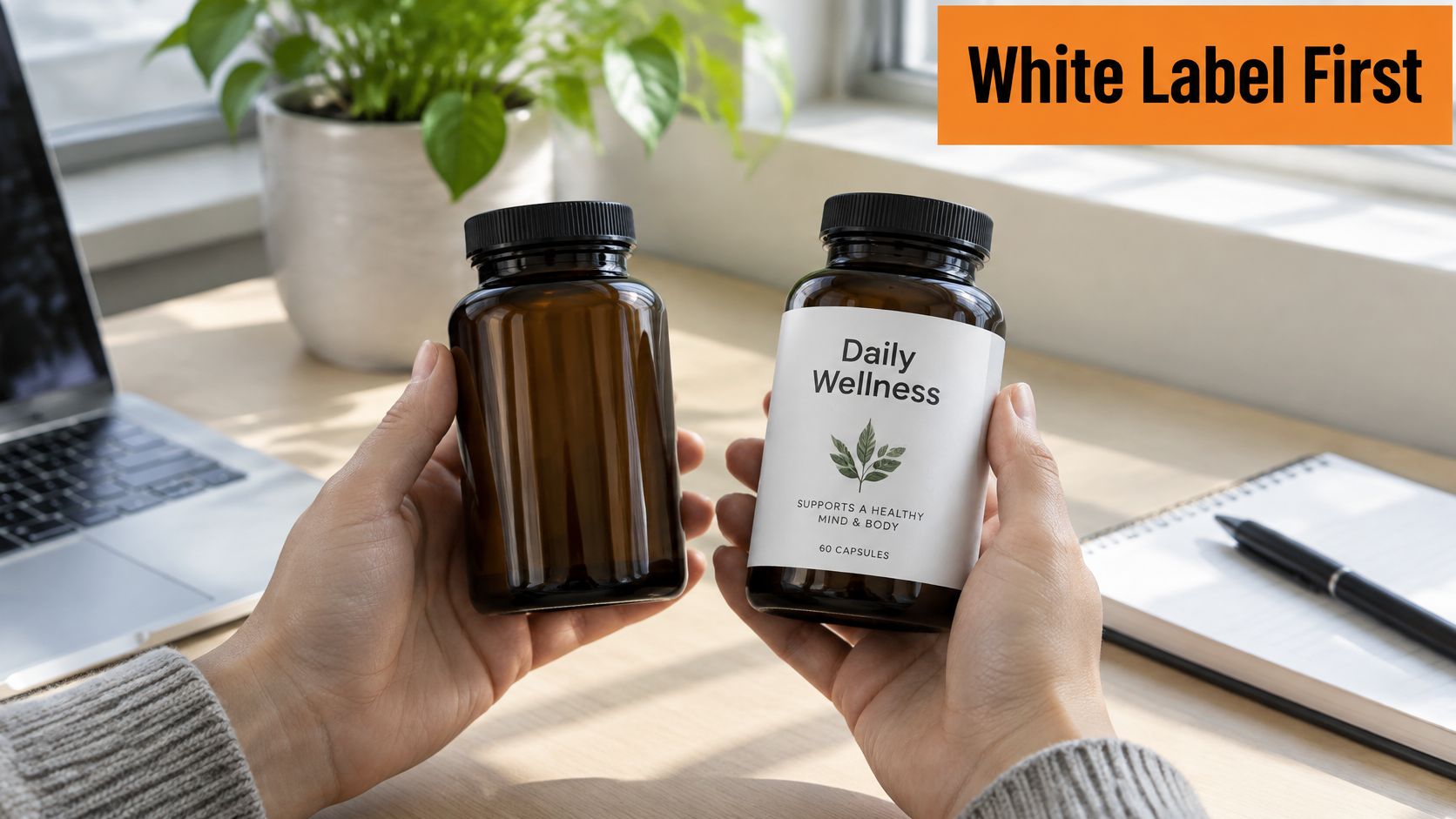
Treat this as a stage decision, not an upgrade path. You can keep a successful white-label product while developing a separate custom item. You can also abandon a proposed custom change when customers won't pay for it.
Start by learning whether people buy, what price they accept, and which truthful, supported message helps them understand the product. Move into private-label development when customer feedback identifies an attribute worth funding and you can carry the inventory without starving the rest of the business.
Turn the choice into an order decision
- Pick the arrangement that matches your evidence. Write down the uncertainty you're trying to resolve, whether that's basic demand or willingness to pay for a specific improvement.
- Get the supplier terms in writing. Resolve ownership, testing, quality, delivery, and exit rights before treating a quote as an actionable option.
- Run the cash and calendar math. Include the complete opening commitment and every approval between your deposit and sellable stock.
Use the video as a discussion prompt while you compare your options.
Your next move doesn't need to involve a deposit. Send your top two suppliers the same specification sheet and ask for written answers on price, minimums, testing, ownership, and delivery. Compare what each supplier agrees to do, then choose the smallest commitment that answers your next business question.
We run a free community for kind, bold, hard-working Chicagoans and Midwesterners who are building brands, with groupchat access included in membership. If you want to compare sourcing questions with other founders, visit Chicago Brandstarters and apply to join. Bring your supplier comparison and the decision you're trying to make.
Leave a Reply