

Say your truck runs fine, your loads are full, and you still end the month with less cash than you expected. I have seen that gap many times. It's usually a money problem, not a driving problem.
You rolled the miles and the settlement landed. Then fuel, a worn tire, a broker who sits on your pay, and a tax pile you never moved all take a cut. The rate sounded fine. Your account says otherwise.
I treat owner operator advice like a leak check. Where the money really goes isn't the rate on the load board. Deadhead miles, slow brokers, and an April tax bill are the holes I watch. Gross revenue is water in the bucket.
If you can't say what the last load cost you, you don't know if you got paid.
Cost is the hole, and profit is what doesn't leak before you get home. You can run these checks between fuel stops.
The eight tips below fix the leaks that drain independent drivers, from loads that lose money to tax bills that arrive without warning. Each one has a worked example, so you can test it on your own freight this week. Pick the leak that's emptying your account and plug that one first. Don't wait for a bad month.
1. Split Your Business and Personal Money
Open a separate business checking account and pay yourself a set amount on a fixed day. I want every dollar in its own lane, like a fuel line between the truck and your wallet. Mixing settlement cash with grocery cash hides your real profit. Tax time turns into a glovebox scramble.

Say a settlement of $4,200 hits on Monday. You pay yourself $800 that week. You move $1,050 into a tax account before you buy fuel. That's a quarter of the check, and I tell drivers to start near there until an accountant sets a better number.
What's left has to cover diesel, insurance, and the truck note. If the business account can't cover those bills, you didn't profit. You spent next week's money.
What to move before you spend
- Business card only: Put fuel and truck costs on a debit or fuel card. Snacks stay off it.
- Friday review: Match every charge to a load or a bill.
- Ask your accountant: Get the tax percentage that fits your income, then stick to it.
Friday habit: Review the business account every Friday. If you can't explain a charge in one sentence, pull it out.
Do this on the next settlement, not next month. The split only works if the tax money moves before the fuel card does.
2. Price Every Load by Cost Per Mile
The American Transportation Research Institute analysis of trucking costs reported that average trucking operating costs fell from $2.270 to $2.260 per mile in 2024. A $3.00 loaded-mile rate can look profitable, but a 15% deadhead rate changes the effective revenue to about $2.61 per total mile before other deductions. I use that benchmark as a warning, not as your personal cost. A paid-off tractor or a rough repair year can move your number a lot.
Watch this before you price the next load.
Say a load pays $2,400 for 1,000 loaded miles. You still drive 200 empty miles to the pickup. At $2.10 per mile, those 1,200 total miles cost $2,520. You lose $120 on a load that looked fine on the board.
Build the number you will not cross
- Recalculate every month: Add fuel, insurance, truck payment, maintenance, permits, and your own pay.
- Track each fill-up: Write the price and the miles per gallon before you leave the island.
- Set a minimum loaded-mile rate: Search only above that number.
Compare the rate per loaded mile with your full cost per dispatched mile, including empty miles. If the load doesn't clear that bar, it isn't a favor. It's a donation.
3. Build a Repair Fund Before You Need It
Repair and maintenance sat at $0.198 per mile in the 2024 benchmark laid out by ATOB's owner-operator cost breakdown. If you run 94,000 miles, that category alone equals roughly $18,612. Treat the fund like a spare tire. A quiet month doesn't mean the next brake job vanished.

Truck payments sit there whether you roll or you sit. Fuel and repairs move with the miles. I want two numbers on paper, fixed cost per week and variable cost per mile. A low-rate load can cover fuel and tolls and still wreck the week if the payment and the insurance aren't already protected.
Say you move $150 from each weekly settlement into a repair account. After 20 weeks you hold $3,000. A brake and tire job shows up on a Thursday afternoon. You pay it from the fund the same day, with no card and no advance on the next load.
Where the money sits
- Automatic transfer on payday: Move the cash before you see it.
- Keep it off your everyday debit card: If you can tap it for dinner, you will.
- Pause new equipment: Don't buy extras until the fund hits the target you wrote down.
Owners who skip this step borrow against future loads. That debt stacks faster than the odometer.
4. Vet Brokers and Shippers Before You Haul
Say you like a rate, then you check the broker on Carrier411 before you accept. You see several unpaid claims. You pass. That pass can save you weeks of waiting on money you already earned with diesel you already burned.
A slow payer freezes your cash even when the rate looks strong. I look up operating authority and insurance on the FMCSA SAFER system before I sign. It's free and public. Then I read payment notes on a broker review site.
A strong rate from a broker who pays on day 60 is a loan you didn't agree to give.
Say the load pays $2,800 and quick pay takes 3%. That's $84 gone before you roll. If they pay in 45 days anyway, your fuel card statement still arrives first. You float the trip. I would rather take a thinner rate from a broker who pays in two weeks.
Before you send the truck
- Confirm the MC number and the surety bond: Match them to the rate confirmation.
- Ask for a credit application: Do it before the first load, not after a missed pay.
- Keep the paperwork: Rate confirmation and bill of lading stay in one folder for every load.
If the broker won't answer those checks, you already have your answer. Leave the load on the board.
5. Keep a Preventive Maintenance Schedule
Service the truck by mileage, not by memory. Oil, filters, brakes, tires, and the annual inspection go on a calendar you write down. Preventive work costs less than a tow and a missed pickup. Clean records also help when an inspector steps up to your door.
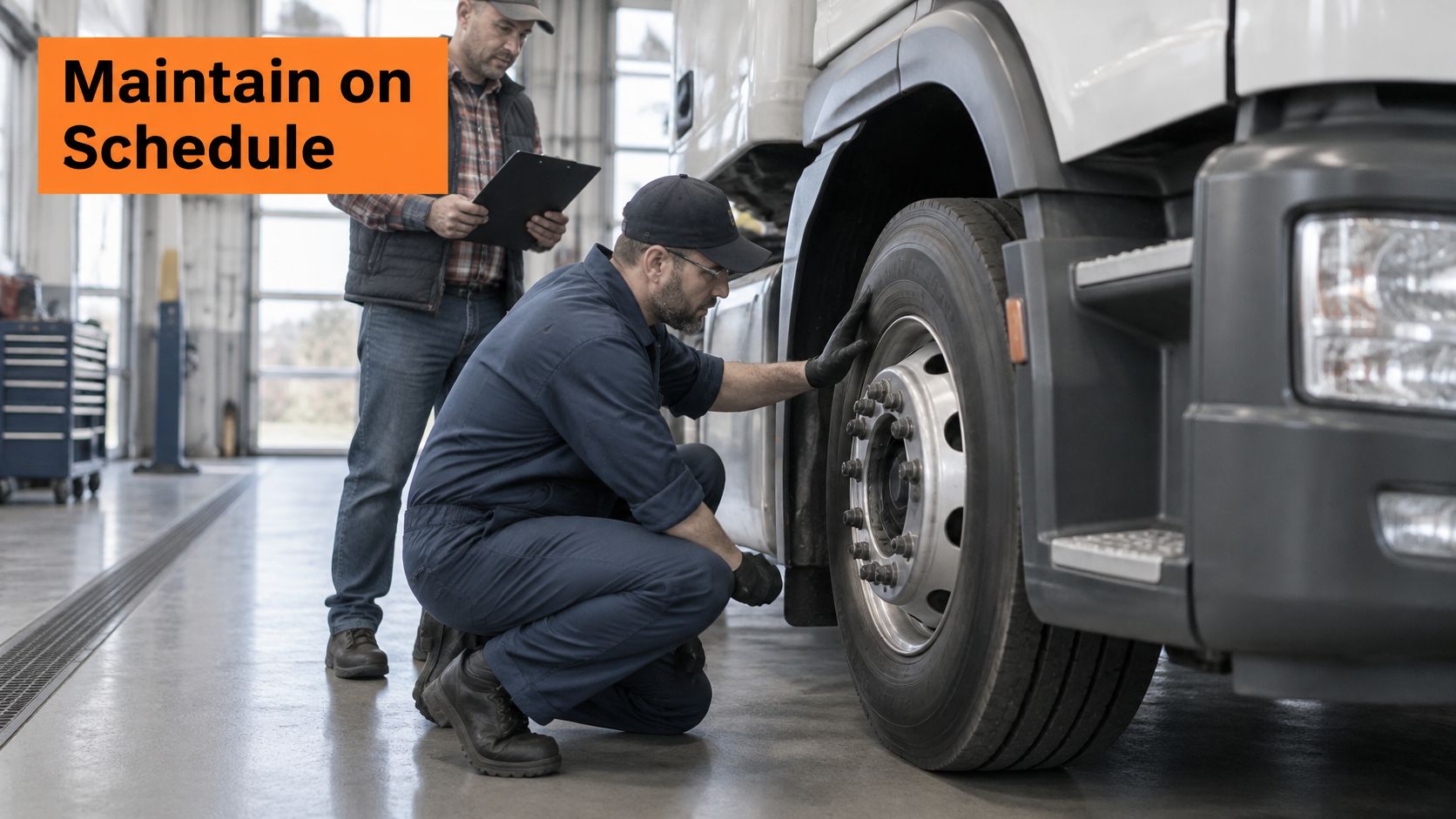
Say you log every oil change and you notice the brakes wearing early, closer to 40,000 miles than the interval you planned. You fix the slack or the lining on a Saturday, in a shop you chose. You don't find out on a ramp with a hot drum and a load that won't wait.
What I check between loads
- Phone reminder: One alert for each service interval, set the day you finish the work.
- Photos at the fuel stop: Tires and brake pads, same angle each time, so wear is obvious.
- Latest inspection in the cab: Paper or a file you can open with no signal.
A roadside call eats the day and the next load. A planned stop eats an afternoon. I take the afternoon. Write the mileage on the receipt before you leave the shop, or the log is just a story.
6. Stay Current on Compliance Paperwork
Put every permit and filing on a calendar you check. That list includes IRP registration, IFTA fuel tax returns, the Unified Carrier Registration, the BOC-3 process agent filing, Form 2290 heavy vehicle use tax, insurance certificates, and drug testing enrollment. One missed renewal can park your truck or freeze your operating authority.

Overdrive's Partners in Business guide notes that new entrants can face a safety-audit correction deadline as short as 10 days when inspectors find certain problems. For IFTA, you track the miles driven and gallons purchased in each state so the fuel-tax filing is right. I block a weekly hour for that bookkeeping. Driving is the trip. The records keep the truck legal to roll.
Deadlines I won't trust to memory
- Alerts 30 days out: IRP, IFTA, UCR, Form 2290, insurance, and drug-test enrollment.
- One digital folder: Every filing and every certificate, named by date.
- SAFER check each quarter: Confirm the profile matches what you think is active.
Say you file IFTA every quarter from a mileage log you update on Fridays. You skip the penalty letters that show up when miles and gallons don't match. If you hire a bookkeeper, you still own the filings, so keep access to the records and a written list of due dates.
7. Pay Estimated Taxes Every Quarter
Nobody withholds taxes from your settlement. You pay them yourself. You owe self-employment tax on net earnings, plus income tax, and the IRS expects estimated payments through Form 1040-ES. Skip the transfers, and April can take the profit you thought you made.
Say a $3,600 settlement hits. You move $900 into a tax account the same day. You do that on every check. When the quarter ends, you send the Form 1040-ES payment from that account. No scramble and no "I'll catch up after this lane."
I start many drivers near 25 percent, then I want a trucking tax pro to adjust it. Your number moves with deductions, a truck note, and your home state. Don't copy another driver's percent because their truck is paid off and yours isn't.
Keep the proof
- Hire a tax pro who knows trucking: Per diem, depreciation, and fuel tax shouldn't ambush you in March.
- Log the expense when it happens: A phone app beats a shoebox in the bunk.
- Save tolls, scales, and lumper fees: Those receipts cut your net. They aren't trash.
The tax account is not extra money. It's money that was never yours.
Send the quarterly payment on the same week you fuel for a long run. Tie it to a habit you already have, or you'll slide it.
8. Build a Peer Group You Can Call
You can spend ten hours in the seat and talk to nobody who understands a bad lane. I don't think that's a character test. It's just the job, and it gets expensive when you guess alone.
Say a driver in a small group hears that a broker stopped paying. She drops that load before she burns 180 deadhead miles to a pickup that won't cash. One text saved the fuel and the week. That's cheaper than any load board subscription.
Chicago Brandstarters runs small, private dinner groups and a group chat for builders who want this kind of support, led by founder Kevin Tao. The rooms stay small on purpose. You can talk about a truck that keeps failing, a rate that looked good and wasn't, or a week that shook you. What's shared stays in the group.
How I would join a group
- Vet new members: Don't share your cost per mile with someone you haven't checked out.
- Keep stories confidential: If people perform, the useful talk dies.
- Show up when you feel fine: The check-in works better before you're already stuck.
You can start with two drivers you already trust. A call every other week is enough until you want a bigger circle.
How the eight owner operator advice tips compare
Use this table to match each money leak with a practical tool and the risk it helps control. The tools work together: a cost-per-mile check can expose a weak rate, while broker checks help reduce the chance of waiting on an unpaid invoice.
| Item | Core Tool or Source | Main Risk Avoided |
|---|---|---|
| Split your business and personal money | Separate business and tax accounts | Hidden profits and tax-time confusion |
| Price every load by cost per mile | Cost-per-mile calculation that includes deadhead miles | Accepting loads that lose money |
| Build a repair fund before you need it | Dedicated repair savings account | Relying on high-interest debt after a breakdown |
| Vet brokers and shippers before you haul | FMCSA SAFER lookup and broker payment history | Unpaid invoices and delayed payments |
| Keep a preventive maintenance schedule | Mileage-based service log and inspection records | Surprise breakdowns and inspection problems |
| Stay current on compliance paperwork | Deadline calendar and organized filing records | Fines, out-of-service orders, or frozen authority |
| Pay estimated taxes every quarter | IRS Form 1040-ES and quarterly payments | Underpayment penalties and surprise tax bills |
| Build a peer group you can call | Private peer group and regular check-ins | Isolation and missed industry warnings |
Start with the row tied to your biggest current leak. If deadhead miles are eating into a rate, calculate the full trip cost before accepting another load. If a repair would force you onto expensive credit, set aside money in a dedicated account. For slow-paying brokers, check payment history before committing your truck and time.
Keep the tools simple enough to use between loads. A separate account makes business cash easier to track; a maintenance log helps you plan service; and a deadline calendar keeps paperwork from slipping. For taxes, use Form 1040-ES to organize quarterly payments. For support, a peer group can provide a place to compare decisions and share industry warnings.
Pick One Lesson and Start This Week
Eight tips can feel like a lot at once, so start with the one that leaks the most money. For most drivers, that means splitting accounts and pricing loads by cost per mile.
Open the separate account, write down your fixed costs, and check your next load against your minimum rate. Once that habit sticks, move on to the repair fund and the compliance calendar. Each small win protects the cash that keeps your truck moving.
A week you can actually finish
On Monday, open the business account if you don't have one, and move a tax share out of the last settlement before you fuel. On Tuesday, list the truck payment, insurance, and permits, then divide by the miles you expect to run. That number is your floor for the week.
On Wednesday, price the load on your screen and add the empty miles to the pickup. If the rate doesn't clear your floor, you pass or you renegotiate. On Thursday, schedule the repair transfer, even if the amount feels small.
- Friday calendar: Put IRP, IFTA, UCR, BOC-3, Form 2290, insurance, and drug-testing enrollment on one list, with alerts 30 days out.
- Saturday receipts: Photograph tolls, scales, and lumpers into one folder before they fade in the sun.
- Sunday call: Text one driver you trust and compare a lane. If you want a standing group, Chicago Brandstarters hosts private dinners for a few builders and a group chat, led by founder Kevin Tao.
You don't need a newer truck to start. You need two accounts, a minimum rate, and the nerve to turn down a pretty number that loses money. I would do the account split on the next settlement. The other habits get easier once you can see your cash.
Peer talk helps when a broker goes quiet or a truck keeps failing the same way. A small group gives you a place to trade rate notes and warnings before you book the next load. Keep those talks private, and don't share your full numbers with someone you just met.
Chicago Brandstarters has a free, vetted community for kind, hard-working builders in Chicago and the Midwest, with small private dinners and a group chat where operators share hard lessons and direct help. If you're an independent driver or a solo operator who wants straight talk about cash, brokers, and lonely weeks on the road, that circle matches the work in these tips. Visit Chicago Brandstarters and see if the next dinner is the right room for you.
Leave a Reply