
You have $2,000 a month, a store you just launched, and more marketing advice than you can use. You're packing orders after work, fixing product photos on weekends, and wondering whether your next dollar belongs in email software, creator samples, or Google Shopping. Every dollar has to work.
I'd start with the work closest to a purchase. Help an interested shopper finish an order. Answer the question that keeps someone from buying. Then pay to reach more people who have that same problem.
You don't need to run every channel this month. You need a small test you can afford, a way to track purchases, and enough margin left after shipping to keep going.
- Use what you have. Start with customer questions, existing visitors, and people who already gave you permission to contact them.
- Buy information carefully. Treat your first campaigns as tests of a product, message, and audience.
- Count the full cost. Include samples, discounts, software, shipping, and your time when you judge a channel.
These ten ecommerce marketing strategies cover owned channels like email and paid tools like Google Shopping. Each has a starting move, a practical trade-off, and a Midwest founder scenario you can adapt without pretending you have a national brand's budget.
I'd work through them in this order, but I wouldn't launch them all. Choose what fits the customers and traffic you have today.
1. Email Marketing
Email gives you a direct way to reach people who asked to hear from you. I think of your subscriber list as a mailbox you control, although you still need permission, reliable delivery, and messages people want.
Start with an abandoned-cart flow. Remind shoppers what they left, answer a common question, and give them a clear route back to checkout. Don't assume you already earned that sale, and don't lead with a discount when a helpful reminder might work.
Litmus reports an average return of $36 for every $1 invested in email marketing, but I'd treat that as a planning reference rather than a promise. Your list quality, costs, attribution, and product margins will determine your result.
Build a Useful First Sequence
Say you run a Chicago candle brand. You could introduce your scents, explain how to choose one, and teach buyers how to care for the wick before sending another promotion.
- Give people a reason to join. Try early access, a scent-selection guide, or a discount you can afford.
- Separate customer groups. Send first-time subscribers different messages from repeat buyers.
- Track purchases and complaints. Review revenue per delivered email, unsubscribes, and contribution margin rather than open rates alone.
I'd add welcome messages after the cart flow, then post-purchase education. Glossier-style community updates and Allbirds-style product announcements are useful formats to consider, but copy the purpose rather than the tone.
Authenticate your sending domain with SPF, DKIM, and DMARC. A large list won't help if you can't reach it.

2. Search Engine Optimization (SEO)
Say you sell leather wallets from Milwaukee. You'll have a hard time competing for wallets, but you can write a useful page for someone searching for a leather wallet for slim pockets. That shopper has already told you what matters.
Start by improving the product page closest to that specific need. Write an original title and description, show the wallet beside familiar objects, and explain capacity, dimensions, leather, and returns. Don't paste in supplier copy and expect shoppers to understand why yours costs more.
SEO takes work before you can judge the return. I'd choose it when you can answer a clear buying question better than the pages a shopper currently finds.
Make Your Product Easy to Interpret
Google's product documentation explains how Product structured data and Merchant Center submissions can supply price, availability, ratings, shipping, and return information. You can use both, and you should keep their details consistent with your visible product page.
Validate your markup with Google's Rich Results Test. For related sizes or colors, check whether your setup correctly connects variants through ProductGroup and Product markup.
- Target buying language. Use the words customers use when they describe the problem.
- Connect useful pages. Link a sizing guide to the relevant products.
- Test on your phone. Read the description, select a variant, and complete checkout yourself.
Backlinko's detailed-guide approach is a useful editorial reference. For a small store, though, I'd fix product and category pages before attempting an enormous library of articles.
3. Social Media Marketing
You don't need a studio to explain why your product exists. You need a clear demonstration and a reason for someone to care.
Say you make cycling bags in Minneapolis. Film yourself fastening a bag to a bike, loading it, and reaching for its contents while wearing gloves. You've answered practical questions that a polished logo animation wouldn't touch.
Your starting move is a phone-shot demonstration on the platform your buyers already use. I'd choose Instagram, TikTok, or Pinterest based on the product and customer, rather than opening accounts everywhere.
Treat social media like a town square. Help someone solve a problem before you ask them to visit your stall.
Use Dollar Shave Club as a reference for a clear, memorable product pitch and Glossier as a reference for customer participation. You don't need to copy either brand's personality.
Watch this example with your own product demonstration in mind.
Turn Attention Into a Test
Reply to questions while the conversation is active. Save repeated objections and use them in your next video or product-page edit.
Track visits, cart additions, and purchases from tagged links. Views can tell you whether people watched, but they can't tell you whether you can afford the channel.
If you later promote posts, resist splitting a small budget across tiny audiences. Meta says its learning period generally needs at least 50 optimization events within seven days, so unnecessary fragmentation can leave each ad set short of useful activity.
4. Influencer Marketing
A creator partnership makes sense when you need someone to demonstrate your product in a setting you can't easily reproduce. Think of a Wisconsin trail runner testing your socks during training, rather than a general lifestyle account holding the package.
Start by contacting ten niche micro-influencers whose content already matches the problem you solve. Read their comments, watch their demonstrations, and check whether followers ask relevant buying questions. A follower count alone tells you very little about fit.
Gymshark's fitness partnerships and Daniel Wellington's watch gifting are familiar reference points. For your small brand, I'd focus on a narrower question: can this creator explain the product convincingly to a relevant buyer?
Agree on the Work Before Shipping
Discuss the product, deliverable, compensation, disclosure, timing, and content rights before you send anything. A free sample doesn't automatically buy you a post or permission to run an ad.
- Use a clear brief. Explain the use case and factual claims, then leave room for the creator's voice.
- Track individual results. Give each partner a tagged link and distinct code.
- Ask for honest feedback. A sizing problem or confusing instruction may matter more than the first campaign's sales.
Flat fees give you clearer deliverables but require cash before results. Affiliate commissions tie payment to tracked sales, yet creators may decline if they expect substantial work.
I'd calculate acquisition cost using fees, product cost, shipping, and discounts. Keep any usable content rights separate in your evaluation, so you don't excuse weak sales with vague claims about exposure.

5. Paid Search and Shopping Ads
Paid search lets you reach someone who already wants an answer. Google Shopping lets that person compare a product image, price, and seller before visiting your store.
I think of paid acquisition as renting a stall on a busy street. You can get visitors quickly, but you pay rent whether they buy or leave.
Start with a high-intent product and a maximum acquisition cost. Subtract product cost, fulfillment, payment fees, expected returns, and the profit you need from net sales. What remains sets your spending boundary, rather than a competitor's ad budget.
Say you sell replacement grill parts from Indiana. A specific compatible-part search deserves a focused landing page, not your general homepage.
Fix the Purchase Path First
Baymard's U.S. shopper research found that 48% of respondents abandoned because extra costs were too high, while 24% cited required account creation. Don't pay to send shoppers into avoidable surprises.
- Verify tracking. Place a test order and check that you record the purchase and correct revenue without duplication.
- Clean the feed. Use accurate titles, images, availability, and variant details.
- Control search intent. Review search terms and exclude irrelevant queries.
- Show the full decision. Explain shipping, delivery timing, compatibility, and returns before checkout.
Amazon Sponsored Products can play a similar acquisition role for marketplace sellers, but don't assume your marketplace economics match your own store.
I'd increase spending only after purchases support the economics. A campaign that generates revenue while losing money on every order hasn't earned a larger budget.
6. Content Marketing
Your support inbox can tell you what to publish next. If people keep asking whether your hiking boots need breaking in, write the answer and show the process.
Start with the question that creates the most hesitation before purchase. Build a useful guide, include original photos or demonstrations, and link to products only where they help the reader.
REI's gear guides and Patagonia's material stories are useful references for teaching through content. You don't need their publishing capacity to explain how to choose, use, or care for what you sell.
Say you run an Ohio skincare brand. A plain-language guide to layering your products could support search, welcome emails, customer service replies, and short videos.
Write for People Who Need Specific Answers
AI-assisted shopping adds another reason to publish clear product facts. Shopify's online shopping trends article reports that 22% of consumers use AI search tools as their primary research channel. I'd respond with accurate information, rather than a flood of generic AI-written posts.
Publish ingredients, dimensions, compatibility, sourcing details you can verify, and honest limits. Explain who should choose a different product.
Editorial rule: Publish the answer you'd give a careful buyer who could ask follow-up questions.
Batch your photography and filming around actual production work. Turn a detailed guide into an email and short clips, but adapt each version to its setting.
The trade-off is time. Useful content requires product knowledge and maintenance, and you may wait for purchases. I'd track assisted purchases, qualified visits, and customer questions before judging a guide by immediate revenue alone.
7. Referral Programs
A referral program gives a satisfied customer a clear reason and an easy way to introduce you to someone else. You can reward the customer with credit and give the friend a first-purchase discount.
Start with a personal invitation to customers who have already expressed satisfaction. You don't need elaborate software to learn whether anyone wants to recommend you.
Say you sell pantry goods from Michigan. After a customer compliments a seasoning blend, send a short note with a referral link and explain what both people receive.
Protect the Economics
Dropbox's storage rewards and Harry's referral approach are useful references, but your physical goods have production and shipping costs. You can't copy a digital-product incentive without checking your margins.
- Reward a completed purchase. Avoid paying for clicks or email signups when you need orders.
- Set clear eligibility. Explain minimum purchases, exclusions, and when you issue credit.
- Limit abuse. Prevent self-referrals and unintended discount stacking.
- Make sharing easy. Use a link that works in text messages without a long signup process.
I'd keep the reward simple enough to explain in a sentence. If a customer needs a diagram to understand the program, you've added work to a favor.
The main trade-off is timing. A new store may have too few happy buyers to generate meaningful referral activity, and an incentive won't repair a disappointing product.
Measure referred purchases, reward costs, returns, and repeat buying. Ask new customers how they heard about you, too, because a friend's recommendation won't always arrive through your tracking link.
8. Customer Reviews and User-Generated Content
A shopper considering your rain jacket wants to know more than whether you like the fabric. They want to see the fit, the pockets, and what a customer says after wearing it outside.
Reviews and user-generated content give you a way to show those details through actual buyers. I think of them as word of mouth you can place beside the purchase decision.
Start with a post-delivery request that asks a specific question. Ask about fit, ease of use, or the problem the customer wanted to solve. Let buyers experience the product before asking for a verdict.
Use Feedback Where Doubt Appears
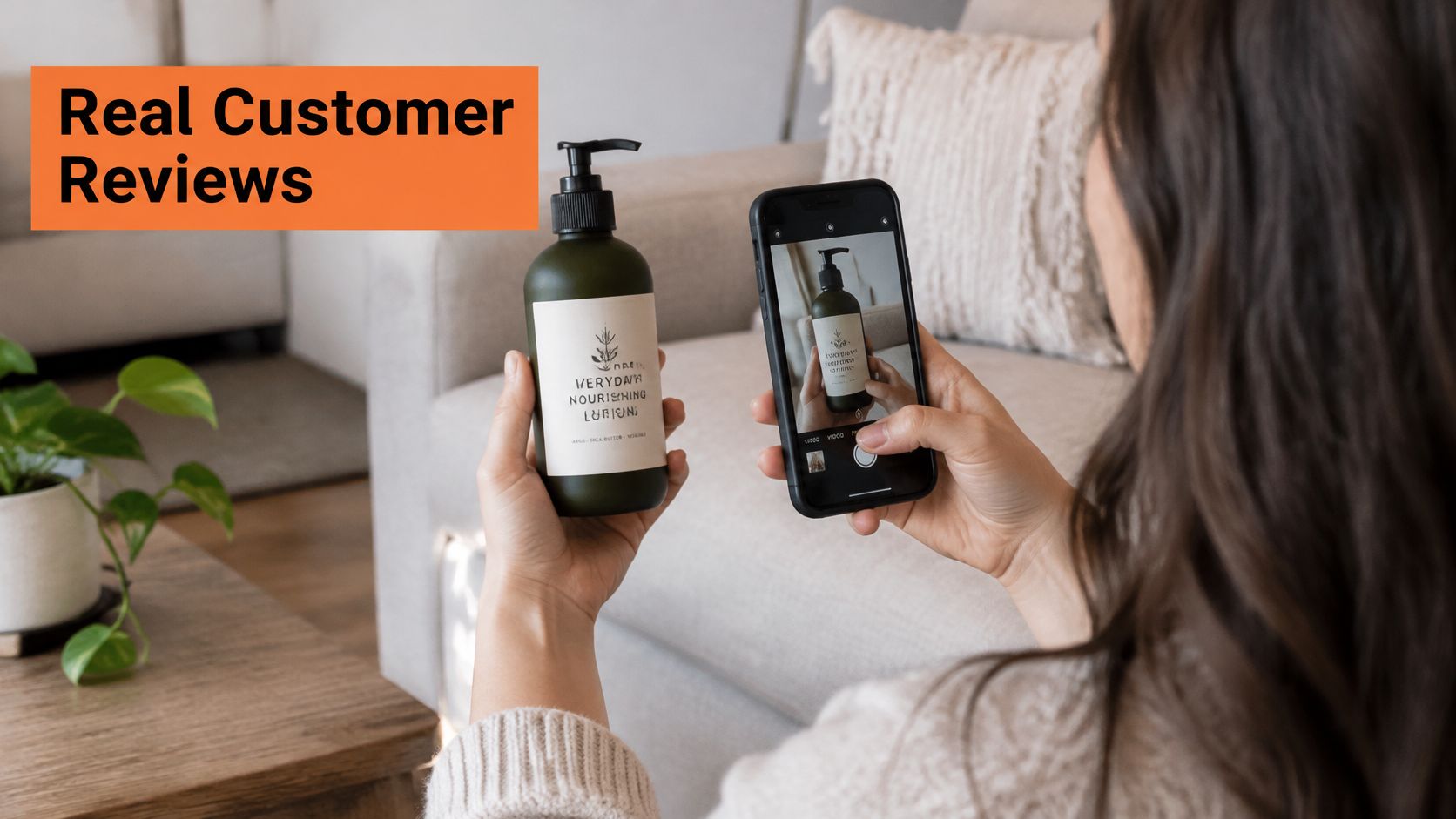
Say you sell lotion from a Chicago workshop. Ask customers to describe texture and packaging, and invite photos without encouraging unsupported medical claims.
Allbirds and Bombas provide familiar product-review examples. For your store, I'd prioritize relevant detail over collecting a large pile of vague praise.
- Ask permission. Get approval before reposting a customer's photo or using it in advertising.
- Keep incentives honest. If you give a thank-you, don't make it conditional on a positive review.
- Answer criticism. Acknowledge the issue and explain the fix without arguing.
- Edit your page. Use repeated feedback to improve descriptions and instructions.
Reviews can't compensate for missing purchase information. Baymard reports that 12% of U.S. shoppers abandoned because the return policy didn't satisfy them, and 9% cited insufficient payment methods.
Place relevant reviews beside sizing, usage, or material details. Keep return terms and payment choices equally easy to find.
9. Subscription and Retention Marketing
Before you sell a subscription, ask whether customers need your product on a schedule. Coffee and pet food fit replenishment better than a durable wallet.
Dollar Shave Club's razor model and Chewy's Autoship are useful references for recurring purchases. Your starting point, though, should be customer usage rather than a desire for predictable revenue.
Start with a reorder reminder before building a subscription program. Say you roast coffee in Iowa. Ask buyers how quickly they finish a bag, then test a reminder that matches their habits.
Personalize With Information You Can Use
McKinsey reports that personalization most commonly produces a 10–15% revenue lift. I'd begin with purchase history and category interest, rather than buying complex software before your tracking works.
Send coffee buyers relevant coffee recommendations. Stop replenishment reminders when someone reorders, and avoid recommending a product they just returned.
A subscription should make the customer's routine easier. Don't make cancellation harder to protect a revenue forecast.
Give subscribers clear pricing and easy ways to skip, pause, or cancel. A discount might encourage signup, but you still need margin after fulfillment and service costs.
For products people rarely replace, try care guidance, complementary purchases, or early access instead. You don't need recurring billing to practice retention.
Track repeat-purchase rate by customer cohort, time between orders, cancellations, and contribution margin. I'd also compare personalized messages with a holdout group when your audience can support it, so you can separate extra purchases from orders customers would have placed anyway.
10. Community-Led Marketing
You have a community when customers help each other without waiting for you to post a promotion. A crowded group with no useful conversation gives you another inbox to manage.
Start by inviting a small group around a shared activity. Say you sell outdoor gear in Wisconsin. You could bring local hikers together to discuss packing, trail conditions, and equipment care.
Peloton's shared workouts and Glossier's customer conversations are useful references. I'd borrow the reason to participate, rather than attempt their scale.
Give Members Something to Do
Ask a practical question, invite product testing, or create a customer challenge. Let members disagree, and explain what you changed after their feedback.
- Choose a clear purpose. Help members accomplish something beyond buying your product.
- Recognize useful contributions. Thank people who answer questions or share thoughtful feedback.
- Protect the space. Set expectations for privacy, respectful discussion, and promotion.
- Close the loop. Tell testers what you learned and what you'll change.
You'll spend time moderating, responding, and keeping promises. I'd avoid opening a group if you only have capacity to drop in sales announcements.
Measure returning participation, useful member conversations, product feedback, and purchases without treating every discussion as a sales opportunity. Ask whether members would miss the group if you closed it.
For a tight-budget founder, community can help you learn why buyers choose, use, or reject your product. You still have to earn participation with useful work. A chat app and a brand logo won't do that for you.
How the ten ecommerce marketing strategies compare on cost, speed, and drawbacks
| Item | Cost Model | Time to Results | Main Drawback |
|---|---|---|---|
| Email Marketing | Low operating cost | Takes time to grow a list; automated flows can drive sales once set up | List growth takes steady effort; excessive or careless sending can hurt deliverability |
| Search Engine Optimization (SEO) | No cost per click; requires ongoing content and optimization effort | Slow; results often take months | Rankings are competitive and can change with search engine updates |
| Social Media Marketing | Free organic posting; paid boosts are optional | Variable; posts can gain reach quickly, but audience growth takes ongoing effort | Algorithms can reduce reach, and regular posting takes time |
| Influencer Marketing | Flat fees, commissions, or gifted products | Variable; depends on creator reach and campaign response | Creators may not generate sales despite payment |
| Paid Search and Shopping Ads | Pay per click | Quick; ads can show soon after launch | Poor targeting or landing pages can waste budget |
| Content Marketing | Requires time and skill to create content | Slow; useful content can bring traffic over time | Quality content takes significant effort to produce |
| Referral Programs | Rewards or discounts paid when referrals convert | Variable; depends on customer participation | Rewards can reduce margins, and referrals may be abused |
| Customer Reviews and User-Generated Content | Low direct cost; may include incentives for submissions | Builds as customers submit reviews and content | New stores may lack reviews, while negative or fake reviews can damage trust |
| Subscription and Retention Marketing | Discounts, loyalty rewards, and recurring-service costs | Builds over repeat purchases | Only suits products customers reorder; billing and shipping add work |
| Community-Led Marketing | Ongoing time for engagement and moderation | Slow, especially in the early months | Requires consistent attention and moderation |
Pick Two Channels and Test for 30 Days
Choose two strategies and give each a measurable goal. I'd start with an abandoned-cart flow and a test with ten micro-influencers, then review results after 30 days. That pairing lets you improve follow-up while testing a source of new visitors.
Adjust that recommendation to your stage. If you barely have visitors, your cart flow won't have much activity. If samples cost too much to ship, test founder-led demonstrations or focused search content instead of committing to creator packages you can't afford.
Write down what you need to learn before you spend. For email, you might track completed purchases after delivery, unsubscribes, and margin. For creators, track qualified visits, new-customer orders, acquisition cost, and usable content you have permission to reuse.
Give Each Test a Spending Boundary
Keep a simple record in a spreadsheet. Include the campaign, audience, message, landing page, costs, purchases, returns, and your next decision.
- Count the full expense. Add samples, postage, fees, discounts, and software.
- Check the purchase path. Complete a mobile order and inspect shipping, payment, and return information.
- Separate observation from certainty. A quiet test may mean weak demand, poor execution, or too little activity.
- Choose the next change. Fix the most obvious constraint before changing every part of the campaign.
Don't add together every platform's claimed revenue. A creator, email platform, and ad account may each claim involvement in the same purchase. Use your store's orders and net sales as the financial record, then use channel reporting to understand how customers arrived.
Decide What Earned Another Test
At the end of the month, keep the work that generates affordable purchases or gives you a clear, useful learning. Repair a test when you can identify a specific problem, like a broken link, unclear demonstration, or unexpected shipping charge.
Stop spending when you can't explain a reasonable path to profit. You don't owe a channel another month because someone called it essential.
I'd add the next channel only after sales show that the first two work. For SEO and content, keep realistic expectations about how long discovery may take, and use early customer responses to judge whether you're answering the right questions.
The best ecommerce marketing strategies for your store are the ones you can execute, measure, and afford to repeat. Finish a small test, learn from actual buyers, and make the next decision with fewer guesses.
Chicago Brandstarters has a free, vetted community for Chicago and Midwest founders, with small private dinners and a group chat for sharing tactics, setbacks, and support. Visit Chicago Brandstarters to compare your marketing tests with other brand builders and get candid feedback on what to try next.
Leave a Reply